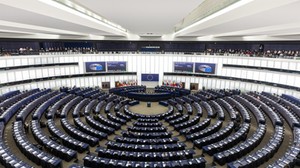
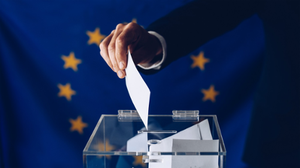
As the only EU institution directly elected by citizens, Members are at the core of the Parliament's work. They decide how Parliament is organised and on its procedures.
Elections to the European Parliament
Since 2002, Member States have been allowed to set a minimum electoral threshold, meaning parties must achieve a minimum number of votes to gain a seat in European elections. This reduces the risk of fragmentation and instability, but is nevertheless seen as a risk to minority and regional voices.
The elections in 15 Member States are decided under the d'Hondt method (named the Jefferson method in the United States). Decisions are based on proportional representation; where the number of votes a political group receives is reflected in the number of seats it occupies. D'Hondt established a mathematical formula used to translate votes into whole seats (rather than fractions of seats), which is used in many parliaments.
While the first position is given to the party with the most votes, as each position is allocated, a divisor is applied to that party's votes. This rule is applied until all seats are filled, and not only ensures positions are allocated proportionately, but establishes an order.
There are no term limits for Members, although this is sometimes a subject of debate. Nor is there is a term limit in the Member States' national parliaments, however beyond Europe, some countries impose limits (such as Costa Rica, Bolivia, and the United States).
The European Parliament has considered electoral reform seeking to 'Europeanise' the European elections by aligning electoral rules across the EU Member States. One question is whether ballot papers used in each Member State for the European Parliament elections can include the logos and/or names of the European political parties to which the respective national political parties are affiliated.
Political groups
Members of the European Parliament are organised according to their political affiliation, not their nationality. The political groups are financed by the Parliament's budget, subject to the decisions of the Parliament's Bureau. This allocation is then managed by each political group.
A minimum of 23 Members (coming from at least a quarter of the Member States) can form a political group, which is independent from national parties. Different national parties can belong to the same group, and Members can join a Parliament group if they are not part of a national party.
Some Members are not attached to a group (known as the 'NI', for non-inscrit), but this has some disadvantages, such as when speaking time is allocated in plenary. However, a NI Member may attend meetings of the Conference of Presidents, although they do not have voting rights.
Office holders
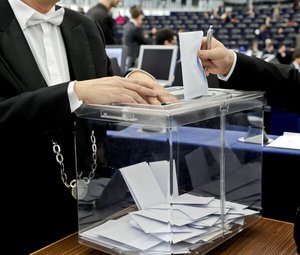
The Parliament's President is elected by absolute majority (of votes cast) for 2.5-year renewable terms (the start and middle of each legislative term). A Member may be nominated as a candidate for President either by a political group or 36 Members. The 14 Vice Presidents and five Quaestors are elected immediately after the President, following a similar procedure.
Allocation of important positions in Parliament, such as committee chairs, are also decided under the d'Hondt method. Decisions are based on proportional representation; where the number of votes a political group receives is reflected in the number of seats it occupies. Parliament's Rules of Procedure state that 'the composition of the committees shall, as far as possible, reflect the composition of Parliament'. The chair and vice-chair of a committee should not be of the same gender, and geographical balance is also considered for these specific roles.
Equal representation
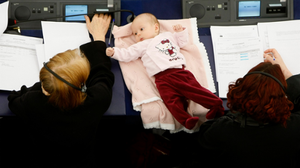
Members taking maternity leave were previously not allowed to vote by proxy. In April 2026, Parliament's plenary approved a reform to the European Electoral Act that permits Members to allow someone to vote in their place during pregnancy and after birth. This amendment was initiated by Parliament's President, Roberta Metsola, in November 2025.
Members of Parliament are not exempt from the violence and harassment that politicians face across the EU and the globe. This has been heightened alongside increased political polarisation, reinforced by factors such as social media, increasing mistrust in governments, radicalisation, and social issues such as gender and migration. There were several incidences of harassment and violence in the context of the 2024 European elections. Systemic investigation and condemnation are needed to combat this phenomenon.
Such harassment is particularly an issue for women, who are exposed to both political and gender violence. It is cited as a barrier to women participating in the political sphere. The EU is taking steps to counter this, such as including provisions in the Digital Services Act that hold digital platforms accountable for their content. Rule 10 of Parliament's internal rules stipulates that all Members must treat each other with respect.
Observers
Parliament's Rules of Procedure allow candidate countries for EU accession to the European Union to field parliamentary representatives as observers to the European Parliament. This allows them to navigate Parliament's organisation in advance of the official accession and organisation of elections in the new Member State. Observers may participate, with some limitations, in parliamentary activities, such as the political groups or committee meetings, but they cannot vote or fill any elected position.