
Article page checkbox is not checked in page info.
Violence and intimidation against politicians in the EU
Violence against politicians in the EU
Ionel Zamfir, Members' Research Service

Summary
Increased political polarisation has led to a proliferation of attacks against elected representatives, political candidates and party members. Verbal abuse and insults, harassment, threats and intimidation, as well as smear campaigns against politicians, occur regularly both online and offline, marking a serious degradation in the quality of political debate in the EU. During the 2024 European elections campaign, there were serious incidents in several countries. Nevertheless, acts of physical violence remain isolated and less frequent in the EU than in many other parts of the world.
Violence is a risk to which politicians have always been exposed, including in democratic regimes. Organised crime and radicalised individuals or groups resort to violence to promote their political or economic agendas. EU countries have been unevenly affected; violence linked to organised crime has particularly affected certain regions, especially southern Italy, where it has proven difficult to eradicate. By contrast, violence driven by political radicalisation is a more recent phenomenon and increasingly affects all EU countries – albeit to varying degrees – and tends to flare up during periods of heightened tension, such as election campaigns and large-scale public protests.
The impact on political debate, free exchange of opinions and compromise-building is profoundly negative. Violence and intimidation pressure politicians to self-censor when addressing politically sensitive issues and, in some cases, to step out of politics altogether. To counter this, several EU countries have adopted preventive and protective measures, including regular data collection. Examples include classifying offences against elected representatives as aggravated offences, simplifying reporting, and providing training, counselling and emergency assistance. Parliaments have also promoted civility and mutual respect in debates through codes of conduct and have established support services such as legal aid, psychological counselling and security assistance.
Violence against politicians on the rise
A tense political landscape
Politically motivated violence against politicians – particularly elected representatives – has been on the rise globally. In the EU, cases of extreme physical violence, such as murder, are rare in comparison with other parts of the world. However, abuse, threats and intimidation both online and offline have become part of EU politicians' everyday life. While local politicians are the most severely affected by this worrisome phenomenon, elected politicians at higher levels of representation are increasingly exposed to it as well. In recent years, murders and attempted murders of elected representatives have prompted a stark awakening to the reality of this issue: Paweł Adamowicz, mayor of Gdansk (Poland), and Walter Lübcke, district president of Kassel (Germany), were murdered in 2019, while Slovakia's Prime Minister Robert Fico survived an assassination attempt in 2024. Although these remain isolated incidents, experts warn that political assassinations carry a serious risk of escalation.
Violence and harassment of politicians flare up during periods of heightened tension, such as political or economic crises, or election campaigns. In recent years, unpopular measures, such as lockdowns during the pandemic or fiscal tightening policies in countries like Greece and France, have led to waves of hostility against decision-makers expressed through verbal abuse and physical attacks. The 2024 European elections witnessed a wave of serious incidents, mirrored in several national and local elections, including those held in Germany and France the same year. Again in 2024, the cancellation of the presidential election in Romania caused severe polarisation, with the 'stolen vote' and other weaponised narratives driving a wave of hate speech, threats and incitement to violence against elected politicians from governing parties, as well as senior judicial and electoral officials. By increasing political tension, public protests can lead to incidents of physical violence. For example, in France, during protests against the killing of a teenager by police in 2023, an arson attack targeted the house of a suburban mayor.
Systematic data collection and research on violence against politicians in the EU are recent and still insufficient to understand its full extent and causes. The severe consequences for the quality of political participation are only gradually emerging. The issue of gender-based violence against women politicians has received comparatively more attention given its deleterious effect on women's political participation. Some of the measures that have been proposed to address this latter phenomenon can benefit men too, even if others are gender-specific.
A multiplicity of forms
Violence encompasses multiple forms: physical violence (with assassination being its most extreme form), psychological violence (verbal abuse, threats, intimidation, harassment, stalking and smear campaigns), economic violence (destruction of property and withdrawal of resources such as campaign financing for women or minority candidates or for entire opposition parties in authoritarian settings), and sexual violence (affecting primarily but not exclusively women). Non-physical violence occurs both offline and online.
Perpetrators can be state entities, such as authoritarian regimes cracking down on political opposition in various forms, or non-state entities, like radicalised individuals and groups, or organised crime groups attacking politicians. In the EU, state-driven repression is rare due to high democratic standards, but radicalised individuals and organised crime still pose a persistent threat.
Violence perpetrated by organised crime mainly targets local officials. The Armed Conflict Location & Event Data Project (ACLED) identified acts of intimidation committed by criminal interests in 2024 against local officials in France, Cyprus, Greece and particularly in southern Italy, which saw more than half of all these attacks.1 Violence by organised crime against elected representatives follows clear patterns that indicate it aims to force elected representatives to bend to the interests of organised crime.
Violence in the context of political polarisation
The rise in violence against politicians has multiple causes, but one driver often mentioned by media and experts2 is political polarisation. Tense political competition, radicalisation, mistrust in governments and elected leaders, and political violence are all facets of political polarisation, even if causal relationships between them are not easy to disentangle.
EU countries are very unevenly affected by political polarisation, with some experiencing low levels, while others have reached high levels. France, Hungary, Poland, Romania and Slovenia have the highest levels of political polarisation according to the score calculated by the Varieties of Democracy (V-DEM data) project.
Ideological polarisation reaches a toxic level when it transforms into affective polarisation, creating a fertile ground for political violence. Affective polarisation is characterised by identifying with one's own political camp and harbouring negative feelings and deep mistrust towards those who do not share the same political convictions. Mistrust in political elites and politicians is well-documented and tied to citizens' dissatisfaction with economic, social and environmental conditions. According to a 2024 OECD survey on political trust, national parliaments and political parties have the lowest level of trust among public institutions in OECD countries, with, respectively, only 37 % and 24 % of citizens trusting them.
With their role as 'echo chambers', social and news media provide an enabling environment for deep polarisation and the spread of abusive and intimidatory messages, often under the disguise of anonymity. Because of this amplified media exposure and because anonymity reduces accountability, politicians face greater personal risk, including violence. The quality of the political discourse matters too. Political leaders' statements condoning violence legitimise violent acts and enhance feelings of impunity among their followers.3 In an environment of toxic affective polarisation, violence can easily spiral in an endless retaliatory cycle, as each violent act strengthens the negative perception of the opposite camp.
Other factors that increase the risk of exposure to violence are demographic in nature and related to polarising social issues such as gender and immigration. Women are more exposed to this risk, as are politicians with an immigrant or minority background. A large-scale survey published in 2025 on politicians with immigrant backgrounds in Sweden found that, across all forms of violence examined, these politicians had experienced significantly more physical and psychological violence than their counterparts without an immigrant background and were targeted more frequently by multiple forms of violence. A survey among Belgian political mandate holders at the regional and federal levels, carried out by an academic researcher (as reported in a press article), showed that, among politicians who were victims of psychological and/or sexual violence, young and female politicians, as well as those with an immigrant background, were more frequently exposed to such violence.
Impact and prevention
Impact of violence
Violence in its various forms has serious consequences on political debate and participation. It discourages politicians from addressing certain sensitive issues and from political participation altogether. The profound and long-lasting psychological effects of aggression, harassment and stalking on politicians have been documented in various surveys. The numbers below speak for themselves.
In Germany, a survey reveals that 81 % of local politicians targeted by verbal and written attacks report experiencing physical and mental effects in their everyday life. An overwhelming majority – 83 % of the survey respondents – also felt threatened by disinformation campaigns and AI-generated 'deep fakes' in their personal life and political career. In Sweden, 28.2 % of respondents in a survey among elected representatives felt concerned that either they or someone close to them could be victims of crime or similar unpleasant events. One in five of those concerned considered leaving a position of trust, and three out of 10 censored themselves when addressing specific issues. In the Netherlands, local political office holders reported less pleasure at work, being less ready to express a position online, and feeling a need to make changes in their way of working due to threats and intimidation. Nearly a quarter of Dutch lower house members who responded to a survey stated that they sometimes do not express their opinions publicly because of potential threats or harassment. In a survey among Irish parliament members, 89 % of respondents stated feeling anxious or afraid after incidents of abuse; 49 % increased security at home; 45 % became hesitant to express certain opinions; 40 % avoided engaging with specific policy areas; and fewer than half – 43 % – felt likely to run for office in the future after such incidents. The respondents linked abuse to topics dealing with immigration (67 %), women's rights (47 %), housing/homelessness (40 %) and LGBTQ+ issues (40 %).
Tackling violence and harassment
Policies adopted by national governments and recommendations by international organisations on the issue point to the need for a comprehensive approach to tackle violence and harassment against politicians. According to a report by the Organisation for Security and Cooperation in Europe (OSCE), these should include preventive measures, effective protection and prosecution (see Box 1).
Systematic investigation and condemnation of all forms of violence is important, as only a few cases are ever reported to public authorities. For example, a 2023 survey among Irish elected councillors showed that, while over 25 % of threats had been reported to the police, only 3.5 % of reported cases resulted in prosecutions. A survey among Dutch local office holders found that 90 % of those confronted discussed or announced it internally, but only 6 % reported it to the police. In Sweden, only 16.3 % of incidents in 2022 involving either threats and harassment or violence, vandalism and theft were reported to the police. The reasons for the low level of reporting are multiple: victims may not consider the offences serious enough or may not believe that reporting will help, especially in cases of abuse, hate speech and incitement committed online.
Proposed solutions have focused on increasing the civility of political discourse, combating hate speech, promoting respect and encouraging cooperation among politicians from diverse groups. Political leaders have an important role to play, as they are expected to condemn any act of violence and avoid using aggressive language. Parliaments can create a culture of mutual respect, by adopting or adjusting internal rules that sanction violent speeches and other acts of incivility and harassment. They can also provide specific support to members, such as facilitating reporting to the authorities, providing legal support and counsel, and offering psychological or security assistance (including financing for members to improve security at their homes or offices).
Data and measures in selected EU Member States
Several EU countries collect regular and systematic data either through regular surveys or administrative sources on the violence and abuse experienced by politicians. Administrative data collection is only possible where authorities record offences against politicians as a specific category of crime (as is done in France and Germany). This section provides an overview of the measures put in place at the national level and/or in national parliaments in a selection of EU countries, including data collection. The data presented below are not inter-comparable across countries, and data collection is not based on similar methodologies; each country has its own definition of relevant offences and its own criteria for counting crime reporting.
Box 1 – Proposed measures
The OSCE Toolkit Addressing Violence against Women in Politics in the OSCE Region provides an overview of measures implemented to combat violence against female politicians. Most of them remain relevant irrespective of gender:
Prevention: awareness raising, capacity building, and data collection
Protection: legal reform, institutional norms (codes of conduct for parliaments, political parties, etc.), and complaint mechanisms; victim protection and support (access to justice, emergency assistance and safety measures, medical, legal and psychological support)
Prosecution: criminal and civil procedures, effective prosecution, and protection measures; effective, proportionate and dissuasive sanctions, and compensation for victims; victim support
Coordinated policies: across sectors and institutions; engaging with civil society; partnerships with the media
The measures established to combat violence and harassment include a variety of approaches, combining government action, adoption of specific legislation, enhanced cooperation with the judiciary, as well as in-house measures taken by parliaments to support their members. A survey of national parliaments in the EU conducted in 2023 by the Irish Parliament Library found that in a slight majority, little more than half (13 out of 23) of the surveyed houses, members of parliament, political groups, civil society groups or others had raised concerns about harassment, abuse and incitement against members.
France
In recent years, France has witnessed an increase in violent acts committed against elected representatives. Between 2021 and 2022, this increase stood at 32 %, and between 2022 and 2023 it was at 13.5 %. In 2024, the country witnessed 2 501 acts of violence or incivility targeting elected representatives, a decrease of 9 % compared to the previous year. While overall there were fewer acts of violence and incivility, physical assault cases increased by 6 % compared to the previous year, totalling 250.4 Elected officials were mainly victims of threats, abuse or offensive comments (68 % of cases). Online attacks accounted for 24 % of the attacks, while degradation or destruction of property represented 8 % of all recorded cases.
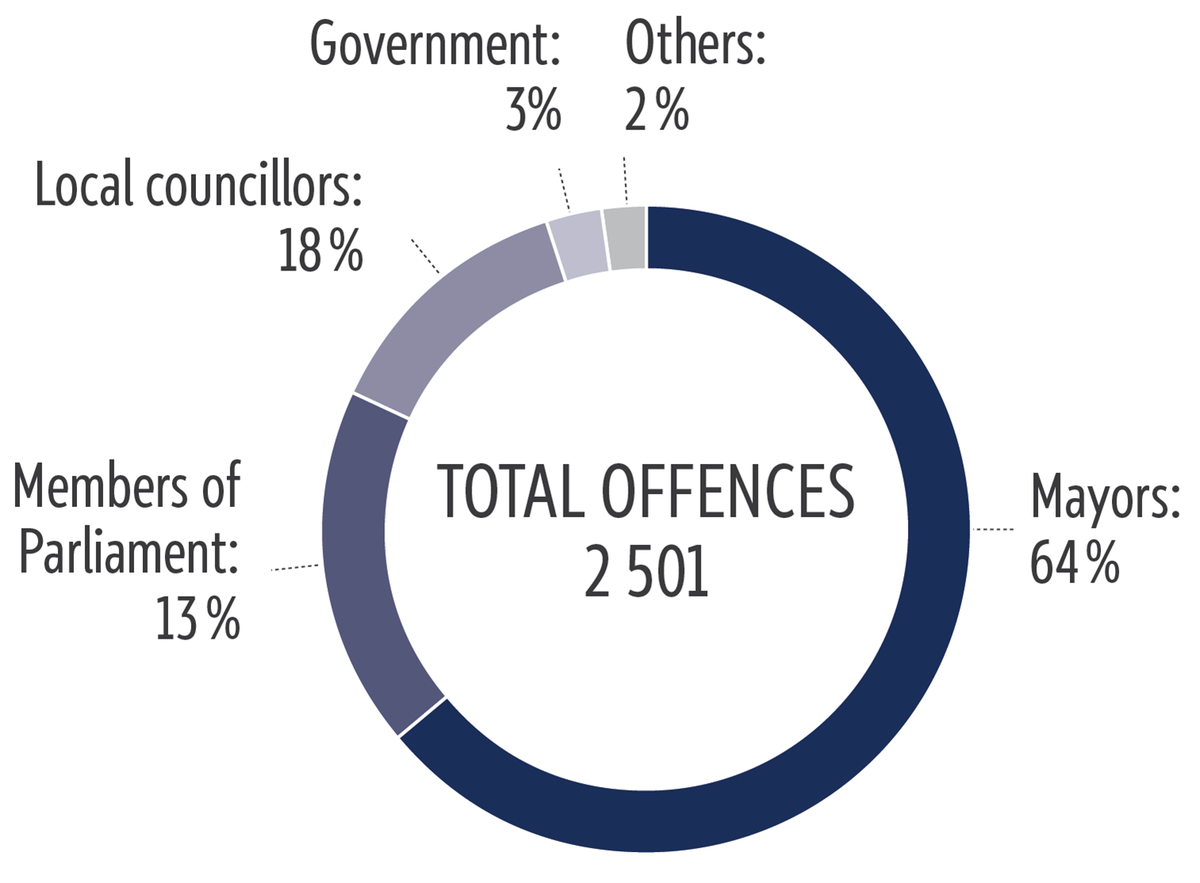
Data source: CALAE report, May 2025.
To collect data and analyse trends, a Centre for the analysis of attacks against elected representatives (CALAE) was established in 2023.
A new law was adopted in March 2024 to protect mayors and local elected representatives. The law provides for more severe sanctions and requires local and regional authorities to protect elected officials and compensate them for any damage they may have suffered.
A national plan to prevent and combat violence against elected officials, adopted in July 2023, includes measures to provide judicial, psychological and security assistance for elected representatives, to strengthen legal sanctions for crimes against local representatives, as implemented through the previously mentioned law. Additionally, the plan seeks to enhance communication between local elected representatives and public prosecutors, among other things.
Concretely, measures include the implementation of emergency buttons by the end of 2025, the distribution of a 'security pack' to newly elected representatives for the 2026 local elections, the creation of a free hotline for psychological support, and training sessions, including a virtual reality module on how to deal with aggressive and violent behaviour.
Under French legislation, violence against politicians is considered a specific crime. Article 433-3 of the French Criminal Code outlines increased penalties for making threats or committing violent or intimidating acts against an elected official in order to coerce them to do or refrain from doing something related to their position. A 2023 law (Law nr. 2023-23) allows associations of regional and local elected representatives, as well as the French National Assembly, the Senate or the European Parliament to become a civil party in criminal judicial proceedings to support elected officials who have experienced violence or abuse in relation to their position or whose family members have been victims of violence.
Germany
Germany has witnessed a significant increase in politically motivated violence, including violent acts against elected representatives and other politicians. Data published by the Federal Crime Office (Bundeskriminalamt) shows a continuous rise in politically motivated offences. In 2024, the number of such offences was 40.2 % higher than in the previous year and 115.9 % higher than 10 years earlier. Politically motivated crimes include offences related to propaganda, damage to property, insults, incitement to hatred, coercion and threats, and violations of assembly law, which together represented 86.8 % of cases in 2024. The election year 2024 had a clear impact on the prevalence of such acts, with almost 12 000 offences being recorded in relation to the elections.
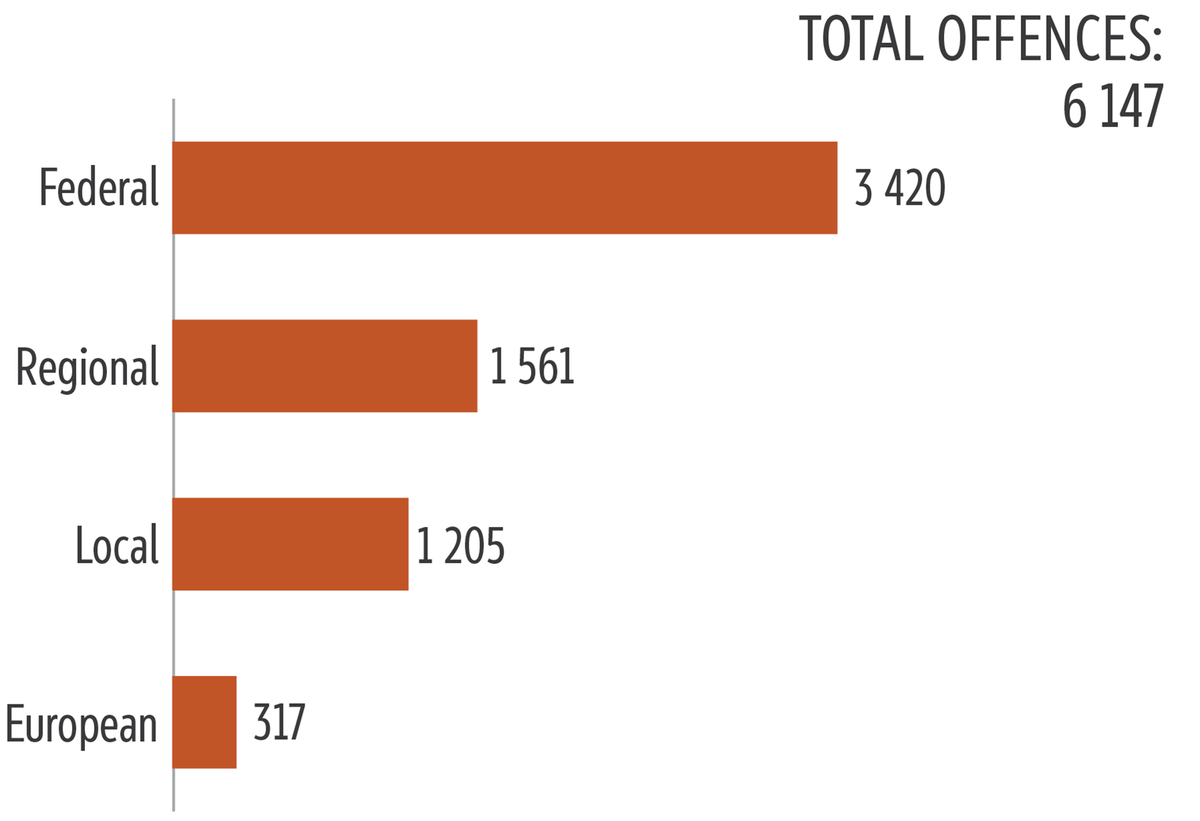
Data source: Bundeskriminalamt, 2025.
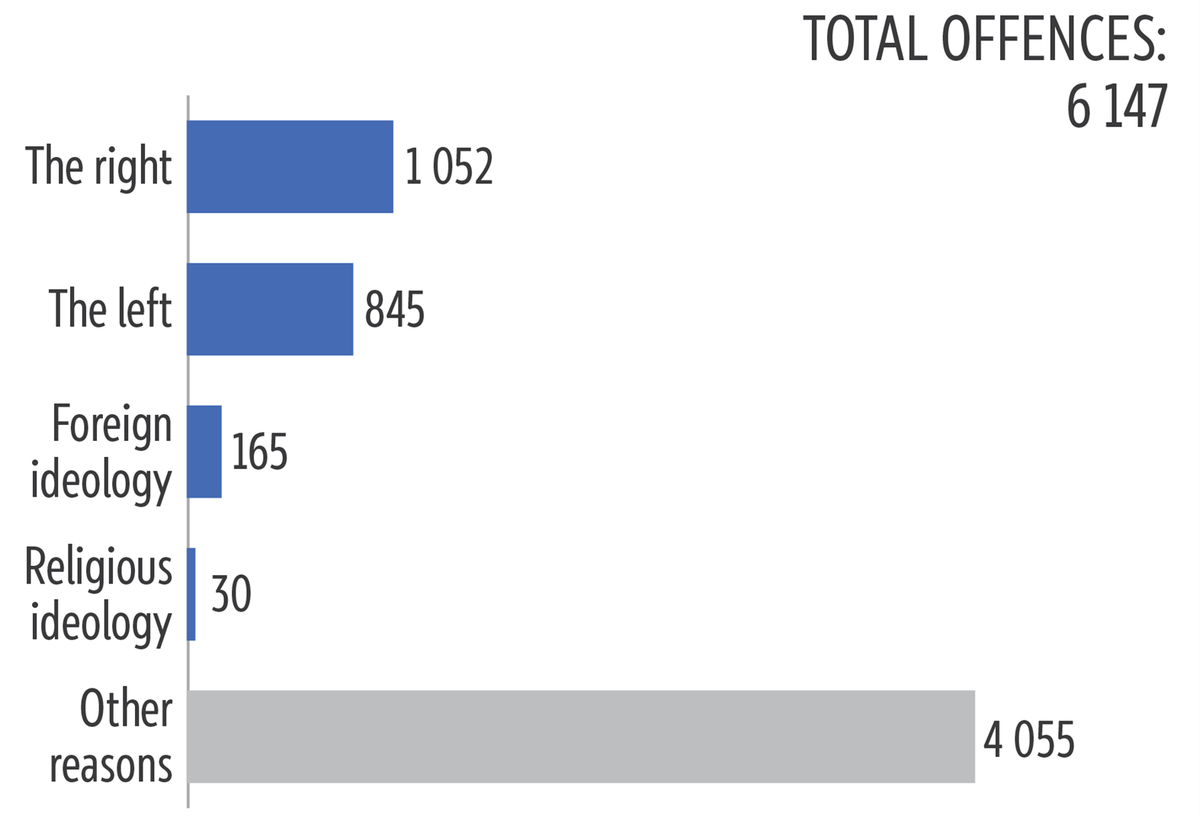
Data source: Bundeskriminalamt, 2025.
There were 4 107 cases involving violent political offences in 2024 – a record high since 2001, when criminal police reporting for such crimes was first introduced.
Office and mandate holders, as well as party representatives and members were the primary targets of politically motivated crime, with 1 256 cases, including 58 violent acts, recorded in the context of elections in 2024 alone. Throughout the year, offences against office and mandate holders and party members targeted mainly the federal level (see Figure 2). Left and right ideologies were the drivers behind a third of these offences. However, in the majority of cases, there was no clear ideological motivation (see Figure 3).
A nationwide survey (Municipal Monitoring on Hatred, Agitation and Violence against Officials – KoMo) has been conducted biannually with all mayors and heads of the rural districts. The seventh survey, conducted from May to October 2024, found that 34 % of office holders had experienced abuse. Of these individuals, 78 % had experienced verbal/written abuse, 19 % had been targeted by hate posts, and 3 % had suffered physical attacks.
The German Criminal Code (§188 StGB) stipulates that publicly insulting, defaming or spreading bad rumours about persons active in political life is a specific offence punishable by imprisonment or a fine if such conduct is likely to seriously affect the public activity of the targeted person. Until 2021, this provision only covered politicians active at the regional and federal levels and did not include insults. Since 2021 (through the adoption of a legislative package against hate and incitement), it also protects local politicians and covers insults as well. Following a number of incidents during the 2024 electoral campaigns, there was a discussion to make violence against politicians a specific criminal offence subject to harsher punishments, but this has not materialised.
An internet platform created by the associations of local and regional authorities provides information to local politicians on how to defend themselves against violence and abuse.
Ireland
The Irish Parliament has established a Task Force on Safe Participation in Political Life, which commissioned a survey among the members of parliament and the political staff and presented a report and an action plan. The findings of the survey, carried out by the Centre for Digital Policy (UCD), show that 94 % of the Parliament's members who responded had experienced some form of threat, harassment, abuse or violence. Most violence occurred on social media, with 73 % members experiencing abuse on social media frequently and 22 % occasionally. Members occasionally experienced abuse when socialising in a personal capacity (36 %) and when participating in social events as politicians (35 %). The most prevalent types of abuse experienced by respondents were abusive language, slurs, threats and the spreading of false information, but physical violence remained rare.
According to the Task Force report, the Irish Parliament has established measures to address the violence experienced by its members. These measures include providing financial support to members to increase security at their homes and offices, offering psychological support services to members, their families and political staff through the workplace support programme. This programme provides confidential counselling services and wellbeing content. Additionally, members receive security briefings from the national police. The report includes a list of recommendations to improve the security of politicians.
The Association of Irish Local Government (AILG), a national body representing elected local councillors, conducted two surveys among its members in 2021 and 2023. The surveys revealed high rates of exposure to violence both online and offline. Between April 2021 and September 2023, 63 % of respondents reported experiencing harassment, threats and intimidation. Additionally, over 38 % of respondents had experienced threats through social media, while 33 % had experienced them in face-to-face interactions.
Netherlands
Conducted every two years since 2010, the Integrity and Security Monitor provides data about the extent to which political office holders and public administration employees at the local and provincial levels are confronted with aggression and violence. The latest survey, conducted in 2024, found that at least 45 % of all decentralised political office holders such as mayors, members of assemblies, councillors and water board directors had experienced aggression in the past year. Compared to two years earlier, serious forms of aggression, such as threats, physical aggression and intimidation, had remained at the same level, but cases of verbal aggression had slightly decreased.
In the early 2000s, the Netherlands was rocked by two high-profile political assassinations – those of politician Pim Fortuyn and film-maker Theo van Gogh. Recent physical attacks, serious threats and intimidation against prominent politicians continue to create an atmosphere of insecurity. Special security measures, including long-term continuous protection, have been implemented to protect individual politicians who are targeted by serious threats. An investigation by the Dutch television programme Zembla (as documented by a press article published in 2023) revealed that at least 41 members of the lower chamber had benefited from special security measures, such as the non-disclosure of their personal data in the Land Registry. Additionally, all 21 chairpersons of the various parties in the lower chamber had been provided with a special emergency button at home, an alarm system, or an anti-burglary door.
The Hague police have established a special unit called the Threatened Politicians Team. If politicians receive a threat, they can report it to this team, which systematically analyses all cases. If the team establishes the presence of a criminal threat under the Criminal Code, it initiates an investigation and criminal proceedings.
Slovakia
Slovakia5 is the only EU country in recent years to have witnessed an assassination attempt at the highest echelon of political power – on 15 May 2024, Prime Minister Robert Fico was targeted in the town of Handlová. Following the attempt, the Slovak Parliament approved several measures.
First, it unanimously adopted a resolution condemning politically motivated violence. The resolution called on political parties, civic organisations and media to respect election results and refrain from spreading hatred toward the democratically elected government.
Second, in June 2024 the government adopted additional legislative measures, the most notable being Act No 166/2024 Coll. on certain measures to improve the security situation in the Slovak Republic (nicknamed the 'Lex Assassination'). This act primarily aimed at amending the Freedom of Assembly Act; Act No 166/2024 came into effect on 15 July.
The act introduced a prohibition on assemblies within a 50-metre radius of buildings where the President, the Government, the Parliament and the Constitutional Court have their seats or exercise their powers. Additionally, it authorised the implementation of such a ban around other buildings used by these institutions on an ad hoc basis.
Furthermore, the act outlined additional prohibitions on assemblies, such as near the residences of individuals targeted by the assembly, in housing areas (excluding squares, parks, marketplaces, etc.), or in situations where there might be a clash with participants of other previously announced assemblies.
The legislation introduced new benefits for the highest constitutional positions (the President of the Republic, the Speaker of the Slovak Parliament, and the Prime Minister), namely:
-
the right to use an equipped and secured accommodation free of charge during the tenure;
-
a lifetime salary granted under specific conditions (for those who spend more than 10 years as Parliament Speaker or Prime Minister, replicating a rule already in force for the President);
-
increased security for senior officials, even after the end of their tenure.
The legislation's declared intention was to increase security for politicians rather than directly amend hate speech laws. Following the assassination attempt, hate posts on social media increased significantly, illustrating a deep emotional polarisation within Slovak society.
Civil society organisations and opposition politicians have denounced many of the implemented measures as excessive restrictions on freedom of expression and assembly, as well as the lifetime monetary compensation for the prime minister. The lifetime salary for long-serving prime ministers – though seemingly a neutral measure – only applies in practice to Prime Minister Fico, and was criticised as a measure designed specifically for him.
Sweden
Since 2014, the Swedish National Council for Crime Prevention (Brå) has conducted regular surveys among politicians on their perception of security. The 2023 survey (which included a summary report in English) was distributed among 13 700 elected representatives. Out of the slightly over 8 000 who participated, 29.5 % stated that they had been the victim of some form of threat, harassment, violence, vandalism or theft in 2022. The percentage of those who reported having been victims was slightly higher among women than among men: 31.0 % versus 28.3 %. This contrast was even stronger when comparing younger with older groups, with 44.4 % of persons aged 29 or younger reporting incidents compared to only 17 % of those in the oldest age group (70 years or older).
An amendment to the Criminal Code, adopted in 2020, made committing violence against elected politicians in Sweden an aggravating circumstance. Chapter 29 Section 2 of the Criminal Code provides for increased penalties for a crime committed against a person on the grounds that he or she has exercised a position as an elected representative at the central, municipal or regional level, in the Sámi Parliament or in the European Parliament, or against a family member of such a person.
The Swedish Association of Local Authorities and Regions (SALAR) has developed a toolkit to support politicians who have been confronted with violence and threats. This includes a free training session delivered in all municipalities and regions, the diffusion of a series of films dramatising real events of threats and hate against persons of public authority, the publication of a document about typical cases of incidents of abuse, hate and violence against politicians that have led to convictions in the courts, and a research project about the negative stereotyping of local politicians on social media.
Violence during the 2024 European elections
Several serious incidents took place during the 2024 European election campaign. In its report on the 2024 elections for the European Parliament, the Commission mentions examples of violence against candidates and other persons involved in campaigning in Germany, Austria, Belgium, Finland, Czechia and Slovenia. Incidents of harassment and violence occurred both online and offline, with women and candidates from minority groups being targeted more frequently. Around 40 % of the national parties surveyed reported that they had established measures to prevent or combat online violence or threats against candidates.
Reports by electoral observers highlighted incidents of violence, harassment and intimidation in several Member States. The OSCE/ODIHR report, titled Special election assessment mission, European Parliament elections 6-9 June 2024, noted serious incidents during the campaign in Portugal, Germany and Ireland, as well as the assassination attempt against Robert Fico. It also cited the 'antagonistic approach displayed by some politicians toward critical media in recent years', which combined with inflammatory rhetoric can lead to acts of violence against journalists.
The Election-Watch.EU final report on the 6-9 June 2024 European elections highlighted links between violence against politicians, political polarisation and foreign interference: 'Acts of political violence against politicians and campaigners at the local level in some MS, most prominently in DE, marked peaks in a concerning trend of a deepening societal polarisation, with growing concerns of a wider gap between political extremes and foreign interference.'
Box 2 – European Parliament position
In its September 2025 resolution on the stock-taking of the European elections 2024, Parliament expressed deep concern over the incidents related to the electoral campaign and encouraged the Commission and the Member States 'to prioritise the prevention of political violence by strengthening laws, frameworks and policies that protect politicians, political candidates, activists, journalists and citizens from violence and harassment during the electoral period'. It also underlined the importance of a comprehensive approach combining prevention, protection and education, by 'fostering a culture of tolerance and respect for differing political opinions'.
Endnotes
Disclaimer
This document is prepared for, and addressed to, the Members and staff of the European Parliament as background material to assist them in their parliamentary work. The content of the document is the sole responsibility of its author(s) and any opinions expressed herein should not be taken to represent an official position of the Parliament.
Copyright
© European Union.
The reuse of this document is authorised under a Creative Commons Attribution 4.0 International (CC-BY 4.0) licence.

https://creativecommons.org/licenses/by/4.0/deed.en
To use or reproduce elements that are not owned by the European Union, permission may need to be sought directly from the respective rightsholders.