
Article page checkbox is not checked in page info.
Maternity leave and voting procedures in the European Parliament and EU national parliaments
Maternity leave and voting procedures in the European Parliament and EU national parliaments
Marie Lecerf, Members' Research Service
Summary
Maternity leave and voting procedures for Members of parliaments differ widely across the European Union (EU). Maternity-related absences are considered justified for Members of the European Parliament, but the current rules do not permit remote voting, proxy voting or temporary substitution. Maternity leave for parliamentarians is generally permitted across the EU's Member States, although legal frameworks and practical arrangements differ. Some national parliaments only allow for temporary substitution in committee work, while others rely on informal agreements. Only a small number of countries, including Spain, Greece and Luxembourg, have formal provisions enabling Members on maternity leave to vote in absentia.
While several parliaments temporarily expanded remote participation during the COVID‑19 pandemic, such measures were typically limited in scope and duration. In most cases, voting in plenary continues to require physical presence in the chamber.
Discussions are ongoing at both European and national level to explore ways of supporting Members in reconciling their parliamentary duties with family responsibilities. Most recently, President Roberta Metsola proposed revisions to the European Electoral Act and the Parliament's implementing measures, including the potential introduction of proxy voting for Members on maternity leave, aimed at aligning parliamentary rules more closely with evolving expectations around work-life balance. This briefing focuses exclusively on maternity leave and does not cover other types of family-related absence, such as paternity or parental leave.
Maternity leave and voting in the European Parliament
Background
Members of the European Parliament are entrusted with a number of rights and responsibilities, including the right to vote. However, illness, serious family-related circumstances, pregnancy and postnatal recovery may prevent Members from attending plenary sessions and prevent them from exercising their voting rights.
Absences without a valid justification may entail financial consequences, including reduced reimbursement entitlements. In addition, prolonged absences can affect a Member's public image – particularly in those Member States with regional, rather than national, constituency-based electoral systems, where direct engagement with voters is expected. A perceived lack of visibility or attendance may undermine public confidence and damage a Member's political career.
While the European Parliament's Rules of Procedure allow for justified absences under specific circumstances, they do not permit any form of temporary replacement or delegation of voting rights. This is consistent with the provisions of the European Electoral Act, which enshrines the principle that a parliamentary mandate is personal and non-transferable.
Legal state of play
At EU level, the 20 September 1976 European Electoral Act (concerning the Election of the Representatives of the Assembly by Direct Universal Suffrage), together with the Rules of Procedure of the European Parliament, sets out the rights and obligations of Members of the European Parliament. While neither document mentions maternity leave explicitly, the issue is addressed in implementing measures.
Maternity leave
Pregnant Members have the right to be excused from meetings three months before and six months after giving birth. Article 31 of the Decision of the Bureau of 19 May and 9 July 2008, which outlines the implementing measures for the Statute for Members of the European Parliament, considers these absences as justified, and therefore prevents Members from suffering any negative financial implications (Article 31(4)).
Voting procedures
Members who are pregnant or on maternity leave currently cannot participate in plenary remotely, vote by proxy, nor temporarily suspend their mandate. Article 6 of the European Electoral Act clearly states that 'Members of the European Parliament shall vote on an individual and personal basis. They shall not be bound by any instructions and shall not receive a binding mandate'. The characterisation of Members' parliamentary mandate as personal and representative forbids any possible delegation of their vote, as confirmed by Rule 193 of Parliament's Rules of Procedure. The rule not only affirms the personal nature of the vote in Parliament but also treats any breach of this rule as a serious violation of Members' standards of conduct (Rule 10), potentially resulting in sanctions against the non-compliant Member (Rules 182‑183).
The European Electoral Act does not address temporary substitution of Members, thereby also prohibiting the temporary replacement of pregnant Members or those on maternity leave. Article 13 of the European Electoral Act addresses the situation when a seat falls vacant in the European Parliament – but mentions only resignation, death, or withdrawal of an elected Member's mandate as justification. In such cases, national authorities are responsible for filling the vacant seat according to the act's provisions. However, according to Article 13(2) of the European Electoral Act, the replacement serves for the remainder of the five-year parliamentary term, not just for a limited period corresponding to the duration of the pregnancy or maternity leave. Therefore, it is not possible to substitute an elected Member temporarily under the current rules enshrined in the European Electoral Act.
Remote participation in parliamentary business was introduced in 2020, through a reform of the Rules of Procedure, driven by the need to ensure continuity during the COVID‑19 pandemic. The remote participation regime, set out in Rule 246, may be applied in extraordinary circumstances, as defined in Rule 245, and also when 'the political balance in Parliament is severely impaired because a significant number of Members or a political group cannot take part in Parliament's proceedings in accordance with its usual procedures (...) for reasons of security or safety, or as a result of the non-availability of technical means' (Rule 244(1)(2)). However, none of these provisions grant Members an individual right to participate remotely in parliamentary activities due to pregnancy or maternity leave.
Recent developments
To address the current lack of provisions covering maternity leave and remote participation, the 2022 proposal to reform the current European Electoral Act draft legislative act proposes that Members may be replaced temporarily during maternity leave by the next candidate on the relevant list for a 16‑week renewable period (Article 27(7) – Vacancies). This proposal is part of a broader effort to repeal and modernise the 1976 European Electoral Act. However, this proposal remains under consideration today and has not yet been adopted, as it requires unanimous approval from the Council and the consent of all Member States (Article 223 TFEU).
Meanwhile, Members have advocated for interim measures, such as proxy voting or remote participation, to ensure continuous representation during maternity leave. Concerns regarding the absence of formal maternity leave and alternative voting arrangements for Members have gradually gained increased attention within the Parliament. In 2023, 13 Members, including Leïla Chaibi (The Left – GUE/NGL, France), Claudia Gamon (Renew Europe, Austria) and Lara Wolters (S&D, the Netherlands), publicly highlighted the lack of institutional support for pregnant Members and initiated a petition addressed to Parliament's President Roberta Metsola. The petition advocated for proxy voting, remote participation, and the option of temporary substitution. The issue was further underscored by personal testimonies from pregnant Members, who criticised the current framework as outdated and inconsistent with democratic representation.
On 16 June 2025, to reflect a growing institutional concern regarding the need to reconcile parliamentary duties with family life, President Metsola formally proposed a set of reforms and informed Parliament's Bureau of new initiatives strengthening maternity rules for Members. The President stated: 'No elected representative should have to choose between their mandate and parenthood'. The planned measures should strengthen maternity rules for Members of the European Parliament who wish to continue to carry out their parliamentary duties and speak for their constituents during this period. Parliament's Bureau should consider a targeted review of the implementing measures for the Statute for Members by autumn 2025, including a dedicated section on maternity-related absences, building on existing rights.
Parliament has also proposed a targeted revision of the European Electoral Act to allow Member States to introduce proxy voting – enabling Members who delegate their plenary vote to another Member of their choice during a period of maternity leave. On 26 June 2025, President Metsola presented this request to the European Council, describing it as a 'targeted, narrow and surgical amendment to the EU Electoral Act – one that is limited to a single, but meaningful point ... to allow female Members of European Parliament who are pregnant or who have just given birth to delegate their vote'.
Maternity leave and voting in national parliaments
Maternity leave
In most of the EU Member States, Members of Parliament may take maternity leave. However, provisions vary significantly across the European Union, reflecting different constitutional traditions and institutional practices.
In Belgium, Denmark, Estonia, Portugal, Latvia, Slovenia and Finland, MPs are entitled to maternity leave, generally under the same social security systems and labour laws as public sector employees. In several of these countries – such as Denmark, Estonia, Latvia, Portugal and Slovenia – formal mechanisms allow temporary substitution during leave. In Belgium and Finland, such substitution is limited to committee work.
In some Member States, maternity leave is granted under alternative legal or administrative frameworks, rather than through explicit parliamentary rules. For example, in Romania, Members may take time off after childbirth, but this is formally categorised as sick leave, as there is no distinct maternity leave provision. In Italy, although maternity leave is not formally defined for parliamentarians, Members may request exemption from allowance deductions during periods of maternity-related absence, which is treated as if the Member were 'on mission'. Likewise, in Germany, maternity-related absences are considered justified and do not result in financial penalties, despite the absence of a formal entitlement. In Finland, maternity leave is classified as a personal absence, with Members continuing to receive full remuneration, while the national social security system (KELA) reimburses Parliament. These arrangements offer practical support, though they do not regulate maternity leave for Members of parliament in an organic way.
In a few Member States, maternity leave is handled through informal practices, rather than dedicated legal arrangements. In France, there is no formal entitlement, but an informal understanding permits pregnant Members or those on maternity leave to be excused from their duties without sanction. A constitutional amendment to allow temporary replacement during maternity or long-term illness is being considered in Parliament.
Voting in absentia
Members of parliament's right to vote while on maternity leave remains unevenly regulated across the EU. Only a limited number of Member States have adopted explicit provisions enabling Members to vote in absentia during maternity leave. In most parliaments, a Member's physical presence in the chamber is still required, and maternity leave does not constitute grounds for exemption.
Explicit provisions for voting in absentia during maternity leave
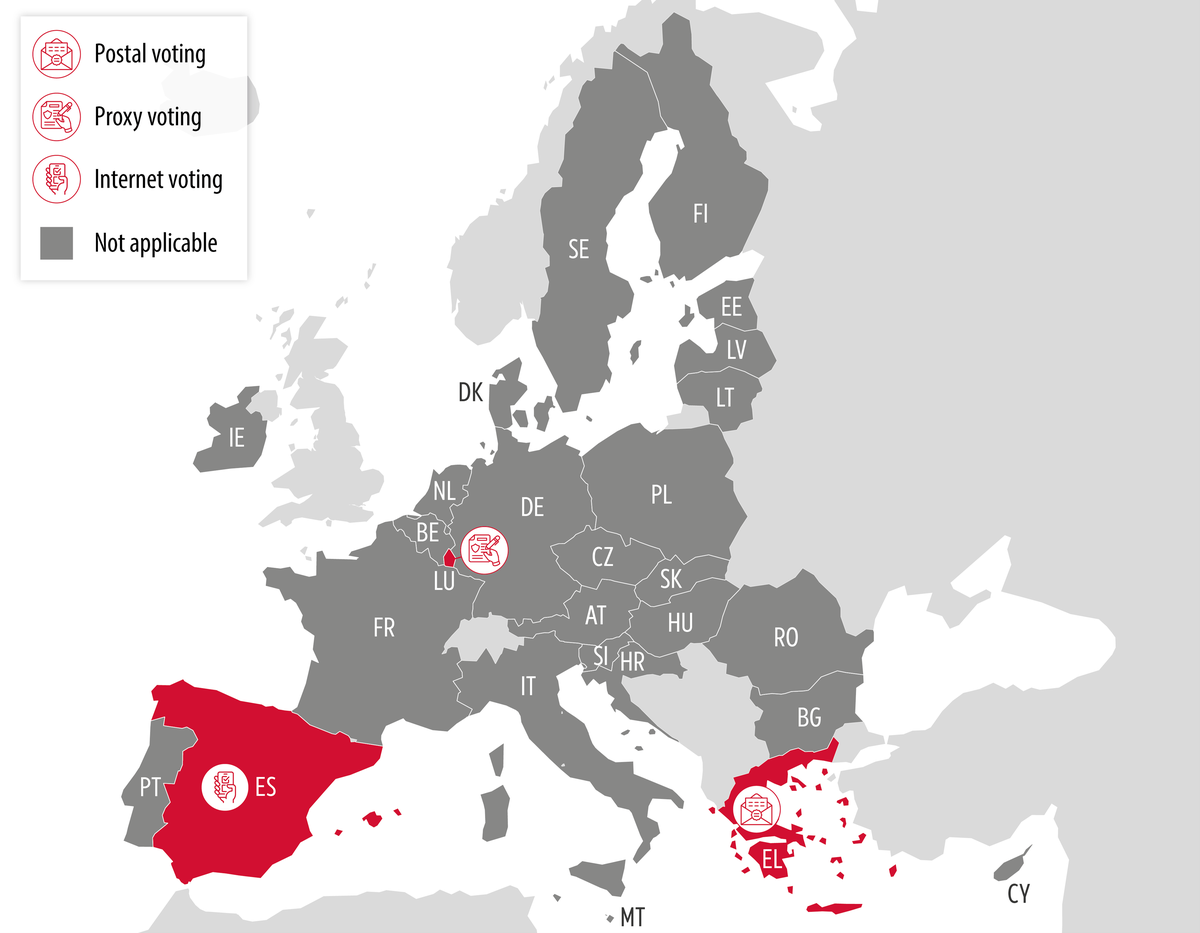
A limited number of Member States1 provide clear and formal entitlements allowing Members of parliament to vote in absentia, specifically during maternity leave. Among the most developed and inclusive systems is that of Spain, where the Members of both houses of the Spanish Parliament (Cortes Generales) are allowed to cast their votes in plenary remotely through an electronic system.
Members of both houses of the Spanish Parliament (Cortes Generales) are allowed to cast their votes in plenary using a remote electronic system (Article 82, Standing Orders of the Congreso de los Diputados and Article 92 of the Standing Orders of the Senado ) when they are pregnant or on maternity leave, or due to serious illness that prevents them from attending plenary sessions. These provisions are active and functional and allow Members to continue full participation in plenary sessions and to contribute to parliament's decision-making during periods of maternity absence.
Indirect or emergency-based remote voting frameworks
Several national parliaments expanded the possibilities for remote participation during the COVID‑19 pandemic. Temporary measures enabled remote voting or attendance for Members unable to be physically present, thereby incidentally benefiting those on maternity leave. For instance, temporary systems for remote or hybrid participation were implemented in Belgium, Estonia, Croatia, Lithuania, Poland, Portugal, Romania and Slovenia, as well as in the Dutch Senate (Eerste Kamer), the German Bundestag and the Slovak National Council – although in the latter two cases, remote participation was restricted to committee work. These emergency frameworks were typically introduced under crisis legislation and, in most cases, have since lapsed or are no longer applicable outside emergency scenarios.
Similarly, Greece has introduced a progressive mechanism for voting in absentia, although in a different format. Article 70a of the Standing Rules of the Greek Parliament permits pregnant Members to cast their votes by post during the final month of pregnancy and in the postnatal period (one month). This includes not only roll-call votes and decisions requiring a qualified majority, but also secret ballots, which may be cast by sealed letter. The use of postal or fax-based voting provides a degree of procedural accommodation while maintaining the integrity of the vote. Although less technologically advanced than Spain's model, it nevertheless constitutes a significant step towards gender-sensitive parliamentary practice.
In Luxembourg, the use of proxy voting provides another route for participation during maternity leave. Members of parliament may formally delegate their vote to another Member in their absence, including for maternity-related reasons. Article 47 (11) of the Règlement de la Chambre des Députés authorises any Member to delegate their vote to one or several Members in their absence. No Member has the right to represent more than one of his/her colleagues (Article 47 (13)). This arrangement allows continued representation and voting accountability, although it does not involve the absent Member's direct participation. While not exclusively introduced to cover maternity leave, proxy voting is legally recognised and offers a practical solution in such contexts. By contrast, in countries such as France, proxy voting is permitted only under specific circumstances – such as illness or force majeure – and does not explicitly apply to maternity leave.
Map 1 – Voting in absentia during maternity leave for Members of EU Member State parliaments
Source: EPRS. Graphic by Lucille Killmayer, EPRS.
No legal provision for voting in absentia
By contrast, the majority of EU Member States make no provision for voting in absentia during maternity leave, whether through remote, postal or proxy means. In these jurisdictions, voting is constitutionally understood as a personal and non-delegable function, requiring the Member's physical presence in the chamber. Countries in this category include Bulgaria, Czechia, Ireland, France, Italy, Cyprus, Latvia, Hungary, Malta, the Netherlands, Austria, Portugal, Romania, Finland and Sweden. While maternity-related absences may be recognised as valid and justified, they do not confer the right to vote or participate remotely, thereby effectively excluding the Members affected from one of the core functions of parliamentary life. Consequently, the citizens they represent are also not represented during that period.
Informal political practices and arrangements
Some parliaments attempt to compensate for the absence of formal voting rights through informal or political arrangements. In Ireland, maternity-related absences have traditionally been accommodated through pairing arrangements, whereby Members from different parties agree not to vote when a colleague is absent. Although the 2024 Maternity Protection Bill formalised leave entitlements, earlier practice relied heavily on informal mechanisms. A similar approach is found in Denmark and Sweden, where pairing or clearing agreements between party groups help maintain political balance during absences, including for maternity. However, such arrangements depend on political goodwill and lack the legal guarantees of formal leave systems.
Main references
- Del Monte, M., Remote voting in the European Parliament and national parliaments, EPRS, European Parliament, 2020.
- Kern, V. and Lecerf, M., Maternity and paternity leave in the EU, EPRS, European Parliament, 2025.
- Preparing a harmonized maternity leave for Members of the European Parliament – legal analysis, EPRS, European Parliament, 2016.
Endnotes
Disclaimer
This document is prepared for, and addressed to, the Members and staff of the European Parliament as background material to assist them in their parliamentary work. The content of the document is the sole responsibility of its author(s) and any opinions expressed herein should not be taken to represent an official position of the Parliament.
Copyright
© European Union.
The reuse of this document is authorised under a Creative Commons Attribution 4.0 International (CC-BY 4.0) licence.

https://creativecommons.org/licenses/by/4.0/deed.en
To use or reproduce elements that are not owned by the European Union, permission may need to be sought directly from the respective rightsholders.