
Article page checkbox is not checked in page info.
Understanding the d'Hondt method: Allocation of parliamentary seats and leadership positions
Understanding the d'Hondt method Allocation of parliamentary seats and leadership positions
Silvia Kotanidis, Members' Research Service
Summary
To allocate seats in collegiate bodies, such as parliaments, a method is needed to translate votes proportionally into whole seats. The d'Hondt method is a mathematical formula that is used widely in proportional representation systems, although it leads to less proportional results than other seat allocation systems, such as the Hare-Niemeyer or Sainte-Laguë/Schepers methods. Moreover, the d'Hondt method tends to favour the electoral lists that win the most votes, to the detriment of those with fewer votes. However, it is effective in facilitating majority formation and therefore in securing parliamentary operability.
The d'Hondt method is used by 15 EU Member States for elections to the European Parliament. It is also used within Parliament as the formula for distributing the chairs of the parliamentary committees and delegations among the political groups, and among the national delegations within some political groups. This proportional distribution of leadership positions within Parliament prevents the dominance of political life by just one or two large political groups, ensuring that smaller political groups also have a say in setting the political agenda. Some argue, however, that this approach limits the impact of election results on the political direction of decision-making within Parliament; they would call instead for a 'winner-takes-all' strategy.
Many national parliaments in the EU also distribute committee chairs and other posts proportionally among political groups, either using the d'Hondt method or through more informal means. Others apply a 'winner-takes-more' approach, reserving only certain committee chair posts with particular relevance to government scrutiny for opposition groups. In the US House of Representatives, all committee chairs are selected from the majority party.
This updates a 2019 briefing, which itself updated a 2016 briefing by Eva-Maria Poptcheva.
Proportional representation and allocation of seats
Electoral systems based on proportional representation emerged with the rise of representative democracy and the extension of electoral suffrage. While the primary aim of non-proportional systems (plurality and majority systems) is to produce stable governments, proportional representation seeks to ensure that the electoral output (votes) is reflected as closely as possible in the electoral outcome (seats). In 1899, Belgium became the first country to adopt a list system of proportional representation, followed by Finland and Sweden.
Proportional representation, together with the development of party politics, made it necessary to draw up mathematical methods for the allocation of seats. This is essential, since when several political parties run for election, the proportional share of the seats in a collegiate body, based on the share of votes cast, is rarely a whole number. The challenge therefore lies in allocating an often predetermined number of whole seats while ensuring that the collegiate body is a 'microcosm' reflecting the composition determined by the electorate as closely as possible,1 and likewise, that parliamentary bodies (committees, bureau, etc.) are a mirror image of the political plurality in the parliament as a whole.
Proportional representation, plurality and majority systems
The different forms of electoral systems used in democracies are shown in Figure 1.
Proportional representation systems are designed to minimise the discrepancy between a party's share of the vote and its share of parliamentary seats.
Plurality systems allocate seats to the candidate or candidates with the most votes, rather than assigning seats according to vote share.
In majority systems, candidates must win not just more votes than anyone else, but an overall majority of votes.
Mixed systems (such as the multi-member proportional system), combine elements of both proportional representation and plurality systems.
There are two main types of proportional representation:
-
list proportional representation – for which a variety of methods are used, and
-
the single transferable vote (STV) system.
For elections to the European Parliament, a system of proportional representation is prescribed by EU law (Article 1(1), 1976 European Electoral European Electoral Act, as amended in 2002).
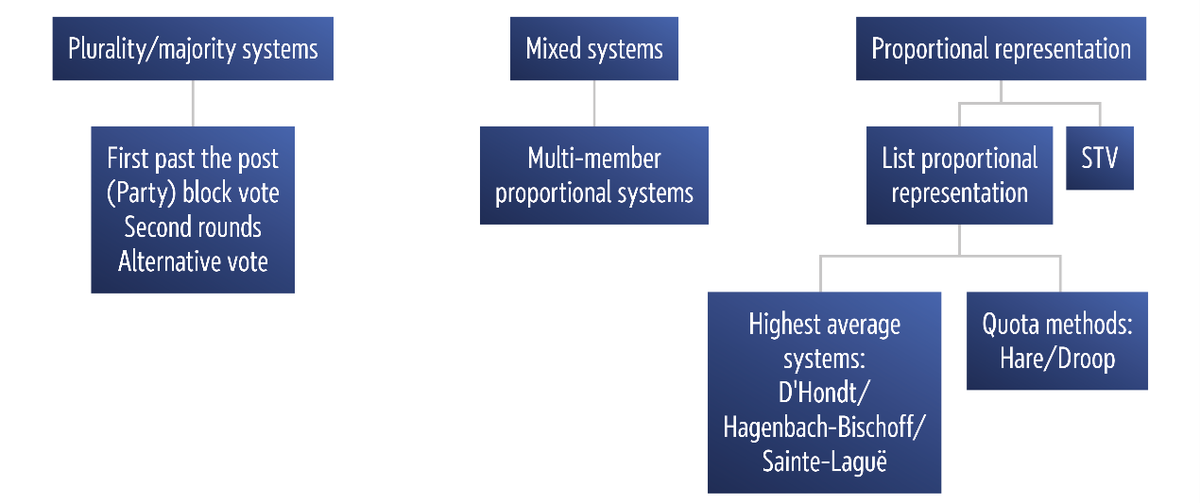
Graphic by Samy Chahri, EPRS.
How the d'Hondt method works
There are two types of method for list systems with proportional representation: largest remainder methods ('quota methods') using subtraction (Hare and Droop methods)2 and highest average methods using divisors (d'Hondt, Hagenbach-Bischoff and Sainte-Laguë methods).
The d'Hondt method
The d'Hondt method results in a less proportional allocation of seats than other formulae such as the Hare/Niemeyer or Sainte‑Laguë/Schepers (modified d'Hondt) methods. In general, it tends to favour electoral lists with higher numbers of votes, to the detriment of those with fewer votes. It should be noted however that all seat allocation methods necessarily lead to a small number of votes not being taken into account for the allocation of seats, so that a certain degree of disproportionality is inherent to all electoral systems.
The d'Hondt method is named after Belgian lawyer and mathematician, Victor d'Hondt, who developed it in the 1880s in an attempt to better accommodate Belgium's different linguistic groups and political traditions in parliament. In the United States, it is known as the 'Jefferson method', since Thomas Jefferson proposed its use back in 1792 for elections to the US House of Representatives.
Under the d'Hondt method, each party's total number of votes is repeatedly divided by the divisor 1 + the number of seats already allocated to that party (i.e. 1, 2, 3, 4, etc.) until all seats are filled. Each division produces a quotient. The list with the highest quotient is awarded the first seat, and then each subsequent seat is allocated to the list with the highest quotient in each round, until all seats have been allocated.
Table 1 illustrates a situation where there are eight seats to be distributed between three parties. Party C has not won enough votes to be allocated a seat, as its quotient remains lower than those of Party A and Party B in all eight rounds. The shading in the table enables the reader to follow the order in which seats are allocated to each party.
| Party A | Party B | Party C | ||||
|---|---|---|---|---|---|---|
| Votes received | 10 000 | 6 000 | 1 500 | |||
| Order of seat allocation | Divisor | Quotient (votes divided by divisor) | Divisor | Quotient (votes divided by divisor) | Divisor | Quotient (votes divided by divisor) |
| 1st | 1 | 10 000 | 1 | 6 000 | 1 | 1 500 |
| 2nd | 2 | 5 000 | 6 000 | 1 500 | ||
| 3rd | 5 000 | 2 | 3 000 | 1 500 | ||
| 4th | 3 | 3 333 | 3 000 | 1 500 | ||
| 5th | 4 | 2 500 | 3 000 | 1 500 | ||
| 6th | 2 500 | 3 | 2 000 | 1 500 | ||
| 7th & 8th | 5 | 2 000 | 2 000 | 1 500 | ||
| Total seats allocated | 5 | 3 | 0 | |||
Source: EPRS, 2024.
Like other highest average methods but unlike subtraction or quota methods, the d'Hondt method allows the quantitative distribution of seats, and also their distribution according to an order of precedence. This is of particular importance where, for instance, parliamentary committee chairs and other leadership positions are being distributed, enabling political groups to choose the posts of most interest to them according to the order resulting from the d'Hondt calculation. Precisely because highest average methods also establish the order of seat allocation, it could happen that there are two (or more) equal highest averages in particular for the allocation of the last seat. In this case, the seat allocation is either decided by lot, or by referring back to the number of votes won in the elections.
The effects of d'Hondt
Proportionality versus functionality
When allocating seats in a collegiate body, the principle of the equality of votes must be upheld. This means that each voter should have the same number of votes and that, as a general rule, each vote should have the same chance of influencing the outcome of the elections. The same principle applies to parliamentary seats: each seat should, in theory, have an equal opportunity to result in membership of a parliamentary body. Any departure from the equality of votes or seats in terms of their chance of influencing the final results must be justified by a higher-ranking imperative, such as preventing excessive parliamentary fragmentation.
In this context, strict proportionality in seat allocation is impossible, since this would lead to the allocation of parts of seats instead of whole seats. It is also problematic in terms of the operability and functionality of collegiate bodies. This is because strict proportionality may increase fragmentation and thus impede the formation of stable parliamentary majorities.
Electoral formulae
While electoral formulae for allocating seats can modify a strictly proportional result, electoral thresholds are a component in electoral systems that renders certain votes ineffective (votes cast for a party that does not reach the threshold), with the aim of preventing excessive parliamentary fragmentation and ensuring that the parliament can function smoothly.
In addition to the need to allocate whole seats, the number of which is often pre-established (although in a few systems the number can be reduced or increased within certain margins, depending on the voting results), seat allocation methods seek to ensure a parliament's operability by facilitating majority formation.
In contrast to many other methods, the d'Hondt method ensures that an absolute majority of votes always translates into an absolute majority of seats.3 On the other hand, while the d'Hondt method guarantees that the party winning the majority of the votes will be allocated the majority of seats, a party that has not obtained the majority of votes can nonetheless gain a majority of seats if all other parties have won fewer votes.
Apparentement
As votes cast for smaller parties can be 'wasted' as they do not amount to enough to obtain a seat, in some countries such lists are allowed to 'pool' their 'wasted' votes. Provided they announce this before the election, these parties can obtain a seat together, despite having run as separate electoral lists. This is the case in Israel and in Switzerland for example.
Other electoral elements of relevance to proportionality
The electoral formula used for the allocation of seats is only one of a number of factors determining the degree of proportionality in the allocation of seats. Other elements of the electoral system – either alone or in combination – also have a bearing on the proportionality of the electoral outcome. These include the size of the constituency and of the collegiate body, the type of the ballot (closed, open or semi-open lists or single transferable vote), and the number of parties (whether it is a two-party system or several smaller parties take part).
Constituency size and number of seats to be distributed
Of particular relevance is the size of the constituency. The larger the constituency, the more proportional the allocation of seats compared with the share of votes cast.4 This is why many countries have chosen to make their entire national territory one single constituency. Sub-division into multiple constituencies leads to increasing disproportionality. It seeks however to promote a stronger bond between voters and their representatives than in the case of a single constituency (or multiple larger constituencies.
Larger assemblies have a more proportional distribution of seats than smaller ones, as the higher the number of seats to be distributed, the higher the degree of proportionality.
Overhang seats
In some countries, the size of the legislative assembly is pre-established only to a certain extent, and the number of seats can be increased depending on the electoral results. This is the case in Germany, for instance, where overhang seats (Überhangmandate) can derive from the interaction between first and second votes, with the German electoral system combining proportional representation with majority voting (in a mixed-member proportional system). So that overhang seats do not lead to other parties losing seats, the total number of members of the Bundestag is increased beyond the initial 598 seats by the equivalent number of overhang seats.
Allocation of chairs and other leadership positions in parliaments
The d'Hondt method in elections to the European Parliament
Member States are free to choose the electoral formula they wish for the allocation of their share of seats in the European Parliament, as long as the formula used ensures proportional representation (Article 1(1) 1976 European Electoral Act, as amended in 2002). Sixteen EU Member States use the d'Hondt method (or slight variations of it) for elections to the European Parliament: Belgium, Czechia, Denmark, Estonia, Spain, France, Croatia, Luxembourg, Hungary, Austria, Poland, Portugal, Romania, Slovenia, Slovakia and Finland.5
Whereas in the majority of Member States the national territory forms a single electoral constituency for the European elections, four Member States divided their territories into multiple constituencies for the 2024 European Parliamentary elections: Belgium, Ireland, Italy and Poland.
Distribution of committee chair and vice-chair positions
According to Parliament's Rules of Procedure 6 'the composition of the committees shall, as far as possible, reflect the composition of Parliament', and 'the proportionality of the distribution of committee seats among political groups must be either the nearest whole number above or the nearest whole number below the proportional calculation' (Rule 216 of the Rules of Procedure in force as of 16 July 2024). The same rule also states that in 'determining the composition of each committee, political groups should strive for a fair gender representation'.
On the distribution of the committee chair and vice-chair posts, Rule 15(2) – which by virtue of Rule 219(3) applies also to committees – states that 'account should be taken of the need to ensure an overall fair representation of political views, as well as gender and geographical balance'. In addition, Rule 219 states that: 'The diversity of Parliament must be reflected in the composition of the bureau of each committee. The Chair and the first Vice-Chair of a committee shall not be of the same gender. Gender balance shall also apply to the other members of the bureau. It shall not be permissible for all of the bureau members to come from the same Member State'.
To these ends, the political groups distribute the posts of the chairs and vice-chairs of the parliamentary committees and delegations among themselves by informal agreement, using the d'Hondt method, although the Rules of Procedure do not prescribe its use. The d'Hondt formula is also used to distribute these posts among the national delegations within some political groups.7
The proportionality sought through this informal agreement among the political groups must nevertheless be confirmed formally in a majority vote to elect the committee bureaux in the committees' constitutive meetings (Rule 219 RoP). During their constitutive meeting, committee members can still vote down a candidate for chair or vice-chair from a political group that has been informally 'assigned' the post according to the d'Hondt method calculation, and choose another, from either the same or another political group. This was the case in the constitution of several committees in the eighth term, with the Europe of Freedom and Direct Democracy group's candidates losing the committee vote against candidates from other groups. Similarly, during the ninth term, Members of the Identity and Democracy group did not chair any committee or delegation.
Distribution of Bureau positions
Parliament's vice-presidents are also nominated taking into account the size of the different political groups, although not in a strictly proportional manner, through application of a mathematical formula.8 Since they are elected in plenary in the order of the number of votes received (usually in several rounds, under Rule 17), smaller political groups that have not forged an agreement with other political groups will normally not obtain a vice-presidency.9
Allocation of rapporteurships in European Parliament committees
Parliament's Rules of Procedure do not address the appointment of rapporteurs and overall committee practice varies. Most committees use variations of a points system. Each political group's quota of points is proportionate to its size. The political group coordinators on the committee distribute the reports and opinions between the different political groups. The number of points each subject is worth depends on the importance of the topic and the type of report. For example, in some committees, the political groups use pre-allocated points to 'purchase' rapporteurships in an auction-type system with reports and opinions given rankings expressed in points. Cases where two or more groups are in conflict are resolved using a preferential order. A few committees use an auction system without pre-allotment of points to political groups.10
Proposed alternatives to the d'Hondt system
Parliament's proportional allocation of chairs and vice-presidencies prevents one or two large political groups from dominating parliamentary political life and gives smaller political groups a say on the political agenda. This is all the more important given the fact that no political group has yet had an absolute majority in the European Parliament. Experts have argued however that the combination of the proportional electoral system for elections to the European Parliament and the proportional allocation of positions within Parliament largely prevents the election results from making major impact on decision-making within Parliament.11 Some have therefore proposed replacing the d'Hondt system for the distribution of chairs and the (relatively) proportional distribution of vice-presidencies with a 'winner-takes-all' or at least 'winner-takes-more' system, to better reflect the political preferences of the majority of voters and to ensure that the electoral results have a direct effect on Parliament's agenda-setting and policy-making direction.12 A look at the rules and practices of national parliaments shows that such an approach would not be unusual in parliamentary practice (see below).
It should be noted in this context that there appears to have been some tendency in the 2014-2019 and 2019-2024 terms away from a strictly proportional distribution of leadership posts towards favouring a winning coalition, giving smaller political groups part of such a coalition a better standing than with the strict application of d'Hondt.13
Allocation of posts within national parliaments
The method for the allocation of seats on parliamentary committees, chairs, rapporteurships and so on is only very rarely expressly established in parliamentary rules of procedure. More often than not it is determined by parliamentary practice and is subject to negotiations between political groups.
Some national parliaments use the d'Hondt method when allocating seats on their parliamentary committees or when distributing official posts such as vice-chairs, committee chairs, etc. In the Finnish Parliament for instance, committee chairs are first quantitatively distributed immediately after the elections using the d'Hondt method, so that the number of chairs received by each parliamentary group is proportional to the number of parliamentary seats that it has gained. Then the largest parliamentary group chooses first which committee chairs it wants, then the second largest group, and so on until all chairs have been allocated.14 The German Bundestag calculates the distribution and order of distribution of seats on parliamentary committees using the Sainte-Laguë/Schepers method (modified d'Hondt method). In Austria, both seats on parliamentary committees and chairs and deputy chairs are distributed between parliamentary groups according to the d'Hondt system, whereas rapporteurships are determined on a case-by-case basis.15 Sweden uses the Saint-Laguë method.
In some EU Member States' national parliaments, chairs of parliamentary committees are distributed proportionally among political groups but on the basis of a political agreement between groups rather than using a specific formula. This is the case in Belgium, Denmark, Spain (Congreso), Luxembourg, the Netherlands, Portugal,16 Romania and Sweden.17
The proportional distribution of committee chairs is however not the rule in all national parliaments. In the French Assemblée nationale, the bureau of each standing committee reflects the political make-up of the House and represents all of its members (Article 39(2), Rules of Procedure). This does not mean however that the chairs of the committees have to be distributed proportionally too. In fact, of the eight standing committees, seven are chaired by members from the majority political group, the only exception being the Committee on Finance. According to the Rules of Procedure the Committee on Finance is chaired by a member of an opposition party (Article 39(3)). The same practice applies in the French Senate. A similar rule aimed at ensuring more effective parliamentary scrutiny over the executive can be found in the Swedish Parliament, where the chair of the Committee on the Constitution is always held by a member of an opposition party, while the others are distributed upon agreement. In Germany, parliamentary practice reserves the chair of the Budget Committee for an MP from an opposition group.
In some Member States, committee chairs are simply elected by a majority, meaning that the political group holding the most seats in parliament (and thus in the committee concerned) provides the chair. However in some cases, such as in Slovakia, Latvia and Lithuania, majority parties do concede some of the chairs to an opposition party, although not in a strictly proportional manner, applying a 'winner-takes-more' approach. In the Spanish Congress of Deputies there is a proportional distribution of chairs in committees, while the Senate applies a 'winner takes more' approach other than for the committee on budget. The most distinct case of majority party domination of leadership positions is the US House of Representatives, where all committee chairs are from the majority party (Rule X 5(c)(1) of the Rules of Procedure).
Main references
- Viola D. M. (ed.), Routledge handbook of European elections, Routledge, 2016.
- Farrell D. M., Electoral systems: A comparative introduction, Palgrave Macmillan, 2011.
- Pukelsheim F., Proportional Representation – Apportionment Methods and Their Applications, Springer International Publishing, 2014.
Endnotes
Classification
Policy areas: EU Democracy, Institutional and Parliamentary Law
Regions: European Union
Committees: Constitutional Affairs (AFCO)
Disclaimer
This document is prepared for, and addressed to, the Members and staff of the European Parliament as background material to assist them in their parliamentary work. The content of the document is the sole responsibility of its author(s) and any opinions expressed herein should not be taken to represent an official position of the Parliament.
Copyright
© European Union.
The reuse of this document is authorised under a Creative Commons Attribution 4.0 International (CC-BY 4.0) licence.

https://creativecommons.org/licenses/by/4.0/deed.en
To use or reproduce elements that are not owned by the European Union, permission may need to be sought directly from the respective rightsholders.