
Article page checkbox is not checked in page info.
Violence against women active in politics in the EU: A serious obstacle to political participation
Violence against women active in politics in the EU A serious obstacle to political participation
Ionel Zamfir, Members' Research Service
Summary
Women continue to be under-represented in EU countries at all levels of political decision-making as well as in political parties. The origins of this situation are complex, but one reason stands out: violence against women active in politics discourages many women from entering the political arena. Female politicians are exposed to two severe and intersecting forms of violence: political violence and gender-based violence.
Violence against people active in politics, whether men or women, is a major obstacle to the exercise of political rights and freedoms, and a serious violation of basic human rights. Increasing polarisation in liberal societies has led to rising violence against political actors. However, violence against women in politics is more than a symptom of political polarisation. It targets women because they are women, takes sexist and sexualised forms, and seeks to discourage women generally from taking part in political life. Women surveyed tend to consider its impact significant and feel less ready to defend certain positions and to continue their political career.
At EU level, ensuring safe participation of women in politics is a priority of gender equality policies. The European Parliament has recognised the seriousness of the phenomenon in numerous resolutions, has adapted its internal rules to prevent sexist and hate speech in its debates, and has established specific mechanisms to deal with harassment.
This briefing updates an earlier version from February 2024.
At the crossroads between two serious forms of violence
Numerous women active in politics at all levels of governance in the EU face various forms of abuse, intimidation, threats and even assaults in their everyday work. Violence against women active in politics1 reflects the intersection of two different but similarly severe forms2 of violence: political violence and gender-based violence. This amplifies its severity and its impact on individual victims. It has serious consequences for both victims and society, as it discourages women from participating in politics, and therefore perpetuates gender imbalance and under-representation of women at all levels of political decision-making – a serious problem for any democracy that aspires to be inclusive.
Women in politics faced with political violence
Political violence is one of the most serious obstacles to the proper functioning of democratic systems and the exercise of political and civil rights by individual citizens. Political violence is understood 'as the deliberate use of force or intimidation by state or non-state actors to achieve political objectives'.3 Traditionally, it was associated mainly with non-democratic regimes; however, many signs currently point to a worrying rise in politically motivated violence in liberal democracies, as a side effect of increased polarisation. Polarisation coalesces around sensitive social issues, including gender equality. Women's political empowerment and a broader presence of women in politics is experienced negatively by some citizens as an encroachment on traditional familiar norms and patterns of political debate and decision-making, and is thus met with rejection and even violence.
Although in EU countries, severe acts of physical violence against politicians, including murders, have taken place, they have been less frequent than in other parts of the world. Most acts of physical violence target property (e.g. locals, homes, cars), and local politicians are at the frontline of this violence. Women have been among those targeted by extreme political violence. Jo Cox – a female British Member of Parliament – was assassinated in 2016 while campaigning for the United Kingdom to remain in the EU. Women active in politics also suffer verbal and written abuse and threats, stalking or harassment, and hate speech, both off- and online. These more subtle forms of violence, and particularly those perpetrated online, have been on the rise, and have a chilling effect on victims, restraining their freedom of expression and motivating some to drop out of politics altogether.
Gender-based violence against women in politics
Violence against women in politics is both a manifestation of political violence and a form of gender-based violence. Gender-based violence against women is understood as violence that is related to victims' gender, in this case to the fact of being a women. It is a serious violation of the human rights of women and a severe form of discrimination affecting women in the EU.
With the ratification of the Council of Europe Convention on preventing and combating violence against women and domestic violence (Istanbul Convention) on 1 October 2023, the EU committed to adopting a gender perspective in all its measures to prevent violence against women, punish perpetrators and protect victims.
Violence against women in politics can be identified on the basis of three elements:4
-
motives: violence against women in politics that targets them because of their gender;
-
forms: it takes gendered forms such as sexist or sexual harassment and threats, or sexual violence;
-
objective: it seeks to discourage women from participating in politics and thus reverse the trend towards women's empowerment.
Violence against women in politics can be categorised in the same way as gender-based violence generally, in accordance with the Istanbul Convention: psychological, physical, sexual and economic; the symbolic/semiotic form (statements and acts that devalue women) can be considered a distinct fifth type of violence.
Gender-based violence against women active in politics is often of a political nature, as it is directed against women's political participation. Forms that do not appear immediately political can still have serious political impact. For example, sexist and sexual harassment is a form of gender-based violence that women in politics encounter frequently. Even if they do not have a deliberate political goal, sexist comments, undesired sexual attention and even assault can have a discouraging effect, particularly on young women in politics.
Origins of the concept
According to political scientist M. L. Krook, who has researched the emergence of the concept of violence against women in politics at international level, it has 'multiple, parallel origins' in women's movements in the world, in places such as Bolivia, Kenya and south Asian countries. The importance of considering the gender dimension of political violence first became clear in developing countries, where a broader presence of women in politics was met with strong resistance, leading to extreme forms of violence against women, including murder. Chronologically, a movement to counter political violence and harassment against women first emerged in the 1990s in Bolivia, leading to the establishment of the Association of Women Council Members and Mayors of Bolivia (ACOBOL) in 1999. The movement drove an important legislative reform that was finally approved into law in 2012.
The interplay between gender and other possible grounds of discrimination, such as ethnic background, sexual orientation or disability (usually known as intersectionality5), increases exposure to violence and intimidation (as found, for example, by the PACE survey mentioned in the next section, by a large-scale survey of politicians with immigrant backgrounds in Sweden, or a survey of Belgian political mandate holders at regional and federal level). While systematic collection of such data is restrained for legitimate reasons of privacy protection, reporting by women politicians themselves6 shows that intersectionality is often associated with an increase in hate speech against them.
International standards and data
International human rights norms enshrine the right of women to live free of violence and participate unhindered in public and political life. The right to participate in politics is recognised in Article 7 of the 1979 United Nations (UN) Convention on the Elimination of All Forms of Discrimination against Women (CEDAW), and also in Sustainable Development Goal 5. In 2017, the CEDAW Committee updated its 1992 General Recommendation on gender-based violence. In the new version, paragraph 14 – defining gender-based violence – refers specifically to violence against women politicians as a form of gender-based violence.
The 2018 report to the UN General Assembly, 'Violence against women in politics', by the UN Special Rapporteur on violence against women, its causes and consequences (then Dubravka Simonovic), marked the first systematic attempt to explain and assess this phenomenon in an official UN document. The report highlighted the fact that violence against women in politics had received little attention, despite being widespread and systematic. It noted its chilling effect on young women wishing to enter politics.
In 2018, the UN General Assembly adopted Resolution 73/148, whose Article 6 encourages national legislative assemblies and political parties to 'adopt codes of conduct and reporting mechanisms, or revise existing ones, stating zero-tolerance … for sexual harassment, intimidation and any other form of violence against women in politics'.
At European level, Resolution 2274 (2019) of the Parliamentary Assembly of the Council of Europe (PACE) focuses on promoting parliaments free of sexism and sexual harassment. It highlights that sexism and violence against women in politics affect the very basis of democracy and undermine the representativeness and the legitimacy of elected institutions. The resolution stresses that this phenomenon is often ignored as the 'price' women have to pay for political participation.
In 2020, the Congress of Regional and Local Authorities of the Council of Europe adopted Resolution 459 on Fighting sexist violence against women in politics at local and regional level. It makes a series of recommendations to local and regional authorities in the member states of the Council of Europe, such as introducing or revising codes of conduct explicitly prohibiting sexist speech and sexual harassment in local and regional councils and assemblies, and establishing effective complaint and sanctions mechanisms.
Another international organisation at European level that has addressed the issue is the Organization for Security and Co-operation in Europe (OSCE). Its Office for Democratic Institutions and Human Rights (ODIHR) has issued a toolkit with specific instruments for parliaments and political parties (see section on 'Tools for tackling violence against women in politics' below).
In October 2016, the Inter-Parliamentary Union (IPU), which brings together representatives of national parliaments from almost all UN states, conducted a first comprehensive survey on sexism, harassment and violence against its female members. The final report, which was based on testimonies of 55 women parliamentarians of different ages from 39 geographically diverse countries, found that psychological violence affected four in every five women parliamentarians. Humiliating sexual or sexist remarks were the most widespread form of this violence affecting 65 % of those surveyed, followed by threats of death, rape, beatings or abduction (44 %). Roughly one third of parliamentarians participating in the survey had been subject to economic violence, one quarter to physical violence, and 22 % to sexual violence. Moreover, 61.5 % of respondents believed that such acts were intended primarily to dissuade them and their female colleagues from continuing in politics. By contrast, only 41.7 % mentioned political rivalry as the motivation.
Taking a position on controversial issues such as defending women's rights and human rights in general was a main driver of such violence against female parliamentarians. Youth and belonging to a minority group were among the demographic characteristics predicting an increased likelihood of violence. Violence and threats undermined the parliamentarians' ability to fulfil their mandates and express their opinions freely, according to 38.7 % of respondents having been victimised; however, the vast majority (80 %) said that such acts only strengthened their determination to fulfil their political mandate.
In close collaboration with the Parliamentary Assembly of the Council of Europe, the Inter‑Parliamentary Union in 2018 conducted a further survey (see Figure 1), this time with a regional focus on Europe, which found an alarming level of sexism, harassment and violence against female members of parliament. The survey was based on interviews with 81 female members of parliament (MPs) from Council of Europe member states (of which 91.4 % belonged to a political party) and 42 parliamentary staff. Surveyed female MPs under the age of 40 were more frequently targeted by sexist and violent acts. One third of female parliamentarians stated that such acts had affected their freedom of expression and action during their terms of office, making them more cautious and leading to them seeking to be less visible. Many cases are not reported (from 46.7 % in cases of physical violence suffered by female parliamentarians to 76.5 % in cases of sexual harassment).
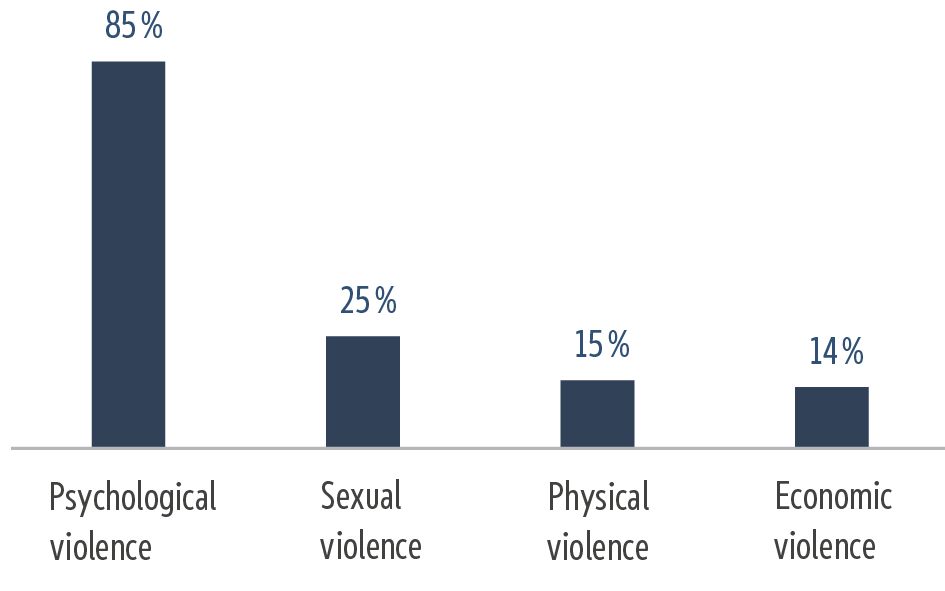
Data source: IPU–PACE survey, 2018. Graphic by Nadejda Kresnichka-Nikolchova.
Situation in the EU
Violence against women needs to be seen against the backdrop of women's under-representation in politics at all levels in the EU, of which it is an important cause. In all EU states, women are under-represented at all levels of political representation, as well as in the leadership of major political parties (see Figure 2).
Data on violence against women in politics in the EU
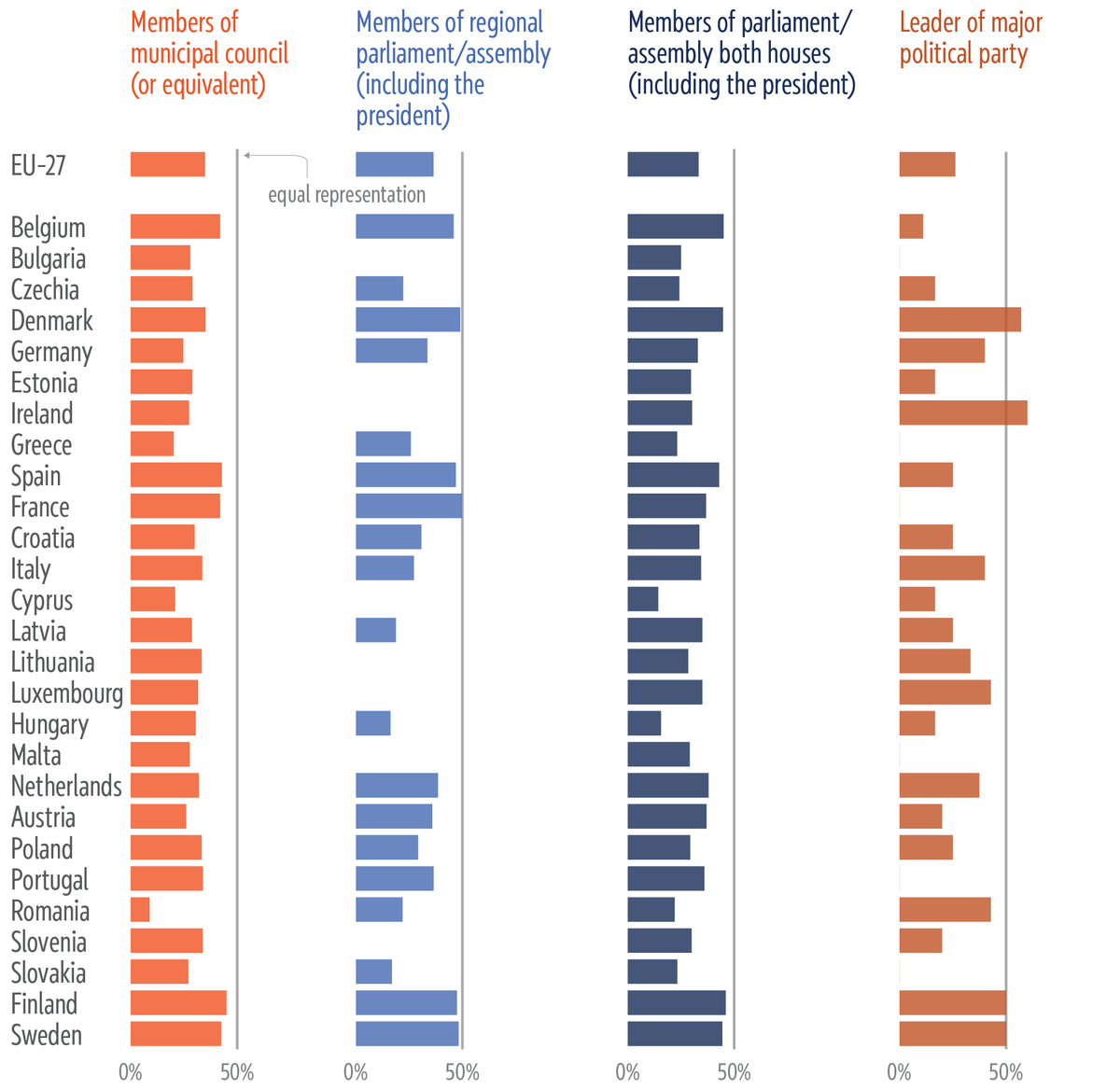
Data source: EIGE, Gender Statistics Database, 2025 (aggregate figure for EU-27). Graphic by Nadejda Kresnichka-Nikolchova, EPRS.
No comprehensive set of data on violence against women in politics in the EU exists;7 however, corroborating information from various sources points to a pervasive problem. While physical attacks remain infrequent, psychological violence, including attacks on women's private life, physical appearance or marital status, as well as symbolic violence seeking to marginalise women and make them feel incompetent, are part of everyday politics in Europe. The multiple causes of this violence range from the perpetuation of sexual stereotypes, to a backlash against women's presence in politics, to resistance against women as newcomers when they are perceived to threaten deep-rooted interests.
Electoral campaigns are an environment where gender-based harassment and hate speech proliferate. The online environment has provided a particularly fertile ground for acts of symbolic and psychological violence against women.8 For example, in Finland, a country that has witnessed a remarkable rise in the number and position of women politicians in recent years, a 2020 study of abusive messages targeting Finnish ministers on the social media platform Twitter concluded that female Finnish ministers received a disproportionate number of such messages throughout the monitoring period (March to July 2020) and that 'a startling portion of this abuse contained both latent and overtly sexist language, as well as sexually explicit language'.
The Council of European Municipalities and Regions (CEMR) in 2023 conducted a Europe-wide survey on violence against women in politics among locally elected female politicians; over 2 600 female politicians (86 % of whom were local officials) in 31 European countries took part and shared their experiences of violence. According to the results, 32 % of respondents had experienced violence, but only 29 % of those affected had reported it, and of those who reported it, only 22 % witnessed consequences for perpetrators. Psychological and cyber violence were the types most commonly encountered, while physical and sexual violence were much less frequent (Figure 3). Half of respondents considered that the level of violence had remained constant, while one third considered that it had increased.
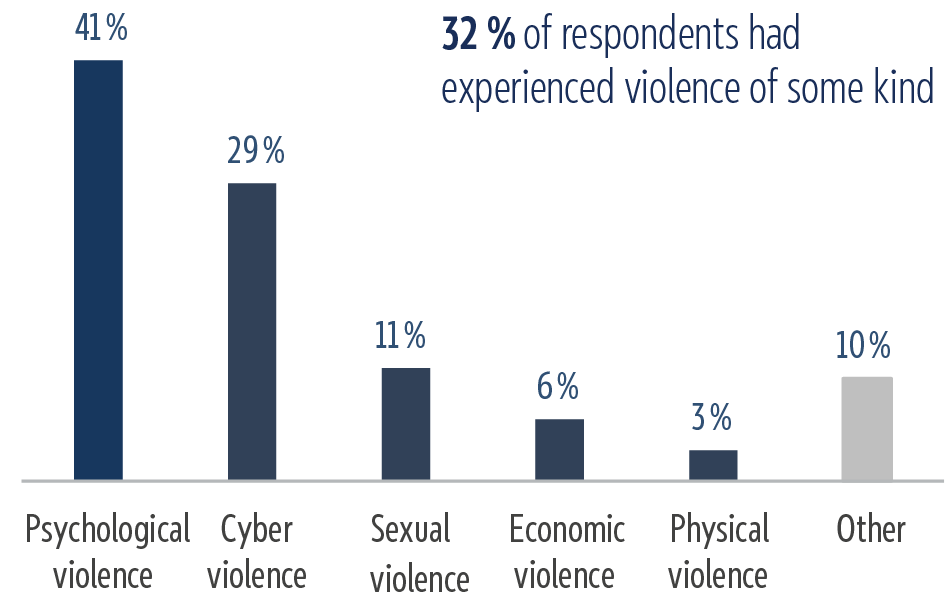
Data source: CEMR study, Women in politics: European trends, 2024. Graphic by Nadejda Kresnichka-Nikolchova, EPRS.
At national level, multiple surveys show the complex and pervasive nature of the phenomenon.9 Some local authorities and politicians' organisations have started collecting data systematically.
In France, an 'Élues locales' 2021 survey of almost 1 000 female elected politicians working mostly but not only in local government showed that 74 % had been subjected to sexist remarks and harassment in the exercise of their functions. Physical violence had only affected 1 % of them. Eighty-two per cent of respondents said they had suffered from acts of violence committed by elected colleagues, compared with only 31 % who had been attacked by a member of the public.
In Germany, the most recent edition of a biannual survey of mayors and districts chairs (KoMo autumn 2024)10 shows that women in these positions are more affected by threats and attacks than men (38 % versus 28 %). During the local elections period in 2024, women were similarly more impacted than men (31 % versus 17 %). Additionally, women encountered disinformation or deepfakes relating to themselves more frequently than men (29 % versus 18 %).
A comprehensive survey of violence towards party members in Germany conducted in 2020 provides insight into the comparative situation at national versus local level.11 The survey included 818 politicians, of whom 525 were women, with an elected mandate or public function at local, regional or federal level. It showed that 40 % of women politicians had experienced some form of sexual harassment, either verbally or through touching. Such experiences are more frequent at federal than local level, and are more likely to affect politicians under the age of 45. While more male than female politicians complain of attacks on social networks (74 % versus 60 %), women are more often the target of sexist remarks and insults (17 % of women compared with 3 % of men). According to the survey, the psychological impact of off- and online attacks is more severe on women.
In Sweden, the Swedish National Council for Crime Prevention (Brå) conducts a regular survey among politicians on acts of violence and threats they face, including online sexual harassment and abuse of female representatives – the 'Politicians' Safety Survey' (PTU). The latest such survey conducted in the period 2012 to 2022 (see summary of results in English published in 2023) shows that the proportion of women suffering violence is slightly higher than that of men: 31 % of female elected representatives compared with 28.3 % of males reported being victim at least once during 2022. Most acts of violence consisted of threats and harassment, with a total of 29.7 % of women and 27.3 % of men stating that they were the victim of this type of violence during 2022. A lower proportion, 5.3 % of elected representatives, stated that they had been the victim of physical violence, vandalism or theft. Women were more worried about violence than men and reported a more severe psychological impact (30.4 % versus 20.7 %).
Parliamentary surveys
At the level of national parliaments, several surveys have been conducted with members. As the Süddeutsche Zeitung reports, according to a 2019 survey by ARD televised political magazine Report München, 90 % of all female deputies in the German Bundestag had been the target of hate speech, 57 % of them on sex-related grounds, across all the parties.
A study carried out in 2020 among female members of the Irish Parliament and female councillors from all major political parties showed that 96 % of those interviewed had received threatening social media or email messages or 'hate mail'; three quarters said they had been threatened online with physical violence, and a quarter that they had been verbally abused in public. A 2024 report for the Irish Lower House of Parliament found that female politicians and political staff were far more exposed to harassment and psychological violence than men, namely to sexual violence threats, prejudicial slurs, (digital) sexual harassment, comments on physical appearance, unwanted sexual attention and sexually explicit messages.
In the Swedish Parliament, a survey conducted by the Parliamentary Working Group on Gender Equality in 2018 showed that many members were satisfied with the working climate and the treatment they received in parliament; nevertheless, women testified that they had been subjected to control tactics and abusive treatment, and to comments about their physical appearance.
Tools for tackling violence against women in politics
The toolkit developed by the OSCE to deal with violence against women in politics stresses the importance of addressing the issue along four axes: prevention, protection, prosecution, and policy coordination, in line with the Istanbul Convention. Measures to ensure equality between women and men in the political field, as well as measures to combat violence against women in general, are considered crucial in preventing and reducing violence against women in politics. In addition to this general approach, the following specific measures are among those proposed by organisations12 working on the topic:
-
in parliaments: draft or expand existing rules of procedure and codes of conduct to cover violence against women in politics; establish confidential complaint procedures; conduct official inquiries; set up dissuasive sanctions, including waiving parliamentary immunity; provide help, counselling, and legal and procedural aid; gather data and conduct regular surveys; organise anti-harassment training courses; report criminal offences to the police; conduct regular assessments of measures in place;
-
in political parties: reject publicly any form of violence against women in politics; recognise the issue in party statutes; adopt internal regulations, codes of conduct and zero-tolerance policies; create women's groups to share experiences; raise awareness and organise training;
-
in political life: raise awareness through public statements, activism and campaigns; involve men; fight the culture of silence surrounding violence against women in politics; collect and analyse data; adopt legislative measures; provide access to justice; conduct effective investigation and prosecution; adopt dissuasive sanctions; provide emergency assistance and victim support;
-
in elections and electoral campaigns: ensure electoral bodies monitor violence against women in politics; make early warning systems for electoral violence sensitive to violence against women in politics; provide training for electoral stakeholders and other actors; organise civic campaigns to educate people on the risks of violence towards women in politics; improve access to political finance for women to ensure a level playing field; create networks of women parliamentarians; track cyber violence.
Violence against women in politics still receives insufficient public recognition, and many victims are reluctant to report it. Reasons include pressure from political organisations wishing to preserve their good image; fear of appearing weak and in a stereotypically female situation; normalisation of such violence as the cost of women's entering politics; concern about political careers; as well as the absence of a complaint procedure or of an entity where to report, and mistrust in the effectiveness of complaint procedures. To deal effectively with this violence, a comprehensive set of mechanisms is needed to assist and support victims, punish perpetrators, and prevent and address it through laws and other public policies.
Examples of parliamentary policies
National parliaments in EU countries have, to varying degrees, established norms to prevent and tackle discriminatory and hate speech, and verbal abuse and threats against other members. Internal rules for ensuring respect in debates are not gender specific, but they are particularly relevant to those who are more exposed to negative stereotypes such as women.
To prevent verbal attacks in debates, most houses rely on their rules of procedures, which contain more or less specific bans on aggressive and offensive language used by politicians taking the floor in sittings against their colleagues, as well as sanctions in cases of non-respect (see text box below).
Parliaments have also adopted codes of conduct or codes of ethics for their members, which members are expected to endorse, for example if they want to have access to leadership positions. These codes ban defamatory and offensive language and attacks against colleague during debates, or require, more generally, parliamentarians to adopt an attitude that does honour to their mandate and house. Such rules reinforce or complement obligations in rules of procedure (for instance Estonia, Croatia, Cyprus, Latvia, Lithuania, Poland, Portugal, Romania, Slovenia, Sweden).
Some parliaments13 have established specific mechanisms to assist and advise parliamentarians on how to deal with attacks, harassment and threats suffered outside of the house, including support for reporting, as well as specific security assistance (Ireland, France, the Netherlands). To prevent harassment, and sexual harassment in particular, several parliaments (e.g. in Spain, France, Sweden) have established complaint procedures, bodies to deal with cases, counselling services, and training for both victims and potential aggressors.
Internal parliamentary rules in EU countries
In Germany, Bundestag Members must respect the dignity of the house during debates (Rule 36). In France, Article 70 of the Rules of Procedure of the National Assembly penalises certain types of behaviour in public sittings, such as attacks, insults, provocations or threats against colleagues. In Cyprus, the Rules of Procedure of the House expressly state that all Members must behave and speak with respect in plenary and committee sessions and avoid the use of abusive language. In Luxembourg, the Rules of Procedure of the Chamber of Deputies prohibit personal attacks during speeches (Article 37). In Hungary, the 2012 Parliamentary Act prohibits using any term or language that harms the reputation of the National Assembly, the dignity of the sitting, or any person or group, in particular a national, ethnic, racial or religious community, as well as the use or threat of physical force and the invitation to use physical force. In Portugal, Article 14(1)(e) of the Statute of Members (Law No 7/93 of 1 March 1993) includes among the duties of MPs to 'respect the dignity of the Republic's Assembly and its Members'. In Romania, the rules of the Senate and the Chamber of Deputies prohibit insulting or defamatory behaviour towards a parliamentarian or other senior official. In Finland, Section 31 of the Constitution of Finland states that representatives must conduct themselves with dignity and decorum, and not behave offensively to another person.
EU policies
Combating violence against women has been among recent EU priorities. The European Commission recognises the chilling effect of online violence on women's participation in public life in the current EU strategy for gender equality (2020-2025), which sets out the general framework for EU action in this area.
In March 2025, the Commission adopted a roadmap for women's rights, which sets out several principles to guide EU action in the area. One refers to political participation and equal representation and provides that 'every woman has the right to actively and safely participate in public life'. One of the objectives pursued by this principle is 'ensuring the safety of women in public life and zero tolerance towards violence, hatred or harassment against women and girls in public life, both online and off-line'.
The 2024 Directive on combating violence against women and domestic violence provides that committing a crime defined in the directive against public representatives, journalists and human rights defenders because of their public role is an aggravating circumstance.
A Commission initiative from 2021 invited the Council to add hate speech and hate crimes to the list of EU crimes, but has stalled in the Council where it requires unanimity. It points to women as a specific group targeted by hate speech, and underlines the deleterious effect of such crimes on participation in public life.
The Digital Services Act can address some of these issues by creating a safer online environment and defining responsibilities and accountability for a range of digital service providers. Very large online platforms and very large online search engines are now required to address risks relating to gender-based violence.
European Parliament positions and internal tools
The European Parliament has adopted various resolutions calling for an end to all forms of violence against women, and against women politicians. In its 2018 resolution on measures to prevent and combat mobbing and sexual harassment in the workplace, public spaces, and political life in the EU, it condemned all forms of harassment against female politicians. Parliament asked the Commission to expand the definition of illegal hate speech to include misogyny and to cover these crimes in the EU Code of conduct on countering illegal online hate speech. Also in 2018, Parliament condemned the backlash against women's rights and gender equality, and called for a strong focus on gender equality during that legislative term.
During the previous term, Parliament highlighted the need to tackle online hate speech and cyber violence directed at female public figures, politicians and activists in its 2021 resolutions on the EU strategy for gender equality and on closing the digital gender gap. In its 2021 resolution on combating gender-based cyber violence, Parliament deplored the negative impact of gender-based cyber violence on the participation of women in public life and debate, and the fact that it leads to self-censorship. It expressed concern that the chilling effect thus created often spills over into offline reality, limiting the engagement of young women in particular. Parliament's resolution of 1 June 2023 on sexual harassment in the EU and #MeToo reiterated that female politicians and those advocating women's rights are particularly exposed to online violence and harassment.
The European Parliament has internal rules and procedures in place that oblige its Members to treat their colleagues respectfully and that address harassment. According to Rule 10 (Standards of conduct) of Parliament's Rules of Procedure, Members must show each other respect, uphold Parliament's dignity and not harm its reputation. Offensive language is banned in parliamentary debates. Incitement to discrimination based, inter alia, on grounds of sex, is considered offensive language. The same rule obliges Members to refrain from any type of psychological or sexual harassment and to respect the Code of conduct annexed to the Rules of Procedure, which reaffirms the obligation for Member to act with respect for Parliament's dignity and reputation. Rules 175 and 176 lay down sanctions for breaches of the standards set out in Rule 10.
Parliament has set up an advisory committee to deal with harassment complaints concerning its Members. At the beginning of the current term, the training for Members on harassment became mandatory.
Endnotes
Classification
Policy areas: Gender Issues, Equality and Diversity
Regions: European Union
Committees: Civil Liberties, Justice and Home Affairs (LIBE), Human Rights (DROI), Women's Rights and Gender Equality (FEMM)
Disclaimer
This document is prepared for, and addressed to, the Members and staff of the European Parliament as background material to assist them in their parliamentary work. The content of the document is the sole responsibility of its author(s) and any opinions expressed herein should not be taken to represent an official position of the Parliament.
Copyright
© European Union.
The reuse of this document is authorised under a Creative Commons Attribution 4.0 International (CC-BY 4.0) licence.

https://creativecommons.org/licenses/by/4.0/deed.en
To use or reproduce elements that are not owned by the European Union, permission may need to be sought directly from the respective rightsholders.