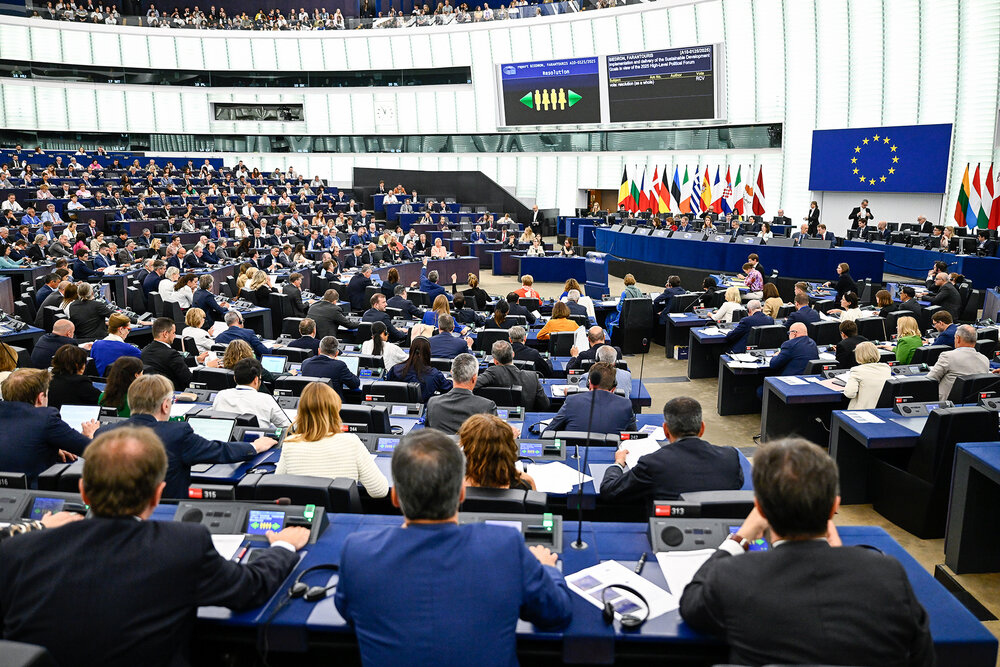
Climate, defence, and China are some of the topics that will be addressed during the first (of two) European Parliament part-sessions this month, taking place from 5 to 8 October 2026. On Tuesday morning, there will be a debate ahead of the European Council meeting on 15 and 16 October. That debate is due to be followed by a ‘This is Europe’ debate with the Prime Minister of Portugal, Luis Montenegro. The main debate on Wednesday morning will address the ongoing legislative process for the EU’s next multiannual financial framework (MFF). Question time with the Commission, on Tuesday afternoon, will allow Members to seek answers on the implementation of the Methane Regulation, which aims to reduce emissions of this gas.
Members will consider the EU’s programme for agile and rapid defence innovation (AGILE). This will grant €115 million to between 20 and 30 projects that focus on disruptive defence.
Parliament’s Committee on Security and Defence (SEDE) and Committee on Industry, Research and Energy (ITRE) jointly shaped the final trilogue agreement, calling for scaling up the defence industry and introducing new firms into the supply chain. Parliament and Council arrived at a provisional agreement on AGILE which, in keeping with the original proposal, will put particular emphasis on small and medium-sized enterprises, scale-ups and start-ups.
EU-China relations
On Tuesday afternoon, Parliament is to debate a recommendation on EU-China relations drafted by its Committee on Foreign Affairs (AFET). The report outlines the challenges concerning bilateral relations; including Chinese human rights violations, trade and competition imbalances, and China’s support to Russia in its war of aggression against Ukraine. The committee text recognises that the EU should strengthen itself from within. The recommendation comes ahead of the EU Trade Commissioner’s planned visit to Beijing in October 2026. EU relations with China have been deteriorating for a number of years, not least since China placed sanctions on Members of the European Parliament and the Parliament’s Subcommittee on Human Rights in 2021 (that were lifted in 2025).
Occupational health
Interinstitutional negotiations have concluded on the Commission’s proposal for the sixth revision of the Carcinogens, Mutagens and Reprotoxic Substances Directive (CMRD), and the final text will now be voted in plenary. This directive aims to limit workers’ exposure to harmful substances, and one way it does so is by setting out the maximum level that a chemical can be present in the workplace – called an occupational exposure limit value (OEL). Parliament’s negotiations were led by its Committee on Employment and Social Affairs (EMPL). Both the Council and Parliament were in favour of the new OELs that the Commission proposed, and called for the inclusion of an OEL for the chemical isoprene – which appears in the provisional agreement. Parliament also shaped the final text by proposing stronger safeguards for personal protective equipment in work.
The EMPL committee has also adopted a legislative-initiative report, which Parliament is due to debate on Monday. This report requests the Commission propose legislation concerning psychosocial risks at work. It recommends elements to be included in this proposal, for example; clear definitions and employer obligations. It calls for the right to a supported return to work and for no proof needed of exposure to risks. The context of this report is diverging national laws, workplace-related changes due to digitalisation, and the absence of an explicit mention of psychosocial risks in other EU legislative acts.
Environment data
Parliament’s Committee on the Environment, Climate and Food Safety (ENVI) adopted a report on the Commission’s proposal to simplify how Member States access and share spatial data, which they currently do through infrastructure called INSPIRE. This report is set to be voted on in plenary, and if adopted, it will serve as Parliament’s position in interinstitutional negotiations. The Commission wishes to remove some provisions in the INSPIRE Directive to avoid overlap between it and other, more modern laws. For example, the revision seeks to make use of the European data portal rather than a separate INSPIRE geoportal. The ENVI report is against the proposed erasure of some aspects of INSPIRE, emphasising the importance of having accessible, interoperable spatial data for environmental reasons. However, it is in favour of reducing administrative burden.
Consular support
Parliament is due to adopt a second report on the Commission’s proposal to amend the directive providing consular support to EU citizens in third countries where they are not represented, and the directive on the emergency travel document. Parliament’s involvement in this file falls under the consultation procedure, meaning that the Council is not bound to act on Parliament’s amendments. Parliament adopted its initial report back in 2024, calling for these directives to cover recognised refugees and stateless persons residing in the EU. Since then, the Council has amended the text significantly, for example by increasing the role of Union delegations regarding the right to consular protection. Consequently, Parliament has been reconsulted.