
Article page checkbox is not checked in page info.
Advanced materials act
Advanced materials act
Guillaume Ragonnaud with Raphaël Wainstain and Emilie Brévière, Members' Research Service
Issues at stake
-
Advanced materials are engineered to outperform conventional materials, and underpin a broad range of technologies, from clean energy to medicine. Examples include carbon-fibre composites that make aircraft lighter, perovskite films that could cut the cost of solar power, and biodegradable polymers that gradually release medication inside the body.
-
The Commission plans to table an advanced materials act in November 2026 to establish a strategic framework for the advanced materials industry. It may take the form of a Council recommendation and is expected to address research funding, scale-up, standards and safety rules.
-
The EU is a leading innovator, competing closely with the US and China: each accounts for roughly 15 % of global foreign-oriented patents, with China slightly ahead. The EU's patents are also among the most internationally protected, a sign of quality. The EU leads in composites and industrial-process technologies. However, it risks losing ground in polymers, and nanotechnology and miniaturisation technologies.
-
Innovation and scale-up in the EU face several obstacles: the 'lab-to-fab' gap; the absence of EU standards to compare materials on safety, sustainability and performance; insufficient data sharing between laboratories, leading to costly duplication; and persistent skills shortages in fields such as materials informatics.
-
Advanced materials could also reduce EU dependence on critical raw materials (CRMs), although this may come at a cost in terms of performance, durability or lifetime, limiting their potential.
Purpose statement
This European Parliamentary Research Service paper aims to inform Members on issues related to a forthcoming Commission initiative. It highlights the main choices which may shape the initiative and which Members may wish to explore ahead of formal Commission adoption. Based on documentary and other sources, it reflects the information available at the time of writing.
For further information on this topic, Members and staff of the European Parliament may contact the author.
Developments and insights – European Commission
What are advanced materials?
There is no single, legally established definition of 'advanced materials'. Drawing on the OECD's working description, advanced materials are understood as 'materials that are rationally designed to have new or enhanced properties, and/or targeted or enhanced structural features with the objective to achieve specific or improved functional performance'. This is a very broad and inclusive category; advanced materials are not united by a common application or physical property, which makes them structurally hard to define.
In its 2025 report to the European Commission, the Joint Research Centre (JRC) proposes a classification of 11 categories of advanced materials:
-
nanomaterials, composed of particles ranging in size from 1 to 100 nanometres;
-
micromaterials, with dimensions on the order of a micrometre (1 000 nanometres);
-
thin films;
-
biomaterials, which are intended to interface with biological systems (tissues, organs, bones, etc.);
-
polymers, which are very long, chain-like molecules (plastics, polystyrene, nylon, etc.);
-
composites, which synergistically combine different materials, often polymers;
-
metals and alloys;
-
glass and ceramics;
-
fibres;
-
cements;
-
nanotechnology and miniaturisation, which are not materials as such but processes for manufacturing structures on a 100 nanometre scale.
The road to the advanced materials act
In 2022, seven entities from across Europe's public and private sectors – spanning research to industry – co‑signed the Materials 2030 Manifesto, calling for a strong European advanced materials ecosystem to underpin the green and digital transitions and a sustainable, inclusive European society. The manifesto sparked a broad debate on the strategic importance of such materials for Europe's industrial future and the need for a strategic agenda for their development.
On 27 February 2024, the European Commission published a communication on advanced materials for industrial leadership in which it set out a strategic framework for advanced materials research, scale-up and production in the EU. The communication proposes a combination of 14 actions addressing the entire value creation chain, spanning early-stage research to deployment and market uptake. The communication also sets out research and innovation priorities, identified in consultation with Member States, that are particularly relevant for joint action in the area of advanced materials, for example, high-performance coatings to protect infrastructure against corrosion in energy distribution and the transmission grid, or advanced materials to improve performance in harsh environments in electronics.
One such action was the creation of a Technology Council for Advanced Materials in July 2024, to coordinate EU action in the sector. It is composed of representatives from Member States, industry and academia. The Technology Council has met three times since its establishment.
In 2025, the advanced materials act was announced as a key deliverable in the EU's competitiveness compass. In March 2025, the Commissioner for Startups, Research and Innovation, Ekaterina Zaharieva, asked the Scientific Advice Mechanism (SAM) for an opinion on the role of advanced materials in EU strategic autonomy. The response, published in April 2026, includes the following recommendations on the act's possible scope:
-
Share research data to a greater or lesser extent depending on its sensitivity (globally if not sensitive, restricted to EU Member States if strategic).
-
Gradually increase regulatory requirements according to a material's maturity level ('technology readiness level' or TRL): light-touch at the early stages of research, and more stringent as the material approaches market launch.
-
Use public procurement to create demand.
-
Reduce fragmentation in the EU research and innovation (R&I) funding landscape, which is currently extensive (co‑existence of Horizon Europe, national programmes and mission-driven initiatives), while funding exploratory research without immediate applications.
Finally, the Commission conducted a call for evidence and a public consultation from October 2025 to January 2026 for the impact assessment currently under preparation. There were a total of 192 feedback responses, with stakeholders supporting the initiative overall. In general, research institutes and public authorities stressed the need for interdisciplinary collaboration between academia, industry and government, while businesses pointed to risks of a long time-to-market linked to regulatory burdens. The advanced materials act is scheduled for the fourth quarter of 2026 in the Commission work programme. Based on the Commission's indicative agenda, it could be presented in mid-November 2026. Recent discussions at events organised by the Commission suggest that the act may take the form of a Council recommendation.
Why is the initiative important?
Why are advanced materials important?
Advanced materials are important firstly because they have a wide range of applications across industrial sectors, including medicine, renewable energies, electronics, construction, space exploration and defence. Table 1 shows some of the most important advanced materials and their applications.
To a lesser extent, advanced materials could also serve as substitutes for certain critical raw materials (CRMs), thus contributing to reducing dependencies. However, most of these substitutes involve trade-offs in areas such as performance, durability, lifetime, cost, or environmental and social impacts, which limits their potential. According to the JRC, the substitution potential is highest for onshore wind, photovoltaics (PV), stationary batteries and electric vehicle (EV) motors, but lower for EV batteries (as they require high energy density), and very low for offshore wind and hydrogen technologies due to strict constraints on performance, lifespan and reliability.
| Advanced material | Category | Applications | Special properties |
|---|---|---|---|
| Carbon-fibre reinforced polymer composites (CFRPs) | Composites | Aircraft fuselages, wind turbine blades, hydrogen and compressed natural gas storage | Outstanding strength-to-weight ratio, high stiffness, high temperature and corrosion resistance |
| Poly(lactic-co-glycolic acid) or PLGA | Biomaterials, polymers | Drug delivery systems within organisms, scaffold for various tissues (bone, cartilage, nerves) | Biocompatible, biodegradable, tunable mechanical properties |
| Metal-halide perovskite | Thin films | Perovskite solar cells | Extremely high power conversion efficiency, cheap manufacturing costs |
| Ultra-high performance concrete (UHPC) | Cements | Construction of nuclear installations and fuel storage, high-rise buildings, bridges | Exceptionally high strength and durability compared with conventional concrete, extremely low porosity |
| Fibre integrated circuits (FICs) | Fibres | Soft brain-computer interfaces (BCIs), smart textiles and virtual-reality wearables, haptic gloves for remote surgery | First ever creation of a printed circuit board on a hair-thin flexible fibre, with an accuracy comparable with commercial chips |
| High-entropy ceramics (HECs) | Glass and ceramics | Thermal protective coatings for aerospace components, nuclear reactor components, electrodes for batteries | Resistance in ultra-high-temperature environments, high hardness and wear resistance |
Source: Compilation by the authors.
EU innovation in advanced materials
There are currently no publicly available data on the production and use of advanced materials in the EU. The section below examines the EU's position on innovation in advanced materials, which offers another perspective from which to assess its competitiveness in this sector.
Position of the EU in the global technological space
The EU is among the world's leading innovators; together with the US and China, it accounts for over half of all global patent filings, and leads in several broad technological fields (see Figure 1). However, its relative share of global patent filings has gradually declined over recent decades, from 22 % in the early 2000s to 19 % in 2020. By contrast, the rise of China has reshaped the global innovation landscape, soaring from nearly 0 % to 16 % of total patent filings in 20 years, narrowing its historical gap with the EU and US.
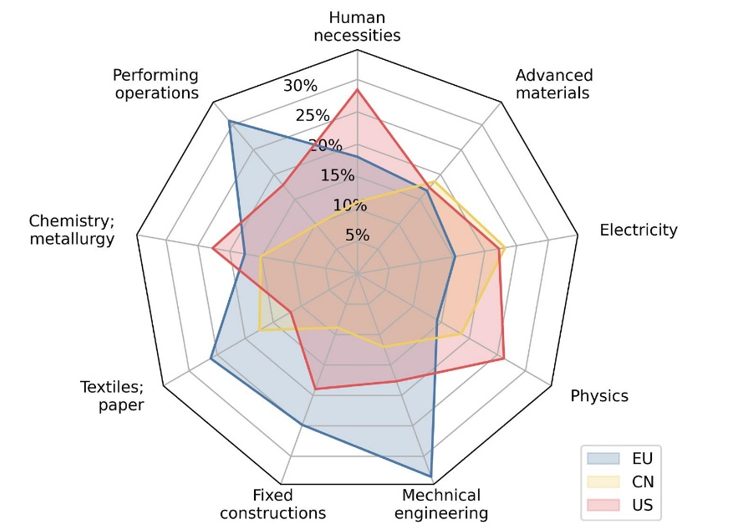
Data source: JRC, 2025. Graphic by Lucille Killmayer, EPRS. Note: Only foreign-oriented patents have been taken into account, i.e. patents protected in several jurisdictions around the world. These generally reflect a high level of innovation, as applicants will only bear the additional costs and complexity when they believe the invention has significant international commercial potential. The 'advanced materials' area was defined by an expert-guided selection of advanced materials technologies; the eight other technology types comply with the Cooperative Patent Classification (CPC).
Regarding advanced materials, the EU, the US and China each hold an approximate 15 % share of global foreign-oriented patents, with China in a slight lead, meaning that the EU is in the race and has room to carve out a strong position in this sector. The EU also ranks first in performing operations (industrial processes), textiles, fixed constructions and mechanical engineering, while the US leads in chemistry and physics, and China has a leading share of patents in electricity-related technologies.
In terms of raw numbers, China files around six times more patents in advanced materials than the EU or the US, but an overwhelming proportion of these are domestic (only protected in China) and less innovative patents, potentially related to Chinese government incentives. The EU produces fewer patents, but these appear to be of higher quality. About one in four European patents in advanced materials is protected simultaneously in Europe, the US and Japan, which ensures EU access to these markets, compared with only one in seven on the US side, and fewer than one in a hundred in China (DG RTD, 2026).
Focus on advanced materials categories
The EU innovates selectively: it is strong in certain categories of advanced materials and almost absent in others, as shown in Figure 2.
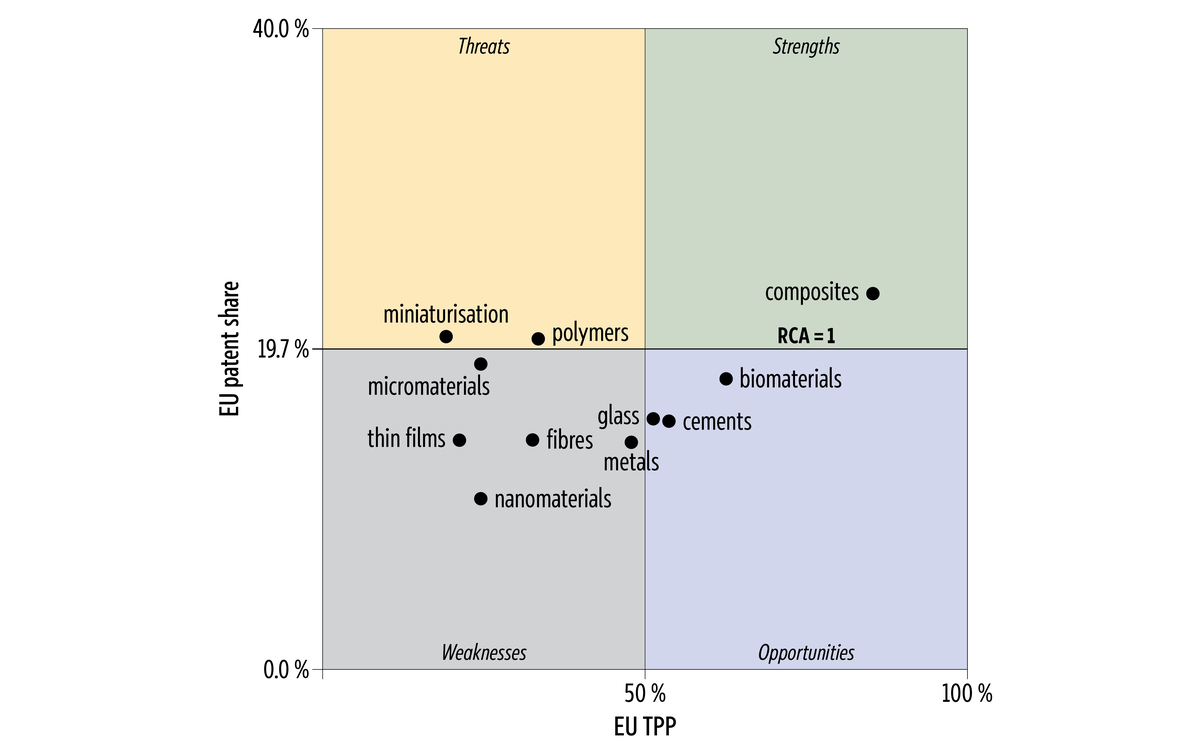
Data source: JRC, 2025. Graphic by Lucille Killmayer, EPRS. Note: The vertical axis shows the EU's current share of global patents in each advanced materials category. The technologies above the horizontal line are those in which the EU has a revealed comparative advantage (RCA) over the rest of the world. The horizontal axis shows the technological progression probability (TPP), i.e. the estimated growth potential of each material in the EU. A TPP greater than 50 % indicates high growth potential.
Polymers, composites and miniaturisation are the subfields in which the EU currently holds a comparative advantage over the rest of the world. However, while composites stand out as a strength, combining current competitiveness and high potential for further development, polymers and miniaturisation are in the threats category, suggesting that the EU risks losing ground there in the coming years. Conversely, biomaterials, glass and cements fall within the opportunities quadrant. This means that although their current specialisation is low, the EU is likely to strengthen its position in these technologies. Finally, five out of the eleven technologies are deemed weaknesses, indicating they have both a weak current specialisation and low growth potential (JRC, 2025a).
There is also strong heterogeneity within the EU: for instance, biomaterials are a strength for 21 out of the 27 Member States but a weakness for Germany, which is why they appear only as an opportunity overall.
As regards sectoral applications of advanced materials, the EU is strongly positioned globally in energy materials, medical materials and electronics, where the share of international patent protection and high citation rates tend to exceed those of the US and China. These sectors are closely aligned with EU policy priorities on decarbonisation, digitalisation and health technologies.
Challenges
The 2026 Scientific Advice Mechanism report identifies several challenges. First, companies struggle with the 'lab-to-fab' gap (also known as the 'valley of death'), the two-to-five-year period after the laboratory development phase and before initial industrial production, when investors may lose confidence, and access to funding and infrastructure become difficult, particularly for SMEs. Paradoxically, the EU has a solid base of research infrastructure for advanced materials, covering all stages of development (laboratories, pilot lines and test beds); the issue is therefore one of access to these facilities. Second, there is a lack of EU standards for comparing materials on safety, sustainability and performance across their life cycles, as well as a lack of criteria for deciding which ones to prioritise. Third, data are not sufficiently shared among scientists, which leads to different laboratories duplicating experiments and results, hindering the innovation process. Finally, skills shortages persist in several fields, such as materials informatics, regulatory science and AI-ready experimentation, which slow the uptake of new approaches.
What the EU already has in place
EU legislative landscape
Although there is no specific legislation for advanced materials, there is a well-established regulatory framework for materials and products on which the EU can build. The REACH Regulation (EC) No 1907/2006 and associated CLP Regulation (EC) No 1272/2008 form the core of the EU regulatory framework for substances and materials. REACH requires any company manufacturing or importing a chemical substance in quantities exceeding one tonne per year to register it with the European Chemicals Agency (ECHA) and document its properties and risks. However, REACH's limitation is that it mainly distinguishes substances based on their chemical composition, whereas advanced materials' special properties often result from other characteristics, such as size, surface properties, molecular weight (in the case of polymers, for example, which have never been included in REACH because their high molecular weight was assumed to imply a low hazard) or nanoscale structure (in the case of nanomaterials). This problem was addressed for nanomaterials in 2020, when specific requirements were added to REACH through amendments to its annexes. This approach that could be replicated on a case-by-case basis for advanced materials to capture their specific characteristics, if necessary. The CLP Regulation, which determines a substance's hazard classification and labelling (toxic, flammable, carcinogenic, etc.), applies the same specific logic to nanomaterials, but suffers from the same limitations.
Regarding final product control, Ecodesign for Sustainable Products Regulation (EU) No 2024/1781 has introduced digital product passports, providing digital access to product-specific information on sustainability, circularity and legal compliance. Its first mandatory application will be for batteries, as provided for in the Batteries Regulation (EU) No 2023/1542. Advanced materials are not addressed as a standalone category in this passport, but will be listed in the composition of the products in which they are used, thereby making it possible to track their real-world impact. These passports are intended to implement the 'safe and sustainable by design' principles set out in Recommendation 2022/2510, which aims to guide the selection of safer materials right from the design stage, that the SAM proposes as the basis for calibrating the act's future obligations.
EU projects and investments landscape
Regarding R&I funding for advanced materials, the EU has three major collaborative programmes under Horizon 2020 and Horizon Europe. First is the co‑programmed European partnership, Innovative Advanced Materials for Europe (IAM4EU) between the European Commission and the industry association IAM-I, which was announced in the Commission's 2024 communication and adopted in March 2025. The Commission and private partners plan to invest up to €250 million each by 2027. IAM4EU is still very early in its funding lifecycle, and has so far funded six projects related to telecoms and e-textiles, for a total of around €30 million.
Second, M-ERA.NET is an EU network that has coordinated 49 public funding organisations from 35 countries to run joint transnational calls in materials science since 2012. Each year, M-ERA.NET issues joint calls for projects on five to six thematic areas related to advanced materials, for which countries apply as groups (at least three different countries for each application). Projects are then selected by an M-ERA panel, with each national agency funding part of the winning projects. In 2026, for example, the indicative budget of all funding agencies was €40 million. European funding for M-ERA.NET has been renewed for the third time, until August 2029 (M-ERA NET 4, following the 2021‑2026 M-ERA NET 3).
Finally, between 2019 and 2026, the EU funded the deployment of open innovation test beds, which are laboratories where companies (particularly SMEs) conducting research on advanced materials or nanotechnologies can test and experiment with their products affordably. The EU has funded 28 projects for a total of €319 million, through grants lasting two to four years, all of which had expired by 2026. The objective was for each laboratory to become financially self-sufficient once the grant expired, but this transition has proved difficult, at least for the first wave of projects in 2023. There are some exceptions, such as i-TRIBOMAT.
Regarding cooperation and data sharing, in June 2026 the Commission launched the MaterialsCommons initiative, a €28 million Horizon Europe project that aims to connect research data on advanced materials from Member States (such as experimental results, material properties or manufacturing processes) through a shared web portal. These data are currently scattered across multiple, incompatible national databases. The objective is to give researchers across Member States access to each other's data instead of duplicating experiments and results, and therefore enable cross-border collaboration across academia and industry. The consortium currently includes 26 academic partners, 21 associated partners and 12 associated collaborators, mostly from industry.
In terms of skills and workforce training, in 2025 the Commission and the European Institute of Innovation and Technology (EIT) launched a European Advanced Materials Academy, which aims to train 200 000 people (students, professionals, SMEs, large enterprises) on several topics related to advanced materials by 2029, through 60 programmes offered by 200 providers and 300 instructors across the EU. The first sessions were scheduled to begin in early 2026, but the training options available to date seem fairly limited.
Existing EU infrastructure
Lastly, a 2026 study by the European Commission shows that the EU has a strong research and technology infrastructure (RI&TI) base dedicated to advanced materials, with 2 943 structures across the EU (with Germany, Spain, Austria and France accounting for over 50 % of the total). These structures cover all research and development stages, from early-stage research (64 % of total infrastructure, 43 % laboratories and 21 % technology centres) to late-stage development and industrialisation (36 % of total infrastructure, with 13 % pilot lines). The study highlights the ongoing need for investment to modernise this infrastructure (purchase of new equipment and services), which it estimates at between €0.9 and €2.1 billion over the next five years. The main sectors concerned are electronics (42 %), energy (30 %) and mobility (13 %).
Member State positions and interested parties' opinions
Industry position
The IAM-I association, which brings together industry, research and technology organisations, universities and associations for developing and deploying advanced materials and is co‑leading the IAM4EU partnership with the Commission, explains that the main problem currently facing companies in the sector is the 'valley of death', when costs rise sharply and investor confidence drops. It calls for the funding instruments under the next MFF to be tailored to support these final development steps, particularly pilot plants and industrial scale-up. Moreover, it calls for the act to establish another advanced materials public-private partnership, an IAM4EU 2.0 with a budget over €2 billion under the 10th EU Framework Programme for Research and Innovation, to provide support throughout the lab-to-market-and-to-scale process.
The IAM-I also asks that the act protect EU industry, first through local content requirements on public and private investment in strategic advanced materials projects (to be defined), and second by requiring that external EU imports of advanced materials meet the same safety and environmental standards as the EU's, to ensure a level playing field. Finally, it calls for more data-sharing infrastructure (as planned in the MaterialsCommons initiative) as well as faster and simpler certification, validation and standardisation procedures.
In 2024, the European Chemical Industry Council (Cefic) welcomed the Commission's strategy as a 'pivotal step' for the green and digital transitions, but raised concerns about the adequacy of funding, arguing that the €500 million target for the IAM4EU partnership (2025‑2027) falls short of what the transformation requires. Cefic called for quicker access to EU R&D funding and greater prioritisation of scale-up support to bridge the gap from lab to industrial production.
National authorities' positions
In the Commission's call for evidence and public consultation, Member States' national authorities broadly supported the initiative. They highlighted the importance of a clear definition of advanced materials. The German Federal Office for Chemicals emphasised that 'a clear focus and improved clarity on what is covered by the advanced materials act is crucial for its effectiveness'. The Dutch National Institute for Public Health and the Environment (RIVM) warned that the current broad description in the call for evidence may require extensive legislative changes, potentially increasing companies' regulatory burden.
The German Environment Agency, the RIVM and the Finnish Safety and Chemicals Agency each emphasised the importance of safety and sustainability, with the latter arguing that 'safety is insufficiently addressed in the call for evidence, while current regulation and test methods may not adequately assess advanced materials safety and sustainability to protect human health and the environment'. The Swedish Chemicals Agency took a different position, arguing that 'well-structured and clear regulatory processes to ensure the safety of European advanced materials are best achieved through existing chemicals legislation, e.g. REACH, and not as part of the advanced materials act'.
Council of the EU
In its conclusions of November 2024, the Council welcomed the Commission's communication on advanced materials, stressing the need to accelerate R&D in this area and apply the 'reduce, reuse, recycle' principles to ensure that next generation advanced materials are safe, sustainable, circular and resource efficient. The Council also recognised the critical role of SMEs and start-ups in conducting R&D and driving innovation, highlighting that these innovators should be supported from early design to testing. The Council further called on the Commission to identify ways to reduce strategic dependencies on CRMs using advanced materials.
European Economic and Social Committee
The EESC welcomed the 2024 communication as a useful first step but highlighted that it is not a strategy per se, given the lack of quantified targets, deadlines and key performance indicators. It welcomed the strengthened EU‑Japan dialogue on advanced materials and the proposed platform for sharing policy developments and exploring joint research, recommending that this type of cooperation be extended to other countries such as South Korea and the US. Finally, it emphasised that the €250 million budget for the IAM-I initiative was insufficient, and called for concrete support for SME participation and incentives for their involvement in future partnerships.
European Parliament views
Parliament has repeatedly recognised the role of advanced materials in the EU's economy and supported their development. In its 2019 resolution on the programme implementing Horizon Europe, Parliament called for sustained investment in research for advanced materials to maintain the EU's leadership position. In 2021, Parliament adopted a resolution on a European strategy for CRMs, welcoming the proposal to promote research and innovation on advanced materials under Horizon Europe to substitute CRMs.
More recently, Parliament has underlined the role of advanced materials technologies in defence – in its 2025 annual report on the implementation of the common security and defence policy – and in electric aviation applications. It has called on the Commission to ensure the supply of advanced materials needed, in particular for battery production.
Main references
- Scientific Advice Mechanism, Scientific opinion on advanced materials, Scientific Opinion No 18, April 2026.
- Albora G. et al., Path to innovation: an Economic Complexity analysis of technological perspectives in the EU: Advanced Materials, 2025.
Classification
Policy areas: Industry
Regions: European Union
Committees: Industry, Research and Energy (ITRE)
Statement on the use of AI
Any AI-generated content in this text has been reviewed by the author(s). Mistral Vibe and Claude were used to improve the readability of the text and broaden the range of sources available to the authors.
Disclaimer
This document is prepared for, and addressed to, the Members and staff of the European Parliament as background material to assist them in their parliamentary work. The content of the document is the sole responsibility of its author(s) and any opinions expressed herein should not be taken to represent an official position of the Parliament.
Copyright
© European Union.
The reuse of this document is authorised under a Creative Commons Attribution 4.0 International (CC-BY 4.0) licence.

https://creativecommons.org/licenses/by/4.0/deed.en
To use or reproduce elements that are not owned by the European Union, permission may need to be sought directly from the respective rightsholders.