Article page checkbox is not checked in page info.
Outcome of the European Council meeting of 15‑16 October 2026
Outcome of the European Council meeting of 15‑16 October 2026
Authors: Ralf Drachenberg, Annastiina Papunen and Rebecca Zamponi, European Council Oversight Unit
Summary
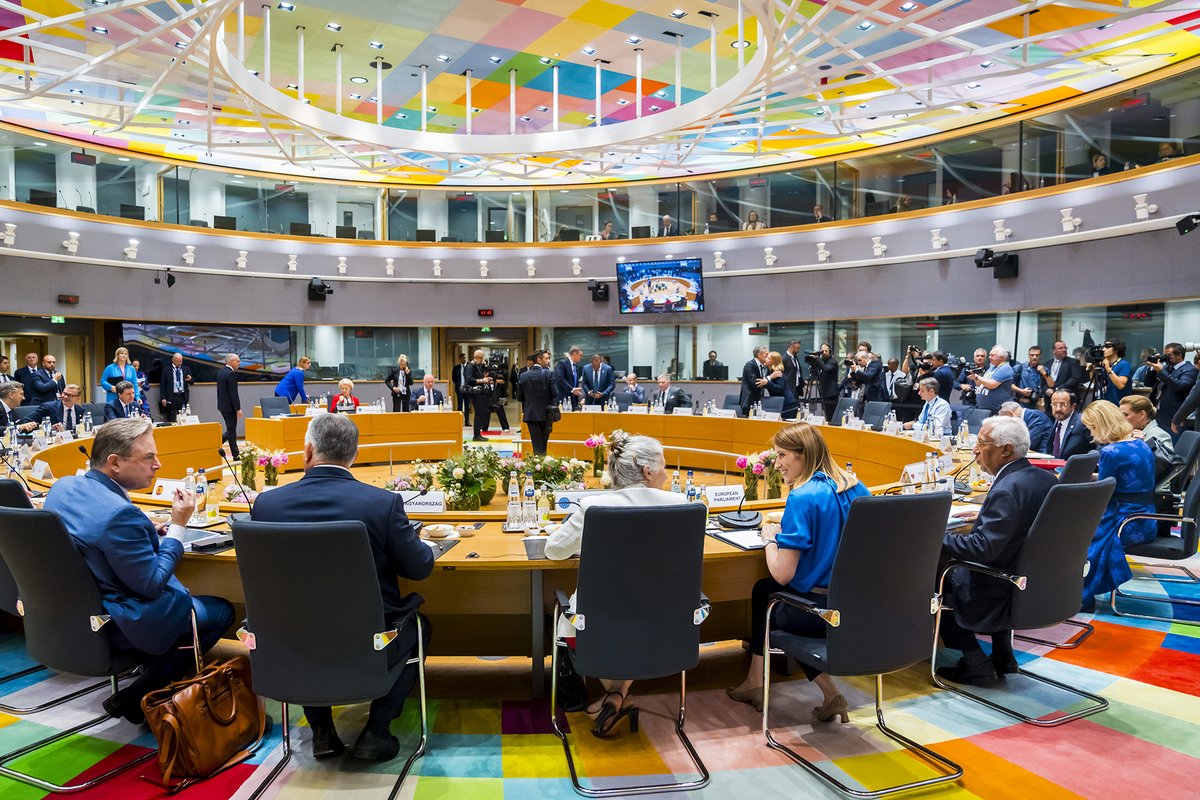
The October European Council meeting, the first of four gatherings of EU leaders before Christmas, dealt with a large number of issues, from competitiveness, in particular energy prices, to the war in Ukraine, the multiannual financial framework (MFF), migration and enlargement. Most, if not all these topics, will be addressed again by EU leaders at the three remaining meetings this year.
On competitiveness, the focus of the discussion was clearly on energy prices and on ways of reducing their impact on the EU economy. In that context, EU leaders discussed the emissions trading system (ETS) at length and welcomed progress on the implementation of the 'One Europe, One Market' roadmap. The strategic discussion on the MFF confirmed that the positions of Member States were still far apart, putting the aim of an agreement at European Council level by the end of 2026 in jeopardy. European Council President António Costa was tasked with presenting an updated negotiating box in November 2026.
In the context of worsening Ukraine‑US relations, EU leaders exchanged views with Ukrainian President Volodymyr Zelenskyy and reaffirmed the EU's unwavering support for Ukraine. The Commission was asked to come up with concrete proposals to address Ukraine's financial needs in 2027. The debate on Ukraine was interwoven with a debate on security and defence, focusing on intensifying Russian hybrid treats and attacks on civilian ships in the Black Sea. The strategic discussion on migration was a long and heated debate; the conclusions, although short, include a reference to the new European Emergency Response Framework to face extraordinary threats such as mass irregular arrivals at the EU's external borders.
The European Council also issued conclusions on foreign information manipulation, the United Nations climate change conference and on the upholding of international law. On the latter issue, EU leaders expressed their deep regret at the sanctions announced by the United States against the International Criminal Court, and reaffirmed the EU's support for the institution.
1. General
As flagged up in the EPRS outlook, a series of meetings took place in the margins of the European Council. On Wednesday night, the leaders of Czechia, Hungary, Poland, and Slovakia met in the Visegrád 4 format. Thursday morning saw various groups of EU leaders – frugals and friends of cohesion – meet on the MFF, and on Friday morning 17 members of the European Council met for their traditional pre‑meeting discussion on migration. Additionally, there was a meeting of the Northern nine (Denmark, Germany, Estonia, Ireland, Latvia, Lithuania, Poland, Finland and Sweden).
As usual, the European Council meeting proper started with a speech by European Parliament President Roberta Metsola, her main message being that 'Europe must step up on three fronts: Security, competitiveness, [and] investment in people's priorities'.
Since the start of his mandate, President Costa has aimed to avoid spending time on revising conclusions at European Council meetings and to enable thorough debates between EU leaders, which incidentally has also led to an increase in the length of meeting conclusions. This time around, however, not only were the conclusions the longest in the Costa era, but there were also numerous requests by EU leaders during the meeting to change elements of the text. Another feature of Costa's presidency has been the organisation of informal retreats on priority issues. Hence, in the post‑meeting press briefing, he announced an 'Alden Biesen 2' at the beginning of February 2027, which will follow up on the two previous retreats on defence and competitiveness.
2. European Council
Competitiveness
EU leaders started their discussions with competitiveness. Energy prices are currently high, impacting European citizens and companies adversely. According to President Ursula von der Leyen, gas prices have gone up by 140 % since the end of February and the price of diesel has doubled: 'Altogether, imported fossil fuels have cost Europe €100 billion extra – without a single molecule of additional energy.' Price differences between Member States have also been a concern, and Czechia's Prime Minister Andrej Babiš stated : 'It is extremely unfair that some countries, because of geographical and energy advantages, pay 30 to 40 euros per megawatt‑hour for electricity, while we pay 160.' To alleviate the situation, EU leaders agreed that it required a coordinated response with targeted and temporary measures, 'taking into account the Member States' specific circumstances'. They welcomed the postponement of certain obligations in the Methane Regulation as well as the short term actions the Commission intends to take: i) prolonging the temporary State aid framework for the hardest hit industrial sectors; ii) optimising efficiency and capacity of EU refineries; and iii) proposing initiatives to bundle energy demand on a voluntary basis. However, the European Council stressed that, in the long term, 'the energy transition remains the most effective strategy for achieving Europe's strategic autonomy, strengthening resilience, [and] structurally lowering energy prices'. In that context, 'making decisive progress' on Energy Union 2030 is a crucial aim. Moreover, EU leaders called for international coordination in stabilising energy supplies and for 'unrestricted trade in energy and energy products between partner countries', a likely reference to the US diesel export limits to Europe.
A lengthy discussion took place on the EU emissions trading system (ETS) and the upcoming ETS2 for transport and buildings. Six Member States (the Visegrád Four – Czechia, Hungary, Poland and Slovakia – Italy and Greece) called for the postponement of ETS2, fearing that it may increase even more the cost of transport and heating, with Estonia calling for its suppression altogether. Conversely, Finland, Sweden and Denmark had sent a letter to Costa insisting that the ETS should not be weakened, as such a move would lead to lower predictability and make investment decisions harder. Germany, Spain, France, Portugal and the Netherlands also supported the Nordic view. Considering the fact that ETS2 had already been postponed from 2027 to 2028, no further postponement was granted. Thus, EU leaders just requested the Commission 'to update the assessment of all impacts of ETS2, in particular its design and safeguards'. EU leaders also asked the co‑legislators to accelerate the ongoing legislative process on the market stability reserve to curb excessive price volatility.
Another key point was the stock‑taking of progress on the 'One Europe, One Market' roadmap since its signature in Cyprus in April. EU leaders welcomed the 'steady progress' shown in the review by the Presidents of the Parliament, Council and Commission, but also called for 'additional progress by the co‑legislators and Commission, both on the level of ambition and on the agreed timelines'.
Macroeconomic imbalances, last discussed in June, were again on the agenda in the context of the tense geopolitical situation and the large trade deficit the EU has with China. Ahead of the meeting, France and Germany published a joint non-paper, suggesting the creation of a new instrument that could restrict access to the single market; this demand is partly reflected in the conclusions, which call on the Commission to urgently 'enhance the EU toolbox with new instruments to better address these imbalances'. Furthermore, Trade Commissioner Maroš Šefčovič travelled to China to engage in a trade dialogue and avoid a dangerous trade war. He came back with a deal limiting the entry of Chinese hybrid cars to the European market, the number of which has been rapidly increasing in recent years.
Simplification, recently a rolling agenda item, was also discussed in light of a letter from 13 Member States (Czechia, Denmark, Germany, Estonia, Italy, Latvia, Lithuania, Hungary, Austria, Poland, Portugal, Slovenia and Slovakia) and a separate one from Belgium, Germany and Italy. EU leaders asked the Commission to present further initiatives to accelerate permitting procedures, avoid gold‑plating and reduce administrative and regulatory burdens.
Ukraine
For the first time since Russia's full‑scale invasion, Ukraine was not the first agenda point. Nevertheless, the conclusions start, as they have done for quite some time, with a reaffirmation of EU support for Ukraine's independence, sovereignty, and territorial integrity as well as an expression of the EU's continuing willingness to provide 'political, financial, economic, humanitarian, military, and diplomatic' support to Ukraine. This reiteration of the EU's support is all the more significant in the current context of worsening relations between Washington and Kyiv. During the Ukraine session, EU leaders addressed: i) preparations for the winter; ii) military and defence support; iii) Ukraine's financial situation; iv) the Black Sea; v) peace and security guarantees; vi) sanctions; vii) illegal so‑called 'elections'; and viii) Ukraine's EU path.
Russia has weaponised winter in each year of its full‑scale war and is doing so again this year, taking advantage of Ukraine's low stock of Patriot interceptor missiles, carrying out 'large‑scale, deliberate and systemic missile and drone attacks'. Hence, EU leaders spoke about the importance of urgently strengthening Ukraine's air and missile defence system as well as the resilience of its critical infrastructure, notably energy infrastructure.
On military and defence support, EU leaders welcomed: i) the release of €6.6 billion from the European Peace Facility; ii) the establishment of the Integrated Anti‑Ballistic Missile Coalition; iii) bilateral aid provided by Member States to Ukraine; and iv) underlined the importance of intensifying EU‑Ukraine defence industrial cooperation.
As a result of Ukraine's deteriorating economic performance, it relies heavily on international assistance to maintain the state budget and finance defence needs. The EU and its Member States are Ukraine's biggest financial backers and, against the backdrop of uncertain US support, the European Council reconfirmed its commitment to addressing Ukraine's financial needs; it would do so together with international partners, who were asked to step up their contributions. Addressing EU leaders, President Zelenskyy asked for an additional €70 billion to cover Ukraine's needs in 2027. As Costa stated, based on updated assessments of financial needs, the Commission would draw up a plan to finance Ukraine in the next year. Moreover, EU leaders called on Ukraine to fulfil the requirements of the revised Ukraine plan, notably to continue reform efforts and uphold the rule of law.
As anticipated, EU leaders criticised Russia's weaponisation of food and the resulting impact on global food security. The European Council stressed that the attacks against civilian shipping, merchant, and commercial vessels in the Black Sea, in Romania and Bulgaria's exclusive economic zones, were unacceptable and constituted a serious violation of international and maritime law. Bulgarian Prime Minister Rumen Radev stated that the two countries would work jointly to halt drone attacks.
Moreover, the European Council reiterated its support for a just and lasting peace, underpinned by security guarantees for Ukraine (notably through the Coalition of the Willing with potential US cooperation), and repeated its support for diplomatic efforts to end the war as well as the EU's readiness to step up engagement. It also noted that Europe would defend its interests and had a key role to play in any settlement. In that context, EU leaders reiterated that the exchange of prisoners of war and the return of unlawfully deported Ukrainian children and civilian detainees must continue as part of the path to peace. Moreover, they also recalled their commitment to supporting Ukraine's recovery and reconstruction alongside international partners, pointing to demining efforts as well as psychological and psychosocial rehabilitation.
In addition, the European Council condemned the illegal organisation by Russia of so‑called 'elections' in Ukraine's occupied territories, and adopted sanctions against 77 individuals involved in the illegal 'elections'. More generally, it underlined its determination to increase pressure on Russia, welcoming the adoption of the 21st package of sanctions and additional listings, while calling for the swift implementation of measures concerning Russian ex‑combatants, the closing of sanctions loopholes, the curbing of Russian shadow fleet operations, and the prevention of Russian and Belarusian participation in international sporting or cultural events. Finally, EU leaders expressed their regret that the United States had temporarily removed sanctions on Russian diesel, despite recent US sanctions and tariffs being agreed on nations that import Russian oil and gas – a deal which has received bipartisan criticism in the US.
Next multiannual financial framework
Even if an agreement was not expected at this meeting, the discussion on the next MFF did not manage to get the European Council closer to a compromise. Nor was there any progress on the new own resources debate, as there is no consensus on any of the options on the table. However, the likelihood of 'a portion of new own resources' in the future long‑term budget seems to be generally acknowledged.
The conclusions on the MFF were very short – and not representative of the length of the debate. They only state that EU leaders had a discussion on the MFF and invited President Costa to take the negotiations forward with the aim of reaching a timely agreement, i.e. an agreement before the end of 2026 to allow for the adoption of the necessary legislative acts in 2027.
Ahead of the meeting, the new negotiating box, presented by the Irish Council Presidency, was criticised from all sides, the Commission, the 'frugal' Member States (Denmark, Germany, the Netherlands, Austria, Finland and Sweden), the 'friends of cohesion' group (Bulgaria, Czechia, Estonia, Greece, Spain, Croatia, Italy, Latvia, Lithuania, Hungary, Malta, Poland, Portugal, Romania, Slovenia and Slovakia), as well as lead MEPs and, jointly, several European Parliament groups (EPP, S&D, Renew Europe, Greens/EFA groups). However, some leaders described the Irish proposal as 'very well‑balanced'.
Discussions on the MFF started on the morning of the European Council meeting, with meetings of the main opposing groups of Member States. The message adopted by the 'friends of cohesion' group, at an event hosted by Italian Prime Minister Giorgia Meloni and Romanian President Nicușor Dan, was that the group would remain united in the negotiations, calling for 1) adopting a budget able to deliver on existing and emerging priorities; 2) safeguarding the cohesion and agricultural budget both in terms of resources and financing rules; 3) fair contributions from Member States on existing and new own resources; and 4) no rebates on national contributions. A parallel meeting of 'like‑minded Member States' of 'net contributors' to the EU budget (Belgium, Denmark, Germany, Austria, the Netherlands, Finland and Sweden), hosted by Austrian Chancellor Christian Stocker, called for 'further, substantial cuts' to the MFF. Belgian Prime Minister Bart De Wever hinted at a possible compromise where net payers would be willing to contribute a bit more, if funding were to go more into competitiveness‑related priorities.
Some, notably French President Emmanuel Macron, Irish Taoiseach Micheál Martin, and Luxembourg Prime Minister Luc Frieden, still support the deadline set by President Costa of reaching an agreement among EU leaders by the end of 2026. However, it seems doubtful that this deadline can be achieved, as certain EU leaders, such as Swedish Prime Minister Ulf Kristersson, argue that 'we are not in a hurry'. Costa reiterated the need to finalise by the end of 2026, explaining that Member States needed more time than usual to implement the framework as a result of the new MFF governance structure.
Costa, who had met with the European Parliament's MFF contact group, including President Metsola, to exchange views on the long term budget the day before the meeting, promised to accelerate work, notably on new own resources. He is expected to submit an updated proposal, probably after the informal meeting in Dublin scheduled for 13 November. The amended 'negotiating box' will then be discussed at a special European Council meeting dedicated exclusively to the MFF on 26‑27 November.
Main message of the EP President: Roberta Metsola expressed Parliament's surprise at the proposed 'cuts to the very funds intended to strengthen our competitiveness, defence and civil protection mechanisms'. She argued that 'we cannot agree on our ambitions, and cut the means to achieve them', adding that it would be a mistake to leave the question of Parliament's support until the end of the negotiations, since 'Parliament is not a rubber stamp and never will be'.
Middle East
EU leaders expressed grave concern about the situation in the Middle East, underlined the need to respect international law, and stated that they would coordinate with regional partners on diplomatic de‑escalation efforts. They called on all actors to ensure freedom of navigation and maritime security, noting the detrimental impact of current disruptions to global economies and vulnerable populations. Arriving for the external relations part of the meeting, the High Representative, Kaja Kallas, suggested that the EU should provide more escort ships on the Red Sea's vital trade route.
EU leaders reiterated their strong condemnation of Iran and its proxies' attacks and destabilising activities, and strongly condemned the Iranian regime's brutal repression of its own people, calling for it to respect human rights. They reiterated that Iran should never be allowed to acquire a nuclear weapon. The European Council also condemned the military escalation in Yemen and the strikes against Saudi Arabia by the Iranian-backed Houthi rebels. As a result of the escalation in the region, the EU-GCC summit due to take place in Saudi Arabia on 24 October has been postponed.
The European Council conclusions on Gaza/West Bank began with the EU reaffirming its commitment to a comprehensive, just and lasting peace based on a two‑state solution, and strongly condemning actions, policies or rhetoric that undermine the two‑state solution. It expressed concern over the lack of implementation by all actors of the ceasefire and the provisions of UNSCR 2803, while reiterating its grave concern regarding the situation in Gaza, notably the dire humanitarian situation. It is worth noting in that context that the European Council's language on Israel's policy in Gaza, unlawful settlements in the West Bank and settler violence has progressively evolved over time. Reiterating their condemnation of Israel's unilateral actions to expand its presence in the West Bank, including East Jerusalem, the European Council 'urg[ed] Israel to immediately reverse the expansion of settlements, ... including by withdrawing its tender for construction in the E1 area'. Moreover, EU leaders underlined the EU's continued support of the Palestinian Authority, but regretted the postponement of elections, calling for them to be held as soon as possible in 2027. Finally, they welcomed the renewal of the EU civilian missions' mandates (EU BAM Rafah and EUPOL COPPS) until June 2027, as well as the launch of the EU‑led Team Gaza Initiative, unveiling nearly €900 million in funding.
On Lebanon, the European Council welcomed the framework agreement signed by Lebanon and Israel in June 2026, urging all actors to fully abide by its provisions. EU leaders also called for the full implementation of UNSCR 1701, namely the full disarmament of Hezbollah, Israel's withdrawal and respect for Lebanon's territorial integrity.
Syria's political transition since the fall of Bashar Al‑Assad's regime in December 2024 saw a new milestone with the inaugural session of the People's Assembly in July 2026, which the European Council welcomed, while also stressing its commitment to a deeper partnership with Syria.
European defence and security
The European Council discussed Russia's intensifying hybrid attacks against the EU and its Member States, as well as ways of responding to the threat. Recent examples of such hybrid attacks include drone attacks striking merchant ships off the Bulgarian coast, the alleged recruitment of Danes by Russia to sabotage defence companies linked to Ukraine, and a drone attack on Leipzig airport. On 12 October, at the Warsaw Security Forum, NATO's top military commander, pointing to the escalation in Russian hybrid attacks, stated that the best way to preserve peace was to prepare for war, while also maintaining open lines of communication. Condemning the escalation, EU leaders agreed that these hybrid attacks had reinforced the need to decisively increase the EU's defence readiness.
To tackle Russia's hybrid threat, the EU and the Member States are called to use all the 'instruments and mechanisms' available to them, including the hybrid toolbox. In parallel, the Council was tasked with accelerating work on the action plan on drone and counter‑drone security, while additional measures are to be considered urgently. EU leaders stated that 'Russia's actions will not remain unanswered', and mentioned further restrictive measures as well as the review and tightening of visa requirements for Russian nationals.
Defence readiness has regularly been on the agenda of the European Council in recent years, with a reiterated commitment to 'deliver at pace and at scale on the defence readiness 2030 objective'. In this context, EU leaders welcomed the presentation of the first annual defence readiness report, which was envisaged in the defence readiness roadmap 2030, and agreed with the overall assessments made. The European Council stressed the importance of ensuring the defence of EU land, sea, and air borders, and encouraged further work on initiatives such as the Eastern Flank Watch. It called on Member States to step‑up efforts to address critical capability gaps and welcomed progress on priority capability areas. EU leaders also underlined that the European defence technological and industrial base needed to be further strengthened to support EU defence readiness, but also to supply equipment to support Ukraine. Furthermore, they highlighted the need to deepen defence industrial partnerships with Ukraine. The European Council welcomed the identification of European Defence Projects of Common Interest by the Council, the adoption of the AGILE regulation, and called for the adoption of the military mobility proposal by the end of 2026.
Finally, the European Council stressed the importance of the Arctic region for European and global security. Taking note of the European Arctic Summit in September, it pointed to the upcoming joint communication on Europe's northern neighbourhood by the Commission and the High Representative.
Migration
EU leaders held a strategic debate on migration. As usual during this institutional cycle, the debate was informed by a letter from von der Leyen, in which she reiterated the Commission's intention to propose a new European emergency response framework. It would provide Member States with additional flexibility in border management, notably in cases 'when sudden or mass illegal arrivals create disruptive and dangerous situations for the maintenance of law, order, public safety and internal security'. The letter also suggests that 'Frontex [should] become a genuinely European capability with the scale, tools and agility to support Member States'. Costa reported that EU leaders were open to the ideas outlined by von der Leyen, in particular the Commission's intention to work closely with the Member States in the development of an emergency framework and on all types of instrumentalisation.
Migration has been referred to at all regular European Council meetings since June 2024, but conclusions on the matter have been rather short. While the October 2026 draft conclusions raised expectations as to more detailed conclusions this time around, due to the lack of unanimity, they were again rather short.
Von der Leyen reiterated that 'migration is a European challenge that needs a European solution'. Stating that the migration pact was yielding results, she stressed, as did President Macron, that the number of irregular migrants entering the EU was at its lowest since 2021 and that the return rate of irregular migrants was now over 30 %. All EU leaders agreed that efforts needed to continue.
EU leaders also raised the situation in Ceuta and Melilla, expressing solidarity with Spain regarding the sudden influx of migrants on 30‑31 July 2026, and welcoming EU support provided in that context.
Main message of the EP President: Roberta Metsola informed EU leaders that the Return Regulation had been signed into law, noting that it was 'a crucial piece of the puzzle' of the EU's migration strategy that Member States had 'to follow through with its swift implementation'.
Enlargement and reforms
As agreed at the June meeting, EU leaders held a discussion on enlargement and internal reforms. While it was supposed to be a strategic discussion, comments from De Wever suggest that EU leaders did not make any concrete progress, either on the enlargement process itself or on internal reforms. The conclusions emphasise the importance of being ready for accession both internally, by ensuring swift and effective decision‑making, and in aspiring Member States, by adapting to EU rules and guaranteeing respect for EU values. The conclusions mention twice that the accession process is merit‑based, and also point out that candidate countries' progress would be assessed on their individual progress, which was not always the case for previous enlargements. The European Council took note of the Commission's communication on 'Preparing for a wider Union' and called on the Council to analyse all elements and take forward work on that basis.
In advance of the meeting, Croatian Prime Minister Andrej Plenkovic had reportedly sent a document to fellow EU leaders outlining a number of issues going back to the war in the former Yugoslavia in the 1990s, which Croatia expected to be resolved before approving Montenegro's accession. Meanwhile, Montenegro aims to close negotiations in 2027 and to join the EU in 2028. Plenkovic raised those concerns again shortly before the meeting, stressing that there were unresolved issues in certain negotiating chapters. Kallas called on Member States not to 'bilateralise the enlargement process'. The conclusions state that the European Council welcomes the work on the drafting of Montenegro's accession treaty, but removed the reference to a possible provisional closure of all the negotiating chapters by the end of this year, included in the draft conclusions of 14 October.
Main message of the EP President: Some candidate countries are progressing, and the EU also needs to take decisions and make progress on enlargement.
Classification
Policy areas: EU Democracy, Institutional and Parliamentary Law | Evaluation of Law and Policy in Practice
Statement on the use of AI
Any AI‑generated content in this text has been reviewed by the authors.
Disclaimer
This document is prepared for, and addressed to, the Members and staff of the European Parliament as background material to assist them in their parliamentary work. The content of the document is the sole responsibility of its author(s) and any opinions expressed herein should not be taken to represent an official position of the Parliament.
Copyright
© European Union.
The reuse of this document is authorised under a Creative Commons Attribution 4.0 International (CC-BY 4.0) licence.
To use or reproduce elements that are not owned by the European Union, permission may need to be sought directly from the respective rightsholders.