
Article page checkbox is not checked in page info.
State of play: EU support to Ukraine
State of play: EU support to Ukraine
Tim Peters with Elena Bersani, Members' Research Service
Summary
The European Union (EU) and its Member States, together as Team Europe, have mobilised around €224.5 billion in financial, military and humanitarian assistance for Ukraine since the start of Russia's full‑scale war of aggression in February 2022, most of it in the form of loans. According to the Kiel Institute, military, financial and humanitarian support to Ukraine from Team Europe and other European states such as the United Kingdom and Norway increased sharply in 2025, nearly balancing the reduction in the United States' support. European institutions stepped up allocations further in the first half of 2026, driven mainly by the new Ukraine Support Loan. At the same time, Ukraine's financing needs have risen as Russia has intensified attacks on critical infrastructure and economic activity, weakening the country's revenue base while increasing expenditure on defence, repairs and essential public services.
By 18 September, the Commission had disbursed almost €15 billion of the new €90 billion Ukraine Support Loan. The €90 billion package comprises €30 billion for budgetary support and €60 billion for defence for 2026 and 2027. The latest disbursement of €3.3 billion is financing drones and missiles, illustrating the increasing emphasis on rapidly expanding Ukraine's defence capabilities and defence‑industrial capacity. Doubts have emerged whether the loan will be enough to cover Ukraine's needs until the end of 2027, prompting several Member States to ask the Commission in August 2026 to re‑examine the further use of immobilised Russian assets to close the gap – a proposal that faces continued opposition from Belgium and other Member States.
On 26 February 2026, the IMF Executive Board approved a new 48‑month Extended Fund Facility of SDR5.9 billion, part of a broader US$136.5 billion international support package. The IMF completed the programme first review on 20 July 2026, releasing a further SDR503 million and concluding that Ukraine's performance remained broadly satisfactory, though implementation of some structural reforms had been delayed. Timely and predictable external financing remains essential to maintaining Ukraine's macroeconomic stability.
This state of play briefing is updated regularly.
EU support for Ukraine: State of play
In response to Russia's full‑scale invasion of Ukraine in February 2022, the EU and its Member States have mobilised around €224.5 billion in financial, military and humanitarian assistance to support Ukraine, according to statistics provided by the European Commission (Figure 1). Support to Ukraine from the EU budget includes financial support through macro‑financial assistance, the Ukraine Facility and, since 2026, the Ukraine Support Loan, as well as loans and guarantees from the EU and its financial institutions.
Most military aid provided by Team Europe to Ukraine comes directly from Member States. Military support to Ukraine at the EU level is channelled through the European Peace Facility (EPF), an off‑budget instrument. Overall, Team Europe has provided over €77.9 billion of military aid to Ukraine to date.
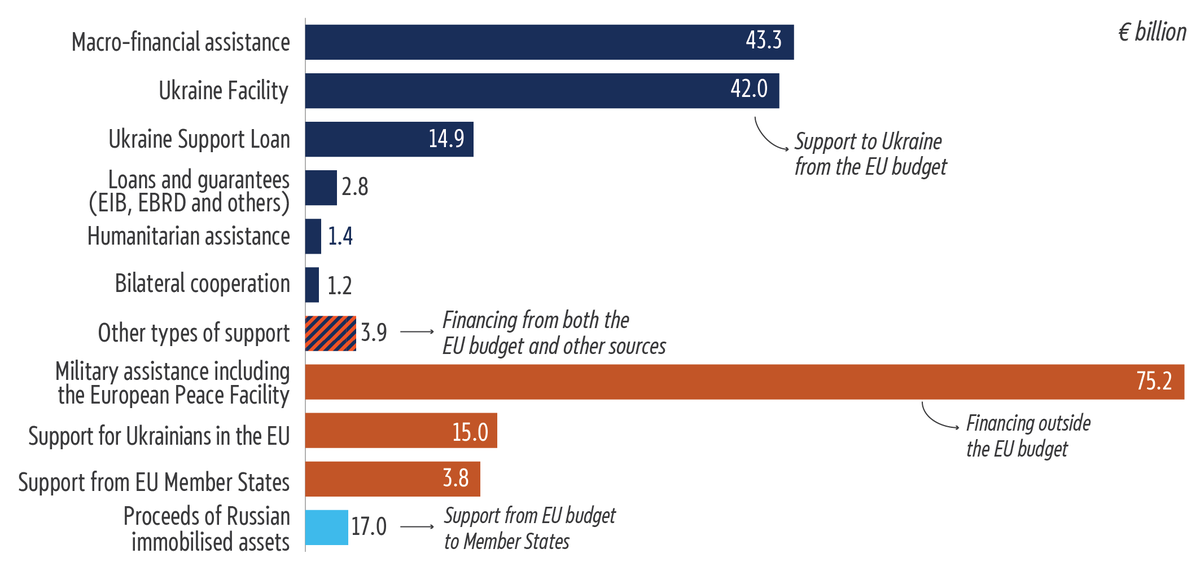
Data source: European Commission, EU Assistance to Ukraine, September 2026; graphic by Nadejda Kresnichka‑Nikolchova, EPRS.
In 2025, Team Europe surpassed the United States (US) as the largest overall donor to Ukraine, taking into consideration allocated financial, humanitarian and military support (Figure 2). Annual aid flows revealed a decisive shift that year: European military support – Team Europe together with non‑EU European countries – surged by 67 % to €28.4 billion, while US military allocations fell sharply to €0.4 billion, and European non‑military aid increased by 59 %, reaching a record €32.4 billion. As a result, European aid to Ukraine was able to nearly balance the full withdrawal of the United States (Figure 3).
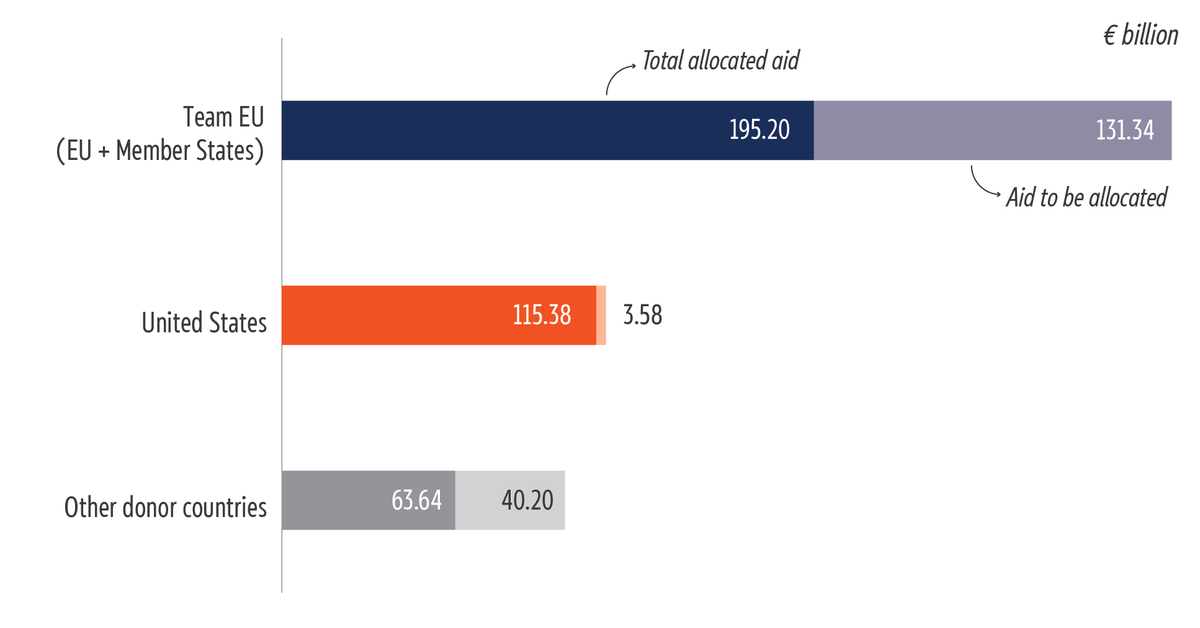
Data source: Trebesch et al., The Ukraine Support Tracker, Kiel Institute, June 2026; graphic by Nadejda Kresnichka‑Nikolchova, EPRS.
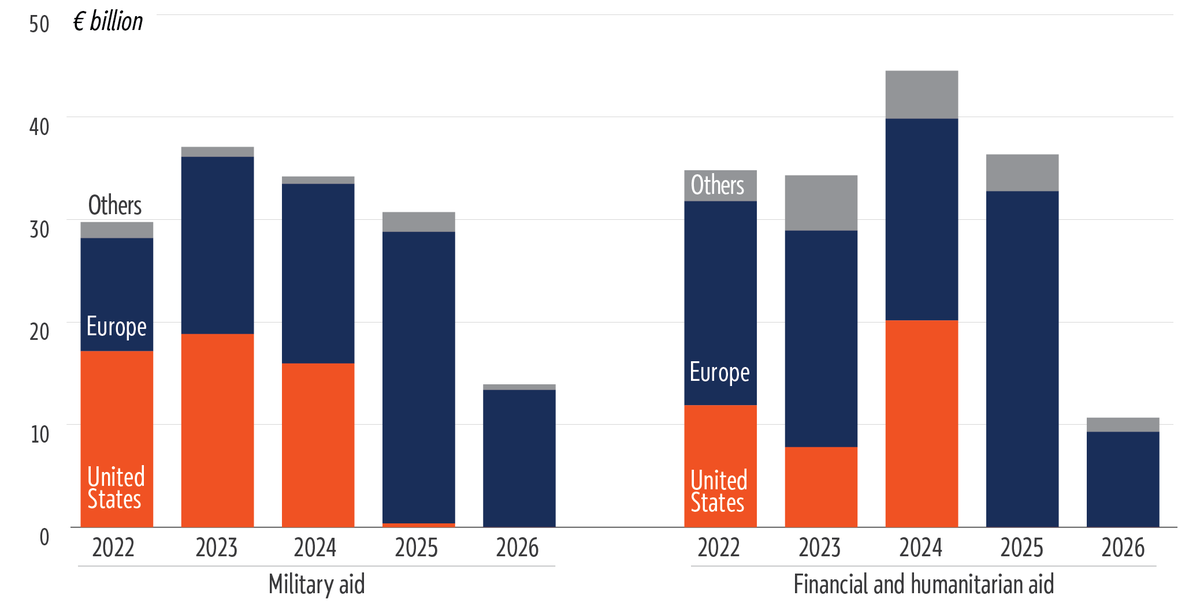
Data source: Trebesch et al., The Ukraine Support Tracker, Kiel Institute, June 2026; graphic by Nadejda Kresnichka‑Nikolchova, EPRS.
Within the EU, Germany remained the largest contributor to Ukraine in terms of bilateral aid and EU budget support, followed by the Netherlands and Denmark. In relative terms, Baltic and Nordic states made the highest contributions as a share of their gross domestic product (GDP). The largest non‑EU donors, in terms of total allocated bilateral aid, were the United Kingdom, Canada (€14.3 billion), Japan (€12.2 billion) and Norway (€11.2 billion) (Figure 4).
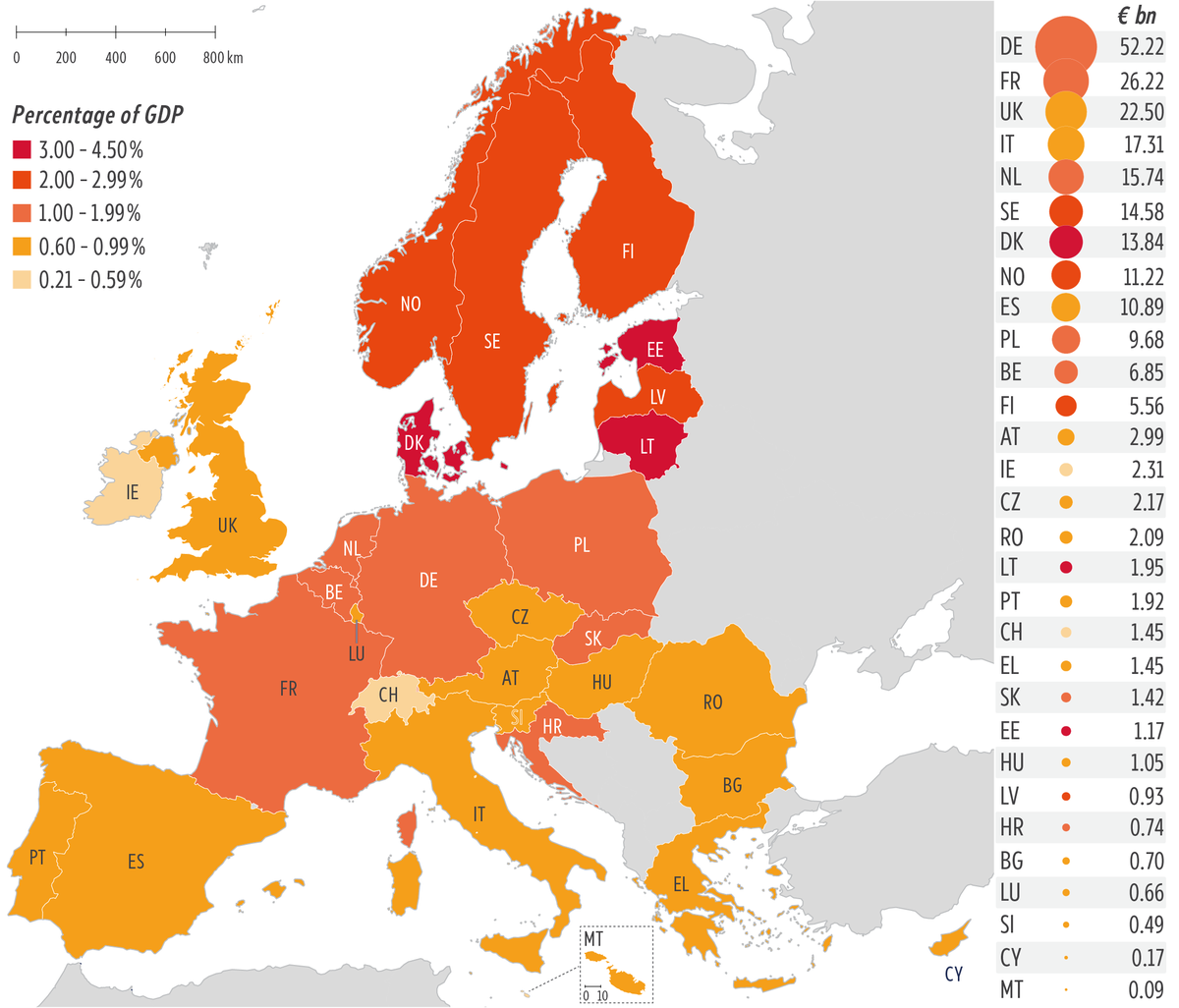
Data source: Trebesch et al., The Ukraine Support Tracker, Kiel Institute, June 2026 and AMECO database; graphic by Nadejda Kresnichka‑Nikolchova, EPRS.
US support to Ukraine mostly came as non‑repayable grants. Grants account for only a relatively small portion of the EU's financial support, owing to the need for unanimous approval under the multiannual financial framework (MFF) for additional grants and limited fiscal space in certain Member States. According to the Kiel Institute data, around 86 % of the EU institutions' financial assistance to Ukraine is provided as loans, including the EU's ERA loan facility, generally on highly favourable terms (Figure 5). Those loans include long grace periods before Ukraine has to start repaying the principal, while the EU covers the interest payments through grants. Repayments and interest payments on loans under the G7 framework are covered by profits generated from immobilised Russian assets and paid through the Ukraine Loan Cooperation Mechanism (ULCM). To support Member States hosting Ukrainian refugees, the EU has made available €17 billion. On this topic, the most recent Kiel Institute estimate, from February 2026, puts spending by EU Member States on Ukrainian refugees at €163.1 billion (Figure 6).
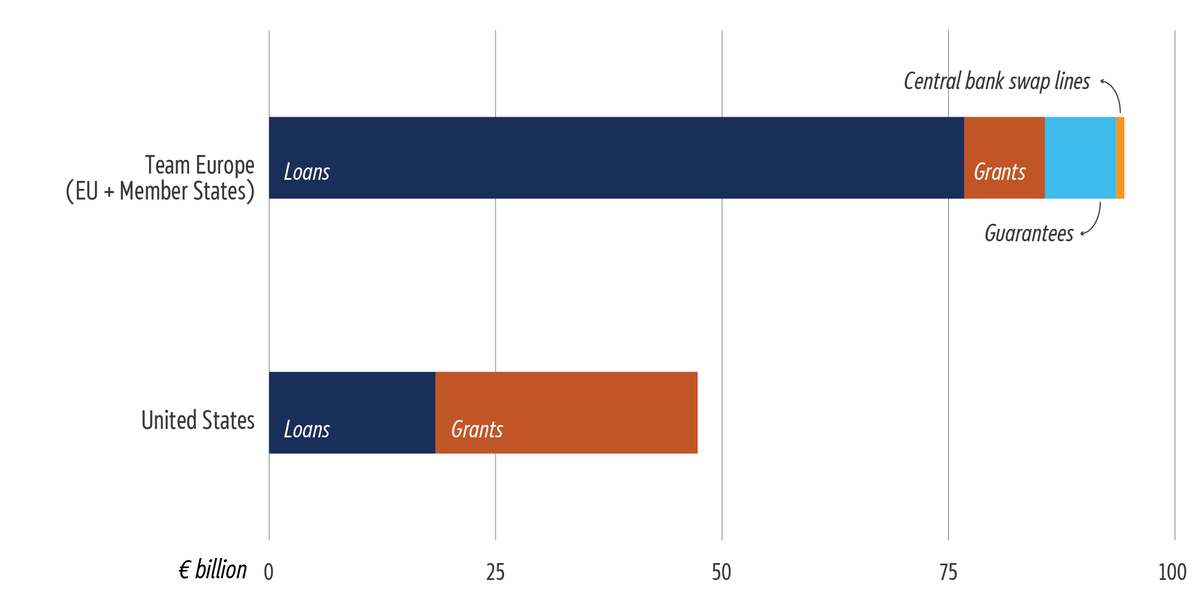
Data source: Trebesch et al., The Ukraine Support Tracker, Kiel Institute, June 2026; graphic by Nadejda Kresnichka‑Nikolchova, EPRS.
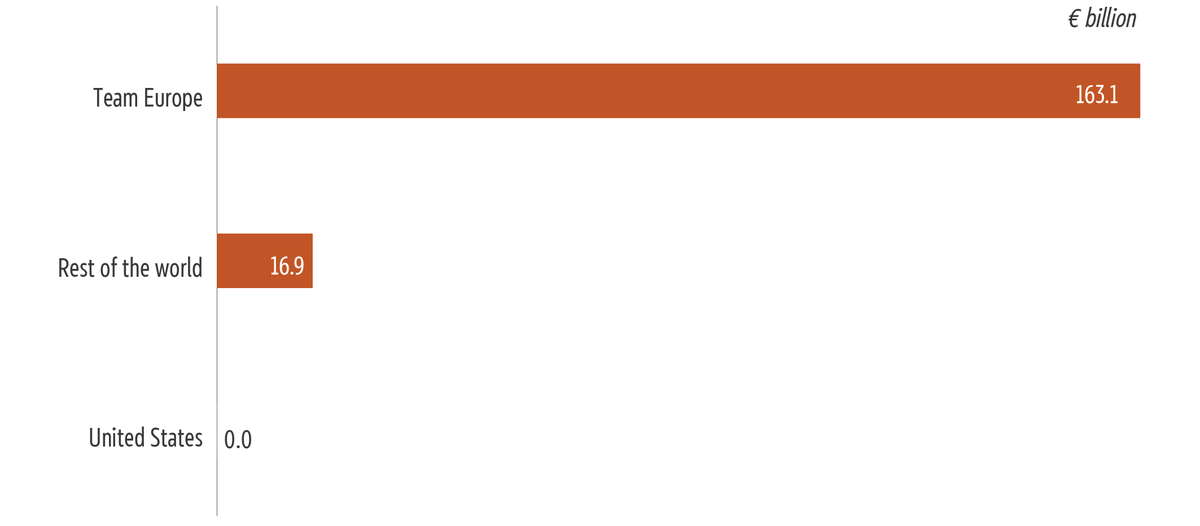
Data source: Trebesch et al., The Ukraine Support Tracker, Kiel Institute, February 2026; graphic by Nadejda Kresnichka‑Nikolchova, EPRS.
Team Europe military support to Ukraine
According to the Kiel Institute, military support allocated to Ukraine by Team Europe overtook military support allocated by the US in 2025 and has continued to widen the gap since. By the end of June 2026, EU Member States and institutions together had allocated €85.7 billion in military support to Ukraine, with a further €87.9 billion pledged but not yet allocated. This brought the total value of EU military pledges to €173.6 billion – a sharp rise from the €111.4 billion pledged as of February 2026, reflecting the roughly €60 billion earmarked for defence under the new Ukraine Support Loan, most of which has yet to be disbursed. Over the same period, the US allocated military support to Ukraine worth €64.6 billion, essentially unchanged from February 2026 (Figure 7).
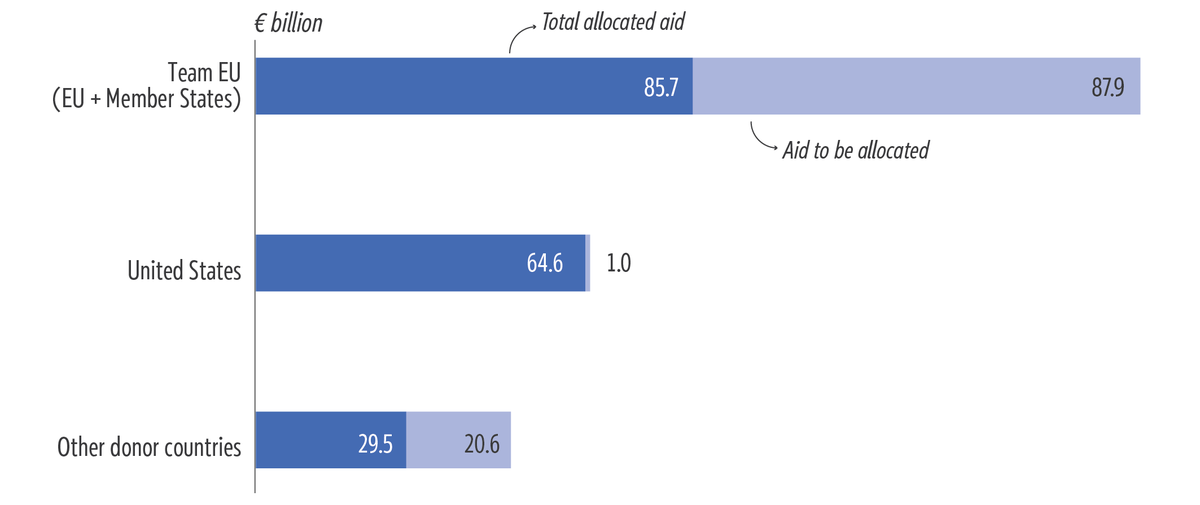
Data source: Trebesch et al., The Ukraine Support Tracker, Kiel Institute, June 2026; graphic by Nadejda Kresnichka‑Nikolchova, EPRS.
Ukraine Support Loan
In December 2025, the European Council agreed to a €90 billion loan to Ukraine to cover the country's financing needs in 2026 and 2027. The loan, financed through EU borrowing on the capital markets and guaranteed by the EU budget's headroom, was designed to cover around two‑thirds of Ukraine's financing needs until the end of 2027, with the remainder expected to come from the IMF and other international donors.
Of the €90 billion loan, an indicative amount of €30 billion is intended for macro‑financial assistance and budget support, and €60 billion for strengthening Ukraine defence capacities. Weapons and military equipment financed by the loan should, in principle, originate from the EU, the European Economic Area or the European Free Trade Association, unless suitable products are not available or cannot be delivered in time. The agreement, made under enhanced cooperation, entails no financial obligations for Czechia, Hungary and Slovakia. The EU budget will cover the interest and other costs of the loan, estimated at around €1 billion for 2027 and around €3 billion per year from 2028.
The legislative package underpinning the loan – a Regulation establishing the Support Loan under enhanced cooperation, a Regulation amending the Ukraine Facility, and an amendment to the EU multiannual financial framework to allow the budget headroom to guarantee the loan – was proposed by the Commission on 14 January 2026 and completed on 23 April 2026, once Hungary's objections to the MFF amendment had been resolved. In July 2026, the EU agreed to let the United Kingdom participate in the loan: following a contribution agreement signed on 13 July, Member States formally approved the UK's participation on 22 July 2026, opening Ukraine defence procurement under the loan to UK‑based manufacturers.
Disbursements began in mid‑2026 (Figure 8). The Commission and Ukraine signed a Memorandum of Understanding on the macro‑financial assistance instalments on 20 May 2026, and the Verkhovna Rada, Ukraine's parliament, ratified the Memorandum and the Loan Agreement on 28 May 2026. The first macro‑financial assistance payment of €3.2 billion followed on 25 June 2026 and was announced at the Ukraine Recovery Conference in Gdansk; a second instalment of around €3.7 billion is expected this autumn, and a third of around €1.45 billion before the end of the year, together making up the €8.35 billion envisaged for macro‑financial assistance in 2026. On the defence side, the Commission disbursed €3.9 billion on 30 June, €1.1 billion on 15 July, €3.47 billion on 30 July and €3.3 billion on 18 September, covering drones, missiles, air defence systems and fighter jets.
By late summer 2026, doubts had emerged over whether the €90 billion loan would cover Ukraine's needs for the whole of 2026 and 2027. According to the Ukrainian authorities, Ukraine faces a financing shortfall of around €23 billion for 2026 alone, covering personnel costs, social spending and advance payments for weapons due for delivery in early 2027. The International Monetary Fund has separately put Ukraine's combined financing needs for 2026‑2029 at around US$140.3 billion under its baseline scenario, above the amount currently committed under the loan. In late August 2026, Sweden, the Netherlands, Spain and Poland wrote jointly to the European Commission asking it to examine further use of the estimated €210 billion in Russian sovereign assets immobilised in the EU to help close this gap – reviving a proposal, often referred to as a reparations loan, that EU leaders had set aside in December 2025 in favour of the Support Loan. EU foreign ministers discussed the question informally on 2 September 2026. Belgium, where most of the immobilised assets are held, restated its opposition, warning of legal and financial risks and calling for any such step to be backed by full risk‑sharing among Member States. The European Commission has said that the current financing plan remains sufficient for the time being, while acknowledging growing uncertainty over whether it will suffice until the end of 2027.
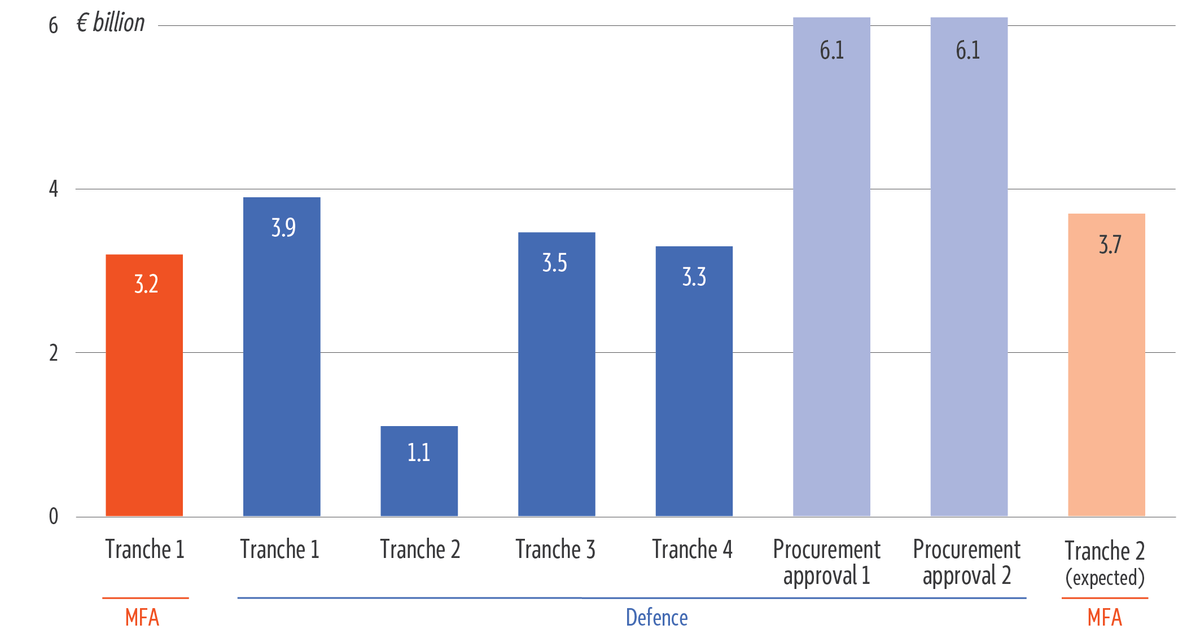
Data source: European Commission (DG Enlargement and Eastern Neighbourhood) and EEAS, press releases on disbursements under the USL, September 2026; graphic by Nadejda Kresnichka‑Nikolchova, EPRS.
Tracking reforms and investments under the Ukraine Facility
The Ukraine Facility, established by Regulation (EU) 2024/792, remains the EU flagship programme supporting Ukraine recovery, reconstruction and EU accession. The Facility originally consisted of three pillars and a financial envelope of up to €50 billion for the 2024‑2027 period; that envelope has since grown, as part of the Facility serves as a delivery channel for the Ukraine Support Loan.
Pillar I provides direct financial support to the Ukrainian government budget. It originally amounted to €38.27 billion, comprising €33 billion in loans and €5.27 billion in grants, with grants financed through the Ukraine Reserve above the EU budget's ceilings and loans backed by the budget headroom guarantee. Since 2026, Pillar I has served as a delivery channel for part of the Ukraine Support Loan: Council Implementing Decision (EU) 2026/919 of 23 April 2026 legally earmarked €8.35 billion for Pillar I as part of the loan's €45 billion 2026 tranche, and the Council formally incorporated this top‑up into the Ukraine Plan's reform‑conditions framework on 30 July 2026, attaching around 30 new steps on rule of law and anti‑corruption. The Ukraine Plan sets out the reforms required for each instalment, and disbursement is monitored through a scoreboard managed by the Commission.
By 8 June 2026, the Council had approved seven regular payments under the Ukraine Facility, together totalling more than €29.5 billion. The most recent, approved on 28 May 2026 under Implementing Decision (EU) 2026/1204, released a partial payment of around €2.8 billion after Ukraine completed 11 of the 20 steps required, plus one outstanding step from the fifth instalment and two from the sixth; the Commission disbursed the funds on 8 June 2026.
Different sources have reported different figures for progress under the Ukraine Plan: at the Commission's 5th Ukraine Facility Dialogue on 4 May 2026, 63 of the then 151 steps were reported as fulfilled, while Ukraine's own Ministry of Economy dashboard put the figure at 86 steps completed as of 28 April 2026. The total itself has since moved: Ukraine's proposed amendments of 12 June 2026, agreed after consulting the Verkhovna Rada, restructured several steps and expanded the Plan to 172 in total, arguing that some steps had become unachievable owing to circumstances beyond its control, and shifted a number of deadlines from the fourth quarter of 2027 to the third so that the final payment request could be submitted and the money disbursed before the Facility's 2027 end date.
On 30 July 2026, the Council formally amended the Ukraine Facility and the Ukraine Plan to reflect the additional €8.3 billion in 2026 financing provided through the Ukraine Support Loan, introducing around 30 new reform steps, including on rule of law and anti‑corruption.
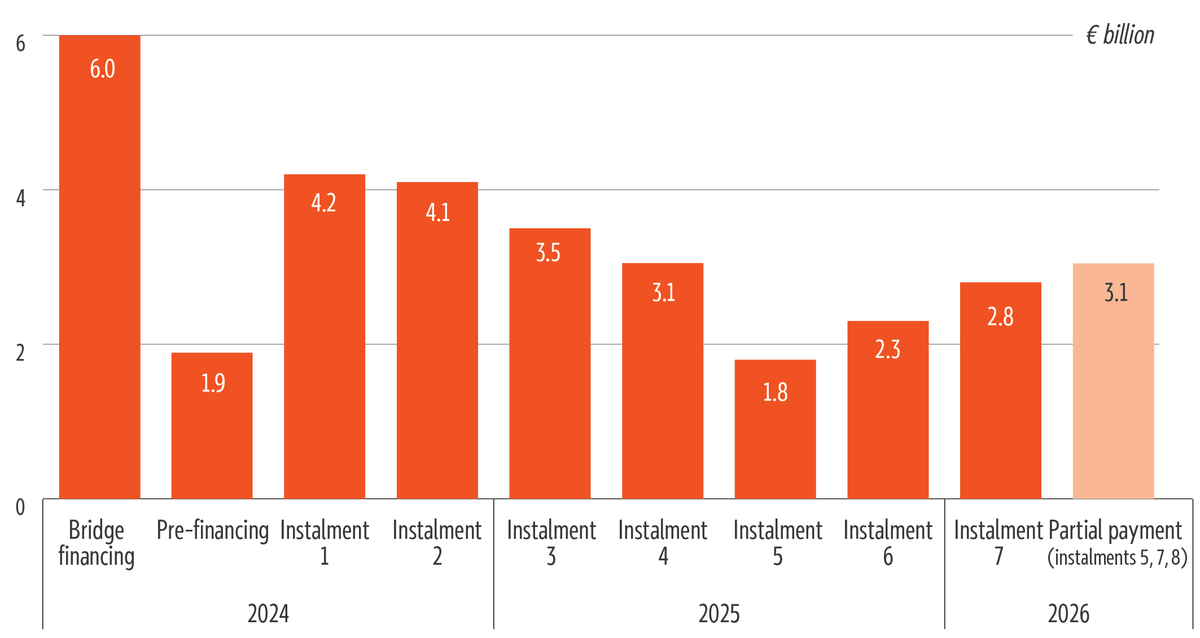
Data source: European Commission, Ukraine Facility, April 2025; graphic by Nadejda Kresnichka‑Nikolchova, EPRS.
Pillar II, the Ukraine Investment Framework, is designed to scale up investment in Ukraine's recovery and reconstruction, and is equipped with €9.5 billion in guarantees and grants, intended to mobilise up to €40 billion in public and private investment. At the Ukraine Recovery Conference in Gdansk on 26 June 2026, the Commission signed further agreements under the framework worth over €1.1 billion, bringing cumulative commitments to around €8.5 billion, expected to mobilise nearly €26 billion in investment. Separately, the Council recorded a cumulative €42 billion mobilised under the Ukraine Facility as a whole – covering all three pillars – as of the same date.
Pillar III provides technical assistance and support measures to facilitate Ukraine's alignment with EU laws and regulations and amounts to €4.76 billion.
Ukraine's external financing needs and debt sustainability
On 26 February 2026, the IMF Executive Board approved a new 48‑month Extended Fund Facility (EFF) arrangement of SDR5.9 billion (about US$8.1 billion, or 295 % of Ukraine's IMF quota), with an immediate disbursement of about US$1.5 billion. Ukraine's EFF‑supported programme aims to anchor macroeconomic and financial stability and advance structural reforms, including on governance, to secure a robust post‑war recovery and support Ukraine's EU accession goal. On 20 July 2026, the IMF Executive Board completed the first programme review and concluded the 2026 Article IV Consultation, enabling a further disbursement of SDR503 million (about US$690 million) and bringing total programme financing to around US$2.2 billion. The Fund assessed Ukraine's performance as broadly satisfactory overall: all end‑March quantitative targets were met, though some structural reforms were delayed and the end‑June target on net international reserves was missed, an outcome the IMF attributed partly to the impact of the war in the Middle East on oil prices.
The first review also revised Ukraine's financing needs upwards. The IMF now estimates the cumulative financing gap under its baseline scenario at US$140.3 billion for 2026‑2029, an increase of US$3.8 billion since the EFF was approved, reflecting changes to the phasing of Ukraine Support Loan disbursements between defence and budget support, fresh financing pledged by Sweden, and revised exchange‑rate assumptions. IMF staff assessed that firm financing commitments were in place for the next 12 months, with good prospects for the remainder of the programme period, though continued donor support remains essential (Figure 10).
Debt continues to be assessed as sustainable on a forward‑looking basis, though this depends on the eventual finalisation of Ukraine's debt restructuring and continued exceptional donor financing. Because the Ukraine Support Loan is treated as a grant for debt‑accounting purposes, Ukraine's public debt trajectory has in fact been revised downwards since the EFF was approved, and is now projected to peak at 111.8 % of GDP in 2026. In April 2026, Ukraine signed a memorandum of understanding with the Group of Creditors of Ukraine, which holds the majority of its official bilateral debt, implementing a new standstill on repayments; a definitive debt treatment is expected once the exceptionally high uncertainty surrounding the war is resolved.
The latest joint damage and needs assessment (RDNA5), published in February 2026 by the World Bank, the Ukrainian government, the EU and the UN, put Ukraine's total recovery and reconstruction needs at US$587.7 billion over a 10‑year horizon – almost three times the country's estimated 2025 GDP.

Data source: IMF Country Report No 26/58, Table 3 (EFF Request, February 2026) and IMF Country Report No. 26/188, Table 1 (First Review and 2026 Article IV Consultation, July 2026) – Note: Converted from US$ using the 2025 average exchange rate (€1 = US$1.08); graphic by Nadejda Kresnichka‑Nikolchova, EPRS.
Support for Ukraine in the 2028‑2034 multiannual financial framework
The Commission proposal for the 2028‑2034 MFF contains budget allocations of €88.9 billion in 2025 prices for supporting Ukraine. The support can be paid as a non‑repayable grant, a guarantee or a loan, provided under Global Europe through a thematic special instrument called the Ukraine Reserve. The annual amount mobilised under the Ukraine Reserve is not to exceed €13.5 billion in 2025 prices, mobilised over and above the normal MFF ceilings through the annual budgetary procedure.
During the first half of 2026, the Council negotiated on the basis of the Commission proposal without settling on final figures. On 11 June 2026, the outgoing Cyprus Presidency tabled a revised negotiating box. The European Council of 18‑19 June 2026 held a policy debate on the negotiating box but did not agree on figures, instead tasking the incoming Irish Presidency with advancing the file towards the European Council meeting in October 2026, with a view to a final agreement by the end of the year. The Irish Presidency duly released a new version of the negotiating box on 10 October.
A study requested by the European Parliament's Committee on Budgets concluded that Ukraine needed around €20 billion annually in external public funding for 10 years of post‑war recovery and reconstruction. Even though international financial institutions such as the IMF and the World Bank, and Western allies such as the United Kingdom, Norway, Canada, Japan and Switzerland, will also contribute to that financing, the main share is expected to fall on Team Europe; against this background, the amount envisaged for Ukraine in the Commission MFF proposal appears modest. The study's authors pointed to the very high level of Ukraine's sovereign indebtedness – 107.1 % of GDP at the end of 2025, according to the IMF July 2026 review, which projected debt to peak at 111.8 % of GDP in 2026 – arguing that EU recovery and reconstruction aid should therefore predominantly take the form of grants rather than loans. The study also recommended broadening aid conditionality beyond anti‑corruption and fiscal consolidation to reward measurable improvements in the business and investment climate, and underlined that large‑scale reconstruction does not make sense while the war continues, meaning EU support should for now remain focused on military and budget assistance.
Use of immobilised Russian assets and the Ukraine Loan Cooperation Mechanism
Following Russia's full‑scale invasion, the EU's third sanctions package included a prohibition on transactions involving the Central Bank of Russia's (CBR) reserves and assets. By February 2024, the total worth of Russian sovereign assets immobilised worldwide had risen to nearly €300 billion; the assets held within the EU, mainly at the Euroclear depository in Belgium, are estimated at around €210 billion (Figure 11).
Regulation (EU) 2024/2773 establishes the Ukraine Loan Cooperation Mechanism, which uses revenues generated from immobilised Russian sovereign assets in G7 jurisdictions to service and repay loans granted to Ukraine by G7 countries; the G7 ERA initiative provided nearly €45 billion in loans to Ukraine on this basis. These windfall profits – the interest and other returns generated by the immobilised assets – are transferred to Ukraine periodically: a fourth transfer of €1.4 billion took place in spring 2026, and a fifth, also of €1.4 billion, on 3 August 2026, covering revenues accumulated in the first half of 2026. Since the assets were immobilised, they have generated a cumulative €8 billion in windfall profits, of which 95 % is channelled to Ukraine via the Ukraine Loan Cooperation Mechanism and 5 % via the European Peace Facility (Figure 12).
On 12 December 2025, the Council adopted a regulation immobilising CBR assets held in the EU, removing the previous requirement to renew sanctions every six months and providing a more stable legal foundation for their use.
Full confiscation of the immobilised Russian Central Bank assets – as opposed to using only the income they generate – remains legally contested and a longstanding political objective of the European Commission and the European Parliament, but continues to face strong opposition in certain Member States, particularly Belgium, where most of the EU‑based assets are held. This debate resurfaced in the second half of 2026: with doubts growing over whether the €90 billion Ukraine Support Loan will cover Ukraine's needs through 2027 (see the Ukraine Support Loan section above), several Member States revived a proposal to use the €210 billion in EU‑based immobilised assets more directly as collateral or a funding source for a further loan to Ukraine, described as a reparations loan. Belgium has continued to argue that such a step would carry significant legal and financial risks, potentially amounting to confiscation, and has called for any further use of the assets to be backed by full risk‑sharing among all Member States rather than falling mainly on the states in which the assets are held.

Source: Each tranche individually sourced to a Commission/EEAS announcement; graphic by Nadejda Kresnichka‑Nikolchova, EPRS.

Anna Caprile and Tim Peters, Confiscation of immobilised Russian sovereign assets: State of play, arguments and scenarios, EPRS, 2025, based on data from the Polish Institute of International Affairs (PISM) and the Swiss Federal Government. For Luxembourg, where estimations vary from 'several billion euros to around €20 billion', the authors opted for a conservative figure (€10 billion).
Classification
Policy areas: Budget | Budgetary Control | Foreign Affairs | International Trade
Regions: European Union, Non-EU Europe and the North
Committees: Foreign Affairs (AFET), Budgets (BUDG), Budgetary Control (CONT), International Trade (INTA)
Disclaimer
This document is prepared for, and addressed to, the Members and staff of the European Parliament as background material to assist them in their parliamentary work. The content of the document is the sole responsibility of its author(s) and any opinions expressed herein should not be taken to represent an official position of the Parliament.
Copyright
© European Union.
The reuse of this document is authorised under a Creative Commons Attribution 4.0 International (CC-BY 4.0) licence.

To use or reproduce elements that are not owned by the European Union, permission may need to be sought directly from the respective rightsholders.