Article page checkbox is not checked in page info.
Outlook for the European Council meeting of 15‑16 October 2026
Outlook for the European Council meeting of 15‑16 October 2026
Authors: Ralf Drachenberg, Annastiina Papunen and Rebecca Zamponi, European Council Oversight Unit
Summary
The October 2026 European Council meeting has a full agenda, topped by a discussion on the next multiannual financial framework (MFF). Other key topics are competitiveness, Ukraine, the Middle East, European defence and security, migration, enlargement and reforms.
On the MFF, EU leaders need to make progress, in particular on agreeing on new own resources, if they want to adhere to their objective of finding an agreement in the European Council by the end of 2026. So far, Member States still diverge strongly on core elements of the MFF, not least the size of the budget. The discussion on competitiveness will notably address the question of simplification. To emphasise the significance of this topic for the European Council, it has been placed as the first point on the agenda – a position that has been reserved for Ukraine since the outbreak of the war. On the latter topic, while reiterating their usual messages of support, EU leaders could raise Ukraine's financial situation, preparations for the winter and forthcoming sanctions. The European Council will also address developments in the Middle East and the EU's readiness to contribute to efforts towards de-escalation. A strategic discussion on migration, which comes after the summer's Ceuta crisis, will include flexibility of procedures at the EU external borders when faced with extreme scenarios. Regarding enlargement and internal reforms, the European Council will have the opportunity to discuss the European Commission's new enlargement strategy. On defence and security, it will take stock of progress in the implementation of previous conclusions and of Europe's defence readiness agenda.
1. General
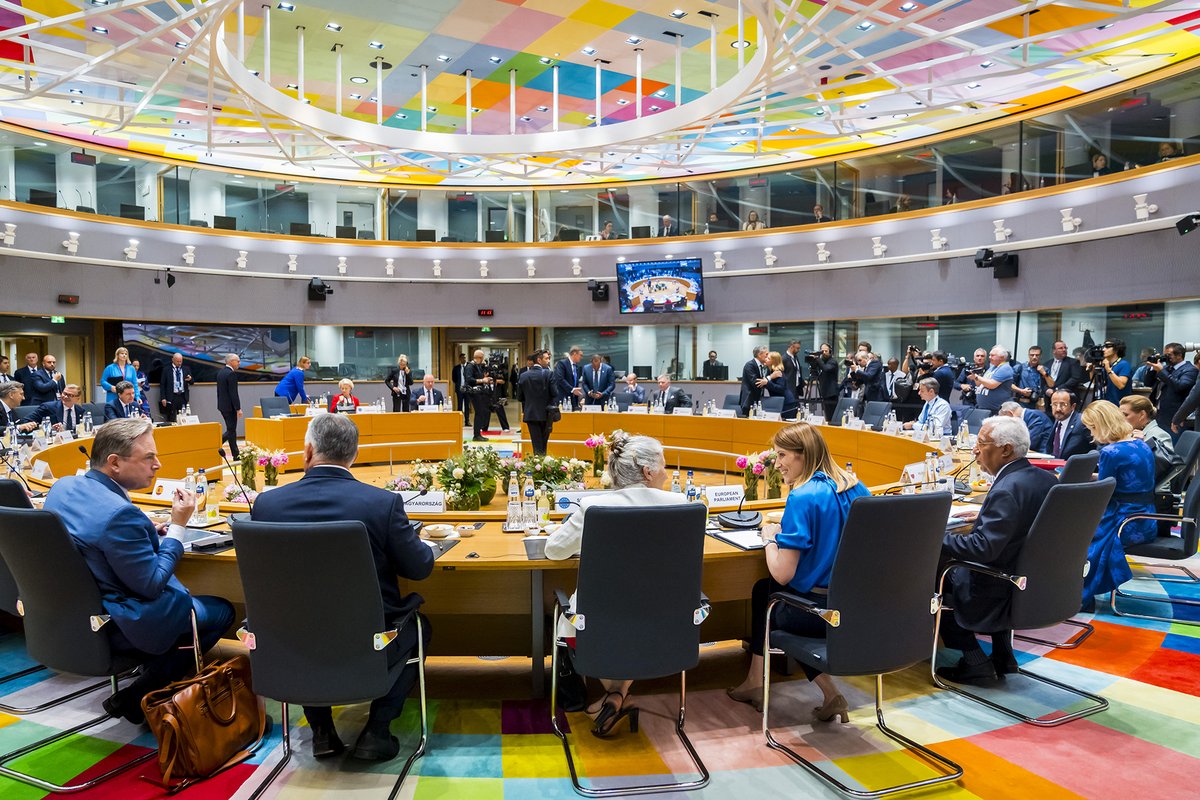
Considering the number of topics on the agenda, multiple pre-meetings are planned ahead of the European Council meeting itself. European political parties will convene for pre-summit meetings with their respective affiliated EU leaders. A group of 'like-minded' Member States on competitiveness will meet, as will the regular group of 'like-minded' countries on migration. In addition, the 'friends of cohesion' (favouring a strong regional and agricultural budget) may meet to discuss the MFF.
The European Council President's first challenge is to focus the leaders' attention on the main topics on the agenda. The President of the European Council, António Costa, made a 'tour des capitales', visiting nearly all EU Member States to discuss the EU agenda with Heads of State or Government, especially the next multiannual financial framework (MFF). Following his preferred working method, Costa has also consulted EU Heads of State or Government ahead of the October meeting through bilateral phone calls.
As usual, the European Council meeting will start with an address by the President of the European Parliament, Roberta Metsola. As was the case in June 2026, the report of the rotating Council presidency on the follow-up to the previous European Council conclusions will be given in the presence of Parliament's President. This report by Irish Taoiseach Micheál Martin will focus on the implementation of the 'One Europe, One Market' roadmap. Many EU leaders are expected to take the floor to discuss the implementation of the legislative programming with Metsola. A Euro Summit meeting, previously envisaged in the European Council's Leaders' Agenda, will not take place.
2. European Council meeting
Competitiveness
EU leaders are expected to take stock of the implementation of the 'One Europe, One Market' roadmap, and urge faster progress. The roadmap, aimed at strengthening the EU's competitiveness by 2027, stems from the February 2026 Alden Biesen retreat and was signed during the April informal meeting in Cyprus. President Costa declared 2026 to be the year of European competitiveness.
EU leaders are likely to continue their discussion on global macroeconomic imbalances – a topic last discussed in June. At the time, they had asked the European Commission to pursue the dialogue with China and to de-risk, but not to decouple. With a trade deficit in goods reaching €1 billion a day in 2025, a level considered unsustainable, EU leaders may seek a sharpening of the trade defence toolbox.
A recent simplification letter signed by 13 Member States (Czechia, Denmark, Germany, Estonia, Italy, Latvia, Lithuania, Hungary, Austria, Poland, Portugal, Slovenia and Slovakia), urging 'reducing unjustified administrative burdens and advancing simplification at EU level as part of a stronger culture of better law-making', may also be discussed. This letter follows a similar effort by 19 Member States (Belgium, Bulgaria, Czechia, German, Estonia, Greece, France, Croatia, Italy, Cyprus, Latvia, Lithuania, Luxembourg, the Netherlands, Austria, Poland, Portugal, Finland and Sweden) last year, which called for 'reviewing, reducing and restraining' EU legislation.
Several cases of hacking of private companies and government services, as well as high-level warnings, triggered a global public debate about safety of artificial intelligence (AI) models and numerous calls for global rules. President Costa intends to put AI on the agenda of the informal meeting in Dublin in November.
Ukraine
The European Council is likely to underline the importance of providing continued military support for Ukraine, and thus welcome the disbursement of €3.3 billion under the €90 billion Support Loan (of which €14.9 billion has been disbursed thus far). This tranche will be used to cover drones and missiles for Ukraine's defence. In this respect, it may also welcome the Commission's decision to release €6.1 billion for Ukraine to procure defence products in the field of air and missile defence, ammunition, drones and electronic warfare. Moreover, EU leaders may touch upon Ukraine's worrying financial gap, amid renewed calls to make use of Russia's frozen assets.
Looking to the winter, EU leaders may call for increased efforts to strengthen Ukraine's critical infrastructure and energy system. Russia has consistently targeted Ukrainian infrastructure, and attempted to weaponise harsh winter conditions. Enhanced energy cooperation and cross-border electricity interconnections are crucial in ensuring energy supplies to Ukraine.
EU leaders may build on calls in a joint declaration signed by the EU and 51 countries (including all EU Member States and all countries seeking EU membership, except Serbia) for Russia to agree to a full, immediate and unconditional ceasefire as an important step towards diplomacy leading to peace – a move Ukraine made in March 2025.
The EU is currently preparing sanctions against hundreds of individuals and entities linked to the Russian military-industrial complex. EU leaders may also welcome the adoption of new sanctions against 10 individuals and 17 entities linked to the unlawful deportation and forcible transfer of Ukrainian children. Regarding existing sanctions, on 22 September, the Council agreed to remove Alisher Usmanov and Mikhail Fridman from the list of people under sanctions, and to extend sanctions against some 3 000 individuals and entities for three years – instead of the six-month extensions up to now.The agreement was reached mere hours before the sanctions list was due to expire, with Latvia, which opposed de-listing the two individuals, constructively abstaining. Latvia, alongside Estonia, imposed sanctions at national level against Usmanov and Fridman. Slovakia had initially called for the de-listing, but it was the call from France – on the grounds of 'national security' – that proved decisive, with further support from Luxembourg.
EU leaders may express concern about increased attacks in the Black Sea, and call for the suspension of strikes, particularly against civilian vessels and critical shipping infrastructure. The Black Sea is a crucial grain export corridor, with Russia and Ukraine supplying approximately one third of the global wheat trade, which often passes through Black Sea ports. In 2022, when Russia blocked Ukraine's Black-Sea grain exports, wheat prices increased by 34 %. Combined with ongoing disruptions to trade routes in the Strait of Hormuz and the Bab-el-Mandeb Strait, an interruption of Black-Sea grain trade could jeopardise global food security. The European Council may signal its support for efforts to secure freedom of navigation in the Black Sea, such as Türkiye's proposal.
The European Council, similarly to the European Parliament, will probably condemn illegal Russian State Duma elections held in temporarily occupied territories of Ukraine, which were conducted without any Organization for Security and Co-operation in Europe (OSCE) observers present.
Next multiannual financial framework
Having discussed the next MFF – the EU's 2028-2035 long-term budget – on several occasions already, the October European Council meeting will open the final phase of negotiations among EU Heads of State or Government, and attempt to find a compromise. While on the size of the MFF, the dividing lines in the European Council are clearly between the net contributors and the net beneficiaries, views are more fragmented on other MFF issues, notably on the choice of new own resources and the balance between policy areas.
The discussion on the next MFF will be shaped by the new version of the negotiating box, a working document the current Irish Council Presidency was tasked to prepare ahead of the October European Council. The previous negotiating box, presented by the Cyprus Council Presidency in June 2026, received substantial criticism from the 'frugal' Member States (Denmark, Germany, the Netherlands, Austria, Finland and Sweden), as it only suggested an overall reduction of around 2 % compared with the original Commission MFF proposal. Conversely, the 'friends of cohesion' group (Bulgaria, Czechia, Estonia, Greece, Spain, Croatia, Italy, Latvia, Lithuania, Hungary, Malta, Poland, Portugal, Romania, Slovenia and Slovakia) argued as recently as 22 September 2026 that the Cyprus-drafted negotiating box 'provides a good basis for the next stage of discussions'.
As mentioned above, between 25 August and 17 September 2026, President Costa visited EU capitals to listen to individual EU leaders' views on the MFF, and then reported to the Irish Presidency. Joint press conferences provided EU leaders with the opportunity to express their positions and red lines. At the end of September, the leaders of the frugal Member States wrote to the Irish Presidency, requesting further cuts amounting to several hundred billion euros. Possible areas expected to be cut are in heading 3 Global Europe, including development aid, neighbourhood policy, and support for candidate countries. There are suggestions that the new negotiating box could also see cuts to heading 1, economic, social, and territorial cohesion, agriculture, rural and maritime prosperity, and security – a move the 'friends of cohesion' are likely to warn against.
President Costa pointed to the 'unanimous support for the objective to come to an agreement by the end of the year. Leaders know that this is necessary, so that we can have a new long-term budget in place by 1 January 2028'. Support for a quick agreement is due in part to forthcoming national elections in key Member States, but also to the changed MFF structure, which will require longer adjustments at national level to operationalise the EU programmes. If an agreement on the next MFF were reached in December 2026, this would be a year earlier than in previous negotiation rounds. However, with negotiations appearing stalled, the target timeline could be in jeopardy.
Crucial to obtaining a positive outcome is an agreement of EU leaders on the choice of new own resources, with the Irish Presidency expected to put forward a 'substantial proposal'. Diversifying the EU's revenue streams is key to avoiding an increase in national contributions or a decrease in European policy ambitions. The Commission had originally proposed five new own resources: (i) a corporate resource for Europe (CORE); (ii) a tobacco excise duty own resource; (iii) a share of the proceeds of the emissions trading system; (iv) the carbon border adjustment mechanism; and (v) a contribution on non-collected e-waste. The European Parliament suggested new own resources in the form of a tax on digital services, online gambling and crypto-assets. President Costa's stated objective for the October European Council meeting is 'to provide clarity on an updated and revised basket of new own resources', as some proposals, in particular the CORE, have been ruled out by national leaders.
Once the revised negotiating box is on the table, the European Council President and his cabinet will formally take over the negotiations. Costa has already called a special European Council meeting on the MFF for 26-27 November with a view to reaching an agreement during the December 2026 European Council meeting.
Middle East
The European Council will address developments in the Middle East and the EU's readiness to contribute to efforts towards de-escalation. EU leaders may also praise efforts from the international community to broker peace. They are likely to reiterate the importance of ensuring freedom of navigation through the Strait of Hormuz and the Bab‑el‑Mandeb Strait, thereby probably also stressing the role of the EU maritime defensive operation EUNAVFOR ASPIDES.
The European Council is likely to reiterate its concerns over the deteriorating humanitarian situation in Gaza and the West Bank. EU leaders may restate their calls for Israel to comply with all its obligations under international law, including international humanitarian law, and for Israel to allow immediate, unimpeded access and sustained distribution of humanitarian assistance at scale into and throughout Gaza. The European Council will recall EU leaders' support for the two-state solution, and reconfirm the EU's support for the Palestinian Authority.
On several occasions, the European Council has condemned the ongoing extremist settler violence and the expansion of illegal settlements in the West Bank, and invited the Council to take work forward on further restrictive measures against extremist settlers. Then, in June, the European Council stressed that 'businesses should not bid for construction contracts for E1 or other settlement developments', and underlined 'the legal and reputational consequences for businesses participating in settlement construction, including the risk of serious breaches of international law'. Since then, Israel has planned to triple the size of the E1 development. EU leaders may condemn the move, as well as any other actions aimed at expanding Israel's presence in the West Bank, which – if further pursued – would render the two-state solution unworkable. While the EU has managed to reach some agreement on sanctions against extremist Israeli settlers, leaders could not to date agree on sanctions on products from those same Israeli settlements. On 8 September, Canada, Denmark, Finland, France, Iceland, Ireland, Norway, Poland, Portugal, Spain, Sweden and the United Kingdom announced sanctions against products originating from Israeli settlements in the West Bank; a few days later, 114 MEPs called on the Commission to present a proposal banning EU trade with Israeli settlements. However, divisions remain strong over the issue, and the required unanimous agreement seems unlikely.
EU leaders may restate the EU's readiness to support the implementation of a peace agreement between Lebanon and Israel. In this regard, the European Council is likely to recall the importance of a continued United Nations (UN) presence in Lebanon in a post-UN Interim Force in Lebanon (UNIFIL) context.
European defence and security
Previous conclusions and the annual defence readiness report, prepared by the European Defence Agency (EDA) in association with the Commission and the High Representative, will form the basis of the security and defence discussion during the European Council meeting in October.
The European Council may condemn the 'dangerous escalation' and hybrid attacks by Russia against EU Member States. EU leaders are likely to reaffirm their commitment to the security of all Member States, and to call on the EU to urgently ramp up its defence readiness. Noting the importance of protecting all EU land, sea and air borders, EU leaders may encourage continued work on the Eastern Flank Watch and other initiatives that protect EU borders.
As set out in Commission President Ursula von der Leyen's State of the Union address, the Commission is planning to use funds from the SAFE instrument to launch a joint EU–Ukraine programme to develop a modular European missile-defence system. EU leaders, who on several occasions expressed support for projects making use of Ukraine's battle and defence-industry experience while developing the EU's own defence industry, may raise the Commission's initiative; this would also reduce reliance on the United States for Patriot air and missile defence systems. Moreover, EU leaders may welcome the agreement reached on further strengthening the EDA as a means to achieving the EU defence readiness 2030 objectives, a request they had made in October 2025 that it 'fully play its role in the field of defence capability development, research and acquisition'.
Migration
Following a request by the Danish Prime Minister, Mette Frederiksen, which was incorporated in the June 2026 conclusions, EU leaders will have a strategic discussion on migration during the October meeting. The events in Ceuta, Spain, on 30-31 July 2026, which saw up to 80 000 people illegally crossing the border from Morocco into the Spanish exclave, and the subsequent critical reactions from many EU Heads of State or Government, make this strategic discussion all the more relevant.
Views on migration policy diverge strongly, with fault lines apparent within the European Council. Some Member States support the regularisation of illegal migrants (i.e. granting legal status to migrants without valid residence permits), while others strongly oppose this. Likewise, the establishment of migrant 'return hubs' outside the EU (i.e. setting up facilities in third countries to host irregular migrants who do not have the right to remain in the EU), is a major source of disagreement, with some strongly promoting these arrangements and others being critical. However, all Member States seem to agree on the need to reinforce the EU's situational awareness and early-warning capabilities.
Whether EU leaders will produce conclusions on the topic remains to be seen. 'Strategic' discussions often signal that the European Council will not give conclusions but instead have an open and frank debate. President von der Leyen announced in her 2026 State of the Union address that the Commission would propose a new European emergency response framework, which would allow for time-limited and strictly defined flexibility in standard procedures at EU external borders when faced with extreme scenarios at the borders, particularly when mass movements are engineered and weaponised. Discussed by Home Affairs Ministers on 2 October, ways of reinforcing migration situational awareness and early-warning capabilities could now be discussed by EU leaders during the European Council meeting.
Enlargement and reforms
As agreed in June 2026, 'in light of the new impetus in the enlargement process', the European Council is set to hold a strategic discussion on enlargement. Since the June meeting, however, Iceland has voted against restarting EU accession talks. This notwithstanding, during a General Affairs Council meeting in September, the European Commissioner for Enlargement, Marta Kos, declared that 'this autumn will be the autumn of enlargement'. Indeed, significant progress has been achieved in 2026, with more negotiating chapters opened and closed so far this year than in the previous 25 years.
In a non-paper published during the summer, Germany and France put forward the idea of structured gradual integration giving candidate countries early benefits from integration while maintaining the existing merit-based accession framework. Belgium, Germany, France, Luxembourg and the Netherlands suggested temporarily limiting some voting rights for future new Member States and creating more rule-of-law safeguards. Reportedly, several central and eastern European countries are reluctant to treat future members differently. The enlargement debate is also closely linked to the reflection on qualified-majority voting, and on ways for the institutions to function despite an increased number of Member States. The Commission is expected to make proposals on the issue on 6 October (previously planned for the end of September). The draft reportedly includes a proposal, according to which only two thirds of EU countries would provide a Commissioner in a given college after EU enlargement; this would require giving up the legal guarantee introduced after the referendum lost in Ireland in 2008, which guarantees every Member State a Commissioner in each college.
Statement on the use of AI
Any AI-generated content in this text has been reviewed by the authors.
Disclaimer
This document is prepared for, and addressed to, the Members and staff of the European Parliament as background material to assist them in their parliamentary work. The content of the document is the sole responsibility of its author(s) and any opinions expressed herein should not be taken to represent an official position of the Parliament.
Copyright
© European Union.
The reuse of this document is authorised under a Creative Commons Attribution 4.0 International (CC-BY 4.0) licence.
https://creativecommons.org/licenses/by/4.0/deed.en
To use or reproduce elements that are not owned by the European Union, permission may need to be sought directly from the respective rightsholders.