
Article page checkbox is not checked in page info.
2026 Israeli legislative election
2026 Israeli legislative election
Armin Wisdorff, Members' Research Service
Summary
Israel is to hold a general election on 27 October 2026 amid ongoing regional conflicts, as well as Prime Minister Benjamin Netanyahu's domestic corruption trial and international arrest warrant. The contest pits Netanyahu's right‑wing, religious coalition against an opposition bloc led by former military chief Gadi Eisenkot. Polls indicate a deadlocked Knesset, with neither side assured of the 61‑seat majority required to govern. Key issues that voters are considering include ending ultra‑Orthodox military draft exemptions, Israel's security doctrine and accountability for the 7 October 2023 failures. Mainstream Jewish opposition parties continue to rule out a coalition with Arab parties, complicating government formation. For the EU, which enforces sanctions against violent West Bank settlers and supports a two‑state solution, the election is critical in shaping future regional stability and diplomacy.
Israeli political system and the Knesset
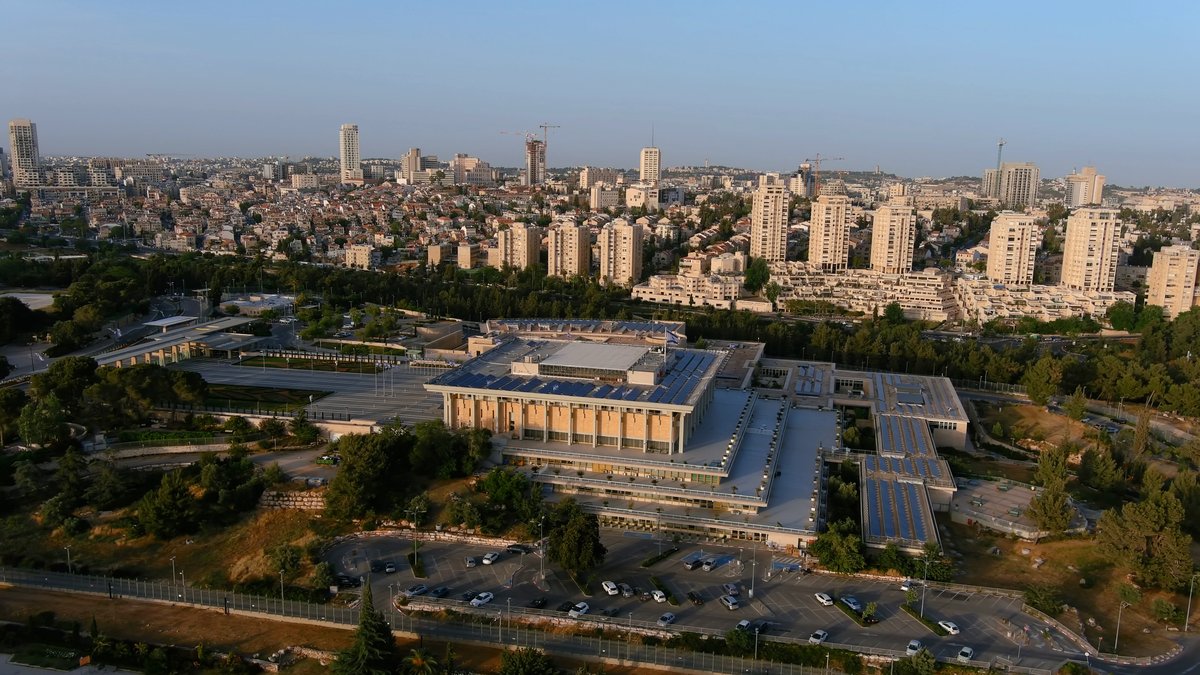
Israel is a parliamentary democracy governed by quasi‑constitutional Basic Laws rather than a codified constitution. Legislative authority resides in the Knesset, a unicameral 120‑seat parliament elected for a four‑year term. The entire country forms a single electoral district with approximately 7.3 million eligible voters. Voters select political parties or closed party lists, rather than individual candidates. Registered lists must pass a 3.25 % electoral threshold to qualify for seats. Seats are distributed proportionally, with surplus seats allocated using the Bader‑Ofer method (equivalent to the D'Hondt method). Parties may also submit surplus‑vote agreements, to minimise wasted votes. This occurs when a party has extra votes, but not enough for a full seat – so they can pool these votes with other parties to make up another seat.
Executive power rests with the government. Following elections, the President – elected by the Knesset for a single seven‑year term – consults the elected factions before tasking one Knesset Member with forming a government coalition, which must be submitted for approval within 45 days of the election.
Key players and electoral dynamics
The 25th Knesset has reached its full statutory term, with the election fixed for 27 October 2026 after parties failed to agree on an earlier dissolution date. Netanyahu leads the conservative Likud party and his right‑wing, religious coalition, the first government in four decades to complete its mandate. His principal rival is former military chief Gadi Eisenkot, leading the newly‑formed centrist Yashar party. Polls suggest a tight race, with neither camp guaranteed a 61‑seat majority. Around 12 party lists are projected to clear the 3.25 % electoral threshold. Several small parties near the threshold could also shape Knesset seat allocations and the post‑election coalition arithmetic.
The opposition camp is fragmented across separate party lists: Eisenkot's Yashar, the Together list (led by Naftali Bennett and Yair Lapid), Avigdor Liberman's secular right‑wing Yisrael Beiteinu, and Yair Golan's left‑wing Democrats. Netanyahu relies on far‑right partners in Otzma Yehudit (led by Itamar Ben‑Gvir) and Religious Zionism (led by Bezalel Smotrich), alongside the ultra‑Orthodox Shas and United Torah Judaism. Arab citizens are represented primarily by the United Arab List (Ra'am) and the Joint List. Mainstream Zionist opposition parties avoid formal partnerships with Arab factions, leaving the anti‑Netanyahu camp structurally constrained and increasing the probability of a political stalemate or repeat elections.
Key election issues
-
Foreign affairs and national security: Simmering hostilities with Iran, Hezbollah, and Hamas in Gaza, coupled with diplomatic strains with Washington, have heightened regional instability. Disagreements concern long‑term strategy and indefinite buffer zones across occupied territories, rather than the underlying military doctrine. A victory for Netanyahu's coalition would be expected to accelerate West Bank settlement expansion, advance de facto annexation, and entrench military control in Gaza. Opposition figures, such as Gadi Eisenkot, criticise settler violence and would seek to improve relations with Washington. However, they broadly share the security doctrine that has emerged following 7 October 2023: rejecting immediate Palestinian statehood, advocating unilateral military freedom of action, and favouring buffer zones in occupied areas. Neither political party platforms, nor public opinion data, treat Palestinian statehood as a prominent issue.
-
Economic situation: Increased defence spending and a high cost of living, including higher energy prices, alongside the 2025 VAT rise to 18 %, remain primary voter concerns.
-
Ultra‑Orthodox conscription: Following a 2024 Supreme Court ruling invalidating blanket military exemptions for seminary students, the Knesset passed a Basic Law in July 2026 framing Torah study as a national value, and froze arrests of draft evaders. Critics say this lays the constitutional groundwork for future exemptions, which has caused public anger amid military shortages.
-
Accountability for 7 October: Opposition parties demand an independent state commission of inquiry with full investigative powers to examine political and military failures surrounding the 2023 attack. Netanyahu's cabinet favours a government‑appointed panel, with narrower powers.
-
Judicial overhaul and corruption trials: Netanyahu's ongoing criminal trial for bribery, fraud, and breach of trust prevents centrist and right‑wing opposition parties from joining a Likud cabinet. Tensions also persist over the coalition's 2023 judicial reform, which seeks to expand executive control over judicial appointments, raising concerns over democratic backsliding.
The EU and Israel
The election is seen by the EU as a potentially critical turning point. It takes place under high external scrutiny; marked by an International Criminal Court arrest warrant for Benjamin Netanyahu for war crimes and crimes against humanity, International Court of Justice genocide proceedings against Israel, and strained relations with its traditional partners in the EU and beyond.
The EU remains committed to a comprehensive two‑state solution based on relevant UN Security Council resolutions. The European Council has called for the demilitarisation of Hamas and Israeli withdrawal from Gaza, while condemning illegal settlement activity in the West Bank and East Jerusalem. The EU has imposed targeted sanctions against extremist settlers and suspended most bilateral funding to Israel, except for support to civil society and Yad Vashem. Further steps, such as suspending the trade provisions of the EU‑Israel Association Agreement or partially suspending Israel's participation in Horizon Europe, require Council approval by qualified majority, but this has yet to be secured. Individually, several Member States have banned trade with Israeli illegal settlements, but an EU‑wide ban remains contentious.
Position of the European Parliament
The European Parliament has reaffirmed support for a two‑state solution, an enforceable permanent ceasefire in Gaza, the full demilitarisation of Hamas, and the resumption of UNRWA funding under strict neutrality safeguards. It has repeatedly condemned settlement expansion and supported sanctions against extremist settlers.
Classification
Policy areas: Foreign Affairs
Regions: Mediterranean and Middle East
Committees: Foreign Affairs (AFET)
Statement on the use of AI
Any AI‑generated content in this text has been reviewed by the author. Gemini Notebook and EP GenAI hub were used to improve the readability of the text and broaden the range of sources available to the author.
Disclaimer
This document is prepared for, and addressed to, the Members and staff of the European Parliament as background material to assist them in their parliamentary work. The content of the document is the sole responsibility of its author(s) and any opinions expressed herein should not be taken to represent an official position of the Parliament.
Copyright
© European Union.
The reuse of this document is authorised under a Creative Commons Attribution 4.0 International (CC-BY 4.0) licence.

To use or reproduce elements that are not owned by the European Union, permission may need to be sought directly from the respective rightsholders.