
Article page checkbox is not checked in page info.
LGBTIQ+ in Africa: Growing discrimination against people with non-conforming sexual orientations and gender identities
LGBTIQ+ in Africa Growing discrimination against people with non-conforming sexual orientations and gender identities
Eric Pichon, Members' Research Service
Summary
Across Africa, lesbian, gay, bisexual, trans, intersex, queer and other sexually and gender-diverse (LGBTIQ+) persons are still far from enjoying the same rights as other citizens. Thirty-three of the 54 African countries criminalise consensual same-sex sexual relations between adults. Several African countries also penalise the public expression of LGBTIQ+ identities or advocacy for LGBTIQ+ rights. Laws targeting LGBTIQ+ persons contribute to violations of the rights to privacy, equality and dignity, and expose individuals to inhuman or degrading treatment and, in some countries, the death penalty. Despite decriminalisation in a few states, the trend of recriminalisation persists, and anti-LGBTIQ+ laws have recently been introduced or toughened in several countries.
Beyond the legal aspect, intolerance of LGBTIQ+ behaviours is widespread in Africa; influences from religious leaders and the narrative that homosexuality is 'un-African' perpetuate this sentiment. Discrimination and violence against LGBTIQ+ persons have dire consequences on their livelihoods and their physical and mental health. Those advocating for LGBTIQ+ rights face significant restrictions and threats, which hinder their ability to operate.
The European Union aims to promote the human rights of LGBTIQ+ persons globally through aid and diplomatic action. However, the effectiveness of these initiatives is often limited by a cautious approach intended to avoid the perception that the EU is seeking to impose values that some political and religious actors characterise as alien to African cultures. Against this background, regional agreements with African partners do not explicitly mention LGBTIQ+ rights, recognition of which a majority of African countries contest in multilateral forums. Nevertheless, the European Parliament has consistently advocated for LGBTIQ+ rights, calling for increased funding, legal protection and the universal decriminalisation of homosexuality.
Glossary
Vocabulary used in this briefing
According to the EU LGBTIQ+ equality strategy 2026-2030, the acronym LGBTIQ+ refers to people:
-
'who are attracted to others of their own gender (Lesbian, Gay) or any gender (Bisexual);
-
whose gender identity and/or expression does not correspond to the sex they were assigned at birth (Trans, non-binary);
-
who are born with sex characteristics that do not fit the typical definition of male or female (Intersex);
-
whose identity does not fit into a binary classification of sexuality and/or gender (Queer);
-
who identify with other sexual orientations or gender identities not specifically captured by the LGBTIQ acronym [and that differ from mainstream assumptions on gender roles] (the +)'.
The definition of other concepts used in this briefing, such as homophobia, transphobia or heteronormativity, can be found in the European Institute for Gender Equality's glossary and thesaurus. While this briefing uses 'LGBTIQ+' throughout the text, one must keep in mind that laws and communities do not discriminate against or protect in a uniform way the various experiences of LGBTIQ+ individuals – consensual same-sex sexual activities between men being the most targeted. In addition, the concepts associated with LGBTIQ+ may be perceived in the African context as culturally inappropriate.
A bleak legal landscape
Criminalisation of same-sex relations
The International LGBTIQ+ Association (ILGA) reports that 33 African states criminalise consensual same-sex sexual acts between adults (see Figure 1). This is over half of the 54 African states recognised by the United Nations, and represents nearly half of the states criminalising such acts globally. Criminalisation sometimes entails breaches to privacy – e.g. through AI systems claiming to detect sexual orientation or the use of fake profiles on dating apps by the police – and inhuman treatment, such as forced anal examination, documented in Egypt (at least until 2019), Cameroon (2020), Tanzania (2020), Tunisia (2021), Uganda (2023), and Zambia (2023). Even where explicit criminalisation does not exist, indirect measures often result in similar effects. For example, legal provisions on 'indecency', 'acts against nature' or 'debauchery' have been used to arrest LGBTIQ+ persons in Benin, the Central African Republic, Côte d'Ivoire, and the Democratic Republic of the Congo.
In recent years, a number of African countries have taken steps to criminalise or aggravate penalties against LGBTIQ+ people.
Gabon introduced penalties for consensual same-sex sexual activity between adults in the Penal Code in July 2019, but reverted to decriminalisation in a law of July 2020. In the wake of the 2023 coup, the new constitution approved by referendum in November 2024 did not reinstate a ban on same-sex relations, but explicitly excluded same-sex couples from marriage. A proposed revision of the Penal Code reportedly aims to recriminalise same‑sex relations with penalties of up to five years in prison and a fine of up to FCFA10 million (€15 245), and to prohibit their 'promotion'.
Uganda's 2023 Anti-Homosexuality Act provides for life imprisonment for consensual same-sex sexual acts and the death penalty for 'aggravated homosexuality,' which targets repeated sexual relations with a person younger than 18, older than 75 or with a disability. The law also criminalises the 'promotion' of homosexuality, with penalties of up to 20 years in prison for individuals and organisations engaging in advocacy or providing support. In 2024, Uganda's Constitutional Court struck down some provisions, such as mandatory reporting requirements and penalties for landlords renting to LGBTIQ+ individuals. However, the core provisions, including those against advocacy, remain.
In February 2024, Ghana's Parliament passed the Human Sexual Rights and Ghanaian Family Values Bill, which would criminalise identifying as LGBTIQ+ and provide for severe penalties for not only consensual same-sex sexual acts between adults but also perceived LGBTIQ+ identity or support for LGBTIQ+ rights. The bill would encourage denunciation, as family members or acquaintances aware of an individual's LGBTIQ+ identity could also face imprisonment for failing to report them. The bill lapsed when Parliament was dissolved in January 2025, but was passed again in May 2026. Ghanaian President John Dramani Mahama has stated that same-sex relationships and gender change are against Ghana's culture and values, and pledged to sign the bill into law.
All three members of the Alliance of the Sahel States (AES), made up of governments brought to power by coups, have criminalised LGBTIQ+ acts and their 'promotion' for the first time in their history: Mali in 2024, Burkina Faso in 2025 and Niger in 2026. This has reportedly resulted in a rapid increase of abuses against individuals considered LGBTIQ+.
Senegal's anti-LGBTIQ+ crackdown
In Senegal, a bill toughening penalties for acts against nature' was proposed by the then Prime Minister Ousmane Sonko in February 2026, with popular support. In fulfilment of a campaign promise by President Bassirou Diomaye Faye, it was quickly approved by the National Assembly by 135 votes to zero on 11 March 2026 and promulgated on 27 March 2026. This law increases prison sentences to between five and 10 years, increases fines and sets mandatory minimum penalties. It also criminalises defending, supporting or financing 'homosexuality, bisexuality, transsexuality, zoophilia, necrophilia or any similar practice', thus exposing activists, NGOs, the media and lawyers to prosecution, with an exemption for public health services.
Influential Islamic NGOs, such as Jamra, had long called for tougher provisions of this kind. A Reuters investigation revealed that And Sàmm Jikko Yi, a network of Senegalese Islamic and civil society organisations, received advice from MassResistance, a US-based Christian organisation, to build support for the adoption of the law.
The United Nations High Commissioner for Human Rights has denounced the legislation for violating the right to privacy, freedom of expression and other fundamental human rights. UNAIDS noted the public health exemption but warned that LGBTIQ+ persons could nevertheless avoid health services for fear of being reported to the authorities. FIDH, the international federation for human rights, accused Senegal of 'violat[ing] its international commitments' to the International Covenant on Civil and Political Rights and the African Charter on Human and Peoples' Rights.

Image source: Graphic by Samy Chahri, EPRS, 2026. Repression or protection can differ according to the various categories of LGBTIQ+ individuals: for a more detailed view, see the ILGA database. Data sources: Legal index: Equaldex, accessed 20 July 2026 – The Equaldex legal index combines 16 policy areas weighted differently to give each country a score from 0 (LGBTIQ+-related activities are illegal and repressed in most areas) to 100 (legal and protected in most areas). It is based on a collaborative, community-verified database; Death penalty: ILGA, accessed 20 July 2026 –The death penalty might apply to some same-sex sexual acts, including consensual, according to national law (Mauritania, Uganda) or under customary or religious rules (in some regions of Nigeria and Somalia).
African positions at international and regional level
The African Group at the UN: Challenging the notion of LGBTIQ+ rights
The Universal Declaration of Human Right, adopted in 1948, and other human rights instruments do not explicitly address sexual orientation and gender identity,1 but the UN bodies have repeatedly confirmed that discrimination on these grounds is contrary to the declaration. The UN Human Rights Council (HRC) was the first UN body to adopt resolutions explicitly addressing sexual orientation, gender identity and sex characteristics.
The first HRC resolution on human rights, sexual orientation and gender identity, in 2011, led to a High Commissioner report on violence and discrimination against individuals based on their sexual orientation and gender identity, and to a panel discussion on ending such discrimination and violence, in March 2012. Reportedly, almost all African delegates refused to participate in the discussion, and the summary of the panel discussion highlights that 'some delegations' raised objections using the following arguments:
-
'sexual orientation' and 'gender identity' are not explicitly defined or mentioned in international human rights instruments, so that no state should be compelled to recognise them as prohibited grounds for discrimination;
-
homosexuality conflicts with the teachings of various religions and cultural traditions;
-
focusing on sexual orientation and gender identity might divert attention from discrimination based on race, gender or religion, or on migrant status;
-
creating special rights risks fragilising the universality of human rights.
In 2016, none of the African member states of the HRC voted in favour of the resolution establishing the mandate for the independent expert on protection against violence and discrimination based on sexual orientation and gender identity (IE SOGI). Later on, on the occasion of the vote to adopt the HRC report at the 71st UN General Assembly (UNGA 71, 2016), the UN African Group tried to delay the establishment of the IE SOGI. However, an analysis of the votes and declarations in UNGA committees and in plenary shows that some African states (such as Seychelles, South Africa, and Cabo Verde) dissented from the African Group position. The mandate is renewed every three years: in 2019, among the then African members of the HRC, only Rwanda, South Africa and Tunisia voted for the extension; in 2022, all African members voted against, except Benin, which abstained; in 2025, only Kenya and South Africa voted in favour, Benin and Ghana abstained, the other nine African members voted against the extension of the IE SOGI mandate.
The African Commission on Human and Peoples' Rights: Progress and pushback
The African Charter on Human and Peoples' Rights (the 'Banjul Charter') – ratified by all African Union (AU) members except Morocco – does not explicitly mention sexual orientation or gender identity. The African Commission on Human and Peoples' Rights (ACHPR), which is tasked with interpreting the charter, had nevertheless confirmed that equality of treatment should be irrespective of sexual orientation: in 2014, it adopted resolution 275 urging states to 'enact and effectively apply' laws against violence 'targeting persons on the basis of their imputed or real sexual orientation or gender identities'. In 2017, in a comment on Article 5 of the Banjul Charter, the ACHPR clearly mentioned 'corrective rape' and forced anal testing among the acts of 'torture and other cruel, inhuman or degrading punishment or treatment'. The ACHPR has thus become a forum on LGBTIQ+ rights in Africa, despite the fact they are not mentioned in the Banjul Charter.
However, the ACHPR's statements are not binding on African states, and its independence is fragile. The ACHPR is not protected against political pressure from AU members. A case in point is the withdrawal by the ACHPR of the observer status it had granted in 2015 to the Coalition of African Lesbians (CAL): in August 2018, after having resisted for three years, the ACHPR eventually complied with the request of the AU Executive Council 'to withdraw the observer status granted to NGOs who may attempt to impose values contrary to the African values'. Furthermore, in November 2022, the ACHPR decided on its own not to grant observer status to three NGOS 'on the grounds that sexual orientation is not an expressly recognised right or freedom under the African Charter, and contrary to the virtues of African values, as envisaged by the African Charter'.
Unfavourable social environment
Homophobia and violence against LGBTIQ+ persons
Surveys show that homophobic feelings prevail across Africa, with few exceptions. A 2024 Afrobarometer poll across 39 African countries found that respondents' acceptance of homosexuality was strikingly low, while at the same time at least eight in 10 Africans expressed high levels of tolerance for people of different ethnicities, religions, political affiliations or nationalities. Nearly three quarters of respondents (74 %) would 'dislike having homosexuals as neighbours'. There were significant differences between countries: intolerance of homosexuals was a minority opinion in only six countries: Cabo Verde (18 %), South Africa (23 %), Seychelles (30 %), Mauritius (34 %), Mozambique (44 %), and Namibia (49 %) (see Figure 2).
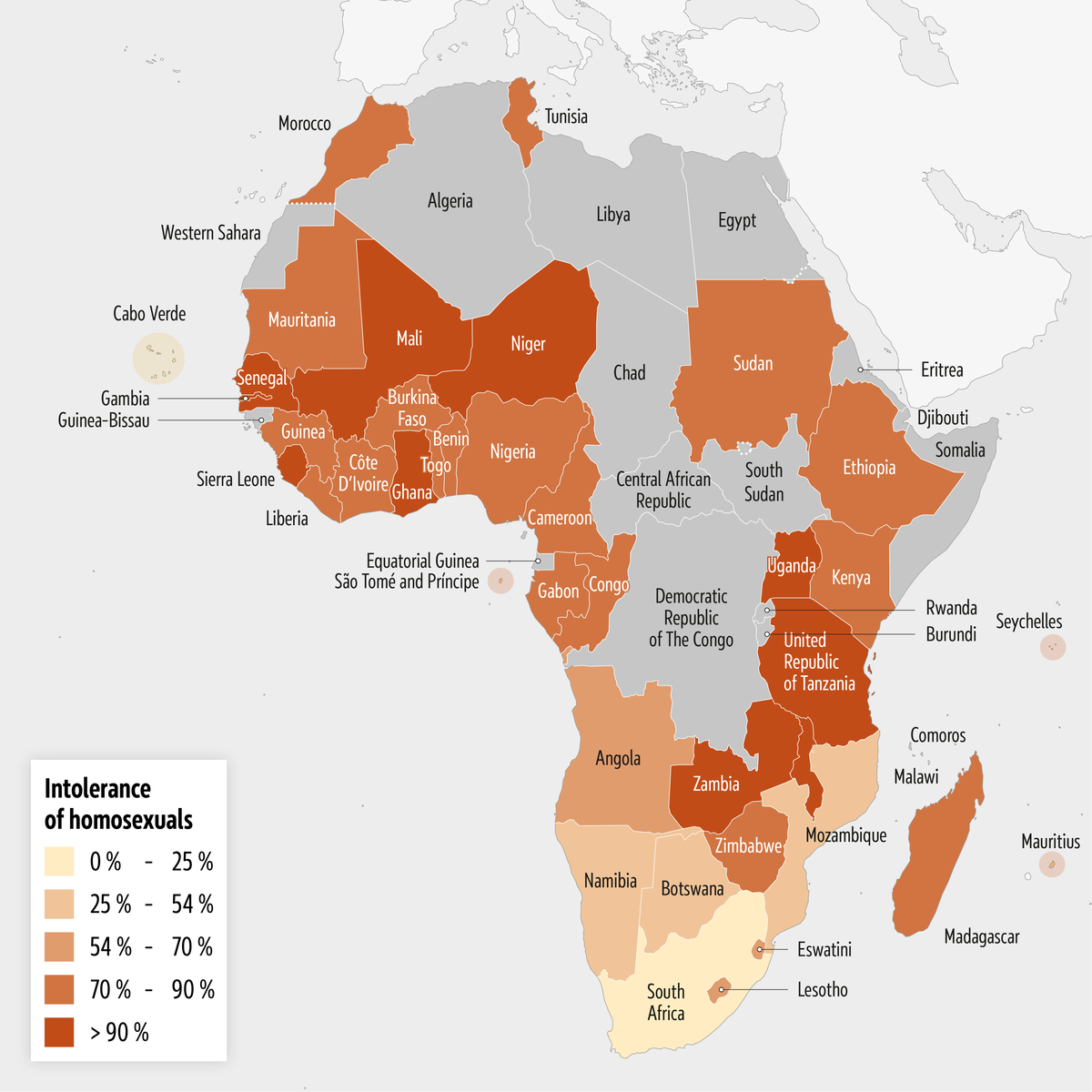
Image source: Graphic by Samy Chahri, EPRS, 2026.
When homophobic and transphobic feelings are encouraged or not punished by the authorities, violence and harassment towards LGBTIQ+ people is exacerbated (such as, among others, in Uganda and in Senegal). This pushes many of them to live in hiding, increasing their mental or physical health problems, or forces them to flee to other countries, where they do not always find a safe haven. Even in the most protective countries (see below box on South Africa), homophobia and transphobia can turn into denial of healthcare, exclusion from school or work, lynching, rapes and killings, as documented by the IE SOGI. Practices of 'conversion (to heteronormative behaviours) therapy' are 'very common' in Africa, according to surveys cited in another IE SOGI report. They include unethical techniques, not based on science, ranging from psychotherapy to 'corrective rape'. In sub-Saharan Africa, they are reportedly practiced within a Christian context, sometimes combined with traditional practices.
Religious and cultural arguments
Despite the formal separation of church and state in most African countries, religious leaders play a significant influence in shaping anti-LGBTIQ+ policy and legislation, due to their prominent role in education, healthcare, humanitarian assistance and social services, particularly where state capacity is limited. In several countries and across Africa, political leaders and religious institutions have allied around opposition to LGBTIQ+ rights, using the concept of 'family values' to bridge their different theological interpretations. One significant example of this trend is the campaign for an African charter on family sovereignty and values, promoted by an interfaith coalition through successive inter-parliamentary conferences. During the fourth one in Ghana (June 2026), lawmakers of 18 of the 20 participating countries approved the draft charter. Defining family as exclusively based on a heterosexual couple, and opposing not only LGBTIQ+ rights, but also abortion, comprehensive sex education, and 'gender ideology', it contradicts several regional and international agreements.
This campaign was convened by the Africa Bar Association and Family Watch International, a US-based conservative Christian association. This is not the only anti-LBGTIQ+ rights campaign funded or supported by US Christian right-wing campaigners: according to a report by Open Democracy, more than 20 US Christian groups spent at least US$54 million in Africa between 2007 and 2020 to influence public opinion and policies against access to abortion and contraceptives, sex education and LGBTIQ+ rights. The influence of the US Evangelicals is manifest in some of the most repressive states, such as Uganda.
More recently, the Russian Orthodox Church has expanded its presence in Africa, often at the expense of established African-based Orthodox jurisdictions such as the Patriarchate of Alexandria. Several observers see this phenomenon as part of Russia's endeavour to increase its footprint in Africa. The Russian Church, supportive of 'traditional moral values', has reportedly gained followers in Malawi, Togo, Tanzania, and Zambia, and makes itself known through the provision of humanitarian aid in other countries.
However, some dissenting religious leaders express more tolerant views: examples include the Christian Inclusive and Affirming Ministries and House of Rainbow networks. The murder of the South African imam Muhsin Hendricks, an activist for LGBTIQ+ rights within Islam, on 15 February 2025, reignited debates both on the attitude of Islam towards LGBTIQ+ and on the effectiveness of the protective laws in South Africa.
Research shows that homosexuality and non-binary gender identities existed in some pre-colonial African societies. While attitudes varied across communities – some repressive, others accepting – European colonial rule codified widespread legal prohibitions. In particular, the British Empire imposed anti-sodomy laws across its colonies, many of which still shape national legal systems today. Despite historical evidence, some African leaders keep claiming that LGBTIQ+ identities and behaviours were introduced by European colonisers and that calling for legal protection would constitute foreign interference. This narrative, often part of a broader decolonial discourse targeting former European powers, is sometimes instrumentalised by other foreign actors aiming to expand their influence in Africa.
The struggle for LGBTIQ+ rights
Difficult advocacy
Research suggests that legal changes combined with advocacy can change societal attitudes positively. However, amidst widespread homo- and transphobia, LGBTIQ+ advocacy is more demanding and less rewarding than other fights for social justice.
Most African countries that criminalise same-sex relations, as well as some that do not explicitly criminalise them, such as Côte d'Ivoire, the Democratic Republic of the Congo and Djibouti, impose restrictions on LGBTIQ+ persons' freedom of expression or freedom of association. Several LGBTIQ+ and human rights organisations have reported significant restrictions in most African countries, such as the refusal to register them, surveillance, intimidation, and arbitrary arrests of their leaders or members. The denial of legal recognition impedes LGBTIQ+ groups from organising peaceful protests, while in contrast thousands have rallied for stricter anti-LGBTIQ+ laws, notably in Senegal and Kenya. Even in countries where LGBTIQ+organisations may have a legal existence, governments also restrict media representation, banning films and publications with LGBTIQ+ content.
As they cannot benefit from public support or subsidies, LGBTIQ+ activists often operate as part of larger non-governmental organisations (NGOs), many of which rely on donors from Europe and other Western countries. This reliance can reinforce the perception that the fight for LGBTIQ+ rights is an imported agenda. At the same time, cuts in foreign aid funding, notably from the United States under the second Trump administration, further limit LGBTIQ+ activists' scope for action and endanger LGBTIQ+ lives in Africa.
Against this backdrop, some activists and scholars are seeking alternative ways to promote LGBTIQ+ rights within Africa's own cultural and historical contexts, exploring new 'paths for the African queers', drawing on traditional gender roles and local advocacy approaches, which are less vulnerable to accusations of foreign influence.
Slow progress towards legal protection
Few African countries (see Figure 1 above) explicitly offer LGBTIQ+ persons legal protection against discrimination. South Africa (see box on South Africa), Mauritius (since 2007) and Angola (since 2021) are among the few countries that criminalise discrimination based on sexual orientation (but not explicitly gender identity) in the provision of goods and services, healthcare, education and employment. They also prohibit incitement to violence against LGBTIQ+ people. Some other African countries explicitly prohibit discrimination in some sectors only, such as Cabo Verde (employment and housing), Botswana, Equatorial Guinea, Liberia, Mozambique, Sao Tome, and Seychelles (employment) . Hate crime on the grounds of sexual orientation is prohibited in Chad. No African country has legislation on 'conversion therapies' and only Kenya prohibits surgical interventions on intersex minors 'without advice of a medical geneticist'.
Only South Africa gives the right to adopt or to marry to same-sex couples. Namibia's Supreme Court ruled in May 2023 that same-sex marriages concluded in other countries must be legally acknowledged in Namibia. However, the Marriage Act of December 2024 overturned this decision and denies the recognition of same-sex marital unions 'wherever concluded'.
South Africa: The regional exception
South Africa is a regional pioneer in the advancement of LGBTIQ+ rights on the African continent. The prohibition of discrimination on the grounds of sexual orientation was already included the Bill of Rights drafted by the ANC before it came into power, and reportedly stems from the ANC Women section's insistence to tackle the issues of sexism and gender-based oppression. In 1996, South Africa was the first country in the world to explicitly ban discrimination on the basis of sexual orientation in its Constitution. Sexual minorities' rights were further protected in a series of laws, especially the Promotion of Equality and Prevention of Unfair Discrimination Act (2000). This law notably prohibited discrimination based on sexual orientation in various sectors, including workplaces, healthcare and education. It also appointed Equality Courts to address cases of discrimination.
In May 2024, after several years of debate, President Cyril Ramaphosa signed the Prevention and Combating of Hate Crimes and Hate Speech Act into law. This 'Hate Speech Act' provides for criminal penalties for discrimination offences and mechanisms for reporting and investigating hate crimes, including against LGBTIQ+ persons. Same-sex couples have been able to adopt and raise children jointly since 2002. Furthermore, same-sex marriage was legalised in 2006, granting same-sex couples the same legal rights as heterosexual ones. In 2020, legislation repealed a provision allowing state marriage officers to cite their own religious or moral convictions to refuse to perform a marriage ritual for same-sex couples. Despite its strong protective legal system, South Africa has not played a significant role in advocating for change at continental level.
A comparison between surveys conducted in 2016 and in 2025-2026 shows that South African society has become more accepting of sexual and gender minorities. While 52 % of respondents still think that same-sex sexual activity is 'always wrong' (down from 66 % in 2016), greater proportions agree that lesbian women and gay men (60 %), bisexual and transgender people (57 %) 'deserve the same rights as all other people'. Around half of respondents 'believe that lesbian (51 %), gay (50 %), bisexual (47 %), or transgender (49 %) people should be included in their culture and traditions'. However, a 2023 report highlights that not all LGBTIQ+ people enjoy others' tolerance. In rural areas in particular, LGBTIQ+ individuals experience bullying and harassment at school or in the workplace, and face difficulties in accessing the healthcare they need. LGBTIQ+ workers are disproportionately represented in informal jobs, and nearly half of black LGBTIQ+ people know someone who has been murdered due to their sexual orientation or gender identity.
EU action and the European Parliament's position
EU guidelines and practice
In 2013, the EU adopted guidelines to promote and protect the enjoyment of all human rights by lesbian, gay, bisexual, transgender and intersex persons. These guidelines as well as the 2023 European External Action Service (EEAS) diversity and inclusion agenda call on EU delegations and Member States' embassies to proactively promote LGBTIQ+ rights in partner countries.They focus on priority areas such as pledging against discriminatory laws and practices, combating anti-LGBTIQ+ violence and supporting LGBTIQ+ human rights defenders. The second EU LGBTIQ+ equality strategy (2026-2030), while mostly concerning actions within the EU, commits to promote the human rights of LGBTIQ+ people at the global level, and to combat discrimination against them, notably through the leverage of trade preferences schemes.
However, in Africa, the EU position that LGBTIQ+ rights are universal human rights is tempered by efforts to avoid reinforcing perceptions that tolerance for LGBTIQ+ behaviours reflects externally imposed 'Western values.' Consequently, the EU has concentrated its advocacy for LGBTIQ+ rights in individual African countries, through political dialogue and support for local civil society and human rights defenders. At the regional level, the EU takes a more cautious approach and does not insist2 on mentioning LGBTIQ+ rights in joint communiqués.
While the joint declaration following the fifth AU-EU Summit (2017) mentioned commitments to 'sexual and reproductive health' and 'reproductive rights' (but not to 'sexual rights'), those issued after the sixth (2022) and seventh (2025) AU-EU summits make no reference to these commitments. None of the 2017, 2022 and 2025 AU-EU declarations, or the 2024 communiqué from the 19th AU-EU Human Rights Dialogue, explicitly mentions specific LGBTIQ+ rights. Similarly, the EU agreement with the Organisation of African, Caribbean and Pacific States (OACPS) avoids mentioning sexual orientation or gender identity (see box on the EU-OACPS agreement).
As regards free trade agreements with African countries, only the economic partnership agreement (EPA) with a group of Southern African Development Community (SADC) countries and the EPA with Kenya commit to international standards on labour. However, these standards do not explicitly protect LGBTIQ+ workers, although the International Labour Organization recommends that the 1958 Convention against discrimination in respect of employment and occupation be interpreted in that sense. Besides, only the EU-Kenya EPA contains a proper dispute resolution mechanism.
Controversy about the EU-OACPS Agreement
The signing of the new agreement between the EU and the Organisation of African, Caribbean and Pacific States (OACPS) – referred to as the 'Samoa Agreement' – has sparked controversy in some African (and Caribbean) states, due to allegations that it would compel the signatories to enforce LGBTIQ+ rights. Reflecting these concerns, Nigeria delayed its signature to carry out a thorough review. Eventually, it signed the agreement in June 2024, on the grounds that it does not contravene Nigerian laws on LGBTIQ+ or on any other matters. Nigeria accompanied its signature with an interpretative declaration/reservation, stating in particular that 'it is Nigeria's understanding that no part of [article 36 on gender equality] or any other article shall be construed or interpreted as permitting other unnatural acts or practices at variance with the Nigerian constitution'.
As a matter of fact, contrary to claims by several organised groups, including the Nigeria Bar Association and the Catholic Bishops Conference of Nigeria, the Samoa Agreement does not mention LGBTIQ+ rights either explicitly or in a deceptive way. Instead, it focuses on gender equality and sexual and reproductive health and rights (SRHR) in terms that do not go beyond existing international conventions. Moreover, the final wording of the agreement did not come as a surprise to its signatories, as it was the result of years of negotiation, resulting in a text that significantly watered down the EU's initial objectives on LGBTIQ+ and SRHR matters.
Analysts contend that the EU's 'selective' non-discrimination approach – for example, when it does not address LGBTIQ+ rights within frameworks involving the AU, its Regional Economic Communities or the OACPS due to differing positions – risks feeding the notion that LGBTIQ+ rights are contingent on cultural acceptance, rather than universal rights. Furthermore, the EU's international advocacy for these rights is made difficult by some of its Member States' stances against LGBTIQ+ 'propaganda'.
As regards the fate of LGBTIQ+ Africans on EU soil, the New Pact on Asylum and Migration requests particular attention for 'vulnerable' asylum applicants. The EU LGBTIQ+ equality strategy 2026-2030 makes it clear that this qualification encompasses LGBTIQ+ persons from African countries where they are criminalised or persecuted. Recently, some EU Member States endeavoured to consider better the risks LGBTIQ+asylum-seekers might face if sent back to countries otherwise considered 'safe', but where their rights are not protected. The Netherlands, which has plans to create 'return hubs' in Uganda despite the latter's poor LGBTIQ+-rights record (see 'Criminalisation' above), asserted that rejected LGBTIQ+ asylum-seekers would not be deported to these 'hubs'.
European Parliament resolutions
The European Parliament has repeatedly stressed the importance of LGBTIQ+ rights on the African continent. It has denounced the increase in discriminatory laws and violent behaviour against persons based on sexual orientation and gender identity in resolutions on individual countries, such as Egypt, Nigeria, Tanzania, The Gambia, and Uganda. In these resolutions, it condemned the rise in violence and discrimination and the adoption of repressive laws, called on authorities to guarantee LGBTIQ+ people's freedom of expression and urges the EU to increase its support to LGBTIQ+ rights defenders and to withdraw existing trade preferences.
In its resolution of 25 March 2021 on a new EU-Africa Strategy, Parliament expressed concern 'about the persistent violence and discrimination against LGBTI people, notably concerning access to healthcare, and call[ed] for the two continents to step up their efforts to protect their rights'. In February 2015, it also called for the new EU-OACPS Agreement to explicitly mention non-discrimination on the grounds of sexual orientation and gender identity , and for sanctions for failure to respect such a clause. These demands were not reflected in the final agreement (see box on the EU-OACPS Agreement above).
In a resolution of 8 February 2024, Parliament called for EU external policies to be LGBTIQ+-sensitive, drawing from civil society organisations' and academic knowledge, and requested the appointment of a Special Representative for LGBTIQ+ Equality. It urged the EU to prioritise and increase funding for projects dedicated to LGBTIQ+ human rights and protection of their defenders. This resolution also called for the EU to afford asylum rights to LGBTIQ+ persons, including those from third countries classified as 'safe countries.'
Parliament called for the universal decriminalisation of homosexuality and transgender identity and the universal abolishment of the death penalty, in a resolution of 20 April 2023.
Main references
- ILGA world database , The International Lesbian, Gay, Bisexual, Trans and Intersex Association.
- Sarpong Owusu Francisca and Malephane Libuseng , Social cohesion: An African collage of imperfect tolerance and cautious trust , Afrobarometer Dispatch No 871, 2 October 2024.
Endnotes
Classification
Policy areas: Development and Humanitarian Aid | Human Rights
Regions: Mediterranean and Middle East, Sub-Saharan Africa
Statement on the use of AI
Any AI-generated content in this text has been reviewed by the author. Perplexity, Consensus and Gemini Notebook were used to broaden and explore the range of sources available to the author.
Disclaimer
This document is prepared for, and addressed to, the Members and staff of the European Parliament as background material to assist them in their parliamentary work. The content of the document is the sole responsibility of its author(s) and any opinions expressed herein should not be taken to represent an official position of the Parliament.
Copyright
© European Union.
The reuse of this document is authorised under a Creative Commons Attribution 4.0 International (CC-BY 4.0) licence.

https://creativecommons.org/licenses/by/4.0/deed.en
To use or reproduce elements that are not owned by the European Union, permission may need to be sought directly from the respective rightsholders.