
Article page checkbox is not checked in page info.
Fostering electrification and digitalisation
Fostering electrification and digitalisation The role of network charges and electricity taxation in the energy transition
Saša Butorac, Members' Research Service

Context
In July 2026, the Commission published its proposal on future-proofing electricity bills, covering network tariffs and electricity taxation, against the backdrop of a renewed energy crisis triggered by the latest Middle East conflict, which started in February 2026. This briefing outlines the main elements of the proposal and explains how regulation shapes electricity bills and why getting it right is essential to ensuring energy affordability in the long run.
The design of network charges and the level of electricity taxes can structurally reduce system costs and drive electrification of the European Union (EU) economy. The briefing also addresses the Commission's proposed measures to accelerate the roll-out of smart meters, which are essential for fostering demand flexibility in the electricity system.
It examines the challenges of developing smart electricity grids and ensuring smooth energy data exchange, both of which are essential for unlocking flexibility services and the potential of AI tools. Parliament's and the Council's previous positions on the subject are outlined, along with the views of key stakeholders.
Legislative proposal
2026/0203(COD) – Proposal for a Regulation of the European Parliament and of the Council amending Regulation (EU) 2019/943, as regards future-proofing electricity bills in the Union, through reducing system costs and fostering electrification and digitalisation – COM(2026) 600, 17.7.2026.
Issue
Network charges (or tariffs) and energy taxation are key to addressing rising energy bills in the European Union in a structured and future-proof manner. EU consumers' energy bills remain elevated compared with those of consumers in other major economies such as the United States (US) or China. In 2025, they averaged more than twice those in the US and were nearly 50 % higher than those in China, significantly affecting the competitiveness of EU industry and the prosperity of EU households.
The EU's dependence on imported fossil fuels is a key driver of elevated energy prices and risks to security of supply. The import bill for fossil fuels was nearly €336 billion in 2025; it has risen by €500 million per day since the closure of the Strait of Hormuz (through which 35 % of seaborne crude oil used to flow) in February 2026. Against this backdrop, the Commission proposal seeks to accelerate electrification of the EU economy through measures targeting network charges and energy taxation. This would, in turn, reduce the EU's dependence on volatile global fossil fuel markets.
The commodity price of energy – that is, the raw cost of generating electricity or procuring fossil fuels – is determined by supply and demand and cannot be regulated in a way that simultaneously maintains clear price signals and market mechanisms. By contrast, the regulatory cost drivers of electricity bills, namely network charges and taxation, can be designed to optimise the use of existing energy infrastructure, thus reducing costs and driving electrification based on clean, affordable and EU-produced energy.
The proposal focuses primarily on network charges: the fees households and industrial consumers pay to maintain, operate, and upgrade the physical infrastructure that delivers electricity. Tariffs in the EU are substantial: they represent between 24 % and 29 % of household electricity bills and around 12 % of the bills of energy-intensive industries.
In the context of the ongoing decarbonisation of the EU energy system, annual investment needs in the EU electricity grids are substantial: around €1.3 trillion over the 2024-2040 period (€730 billion for distribution grids and €472 billion for the transmission infrastructure). These investments are ultimately reflected in the bills of EU customers through network charges.
Designing these charges in a way that optimises the use of existing infrastructure, promotes the use of non-wire solutions and fully unlocks system flexibility can substantially reduce costs and thus keep electricity affordable. The Commission insists that, to achieve these objectives, it is necessary to ensure consistent implementation of smart tariff design principles in all Member States, hence the legally binding measures set out in the proposal.
The proposal also addresses the growing problem of grid connection queues (delays in connecting new users to the grid), which are a major obstacle to accelerating the roll-out of renewables and driving electrification forward. At least 16 Member States faced grid connection queues as of mid-2025. The smart design of network charges can significantly reduce these queues and address the problem of speculative connection requests.
Besides network charges, taxes are the other regulatory component that determines final electricity bills. Taxes and levies on electricity in the EU accounted for around 29 % of the overall household electricity retail price in the second half of 2025. They can serve as a powerful lever to reduce electricity prices and accelerate the decarbonisation of electricity generation in the EU.
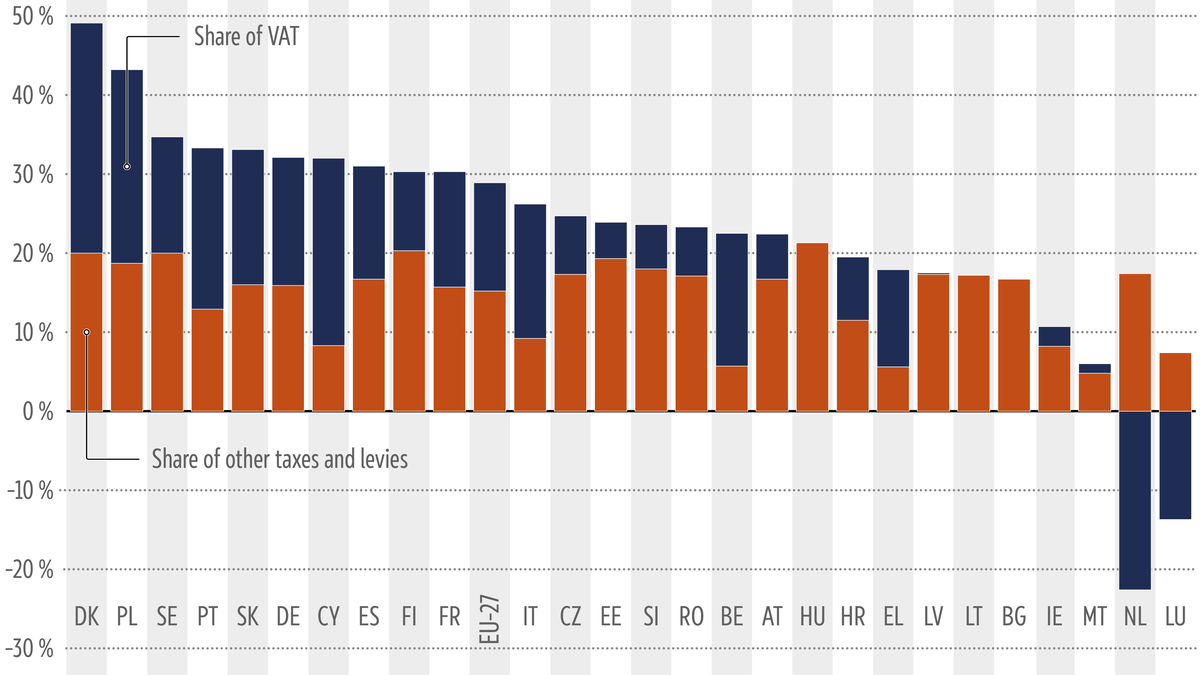
Data source: Eurostat, graphic by Samy Chahri, EPRS, 2026.
With this goal in mind, the Commission proposed a recast of the Energy Taxation Directive in July 2021, but negotiations in the Council have stalled, given the sensitivity of the issue and the unanimity required to adopt the recast directive. The proposal on future-proofing electricity bills would introduce a general energy taxation principle to ensure that electricity is not taxed at a higher rate than natural gas. Some Member States tax electricity higher than natural gas.
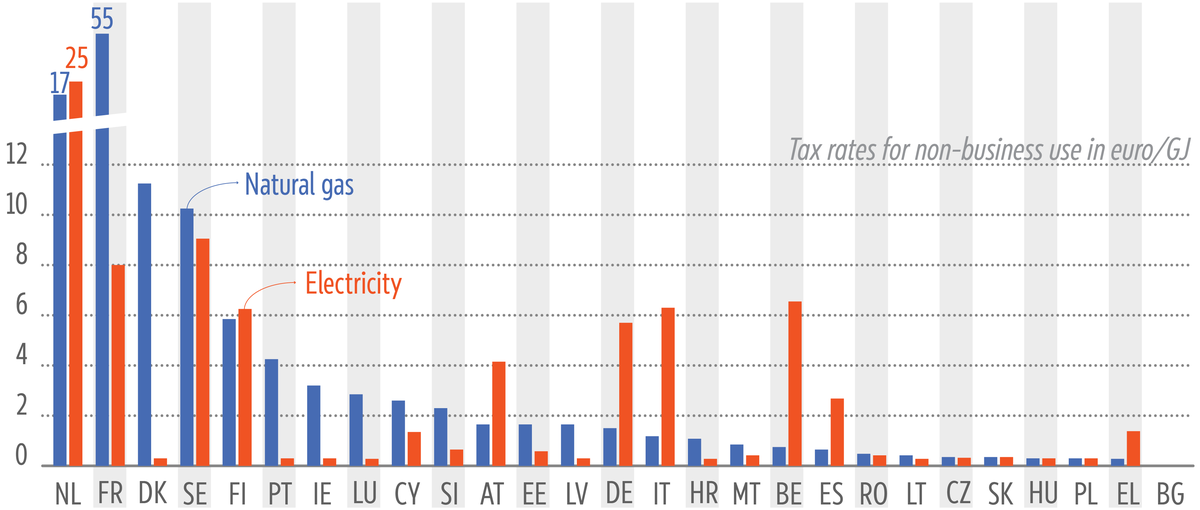
Data source: European Commission, graphic by Giulio Sabbati, EPRS, 2026.
Concerning smart meters, the current framework has led to uneven deployment of these tools across the EU. This has limited the development of demand-side flexibility, which is crucial for the effective functioning of the modern decentralised electricity system, in which variable renewable sources of energy play an increasingly important role. The Commission proposal to introduce a legally binding target of smart metering systems covering at least 75 % of final customers in Member States by the end of 2033, should be seen in this context.
EU policymakers have worked intensively to curb the rise in energy prices and its impact on the EU economy since 2021, when inflationary pressures stemming from supply chain disruptions following the COVID-19 pandemic began to emerge. Russia's invasion of Ukraine prompted the landmark REPowerEU initiative, published in May 2022, with the aim of accelerating the EU's energy transition based on clean energy sources.
The Commission proposal builds on a number of recent Commission initiatives. It codifies in EU law provisions of non-legislative initiatives such as the Guidance on efficient and timely grid connections (part of the European grids package published in December 2025). The proposal is directly linked to the affordable energy action plan, published in February 2025, and the Commission's AccelerateEU initiative of April 2026. It responds directly to the March 2026 European Council call on the Commission to present targeted measures to lower all components of electricity prices and was published alongside the electrification action plan in July 2026.
The Commission proposal does not entail a fundamental revision of taxation principles or the design of network charges. Instead, it builds on the current framework by strengthening certain provisions on tariffs to ensure consistent and effective implementation by the national authorities. The proposal also pursues the same goal as the recast of the Energy Taxation Directive.
Main points of the proposal
The Commission proposal would amend Regulation (EU) 2019/943 on the internal market for electricity (the Electricity Regulation), a pillar of EU electricity market design along with Directive (EU) 2019/944 on common rules for the internal market for electricity (the Electricity Directive), without undertaking a full revision of the regulation. The proposal maintains the existing framework on network tariffs enshrined in the Electricity Regulation and is in line with the Energy Taxation Directive. The main new regulatory solutions in the proposal are outlined below:
-
network charges (Article 18): The proposal would restructure parts of Article 18 of the Electricity Regulation. The requirement that tariffs should provide appropriate incentives to system operators would become a guiding principle for tariff design; this would apply not only to distribution system operators (DSOs) but also to transmission system operators (TSOs), across all voltage levels.
Furthermore, the proposal introduces an additional design principle under which tariff methodologies should provide appropriate incentives for system users to reduce peak load consumption (lowering the amount of electricity used during the busiest times of the day) by adding a capacity element to the tariff structure.
In the same vein, the proposal stipulates that national regulatory authorities (NRAs) should design tariff methodologies that include time-of-use elements, which can further incentivise system users to produce or consume electricity in ways that reduce system peaks and make full use of renewable energy when it is abundant (the current Electricity Regulation does not make this mandatory for NRAs).
The proposal would also increase the transparency of tariff design structuring by introducing the following requirements: (i) publication of the costs to be recovered by TSOs and DSOs through network charges; (ii) publication of details underlying tariff methodologies; and (iii) public consultation by NRAs of relevant stakeholders before fixing or approving tariff methodologies. Furthermore, the EU Agency for the Cooperation of Energy Regulators (ACER) and NRAs would be required to carry out efficiency comparisons of TSOs and DSOs respectively, to assess how cost-effectively each operator manages, plans, and operates its grid.
According to the proposal, the Commission would be empowered to adopt delegated acts establishing guidelines on: (i) a common structure and harmonised methodology for transmission and distribution tariffs; (ii) conditions under which NRAs could introduce separate network charge regimes for specific categories of system users, such as energy-intensive industries, data centres and energy communities; and (iii) harmonised rules on the public consultations carried out when drafting tariff methodologies. The proposal also clarifies that Member States could financially support the development of their electricity networks to accelerate decarbonisation, electrification and market integration in line with EU fiscal rules.
-
smart grid indicators and innovation (Article 18a): Based on findings that the use of innovative and digital solutions in operating and planning electricity grids is insufficient, the Commission proposal introduces a framework for smart electricity grid indicators to enhance the uptake of non-wire, smart and digital solutions. ACER would be tasked with issuing a recommendation on a limited set of indicators. In addition, the proposal would require system operators to establish a voluntary, secure electricity grid data exchange framework to support the development and deployment of state-of-the-art technologies for grid optimisation. Specifically, the proposal would require TSOs and DSOs to manage and exchange grid data with each other, which is essential for fully enabling flexibility services and developing AI tools geared towards optimisation of the energy system.
-
smart meters (Article 18b): The proposal would introduce a minimum level of smart-meter deployment in Member States. National authorities would have to ensure coverage of at least 50 % of final customers by the end of 2030 and 75 % by the end of 2033. Member States with deployment levels below 30 % when the regulation enters into force would have until the end of 2031 and 2034, respectively, to meet these targets.Cost-benefit assessments under the Electricity Directive would apply only to deployment beyond the 75 % threshold, thus accelerating deployment in Member States that have not yet reached this level.
-
electricity taxation (Article 18c): The proposal seeks to ensure that taxation does not discourage electrification (for instance, wider uptake of heat pumps or electric vehicles). It would establish a legal obligation for the minimum level of taxation for electricity to keep the excise duty rate for electricity at or below that for natural gas and facilitate reduced electricity taxation, potentially down to zero, for energy-intensive businesses. Member States would retain responsibility for setting their national electricity tax levels within this framework.
-
grid congestion (Article 18d): The proposal would clarify the powers of NRAs when grid capacity is scarce, in line with the Guidance on efficient and timely grid connections published in December 2025. NRAs could discourage speculative connection requests by taking into account the maturity and progress of projects applying for grid connection and, where necessary, prioritise categories of users. These could include the public sector, social services, energy communities, households, SMEs, data centres, energy-intensive industries or market participants in the transport sector. The criteria would have to be objective, transparent and non-discriminatory and could take account of economic, social, environmental and network impacts.
These measures would complement flexible connection agreements, cross-sectoral network planning and the use of smart, digital and non-wire solutions.
Analysis
The Commission put forward this proposal partly in response to Member States' failure to reach a compromise on the recast of the Energy Taxation Directive (ETD). Whereas the recast required unanimity in the Council, the current proposal (a regulation) does not, as it is subject to the ordinary legislative procedure. The Commission underlines that the 'targeted taxation measures ... are purely ancillary to the main energy system objective ensuring the functioning of the energy market'. Nevertheless, some Member States may question this choice on grounds of national sovereignty and the unanimity requirement applicable to taxation measures.
The proposed new tax regime for electricity is likely to have significant positive effects: it could help lower energy costs, improve the competitiveness of EU industry, accelerate electrification and stimulate investment in clean technologies. Only the eight Member States that still tax electricity more heavily than natural gas would be affected by the new taxation principles set out in the proposal.
On the other hand, a Union-wide requirement to roll out smart meters could strain limited resources in Member States with deployment rates below the 30 % threshold. Implementation could also prove difficult due to the fragmentation of the DSO landscape, as DSOs are ultimately responsible for smart meter deployment. Establishing a governance and technical framework for seamless data exchange between system operators could present an integration challenge encompassing technical, cybersecurity and interoperability issues. The proposal would also entail additional administrative costs for NRAs, TSOs and DSOs, although the expected reductions in system costs should substantially outweigh these costs.
Parliament's prior position
The European Parliament has consistently shaped the political and legal landscape for energy affordability in general and network tariff design in particular. Parliament adopted a resolution on electricity grids in June 2025. In it, Parliament called for action to unlock demand-side flexibility by accelerating the deployment of smart meters and ensuring efficient price signals to allow consumers to optimise their consumption and reduce their electricity bills. Parliament asked the Commission to identify a set of best practices for equitable network tariff composition and called on national authorities to promote flexible network tariffs that allow consumers to react to price signals while shielding vulnerable households and businesses from price peaks.
In its July 2025 resolution on the security of energy supply, Parliament linked a comprehensive approach to energy security with the affordability and sustainability of energy supply chains.
In its June 2025 resolution on the Clean Industrial Deal, Parliament underlined the importance of aligning the taxation of energy products with the EU's energy and climate objectives, effectively calling for lower of national taxes on electricity relative to those on fossil fuels. It also called for a harmonised approach to the design of tariff methodologies.
In April 2025, Parliament adopted a resolution on European energy-intensive industries (EIIs), in which it called on the Commission to develop recommendations for reducing EIIs' exposure to rising energy costs, including by reducing taxes and levies and harmonising network charges.
Prior positions of other EU institutions
Council
The Council adopted its conclusions on sustainable electricity grids in May 2024. It emphasised the importance of optimising the use of existing grids before building new infrastructure and formally supported the development of innovative tariff designs, such as time-of-use tariffs, to incentivise consumers to shift their demand away from peak hours.
Regarding energy taxation, which also encompasses electricity taxation, the Council has been unable to reach unanimity on the Commission proposal to recast the Energy Taxation Directive. The Commission presented the proposal in July 2021 to align national energy taxation with the climate and energy objectives of the European Green Deal.
The March 2026 European Council called on the Commission to present measures across all components of electricity prices to lower them and address excessive volatility in the short term, including for energy-intensive sectors, taking into account the different situations across Member States.
European Court of Auditors
In its 2022 Energy taxation, carbon pricing and energy subsidies report, the European Court of Auditors (ECA) noted that even after accounting for the effect of taxes on emission-trading allowances, the 'the price of energy products... did not reflect the environmental cost of emissions'. The ECA underlined that low energy taxes on fossil fuels increase the relative cost of low-carbon technologies and hinder the energy transition, which is further delayed by national subsidies for fossil fuels.
Preparation of the proposal
Given the need for urgent action following the US-Israeli military strikes on Iran and the subsequent closure of the Strait of Hormuz in February 2026, the Commission was exempted from carrying out an impact assessment and stakeholder consultations before publishing this proposal. In line with the better regulation guidelines, an accompanying staff working document (SWD) explained the proposal's rationale and assessed how the proposed measures could increase the cost-effectiveness of grid operation and foster electrification. It also presented the available evidence supporting those measures.
Points of view
In the absence of a dedicated stakeholder consultation, the Commission prepared the proposal drawing on the findings of recent public consultations on the European grids package and the strategic roadmap for digitalisation and AI in the energy sector. In the European grids package consultation, 76 % of respondents agreed that further measures were needed to increase grid efficiency.
The European Network of Transmission System Operators for Electricity (ENTSO-E) welcomes the proposal. More specifically, it supports the proposed measures on well-designed network charges, fair remuneration frameworks for grid operators, accelerated smart meter deployment and fair taxation of electricity, while stressing the need to strike the right balance between affordability for consumers and financeability for system operators. ENTSO-E argues that, since system operators face market competition from other industries for capital, competitive remuneration frameworks are key to both attracting investors and keeping capital costs low. It also advocates amending Article 18 of the proposal to ensure that system operators' financial flexibility is not restricted and that a clear distinction is drawn between remuneration and network tariff design. Lastly, ENTSO-E argues that the design of cost-reflective network tariffs must retain elements of subsidiarity and flexibility rather than follow a strictly top-down approach.
Eurelectric has, over the years, consistently advocated some of the key measures included in the Commission proposal: alignment of national taxation with EU energy goals and smart network tariff design. It supports reducing national VAT rates on electricity and shifting the fiscal burden onto fossil fuels to incentivise the electrification of the EU economy. Specifically, it argues for non-electricity-related taxes and levies to be removed from electricity bills to make cost comparisons more transparent and incentivise consumers to switch to less carbon-intensive energy sources. Eurelectric favours smartly designed network tariffs that help optimise system use by reducing peak demand. It argues that these tariffs should not be harmonised at EU level but rather tailored to local specificities while remaining clear and understandable to consumers. Eurelectric also emphasises that EU policymakers need to strike a balance between reducing energy costs and reducing short-term price volatility, while preserving the long-term investment signals necessary to attract the capital needed for the energy transition.
A number of environmental organisations (CAN, T&E, WWF, EEB) have long argued in favour of reducing taxes on electricity relative to those on fossil fuels as one of the main tools to drive the energy transition forward, accelerate electrification of the EU economy and achieve the EU's climate goals. CAN argues that this is also necessary to ensure a fair transition by addressing the cost of living crisis and enhancing citizens' trust in the energy transition. Furthermore, NGOs have underlined the need to contain network charges and anticipate rising grid investment needs by redesigning tariffs to better reflect grid capacity and encourage more efficient use of the system, thereby reducing the need for costly infrastructure investment. The EEB has previously pointed out that Commission initiatives 'do not include dedicated EU funding streams or binding measures' to accelerate electrification, while highlighting the potential of direct public investment, 'particularly in buildings and energy infrastructure', to accelerate progress.
Bruegel, a Brussels-based economic think-tank, points out in a 2024 paper that 'energy taxation reform is a long-overdue component of the European Green Deal', as many EU countries have a higher tax rate on electricity than on gas for households and small businesses. Bruegel underlines the effectiveness of taxation policy in the context of the energy transition, arguing that energy taxes 'could be reduced almost immediately... there is scope for this because excise duties and VAT levels in many EU countries are above the EU minimum rates'. Specifically, Bruegel argues that electricity prices relative to those of fossil-fuel alternatives are a critical determinant of the economic case for electrification 'and so reducing electricity taxes relative to fossil fuels would help to achieve this'. Concerning network charges, a Bruegel paper underlines the complexity of translating electricity-system costs into final consumer prices. It argues for harmonisation and simplification while preserving flexibility for specific national circumstances.
Background information
Network charges: Network charges are complex in their design. They are set for regulatory periods (typically lasting four to five years), during which the NRAs determine the level of tariff remuneration and tariff methodologies, both of which determine the incentives for system operators and how total costs are distributed among system users through network charges.
The principles for developing tariffs are set out in the Electricity Regulation, which stipulates that network charges must be 'cost-reflective, transparent, take into account the need for network security and flexibility and reflect actual costs incurred…'. In addition, the tariff regime should support 'overall system efficiency', provide 'price signals to consumers and producers', 'locational signals at Union level and take into account the amount of network losses and congestion caused, and investment costs for infrastructure'.
Reducing peak consumption: Electricity grids are generally designed to meet consumers' peak demand. Incentives through network charges that encourage energy consumers to reduce peak demand can reduce the need to physically expand the network to cover peak consumption and consequently lower the investment needed for this expansion. This can, in turn, translate into lower network charges. The Commission proposal indicates that one way for tariffs to incentivise system users to reduce peak demand is by adding a capacity element to the tariff structure, i.e. basing part of the tariff on system users' peak electrical demand (measured in kilowatts, kW) rather than just the total amount of energy they consume (measured in kilowatt-hours, kWh).
Benefits of smart tariff design: Designing network charges to reduce peak load through capacity charges can play a crucial role in reducing the overall need for grid reinforcements. For instance, according to a 2025 report published by the Dutch government, making better use of the network could reduce the cumulative investment needs by 2040 by up to €22.5 billion for the Netherlands alone. Furthermore, an Agora Energiewende study found that applying dynamic time-of-use grid tariffs can reduce grid expansion costs at the low voltage level by around 50 % compared to having no price signals at grid level. Furthermore, it found that households with dynamic tariffs could save €600 per year in the long term. Locational charges can help direct investment in generation closer to demand (and vice versa), thereby reducing costly network congestion and overall investment needs and minimising network costs for all users. In general, the French NRA expects that appropriately accounting for flexibility solutions as an input to grid capacity sizing could bring significant savings for the power system: savings for the TSO alone are estimated at nearly €7 billion over 15 years.
Smart grids and innovation: Examples of non-wire, smart and digital solutions for grids include dynamic line rating, power-flow control devices, advanced sensors, smart meters, real-time monitoring and automation systems, and other digital tools that help system operators monitor, manage and optimise grid use more efficiently. Improving grid productivity means making better use of existing electricity network infrastructure so that the grid can connect more renewable generation and flexibility resources, meet growing demand from electrification and transport more electricity with fewer losses, less congestion and lower system costs, rather than relying solely on conventional grid expansion.
Provisions on smart grid indicators (SGIs) aim to tackle information asymmetry between system operators and regulatory authorities regarding system performance by equipping both with a unified set of smart grid indicators to measure progress in and uptake of smart electricity grid solutions, and to facilitate coordination between national approaches and the exchange of best practices.
Benefits of developing SGIs: Faster development of smart grids would reduce or defer the costs of conventional grid reinforcement, because smart, digital and grid-enhancing solutions can deliver network benefits more quickly and, in some cases, at lower cost than conventional investment. The European grids package impact assessment underlined that grid-enhancing technologies 'could expand network capacity by 20-40 % by 2040 and save up to 35 % in conventional grid expansion costs'. Furthermore, digital flexibility can increase the capacity of grids to serve more load without network expansion: average peak demand could be reduced by 20-40 % through digital demand management and the integration of distributed energy resources.
Energy data exchange: The current EU framework on data access and exchange in electricity markets establishes rules governing metering and consumption data, customer switching procedures and the functioning of energy services such as demand response, energy communities and energy sharing. Given that electricity systems are becoming increasingly complex due to the growing integration of intermittent renewable energy sources, electrification and an increasing need to integrate flexibility resources, system operators need to be able to process large quantities of data and monitor the system in greater detail. However, fragmentation and insufficient interoperability among existing data exchange frameworks significantly affect the availability, use and exchange of energy data in the EU. To address this issue, the Commission is proposing new legal obligations for system operators concerning data exchange, arguing that enhanced energy data exchange will help make the operation of electricity systems more efficient, secure and flexible. Specifically, a SmartEN and DNV study estimates that demand-side flexibility (which can be fully utilised only with smooth data exchange) could deliver benefits to consumers of around €100 billion per year, while indirect benefits are estimated to reach up to €300 billion per year by 2030. In addition, easily accessible grid data are ssential for training AI tools to optimise the energy system.
Smart meters: The current EU framework has led to uneven and insufficient smart meter deployment in some Member States, thus limiting the development of demand-side flexibility, which is crucial for the effective functioning of modern decentralised electricity systems given the rising share of intermittent renewable energy sources. Smart meters are essential for aligning demand more closely with generation: they provide near-real-time data and thereby support flexible consumption and time-based billing. According to Commission data, 15 Member States already meet the proposed 2030 target of a 75 % deployment rate for smart meters, as their current rates are above 80 %. Five Member States remain below 80 % and seven are even further behind. The Commission notes that without a clear rollout programme for all Member States, fragmentation among distribution system operators (which are the entities that actually deploy smart meters) can lead to different technical solutions and slow down deployment compared to more coordinated models.
Taxation: The Energy Taxation Directive sets out minimum tax rates for electricity and energy products. It sets minimum rates for electricity at €0.5/MWh for business use and €1/MWh for non-business use. It also lays down minimum rates for natural gas used for heating purposes . These minimum rates are €0.15/gigajoule (GJ) for business use and €0.3/GJ for non-business use. The Commission proposed a recast of the directive in July 2021, but it remains blocked in the Council. Under the current framework, most Member States already apply excise rates to electricity that are lower than or equal to those applied to natural gas. Nine Member States would be affected by the proposal: Belgium, Italy, Ireland, Spain, Germany, Austria, the Netherlands, Finland and Poland. The Commission's estimates of the impact of introducing new taxation principles on national budgets vary widely. They range from a revenue loss of €5.19 billion to a revenue increase of €16.59 billion. Total revenue reported by all Member States for 2024 from electricity taxation under the Energy Taxation Directive was €18 billion (around 0.1 % of EU GDP).
European Parliament supporting analyses
- Anglmayer, I., European energy grids package, EPRS, European Parliament, April 2026.
- Baert, P., Revision of the Energy Taxation Directive: Fit for 55 package, EPRS, European Parliament, 2024.
- Butorac, S., EU Electricity Grids, EPRS, European Parliament, January 2026.
Other sources
- European Commission, Future-proofing electricity bills in the Union, through reducing system costs and fostering electrification and digitalisation, (EU) 2019/944, (EU) 2024/1788 as regards acceleration of permit-granting procedures, COM(2026) 600 final.
- European Commission, Commission staff working document Accompanying the document Proposal for a Regulation of the European Parliament and of the Council amending Regulation (EU) 2019/943, as regards future-proofing electricity bills in the Union, through reducing system costs and fostering electrification and digitalisation, SWD(2026) 600 final.
- European Commission, European Grids Package, 10 December 2025.
- Council, European grids package: Council backs modernised energy network for decarbonisation, Press release, 26 June 2026.
- European Parliament, Resolution on Electricity Grids: The Backbone of the EU Energy System, 19 June 2025.
Statement on the use of AI
Any AI-generated content in this text has been reviewed by the author.
Disclaimer
This document is prepared for, and addressed to, the Members and staff of the European Parliament as background material to assist them in their parliamentary work. The content of the document is the sole responsibility of its author(s) and any opinions expressed herein should not be taken to represent an official position of the Parliament.
Copyright
© European Union.
The reuse of this document is authorised under a Creative Commons Attribution 4.0 International (CC-BY 4.0) licence.

https://creativecommons.org/licenses/by/4.0/deed.en
To use or reproduce elements that are not owned by the European Union, permission may need to be sought directly from the respective rightsholders.