
Article page checkbox is not checked in page info.
National climate targets and flexibilities post-2030
National climate targets and flexibilities post‑2030
Liselotte Jensen, Members' Research Service
Issues at stake
-
Targets: The proposal will set national greenhouse gas (GHG) emissions targets. Early indications point to significant change in the target‑setting approach.
-
Simplicity and flexibility: The European Commission is expected to propose a simple and cost‑effective approach to deliver on EU climate targets, including through enhanced flexibility within and across sectors and instruments. A balancing act to ensure delivery with a less stringent approach.
-
Solidarity and fairness: Difficult discussions are expected on fairness and solidarity in Member States' climate action as the EU moves closer to net‑zero emissions.
-
International carbon credits: The use of credits as flexibility in EU climate policy will need to be defined in the post‑2030 text on national targets and flexibilities, as it was for emissions trading system sectors in the ETS review proposal.
-
Natural removals uncertainty: Europe's natural carbon sink is struggling, with 2030 targets under the Land Use, Land‑use Change and Forestry (LULUCF) Regulation at risk of being missed. How will it look by 2040?
Purpose statement
This European Parliamentary Research Service paper aims to inform Members on issues related to a forthcoming Commission initiative. It highlights the main choices which may shape the initiative and which Members may wish to explore ahead of formal Commission adoption. Based on documentary and other sources, it reflects the information available at the time of writing.
For further information on this topic, Members and staff of the European Parliament may contact the author.
Developments and insights – European Commission
The revision of national targets and flexibilities in the EU climate policy framework was announced for the fourth quarter in the Commission's 2026 work programme. The revision is necessitated by the 2050 climate neutrality obligation of the European Climate Law, and will align the climate acquis to the recently adopted intermediary 2040 climate target, which entered into force on 7 April 2026. The forthcoming proposal covers two of the three primary pillars of the current EU climate acquis; the Land Use, Land-use Change and Forestry (LULUCF) Regulation and the Effort-sharing Regulation. The third pillar is the EU emissions trading system (ETS), for which the Commission adopted its revision proposal in July 2026.
All three pieces of legislation were revised in 2023 to align to the 2030 climate target, but not beyond. The Q4 revision proposal is therefore referred to as the post‑2030 climate framework, with the EU ETS a separate proposal. For the post‑2030 period, new approaches and policy instruments are expected to gain a significant role in achieving, by 2040, the agreed 90 % net greenhouse gas (GHG) emissions reduction target, compared to 1990. This includes the role of international credits, as well as domestically certified carbon removals under the Carbon Removal and Carbon Farming (CRCF) Regulation. In addition to core climate policy measures, the Commission will share its energy policy plans for the decade ahead with an energy union package, initially scheduled for the third quarter of 2026. Under this package, the announced legislative proposal for the development of CO2 transportation infrastructure and markets will also play an essential role in supporting the roll‑out of carbon capture and storage (CCS).
Latest information from the Commission indicates that the energy and climate files (including a separate proposal on the implementation of international credits and the announced revision of the Governance Regulation) would be adopted together in early December. This would narrowly allow a first discussion of all files in Council meetings on 10 and 11 December 2026. Enabling conditions proposals, such as the announced revision of the CRCF Regulation and the CO2 transportation infrastructure and markets proposal could come by November, but at least the latter may remain part of the energy union package. Member State representatives, including the Irish Presidency, had anticipated that the proposal on national targets and flexibilities would be released at the end of November, following COP31, which will be held in Turkey from 9 to 20 November 2026. A positive or negative opinion from the Regulatory Scrutiny Board (RSB) on the impact assessment submitted in July, could also impact the adoption timeline for the file.
Why is the initiative important?
At the end of 2026, the Commission will have laid out its core legislative proposals needed to build a coherent plan for decarbonisation. This is one of the overarching objectives called for in the 2024 Draghi report, arguing that a coherent plan to deliver on EU climate targets is key to unlocking growth opportunities and boosting Europe's competitiveness. The Clean Industrial Deal was the first flagship initiative to this end, and the energy and climate packages are essential to remove any uncertainties regarding Europe's decarbonisation pathway and unlock investments for delivery.
The approach to these policy areas is also expected to change quite significantly. The Commission has promised a less prescriptive approach, and the newly adopted revision of the European Climate Law specifically calls for 'enhanced flexibility within and across sectors and instruments, to support the achievement of targets in a simple and cost‑effective way'.
This indicates a step change compared to the very prescriptive 'Fit for 55' package designed to deliver the climate law's first target, set for 2030. While no dedicated simplification omnibus for climate policy has been proposed, targeted amendments have sought to increase flexibility in EU climate policy. Beyond this call for flexibility, simplicity and cost‑effectiveness, the new framework will also need to create a policy push and incentives to scale domestic technological carbon removals and transition of European industry through clean tech innovation and broad decarbonisation.
A net 90 % reduction by 2040 requires action across all sectors and Member States. The Commission still refers to the 2024 impact assessment for setting the 2040 climate target as the backbone for its assumptions and indication of efforts needed in the next decade. This despite it not accounting for the potential use of international credits and the geopolitical developments and other changes in underlying data, occurring since its 2023 calculations. Figure 1 shows the sectoral emissions reductions needed to achieve the 2030 climate target compared to 2005 GHG emissions, and the subsequent percentage reductions needed by 2040, compared to 2030, to deliver the 2040 target.
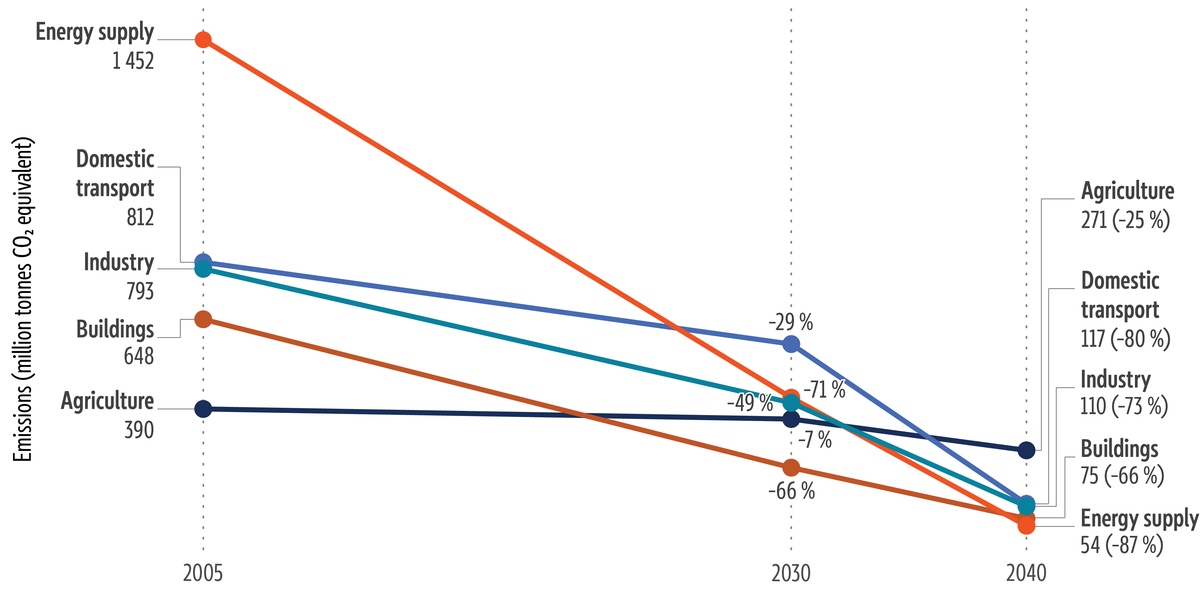
Data source: SWD(2024) 63 final. Graphic by Marco Scipioni and Lucille Killmayer, EPRS.
The 2040 climate target communication noted that gross emissions would need to be below 850 million tonnes of CO2 equivalents (MtCO2e), with nature‑based and industrial removals reaching around 400 MtCO2e.
Towards a new approach
Building on a similar approach from 2013 to 2020, the 2023 revised Effort‑sharing Regulation (ESR) covering 2021 to 2030 sets an EU‑level target of reducing GHG emissions from ESR sectors by 40 % by 2030, compared to 2005. Sectors under ESR include domestic transport (excluding aviation), buildings, agriculture, small industry, and waste. The target is delivered through binding national reduction targets, ranging from 10 % to 50 %, set out through annual emission allocations (AEAs). As seen in Figure 2, EU level emissions for these sectors remained under the total AEAs until 2023. In 2024, the total limit was exceeded, with ESR scope emissions surpassing the national limits in 17 Member States (preliminary data, before flexibilities).
The ESR has several integrated flexibility measures, including banking, borrowing and trading emissions. Despite the existing flexibilities, based on Member States' own March 2025 projections, only five expect to deliver on their 2030 target with existing national policies. With additional measures, this figure could increase to 15 Member States, with projections still showing an EU level shortfall of 2 percentage points (PP). The EU ETS for buildings, road transport and additional sectors (ETS2) was proposed as part of the 2023 EU ETS revision, as a separate ETS. With national measures under ESR showing inadequate progress in lowering emissions, the use of carbon pricing to incentivise fuel switching for these sectors is expected to deliver results in a cost‑effective manner. Originally planned to start in 2027, legislators delayed it until 2028, as part of the 2040 climate target agreement. To date it is unclear what the impact of the delay will have on projections for the ESR emissions for 2030 and beyond.
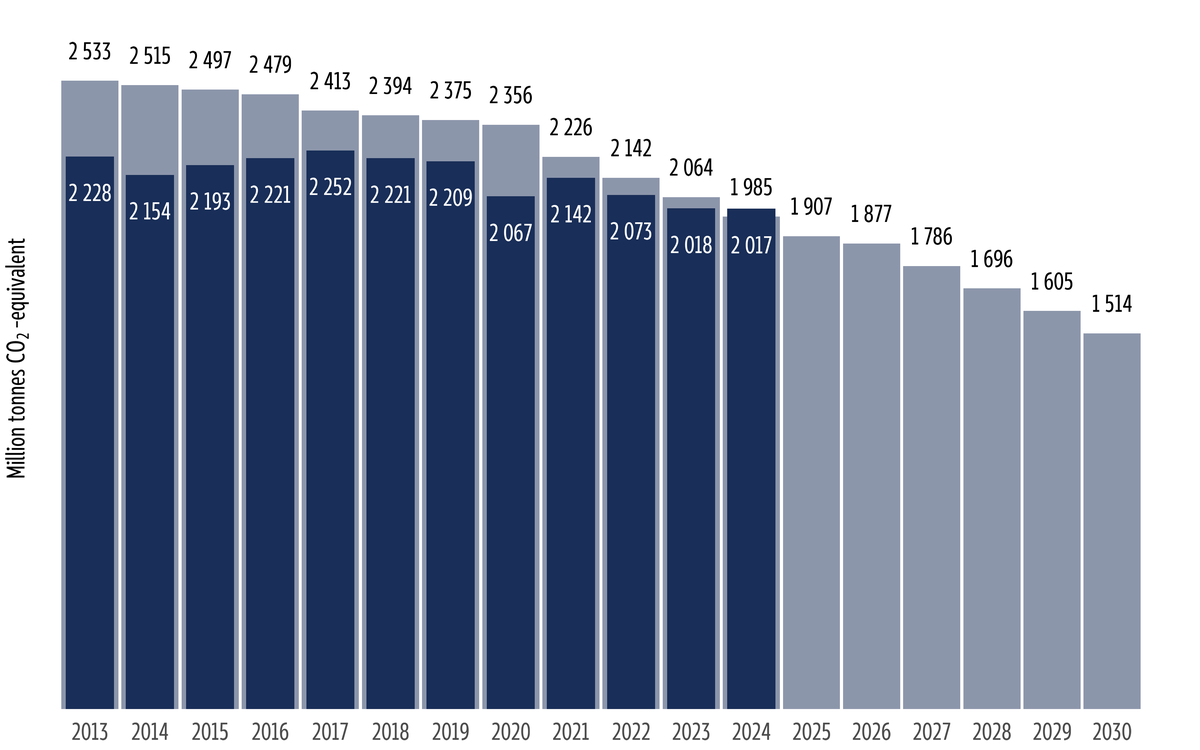
Data source: Eurostat dataset (env_air_gge), accessed July 2026. Implementing Decision (EU) 2026/895. Graphic by Marco Scipioni, EPRS.
Until 2030, carbon removals are only considered in EU climate policy from the natural carbon sink, governed under the LULUCF Regulation. This regulation was also strengthened in 2023 in an effort to reverse the declining carbon sink trend, seeking to increase the sink by 42 MtCO2e, reaching ‑310 MtCO2e by 2030. The 2025 comprehensive review of national GHG inventories led to reporting adjustments, in turn increasing the carbon sink in historical data. As seen in Figure 3, 2024 was the first year in over a decade to show a carbon sink increase. Despite this positive development, the current gap to the 2030 target is more than double the 42 MtCO2e removals which the 2023 LULUCF revision aimed to deliver. National circumstances vary significantly, and climatic conditions have an important impact on baseline calculations and annual fluctuations. As of 2024, four Member States have met their 2030 removal target, while eight are so far from it that achievement is unlikely. Uncertainty linked to rising climate change, disease or pest risks, and the long time horizons for impacting the natural processes to increase the carbon sink, led policymakers to cordon off reduced removals from LULUCF, increasing the emissions reduction burden for other sectors.
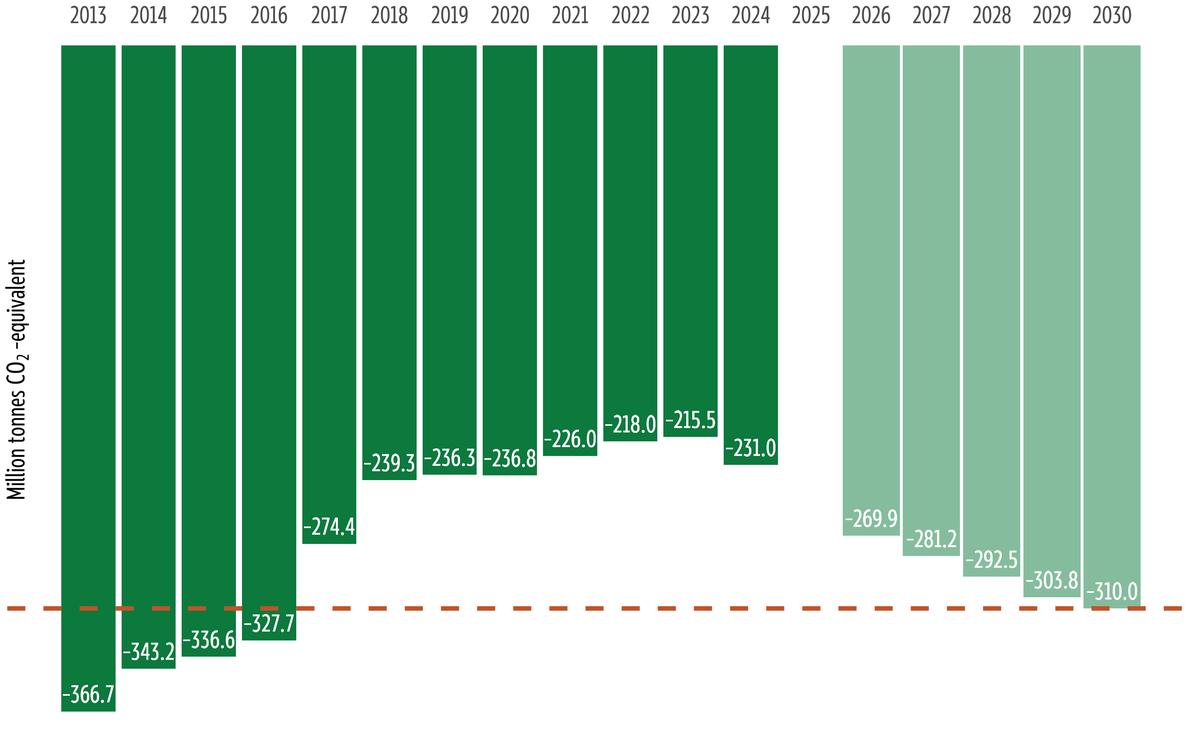
Data source: Eurostat dataset (env_air_gge), accessed July 2026. Implementing Regulation (EU) 2026/893. Graphic by Marco Scipioni, EPRS.
Increased flexibility and simplicity
In the framework towards 2030, various flexibilities exist across ESR, LULUCF and EU ETS. These are however capped at a certain level or have conditionalities which makes it uncertain in policy planning whether they will be available. For example, a Member State which overachieves on its removals obligation under LULUCF, would in principle be able to transfer the surplus towards its ESR compliance. This flexibility is however only available if the EU‑level target is achieved, meaning that overachieving countries today look to lose, due to underachievement overall.
From 2030 onward, the separate ESR and LULUCF Regulations look set to be discontinued. New flexibilities will focus on cost‑effectiveness and creating positive incentives for transition sectors, while allowing flexibilities between sectors. Part of this new approach is to increase the emissions space through offsetting. This includes the potential use of international credits as well as domestic carbon removals (see below). The other way the Commission is considering increasing flexibility and providing for a simpler framework is in target setting.
New approach to target setting
In workshops and meetings throughout 2026, the Commission has floated the idea of using economy‑wide targets. The idea is that this will improve cost‑effectiveness and provide full flexibility, as Member States will have more choice of sectoral focus. It should also allow for a simpler monitoring, reporting and verification framework (MRV). Following the example of the ETS proposal, it seems likely that the Commission would set such an economy‑wide target at 85 %, with conditionalities on sufficient progress and availability of high‑quality international credits, to not revert to a 90 % trajectory by mid‑decade. From there, it may propose national economy‑wide targets taking national circumstances and solidarity into consideration.
Incentives and market‑based tools will play a much bigger role in delivering the 2040 target, with an aim to restructure the national energy and climate plans (NECP) into investment roadmaps, linking planning and reporting closer together. This is visible from the meetings held concerning the review of the Governance Regulation, which is the tool to track progress and ensure corrective measures, if off‑track. The use of key performance indicators (KPIs) combined with core targets is a central topic in that space. Defining the efforts needed by Member States through national economy‑wide targets, combined with access to additional flexibilities based on achieving various KPIs, is considered a more positive incentive‑based approach. In such a frame, the LULUCF sector could still have a separate core target, to maintain the carbon sink, but reward overachievement or implementation of measures focusing on long‑term results without immediate effect, through a carbon sink KPI. Similarly, setting a KPI or separate national objectives to increase carbon removals is considered a way to direct public investment and give signals to the market.
Enabling policies regarding infrastructure and fuels, including phasing out fossil fuels will be needed to reach the EU level target by 2040, for which KPIs could also play a role. Under an economy‑wide target, market approaches to incentivise action such as carbon pricing under the EU ETS and ETS2, will be increasingly important, also in the context of a likely discontinuation of national AEAs. The land sector will remain a challenge, with LULUCF removals under pressure and agricultural emissions remaining stable for the past decade. The agricultural sector today represents a 19 % share of EU total emissions, a share expected to rise to account for over 50 % of residual emissions in 2050. The approach to reduce land sector emissions and boost removals looks to use 'carrots' rather than the 'stick'.
Domestic carbon removals
The CRCF Regulation provides for the certification of domestic carbon dioxide removals (CDR) from different activities. These carbon removals are expected to play a major role in providing flexibility towards 2040. They are also an essential part of delivering carbon neutrality by 2050, as they are needed, together with the natural carbon sink, to offset residual emissions. In May 2026, the first CRCF methodology entered into effect, paving the way for certifying three activities as permanent carbon removals. In July 2026, the Commission put forward the second CRCF methodology covering three carbon farming activities. A third methodology for carbon storage in product activities is planned to be adopted in early 2027. The European Parliament has requested to extend the two‑month deadline to object to the delegated act methodology for carbon farming, as a Member made a motion to object. This will be put to a vote in committee, most likely in October 2026.
The Commission aspires for these new approaches and technologies to provide flexibility through added emissions space for 2040 and 2050. The ETS proposal includes further measures to support take‑up of CDR, including an industrial decarbonisation bank and an innovation fund. In addition, carbon farming activities are presented as a means to create additional revenue streams for farmers and foresters. Ideally this would lead to an increase in the carbon sink or a reduction in emissions linked to agriculture, without the need for a prescriptive top‑down regulatory framework. At the end of 2026, the Commission is further expected to propose a revision of the CRCF Regulation to cover, in addition, activities leading to livestock emissions reduction.
International credits adding emissions space
Added emissions space is made possible with the potential role of international credits, set at up to 5 % of 1990 net emissions. Quantifying how many tonnes of CO2 this would mean has been a topic of debate. The July 2026 ETS revision proposal shed some light on the Commission's reading of the text, by including in proposed article 9b the possible purchase of 260 million international credits (each credit equals 1 tonne of CO2), financed by 260 million ETS allowances. While the legislative proposal does not state how much of the total potential 5 % international credits this 260 Mt equals, the press release referred to 2 %. A leaked Commission presentation of 2 September 2026, gave further details, among other things confirming the total quantity of international credits from 2036 to 2040, amounting to 705 Mt. This is based on a linear trajectory from 0 % in 2035 to 5 % in 2040. This approach gives the highest possible amount of credits, whereas 5 % of 1990 net emissions, based on the data available today would equal 236 Mt (net 1990 scope emissions of 4 726 Mt). Based on the above, 445 Mt of added emissions space through offsetting with international credits is to be integrated under the national targets and flexibilities proposal.
Member State positions and interested parties' opinions
With the proposal not yet public, the main indication of Member States' views can be gathered from Council discussions at the time of setting the 2040 climate target, as well as early reactions to the July EU ETS proposal. While the Irish Presidency prioritises advancing negotiations on the EU ETS revision, it will likely only facilitate an initial presentation of the national targets and flexibilities proposal. The roadmap ambition to reach a deal on the EU ETS revision by Q1 2027 is seen as overly ambitious by many Member State representations, as it is not only technical but also closely linked to national targets and the flexibilities proposal. The ETS cap and scope has a significant impact on national efforts as noted by seven Member States in early July 2026, calling for an ambitious ETS. The Lithuanian Council Presidency in spring 2027, followed by Greece, will work on advancing negotiations on the post‑2030 climate and energy framework, set as a key priority for the current trio presidency
The revamp of the climate policy architecture, spelling an end to the separate regulations covering LULUCF and ESR, and the reflections around an economy‑wide target has raised more questions than answers at Member State level. The issue of keeping a LULUCF target of some form was highlighted by several Member State contacts. Some specifically worried that the ambitions of the 2025 bioeconomy strategy risks undermining the carbon sink, while early on, Sweden and Finland pointed out their views on positive economic synergies from active forest management in a bioeconomy context. How an economy‑wide target would work to improve flexibility, in a framework also containing two carbon pricing instruments with clear emissions caps, was not as clear to Member State staff working on the file as it seems to be to the European Commission. What was clear to most however was that the solidarity mechanism would become a sore spot for negotiating these files, as high‑ambition Member States will be reaching feasibility constraints and the most cost‑efficient emissions reductions are likely to be found in poorer Member States. Some specifically noted objections to the solidarity mechanism, though the climate law clearly lists solidarity as a factor in developing EU climate policy. Most recently, both Spain and France released joint statements with the United Kingdom, reaffirming their commitment to ambitious climate action.
Interested parties and stakeholders had the option to respond to the call for evidence on the file by 4 May 2026. The responses, as well as stakeholder views on the 2040 target, remain pertinent to understand topics for potential debate. The issue of setting separate targets for nature‑based or technological removals in parallel with direct emissions reduction targets remain a constant. In a 2026 report, Bellona Europe outlined its recommendations for the post‑2030 climate framework. They include keeping separate targets for LULUCF and technological carbon removals, further arguing to maintain two separate regulations regarding LULUCF and effort‑sharing sectors. They also call for the EU to develop a specific approach to define and reduce residual emissions. Prioritising domestic action, the report argues for setting aside international credits in a strategic reserve with limited use cases conditional on domestic progress. The topic of how to approach international credits in the post‑2030 framework is already receiving attention with the initial release of the EU ETS proposal.
Furthermore, with energy price concerns due to the situation in the Strait of Hormuz, the issue of phasing out fossil fuels, may be prominent in the context of the energy union as well as for the 2040 climate framework. In April 2026, Frank Elderson, board member of the European Central Bank (ECB) authored an ECB blogpost, referencing a March 2026 speech by ECB President Christine Lagarde, arguing the need to decarbonise Europe's economy. He outlined the 'fossilflation' risks of Europe's dependence on fossil fuels, noting how clean energy autonomy would protect households from price shocks and improve macroeconomic stability. In August 2026, almost 200 European and international organisations, industry associations and national organisations called on the Commission's President to dedicate her annual 'State of the Union' speech to the topic of phasing out fossil fuels.
Following the ETS revision debates will also provide insights into stakeholders' concerns and ideas for the wider climate policy framework. In January 2026, Oeko-institut released a policy option analysis considering ETS, ESR and LULUCF synergies when looking towards 2040.
European Parliament views
On 19 June 2025, Parliament welcomed the Clean Industrial Deal initiative as an overarching growth strategy for Europe, noting that the transition to a decarbonised economy can only be succesful if competitiveness is maintained. It called for completion of the energy union and welcomed the Commission's ambitions regarding carbon management. Since 2019, all of Parliament's resolutions ahead of the annual climate conferences (COP) note the issue of fossil fuel subsidies. The October 2025 resolution on COP30 insisted on the urgent need for ambitious and time‑bound plans to phase out fossil fuel subsidies and fossil fuel production. It further noted that EU subsidies for fossil fuel imports distort incentives for the clean energy transition.
In its April 2026 resolution on the 2028‑2034 MFF proposal, Parliament called for increased funding under the connecting Europe facility (CEF) to facilitate the indispenable clean energy transition, and cross‑border structural investment. It further reiterated its call for a reinforced investment partnership with the EIB, leveraging the EU budget to mobilise private investment, and de‑risk investment in key policy areas, including climate. It noted that the additional investment needs to deliver climate neutrality cannot be delivered by the EU budget alone. Ahead of the 2040 climate target proposal, in November 2024, the European Parliament called on the Commission to 'propose separate sub‑targets for gross emissions reductions, land‑based removals and technological removals as part of the 2040 target'. As this was not part of the proposal at the time, the national targets and flexibilities proposal will be another opportunity to discuss the approach to target setting.
Classification
Policy areas: Environment
Regions: European Union
Committees: Environment, Climate and Food Safety (ENVI)
Statement on the use of AI
Any AI‑generated content in this text has been reviewed by the author.
Disclaimer
This document is prepared for, and addressed to, the Members and staff of the European Parliament as background material to assist them in their parliamentary work. The content of the document is the sole responsibility of its author(s) and any opinions expressed herein should not be taken to represent an official position of the Parliament.
Copyright
© European Union.
The reuse of this document is authorised under a Creative Commons Attribution 4.0 International (CC-BY 4.0) licence.

To use or reproduce elements that are not owned by the European Union, permission may need to be sought directly from the respective rightsholders.