
Article page checkbox is not checked in page info.
Extended producer responsibility: 2026 turning point
Extended producer responsibility: 2026 turning point
Camille Siefridt, Members' Research Service

Summary
Extended producer responsibility (EPR), an approach under which producers bear financial, or financial and organisational, responsibility for managing products at the waste stage, is entering a particularly active period of European Union (EU) regulatory development. Producer-responsibility obligations for packaging were introduced at EU level by the 1994 Packaging Directive, while the Waste Framework Directive now provides the horizontal framework for EPR schemes.
The legal backbone of EU EPR runs from the minimum requirements set by Article 8a of the Waste Framework Directive to the stream-specific instruments now in force for packaging, batteries, textiles, electronic waste, end-of-life vehicles and single-use plastics.
The year 2026 brings three major developments at EU level.
First, the Packaging and Packaging Waste Regulation began to apply directly across all 27 Member States on 12 August 2026. As a regulation, it substantially harmonises EU packaging rules, although national differences could remain in areas where implementation, administration and enforcement are left to Member States.
Second, the European Parliament and the Council are examining two European Commission proposals under the Environmental Omnibus package that would suspend, until 1 January 2035, certain obligations for producers established in one Member State to appoint an authorised representative when supplying products in another Member State. The proposals do not establish an equivalent general exemption for third-country producers. Industry and civil-society organisations have taken differing positions on the balance between reducing administrative burdens and maintaining effective enforcement.
Third, the Commission plans to propose a circular economy act in the third quarter of 2026, including a horizontal reform of extended producer responsibility.
Extended producer responsibility (EPR): What it is and how it works
Extended producer responsibility is the policy principle under which those who design, manufacture and sell a product must also bear the financial – and sometimes operational – cost of managing that product when it becomes waste (see Figure 1). The principle's initial rationale is also one of competitive neutrality: where public authorities bear the costs of managing waste generated by products placed on the market, producers may benefit from an indirect public subsidy, potentially distorting competition. By assigning specified end-of-life costs to producers, EPR seeks to internalise those costs in product prices and to apply the 'polluter pays' principle: those responsible for environmental damage should pay to cover the costs.
EPR may also create incentives to design products that are less costly to collect, sort, reuse or recycle. Whether it changes product design in practice depends on the level and differentiation of producer fees, as well as on other regulatory and market factors. The extent to which costs are transferred from public authorities and waste holders to producers depends on each scheme's cost-coverage rules. Producers may pass some compliance costs on to consumers through product prices. Producer-responsibility obligations for packaging entered EU law with Directive 94/62/EC in 1994.
When a producer places a covered product on a national market, it becomes subject to EPR obligations. In practice, most producers join a producer responsibility organisation (PRO) – a collective compliance body – rather than acting individually. A PRO's role depends on the model of the EPR scheme. In a financial scheme, the PRO collects producers' contributions, and provides financial support for the local authorities and operators responsible for collection, sorting and treatment. In an operational scheme, the PRO directly organises the management of waste and contract service providers selected through tendering procedures. Mixed schemes combine financial support with operational responsibilities. The use of operational EPR models changes the allocation of responsibilities in the value chain. Rather than acting principally as a funding body, the PRO assumes a more direct organisational role, and may contract directly with service providers for collection, sorting, treatment or recovery activities.
Within any of these models, producers typically pay a base fee calculated from a product's weight and material type. On top of this, eco-modulation – adjusting waste compliance fees according to environmental criteria – applies a bonus‑malus, i.e. a financial reward or penalty based on environmental performance expressed as a percentage discount or surcharge based on specific design criteria. The legal basis for this mechanism is Article 8a(4)(b) of the Waste Framework Directive, as introduced by the 2018 amendment (Directive (EU) 2018/851), which requires Member States to set fees according to durability, reparability, reusability, recyclability and the presence of hazardous substances.
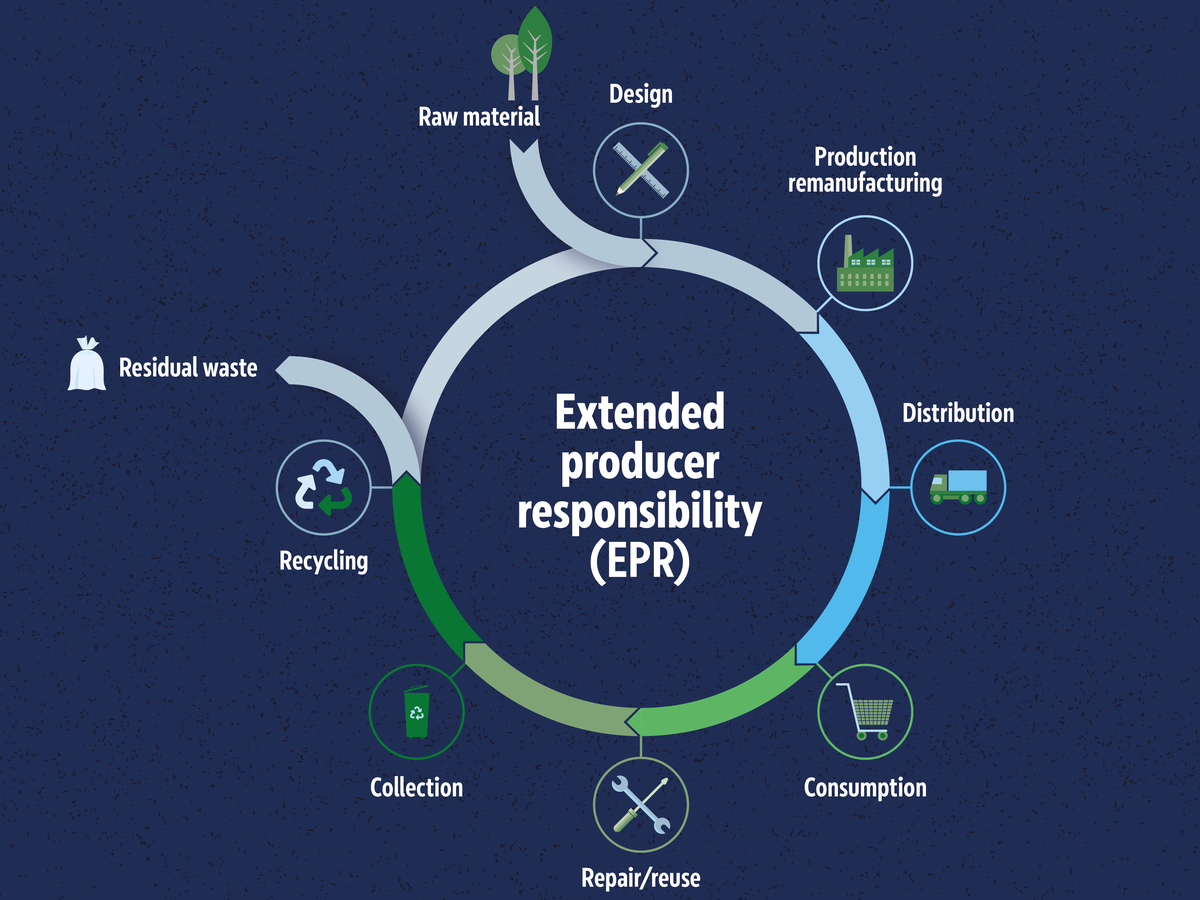
Source: Compiled by the author; graphic by Samy Chahri, EPRS, 2026.
Three files to watch in 2026
Since 12 August 2026, the Packaging and Packaging Waste Regulation (PPWR) has applied directly in all 27 Member States. It harmonises key packaging requirements, and establishes an updated framework for producer responsibility. The detailed allocation and administration of packaging-waste costs continues to interact with the minimum requirements in Article 8a of the Waste Framework Directive.
In October 2026, in the context of ongoing legislative procedures concerning two texts within the Environmental Omnibus package (Omnibus VIII), the European Parliament is expected to vote, on:
-
a proposed regulation suspending certain authorised-representative obligations for EU-based producers operating cross-border, while retaining Member States' ability to require representatives or equivalent traceability for third-country producers for batteries, waste batteries, packaging and packaging waste;
-
a proposed directive doing the same for textiles, waste electrical and electronic equipment (WEEE, or 'e-waste') and single-use plastics.
Finally, the Commission's 2026 work programme schedules the circular economy act (CEA) proposal for the third quarter (Q4) of 2026. The initiative is expected to address extended producer responsibility, alongside revisions to the waste framework, landfill and WEEE rules, and measures relating to secondary raw materials.
Together, these three developments mark a critical juncture for EU EPR. While the PPWR's direct application is already reshaping the substantive baseline for packaging, two forthcoming milestones – the vote on the Environmental Omnibus package and the publication of the circular economy act – are set to decide whether the EU's enforcement architecture is simplified or overhauled. This combination of newly applicable obligations and pending structural reforms represents the most consequential recalibration of the EU EPR framework since the adoption of the 1994 Packaging Directive (see Box 1).
Box 1: Circular economy key figures
12.2 %: the EU's circular material-use rate in 2024, against an indicative target of 24 % by 2030, set out in the 2025 Clean Industrial Deal (up from an original 22.4 % goal under the 2020 circular economy action plan). At the current pace, the European Environment Agency (EEA) assesses the EU as not on track to meet either target. EPR schemes help finance recycling infrastructure, yet the EEA notes that increasing recycling alone will not close this gap – reduced material use and stronger prevention and reuse measures are also needed.
18 out of 27: the number of Member States at risk of missing at least one 2025 waste recycling target (EEA 2023). This is the performance baseline of EPR as currently designed.
500: the number of days some companies spend per year on EPR compliance under the current fragmented system, according to a 2025 study commissioned by Ecommerce Europe and prepared by Eunomia.
EU legal framework
As mentioned previously, the legal backbone of all EU EPR is the Waste Framework Directive, in particular Article 8a, as well as sector- and waste stream-specific pieces of legislation that further detail the expectations regarding the EPR (see Table 1).
Article 8a lays down general minimum requirements for EPR schemes, including clear allocation of responsibilities, measurable targets, reporting, information to waste holders, equal treatment of producers, monitoring and enforcement, transparency, cost coverage, and regular stakeholder dialogue. For collective schemes, producer contributions must, where possible, be modulated according to product characteristics.
| Stream | Instrument | Legal form | Entry into force / Application of EPR obligation |
|---|---|---|---|
| Packaging | Regulation on packaging and packaging waste (PPWR, Regulation (EU) 2025/40) | Regulation | Applicable since August 2026 |
| Textiles/footwear | Directive on waste (Directive (EU) 2025/1892 amending Directive 2008/98/EC as regards extended producer responsibility for textiles) | Directive | In force since October 2025; EPR schemes applicable by April 2028 |
| Batteries | Regulation concerning batteries and waste batteries (Regulation (EU) 2023/1542) | Regulation | Applicable since August 2025 |
| WEEE | Directive on waste electrical and electronic equipment (WEEE, Directive 2012/19/EU) | Directive | Applicable since 2014 (producer responsibility) |
| End-of-life vehicles | Regulation on circularity requirements for vehicle design and on management of end-of-life vehicles (Regulation (EU) 2026/1738) | Regulation | Applicable from September 2029 |
| Single-use plastics | Directive on the reduction of the impact of certain plastic products on the environment (SUP, Directive (EU) 2019/904) | Directive | In force since 2021; EPR schemes applicable in 2023 and 2024 depending on the scope |
Data source: EUR-Lex, consolidated texts for each instrument.
A notable structural shift is the EU's growing reliance on directly applicable regulations (rather than on directives) for product-specific waste streams, driven partly by critical raw-material security (see Box 2). This trend covers batteries, packaging, and end-of-life vehicles. While direct applicability curbs national divergence during transposition, disparities may persist across Member States in terms of administration, implementation and enforcement.
The Ecodesign for Sustainable Products Regulation (ESPR) is the primary upstream framework complementing downstream EPR obligations. Digital product passports (DPPs) are expected to progressively connect verified product sustainability data to EPR fee calibration, which could make eco-modulation more precise and less dependent on producer self-declaration. The Circular Cities and Regions initiative recommended in its April 2026 policy report that the future CEA legally require eco-modulated fees to draw on verified DPP data.
Box 2: EPR as industrial policy – WEEE and critical raw materials
WEEE EPR is no longer primarily an environmental issue – it is also a strategic-autonomy one. The EU imports nearly 100 % of its heavy rare-earth elements, primarily from China. A May 2026 analysis by the Commission's Joint Research Centre (JRC) found that 46 % of the strategic and critical raw materials contained in electrical and electronic equipment is lost at the collection stage, before it even reaches a recycler. Hard-disk drives and cables have significant critical raw material-recovery potential if well-collected.
On 3 December 2025, the Commission adopted the RESourceEU action plan and proposed amendments to the Critical Raw Materials (CRM) Act. The proposal would expand requirements concerning information on recycled content in permanent magnets. It provides for delegated acts setting minimum recycled-content shares after the relevant calculation rules enter into force and, in any event, by 31 December 2031. The RESourceEU action plan states that the Commission will propose measures under the circular economy act to increase recovery of critical raw materials, including from e-waste.
What works within EPR
EPR schemes can raise collection and recycling rates. This is the strongest and most consistent finding in the EPR evidence base. An analysis by the Organisation for Economic Co-operation and Development (OECD) across multiple markets found recycling-rate increases of 10-44 % within five years of the introduction of packaging EPR. France's WEEE data showed collection tripling from 2.9 to 8.8 kilograms per inhabitant within four years of EPR implementation. Furthermore, reviews of seven markets (Belgium, the Netherlands, Portugal, South Korea, Spain, as well as two Canadian provinces) showed recycling-rate increases with the introduction of EPR law in all observed programmes.
EPR shifts waste management costs from taxpayers to producers, although the extent of this shift varies significantly by country: producer fees cover 100 % of net collection and treatment costs in Austria, Belgium, Czechia, Germany and the Netherlands. EPR fees mobilise significant sums from industry for waste management infrastructure: for example, France's packaging scheme alone collected over €1 billion in producer fees in 2023 to fund collection and sorting infrastructure (for further detail, see Box 3).
EPR has played a central role in underpinning Europe's recycling sector, with the EU's overall packaging recycling rate reaching 67.5 % in 2023. In addition, predictable EPR financing and contracted material flows can improve the investment conditions for collection, sorting and treatment infrastructure, although the effect depends on contract duration, fee stability, market demand for secondary materials, and regulatory certainty.
EPR schemes are also one of the funding mechanisms behind the EU's circular economy sector, which supported an estimated 4.3 million jobs in 2021; however, this figure covers recycling, repair and reuse activities broadly, not EPR-financed operations alone.
What EPR has not yet achieved
Challenge 1: EPR has neither prevented waste nor meaningfully incentivised product redesign
This is the most consistently documented EPR failure: evidence that existing EPR schemes prevent waste or drive substantial product redesign remains limited and mixed. A study on EPR packaging fees across 25 EU Member States from 1998 to 2015 found that a 1 % increase in fees correlated with only a decrease of 0.06 %, or roughly 100 grams, in packaging waste per capita. EPR has generally been more effective at financing collection and recycling than at reducing waste generation or changing product design. With the EU's circular-material use rate stagnating at 12.2 %, far below the 24 % target for 2030 (see Box 1), eco-modulation in most Member States continues to reward end-of-life recyclability rather than durability or repairability, a price signal too weak to alter industrial design at scale.
In addition, a June 2024 independent institutional report by three French government inspectorates found that around 40 % of France's EPR-covered waste was not collected, and around 50 % was not recycled. The report also identified conflicts of interest, where PROs are governed by the producers that finance them, potentially weakening incentives for prevention, durability, repair and reuse (see also challenge 5).
Challenge 2: EPR fragmentation creates a single market barrier
EPR compliance remains organised primarily through national and product-specific systems. Producers operating cross-border may therefore face different definitions, registration portals, reporting formats, fee structures and deadlines, both between Member States and between product streams within the same Member State.
The Commission's May 2025 single market strategy identified EPR fragmentation as one of 10 priority barriers to the single market.
Challenge 3: EPR enforcement struggles to catch free-riders, particularly online
Free-riding, where producers place products on the EU market without registering or paying EPR fees, is an acknowledged structural problem (see Box 3).
-
At the December 2024 Environment Council meeting, several Member States raised concerns over EPR free-riding by third-country online sellers; a joint letter from Czechia, Denmark, France and Slovakia estimated related losses in the hundreds of millions of euros in customs duties alone, noting that enforcement remains 'difficult, particularly for small shipments from outside the EU'.
-
In a joint statement in September 2025, 64 environmental and consumer-protection associations, as well as industry, retail and wholesale organisations, including the Extended Producer Responsibility Alliance (EXPRA), argued that online marketplaces must become 'proactive partners in EPR', verifying seller registration and accepting financial liability for unpaid fees.
-
The European Organisation for Packaging and the Environment (EUROPEN), in its January 2025 EPR recommendations, noted cases of free-riding 'for instance in distance selling or in the case of non-EU operators selling packaged goods directly to consumers'.
Box 3: Free-rider challenge and statistical discrepancies
Free-rider volumes:a free rider is a company that avoids paying its legally required recycling and waste-disposal fees, while still benefiting from the public waste system. No authoritative EU-wide estimate of free-rider volumes for packaging or batteries exists. For WEEE, the OECD has estimated free-riding at 5 to 10 % of the EEE market between 500 000 and 1 000 000 tonnes annually, while no comparably precise figure exists for other streams. This remains a significant evidence gap for the debate on the Omnibus VIII package and the 'authorised representative' (see also Box 4).
Cost-coverage figures: substantial EPR financing does not necessarily ensure adequate cost coverage or environmental performance. Even a legally defined cost-coverage target can generate persistent disagreement over actual performance. In France, the PRO is required to cover 80 % of local authorities' net reference costs since January 2023; non-profit organisation Citeo, acting as PRO, reports covering 72 % of these costs. However, Amorce, representing two thirds of French local authorities, has repeatedly disputed whether this threshold was reached: in 2022, it calculated that Citeo paid only €825 million, against €1.6 billion in actual local-authority spending – a real-terms coverage rate below 50 % (40 % in 2021).
Recycling-rate statistics and definitions: statistics on recycling rates are highly sensitive to methodological choices. In 2020, EU rules shifted the official 'calculation point', moving the measurement of recycled waste from the output of sorting facilities to the input of final recycling operations, where sorting residues and non-target materials are fully deducted. According to Eurostat, this single accounting change reduced the reported EU packaging recycling rate by 3.4 percentage points, without any decline in physical recycling activity. Difference arise from definitions of 'recovered' material and inclusion of non-target materials. It therefore remains key to scrutinise the methodology behind any recycling-rate figure in impact assessments or stakeholder submissions.
Challenge 4: EPR systematically underfunds the top tiers of the waste hierarchy
The Waste Framework Directive ranks prevention and preparing for reuse above recycling in the waste hierarchy. In practice, EPR cost coverage has traditionally concentrated on collection, sorting and recycling.
Current eco-modulation focuses almost exclusively on recyclability, and end-of-life characteristic, rather than upstream design attributes (durability, repairability, recycled content, hazardous substances) – attributes the Waste Framework Directive itself already envisages under Article 8a(4)(b). OECD analysis and academic evidence point to the same conclusion: eco-modulation needs to extend beyond recyclability if EPR is to drive upstream behavioural change. Linking future eco-modulated fees to verified DPP could improve the consistency and auditability of product-level criteria, provided that the relevant data fields, verification rules, access rights and governance arrangements are established.
Challenge 5: PRO governance can weaken accountability and affect downstream operators
In most collective systems, PROs are governed and financed by the producers whose compliance costs they administer. This can create structural tension between cost containment for producers and the public-interest objectives of EPR, including waste prevention, reuse, high-quality recycling and full cost coverage.
Where PROs directly organise waste management, their decisions on contracts, eligibility criteria, fee allocation and performance data can substantially affect municipalities, recycling operators, social-economy enterprises, and reuse and repair networks. The balance between producer governance, independent public oversight and the meaningful participation of downstream actors is therefore central to EPR performance, as defined within Article 8a of the Waste Framework Directive, which requires Member States to define the roles and responsibilities of producers, PROs, waste operators, local authorities and reuse actors, to ensure regular stakeholder dialogue, and to provide independent or public oversight where several PROs operate.
Reform horizon and forthcoming decisions for Members of the European Parliament
Environmental Omnibus: Decision 1 for Parliament (October 2026)
With its Environmental Omnibus package, the Commission proposes suspending until 1 January 2035 the mandatory appointment of an authorised representative (AR) in each Member State for EU-based producers selling across borders (see Box 4). The proposed suspension is directed principally at intra-EU cross-border obligations. Under the Commission proposal, Member States could continue requiring third-country packaging producers to appoint an authorised representative, or could use alternative means to ensure traceability and enforcement. The stated aim of the overall Environmental Omnibus is reducing administrative burden by 'at least 25 % for all companies and at least 35 % for SMEs [small and medium-sized enterprises]'.
Box 4: What is an authorised representative, and what is the current situation?
An authorised representative for EPR is a natural or legal person established in a Member State and appointed by written mandate to fulfil specified producer-responsibility obligations on a producer's behalf. Depending on the applicable instrument and national arrangements, these tasks may include registration, reporting and financial contributions.
Under the PPWR, the Batteries Regulation and similar instruments, an EU-based producer must currently appoint an AR in every other Member State where it places products on the market for the first time; non-EU producers face separate AR requirements.
State of play between the co-legislators: on 24 June 2026, the Council agreed its positions on three files within the Omnibus VIII package. It announced that it would pursue its work on the environmental assessments regulation, but paused work on the two texts addressing authorised-representative requirements, citing reservations among a majority of delegations and the forthcoming CEA review. This leaves the AR suspension without an agreed Council position for now, even as Parliament's own process continues.The draft reports (on textiles, single-use plastic and WEEE, and on batteries and packaging) by the rapporteur for the Committee on the Environment, Climate and Food Safety (ENVI), Ingeborg Ter Laak, propose limiting the suspension to micro and small enterprises (defined as having fewer than 50 employees and a turnover of under €10 million); adding a sunset clause tied to the circular economy act's entry into force or 1 January 2035, whichever comes first; and, notably, tightening rather than loosening the third-country-producer requirement, removing the flexibility the Commission had proposed to let Member States use alternative enforcement means instead of a mandatory AR for third-country producers.
Arguments for suspension: a coalition of nine trade associations argued in a joint statement (March 2026) that EPR enforcement relies primarily on data, reporting and financial flows rather than physical local representation, and that maintaining national AR requirements risks fragmenting the single market. They consider that the suspension until 2035 would create 'the political space needed' for the circular economy act to design a more harmonised EU-wide compliance model.
Arguments against suspension: a joint statement (9 April 2026), signed by 13 stakeholders (e.g. non-governmental organisations such as the European Environmental Bureau (EEB) and industry bodies including EucoLight, Recycling Europe and APPLiA), warned that the AR is 'the essential legal connection between non-established producers and national enforcement authorities'. They argued that suspending it would weaken enforceability, particularly for third-country producers, calling instead for the AR framework to be addressed comprehensively within the circular economy act. In January 2026, Estonia, Spain, France, Luxembourg and Austria raised formal concerns in the Council.The French Senate (Resolution No 478 of March 2026) formally opposed the suspension on subsidiarity and proportionality grounds.
Proposal for a circular economy act: Decision 2 (Q3-Q4 2026)
Drawing on the European Commission's consultation outcomes, a Commission communication, an Institute for European Environmental Policy (IEEP) analysis, an EPRS briefing, and Commission expert group findings, the following EPR-specific measures are likely to be considered by the Commission.
-
Digital one-stop shop: stakeholders have proposed an EU interface for EPR registration and reporting to reduce duplication across national systems. A digital portal could facilitate compliance but would not by itself harmonise the underlying legal definitions, reporting obligations, fees, or enforcement arrangements.
-
WEEE Directive revision: the Commission has confirmed that the proposal for a circular economy act would include a WEEE review aimed at improving collection and treatment, and at increasing recovery of critical raw materials. As detailed in Box 2, aligning WEEE collection and recycling targets with the CRM Act directly connects a producer-responsibility reform with the EU's broader strategic autonomy agenda. Higher collection targets, material-specific recovery requirements (particularly to meet the CRM Act's 25 % recycling target in 2030), reuse targets, and harmonised EPR rules remain possible policy options pending publication of the proposal and its impact assessment.
-
PRO governance: possible reforms include minimum transparency, accountability and procurement standards for PROs, together with clear public oversight.
-
Eco-modulation expansion: policy options include broadening practical fee criteria beyond recyclability to durability, reparability, reusability, recycled content and hazardous substances, potentially using verified ESPR or DPP data.
-
Waste hierarchy reorientation: social-economy and environmental organisations have proposed earmarking part of EPR financing for reuse and repair, and extending cost coverage for preparing WEEE for reuse.
Main references
- Brown, A., Laubinger, F. and Börkey, P.,
- New Aspects of EPR: Extending producer responsibility to additional product groups and challenges throughout the product lifecycle
- , OECD Environment Working Paper No. 225, OECD, 2023.
- European Commission, communication on the single market: our European home market in an uncertain world, COM(2025) 500, May 2025.
- European Environment Agency, Circular material use rate in Europe, November 2025.
- Siefridt, C., Circular economy act, EPRS, European Parliament, January 2026.
Classification
Policy areas: Environment | Industry
Regions: European Union
Committees: Environment, Climate and Food Safety (ENVI), Industry, Research and Energy (ITRE)
Statement on the use of AI
Any AI-generated content in this text has been reviewed by the author. EP GenAI Hub was used to improve the readability of the text, enhance the alternative text for image readability, and broaden the range of sources available to the author.
Disclaimer
This document is prepared for, and addressed to, the Members and staff of the European Parliament as background material to assist them in their parliamentary work. The content of the document is the sole responsibility of its author(s) and any opinions expressed herein should not be taken to represent an official position of the Parliament.
Copyright
© European Union.
The reuse of this document is authorised under a Creative Commons Attribution 4.0 International (CC-BY 4.0) licence.

https://creativecommons.org/licenses/by/4.0/deed.en
To use or reproduce elements that are not owned by the European Union, permission may need to be sought directly from the respective rightsholders.