
Article page checkbox is not checked in page info.
Revision of the EU emissions trading system and the market stability reserve
Revision of the EU emissions trading system and the market stability reserve
Juan Fernando López Hernández, Members' Research Service

Context
The European Commission is proposing to revise the EU emissions trading system. The proposal aims to balance the overall EU target of reducing greenhouse gas emissions by 2040, with an enabling framework to boost Europe's competitiveness and sustainability goals. The proposal addresses key elements of the system, including the overall ambition, the role of international credits, permanent and non-permanent carbon removals, existing and new funding instruments, use of revenues, a broader scope of the aviation and maritime transport sectors, and the carbon leakage framework. Following the example of the inclusion of the maritime transport sector in 2024, the Commission proposes to gradually expand carbon pricing to CO2 emissions from municipal waste incineration. The proposal builds on the legislative mandate following the last revision of the system in 2023, while addressing additional concerns on competitiveness raised in 2026, in a context of high energy prices.
Legislative proposal
2025/0212(COD) – Proposal for a directive of the European Parliament of the Council amending Directive 2003/87/EC and Decision (EU) 2015/1814 as regards driving competitiveness and cost-effective decarbonisation – COM(2026) 616, 17.7.2026.
Next steps in the European Parliament
For the latest developments in this legislative procedure, see the Legislative Train Schedule: 2025/0212(COD).
Issue
On 21 October 2025, as part of its work programme for 2026, the European Commission announced the legislative update of Directive 2003/87/EC establishing a system for greenhouse gas (GHG) emission allowance trading within the Union (EU ETS Directive) for the third quarter of 2026. By July 2026, the EU ETS Directive mandates the Commission to report on various issues, potentially leading to legislative proposals where appropriate. These issues comprise:
-
the coverage of GHG emissions from international flights;
-
the inclusion of small combustion installations;
-
the inclusion of municipal waste incinerators and landfills;
-
the question of how to account for negative emissions resulting from GHG that are removed from the atmosphere and safely and permanently stored.
Additionally, the EU ETS Directive requires the Commission to address other issues with later deadlines:
-
the inclusion of GHG emissions from medium-sized offshore and cargo ships;
-
the expansion beyond the existing 50 % of GHG emissions coverage for international maritime voyages ;
-
the assessment of non-CO₂ aviation effects;
-
the impact of carbon leakage on sectors not covered by Regulation (EU) 2023/956 on the carbon border adjustment mechanism (CBAM Regulation).
The EU emissions trading system (EU ETS) update would set the legislative framework beyond 2030. The Commission proposal to amend the EU ETS Directive concerns Phase 5 of the ETS (2031-2040), incorporating both the issues with a July 2026 deadline and those with later deadlines. The Commission will also update Decision (EU) 2015/1814 concerning a market stability reserve (MSR Decision) as regards stationary installations, aviation and maritime transport (MSR1) following a mandatory review before the end of 2026. Moreover, the Commission proposal targets additional issues that, while not required by the legislative mandate, have been raised by Member States ahead of the release of the Commission proposal. The latter aim to address competitiveness concerns in a context of geopolitical instability and energy price fluctuations, following statements by the European Council in early 2026. The Commission would expand the lifetime of the EU ETS beyond 2040, while providing flexibility to industries through a slower trajectory to achieve climate goals.
The Commission proposal to revise the EU ETS Directive and MSR1 is complemented by:
-
a proposal amending the EU ETS Directive as regards revised benchmark values for the heat and fuel benchmarks from 2026 to 2030 (COM(2026) 619) (see Legislative Train Schedule);
-
a proposal amending Regulation (EU) 2015/757 (MRV Maritime Regulation) and Regulation (EU) 2023/1805 to simplify and streamline monitoring, reporting and verification (MRV) in the maritime transport sector to align with the EU ETS (COM(2026) 620) (see Legislative Train Schedule);
-
a targeted proposal, released in April 2026, amending the MSR Decision as regards ceasing the invalidation of allowances in the MSR1 (COM(2026) 153) (see Legislative Train Schedule).
Main points of the proposal
The Commission proposal seeks to align the EU ETS with the target enshrined in Regulation (EU) 2026/667 amending Regulation (EU) 2021/1119 establishing a framework for achieving climate neutrality (the European Climate Law) as regards the setting of a Union intermediate climate target for 2040. The amended European Climate Law mandates a net 90 % reduction of EU GHG emissions by 2040 compared with 1990 levels. The Commission proposal to revise the EU ETS Directive and MSR Decision consist of the following elements:
-
a less ambitious linear reduction factor (LRF);
-
new rules for the integration of international credits and permanent carbon dioxide removals (CDR);
-
extension of the EU ETS scope and funding for aviation and maritime transport;
-
inclusion in the EU ETS of municipal waste incineration;
-
revised rules to address carbon leakage, notably for the free allocation of allowances, and the continuation of the indirect cost-compensation mechanism;
-
revised rules for the MSR and new rules on the use of EU ETS revenues;
-
revised rules for existing funding instruments, and the creation of a new Industrial Decarbonisation Bank (IDB) preceded by an EU ETS Investment Booster.
The Commission is proposing to continue reducing GHG emissions from the industrial, energy, aviation and maritime transport sectors (and to extend this goal to the incineration of municipal waste) while supporting their competitiveness. For these sectors, the proposal reduces the LRF from 4.4 % to 3.7 % in the period 2031-2035, and to 1.7 % in 2036-2040 (otherwise 2.7 %, if suitable international credits are not available, pending a European Commission assessment by 2033) (see Figure 1).
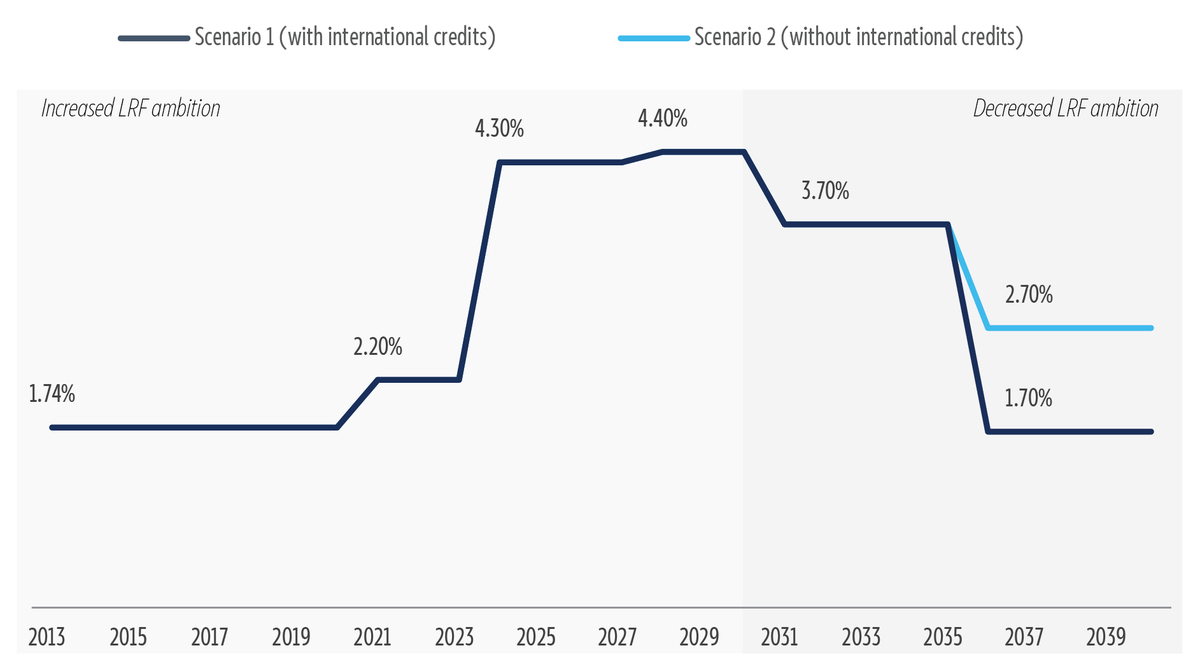
Source: Compiled by the author, based on Directive 2003/87/EC (for the period 2013-2031) and Commission proposal COM(2026) 616 (for the period 2031‑2040); graphic by Nadejda Kresnichka-Nikolchova, EPRS, 2026.
The proposal would initially set aside around 260 million allowances for the funding of high-quality international credits. The purchase of international credits aims to provide additional flexibilities to ETS sectors between 2036 and 2040.1 The 260 million allowances correspond to the cumulated gap between the annual 1.7 % scenario with international credits and the 2.7 % LRF scenario without international credits, between 2036 and 2040. The Commission proposes a new facility to centralise the purchase of these international credits and CDR, with further details pending a Commission proposal scheduled to be published at the end of 2026.
As regards CDR, the Commission would increase the EU ETS cap with an initial amount of 250 million allowances, which could reach 260 million allowances if needed. They will be auctioned from 2031 to 2040 and allocated to the Commission to fund purchases of an equivalent amount of CDR units from technologies recognised under Regulation (EU) 2024/3012 establishing a Union certification framework for permanent carbon removals. Initially targeting biogenic emissions capture with carbon storage (BioCCS) and direct air capture with carbon storage (DACCS), EU ETS sectors would benefit from using CDR certificates to compensate for their residual emissions up to zero.2 The Commission targets a report by December 2034 that may expand the list of CDR activities.
The EU ETS regulates GHG emissions from aviation and maritime transport within a limited geographical scope. Aircraft operators are required to surrender CO2 emissions from flights between aerodromes in the European Economic Area (EEA), Switzerland and the United Kingdom (UK); following a 'stop the clock' decision. Small aircraft operators operating flights (below 10 000 tonnes of annual CO2 emissions), certain type of flights (e.g. military), and outermost-region flights within the same Member State are excluded from having to surrender CO2 emission allowances. In the case of maritime transport, the EU ETS requires ship operators to surrender allowances for their GHG emissions for voyages from cargo, passenger and offshore large ships above 5 000 gross tonnage (GT) between EEA ports, and half of the emissions from voyages between EEA and non-EEA ports.
The Commission proposes to extend the scope as follows.
-
For aviation, starting in 2029 to flights departing from the EEA to destinations within 5 000 kilometres of the EU centre (Frankfurt), not yet covered by the EU ETS.3 By July 2032, the Commission would assess the Carbon Offsetting and Reduction Scheme for International Aviation (CORSIA), to decide whether these flights should remain regulated by the EU ETS. The Commission also proposes to include business flights, pending a Commission implementing act listing them, and to extend funding support to sustainable aviation and other eligible fuels.
-
For maritime transport, to certain categories of small ships above 400 GT (see Table 1). By December 2031, the Commission would assess whether the scope should be expanded to additional ships (roll-on roll-off passenger (ro-pax) ships, and passenger ships below 5 000 GT). In addition, the Commission aims to reduce the risk of evasion by expanding the definition of port of call and the list of transhipment ports.4 The Commission proposes to incentivise the deployment of sustainable fuels, clean propulsion technologies and hydrogen, including the creation of a sustainable maritime alternative propulsion mechanism earmarking ETS revenues (up to 110 million allowances) for maritime transport between 2028 and 2040. Existing derogations for ice-class ships, voyages in outermost regions, and certain small islands would remain until 2035, pending a Commission revision beforehand.
Maritime transport under the MRV Maritime Regulation and EU ETS
Annex I of the EU ETS Directive relies on the MRV Maritime Regulation to determine which categories of ships are covered by the EU ETS. As a general rule, all ships covered by the MRV Maritime Regulation have to pay into the EU ETS for the GHG emissions (CO2, methane and nitrous oxide) as from January 2026, with several exceptions:
-
general cargo and offshore ships below 5 000 GT but not below 400 GT (Article 2(1a));
-
offshore ships of 5 000 GT and above until 31 December 2026 (Article 2(1b)).
In addition, with the Commission's proposed amendments to the MRV Maritime Regulation, the categories of ships shown in Table 1 would be included under the scope of the EU ETS Directive.
| In the MRV Maritime Regulation scope | In the EU ETS Directive scope |
|---|---|
| Commercial-purpose cargo or passenger ships of 5 000 GT and above (Article 2(1)) | |
| Ships below 5 000 GT but not below 400 GT under the categories (Article 2(1d)):
(a) oil tankers (b) chemical tankers (c) gas carriers (d) liquefied natural gas (LNG) carriers (e) ro-pax ships (f) passenger ships | From 1 January 2031, ships below 5 000 GT but not below 400 GT under the categories (a) oil tankers, (b) chemical tankers, (c) gas carriers, (d) LNG carriers;
after 1 January 2032, if Commission positive assessment, ships below 5 000 GT but not below 400 GT under the categories (e) ro-pax ships, (f) passenger ships |
| General-cargo ships below 5 000 GT but not below 400 GT for transporting cargo for commercial purposes (Article 2(1a)) | From 1 January 2031 |
| Ships for the purpose of performing or supporting offshore operations in connection with an offshore worksite, of 5 000 GT and above (Article 2(1ba)); and below 5 000 GT but not below 400 GT (Article 2(1aa)) | From 1 January 2031 |
| Excluded:
warships, naval auxiliaries, fishing ships, wooden ships of a primitive build, and ships not propelled by mechanical means (Article 2(2)); ships owned or operated by a government and used only for non-commercial purposes (Article 2(3)) |
|
Source: Compiled by the author, based on Commission proposals to revise the MRV Maritime Regulation and EU ETS Directive.
The proposal would expand the EU ETS to cover CO2 emissions from municipal waste incineration and co-incineration in installations with a capacity exceeding 3 tonnes per hour (excluding chemical recycling), while excluding hazardous waste. The requirement to surrender allowances would be phased in gradually over the period 2031-2034, while Member States have the possibility to exempt installations within their territory until December 2035, provided they demonstrate by 31 July 2029 at least two of the following requirements:
-
they have a national carbon tax on waste incineration higher than the EU ETS average auctioned carbon price adjusted for the phase-in, for the GHG emissions of the years 2031-2035;
-
they are on track to re-use and recycle municipal waste to a minimum of 60 % by weight by 2030, and of 65 % by 2035, as defined in Directive 2008/98/EC on waste;
-
they are on track to reduce municipal waste landfilled to 10 % or less of the total amount of municipal waste generated (by weight) by 2035, as defined in Directive 1999/31/EC on the landfill of waste.
The Commission would assess by 31 July 2029 whether the MRV of CO2 emissions in the EU ETS should apply to landfills from 2031 at the soonest or 2034 at the latest.
Protection against carbon leakage would be maintained through free allocation, CBAM and indirect cost compensation. The Commission is proposing different timelines for the phase-out of free allocation:
-
for CBAM sectors, extending the deadline from 2034 to 2038; starting in 2028, reintroducing 15 % of the free allocation that was otherwise phased out due to the CBAM factor;5
-
for other energy intensive industries exposed to a risk carbon leakage but not covered by CBAM, free allocation should remain at least until 2040;
-
for district heating, free allocation would be phased out in equal amounts starting in 2030, with no free allocation available as from 2040.
In a separate legislative proposal, the Commission asked for adjustments to the heat and fuel benchmark values determining the level of free allocation in the period 2026-2030. The Commission is proposing to add two new paragraphs to Article 10a.
-
The maximum annual reduction rate to be applied to the update of the values for heat and fuel (fallback) benchmarks for the period from 2027 to 2030 would be reduced to a percentage rate value using the entire 3 % free-allocation buffer available (80 million allowances) and without triggering a cross-sectoral correction factor (CSCF), i.e. a uniform adjustment reducing the amount free allowances to all sectors if triggered. The adjustment to free allocation for 2026 would be implemented through an update of the benchmark value for 2027.
-
The above paragraph would not apply to oil and gas activities.6 Instead, for these activities, the Commission would establish sector-specific sub-benchmarks, differentiated from all other activities falling under the fallback benchmarks. The proposed revised methodology for fallback benchmarks would follow a delegated act. This separate proposal aims to increase free allocation to industry falling under the heat and fuel benchmarks, worth around €6 billion for the period 2026-2030.
As from 30 September 2029, operators of installations receiving free allocation would be required to develop Invest in EU decarbonisation plans, with an amount equivalent to the financial value of 100 % of their free allocation. They would be allowed to group with several other ETS installations, forming a pool of installations, through a joint decarbonisation investment agreement for a five-year period starting on 1 January 2031. National authorities would allocate 80 % of the free allocation volume upon submission of the plan, while the rest would be provided only when the plan has been verified, implemented and achieved, by the end of the five-year period. Projects in installations awarded under the Industrial Decarbonisation Bank, the Investment Booster, the Innovation Fund, as well as the 10 % most efficient installations in the benchmark curve,would be exempt from the requirement to develop these plans.
In addition, the Commission would adjust the benchmark values determining the level of free allocation for both 2031‑2035 and 2036‑2040. For these periods, the maximum annual reduction would be reduced from 2.5 % to 2 %, while the same 0.3 % minimum reduction would remain. For 2031-2040, the buffer to avoid triggering a CSCF would be increased from 3 % to 4 % of the total quantity of allowances to maintain the EU ETS auctioning share, thus reducing the possibility of triggering a decrease in the amount of free allocation for all sectors.
The Commission proposes to amend Article 1 of the MSR Decision to enable more dynamic intakes and releases of allowances in a potentially shrinking market.
-
The upper buffer threshold triggering allowances from the market being placed in the MSR is lowered from 1 096 million to 947 million allowances. Above this threshold, an intake rate of 12 % of the total number of allowances in circulation (TNAC) (currently 24 %) applies.7
-
The upper absolute threshold of 833 million allowances remains. If in any given year, the TNAC is between this and the 947 million allowances, a number of allowances equal to the difference between the TNAC and 833 million allowances is placed in the MSR.
-
A new lower absolute threshold would operate if the TNAC is between 400 million and 300 million allowances. In this case, a number of allowances equal to the difference between 400 million allowances and the TNAC is released from the MSR to the market.
-
The lower buffer threshold triggering allowances from the market being placed in the MSR is lowered from 400 million to 300 million allowances. Below this threshold, 100 million allowances would be released from the MSR to the market.
The MSR thresholds would decrease annually by 4 % starting in 2029 (Annex I of the Commission proposal amending the MSR Decision). In a separate revision, the Commission proposed to stop the invalidation rule, under which allowances held in the MSR above 400 million are permanently removed.
Member States would be required to re-invest at least 50 % of the revenues generated from auctioned allowances in priority areas benefiting the decarbonisation of ETS sectors. This requirement would not apply to the revenues used for supporting indirect cost compensation through State aid. Neither would it apply to the revenues going to the EU budget.8 In addition to the income received directly by Member States, EU ETS revenues will continue financing EU instruments such as the Innovation and the Modernisation Funds until 2040. As for the Modernisation Fund, the Commission would extend eligible areas to electrification and industrial decarbonisation, including carbon capture, storage and utilisation. Only Member States below a 75 % (previously 60 %) of the EU's average gross domestic product per capita in 2022-2024 would benefit, thus excluding Slovenia from the existing list of beneficiaries (Annex IIb). Fossil fuel investments would be excluded from the Fund, and a new Article 10da would enable the suspension of disbursements if beneficiaries violate the EU rule of law.
Furthermore, the Commission proposes a new Industrial Decarbonisation Bank from 2031 to 2040 to support technologies reducing GHG emissions in stationary installations, aiming for a total €100 billion envelope, supported by carbon contracts for difference (CCfDs) or carbon premiums.9 The Bank would be preceded by an Investment Booster until 2030, providing 400 million allowances on a first-come, first-served basis. These allowances come from the remaining free-allocation buffer that results from the non-application of the CSCF in Phase 4 of the EU ETS, unless they are used to finance the Innovation Fund. In addition, 160 million allowances would be reserved for low-income Member States.
Parliament's prior position
During the revision of the European Climate Law in 2026, the European Parliament adopted a legislative resolution on a framework for achieving climate neutrality. Parliament accompanied its resolution with a position at first reading asking, among other things, for an adequate contribution towards the 2040 climate target of domestic permanent removals such as BioCCS and DACCS, to compensate for residual hard-to-abate emissions in the EU ETS. In addition, Parliament asked for a revision of the EU ETS trajectory in a manner that would allow for a limited amount of emissions after 2039, and a slower free-allocation phase-out pathway from 2028 onwards, including through the Industrial Decarbonisation Bank and a review of the MSR, while reducing the risk of carbon leakage. It also asked for international credits not being used for compliance in the EU ETS. The final legislative act adopted by Parliament and the Council includes all the above-mentioned elements for the EU ETS, except the latter on international credits.
Member States' prior positions
On 19 March 2026, the European Council asked the Commission to present a review of the EU ETS to reduce the volatility of the carbon price and mitigate its impact on electricity prices, while preserving the essential role of the EU ETS. In July, a coalition of Member States reportedly called for strengthening the EU ETS, adjusting the LRF from 2036 only, and for international credits not playing a role for compliance within the EU ETS. A different group of Member States asked for extending the EU ETS cap closer to 2050, avoiding general conditionalities for installations to benefit from free allocation, pausing the phase-out-free allocation for CBAM sectors, taking into account national circumstances reflected in all EU ETS funding mechanisms, carbon price predictability, and for addressing ETS2-related concerns, among other things.
Stakeholders' points of view
Stakeholder views on the Commission proposal vary, including across CBAM sectors.10 For the European Steel Association (EUROFER), the postponement of the free-allocation phase-out does not remove investment uncertainty faced by the steel sector, while missing the right enabling conditions (including a solution for exports in CBAM). While Fertilizers Europe welcomes the Commission proposal to slow the withdrawal of free allocations for CBAM sectors as a 'necessary correction', Cement Europe does not support postponing the phase-out, provided an effective CBAM is in place. However, it does support the inclusion of municipal waste incinerators under the scope of the EU ETS (while expressing concerns about its complexities). For the Confederation of European Waste-to-Energy Plants (CEWEP), the inclusion of municipal waste incineration in the EU ETS should promote high environmental performance in line with the waste hierarchy, and avoid unintended consequences.
Non-governmental organisations such as the European Environmental Bureau (EEB) and Bellona claim that the Commission proposal undermines the incentive to invest in decarbonisation, notably through a lower LRF, alongside the potential inclusion of international credits and CDR. For Carbon Gap, the integration of CDR does not provide protection against the risk of under-delivery. For the Potsdam Institute for Climate Impact Research (PIK), the additional flexibilities proposed in the revision of the EU ETS Directive do not alter the course of EU climate policy; the PIK finds that the Commission proposal provides clarity on the role of the EU ETS towards the EU 2040 target. The European Roundtable on Climate Change and Sustainable Transition (ERCST), a Brussels-based think tank, welcomes the recycling of revenues to industrial sectors and the provisions for the inclusion of international credits and CDR in the EU ETS.
Background information
The EU ETS has been operational since 2005 and covers around 45 % of EU GHG gas emissions. In 2025, stationary installations and aircraft operators reduced their GHG emissions by half compared with a 2005 baseline. The EU ETS has included maritime transport emissions within its scope since 2024, and goes beyond EU borders, accounting also for the GHG emissions of Iceland, Liechtenstein, Norway, and electricity generators in Northern Ireland. Since 2020, it links with the Swiss ETS, and a discussion to link with the UK ETS is ongoing. Starting in 2028, a new and separate EU ETS (ETS2) will include the GHG emissions from road transport, buildings, and additional sectors not covered by the EU ETS . The latest revision of the EU ETS Directive, adopted in 2023, established the GHG emissions reduction target for 2021-2030 (62 % reduction below 2005 levels by 2030), in line with the overall EU emissions reduction target of a net 55 % GHG emissions reduction below 1990 levels by 2030.
The MSR Decision sets the rules for the MSR in the EU ETS. The MSR is a rule-based mechanism to address market imbalances caused by a growing surplus or shortage of allowances. By adjusting the supply of allowances through auction volumes according to predefined rules, the MSR ensures flexibility and predictability of the carbon market. When the TNAC exceeds a certain threshold, allowances are removed from auctions and stored in the reserve to reduce oversupply. Conversely, if the TNAC falls below a lower threshold, allowances are released from the reserve to the market, thus increasing market supply. The MSR allows the EU ETS to respond to unexpected demand shocks, while maintaining its objective of achieving GHG emissions reductions.
In April 2026, the European Parliament, the Council and the Commission signed a joint declaration, the 'One Europe, One Market' roadmap, committing to deliverables in priority EU legislative files. The three institutions target an agreement for the revision of the amendments on invalidation rules to the MSR by the end of 2026, and for a revision of the EU ETS Directive and of the MSR Decision by the first quarter of 2027.
European Parliament supporting analysis
- Grgas Brus, K., EU emissions trading system (2026 revision), EPRS, European Parliament, September 2026.
- López Hernández, J. F., Free allocation in the EU emissions trading system, EPRS, European Parliament, July 2026.
- López Hernández, J. F., Update of the EU emissions trading system for stationary installations, aviation, and maritime transport, EPRS, European Parliament, April 2026.
- Jensen, L., Certifying EU permanent carbon removals: State of play in implementing the EU's Carbon Removal and Carbon Farming Regulation, EPRS, European Parliament, April 2026.
- López Hernández, J. F., Revision of the EU emissions trading system, EPRS, European Parliament, January 2026.
- Jensen, L., Amending the European Climate Law, EPRS, European Parliament, November 2025.
- López Hernández, J. F., Linking the EU and UK emissions trading systems, EPRS, European Parliament, July 2025.
- López Hernández, J. F., International carbon credits and EU climate targets, EPRS, European Parliament, June 2025.
Endnotes
Classification
Policy areas: Environment
Regions: European Union
Committees: Environment, Climate and Food Safety (ENVI)
Statement on the use of AI
Any AI-generated content in this text has been reviewed by the author.
Disclaimer
This document is prepared for, and addressed to, the Members and staff of the European Parliament as background material to assist them in their parliamentary work. The content of the document is the sole responsibility of its author(s) and any opinions expressed herein should not be taken to represent an official position of the Parliament.
Copyright
© European Union.
The reuse of this document is authorised under a Creative Commons Attribution 4.0 International (CC-BY 4.0) licence.

https://creativecommons.org/licenses/by/4.0/deed.en
To use or reproduce elements that are not owned by the European Union, permission may need to be sought directly from the respective rightsholders.