
New approaches to asylum and integration in the EU: Denmark's migration makeover
Summary
Denmark has radically overhauled its approach to asylum in recent decades. Whereas initially the focus was on integration, the priority now is to return refugees as soon as possible. This is partly the result of migrants now representing a much larger share of the population. Many Danes are concerned this could pose a threat to the country's generous welfare system. As Denmark has an opt‑out on the EU's migration policies, it has been able to make its asylum policies stricter than other EU countries. This has contributed to Denmark receiving fewer asylum applicants than nearby countries with a similar economy and culture. However, this has also resulted in less certainty for asylum applicants, leaving them to experience more stress and anxiety.
Introduction
Over the past few decades, Denmark has moved from a country with a liberal approach to migration to having one of the strictest policies within the EU.
It was the first country to sign and ratify the 1951 Geneva Refugee Convention, while its Aliens Act, adopted in 1983, gave the children and parents of refugees the right to family reunification. Denmark also became the first country to adopt an Integration Act, in 1999.
As migrants increased as a share of the population, public opinion shifted, and migration became a political issue. Policies grew increasingly stricter, until returning migrants – rather than integrating them – became the priority.
Its strict migration policies have led to Denmark to be criticised by non‑governmental organisation (NGOs), as they are concerned migrants' fundamental rights are not being fully respected. However, despite Denmark being the only EU country to have a comprehensive opt‑out on the EU's migration policies1 – which allows it to deviate from those policies in a way other Member States cannot (see text box below) – it has proved influential in pioneering restrictive immigration policies, as argued by the Migration Policy Institute.
A potted history of Denmark's migration policies
Towards the end of the 1960s, Denmark invited guest workers from other countries to help meet the increased demand for labour, similar to what other countries such as Germany and the Netherlands had done. Most of these workers were men, and the expectations was that they would return to their country of origin after a few years. After the 1973 oil crisis pushed up unemployment, the Danish government put an end to labour migration from countries outside the European Economic Community, which it had joined earlier that year.
As mentioned earlier, in 1983, Denmark adopted the Aliens Act, which was seen as the most liberal law of its kind at the time. Under the new law foreigners living in Denmark that who had a permanent residence permit or had refugee status were entitled to family reunification. In addition to children and spouses, this right also applied to parents aged over 60 as well as in some cases more distant relatives.
After this, migration laws became gradually stricter. In the 1980s, the number of immigrants increased strongly because of refugees and former guest workers bringing relatives to Denmark. This led the government to update the Aliens Act with a view to facilitating the deportation of criminal immigrants and tightening the rules for asylum and citizenship. The rules on family reunification were tightened in 1992. The automatic right to reunification was removed, with migrants being required to prove they could provide for the partner they wanted to move to Denmark. In the 1990s, migration became an electoral issue in Denmark for the first time. From the 2000s on, new rules rendered integration more conditional, while access to residence and family life was being restricted.
The 2015 'migration crisis', when a large number of irregular migrants unexpectedly arrived in the EU, served as a catalyst for stricter measures in Denmark. Legislation adopted following the crisis, referred to as a paradigm shift, changed the focus from integration to returns. Policies would now be about financial self‑sufficiency and getting asylum applicants to return home as soon as possible. This meant that all asylum applicants' residence permits were changed to temporary and short‑term; asylum applicants would remain at risk of losing them again, and they were told, and expected, to return home as soon as the situation in their country improves.
A July 2026 blog by Michelle Pace argued hat the shift in migration approach over the decades should be seen as a reinterpretation of refugee protection. Initially, Denmark had been focused on integrating asylum applicants as effectively as possible. Refugees were expected to stay for a long time, possibly for life, and it therefore made sense to work on long‑term integration. Later, this approach shifted to managing temporary presence until return becomes possible. However, as Pace noted, this transformation took place with Denmark remaining within the framework of European asylum law and the 1951 Refugee Convention.
Denmark's opt‑out on EU migration policies
Denmark is unique in that it is the only EU country having a comprehensive opt‑out relating to the EU's migration policies. After Danish voters rejected the Maastricht Treaty in a referendum in 1992, the country was offered opt‑outs regarding the monetary union, defence,2 citizenship, as well as on policing and justice, to convince Danes to back the treaty in a new referendum. The latter opt‑out concerning justice and home affairs means that EU acts created under those powers are automatically not binding on Denmark. Denmark is a member of the Schengen area, but given its justice and home affairs opt‑out, it decides on a case‑by‑case basis whether to adopt new Schengen‑related matters. This is done on an intergovernmental basis with the country.
The opt‑out has afforded Denmark more freedom to develop its own asylum policies, as it is not part of the EU's common European asylum system. Procedures and criteria for offering asylum can therefore differ from other EU countries'. It also means that Denmark cannot benefit from funding from the EU's Asylum, Migration and Integration Fund.
Migration to and from Denmark over the years
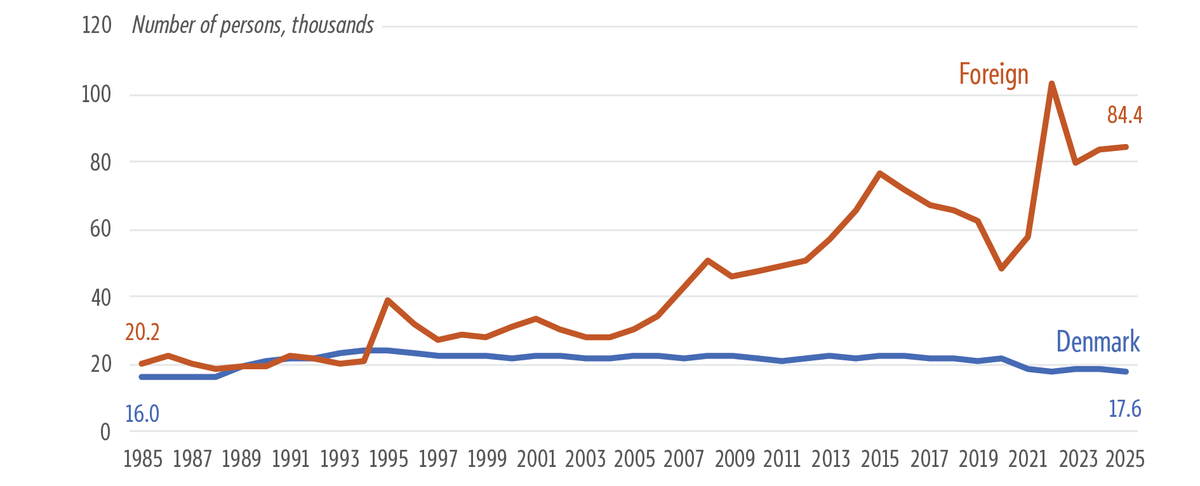
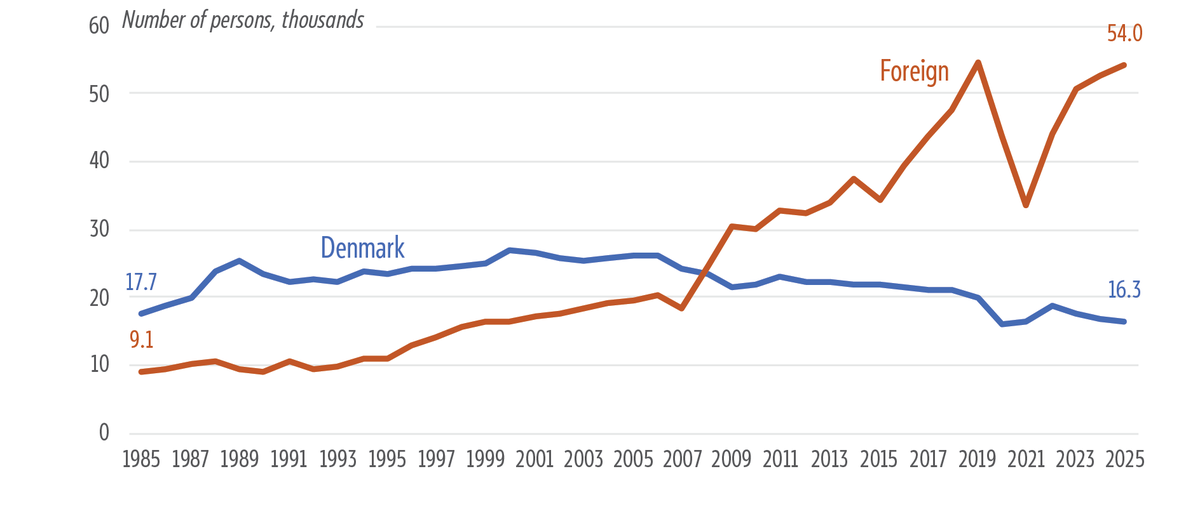
Migration has had a significant impact on Denmark in recent decades. Denmark's population grew from 5.1 million in 1985 to 6.0 million in June 2025 (most recent data available from Statistics Denmark), an increase of 18 %. Figures 1 and 2 illustrate how immigration and emigration by Danish and non‑Danish citizens evolved from 1985 to 2025. The number of Danish citizens living abroad immigrating to Denmark, as well as that of Danish citizens living in Denmark emigrating from Denmark, remained fairly stable during that period. However, significantly more foreigners arrived over time. While a much higher proportion of foreigners also started to leave since 2007, this was still fewer than those who arrived.
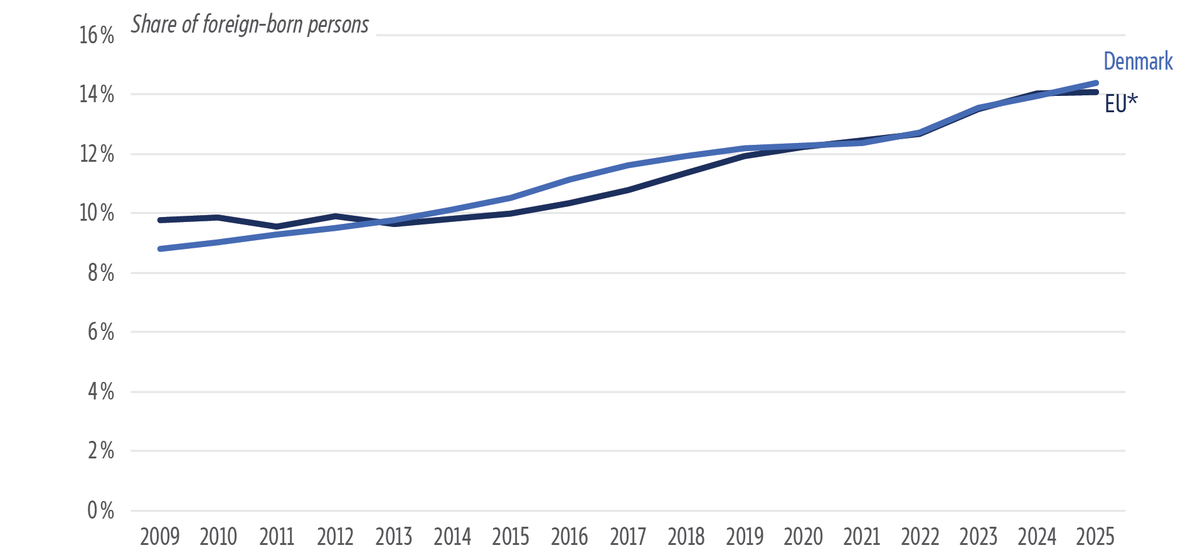
The share of immigrants as a percentage of the total population was 2.8 % in 1985 and 13.0 % in 2026. An immigrant is defined as a person born abroad whose parents are not Danish citizens and born in Denmark. If no information about either parent is available and a person is born abroad, that person is also considered an immigrant. Figure 3 shows how the increase in the share of foreign‑born is part of an EU‑wide trend from 2009 to 2025.
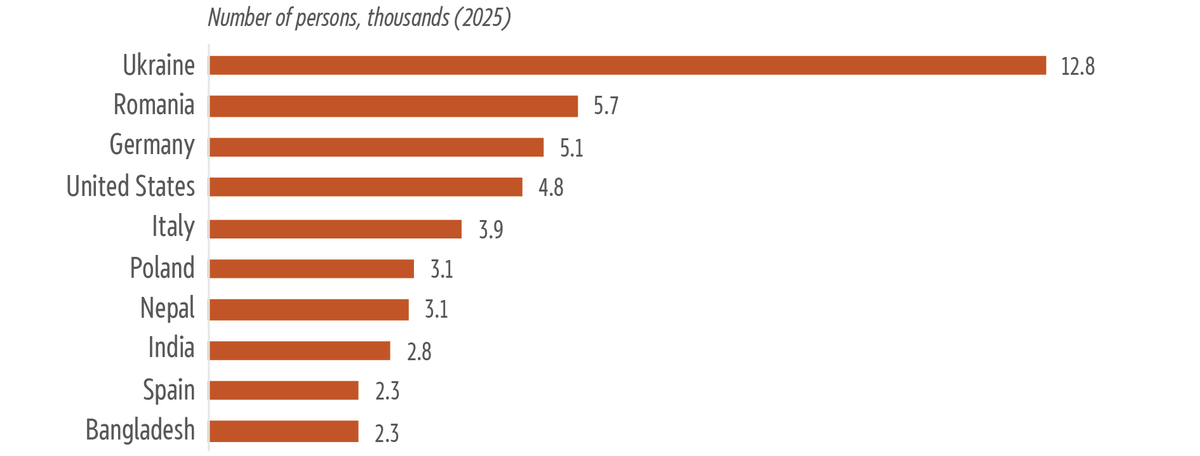
On 1 January 2025, non‑EU citizens represented 9.7 % (583 700) of Denmark's population, and EU citizens (not including those with Danish citizenship), 4.6 % (278 400), according to Eurostat. Figure 4 shows the top 10 countries of origin for immigrants arriving in Denmark in 2025. Immigrants from Ukraine rank first, which is likely due to the ongoing war in the country.
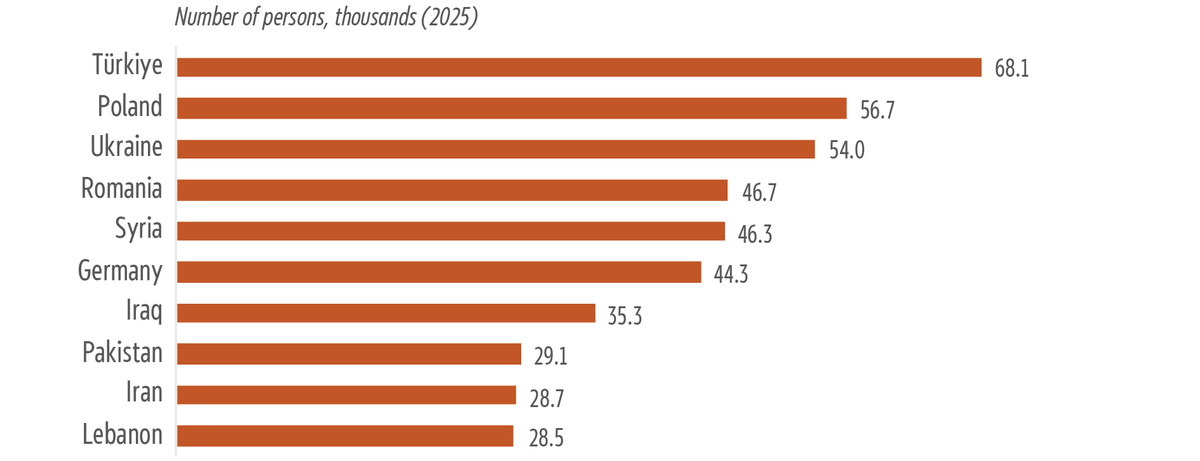
According to Statistics Denmark, the share of immigrants and their descendants as a percentage of the total population was 3.3 % in 1985 and 16.8 % in 2026. A descendant is a person born in Denmark whose parents are neither Danish citizens nor born in Denmark. If no information about either parent is available and the parent is a foreign citizen, the person is also considered a descendant. Figure 5 shows the top 10 countries of origin for immigrants and their descendants in Denmark in 2025.
According to Eurostat, when comparing the share of foreign‑born residents with other EU countries, Denmark ranks 13th, with 14.4 % of the population being born abroad on 1 January 2025, placing it roughly midway among EU countries. Compared with nearby or similar countries, Denmark has a lower share of foreign‑born residents than most; it is higher than Finland's (10.0 %), but lower than Sweden's (20.8 %) and Norway's (18.7 %). It is also lower than that of Germany (20.5 %) and the Netherlands (16.8 %).
Residence permits
In 2025, Denmark issued 701 residence permits for asylum; 2 300 for family reunification; 20 091 for study (excluding people from the EU/European Economic Area (EAA): 5 827 for work (fast‑track, pay limit scheme for people not from EU/EAA) and 3 269 for dependent family members for people who came to work, as well as 33 264 for people from the EU/EAA; as well as 816 for other residence cases. In addition, 12 633 Ukrainians were granted a residence permit under the Special Act, the national law on temporary protection for people displaced from Ukraine, according to Statistics Denmark.
Why Denmark overhauled its asylum policies
The need to protect Denmark's social security system is often cited as a motive for its restrictive asylum policies.The country is known for its generous welfare model that guarantees universal access to healthcare, family benefits, and pensions. Although the system enjoys broad support among Danes, many are concerned about the migrants' potential impact on it. For example, a 2023 survey among young Danes found that 34 % think refugees and immigrants abuse the welfare system.
A 2004 article by Peter Nannestad,which assessed whether immigration was a challenge to the Danish welfare state, concluded that this could be the case for non‑Western migrants and their descendants:
Immigrants from nonwestern countries and their descendants have been net beneficiaries of the Danish welfare state for a long period due, primarily, to lower labor market participation rates and higher unemployment rates compared to both immigrants from western countries and native Danes.
He noted that, although this could change with time, there was little evidence to suggest they could catch up with Danes or Western immigrants:
Typically, immigrants from nonwestern countries are still net beneficiaries of the welfare state even after more than 10 years of stay in the country. The educational achievements of second‑generation immigrants from nonwestern countries suggest that a considerable part will end up in the group of unskilled workers that faces ever decreasing demand in the Danish labor market.
A 2019 paper by Ole Agersnap, Amalie Sofie Jensen and Henrik Kleven found that a Danish measure to lower benefits for non‑EU immigrants by about 50 % led to a reduction of the net flow of immigrants by about 5 000 people per year, suggesting that some migrants might be interested in coming to the country for the benefits.
The Migration Policy Institute referred to Danish officials calling the country's restrictive asylum policies 'necessary' to 'ensure that benefits are only being offered to residents who fully contribute to tax revenue and other social structures'. The institute also pointed out that migrants' share of the population had increased strongly between 1980 and 2025.
A 2022 article by Jacob Nielsen Arendt, Christian Dustmann and Hyejin Ku on refugee migration and the labour market stated that reducing welfare payments to refugees were likely policy responses to the electorate's perception that refugees receive too much financial aid.
Martin Bak Jørgensen of Aalborg University called deterrence 'a primary motivation' behind the stricter policies, with most political parties agreeing there is a need to limit the number of refugees.
How Denmark translated its new approach to asylum into policies
With attitudes to asylum evolving in Denmark over time, existing policies were gradually adapted, and new policies adopted, in response to the new approach. As the country has an opt‑out relating to the EU's migration policies, it is able to go further than other EU countries.
Compared with other Member States, Denmark's asylum policies are more restrictive; returns are more of a priority, while protection is seen as something temporary. While many Member States consider asylum to be the start of a long‑term integration process aimed at fully absorbing asylum seekers into society, Denmark sees asylum as temporary, and aims to return those benefiting from international protection as soon as the situation allows. This results in stricter reception and residence rules, more limits on family reunification, a longer period to become a permanent citizen, and asylum seekers being asked to contribute towards the cost of sheltering them.
Conditions for asylum seekers
Specific rules exist regarding living conditions for asylum applicants in Denmark.
Asylum seekers have their living expenses (for instance, necessary healthcare, education and accommodation) covered by the immigration service; however, this does not apply if they are married to someone living in Denmark. They are entitled to a cash allowance – the basic allowance for an adult for a day is DKK 63.23 (about €8.46) – and may also be entitled to a supplementary allowance if they abide by a signed contract with the accommodation operator requiring them to take classes, take part in certain activities at the asylum centre or do work at the centre. Those expected to return may also be eligible if they sign a return contract with the Danish Return Agency.
Asylum seekers are not allowed to run their own business, but if they are aged 18 or older, they may work after prior approval by the immigration service; this permission is granted for one year at a time. They can apply for an extension before the current approval expires.
Any form of regular employment is allowed, provided that pay and working conditions are considered 'normal' for employment in Denmark. If an asylum seeker starts work before the contract with the immigration service has been signed, they could be fined or sent to prison.
Police are allowed to seize cash valuables from asylum applicants in Denmark to help pay for the cost of their stay in asylum centres. This applies to cash over DKK 10 000 (about €1 340) and to items estimated to be worth more than that. However, it does not apply to items with sentimental value such as wedding rings.
These items should be returned to the applicants when no costs have been incurred; for example, if the applicants leave Denmark before being placed in an asylum or accommodation centre.
Returns
Those who had their application for asylum rejected are expected to leave immediately. Danish authorities can use various means to encourage rejected asylum seekers to leave voluntarily.
To boost returns, Denmark offers incentives to those who failed their asylum claim or those who retracted it. Those who cooperate can apply for up to DKK 20 000 (about €2 680). This could be in the form of cash or in‑kind repatriation support.
Use of third countries for asylum claims and returns
In 1986, Denmark tabled a draft resolution in the United Nations (UN) General Assembly to create UN centres where asylum claims could be processed, in order to coordinate the resettlement of refugees among all states.
In September 2020, the Danish government appointed a new special envoy on migration to open reception centres outside the EU's borders and prevent 'as many spontaneous asylum‑seekers as possible'.
In June 2021, the Danish Aliens Act was amended. More specifically, Denmark's parliament passed Bill L 226, a legislative amendment that would allow the transfer of asylum seekers to a third country outside the EU for the purposes of both asylum processing and protection of refugees.3
In 2022, Denmark was reported to be in talks over the possibility of transferring asylum seekers to Rwanda. However, it now seems focused on working on this with other EU countries, and wanting the EU to play a role in setting up return hubs where such migrants could be placed.
On 17 June 2026, the European Parliament adopted the Return Regulation. Once the new rules enter into force, the they would allow EU countries to set up return hubs in non‑EU countries to host migrants who do not have the right to stay in the EU. Denmark is collaborating with Germany, Greece, the Netherlands and Austria on creating these return hubs outside the EU. They expect to announce agreements with third countries by the end of 2026.
Family reunification
Because of its opt‑out, Denmark is not bound by EU rules on family reunifications. The main piece of secondary EU legislation dealing with family reunification rights of third‑country nationals is the Family Reunification Directive, which applies in all EU Member States except Denmark and Ireland.
Family reunification for people with temporary protected status in Denmark
People who have been granted temporary protected status in Denmark are generally not able to sponsor someone for family reunification until their residence has been extended after two years of residence.
Several strict requirements have to be met before reunification can take place.
Specific family reunification rules apply to those wanting to reunite with a child. The child normally has to be under 15; for those aged 15 to 18, reunification is only possible under special circumstances.
Other migrants
Similar rules on family reunification as a spouse or partner exist for migrants who have a residence permit because of work or study, including EU citizens, Danish citizens and citizens from Nordic countries. The applicant and their spouse/partner would need to be at least 24 years old, meet the integration requirements, and actively participate in language learning.
European Court of Human Rights
Although Denmark has an opt‑out on some of the EU's rules, it is still bound by the European Convention on Human Rights. The country has been obliged to update its family reunification rules as a result of a ruling by the European Court of Human Rights.
The waiting period for family reunification was initially three years. However, Denmark reduced this to two years, after the Court found in the case M.A. v Denmark that authorities had failed to strike a fair balance between the applicant's needs individually and the country's economic wellbeing in their assessment of the applicant's request to be reunited with his wife.
Neighbourhood policy
In 2018, Denmark adopted what is known as the ghetto package, aimed at transforming neighbourhoods with a high percentage of immigrants. The legislation differentiated between 'vulnerable areas' and 'ghettos'. A vulnerable area is an area that has above‑average rates of at least two of the following criteria:
-
unemployment
-
criminal convictions
-
low education
-
low income.
A ghetto has to have above‑average rates of at least two of those criteria, in addition to being a housing area where immigrants and the descendants from 'non‑Western countries' make up more than half of the population. Denmark later changed the name from 'ghetto' to 'transformation area'.
If an area is designated as a ghetto or transformation area, authorities can decide to privatise or demolish social housing in that area, in the hope of encouraging other people to move there.
Residents of those areas could also be subject to double criminal penalties if found to have committed offences such as public‑order violations, assault, arson, vandalism, threats and extortion.
NGOs have voiced concerns about how the distinction in areas was being made, and about the impact the legislation would have on residents.
According to Amnesty International, the categorisation of neighbourhoods and the application of special measures 'clearly discriminates against certain people on grounds of their race and ethnicity, as well as due to their socially disadvantaged status'. They were also concerned that the privatisation and demolition of social housing would 'result in people being made homeless and others living in inadequate housing'.
In November 2019, the UN Committee on Economic, Social and Cultural Rights recommended that Denmark make changes to the legislation:
The Committee is concerned that it infringes upon rights such as the freedom of residence and the liberty of parents to choose their children's school. The Committee is also concerned that the law is discriminatory as it introduces the categorization of areas as 'ghettos', defined by the proportion of residents from 'non‑Western' countries. Thus it not only results in discrimination based on ethnic origin and nationality, but also further marginalizes those residents. In addition, the law provides for the doubling of sentences for crimes committed in 'increased punishment zones'. Furthermore, the Committee is concerned that rather than providing for support, the law introduces sanctions, such as the withdrawal of child benefit if parents do not enrol their children in mandatory language programmes or develop their Danish language skills at home.
The residents of one of the areas affected, Mjølnerparken in Copenhagen, are currently challenging a development plan for their neighbourhood, which was established on the basis of this legislation, and the case was referred to the Court of Justice of the European Union. On 18 December 2025, the Court issued a preliminary ruling to clarify which situations may constitute discrimination based on ethnic origin under EU legislation. However, it has left it to the national court to judge whether the Danish legislation in question gives rise to direct or indirect discrimination. The Danish court has not yet issued its final ruling.
Border controls
As of 4 September 2026, 10 Schengen states carry out checks at one or more sections of their internal borders to address migration and security threats.
Regulation (EU) 2016/399 (the Schengen Borders Code – SBC) lays down the rules governing the movement of persons across borders, including the conditions under which Schengen states may temporarily reintroduce checks at internal borders.
The SBC has been amended several times. The latest amendment (Regulation (EU) 2024/1717, in force since July 2024) revised the framework for the reintroduction of internal border controls, specifying new deadlines and additional monitoring and reporting requirements. Schengen states are allowed to extend temporary border control at internal borders for up to two years, with an additional year 'in major exceptional situations'. The revision also clarifies the measures that may be used as an alternative to border control (such as police checks), and introduces a new procedure for the swift transfer between Member States of third‑country nationals apprehended in border areas.
Denmark reintroduced checks at its internal borders on 4 January 2016 and continues to maintain them. The country issued the following notification on the introduction/continuation of its most recent internal border controls (12 July to 11 November 2026):
Continued threats to public policy and internal security posed by possible sabotage actions by Russia, as well as ongoing terrorism‑related incidents and organised crime, notably linked to the US‑Israeli conflict with Iran and radicalisation by groups such as Islamic State and Al‑Qaida with potential attacks on Jewish and Israeli targets; land and sea borders with Germany.
Acquiring Danish citizenship
Strict requirements make it challenging for migrants to become a Danish citizen. This generally includes the requirement to have continuously lived in Denmark for nine years. If people travel frequently abroad, this could affect their eligibility. They must also be able to support themselves financially, and have been in full‑time employment or engaged in self‑employment for at least three years and six months within the past four years. Having committed criminal offences can also prevent people from becoming Danish citizens.
Impact
While the change in policies is likely to have led to fewer refugees moving to Denmark to apply for asylum, it also had a significant impact on the lives of asylum applicants in the country.
Evolution of the number of asylum applications
The evolution of the number of asylum applicants in Denmark since 2000 has diverged from the general trend in the EU, as shown in Figures 6 and 7. For example, unlike the EU as a whole, the country did not experience a sharp rise in asylum applications from 2020 to 2023.
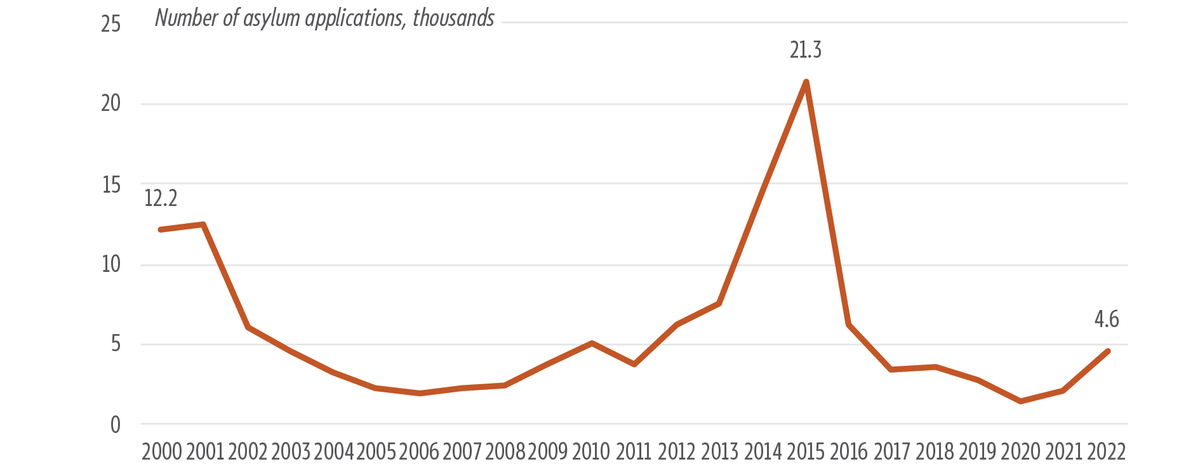
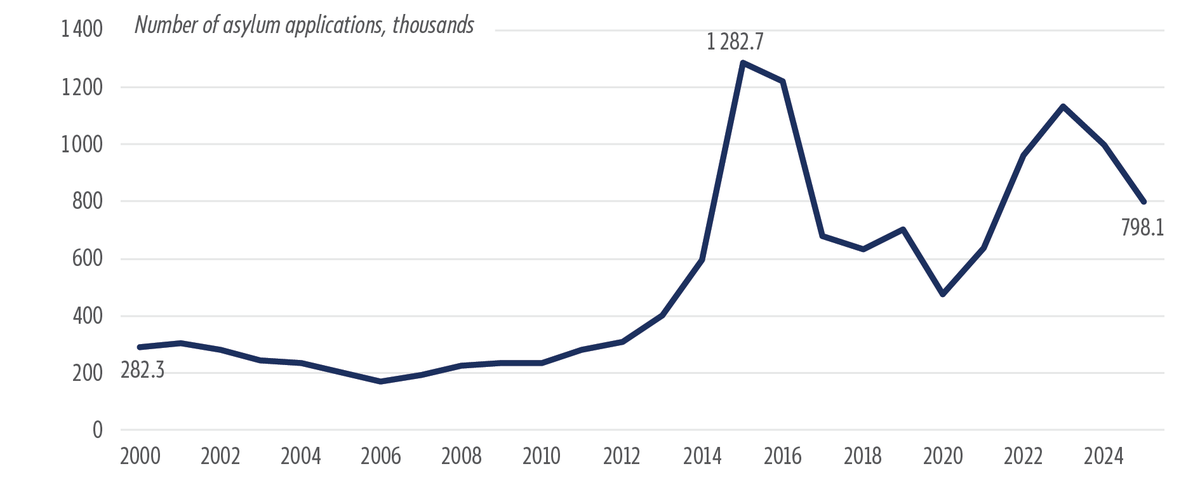
In 2015, Europe experienced a sudden and unexpected influx of asylum applicants, with more people than usual claiming asylum. According to estimates, some 1.3 million people asked for asylum that year,the highest number in a single year since World War II. The majority of applicants came from Syria, as a result of the civil war in the country, but there were also large numbers of applicants from countries such as Afghanistan, Iraq, and Pakistan , where people fled conflict, repression or severe insecurity.
The COVID‑19 pandemic in 2020 and 2021 led to fewer people migrating due to travel restrictions, resulting in a rebound of migration numbers in 2022 as restrictions were eased.
In the wake of Russia's February 2022 full‑scale invasion of Ukraine, many Ukrainians fled to other parts of Europe.
To determine whether Denmark receives more or fewer asylum applications than other EU countries, it is important to look at the asylum applications per capita, since countries with larger populations would be expected to receive more asylum applications. Examining per‑capita figures makes it easier to compare countries with different population sizes.
The European Union Agency for Asylum compiled asylum applications number per capita for all EU countries plus Norway and Switzerland for 2025. Out of these countries, Denmark ranks 23rd, significantly below the average.
As the situation can vary in different parts of Europe, it may also be insightful to compare Denmark with nearby and similar countries. Although fellow Nordic countries Finland, Norway and Sweden also receive below‑average asylum applications per capita, Denmark had the lowest ranking out of all of them. Germany, to the immediate south of Denmark, was ranked fourth for per‑capita asylum applications, significantly above the average. The Netherlands, with a similar economy and culture as Denmark, was ranked marginally below the average but higher than Denmark.
Refugees Welcome, a humanitarian organisation, points out on its website that refugees make up only 1 % of all foreigners granted residence permits in Denmark. In addition, it states that people with asylum as the basis for residence represent only 1.9 % of the population.
Impact on asylum seekers
A 2019 report by Dansk Flygtningehjælp (Danish Refugee Council) NGO revealed that the constant legal changes led to refugees experiencing stress, dissatisfaction, depression and anxiety. Of those surveyed, 70 % reported feeling financial issues affecting their wellbeing to a high or very high degree.
Denmark is marked significantly lower for its integration policies compared with nearby, similar EU countries in the 2025 Migrant Integration Policy Index. The index is a tool to compare integration policies across 56 countries in six continents, including all EU Member States. The countries are allocated points from 0 (critically unfavourable) to 100 (favourable). In 2025, Denmark was marked 49, as were Czechia and Greece, while Sweden was the highest‑ranking EU country with 86, followed by Finland with 84. Meanwhile, Germany was marked 58 and the Netherlands 57.
In 2022, Jacob Nielsen Arendt, Christian Dustmann and Hyejin Ku carried out a review of policies relating to refugee migration and the labour market in Denmark over the past 40 years. One of the questions examined was whether reducing welfare payments encouraged labour‑market participation. The authors conclude that there was a short‑term response in employment probabilities, particularly for men, but that these do not continue over the long term. In addition, these measures could push many refugee households below the poverty line, leading to 'higher criminal activity of refugees as well as their children'. The authors also pointed out that not knowing for certain whether they are allowed to stay long‑term in the country could cause refugees to invest less in their skills, which leads them to perform below their economic potential.
In a 2020 publication, Martin Bak Jørgensen also refers to the uncertainty faced by refugees in Denmark, as they could be returned to their country of origin once Danish authorities consider it safe:
The decision to declare a country safe can seem quite arbitrary, as it results more from bilateral agreements with economic gains than a genuine assessment of security risks. As an example, Somalia is now considered a safe country by the Danish authorities despite the ironic fact that Danish civil servants from the Foreigners' Service who negotiated the return agreement with the Somali government never dared to leave the airport in Mogadishu as it was not deemed safe enough for them. The Danish civil servants trusted the assessment of the Institute for Economics and Peace that the country is not considered a dangerous place despite its ranking as the fifth most dangerous country in the world. As a result of the agreement, hundreds of Somalis with refugee statuses living in Denmark now face deportation.
Main references
- Hedetoft, U., Denmark: Integrating Immigrants into a Homogeneous Welfare State, Migration Policy Institute, 2006.
- Leclerc, G. and Mentzelopoulou, M. M., Extraterritorial processing of asylum claims, EPRS, European Parliament, July 2025.
- Pace, M., The Danish 'paradigm shift' and the quiet rewriting of refugee protection in Europe, Refugee Studies Centre, July 2026.
- Wium Olesen, N., Elkjær Sørensen, A., Borring Olesen, T. and Farbøl, R., Danish immigration policy, 1970-1992, Aarhus University, 2019.
Endnotes
Classification
Policy areas: Area of Freedom, Security and Justice
Regions: European Union
Committees: Civil Liberties, Justice and Home Affairs (LIBE)
Statement on the use of AI
Any AI‑generated content in this text has been reviewed by the author(s).
Disclaimer
This document is prepared for, and addressed to, the Members and staff of the European Parliament as background material to assist them in their parliamentary work. The content of the document is the sole responsibility of its author(s) and any opinions expressed herein should not be taken to represent an official position of the Parliament.
Copyright
© European Union.
The reuse of this document is authorised under a Creative Commons Attribution 4.0 International (CC-BY 4.0) licence.

To use or reproduce elements that are not owned by the European Union, permission may need to be sought directly from the respective rightsholders.