
Article page checkbox is not checked in page info.
International dimension of the proposed Industrial Accelerator Act
International dimension of the proposed Industrial Accelerator Act
Marc Jütten and Marcin Szczepanski, Members' Research Service
Summary
The Industrial Accelerator Act (IAA) legislative proposal is designed to strengthen the EU's industrial base, reduce its dependencies, and shield it against unfair foreign competition, in particular through low-carbon and/or Union-origin requirements ('Made in Europe' clause) in public procurement procedures and public support schemes. The IAA is also seen as a direct response to unfair trading practices from (non-EU) third countries, particularly China, with which the EU runs an enormous trade deficit that reached €359.8 billion in 2025.
From an international trade perspective, an important element of the proposal is how the European Commission seeks to ensure the EU's international commitments in public procurement under the World Trade Organization Agreement on Government Procurement (GPA) and in EU trade agreements. The proposal, as it stands, would, in principle, allow certain third countries that have a free trade agreement with the EU or have signed the GPA secured access to the European public procurement market and to public support schemes. This has led to criticism that the 'Made in Europe' clause would, in practice, be too weak in view of the large amount of third countries that could be given access. However, according to the Commission, this would only apply if those countries grant reciprocal access to their public procurement markets. The IAA further establishes requirements for certain foreign direct investment (FDI) in selected emerging sectors, including key clean technologies. To ensure that FDI strengthens EU supply chains, promotes technology transfer, and supports quality job creation, the proposed IAA introduces conditions for investments above €100 million in sectors such as batteries, electric vehicles and critical raw materials.
Discussions are ongoing, in particular on how far the 'Made in Europe' rules should extend to EU trading partners. The European Parliament rapporteurs propose a more targeted 'opt-in' approach, setting a series of conditions under which third-country content may be treated as equivalent to Union origin to accelerate European industries effectively and boost economic sovereignty, while some business organisations prefer to use the concept of European preference in a more cautious manner, taking account of key trading partners.
Background: Industrial Accelerator Act proposal
Against the backdrop of productivity, competitiveness and strategic-dependency problems – as highlighted in the Draghi report on European Competitiveness – the EU is increasingly designing its policies as tools to strengthen economic security. This also holds true for the conception of a new economic foreign policy, as outlined in the European Commission's 2024-2029 priorities, a strategy that simultaneously pursues economic security, trade and investment in partnerships. On the one hand, the EU is committed to remaining one of the world's most open markets, and is looking to conclude new trade and investment agreements, for example with India or Mercosur; on the other, it aims for a stronger security-oriented trade approach, as described in the mission letter for Maroš Šefčovič, Commissioner for Trade and Economic Security. As a direct response to protectionism and unfair trading practices, the EU fosters its trade defence instruments and demonstrates greater readiness to deploy anti-dumping, anti-subsidy and safeguard measures. However, it is becoming apparent that the balancing act between keeping the EU economy open for trade and investment with the rest of the world, and the concept of a secure economy that protects and enables European companies to grow and create jobs in the EU, is growing both increasingly important and challenging.
The discussion surrounding one of the Commission's latest flagship initiatives seems to confirm this: on 4 March 2026, the Commission adopted the Industrial Accelerator Act (IAA) legislative proposal, designed to strengthen EU competitiveness and industrial resilience in the face of global pressures, unfair trading practices and strategic dependencies. The aim of the IAA is to boost demand for low-carbon, European-made industrial products such as steel, cement and aluminium, and for net-zero technologies such as batteries, solar, wind and heat pumps, ensuring that, by 2035, manufacturing represents 20 % of the EU's gross domestic product (compared with 14.3 % in 2024). Specifically, the IAA aims to introduce low-carbon and/or Union-origin requirements in public procurement procedures and public support schemes. It further establishes requirements for certain foreign direct investment (FDI) in selected emerging sectors, including electric vehicles and key clean technologies.
External impact of the IAA proposal
Although the IAA is an EU industrial policy instrument, it has a significant international dimension impacting the EU's common commercial policy. Notably, the EU would restrict trading partners' access to the EU market by setting up a series of new conditions. According to the proposal, whenever EU Member State governments spend public money in selected sectors – through procurement, subsidy schemes or auctions – products would need to meet what is referred to as 'Union-origin' requirements, low-carbon standards or both.The precise rules vary across sectors and instruments, as visualised by the Delors Centre in a recent policy brief. Compared with the present situation, this move would exclude certain foreign actors, in particular China, but also several of the EU's like-minded partners that have a trade agreement with the EU in place. In addition, the proposal would establish conditions for certain types of FDI.
Union origin in public procurement and public support schemes
The IAA would take into account the Union's international commitments in public procurement under the World Trade Organization (WTO) Agreement on Government Procurement (GPA) (see text box) and EU trade agreements. Article 8 of the proposal says that 'third countries with which the Union has concluded an agreement establishing a free trade area or a customs union, or that are parties to the GPA, shall be deemed to be of Union origin'. The EU has trade agreements with over 80 countries in place, and the GPA has been signed by 22 countries (with many of them also having a trade agreement with the EU). The conditions set out in the proposal would, for instance, lead to the exclusion of China from the EU's public procurement market, as the country has neither signed the GPA, nor does it have an FTA with the EU. Conversely, the United States (US), with which the EU does not have an FTA, is a signatory state of the GPA. Therefore, the US would, in principle, benefit from having access to public procurement procedures in the EU. However, one important specification in Article 8 states that only 'where relevant obligations of the Union exist under that agreement, [content] shall be deemed to be of Union origin'.
WTO Agreement on Government Procurement (GPA)
Formally adopted in March 2012, the GPA is a plurilateral agreement within the framework of the WTO, meaning that not all WTO members are parties to the Agreement. At present, the Agreement has 22 parties comprising 49 WTO members. The fundamental aim of the GPA is to mutually open government procurement markets among its parties. According to the WTO, the GPA parties have opened procurement activities estimated to be worth more than US$1.7 trillion annually to international competition (i.e. to suppliers from the GPA parties offering goods, services or construction services).The GPA is composed mainly of two parts: the text of the Agreement, and parties' market-access schedules of commitments. As a binding international treaty, the GPA is administered by the Committee on Government Procurement, composed of representatives of all the Agreement's parties. The Agreement is enforced through two mechanisms: the domestic review mechanism at the national level, and the WTO dispute settlement mechanism at the international level.
Consequently, as experts from the Bruegel think tank point out, if a third country has a trade agreement with the EU that does not contain public procurement commitments, economic operators or entities established in that country must be excluded from access to public procurement procedures in the EU (see also Figure 1). This would apply to some of the EU's FTA partners. India, for example, with which the EU officially concluded negotiations for an FTA on 27 January 2026, would fall out of the scope, since the envisaged FTA with India does not contain public procurement commitments, nor is India a signatory state to the GPA. The list of FTA partners benefiting from Union origin status would therefore be reduced significantly compared with the long list of countries with which the EU has an FTA in place. The Commission indicates that less than 30 EU FTAs contain public procurement rules, while negotiations with some additional countries are ongoing. However, even if a third country meets the formal requirements (GPA and/or FTA with relevant commitments), this is still no guarantee that its entities or operators will have access to public procurement procedures in the EU, as the Commission must adopt delegated acts (Article 8(2)) to exclude countries from the scope if that country has failed to provide national treatment relating to Union products or entities, or in order to avoid dependencies that may threaten the security of supply in the Union. According to the Commission, some countries have introduced protectionist measures relating to procurement contracts that hit EU companies. Countries that have applied such policies include Brazil, China, India, Indonesia, Russia, Türkiye and the US. However, given the recent developments in the EU's network of trade agreements, this list of countries could be reduced. The envisaged EU–Indonesia Comprehensive Economic Partnership Agreement, for which negotiations were concluded in September 2025, includes a chapter on government procurement, as does the EU–Mercosur agreement (of which Brazil is a signatory), which has applied provisionally since 1 May2026.
As the Commission opted not to establish upfront a single list of trusted third countries with fully secured access to the EU procurement market, clarity as to which third countries exactly would benefit from an equivalent to 'Union origin' status and secured access to the EU's public procurement market is currently lacking. Commission Executive Vice-President Stéphane Séjourné reportedly argued that the equivalence clause on EU origin would apply to only a very limited group of around 20 countries.
A similar approach applies to public support schemes. Here, the proposals states in Article 9 that 'content originating in third countries with which the Union has concluded an agreement establishing a free trade area or a customs union shall be deemed to be of Union origin'. Since the GPA criterion does not apply here, the restriction would, in this case, be even greater. US entities or operators, for instance, would fall out of the scope. The same applies to China.
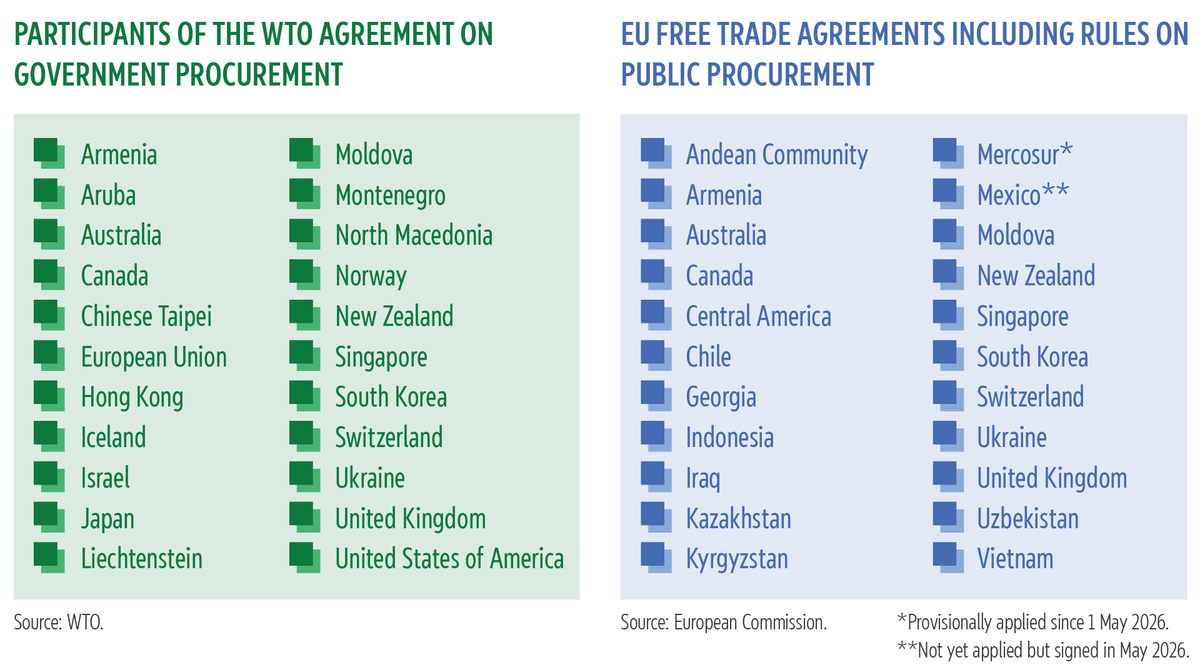
Source: Compiled by the authors, based on WTO and European Commission data; graphic by Nadejda Kresnichka-Nikolchova, EPRS, 2026.
Conditions for certain foreign direct investments
Another mandatory condition concerns FDI. To ensure that FDI strengthens EU supply chains, promotes technology transfer, and supports quality job creation, the proposed IAA introduces (Article 17 and following) conditions for investments above €100 million in emerging sectors such as batteries, electric vehicles, photovoltaics, and critical raw materials if more than 40 % of the global manufacturing capacity is held by the third country of which the foreign investor is a national or undertaking. Such investments must not be implemented unless explicitly approved by the Investment Authority or the European Commission. Third countries with which the Union has concluded FTAs or economic partnerships are exempt from these provisions, to the extent that the respective agreements include relevant commitments with regard to FDI, such as with Canada, Chile, New Zealand and the United Kingdom (UK).
Article 18 sets out six requirements for FDI, including having ownership interests below 49 % of the share capital; concluding agreements on licensing intellectual property rights; research and development spending of at least 1 % of the company's gross annual revenue; EU workers accounting for at least 50 % of the workforce; and a strategy – to be published on the investor's website – for enhancing EU value chains and ensuring that at least 30 % of inputs used for the products placed on the EU market are sourced from the EU.
The IAA and other EU procurement rules
The International Procurement Instrument (IPI) was adopted in 2022 with the aim of facilitating reciprocal opening of procurement markets in third countries. It is intended to be deployed when there is an apparent lack of reciprocal access to such markets to EU bidders. It enables the Commission to launch an investigation on its own initiative or as a result of a substantiated complaint by a Member State or an interested party. Tenderers from concerned countries could subsequently be subject to measures lowering their chances of successfully bidding in the EU, and could even be excluded from public procurement procedures altogether. In 2025, the Commission adopted the first IPI measure excluding Chinese companies from participating in EU public tenders for medical devices above €5 million. It also limited the share of Chinese medical devices to a maximum of 50 % in relevant contracts.
Crowell legal analysts say that the Commission increasingly seeks to rely on unilateral tools to address the regulatory gaps not fully covered by WTO rules. The IPI complements the WTO's GPA because it primarily applies to countries that are not signatories either to the GPA or to any other bilateral or multilateral procurement agreements with the EU. While the IAA has a more sectoral approach, the IPI focuses on the wider concept of reciprocity in procurement access. Both instruments may increase reciprocity of access. Legal firm GIDE sees the IAA as a complementary tool to the IPI, offering further negotiating leverage towards third countries. If third countries that have an FTA with the EU, particularly guaranteeing procurement reciprocity, are awarded 'content equivalent to Union origin' status, the IAA could create an incentive for other third countries to conclude such agreements.
On 9 September 2026, the Commission adopted a much-awaited proposal for a public procurement act (PPA). The proposal aims to simplify and modernise the legal framework by consolidating the three currently binding public procurement directives (and sector-specific legislation) into one regulation. Similarly to the IAA, it seeks to reduce harmful dependencies, address unfair practices, and strengthen European industrial capacity. It would introduce European preference provisions, to ensure public funding supports EU security, resilience and fair competition. The proposed act would allow for full access to EU procurement markets for operators and products covered by the EU's international procurement commitments, such as the GPA or FTAs with procurement commitments. This is similar to what the Commission proposed in the IAA for procurement but different from the IAA provisions for public support schemes (countries with which the EU concluded FTAs and customs unions). That means the act would cover the US but not China. Essentially, the PPA would become a horizontal framework for European-preference requirements and, as such, has been designed not to conflict with the sector-specific legislation. Therefore, the general rules of PPA would apply, unless the IAA, which is sectoral in character, provides otherwise, including on the determination of origin.
The PPA would facilitate exclusion of offers from third countries with which the EU does not have international procurement commitments, be it in the form of the GPA or an FTA, such as China. Authorities would also be able to restrict participation to EU or covered firms only, impose origin requirements, and apply a price discount or grant extra points to bids with EU-origin content. They would also be able to reject tenders where EU or equivalent/covered content accounts for less than half of the value. Importantly, the PPA would also enable restrictions and exclusion from EU procurement markets even for partners with FTAs or under the GPA where the Union's strategic interests so require. That would be the case for a country having failed to grant EU firms reciprocal treatment, in breach of its legal commitments. Other grounds include the protection of the EU's economic security interests and security of supply, where exclusion would be used to avoid dependencies or other risks. Such decisions would be implemented through Commission delegated acts, which can be objected to by the European Parliament and the Council. This is similar to the IAA, which also envisages the use of delegated acts by the Commission to exclude countries on similar grounds.
Other major procurement markets
United States
The 'America First' policy became even more pronounced with President Donald Trump's second term, impacting US procurement and trade policy. The US has traditionally had high local-content thresholds for many industrial goods in federal procurement. Moreover, the Global Trade Alert underlines that the US has historically led the use of discriminatory public procurement tools favouring domestic suppliers.
Notably, the GPA covers only 37 out of the 50 US states.Despite being its signatory, the US indeed raised numerous barriers to its procurement markets, applied both on federal and state level. They include predominantly the 'Buy America(n)' local-content requirements in public procurement, as well as other exceptions and restrictions, either sectoral (such as in defence and shipbuilding) or related to the size of the bidding enterprises (preferential treatment of US small and medium-sized enterprises) and procurement thresholds.1 Worth highlighting in the context of the IAA is the Build America Buy America Act (BABAA), a domestic content-procurement preference provision enacted as part of the 2021 Infrastructure Investment and Jobs Act (IIJA). It requires all iron, steel, manufactured products, and construction materials (non-ferrous metals, plastic, glass, cables, fibre, lumber, wood and drywall) used in infrastructure projects funded federally under the IIJA to be produced domestically in the US. For manufactured products, the percentage of US-made components in the purchased product must be at least 75 % by 2029. These provisions apply to all areas covered by the IIJA, including transportation, electrification, grid upgrade, carbon capture and storage, battery manufacturing, and critical-mineral supply chains.
Similarly, the Inflation Reduction Act under President Joe Biden supported a strong local-content requirement and 'Buy America' policy in procurement but was largely unwound by the second Trump administration. Instead, it enacted a trademark federal statute, the One Big Beautiful Bill Act (OBBBA). Regarding domestic content requirements, the OBBBA kept the rules for steel and iron unchanged at 100 % domestically produced. Regarding the manufactured product thresholds (set before OBBBA at a flat 40 %), the act progressively increases them to 45 % for construction between mid-2025 and 2026, then to 50 % for construction starting in 2026, and to 55 % for construction starting as of 2027.
Regarding FDI conditionality, the Committee on Foreign Investment in the United States (CFIUS) is mandated to consider the covered transaction's effect on supply chain resilience and security, both within and outside the defence industrial base, in manufacturing capabilities, services, critical mineral resources, or technologies that are fundamental to national security, including: microelectronics, artificial intelligence (AI), biotechnology and bio-manufacturing, quantum computing, advanced clean energy (such as battery storage and hydrogen), climate adaptation technologies, critical materials (such as lithium and rare-earth elements), elements of the agriculture industrial base that have implications for food security, and any other sectors. The US has also implemented conditionalities/restrictions in outbound investment. These prohibit certain investments involving 'countries of concern' such as China, and sensitive technologies and products (such as semiconductors, quantum and AI) that pose an acute national security risk. Authorities also require notification for investments in technologies with a lower risk profile.
China
The EU's largest trade imbalance is with China, which increasingly dominates strategic industrial sectors, value chains, and critical raw materials. The trade deficit has reached nearly €1 billion a day, resulting in a trade deficit of €359.8 billion in 2025. Access to China's significant public procurement market is largely restricted by laws, regulations and policies favouring domestic over foreign goods and services. A 2026 RAND corporation study shows that Beijing has been deploying government procurement over many years to promote various policy objectives such as indigenous innovation, security, and industrial leadership. Although China's public procurement policy is inconsistent with the GPA, it is complicated for the EU to legally challenge it, as China is not party to the GPA.
The country pursues an active Buy Chinese policy where, in practice, only domestic companies can win bids in public tenders, and foreign ones are only admitted under specific conditions. Government agencies and related entities are obliged to purchase equipment and technology from Chinese state or private companies unless they cannot be sourced domestically. The limited access to public tenders is made worse by inadequate transparency, and Buy Chinese covers all sectors. The State Council Notice on Implementing Domestic Product Standards and Related Policies in Government Procurement entered into force on 1 January 2026. It grants domestic products a 20 % price bonus over non-domestic products, meaning they can be 20 % costlier and still able to compete with foreign offers. The notice specifies the conditions that must be met for products to qualify as 'domestic': (i) they are manufactured in China; (ii) the cost of domestic components reaches the specified threshold; (iii) the key components and key processes of specific strategic products and critical manufacturing processes must be completed within China.
FDI conditionality is governed by the 2020 Foreign Investment Law, which is based on the principle of 'national treatment' – that is, it ensures that foreign investors enjoy the same standing and the same treatment as domestic enterprises. This applies to firms in sectors not subject to restrictions under the regularly updated Negative List for Access of Foreign Investment. The latest edition from 2024 identifies 29 sectors where foreign investment is restricted. It also mentions where FDI is prohibited altogether, for example in media, postal services, fishing, and tobacco sales. FDI outside the scope of the Negative List could still trigger a separate review under the National Security Review (NSR) mechanism. Investments that may affect national security or public interests, such as those in defence, critical infrastructure or sensitive technologies, are subject to additional scrutiny.
European Parliament position
In their draft report, Parliament's rapporteurs for the legislative file, Anna Cavazzini (Greens/EFA, Germany), Christophe Grudler (Renew, France) and Pierre Jouvet (S&D, France), from the Committees on International Trade (INTA), on Industry, Research and Energy (ITRE), and on the Internal Market and Consumer Protection (IMCO), are aiming at a significantly more restrictive scope than the European Commission proposes. They follow an opt-in approach: unlike the Commission proposal, countries do not qualify a priori as equivalent to Union origin by virtue of reciprocal access to the public procurement market through an FTA or the GPA. According to the rapporteurs' draft report, the Commission may adopt delegated acts in order to establish content originating in a third country to be of Union origin if several conditions are fulfilled, such as: de jure and de facto (legally and effectively) national treatment under the agreements establishing a free trade area or a customs union or the GPA; consistency with the Union's economic security; equivalent conditions of competition; and fundamental International Labour Organization conventions ratified and effectively implemented. Moreover, FDI requirements should already apply on investments exceeding €50 million.
Stakeholder positions
While stakeholders are broadly supportive of the IAA proposal as an industrial policy instrument, there is a certain division over how far the 'Made in Europe' rules should extend to non-EU trading partners. For example, BusinessEurope urges that the concept of European preference be used in a targeted and cautious manner, taking account of key trading partners, particularly those deeply integrated with the EU. Moreover, it argues that the proposal should be revised regarding FDI, as the proposal would risk developing a second, parallel system for FDI screening in the EU, leading to duplications, legal discrepancies, and increased administrative burden for both authorities and investors. ETUC, on the other hand, demands that the effectiveness of local content requirements and FDI provisions not be undermined by broad or poorly defined exemptions. Inclusion should be strictly limited to European Free Trade Association (EFTA) countries, EU candidate countries and the UK. According to ETUC, 'Made in Europe' should operate on an opt-in basis, whereby eligibility is conditional on demonstrating effective reciprocity, genuine value creation within Europe, and full compliance with EU social, labour and environmental norms, as well as respect for human rights. Any inclusion of additional strategic partners should remain exceptional, narrowly defined, and subject to these same binding conditions.
The European Economic and Social Committee (EESC) delivered an opinion stating that the proposed extension of Union origin to third countries under FTA or GPA participation does not ensure effective reciprocity or equivalent regulatory, environmental and cost conditions. Consequently, the EESC demands that the IAA incorporate explicit safeguards, subjecting any equivalence to Union origin to strict, verifiable conditions that guarantee effective reciprocity, compliance with EU standards, and protection of European value chains against distortive competition.
Some experts hold the view that, although the IAA procurement conditions as set by the Commission appear consistent with WTO and FTA obligations, the proposal to link consumption subsidies or other incentives to 'Union origin or equivalent' conditions entails a serious risk of legal challenge at the WTO by countries that are not party to an FTA with the EU.
China expressed grave concerns over the IAA proposal. According to the Chinese government, it would establish discriminatory requirements against foreign investors, and could violate fundamental WTO principles. China is threatening to take countermeasures if the EU ignores China's suggestion and insists on pushing the legislation through.
Main references
- European Commission, Industrial Accelerator Act, website.
- García Bercero, I., Collin, A. M., McWilliams, B. and Tagliapietra, S., The flaws in the European Union's proposed Industrial Accelerator Act and how to fix them, Policy Brief Bruegel, May 2026.
- Jäger, P. and Redeker, N., Paradigm Shift in Principle, Paper Tiger in Practice? How to Make the Industrial Accelerator Act Count?, Policy Brief, Jacques Delors Centre, June 2026.
- Szczepański, M., Strengthening EU economic security – From crisis response to proactive anticipation: Joining the dots for a resilient economy, EPRS, European Parliament, March 2026.
- Widuto, A., Industrial Accelerator Act, EPRS, European Parliament, May 2026.
Endnotes
Classification
Policy areas: International Trade
Regions: European Union
Committees: International Trade (INTA)
Statement on the use of AI
Any AI-generated content in this text has been reviewed by the authors.
Disclaimer
This document is prepared for, and addressed to, the Members and staff of the European Parliament as background material to assist them in their parliamentary work. The content of the document is the sole responsibility of its author(s) and any opinions expressed herein should not be taken to represent an official position of the Parliament.
Copyright
© European Union.
The reuse of this document is authorised under a Creative Commons Attribution 4.0 International (CC-BY 4.0) licence.

https://creativecommons.org/licenses/by/4.0/deed.en
To use or reproduce elements that are not owned by the European Union, permission may need to be sought directly from the respective rightsholders.