
Article page checkbox is not checked in page info.
Capping and degressivity of direct payments: Limiting hectare-based payments to big farms
Capping and degressivity of direct payments Limiting hectare-based payments to big farms
Nikolina Šajn, Members' Research Service
Summary
In the EU, 20 % of farms get 80 % of hectare-based direct payments under the common agricultural policy (CAP). This has been an issue since the introduction of these payments, and successive European Commissions have tried to solve it by capping these payments, but this measure has so far been optional for Member States. As part of the ongoing CAP reform, the European Commission has proposed a mandatory annual cap of €100 000 per farm, with a progressive reduction of the hectare-based payments starting at €20 000.
Issue
Since the introduction of decoupled area-based CAP payments in 2005, 20 % of farms have been getting around 80 % of direct payments. The ratio has remained largely unchanged, despite successive CAP reforms experimenting with various systems of progressive reduction (degressivity) and/or capping of direct payments. This is mostly because direct payments are largely paid by the hectare and their distribution therefore reflects the concentration of agricultural land: the 20 % biggest beneficiaries of direct payments account for about 80 % of EU agricultural land.1 However, these ratios differ among Member States. For instance, in Slovakia, Czechia, Estonia, Latvia and Romania, the 20 % biggest beneficiaries received more than 85 % of direct payments, while in the Netherlands, France and Luxembourg they received less than 55 % of the national direct payments envelope. The largest beneficiaries of direct payments include large agricultural enterprises but also family-run farms. According to the European Commission, farms with 5 to 250 hectares, which make up about half of all farms, receive over 70 % of direct payments and manage 68 % of EU farmland.
A small number of holdings received very large amounts of direct payments. A 2021 European Parliament study identified the 50 largest CAP beneficiaries in 2018 and 2019. These included natural persons, public bodies, limited liability companies and other legal persons, some of which received tens of millions of euros in CAP funding (not just direct payments). According to a 2026 article published in The Guardian, the United Arab Emirates royal family benefited from more than €71 million in CAP subsidies from 2019 to 2024. A 2024 article published in The Guardian reported that 17 billionaires were linked to €3.3 billion in CAP subsidies over 2018-2021. A 2026 Greenpeace study focused on some of the top 1 % beneficiaries in six countries, including extremely wealthy individuals and companies receiving millions of euros. At the same time, a 2026 European Parliament study on farm income concluded that small farms have a greater need for income support than larger farms, as they cannot benefit as easily from economies of scale. It also concluded that the system of basic hectare-based income support, which provides generic support to all farms, should be improved to make the use of CAP funds more efficient.
Current CAP rules
According to the CAP Strategic Plans (CSP) Regulation, Member States are required to redistribute at least 10 % of the adjusted envelope for direct payments from big to small and medium-sized farms.2 They are required to do this by paying a top-up on the first hectares through the complementary redistributive income support for sustainability (CRISS), which provides a top-up for the first hectares, unless they can demonstrate that they can achieve the target by other measures, such as capping and/or degressivity of payments under the basic income support for sustainability (BISS).
If Member States introduce capping, they must reduce by 100 % any portion above €100 000 of the amount of the BISS granted to a farmer for a given calendar year. If they introduce degressivity, they can reduce the amount of the BISS exceeding €60 000 by up to 85 %, and can set additional ranges and percentages above €60 000.3 Currently, four Member States apply only capping, two apply only degressivity, and five apply both capping and degressivity. Member States can deduct labour costs before applying these ceilings (see Figure 1).
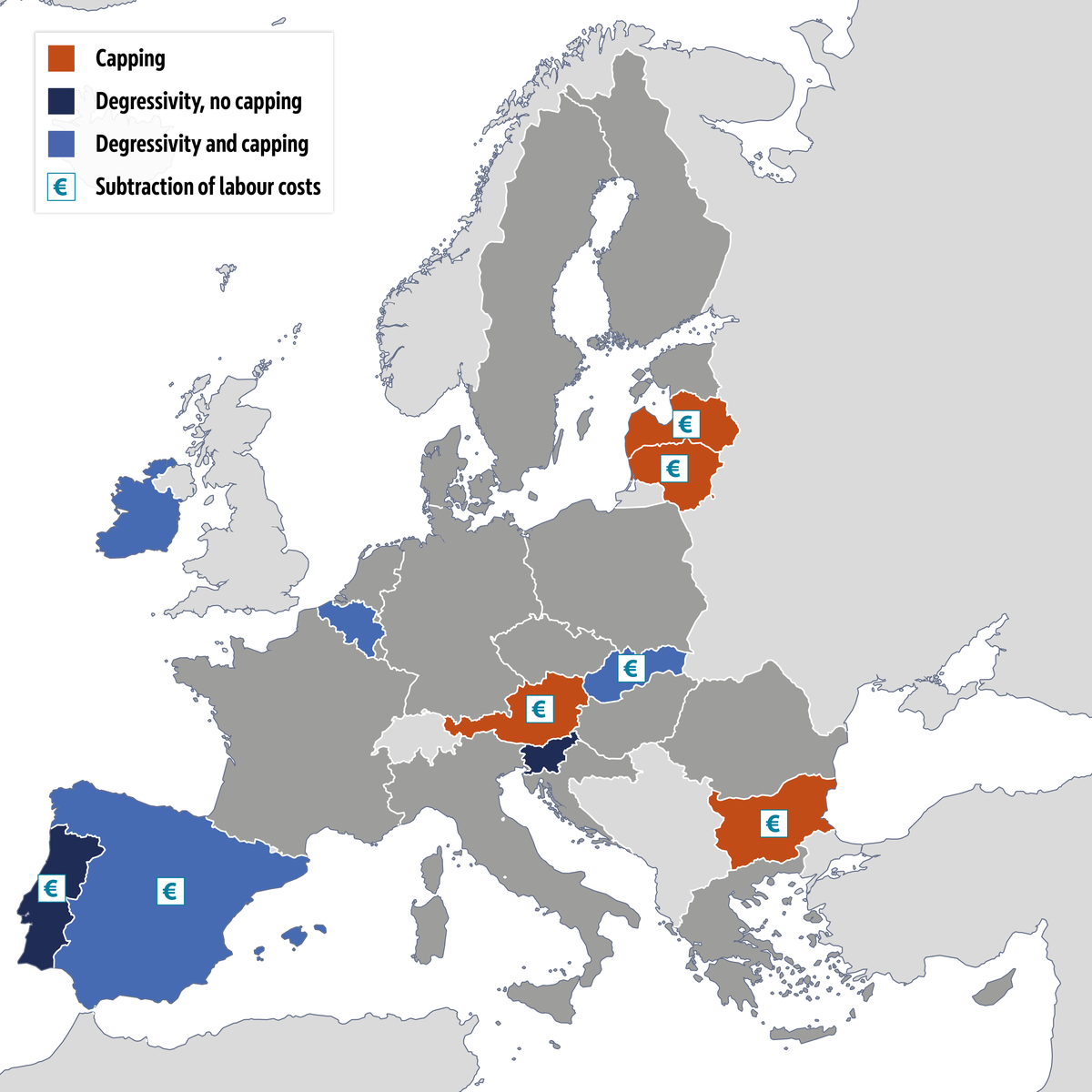
Image source: European Commission, Basic income support for sustainability (BISS). Graphic by Samy Chahri, EPRS.
Member States that apply degressivity and capping expect modest savings, which in most of them do not exceed 1 % of the direct payment allocation (see Table 1).
| Member State | Savings planned for 2023-2027 (€) | Allocation of direct payments (€)* for 2023-2027 | Savings as a share of direct payments (%) |
|---|---|---|---|
| Belgium | 1 304 657 | 2 373 737 980 | 0.05 |
| Bulgaria | 60 087 143 | 4 106 170 629 | 1.46 |
| Ireland | 7 000 000 | 5 931 409 980 | 0.12 |
| Latvia | 384 953 | 1 713 584 517 | 0.02 |
| Lithuania | 1 500 000 | 3 012 267 192 | 0.05 |
| Portugal | 6 350 000 | 3 486 264 037 | 0.18 |
| Slovakia** | 20 000 000 | 1 658 501 962 | 1.21 |
| Slovenia | 5 988 546 | 657 650 260 | 0.91 |
| Spain | 54 258 200 | 24 141 642 092 | 0.22 |
Data source: National CAP strategic plans, CAP Strategic Plans Regulation, EPRS calculations.
* The adjusted direct payments based on Annex IX of the CSP Regulation.
** Slovakia's figures are calculated over four years.
According to the national CSP plans, all Member States applying capping and/or degressivity use the resulting savings to finance the CRISS. The only exceptions are Lithuania, which uses these savings primarily for payments to young farmers, and Slovakia, which transfers the savings to the rural development CAP pillar.
Commission proposal
The Commission's proposal for the 2028-2034 CAP would require the new basic payment – degressive area-based income support (DABIS) – to be differentiated by farmer group or geographical area, with support targeted at farmers most in need (Article 6). Applying capping and degressivity to DABIS would be mandatory. Degressivity would apply to annual DABIS payments above €20 000 per farm, so the payments would be reduced as follows:
-
by 25 % from €20 000 to €50 000;
-
by 50 % from €50 000 to €75 000;
-
by 75 % from €75 000 upwards.
The amount of the DABIS would not be allowed to exceed €100 000. Farms would reach this amount only if, before the application of degressivity (i.e. before payments reductions), they were entitled to €255 000.
For instance, a large farm would receive the following payments: the first €20 000 would not be reduced; for the bracket from €20 000 to €50 000, it would receive €22 500 instead of €30 000; for the bracket from €50 000 to €75 000, it would receive €12 500 instead of €25 000; and for the bracket from €75 000 to €255 000, it would receive €45 000 instead of €180 000. This would bring the payments received to €100 000.
Member States would be able to set the average DABIS payment per hectare between €130 and €240. If the payment is €240 per hectare, farms would reach €20 000 and therefore become subject to the first degressivity bracket (involving a 25 % reduction) if they exceed 83 hectares, while if the payment is €130 per hectare, farms would become subject to degressivity if they exceed 154 hectares. The cap would apply to farms from 1 063 and 1 962 hectares, respectively (see Figure 2).
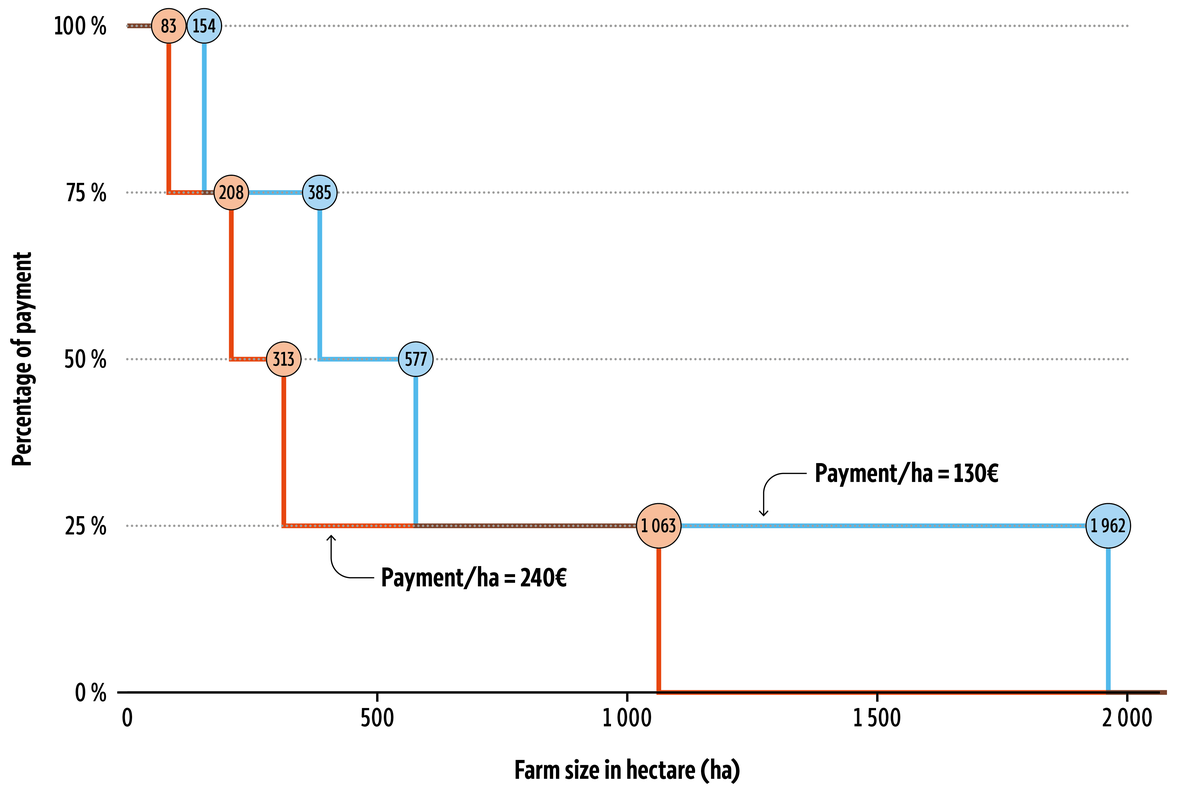
Image source: Data compiled by the EPRS based on the Commission's CAP proposal, COM(2025) 560. Graphic by Samy Chahri, EPRS.
Who could be affected by the Commission's proposal
The Commission has estimated that degressivity of DABIS would affect relatively few farmers, as, in 2023, around 4 % of CAP beneficiaries received more than €20 000, while some 1 600 farms received between €100 000 and €255 000 of basic payments and would be subject to capping.
However, some Member States could be affected more than others, including Germany, where large farms are concentrated in the eastern part of the country. A study (in German) on the impact of the reform on Saxony estimates, for instance, that, given the farm structure in that federal state, where many small and medium-sized farms coexist with many large agricultural companies and corporate groups (the 100 largest of which manage 30 % of agricultural land), the total amount of direct payments in Saxony could decline from €164 million in 2024 to between €82 million and €120 million, depending on the payment per hectare. According to the European Commission's report on indicative figures for CAP support in 2023, capping would affect a significant share of direct payments in Czechia, Estonia and Bulgaria, for instance.4
On the other hand, large agricultural companies could still partly avoid capping if they operate through subsidiaries, in particular if the subsidiaries are located in different Member States, as capping and degressivity would apply only to payments in a single Member State, rather than to a beneficiary's combined payments across the EU.5 There are also concerns that big companies could artificially split up their farms to avoid capping. The low degressivity threshold of €20 000 could make this option less attractive for big companies.
Legislative process
The Commission's proposal, published on 17 July 2025, is now under consideration by the European Parliament and the Council. In Parliament's Committee on Agriculture and Rural Development (AGRI), the rapporteur, Norbert Lins (EPP, Germany), suggested in his draft report scrapping degressivity for area-based payments, increasing the cap to €500 000 and calculating the amounts per natural person. Member States could still apply a cap of €100 000 per farmer, but on a voluntary basis. The planned average payment per hectare for (D)ABIS would range from €130 to €200. Redistributive payments would continue.
At this stage, the Council draft compromise amendments, put forward by the Cyprus Presidency, do not include any proposals regarding capping and degressivity. It appears that the Member States are divided on the issue, with Germany in particular, but also Czechia, Italy, Hungary, Slovakia and Sweden, publicly expressing their opposition to making capping and degressivity mandatory.
Stakeholder views
COPA and COGECA, which represent farmers and cooperatives in the EU, have accused the Commission of not respecting the diversity of EU agriculture. They have also commented that the 'nonsensical approach to area-based income support via degressivity and capping ignores the need to support all farmers genuinely contributing to food security'. On the other hand, Via campesina, which represents small-scale farmers and 'peasant farmers', welcomed the inclusion of capping and degressivity for direct payments, but called for the cap to be set even lower, at €60 000. It argued that this could minimise the negative consequences of the CAP's focus on hectare-based payments, which 'benefit mainly the largest farms in Europe, drive land concentration and impede the inclusion of young farmers'. It also gave a mixed review to the AGRI draft report. Several environmental organisations – the Institute for European Environmental Policy (IEEP), the European Environmental Bureau (EEB), Greenpeace and the World Wide Fund for Nature (WWF) – all welcomed the proposed mandatory degressivity and capping of the area-based income support in favour of farmers who need it the most, as a step towards making the CAP fairer.
Endnotes
Classification
Policy areas: Agriculture and Rural Development
Committees: Agriculture and Rural Development (AGRI)
Statement on the use of AI
Any AI-generated content in this text has been reviewed by the author. ChatGPT was used for translation to broaden the range of sources available to the author.
Disclaimer
This document is prepared for, and addressed to, the Members and staff of the European Parliament as background material to assist them in their parliamentary work. The content of the document is the sole responsibility of its author(s) and any opinions expressed herein should not be taken to represent an official position of the Parliament.
Copyright
© European Union.
The reuse of this document is authorised under a Creative Commons Attribution 4.0 International (CC-BY 4.0) licence.

https://creativecommons.org/licenses/by/4.0/deed.en
To use or reproduce elements that are not owned by the European Union, permission may need to be sought directly from the respective rightsholders.