
Article page checkbox is not checked in page info.
Ceasefire agreement in northeast Syria: Assessing progress in implementation
Ceasefire agreement in northeast Syria Assessing progress in implementation
Carmen-Cristina Cîrlig, Members' Research Service
Summary
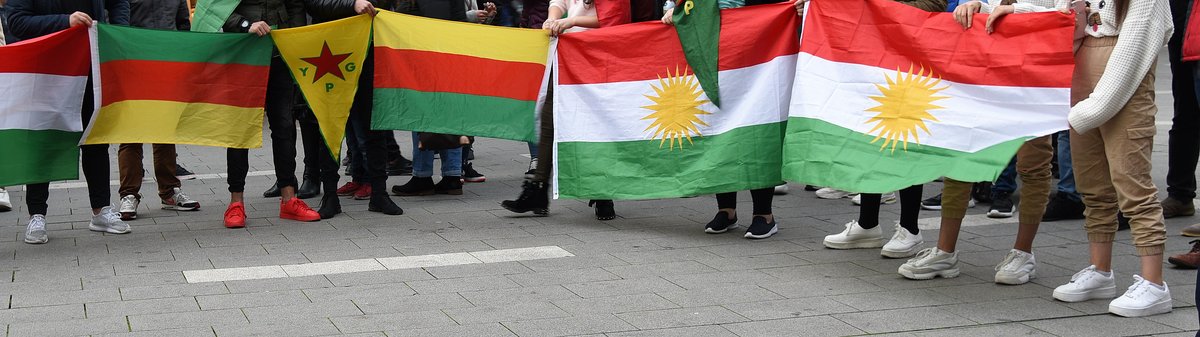
The 10 March 2025 agreement between the Kurdish-led Syrian Democratic Forces (SDF) and the Syrian interim authorities aimed to integrate the security and civilian institutions established in northeastern Syria into the state structures by the end of the year. Its failure prompted a rapid government offensive in January 2026, which led to the SDF losing a vast majority of territory. The resulting violence displaced over 170 000 people and raised serious concerns about the SDF-guarded detention centres and camps holding Islamic State (ISIL/Da'esh) fighters and their families.
A new agreement, signed on 30 January 2026, ended the fighting but also weakened hopes for preserving Kurdish autonomy. The deal provides for a comprehensive ceasefire and a phased integration of the SDF and the administrative structures of the Autonomous Administration of North and East Syria (AANES) into Syrian state institutions. While slow, progress in implementation has been visible.
External players remain influential in post-Assad Syria. The United States (US), the Kurds' main ally against ISIL/Da'esh, has shifted its support to the Syrian interim authorities, a move criticised as an 'abandonment' of the Kurds. Conversely, Türkiye has, directly or through proxies, fought against the SDF, viewing its main component, the Kurdish People's Protection Units (YPG), as an offshoot of the terrorist-designated Kurdistan Workers' Party (PKK).
Since the fall of the Assad regime in December 2024, the European Union (EU) has called for a peaceful and inclusive transition and the protection of all minorities. The EU welcomed the January 2026 agreement and announced the resumption of the EU-Syria cooperation agreement. The European Parliament also welcomed the deal, while insisting on the need to ensure Kurdish civil and educational rights and political representation.
The Kurds in Syria
Estimated at 35 million, the Kurdish population is spread across Iraq, Iran, Türkiye and Syria. Kurds are Syria's largest minority, believed to account for 10 % of the population. They are concentrated mainly in the country's northeast, spread across three cantons (Afrin, Kobane and Jazira) in two non-contiguous areas along the borders with Türkiye and Iraq. Kurds refer to this territory as Rojava or Western Kurdistan. According to 2011 data, around half of Syria's Kurds outside these areas lived in Aleppo and Damascus.
Syria's Kurds have been subject to ethnic discrimination and human rights violations during the Assad and previous regimes. The 1962 decree deprived over 120 000 Kurds of their Syrian citizenship and thus of their civil rights,1 while the Assad regime's Arab Belt project was a policy of forced Arabisation in Kurdish areas along the Syrian-Turkish border, in order to 'prevent the formation of a contiguous Kurdish region across borders'.
The Kurds take up the fight against ISIL/Da'esh (2012-2019)
Unlike the Kurds in neighbouring Türkiye, Iraq and Iran, the Kurds in Syria did not engage in insurgency against their state, apart from a 2004 uprising. In the past, however, many Syrian Kurds were recruited into the Kurdistan Workers' Party (PKK). Designated by Türkiye, the US and the EU as a terrorist organisation, the PKK waged an insurgency against the Turkish state until recently. Building on a previous structure (the People's Self-Defence Units (YXG), formed in 2011), the People's Defence Units (YPG ) were officially established in July 2012, followed by the Women's Protection Units (YPJ) in April 2013. With PKK support, the YPG took control of territory vacated by Assad forces, committing itself to defending Kurdish areas against Islamist groups and liberating all Kurdish territory in Rojava. From the outset, the YPG allied itself with non-Kurdish forces in northeastern Syria, including Christian and Arab tribal fighters, to fight Islamist militias. By late 2013, these forces numbered around 35 000 fighters. They were officially renamed the Syrian Democratic Forces (SDF) in October 2015.
Despite Turkish objections, the YPG/SDF became the United States' main ally on the ground in the fight against ISIL/Da'esh, after the setbacks of the 'train and equip' programme for the Turkish-backed Syrian opposition. The first instance of US support for the YPG was the siege of Kobane, whose liberation in January 2015 marked the first battlefield defeat of ISIL/Da'esh in Syria. Between 2015 and 2019, the Kurdish-led SDF, with US support, successfully pushed back ISIL/Da'esh. In May 2017, US President Donald Trump approved the direct arming of the YPG.2 In March 2019, the SDF proclaimed the territorial defeat of ISIL/Da'esh in Syria and the elimination of its 'caliphate'. By April 2019, the SDF was in control of 28 % of Syrian territory. At the end of January 2026, the SDF numbered 70 000 fighters.
De facto autonomy for northeast Syria during the civil war
In the political arena, numerous Syrian Kurdish parties are organised into two main alliances: the Kurdish National Council in Syria (KNC), supported by Masoud Barzani's Kurdistan Democratic Party (KDP), which rules the Kurdistan Region of Iraq, and the Syrian Democratic Council (SDC), established in 2015 and dominated by the Democratic Union Party (PYD), considered to be the PKK's offshoot in Syria and the political party behind the YPG. The Syrian Democratic Council serves as the political umbrella of the Autonomous Administration of North and East Syria (AANES) and the SDF.
During 2012-2014, the PYD-YPG movement established itself as the 'hegemonic politico-military power in northern Syria'. The YPG disbanded other Kurdish militias in areas under its control and refused to allow the Iraqi-based Roj Peshmerga fighters into Syria, while reportedly coercing its Kurdish opponents. By 2013-2014, the PYD had established the Kurdish Autonomous Region and adopted a Social Contract, which included the Arab, Kurdish, Turkmen, Christian and Armenian communities in the decision-making mechanism. The AANES was formally established in September 2018 to administer seven regions in northeastern Syria (including Arab-majority areas formerly under ISIL/Da'esh rule), which include some of the country's most significant oil and gas fields and wheat reserves.
The PYD and the KNC
Relations between the PYD and the KNC have been historically strained. The PYD, established in 2003, has been linked to the PKK, whereas the KNC, a coalition of 18 Kurdish groups, was founded in 2011 with the backing of the Kurdistan Regional Government (KRG) in Iraq, which shared Türkiye's goal of limiting PKK influence in Syria. The 7 000-strong Roj Peshmerga, in Iraqi Kurdistan, is the military arm of the KNC.
KRG attempts at reconciling the KNC and PYD resulted in several agreements (2012, 2013 and 2014) to jointly administer the Kurdish areas, establish a common position in talks with the Assad regime and unite against ISIL/Da'esh. These efforts failed to materialise, as the PYD established its dominance in northeastern Syria. Three Turkish land invasions in northern Syria (2016, 2018 and 2019) and waning US support prompted new efforts at reconciliation in 2020, but these too reached a deadlock over several issues.
After the fall of the Assad regime, Kurdish parties once again tried to form a united front. Both the SDC and the KNC rejected the constitutional declaration signed on 13 March 2025 by Syria's interim president, Ahmed al-Sharaa. In April 2025, at the 'Unity of Kurdish position in Rojava' conference, the KNC, the PYD and the AANES called for a fair resolution of the Kurdish issue in Syria through 'democratic decentralisation' and the establishment of a joint Kurdish delegation to start talks with Damascus to this end, among other demands. The interim government rejected these demands, warning against 'separatist attempts'.
After the 30 January agreement, other disagreements emerged. The PYD boycott of the electoral process means that only KNC affiliates have been appointed to the transitional parliament, while the KNC has accused the PYD of monopolising talks with Damascus.
Negotiations between the Syrian government and the SDF
Following the collapse of the Assad regime, Syria's interim president, Ahmed al-Sharaa, announced in January 2025 the dissolution of all military factions and their integration into state institutions. In December 2024, SDF commander Mazloum Abdi expressed readiness to engage with the new authorities in Damascus and with Türkiye, against the backdrop of SDF territorial losses in the Aleppo area to the Turkish-backed Syrian National Army and protests in the SDF-ruled majority-Arab provinces.
On 30 December, al-Sharaa and Abdi met for the first time through US mediation. Talks thereafter focused on the oil and gas fields and other resources under SDF control, the integration of the SDF into state security structures and the fate of the prisons and camps housing ISIL/Da'esh prisoners and their families.
Differing positions
To address the situation in northeastern Syria, President al-Sharaa emphasised the need to preserve Syria's unity, ensure the departure of foreign militants, restore the state's monopoly over the use of force and integrate SDF forces into the Syrian army on an individual basis.
The SDF insisted on a 'decentralised secular state based on democracy' and the integration of SDF forces as a unified bloc within the army. However, wary of the US' withdrawal from Syria and another possible Turkish invasion, in January 2025, the SDF indicated its willingness to hand over oil resources to Damascus, provided they were fairly distributed among Syrian provinces, and to withdraw the non-Syrian Kurdish (i.e. PKK) fighters from Syria.
The 10 March 2025 agreement
Talks between Damascus and the SDF led to an agreement on 10 March 2025, instituting a ceasefire and providing that:
-
all Syrians are guaranteed the right to representation and participation in the political process and in all state institutions, regardless of religion and ethnicity;
-
the Kurdish community is recognised as an integral part of the Syrian state, which guarantees its citizenship and other constitutional rights;
-
the civil and military institutions in northeastern Syria would integrate into the Syrian state;
-
all displaced Syrians would safely return to their towns and villages.
Joint committees were tasked with defining the details and implement the agreement by the end of the year. The agreement did not address decentralisation or autonomy for the Kurds. Internationally, the agreement was widely welcomed, while Türkiye continued its military operations in northeastern Syria against 'Kurdish militants'.
On 1 April 2025, another agreement was reached on Sheikh Maqsoud and Ashrafiyeh, Aleppo's majority-Kurdish neighbourhoods, which had been under SDF control since 2015. It provided for the withdrawal of SDF forces and the release of detainees. Only the Asayish, the SDF-linked police force, was to remain, pending its integration into the Interior Ministry. Two days later, the parties exchanged more than 200 prisoners, but by June 2025, the deal ran into blockages.
Collapse of the agreement
Amid Kurdish demands for decentralisation and a constitution enshrining Kurdish rights, as well as disagreement over the integration of the SDF as a unified bloc into the army, implementation of the March deal soon stalled and effectively stopped in July 2025, when violence in the Druze-dominated Suwayda in southwestern Syria prompted the SDF's refusal to disarm. In early August, clashes broke out between the SDF and Syrian army forces, while a Kurdish conference calling for decentralisation and 'a new democratic Syrian constitution' led Damascus to suspend the next round of talks. Regular clashes continued in the Aleppo and Raqqa areas, despite the agreed ceasefires.
While diplomatic efforts intensified at the end of 2025, Commander Abdi reaffirmed the SDF's priorities, including: changing the constitutional declaration to include clauses on Kurdish rights; drafting a permanent Syrian constitution, through an inclusive process; decentralisation; and organisational autonomy for the SDF within the Syrian army. However, on 22 December, fighting resumed in Aleppo, leading to the collapse of the March agreement.
Government offensive and the 30 January 2026 agreement
In early January 2026, against the backdrop of the US declaration of support for the Syrian government as the primary force against ISIL/Da'esh, and Türkiye's increased pressure on Damascus to escalate operations against the SDF, government forces advanced rapidly into SDF-held areas. By 11 January, they had taken control of Aleppo's Kurdish-majority neighbourhoods and, by 18 January, had entered into SDF-controlled Raqqa, Al-Hasakah and Deir Ez-Zor, seizing key infrastructure. Arab tribal forces also rose against the SDF.
At the same time, on 16 January 2026, President al-Sharaa issued Presidential Decree No 13, granting Syrian nationality to all Kurds residing in Syria, prohibiting discrimination, establishing Kurdish as a national language alongside Arabic (which remains the sole official language), guaranteeing the right to education in Kurdish in Kurdish-majority areas and declaring Newroz (a celebration observed by the Kurdish community) a national holiday. The AANES welcomed the move, but stressed that real guarantees required 'a comprehensive constitutional framework'.
On 18 January, a US-brokered ceasefire agreement, favouring Damascus, provided for a comprehensive ceasefire; the handover to the Syrian government of Raqqa and Deir ez Zor governorates, as well as all border crossings and oil and gas fields in northeastern Syria; the integration of all civilian institutions in Hasakah province into state structures; and the integration of SDF forces on an 'individual basis'. The government committed to appointing SDF nominees to senior military, security and civilian posts in state institutions and to taking over the SDF-managed prisons and camps. The SDF pledged to remove all non-Syrian PKK members from Syria. The safe and dignified return of residents of Afrin and Aleppo to their areas would be ensured. Renewed fighting led to the rapid collapse of the agreement. By 25 January, more than 170 000 people had fled their homes in northeastern Syria.
Fears of Islamic State resurgence
The fighting raised concerns about the SDF-managed detention centres and camps holding ISIL/Da'esh fighters and the women and children associated with them. Between 2018 and 2019, some 10 000 men and teenagers were placed in detention facilities, while 60 000 women and children were placed in camps in northeastern Syria. This detention system collapsed in early 2026, reportedly 'chaotically and with little transparency', after years of international reluctance among countries to repatriate their citizens and cuts in US funding for the camps.
In September 2025, SDF prisons held around 8 400 ISIL/Da'esh detainees from over 70 countries, with many of their families among the displaced persons in the al-Hol and Roj camps. In December 2025, the population of the al-Hol camp stood at 23 411 people, and that of the Roj camp at 2 324, most of whom were children (over 60 %) and women (over 30 %). The US had pushed for their repatriation, citing humanitarian and security concerns related to ISIL recruitment and radicalisation, while demanding that central authorities assume responsibility for the facilities.
After the escape of 200 ISIL prisoners on 20 January 2026, by 13 February the US had transferred 5 700 ISIL prisoners to Iraq, including over 3 500 Syrians. Reports of an 'exodus' of around 20 000 people (mostly women and children) from the al-Hol camp, including 6 000 foreign nationals, raised fears about a growing terrorist threat. Government authorities took over the camp and relocated the remaining residents. Repatriation efforts are underway to close Roj, the last active camp, which mostly holds foreign nationals (94 %).
-
the withdrawal of forces from the contact lines and the deployment of Interior Ministry forces into Al-Hasakah and Qamishli for a 'specific period', to assume control of civilian institutions and start the integration of local security forces;
-
the integration of the SDF into the Syrian army through a division comprising three SDF brigades, and an additional brigade within a division operating in the Aleppo governorate;
-
the integration of AANES institutions into the Syrian state;
-
the appointment of Kurdish officials to local and central government posts;
-
the recognition of Kurdish educational certificates;
-
addressing Kurdish civil and educational rights, building on Presidential Decree No 13;
-
the return of displaced persons.
The agreement did not address the key Kurdish demands for decentralisation and for enshrining Kurdish rights in the constitution. Moreover, the SDF lost 80 % of the territories under its control, dashing hopes for its decentralised, community-led project.
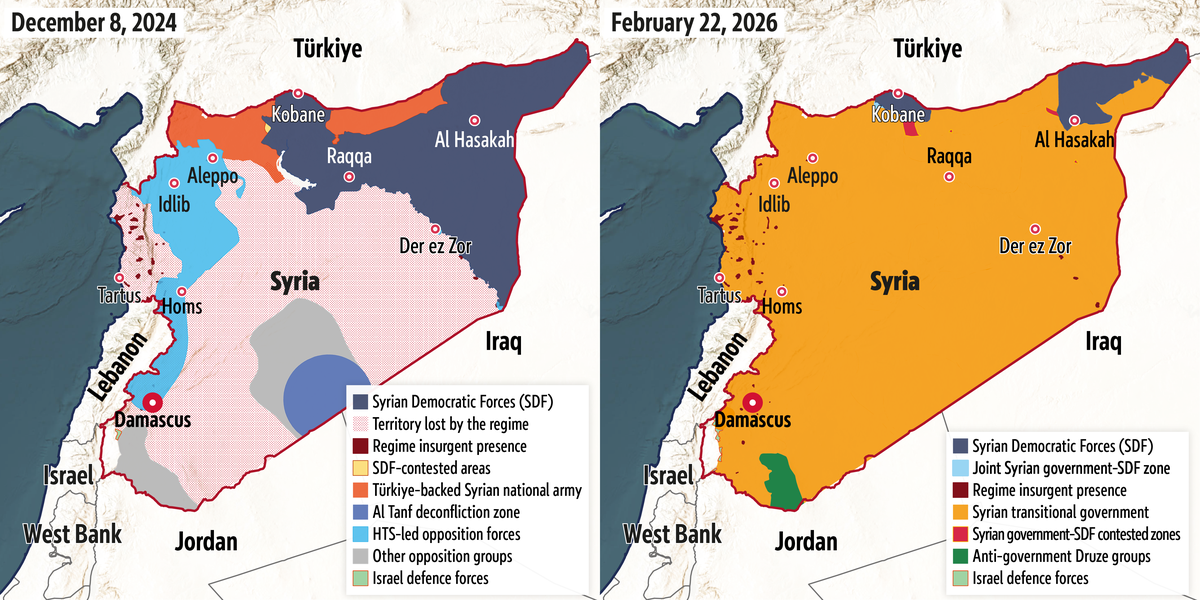
Image source: EPRS, based on the Institute for the Study of War and AEI's Critical Threats Project. Graphic by Samy Chahri, EPRS, 2026.
Implementation of the ceasefire agreement
Implementation started on 2 February 2026 and there has been some progress despite differences of interpretation and some SDF factions opposing the deal, including the Women's Protection Units (YPJ). The UN Security Council welcomed the agreement on 12 February. Nevertheless, restrictions on humanitarian access and public services in Kobane continued well after the ceasefire.
Security aspects
The tense discussions in the first months focused on the structure of command and control, the status and ranking of SDF officers within the Syrian army and the future of security forces such as the Asayish. Despite divergences, progress was made: in March, Kurdish YPG commander Sipan Hemo was appointed Deputy Minister of Defence for the Eastern Region and, in early May, integrated brigades were established under the 60th and 72nd divisions, with four brigades drawn from SDF ranks (3 000 fighters each) deployed in Kobane, Al-Hasakah, Qamishli and Derik. Senior SDF commander Ciya Kobani was also appointed deputy commander of the army's 60th division operating in Aleppo. Other positive steps towards integration have been the start of joint training of brigades in Damascus and salary payments by the Defence Ministry, as well as the emergence of a framework for official recognition of SDF fighters killed or injured in the fight against ISIL/Da'esh. The integration of the 15 000 Kurdish Asayish into the Ministry of Interior has started, and joint patrols with government forces have been carried out.
Moreover, in February, the transfer of at least 100 PKK militants to Iraqi Kurdistan was reported.
Progress was also made on the detainee file, although the phased approach has been criticised. Between March and June, prisoner swaps led to the release of over 1 200 SDF detainees and more than 500 individuals held by the SDF. Exchanges are set to continue until the file is resolved.
The SDF had also started dismantling checkpoints and had handed over control of the region's prisons by late April.
Another major issue is the return of people displaced from Afrin following the 2018 Turkish operation that led to the occupation of the city. By early June, five groups of displaced Kurds (4 200 families) returned to Afrin, with another 1 300 families set to return once the school year ends. However, many returnees have found their homes looted, and disputes over property rights and other intercommunal tensions have erupted.
Several issues remain unresolved, such as the integration of more SDF forces into the Syrian army, the structure of future divisions and brigades, and the surrender of SDF heavy weapons. The SDF still exercises independent security authority in the region, although coordination with the government has improved. The integration of the Asayish remains a sensitive issue, and the fate of the YPJ (Women's Protection Units) remains undecided, as Damascus opposes their inclusion in the army, favouring instead internal security roles.
Since February, Kurdish-Arab tensions in northeastern Syria have flared occasionally in relation to prisoner swaps, the integration of SDF forces into local structures and state symbolism, suggesting local resistance to the integration and triggering fears of broader confrontation.
Economic aspects
The transitional government has taken control of key assets, including oil and gas fields, the Qamishli Airport and important border crossings. Furthermore, it has begun implementing state customs procedures in the northeast. Until integration is finalised, the SDF will continue to collect border revenues and taxes, and some oil revenues (talks are ongoing for a final agreement on oil production sharing). Progress has also been registered in the agricultural sector.
Political aspects and administrative integration
Around 50 000 AANES employees are set to keep their posts in the state structures. Practical progress has been made in some areas, such as healthcare, with the integration of AANES workers and the appointment of officials of Kurdish origin. Another notable appointment is that of a high-level SDF official as al-Hasakah governor. The process of granting Syrian citizenship to more than 10 500 Kurdish individuals who have made naturalisation requests under Presidential Decree No 13 of 2026 is also underway.
On the other hand, the transfer of judicial institutions to Damascus has run into obstacles, contributing to tensions on the ground. Criticism has also emerged over the political and cultural rights of the Kurds, who claim that Syria's transitional system provides them with limited meaningful representation. A recent government reshuffle did not take SDF proposals into account. Moreover, although the electoral process for an indirectly-elected legislature 3 resumed in the northeast, many Kurdish parties rejected the selection in May of nine representatives (Kurds and Arabs) for Qamishli, Kobane, al-Hassakah and Afrin. Unlike the KNC, the PYD boycotted the process, arguing that it was undemocratic and biased against Kurds. The issue of Kurdish language rights and education is 'non[-]negotiable' for most Kurds, who demand the constitutional recognition of Kurdish as an official language and the right to education in Kurdish in Kurdish-majority areas. The government agreed to recognise all middle and high-school diplomas issued by AANES so far, while children graduating in 2026 and 2027 from AANES schools will receive their diplomas from the Syrian state. Discussions continue regarding curricula after 2027 and the recognition of AANES-issued university diplomas.
Role of external powers
External powers still play a key role in Syria's new political order. While Israel (which, since the fall of Assad, has extended its occupation of Syrian territory beyond the Golan Heights) is keen on stoking tensions between the regions and Damascus, the US and Türkiye prefer a centralised state to fragmentation.
The United States, the YPG/SDF's main ally against ISIL/Da'esh, has kept a limited troop presence in AANES since 2019. However, after President Trump's support shifted to Syria's interim leadership and after Syria joined the Global Coalition against ISIL/Da'esh in November 2025, the US pressured the SDF into negotiating with Damascus. By mid-April 2026, the US handed all its bases in Syria over to the Syrian interim government.
Türkiye has been seen as the winner of the Syrian civil war, having backed opposition groups against the Assad regime. It currently enjoys strong ties with Syria's interim leadership. Between 2016 and 2019, three Turkish military operations in Syria targeted the YPG/SDF. As the new peace process between Türkiye and the PKK unfolds, Türkiye has, since May 2025, backed the SDF and AANES integration into the Syrian state, while threatening military action if integration stalls and rejecting demands for Kurdish autonomy. Despite the ceasefire, around 10 000 Turkish troops are set to remain in northern Syria, possibly until 2028.
Outlook
Although progress is slow, the integration process is advancing amid many challenges. The Kurds' deep mistrust of the interim authorities in Damascus is reinforced by their lack of political representation in the transition and the concentration of power in the hands of President al-Sharaa. Another difficulty lies in bridging the gap between the Kurds' secular approach and the central authorities' Islamist vision. The prospects for constitutional recognition of the Kurdish community and the Kurds' individual rights will also determine the success of the integration. Finally, according to some experts, a lasting settlement can only stem from 'a participatory and inclusive political process', whereas according to others, the deal could become a model for integrating other minorities, such as the Alawites and the Druze, even if it ends the prospect of Kurdish autonomy.
The European Union
The European Council has on several occasions underlined the need for a peaceful, inclusive and Syrian-led transition, for the protection of the rights of all Syrians without discrimination and for full respect for Syria's independence, sovereignty and territorial integrity.
On 28 May 2025, the EU lifted all economic and financial sanctions on Syria, while maintaining sanctions linked to the Assad regime and introducing restrictive measures against those responsible for the violence against Alawites in March 2025.
Since 2011, the EU and its Member States have mobilised nearly €37 billion in assistance to Syrians in Syria and the region. Donor pledges at the ninth Syria Conference in 2025 reached €5.8 billion, including €2.5 billion pledged by the EU for 2025 and 2026. On 9 January 2026, the EU proposed a new framework for cooperation with Syria, including a new political partnership; economic cooperation, in particular the resumption of the EU-Syria cooperation agreement; and a €620 million financial support package for 2026 and 2027.
On 10 January 2026, the EU called for an end to hostilities between the SDF and government forces, the protection of civilians and improved access to humanitarian aid. On 19 January, the EU High Representative welcomed the ceasefire and emphasised that the integration process should involve meaningful political and local participation and the full protection of Kurdish rights. On 30 January 2026, the EU welcomed the agreement between the SDF and Damascus.
At the first EU-Syria High-level Political Dialogue on 11 May 2026, the EU announced the resumption of the 1978 EU-Syria Cooperation Agreement, partially suspended in 2011. The EU is also preparing to launch a Technical Assistance Centre to help build the capacity of Syrian institutions and strengthen cooperation with the private sector.
The European Parliament
Since the fall of the Assad regime, Parliament has adopted two resolutions: on the need for EU support towards a just transition and reconstruction in Syria (March 2025) and on the urgent need to protect religious minorities in Syria (July 2025).
On 10 February 2026, Parliament debated the situation in northeastern Syria. Underlining the role of Kurdish fighters in supporting the Global Coalition against Da'esh, EU parliamentarians insisted that the ceasefire must respect Kurdish rights, representation and local governance, reaffirmed the need to protect all minorities in Syria, and emphasised that EU support must have clear conditionality attached. The next day, Parliament adopted a resolution that backs the 30 January agreement and calls for full recognition, political participation and equal rights of the Kurdish community. Parliament also called on the EU and its Member States to combat the resurgence of Da'esh and urged Türkiye to stop its military intervention in northeastern Syria.
Parliament's Foreign Affairs committee is drafting a report on EU-Syria political relations.
Main references
- Loft, Ph., 'Syria one year after Assad: Forming an interim government', House of Commons Library, January 2026.
- Knights, M. and van Wilgenburg, W., 'Accidental Allies: The U.S.–Syrian Democratic Forces Partnership Against the Islamic State', London: I.B. Tauris, 2022.
Endnotes
Acknowledgements
Any AI-generated content in this text has been reviewed by the author. Perplexity.ai was used to improve the readability of the text.
Disclaimer
This document is prepared for, and addressed to, the Members and staff of the European Parliament as background material to assist them in their parliamentary work. The content of the document is the sole responsibility of its author(s) and any opinions expressed herein should not be taken to represent an official position of the Parliament.
Copyright
© European Union.
The reuse of this document is authorised under a Creative Commons Attribution 4.0 International (CC-BY 4.0) licence.

https://creativecommons.org/licenses/by/4.0/deed.en
To use or reproduce elements that are not owned by the European Union, permission may need to be sought directly from the respective rightsholders.