
Article page checkbox is not checked in page info.
Nuclear deterrence in Europe and the French 'forward deterrence' initiative
Nuclear deterrence in Europe and the French 'forward deterrence' initiative
Sebastian Clapp, Members' Research Service
Summary
Europe's nuclear deterrence architecture is undergoing its most significant transformation since the end of the Cold War. Russia's invasion of Ukraine, repeated nuclear coercion by Moscow and growing uncertainty regarding the long-term reliability of US security guarantees have returned nuclear deterrence to the centre of European defence policy. NATO continues to define itself as a nuclear alliance, with the United States (US) providing the core of its deterrence posture through nuclear-sharing arrangements, while France and the United Kingdom (UK) maintain independent nuclear forces. European allies are modernising nuclear infrastructure, introducing B61‑12 gravity bombs and F‑35A dual-capable aircraft, and increasing readiness through exercises and enhanced nuclear planning. Although France and the UK possess credible and survivable nuclear arsenals, experts generally agree that their capabilities complement rather than replace the US nuclear umbrella.
In response to the deteriorating security environment, France has sought to expand the European dimension of its independent deterrent through President Emmanuel Macron's 2026 'forward deterrence' initiative. The proposal envisages deeper strategic consultations, allied participation in French nuclear exercises and the potential deployment of French nuclear-capable aircraft to allied territory. However, France retains exclusive control over nuclear decision-making and explicitly rejects any form of nuclear sharing or formal extension of deterrence guarantees. The initiative therefore aims to strengthen European involvement in deterrence while preserving French strategic autonomy.
The European Parliament recognises nuclear deterrence as an important component of European security, and highlights the role of French and British nuclear forces in protecting Europe. At the same time, it reaffirms support for the Nuclear Non‑Proliferation Treaty and calls for stronger efforts to prevent proliferation, improve arms export controls and strengthen Europe's overall security architecture.
Introduction
Europe's security environment has dramatically changed since Russia's war against Ukraine, persistent nuclear coercion by Moscow and growing uncertainty surrounding the future role of the US in European security have reignited debate about the role of nuclear deterrence on the continent. Russia's full-scale invasion of Ukraine in 2022 demonstrated that large-scale interstate war remains a reality in Europe, while Moscow's repeated nuclear threats have highlighted the continued importance of nuclear weapons as tools of coercion and strategic influence. At the same time, uncertainty over the long-term reliability of US security guarantees has increased. Concerns about the future of transatlantic relations, combined with Washington's growing strategic focus on the Indo-Pacific, have raised questions about the extent to which the US will continue to underpin Europe's conventional and nuclear deterrence posture. These developments have prompted concerns that Europe needs to assume greater responsibility for its own security, either because US commitments weaken or because Washington becomes less willing to bear the primary burden of extended nuclear deterrence. In this context, France has sought to expand the European dimension of its independent nuclear deterrent while maintaining exclusive national control over nuclear decision-making. In March 2026, President Emmanuel Macron announced a new concept of 'forward deterrence', aimed at deepening strategic dialogue and practical cooperation with European partners. The initiative reflects a broader French effort to foster a shared European strategic culture and strengthen Europe's capacity to act in an increasingly contested security environment.
NATO nuclear deterrence
Europe is currently undergoing the most significant transformation of its nuclear posture since the end of the Cold War. After three decades during which the role of nuclear weapons steadily declined within European security policy, concerns about strategic instability, Russian aggression and the long-term reliability of transatlantic security guarantees have returned nuclear deterrence to the centre of defence planning. While the overall number of nuclear weapons deployed in Europe remains far below Cold War levels, NATO member states are investing heavily in modernisation programmes, infrastructure upgrades, operational readiness and nuclear planning mechanisms to ensure that deterrence remains credible.
NATO defines itself as a nuclear alliance and views nuclear weapons as a core component of its broader deterrence and defence posture alongside conventional forces, missile defence, cyber capabilities and space assets. The alliance maintains that the primary purpose of nuclear weapons is to preserve peace, prevent coercion and deter aggression. The 2022 NATO strategic concept states: 'NATO will take all necessary steps to ensure the credibility, effectiveness, safety and security of the nuclear deterrent mission. The Alliance is committed to ensuring greater integration and coherence of capabilities and activities across all domains and the spectrum of conflict, while reaffirming the unique and distinct role of nuclear deterrence'. Political control over nuclear policy remains highly centralised through the Nuclear Planning Group (NPG), NATO's principal body for consultation and decision-making on nuclear matters. Through the NPG, all NATO members – with the exception of France – participate in discussions on nuclear strategy, force posture, exercises and deterrence policy, reinforcing the principle that nuclear deterrence remains a collective alliance responsibility rather than the exclusive domain of the nuclear-armed states. France, the UK and the US are NATO's three nuclear-weapon states under the Non‑Proliferation Treaty. While the US provides the core of NATO's nuclear deterrent, the independent nuclear forces of the UK and France also contribute to the alliance's security. France does not participate in NATO's nuclear arrangements, including the NPG, because since the presidency of Charles de Gaulle it has maintained a doctrine of strategic autonomy, insisting that its nuclear forces must remain under exclusive national control and outside multinational command structures.
A central pillar of NATO's deterrence architecture is the nuclear-sharing arrangement. By distributing both the political responsibilities and operational risks associated with nuclear deterrence, these arrangements reinforce alliance solidarity and cohesion. They also provide participating allies with a role in shaping NATO's nuclear policy and posture that they would otherwise not possess. From an operational perspective, nuclear sharing offers both military and political instruments for deterrence and can contribute to escalation management during crises. Moreover, nuclear sharing serves as the clearest manifestation of the US's extended deterrence commitment to its European allies and contributes to limiting incentives for nuclear proliferation across Europe.
In practical terms, NATO's nuclear-sharing arrangements mean that participating allies share not only the benefits of US extended deterrence, but also its political responsibilities and operational risks. They participate in nuclear decision-making through NATO's NPG, contribute dual-capable aircraft, personnel and infrastructure to support NATO's nuclear mission, and, if authorised, could deliver US nuclear weapons in a conflict. In return, they accept that these assets and bases could become priority targets in a crisis or war, reinforcing alliance solidarity and burden sharing. A NATO nuclear mission involving US nuclear weapons requires political consultation and approval within the NATO NPG, but the release and use of the weapons ultimately requires authorisation from the US president.
According to the Bulletin of the Atomic Scientists, the US Air Force is estimated to deploy between 100 and 120 B61‑12 non‑strategic nuclear weapons in Europe under this arrangement. (Strategic nuclear weapons are designed to deter or conduct large-scale nuclear war by targeting an adversary's homeland, leadership or nuclear forces; non‑strategic (tactical) nuclear weapons are intended for battlefield or regional use and provide more limited options for deterrence and escalation management during a conflict.) These weapons have long been stationed at six air bases across five NATO member states: Aviano and Ghedi in Italy, Incirlik in Türkiye, Kleine Brogel in Belgium, Volkel in the Netherlands and Büchel in Germany. Their deployment is embedded within NATO's nuclear-sharing framework, under which dual-capable aircraft operated by host nations are certified and equipped to deliver US nuclear weapons, if authorised. Although Greece and Türkiye previously maintained additional nuclear weapons storage facilities, the weapons assigned to these sites have since been removed, leaving the storage vaults in a caretaker status. Consequently, Greek and Turkish F‑16 aircraft now retain only a residual contingency role within NATO's nuclear mission.
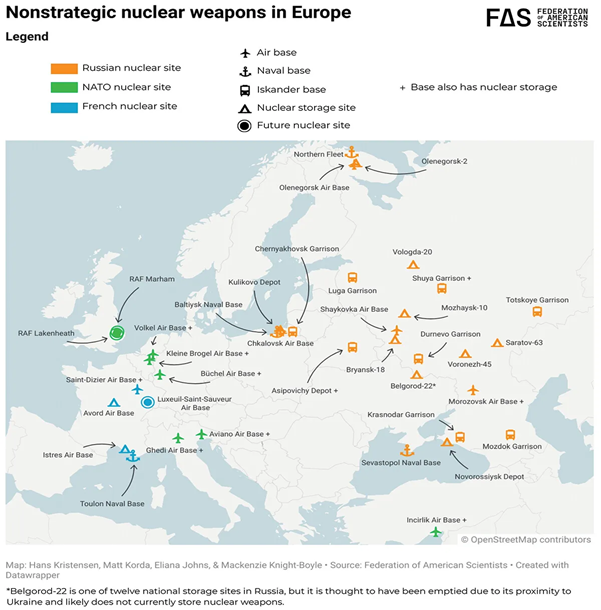
Source: Bulletin of the Atomic Scientists, December 2025.
NATO's nuclear arrangements are currently being modernised. This is centred on two major developments: the introduction of the B61‑12 gravity bomb and the transition to the F‑35A Lightning II fighter aircraft. The B61‑12 represents a significant technological improvement over earlier variants, incorporating enhanced guidance and accuracy that increase operational flexibility and effectiveness. Simultaneously, NATO members are replacing ageing Tornado and F‑16 aircraft with dual-capable F‑35As able to carry both conventional and nuclear weapons. The introduction of new aircraft and weapons systems has required extensive infrastructure modernisation across Europe. Air bases involved in the nuclear mission are undergoing substantial upgrades to weapons storage facilities, security systems, command-and-control networks, aircraft shelters, maintenance facilities and communications infrastructure.
Alongside force modernisation, NATO has also increased its emphasis on nuclear readiness and training. The annual 'steadfast noon' exercise remains the alliance's principal nuclear training activity, involving dual-capable aircraft from numerous member states. Although no live nuclear weapons are used, the exercise rehearses operational procedures, interoperability and coordination between conventional and nuclear forces. These activities demonstrate that NATO's nuclear posture relies on contributions from a much wider group of allies than those physically hosting nuclear weapons.
The UK and France's nuclear deterrence
The UK and France are western Europe's two nuclear weapon states, together maintaining an estimated stockpile of around 515 nuclear warheads in 2025 (according to the Bulletin of the Atomic Scientists, the UK had around 225 and France around 290 warheads ). France also has around 80 retired warheads pending dismantlement, bringing its overall nuclear inventory to roughly 370 warheads. While both countries operate independent nuclear deterrents under exclusive national political control, their relationship with NATO differs significantly. The UK assigns its nuclear forces to NATO's collective deterrence, whereas France remains outside NATO's nuclear-sharing arrangements, although its nuclear forces are recognised as making a significant contribution to the alliance's overall security. For comparison, the US and Russia maintain by far the world's largest nuclear arsenals. According to the Bulletin of the Atomic Scientists, the US possessed an estimated stockpile of approximately 3 700 nuclear warheads in 2025, with around 1 770 deployed, while Russia is estimated to have approximately 4 309 nuclear warheads assigned to its strategic and non‑strategic nuclear forces. Both countries are undertaking extensive nuclear modernisation programmes, although Russia currently maintains a larger active stockpile.
The UK's nuclear role
The UK has emerged as one of the most important actors in Europe's evolving nuclear landscape. For decades, Britain relied exclusively on its submarine-based nuclear deterrent, maintaining a continuous at-sea deterrence posture through its ballistic missile submarines. Although the UK maintains full operational control over its Trident nuclear deterrent, it remains technically dependent on the US. The Trident missiles are US-designed, require maintenance in the US by Lockheed Martin and rely on certain US‑supplied components for warhead production. While a long-term bilateral defence agreement underpins this cooperation, these dependencies mean that Britain's nuclear deterrent is not entirely free from potential US political or technical influence. Recent policy decisions indicate a broader role for the UK within NATO's nuclear architecture. London has announced plans to acquire dual-capable F‑35A aircraft and participate directly in NATO's nuclear-sharing mission, thereby restoring an air-delivered nuclear capability for the first time in decades. Media reports indicate that in July 2025, for the first time since at least 2008, US nuclear weapons returned to the UK at RAF Lakenheath.
UK nuclear cooperation with European partners
UK nuclear cooperation with European partners remains structurally limited, highly differentiated and conducted solely on a bilateral basis. The closest and most institutionalised relationship is with France, codified in the Lancaster House Treaties, which explicitly commit both states to long-term collaboration on nuclear warhead stewardship through the Teutates programme, while reaffirming that their deterrents remain fully independent and under national control. More recently, the Trinity House Agreement reinforced this position by deepening strategic alignment and signalling coordination, including the political dimension of nuclear deterrence, but again stopped short of any operational integration or shared doctrine. Beyond France, UK nuclear interaction with European partners is largely mediated through NATO, where the UK contributes its deterrent to alliance security and participates in consultative mechanisms such as the NPG, rather than through the EU itself, which lacks competence in this domain.
France's nuclear role
France has likewise sought to strengthen its role as a European nuclear power in recent years. Unlike the UK, France maintains a fully independent nuclear deterrent outside NATO's nuclear-sharing arrangements. French nuclear forces consist of both submarine-launched ballistic missiles and an airborne nuclear component carried by Rafale aircraft. Recent announcements regarding the reactivation of the nuclear mission at Luxeuil air base and the deployment of future Rafale F5 aircraft equipped with next-generation nuclear delivery systems indicate a substantial expansion of French nuclear capabilities. These developments have been accompanied by a broader political debate about the role of French nuclear forces in European security, with President Emmanuel Macron signalling a willingness to discuss how France's deterrent might contribute to the protection of European allies (see below).
French nuclear deterrence
French nuclear deterrence emerged from the experience of the Second World War and the conclusion that national survival cannot depend exclusively on alliances. The rapid collapse of France in 1940, exclusion from the Manhattan Project and subsequent concerns regarding the credibility of US security guarantees during the Cold War reinforced the French commitment to strategic autonomy. Since acquiring nuclear weapons in 1960, successive governments have viewed deterrence primarily as a political instrument designed to protect national sovereignty and vital interests. Nuclear deterrence has therefore become a central component of France's broader conception of strategic autonomy and independent decision-making. French nuclear doctrine is based on preventing aggression by threatening an adversary with unacceptable damage. Nuclear weapons are regarded primarily as political instruments whose purpose is to preserve peace by making aggression irrational. Several features distinguish the French approach. Strategic ambiguity regarding the definition of France's 'vital interests' is intended to complicate adversaries' calculations. Decision-making authority remains concentrated in the hands of the president of the Republic. France currently maintains a two-component deterrent consisting of airborne and sea-based nuclear forces.
More nuclear weapons in Europe?
A key question emerging from these debates concerns whether Europe could rely on its own nuclear capabilities should US security guarantees weaken in the future. While some political leaders, particularly in eastern Europe, have raised the possibility of additional European states acquiring nuclear weapons, such a scenario remains highly unlikely. Legal constraints imposed by the Nuclear Non‑Proliferation Treaty (NPT), combined with the immense financial, technological, industrial and political barriers associated with developing an indigenous nuclear arsenal, make the emergence of new European nuclear powers improbable in the foreseeable future.
Germany illustrates this dilemma particularly well. Although it hosts US nuclear weapons and participates actively in NATO's nuclear-sharing arrangements, it lacks an independent nuclear deterrent. Consequently, any reduction in the American nuclear presence in Europe would not automatically result in greater European strategic autonomy. On the contrary, countries such as Germany could find themselves with reduced access to nuclear deterrence capabilities unless alternative European arrangements were established. As a result, discussions regarding a more autonomous European approach to nuclear deterrence inevitably focus on France and the UK. Although their arsenals are significantly smaller than those of Russia or the US, both countries possess credible second-strike capabilities that can survive a nuclear attack and inflict unacceptable damage on an adversary. Deterrence effectiveness depends not solely on the number of warheads available but also on the survivability, credibility and destructive potential of those forces.
French and British nuclear capabilities are complementary in important respects. Both countries maintain submarine-based deterrents equipped with ballistic missiles, ensuring a survivable retaliatory capability. France additionally retains an airborne nuclear component (and the UK is building one again), providing greater flexibility across the escalation spectrum. Both deterrents continue to undergo modernisation and together represent the only independent nuclear forces currently available to Europe. Nevertheless, important limitations remain. The UK's nuclear deterrent continues to rely on significant technical cooperation with the US, particularly regarding the Trident missile system and aspects of maintenance and infrastructure. France maintains a more autonomous nuclear posture, exercising full national control over its forces. Yet the central issue for European policymakers is not whether French and British nuclear forces could fully replace the American nuclear umbrella, but whether they are sufficient to shape Russian strategic calculations, reassure European allies and contribute credibly to deterrence in a future characterised by greater uncertainty regarding American commitments.
According to experts from the Centre for Strategic and International Studies, French and British nuclear forces complement US extended deterrence in Europe but cannot realistically replace it if the US withdraws. Their arsenals are much smaller, their capabilities are not structured to replicate the US nuclear presence in Europe and their doctrines focus primarily on national deterrence rather than providing nuclear guarantees to allies.
Nuclear non‑proliferation
Nuclear weapons are the most destructive weapons ever created, capable of destroying entire cities, causing millions of deaths and producing long-term environmental and humanitarian consequences. Although they have only been used in war twice, at Hiroshima and Nagasaki in 1945, approximately 13 400 nuclear weapons remain worldwide, and more than 2 000 nuclear tests have been conducted. The international community regards nuclear disarmament as the most effective way to reduce these dangers, though progress has been slow. To strengthen non‑proliferation and disarmament efforts, regional nuclear-weapon-free zones have been established, and the United Nations has pursued nuclear disarmament since its founding in 1946. Over time, several key treaties have been adopted, including the Treaty on the Non‑Proliferation of Nuclear Weapons (NPT), the Partial Test Ban Treaty (PTBT), the Comprehensive Nuclear-Test-Ban Treaty (CTBT) and the Treaty on the Prohibition of Nuclear Weapons (TPNW). Despite strengthening the global nuclear governance framework, several of these treaties suffer from limited effectiveness because major nuclear-armed states, including the US and Russia in certain cases, have not signed, ratified or fully implemented them. Additional bilateral and multilateral arrangements seek to limit nuclear arsenals and prevent the spread of nuclear weapons and delivery systems. Despite these efforts, many analysts argue that the risk of nuclear conflict is now greater than at any point since the Cuban missile crisis of 1962, especially due to the ongoing Russian full-scale invasion of Ukraine.
The French 'forward deterrence' initiative
In his March 2026 speech at Île Longue on France's nuclear deterrence, President Macron argued that Europe now faces a far more dangerous security environment, characterised by Russian aggression, growing nuclear proliferation, uncertainty about long-term US security guarantees and the erosion of arms control regimes. In response, he announced a strengthening of France's nuclear deterrent, including an increase in the number of nuclear warheads, greater opacity regarding arsenal size and the continued modernisation of France's strategic nuclear forces.
The central innovation of the speech was the introduction of a policy of 'forward deterrence', which seeks to deepen nuclear cooperation with European partners while preserving France's complete sovereignty over nuclear decision-making. Macron proposed regular strategic consultations, allied participation in French nuclear exercises and the potential temporary deployment of elements of France's strategic air forces to allied territory. However, he explicitly rejected any sharing of nuclear decision-making, planning or the definition of France's vital interests, stressing that the initiative does not constitute a formal nuclear guarantee or replacement for NATO's nuclear mission.
Macron presented forward deterrence as complementary to NATO and linked it to stronger European conventional capabilities, particularly in missile warning, air and missile defence, and long-range strike systems. More broadly, he argued that Europeans must assume greater responsibility for their own security and work towards a new European security architecture adapted to an era of renewed great-power competition and heightened nuclear risk.
The French proposal represents an attempt to 'Europeanise' deterrence without Europeanising ownership or control of nuclear capabilities. Rather than replicating NATO's nuclear-sharing arrangements, it seeks to create greater European involvement in the political and strategic dimensions of deterrence. The initiative aims to strengthen consultation on nuclear issues, improve understanding of escalation dynamics and encourage European contributions to supporting capabilities such as early warning systems, integrated air and missile defence, and long-range precision strike. France increasingly argues that its vital interests possess an inherently European dimension because of the continent's deep political, economic and security interdependence.
NATO's nuclear-sharing arrangements are based on the forward deployment of US nuclear weapons in Europe, with participating allies hosting US B61 bombs, maintaining dual-capable aircraft and participating in nuclear planning through the NATO NPG. Although the weapons remain under exclusive US control until a decision on their use is authorised by the US president, participating allies share the political responsibilities and operational risks associated with NATO's nuclear mission. By contrast, based on current information, President Emmanuel Macron's initiative does not seek to establish a European equivalent of NATO nuclear sharing. Instead, it proposes a strategic dialogue on how France's independent nuclear deterrent could contribute to European security, while preserving France's long-standing principle of exclusive national control over its nuclear arsenal and remaining outside NATO's nuclear-sharing arrangements.
Several European countries have joined discussions with France on deterrence-related cooperation, including Germany, Poland, Sweden, Denmark, Belgium, Greece, the Netherlands and the UK. In May 2026, Norway became the latest participant. The decision is notable given Norway's traditionally strong Atlanticist orientation and reliance on NATO's collective defence arrangements. While Oslo reaffirmed that NATO remains the cornerstone of its security policy, its participation suggests growing interest among European states in complementing existing deterrence structures through closer engagement with France.
In June 2026, Finland's parliament voted to lift its long-standing ban on facilitating NATO nuclear weapons on its territory. The reform reflects Helsinki's post‑2022 shift in security policy following Russia's invasion of Ukraine, while the government is also exploring closer cooperation with France's proposed European nuclear deterrence initiative, although no final decision has been taken.
Lithuania is debating the removal of its constitutional ban on nuclear weapons. The country's parliamentary parties reached a political agreement in July 2026 to pursue a constitutional amendment. The proposed reform represents a major legal overhaul and would require approval by a two-thirds majority in two separate parliamentary votes. President Gitanas Nausėda emphasised that there are no immediate plans to host nuclear weapons, but that removing the restriction would give Lithuania and NATO greater flexibility should the security situation worsen.
Across the emerging debate on France's new policy of forward deterrence, analysts broadly agree that it represents a significant adaptation of French nuclear policy to a deteriorating European security environment, but not the creation of a European nuclear umbrella. Jyri Lavikainen of the Finnish Institute of International Affairs argues that the initiative strengthens NATO's deterrence posture by enabling the dispersal of French nuclear-capable aircraft to allied territory and increasing allied participation in French nuclear exercises. However, because France has retained its traditional doctrine of central deterrence and rejected a flexible response posture, the policy does not constitute an alternative to US extended deterrence and should instead be understood as a complementary addition to NATO's existing deterrence architecture.
Similarly, Héloïse Fayet of the French Institute of International Relations (IFRI) contends that Macron's concept of forward deterrence seeks to integrate France's nuclear forces more closely into European security while preserving the core principles of French nuclear doctrine and strategic autonomy. Although the initiative expands consultation and cooperation with European allies, including the potential deployment of French nuclear-capable aircraft during crises, it stops short of offering formal security guarantees and is intended to complement rather than replace NATO and the US nuclear guarantee. Michel Duclos of Institut Montaigne likewise views Macron's March 2026 speech as an important evolution of French nuclear policy, driven by a worsening security environment and growing uncertainty. While he emphasises that forward deterrence remains complementary to NATO, Duclos argues that it outlines a roadmap for strengthening both European deterrence and conventional defence cooperation. He further suggests that the initiative implicitly prepares a potential fallback option for some European states should US extended deterrence weaken in the future. Claude-France Arnould of the Brussels Institute for Geopolitics also interprets forward deterrence as a pragmatic adaptation of France's long-standing deterrence doctrine. In her view, the initiative operationalises the European dimension of French nuclear policy through deeper cooperation with selected European partners, helping to reassure allies and strengthen European security amid uncertainty over US guarantees. Nevertheless, like the other analysts, Arnould stresses that the policy does not amount to the establishment of a formal French nuclear umbrella for Europe.
European Parliament position
In its resolution of 21 January 2026 on the implementation of the 2025 annual common security and defence policy report, Parliament recognises that nuclear deterrence remains an important component of European security, noting that France and the UK are the only European states possessing nuclear weapons, and stating that a nuclear deterrent is of crucial importance for the protection of Europe. The European Parliament also expresses concern about the weakening of non‑proliferation and arms control regimes, and calls for the EU to take on a stronger role in preventing the spread of weapons of mass destruction. It reaffirms support for the Treaty on the Non‑Proliferation of Nuclear Weapons as the cornerstone of global non‑proliferation efforts, while recognising the importance of nuclear deterrence for European security. The Parliament also urges greater transparency and coordination in EU arms export policies, and calls on Member States to apply EU export control rules strictly, particularly where there is a risk that exported weapons could be used for aggression.
Statement on the use of AI
Any AI-generated content in this text has been reviewed by the author. EP GenAI hub was used to improve the readability of the text and broaden the range of sources available to the author.
Disclaimer
This document is prepared for, and addressed to, the Members and staff of the European Parliament as background material to assist them in their parliamentary work. The content of the document is the sole responsibility of its author(s) and any opinions expressed herein should not be taken to represent an official position of the Parliament.
Copyright
© European Union.
The reuse of this document is authorised under a Creative Commons Attribution 4.0 International (CC-BY 4.0) licence.

https://creativecommons.org/licenses/by/4.0/deed.en
To use or reproduce elements that are not owned by the European Union, permission may need to be sought directly from the respective rightsholders.