
Article page checkbox is not checked in page info.
EU funding for the energy transition
EU funding for the energy transition
Saša Butorac and Agnieszka Widuto, Members' Research Service
Summary
European Union (EU) public money is essential for mobilising private capital for the energy transition. Multiple EU funding programmes – both within and outside the multiannual financial framework (MFF) – provide this essential de‑risking tool for attracting investment in clean technologies, energy infrastructure, energy efficiency and other drivers of the energy transition. The European Parliament's position is that the 2028‑2034 MFF should be increased to €2.014 trillion (a €197.30‑billion increase compared with the European Commission's original proposal), and that it must focus on financing European public goods that offer added value in comparison with national spending, such as cross‑border projects. Parliament stresses the importance of introducing new own resources streams, which should target new revenue of €60 billion per year.
Introduction
European Union (EU) funding programmes enabling the energy transition are key to making this complex and challenging process a success. Given the scale of investment needs, EU funds are the main tool to attract private capital and ensure that it flows at the necessary volumes into projects developing a clean, affordable and homegrown energy system that can power a competitive European economy.
The EU energy system's ongoing overhaul has three main drivers:
-
the imperative to cut energy costs in view of regaining the European industry's competitiveness;
-
the necessity of weaning Europe off the volatile global fossil fuel markets in the context of increasing geopolitical tensions and, thus, eliminating its dependency on imported oil and natural gas.
Given that around 57 % of available energy in the EU still comes from largely imported fossil fuels (at a cost of €375.9 billion in 2024), the goal of ensuring secure, clean and affordable energy sources entails a fundamental transformation of the European energy system.
As a consequence, the energy system that has been evolving in Europe will be largely electrified. Nascent hydrogen market and carbon capture and storage (CCS) technologies are expected to play an important role for the hard‑to‑abate sectors that cannot be electrified. Much progress will need to be achieved in terms of energy savings and efficiency gains. Crucially, the European electricity grids need to develop rapidly into a modern and upgraded network to accommodate the rising electrification of the economy based mostly on renewable and nuclear power sources. The investment needs for electricity grids alone in the EU by 2040 amount to €1.2 trillion, while those relating to hydrogen networks stand at €240 billion.
The electrification rate of the final energy consumption is currently around 23 %, while the Clean Industrial Deal set a key performance indicator for electrification rate at 32 % in 2030. Around 50 % of the electricity generated in the EU comes from cheap, domestic renewable energy sources; a decreasing but nevertheless still significant part (around 23 %) comes from gas‑ and coal‑powered plants, which often provide power during peak hours. The sectors that would need to be largely electrified are transport, buildings (i.e. heating and cooling), and some industrial processes.
The scale of investment needed to ensure a timely and successful energy transition is formidable. The European Commission calculates that delivering the clean energy transition will require '€660 billion of investment annually until 2030, rising to €695 billion between 2031 and 2040'. Despite increased investment over the past years, both the pace and scale of investment have to increase to reach the necessary levels. The International Energy Agency (IEA) estimates that the investment in clean energy, buildings' energy efficiency and grids (key elements of the energy transition) in the EU reached around €480 billion in 2025. According to an International Monetary Fund (IMF) analysis, the EU's energy transition only has 'modest macroeconomic impacts' in terms of short‑term economic costs of transitioning if the carbon price is set right and green subsidies are utilised to support the transition. In particular, the IMF modelling implies an 'average aggregate investment cost' of around 1 % of gross domestic product (GDP) over the 2026‑2035 period.
Against this backdrop, the Commission, in March 2026, put forward a clean energy investment strategy (see text box) to help mobilise significant additional private investment for clean energy.
Clean energy investment strategy
The strategy was launched in March 2026 to help mobilise private capital for clean energy investment. It will benefit from €75 billion in financing from the European Investment Bank (EIB) over a three‑year period, with selected actions also eligible for support under InvestEU. The strategy proposes four measures: (i) Improving access to capital markets for electricity grid operators (including access to equity); (ii)) Supporting grid operators by boosting bank's lending capacity; (iii) Providing targeted public funds to de‑risk innovative clean energy technologies and energy‑efficiency investment; and (iv) Setting up an Energy Transition Investment Council with the investment community.
Source: European Commission, clean energy investment strategy, COM(2026 116, 2026.
On the other hand, significant funds still flow into fossil fuel subsidies in many Member States, thereby diverting significant resources from the energy transition. Member States' annual support for fossil fuel increased by 18 % in 2024 to around €97 billion compared with 2021 (pre‑crisis year). One of the key 'fit for 55' files proposed by the European Commission in July 2021 – the Energy Taxation Directive (ETD) – was meant to address precisely this challenge: how to ensure that Member States' fiscal policy is in line with the European Green Deal goals.The proposal requires unanimity in the Council of the EU for its adoption; an agreement on the ETD revision has yet to be reached. The Commission proposal on network charges, due to be published on 22 July 2026, seeks to address the issue of Member States' taxes on electricity, and how they compare with taxes on fossil fuels, through a targeted revision of the Electricity Market Regulation.
The purpose of the EU funding programmes is thus to use public financing as a catalyst and to de‑risk projects, spread financing costs over time, and attract a wider base of investors, including large‑scale institutional capital. The programmes that are part of the current 2021‑2027 EU long‑term budget – the multiannual financial framework (MFF) – include the InvestEU Programme, the Connecting Europe Facility (CEF), the LIFE Clean Energy Transition sub‑programme, and the strategic technologies for Europe platform (STEP). In the 2028‑2034 MFF, these programmes would be integrated into a single pillar: a newly established competitiveness fund. Separately, the Recovery and Resilience Facility (RRF), a temporary instrument and the centrepiece of Next Generation EU (which is outside the MFF), stipulates that the Member States need to spend at least 37 % of the total €577 billion fund on the green transition. The Modernisation Fund and Innovation Fund also operate outside the MFF by channelling the sales of EU emissions trading system (EU ETS) allowances into the energy transition. For its part, the EIB Group intends to deliver over €75 billion of financing over the next three years to support the energy‑transition objectives. Finally, EU Member States can use direct national fiscal support for the energy transition within the Clean Industrial Deal state Aid framework (CISAF).
The following sections provide an overview of the operational scope and performance of each of these primary funding instruments. Figure 1 outlines various sources of EU funding for the energy transition in the 2021‑2027 period, including programmes and funds under the relevant MFF headings, as well as funding sources outside the core EU budget.
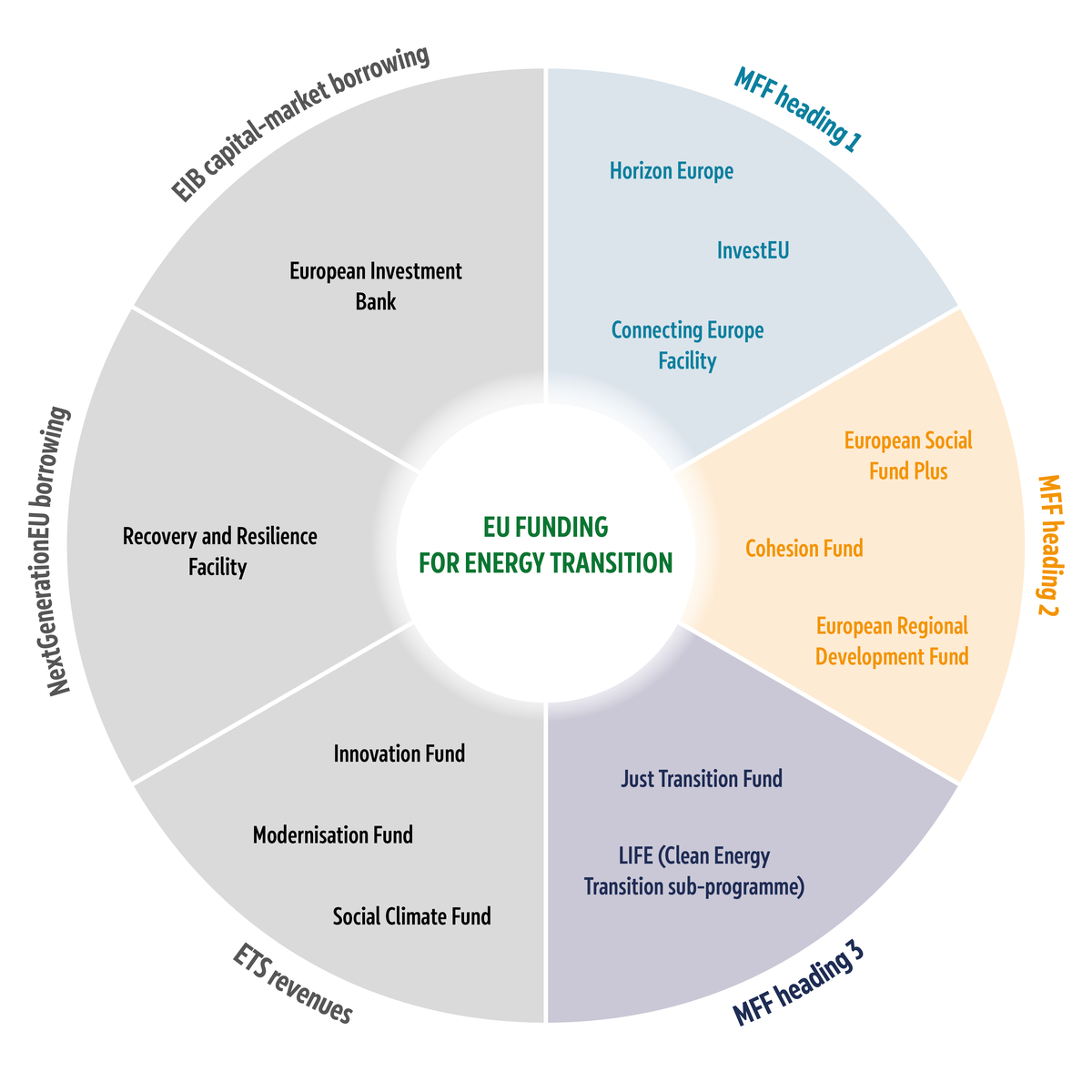
Source: Compiled by the authors; graphic by Lucille Killmayer, EPRS, 2026.
Connecting Europe Facility (CEF)
The Connecting Europe Facility (CEF) is a key EU funding instrument in delivering the green transition and an important enabler towards the EU's decarbonisation objectives for 2030 and 2050. It is designed to bridge the gap between an infrastructure project's commercial risks and its broader socioeconomic benefits, including security of supply. It consists of transport, energy and digital window. Its energy window, operating under the Trans-European Networks for Energy (TEN‑E) framework, offers grants and procurement to lower investment risks, directly mobilising private capital to deliver the high‑performing, cross‑border energy networks linking Member States' energy systems necessary to reach the EU's 2030 and 2050 climate and energy targets.
The current 2021‑2027 cycle allocates €5.84 billion specifically for energy networks within a wider €33.7 billion CEF II envelope. The European Commission has proposed an overall envelope of €81.4 billion for the 2028‑2034 cycle, comprising a €29.9 billion allocation reserved for cross‑border energy projects.
The Commission proposes every two years a list of projects of common interest (PCIs) to map out priority corridors aligned with the European Green Deal. The list comes in the form of a delegated act subject to scrutiny by Parliament and the Council, which have the right to block the adoption of the act without the right to amend it. The criteria for PCI status are laid down in the Regulation on the Trans‑European Networks for Energy (TEN-E Regulation). The regulation was fully brought in line with the European Green Deal goals in 2022. Its 2022 revision also introduced projects of mutual interest (PMIs) for joint ventures with non‑EU countries. The Commission proposal for its latest revision forms the core part of the European grids package published in December 2025.
The official European Commission CEF performance overview shows a considerable surge in market demand for CEF grants and a rapid pivot towards green priorities during the current cycle.
-
Demand exceeding the available fund: a substantial project demand caused applications to over‑subscribe available call budgets 3.8 times over by early 2025.
-
Carbon hub investments: the programme allocated over €889 million to CCS networks during this cycle – a sixfold increase over the prior seven‑year framework.
-
Historical benchmarks: CEF Energy has funded 224 actions since its launch. Across both CEF I and II, it has supported the deployment of 17 000 alternative‑fuel supply points.
-
Stakeholder feedback: the European Economic and Social Committee (EESC) warned of a significant funding gap, noting Europe requires over €845 billion in transport investment alone over the next 15 years to successfully attract sufficient private backers.
Looking ahead, negotiations under the ordinary legislative procedure will commence in the autumn of 2026 on the CEF III framework for the 2028‑2034 MFF. In its April 2026 resolution on the proposal for the 2028‑2034 MFF, the European Parliament called for 'an adequate reinforcement of priority programmes under heading 2', which includes the CEF. In particular, Parliament called for a CEF allocation of €91.29 billion in current prices (equivalent to €81 billion in 2025 constant prices), i.e. a €10 billion increase compared with the Commission proposal.
LIFE – Clean Energy Transition (CET) sub‑programme
The LIFE programme is an EU funding instrument for environment and climate action. Established in 1992, its primary goal is to support the transition toward a sustainable, circular and climate‑neutral economy, protect biodiversity, and drive the European Green Deal. The current LIFE programme (2021‑2027) has a total budget of €5.45 billion.
The LIFE Clean Energy Transition (CET), one of the four LIFE sub‑programmes, is designed to translate EU climate objectives into actions at a regional and local level. Based on a budget of nearly €1 billion over the 2021‑2027 period, the programme provides coordination and support actions specifically aimed at addressing the non‑technological market barriers stalling the socioeconomic transition to sustainable energy sources. Rather than financing heavy infrastructure, the programme focuses on actions with high EU added value, engaging local public authorities, small and medium‑sized enterprises, non‑profit organisations, and consumer groups.
The sub‑programme funds between 60 and 70 projects annually, structuring its co‑financing across five target areas to drive systemic change:
-
building a national, regional and local policy framework supporting the clean energy transition;
-
accelerating technology roll‑out, digitalisation, new services and business models, and enhancement of the related professional skills on the market;
-
attracting private finance for sustainable energy;
-
supporting the development of local and regional investment projects;
-
involving and empowering citizens in the clean energy transition.
The mid‑term evaluation indicates highly efficient deployment and tangible energy savings across Member States.
-
The programme mobilised over €820 million in clean energy investments and private finance between 2021 and 2024.
-
Achievements include setting up 38 residential one‑stop shops, supporting over 500 energy communities, assisting 66 district heating/cooling operators, and training nearly 50 000 professionals through the BUILD UP Skills project.
-
In 2021‑2022 alone, funded projects reduced energy consumption by roughly 8 000 gigawatts (GW) per year (comparable to Ireland's annual household use), and grew renewable generation to 4 664 GW per year.
Parliament, in its above‑mentioned April 2026 resolution on the 2028‑2034 MFF, stressed that 'the LIFE programme plays a central role in mainstreaming the EU's environmental objectives and commitments'. It underlined that the total LIFE envelope should amount to €3.39 billion in current prices (equivalent to €3 billion in 2025 constant prices).
Recovery and Resilience Facility (RRF)
Launched in 2021 as a response to the consequences of the COVID‑19 pandemic, the Recovery and Resilience Facility (RRF) has helped the EU's emergence as a stronger and more resilient economic power. The facility amounts to €577 billion, out of which at least 37 % have to support the green transition. According to Commission figures, the Member States have exceeded this target (41 % on average).
Member States have added specific chapters to their national recovery and resilience plans (NRRPs) under Next Generation EU, with the goal of financing key investments and reforms that will help achieve the REPowerEU objectives. These objectives include energy savings, the diversification of energy supplies, and the accelerated roll‑out of renewables.
In total, RRF climate expenditure amounts to around €235 billion, with €153.8 billion specifically allocated to energy‑related measures. All EU countries have a REPowerEU chapter (NRRPs), and all have allocated significant funds to energy, ranging from 18 % in Slovenia to 39 % in Bulgaria, with an EU average of 27 %. Until May 2026, €400 billion has been disbursed across the EU.
InvestEU
The InvestEU programme is one of the main EU instruments to secure long‑term funding by leveraging private and public capital for the clean transition, primarily in the areas of energy efficiency, renewable‑energy generation, transmission, distribution and storage, as well as decarbonisation projects. By combining multiple prior financial instruments into a single framework, it streamlines investment access for green and digital transitions, innovation, and the REPowerEU plan. It operates via three components: the InvestEU Fund, the InvestEU Advisory Hub and the InvestEU Portal.
The InvestEU Fund provides a €26.2 billion EU budget guarantee to implementing partners to enhance their risk‑bearing capacity, with the goal of mobilising at least €372 billion in additional private investment. Funded through Next Generation EU, it works in tandem with the RRF – which delivers €723 billion in loans and grants for Member State reforms – allowing the two programmes to provide complementary financing opportunities for the same policy priorities on a greener, more digital and resilient European economy.
In September 2025, Parliament and the Council finalised an agreement to simplify InvestEU, lowering administrative burden for Member States and shifting capacity towards the Clean Industrial Deal, the Competitiveness Compass, and military mobility infrastructure.
The Commission's interim evaluation , which examined the programme's implementation through December 2023, validated InvestEU's high performance and strong resource mobilisation.
-
Capital sourced: by mid‑2024, InvestEU mobilised approximately €280 billion in investment, with nearly 70 % of the signed volume coming from the private sector.
-
Climate action: projects centred on climate action accounted for close to 45 % of this signed total.
A February 2026 report by Counter Balance, a coalition of nine non‑governmental organisations, warns that 'InvestEU ... is expanding public guarantees while failing to ensure policy steer and democratic accountability'. The authors of the report notes that, unless reformed, the programme would 'fail to ensure that industries increase productive investment and contribute to a just transition'. In particular, the report argues that vague definitions of 'additionality' have allowed public guarantees to support projects proposed by companies with ample own resources without ensuring they truly benefit society or the environment.
In its above‑mentioned April 2026 resolution on the 2028‑2034 MFF, Parliament strongly insisted that it is necessary to increase the size of the InvestEU instrument compared with 'the current programme', and that it be available from the outset.
Strategic technologies for Europe platform (STEP)
The strategic technologies for Europe platform (STEP) was set up to strengthen the EU's industrial capacity and accelerate the manufacturing of critical technologies. STEP aims to ensure that Europe leads in clean tech, digital and biotechnology sectors, structurally reducing supply chain dependencies on third countries. It delivers on recommendations from the Draghi report. STEP channels existing funding resources to drive innovation and growth in clean energy, artificial intelligence (AI) and cybersecurity.
Rather than acting as a stand‑alone fund, STEP relies on a coordinated approach, supported by four operational tools:
-
Redirecting – Gateway for EU funding to STEP sectors;
-
STEP portal – Information on funding opportunities for projects;
-
STEP Seal – Label for flagship projects, easing their access to funding;
-
One‑stop shop – Single contact point for industry and managing authorities.
Financially, STEP covers €2 9 .4 billion in funding across 11 EU programmes. The interim evaluation confirmed that, despite some implementation hurdles, the mechanism is effectively steering resources toward technological sovereignty:
-
Member States have integrated STEP priorities into cohesion programmes, quickly mobilising approximately €6.3 billion;
-
centrally managed Commission calls have mobilised around €9.5 billion, with over €5.1 billion already awarded to selected projects;
-
the platform has successfully awarded 190 STEP Seals to high‑quality strategic projects.
Modernisation Fund
The Modernisation Fund is a funding mechanism outside the MFF, designed to overhaul energy systems in 13 lower‑income EU Member States. The fund targets investments in renewable energy, energy efficiency, energy storage, energy networks and just transition in carbon‑dependent regions. Running through the 2021‑2030 period, it helps beneficiary countries meet their climate targets and align with the European Green Deal. The beneficiary Member States include Bulgaria, Czechia, Estonia, Greece, Croatia, Latvia, Lithuania, Hungary, Poland, Portugal, Romania, Slovenia and Slovakia.
The fund is entirely financed through market revenues generated from auctioning emissions allowances under the EU ETS. The Modernisation Fund's total revenues amount to €57 billion from 2021 to 2030, assuming a carbon price of €75 per tonne of carbon dioxide (tCO₂). So far, €20.7 billion has been disbursed to the eligible Member States.
Financially, the mechanism utilises a baseline 2 % auction share (2021‑2030), an additional 2.5 % auction share (2024‑2030), and voluntary transfers from Member States' solidarity allocations. Co‑financing is subject to EU State aid rules and the strict avoidance of double funding.
The Modernisation Fund envisages two types of investment: (i) priority investments that have to fall into at least one priority area as defined by the EU ETS Directive; and (ii) non‑priority investments that do not fall into a priority area but meet the fund's objectives and demonstrate reduction of greenhouse gas (GHG) emissions.
A Bankwatch Network report on the Modernisation Fund warned of persistent transparency challenges, noting that a significant share of disbursements continues to flow towards fossil gas, waste incineration and biomass combustion projects, 'all of which undermine the very purpose of the Fund – to create sustainable energy systems'.
Innovation Fund
The Innovation Fund is one of the world's largest funding programmes focused on the commercial demonstration and scaling of highly innovative low‑carbon technologies. It operates outside the MFF and is financed directly by industrial emitters paying into the EU ETS; the fund re‑invests these revenues in projects across the EU, Iceland, Liechtenstein and Norway. Its technological focus spans energy‑intensive industries, renewables, energy storage, hydrogen, net‑zero mobility, buildings, and carbon capture, use and storage (CCUS).
Based on a carbon price estimate of €75/tonne, the fund's projected budget from 2020 to 2030 is approximately €40 billion, having already awarded roughly €15 billion to around 260 projects. In 2023, an extensive revision of the EU ETS Directive upgraded the fund's capabilities and modified its operational rules:
-
the total size was expanded from 450 million to approximately 530 million ETS allowances;
-
the fund integrated new sectors (maritime and aviation) and medium‑scale projects, and mandated strict compliance with the 'do no significant harm' (DNSH) principle starting in 2025;
-
new financial instruments were introduced ('competitive bidding');
-
increased technical assistance is now provided to historically under‑represented Member States, to improve geographical equity.
Despite its vast financial capacity and clean‑tech potential, the programme has faced significant operational criticism. The European Court of Auditors (ECA) special report 1/2026 criticises the deployment as sluggish, stating that it has under‑delivered on its core emissions reduction targets. The ECA warns that resource allocation lacks structured strategic analysis, and notes that projects frequently face delays, cancellations, and over‑optimistic emissions avoidance estimates.
Clean Industrial Deal State aid framework (CISAF)
The Commission established the Clean Industrial Deal State aid framework (CISAF) on 25 June 2025 to help Member States provide financial support for clean energy, industrial decarbonisation, and green tech manufacturing. In force until 31 December 2030, it replaced the temporary crisis and transition framework (TCTF) to offer long‑term investment predictability.
The CISAF simplifies State aid rules in five main areas:
-
roll‑out of renewable energy and low‑carbon fuels;
-
temporary electricity price relief for energy‑intensive users to ensure the transition to low‑cost clean electricity;
-
decarbonisation of existing production facilities;
-
development of clean tech manufacturing capacity in the EU;
-
de‑risking of investment in clean energy, decarbonisation, clean tech, energy infrastructure projects and projects supporting the circular economy.
Cohesion policy
Cohesion policy, with a budget for 2021 to 2027 totalling €392 billion, covers several funds that can support the energy transition. The principle of 'thematic concentration' requires that a proportion of funds must be dedicated to one of the policy's objectives on a 'greener, low‑carbon Europe transitioning towards a net‑zero economy'. The European Regional Development Fund (ERDF) can be used for actions such as energy efficiency, reducing GHG emissions, renewable energy, developing smart energy systems, grids and storage outside the TEN‑E, as well as promoting sustainable transport. The Cohesion Fund is available only to 15 lower‑income Member States. It supports investment in the environment and transport, including in particular renewable energy. The European Social Fund Plus (ESF+) focuses mainly on employment, social inclusion and skills. In the context of the energy transition, it can be used for the adaptation of workers to change, reskilling, education and training, job creation in the energy sector, and the social integration of people at risk of poverty or social exclusion. While support from the ERDF and ESF+ is available for all regions, the levels of EU co‑financing are highest for less developed regions.
The Commission mid‑term evaluation found that, in the ERDF and the Cohesion Fund, the climate focus is stronger than legally required, with 33 % of ERDF and 56 % of Cohesion Fund budgets dedicated to climate action – above the minimum required commitment of 30 % for the ERDF and of 37 % for the Cohesion Fund. The funding directly programmed for energy‑related actions amounts to €42.2 billion (€26.2 billion for energy efficiency, €10.2 billion for renewable energy, and €5.8 billion for smart energy systems). The Commission evaluation states that energy‑efficiency actions are advanced and focus mainly on public infrastructure, buildings and enterprises, while the implementation of the renewable energy resources remains limited and uneven. In terms of the ESF+, 6 % of its funding is set to be used for investment in green jobs and green skills.
The proposed amount for the future cohesion policy in the 2028‑2034 period is €450 billion, with at least €218 billion earmarked for less developed regions. Support would be delivered through national and regional partnership plans (NRPPs), which are proposed to merge the main cohesion policy funds under one framework, together with other funds for agriculture, fisheries and security.
In its above‑mentioned April 2026 resolution on the 2028‑2034 MFF, Parliament called for maintaining cohesion policy separate, rather than merging it with other policy areas, and expressed concern over introducing the NRPP model, as it risks fragmenting and re‑nationalising EU spending and weakening funding predictability, transparency and multilevel governance. Moreover, the resolution underlines that cohesion policy should remain a key territorial investment instrument for energy‑related objectives, including energy infrastructure, a just transition, sustainable housing, and action against energy poverty.
Just Transition Fund (JTF)
The Just Transition Fund (JTF) – linked to cohesion policy funds in the 2021‑2027 period – supports regions most affected by the transition towards climate neutrality. These are mainly carbon‑intensive regions, relying on fossil fuels and high‑emissions industries. The JTF supports investment in:
-
affordable clean energy, including energy storage;
-
renewable energy and energy efficiency;
-
reduction of GHG emissions;
-
research and innovation activities;
-
renewable energy and energy efficiency, including for the purposes of reducing energy poverty
-
smart and sustainable local mobility, including decarbonisation of the local transport sector and its infrastructure;
-
modernisation of district heating networks;
-
digitalisation, digital innovation and connectivity;
-
regeneration and decontamination of brownfield sites and land restoration, including green infrastructure and repurposing projects;
-
the circular economy, including waste reduction, resource efficiency, repair, reuse and recycling;
-
retraining of workers and jobseekers;
-
job search assistance
-
education and social inclusion.
Investments relating to fossil fuels and nuclear power plants are excluded.
The fund is part of the broader Just Transition Mechanism, which also includes a scheme under InvestEU and a public‑sector loan facility implemented together with the EIB. The JTF has a budget of €19.7 billion (in current prices) for 2021‑2027, with €8.4 billion coming from the MFF, €10.8 billion from Next Generation EU, and €0.5 billion from voluntary transfers from other cohesion policy funds (the ERDF and ESF+). The co‑financing rate (i.e. the percentage of project costs covered by the EU) varies depending on the level of economic development of the region where the project is located (from 50 % to 85 %). The remaining amount has to be provided by national or regional/local authorities.
The InvestEU 'Just Transition' scheme is expected to mobilise between €10 billion and €15 billion in private‑sector investment, while the Public Sector Loan Facility combines €1.3 billion in grants financed from the EU budget with between €6 billion and €8 billion in loans from the EIB, with the aim of mobilising between €13.3 billion and €15.3 billion in public investment. To obtain funding, the Member States had to prepare territorial just transition plans outlining the specific interventions. The Just Transition Platform is a single access point with technical and advisory support regarding the funding opportunities under the Just Transition Mechanism.
The Commission's mid‑term evaluation of the JTF found that the fund is well‑targeted at territories most exposed to the climate transition, with 70 territorial just transition plans covering 96 territories, and a distinctive place‑based approach combining economic diversification, reskilling, clean energy, circular economy and site‑regeneration measures. However, implementation remains at an early stage: by 30 June 2024, only around 22 % of JTF funding had been decided, and a mere 0.46 % had been spent, with major differences between Member States. Physical progress is similarly uneven, with output and result progress concentrated in a small group of countries, while several Member States had not yet reported progress.
In its above‑mentioned April 2026 resolution on the 2028‑2034 MFF, Parliament regretted that the proposal does not include a stand‑alone instrument for just transition. It called for relevant funds under the next MFF to support the just transition, and highlighted the need for synchronisation between the CEF, the proposed European competitiveness fund and the NRPPs in the context of decarbonisation and the clean‑energy transition.
Social Climate Fund
The Social Climate Fund was adopted in 2023 to support the most vulnerable citizens and businesses affected by the extension of the EU ETS to the buildings and road transport sectors (ETS2). With a budget of €65 billion (up to €86.7 billion with national contributions) over the 2026‑2032 period, it can be used for direct income support and investment in the energy efficiency of buildings and in sustainable transport. The fund is financed from external assigned revenues rather than the ordinary MFF headings. Its budget will be based mainly on ETS2 auctioning schemes and complemented by Member States co‑financing. Initially, it will be funded from the existing EU ETS revenues to help cover part of the Social Climate Fund financing relating to the ETS2 postponement to 2028.
By the end of June 2025, EU countries were required to submit their social climate plans outlining concrete measures that help to reduce end users' reliance on fossil fuels, boost building renovations, decarbonise heating and cooling systems, integrate renewable energy, and increase the uptake of zero‑ and low‑emission mobility and transport. Temporary income support can be used only to support vulnerable households and transport users. So far, only eight plans have been submitted. The first payment requests can be filed to the Commission as of 31 July 2026, provided that the agreed milestones and targets have been met.
The Social Climate Fund was designed as a one‑off, temporary instrument tied to ETS2's initial roll‑out phase, and is therefore not mentioned in the proposal on the 2028‑2034 MFF. However, the proposal regarding the establishment of a new European fund to be delivered through the NRPPs provides for the inclusion of a chapter on social climate plans in those plans. Social Climate Fund funding is expected to end as planned in 2032.
Horizon Europe
The EU research and innovation funding programme, Horizon Europe, has a budget of €93.5 billion for the 2021‑2027 period. Research projects focusing on energy are funded mainly from the climate, energy and mobility cluster, which includes areas of intervention such as energy supply, energy systems, energy storage, clean transport and buildings, and industrial facilities in energy transition.
According to the 2025 Horizon Europe interim evaluation, the energy portfolio also shows strong mobilisation effects and high industry participation. Particularly successful actions include partnerships such as the Clean Hydrogen Joint Undertaking, which expanded electrolyser capacity from 100 kilowatts (kW) in 2011 to 30 megawatts (MW) in 2023, and the European Institute of Technology and Innovation (EIT) knowledge and innovation communities, which launched 956 innovations on the market, created 436 start‑ups, and supported 5 806 start‑ups and scale‑ups. The evaluation also points out useful synergies with the CEF for the deployment of innovative energy solutions, and with LIFE for the uptake of results from the clean‑energy transition.
The Commission proposal for Horizon Europe for the years 2028 to 2034 doubles the programme's future budget to €175 billion. One of its four pillars, 'Competitiveness and society', is set to include funding for 'clean transition and industrial decarbonisation'. Parliament's Committee on Industry, Research and Energy (ITRE) has prepared a draft report on the new proposal, with Parliament's official negotiating position expected to be put to the vote during the October 2026 plenary session.
Energy transition at local and regional level
EU funding for the energy transition reaches local and regional authorities through several channels. The most directly territorial route is cohesion policy, where the ERDF, the Cohesion Fund, Interreg, ESF+ and the JTF can support energy efficiency, renewable energy, skills, cooperation and transition measures through national or regional programmes, although actual access depends on Member State or regional programming choices. In parallel, centrally managed or thematic schemes offer more targeted opportunities: the LIFE programme can fund local pilot and demonstration projects in energy efficiency and renewables; Horizon Europe and NetZeroCities support innovation and climate‑neutral city action; the European City Facility helps municipalities prepare investment concepts and feasibility work; and InvestEU, together with EIB advisory tools such as ELENA, can help make local projects bankable and attract further public or private finance. Local and regional authorities are therefore both beneficiaries and delivery actors. Under the 'fit for 55' framework, they are expected to plan and implement building renovation, public‑sector energy savings, local heating and cooling plans, renewable‑energy communities, one‑stop shops and citizen engagement, while also translating EU and national objectives into locally tailored investment opportunities.
Source: Beamud, F., Gallego, F., Truc, M. et al. (Milieu Consulting), Speeding up the clean energy transition at local and regional level – The impact of the Fit for 55 package, European Committee of the Regions, 2025.
2028‑2034 MFF
The Commission proposed a €2 trillion budget in current prices for the 2028‑2034 MFF. It introduced a 35 % climate and environment spending target for the overall budget, which would mobilise over €700 billion if agreement is reached to keep the budget size at the level proposed by the Commission. Specifically, the proposed European competitiveness fund, the central pillar of the 2028‑2034 MFF, would seek to strengthen the EU's economy through investment aimed at decarbonising the European economy, accelerating the development of clean technologies and the circular economy, and driving forward the energy transition.
As mentioned earlier, Parliament's defined its position on the proposal for the 2028‑2034 MFF in its April 2026 resolution. Its defining issue in the forthcoming negotiations with the Council: the overall size of the budget should be increased. Parliament criticises the Commission proposal as a 'token increase' that effectively freezes funding in real terms once adjusted for inflation. Consequently, Parliament demands that the 2028‑2034 MFF be set at 1.27 % of the EU's gross national income (GNI), which amounts to €2.014 trillion (a €197.30 billion increase).Parliament's position is that COVID‑era Next Generation EU borrowing repayments should be completely separated, and accounted for 'over and above' the established budget ceilings to protect funding for key domestic programmes that would be concentrated in the competitiveness fund, which, according to the Commission proposal, should be endowed with €234 billion. One of the fund's four sub‑programmes is 'Clean transition and industrial decarbonisation'.
Parliament strongly objects to the Commission's proposed 'one plan per Member State' approach under the NRPPs, warning that it threatens to fragment the single market, bypass regional and local authorities, and centralise decisions. Parliament argues that the next MFF must focus on financing European public goods with 'discernible added value compared to national spending, such as cross‑border projects', noting with deep concern that heading 1 funding ('Europe's social model and quality of life') faces unacceptable cuts. Specifically, Parliament underlined 'the crucial importance and added value of EU investment in developing clean energy infrastructure and accelerating grid modernisation and cross‑border interconnection'. Lastly, Parliament demands stronger oversight, a clause on a mandatory mid‑term review by July 2031, a robust mechanism for rule of law conditionality, as well as the implementation of new own resources streams targeting a level of revenue of at least €60 billion per year.
Outlook
As the scale of investment required for the energy transition remains substantial, EU funding has a key enabling role to play in mobilising wider public and private investment. EU funding for the energy transition is entering a period of both opportunity and uncertainty, as the next MFF for the 2028‑2034 period is still under negotiation. The Commission's proposal would significantly reshape the current funding architecture: much of cohesion and other shared‑management funding would be channelled through national and regional partnership plans, while the new European competitiveness fund would bring together several strands of support relevant to clean technologies, decarbonisation, and strategic energy investments. While this aims to make EU funding more flexible and easier to navigate, it also raises questions about earmarking, transparency and territorial balance. Local and regional authorities' practical role in shaping investment choices is paramount: EU funding is only useful if municipalities, regions and project promoters can access it, co‑finance it, manage applications, and deliver projects on time.
ETS‑funded instruments will also remain important for clean‑energy and industrial decarbonisation; however their future contribution is not fully predictable, as their envelopes depend on carbon‑price developments and on the evolving balance between climate ambition, market stability and affordability concerns. More broadly, the policy framing of the energy transition is likely to continue shifting from a primary focus on decarbonisation under the European Green Deal towards the interlinked priorities of competitiveness, affordability, industrial resilience and energy security. In this context, the impact of EU funding will depend both on the resources available and on whether practical bottlenecks in grids, permitting, renovation capacity, clean‑tech supply chains, skills, and administrative capacity can be addressed.
Main references
- Beamud, F., Gallego, F., Truc, M. et al. (Milieu Consulting), Speeding up the clean energy transition at local and regional level – The impact of the Fit for 55 package, European Committee of the Regions, 2025.
- European Commission, Clean energy investment, website.
- European Commission, EU funding possibilities in the energy sector, website.
- European Commission, Europe's budget – Delivering on the clean transition, 2025.
- Widuto, A., Energy transition in the EU, EPRS, European Parliament, 2023.
Classification
Policy areas: Energy
Regions: European Union
Committees: Industry, Research and Energy (ITRE)
Statement on the use of AI
Any AI‑generated content in this text has been reviewed by the author(s).
Disclaimer
This document is prepared for, and addressed to, the Members and staff of the European Parliament as background material to assist them in their parliamentary work. The content of the document is the sole responsibility of its author(s) and any opinions expressed herein should not be taken to represent an official position of the Parliament.
Copyright
© European Union.
The reuse of this document is authorised under a Creative Commons Attribution 4.0 International (CC-BY 4.0) licence.

To use or reproduce elements that are not owned by the European Union, permission may need to be sought directly from the respective rightsholders.