
Article page checkbox is not checked in page info.
Passenger package: Towards seamless multimodal travel and stronger passenger rights in the EU
Passenger package Towards seamless multimodal travel and stronger passenger rights in the EU
Monika Kiss, Members' Research Service

Summary
The passenger package responds to the fragmentation of EU passenger transport, where travellers face difficulties in planning and booking multimodal and cross‑border journeys due to disconnected ticketing systems, limited data access and weak interoperability between operators. This often forces passengers to buy separate tickets and reduces protection if disruptions occur across different journey legs.
The Commission has identified multimodal digital mobility services as a key solution but finds that their development is constrained by uneven access to transport data and ticketing systems. It concludes that voluntary industry action is insufficient to overcome these structural barriers and proposes EU‑level legislation to ensure fair access to data and ticketing, improve interoperability and strengthen passenger rights.
Adopted in May 2026, the passenger package includes rules on multimodal booking, rail ticketing and enhanced protection for single tickets, to enable seamless door‑to‑door booking and consistent passenger rights across operators.
The package supports the European Green Deal and the sustainable and smart mobility strategy by making sustainable transport, especially rail, easier to use and more competitive. It builds on the Intelligent Transport Systems (ITS) Directive by enabling access to and use of transport data for integrated booking and implements key objectives of the EU's action plan for long‑distance and cross‑border rail and the high‑speed rail strategy by addressing fragmented ticketing and improving cross‑border rail integration.
Background
Currently, passengers continue to face significant difficulties when planning and booking multimodal and cross‑border journeys. Travel information, fares and ticketing services are often fragmented across different operators and booking platforms, making it difficult to compare travel options, identify the best fares available or purchase a single ticket covering the entire journey. Many railway undertakings do not provide third‑party distributors with full access to real‑time timetable, fare and booking data, while technical differences between reservation and ticketing systems further limit interoperability. As a result, passengers frequently need to purchase multiple separate tickets from different operators, particularly for international rail travel.
The widespread use of separate tickets also has important consequences for passenger rights. Under the current legal framework, passengers travelling on independently purchased tickets do not generally benefit from through‑ticket protection. If a delay on one leg causes a missed connection, the operator of the subsequent service is not normally obliged to rebook the passenger, provide assistance or compensate for the missed connection, unless the journey was purchased under a single transport contract or as a through‑ticket. Consequently, passengers bear a greater share of the financial and practical risks associated with delays and disruptions, reducing confidence in cross‑border rail travel.
A 2025 Eurobarometer survey highlighted strong public demand for seamless travel and more reliable online booking services, which are already used by 76 % of respondents. 35 % of respondents who had combined different collective transport modes in the past two years reported that these journeys were difficult to book. This proportion rose to 36 % for journeys where different transport operators within one mode were combined.
Some 31 % of respondents did not book journeys combining different transport modes, and 36 % did not book journeys where different transport operators within one mode were combined (for instance international and regional rail services). Apart from cases where a combination was not needed (one transport mode or operator brought the passenger to their destination), reasons for this reluctance were that the journey would take too long or be too expensive, passengers could not find a suitable combination or there was a risk of being stranded if they missed a connection.
Multimodal digital mobility services
Multimodal digital mobility services (MDMS) are digital platforms and applications that enable travellers to plan, book and pay for journeys involving multiple transport modes and service providers through a single interface. By integrating a range of mobility options into one platform, MDMS aim to provide a seamless and user‑friendly travel experience.
An MDMS platform can combine public transport services, such as buses, underground, trams and rail, with shared mobility options, including bike‑sharing, e‑scooter‑sharing and car‑sharing, ride-hailing services, taxis, parking services, walking routes and electric vehicle charging infrastructures. In addition to bringing together different transport modes, MDMS typically provide multimodal journey planning, real‑time travel information, integrated ticketing and payment, personalised journey recommendations and a single user account that gives access to multiple mobility service providers.
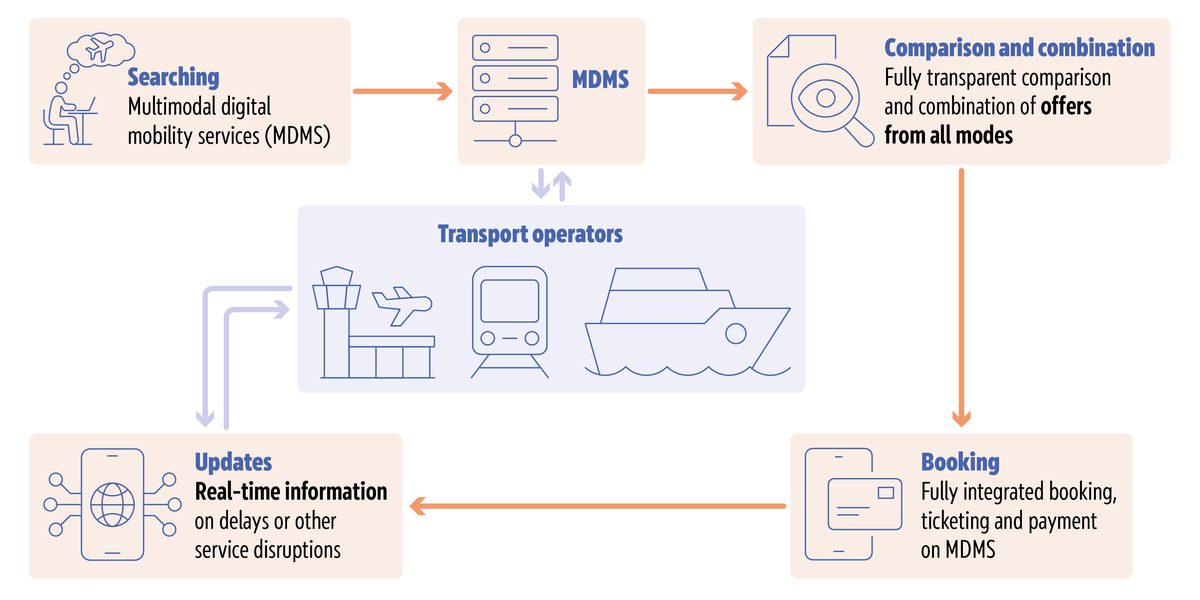
Source: Kearney analysis. Graphic by Samy Chahri, EPRS.
The use of multimodal digital mobility services (MDMS) can significantly enhance the travel experience and make journeys more convenient, expand the range of travel options available and improve value for money. By integrating multiple transport services into a single platform, MDMS reduce the time and effort required to plan and book trips, offer a wider choice of destinations, departure times and service frequencies, and enable travellers to compare prices and identify the most suitable travel options.
Examples of MDMS include mobility-as-a-service (MaaS) platforms, online travel agencies, metasearch platforms, content aggregators and transport operators' own distribution channels, such as Deutsche Bahn's Navigator app. According to foresight estimates, by 2030 mobility platforms could generate up to 500 million additional passenger journeys, contribute to 50 % growth in intercity transport and attract approximately 172 million new high‑speed rail passengers.
Computerised reservation systems (CRS) are a specific type of MDMS operating in the business‑to‑business (B2B) market. The EU adopted a code of conduct in 1989, revised in 2009, to prevent anti‑competitive practices and regulate relations between CRS providers, transport operators and travel agents. A 2020 evaluation found that the code no longer ensured a level playing‑field, particularly because it failed to address imbalances in bargaining power between CRS providers and airlines.
Preparation of the passenger package
The EU has actively promoted multimodal digital mobility services since the late 2010s. A major milestone was the adoption of the multimodal travel information services (MMTIS) delegated regulation in 2017, which supports the availability of transport data to enable multimodal journey planners. The 2020 sustainable and smart mobility strategy announced the objective of enabling seamless multimodal travel through digital solutions, including an initiative on MDMS and a common European mobility data space. In 2021, an MDMS initiative was announced in the Commission President's letter of intent and the 2022 Commission work programme. On 29 November 2023, instead of a standalone legislative proposal on MDMS, the Commission presented a passenger mobility package containing several legislative and non‑legislative measures to improve multimodal passenger mobility. This package includes a proposal on passenger rights for multimodal journeys, putting forward, for the first time, a common framework to protect passengers travelling on a journey that combines different modes of transport, such as buses, trains and flights. It strengthens passengers' rights to receive clear information before and during their journey, including information on minimum transfer times between connecting transport services. Furthermore, where a multimodal journey is purchased under a single transport contract, passengers should be entitled to assistance from the carrier in the event of a missed connection. Interinstitutional negotiations are ongoing on this file. To support the Commission in the work on sustainable multimodal mobility, the multimodal passenger mobility forum (MPMF) was established in 2021 and published a report in 2023.
In her political guidelines of July 2024, Commission President Ursula von der Leyen set out a vision in which Europeans can buy a single ticket from a single platform and enjoy passenger rights for their whole trip. This ambition was reaffirmed in her mission letter to the Commissioner for Sustainable Transport and Tourism, Apostolos Tzitzikostas, although it was not mentioned in the Commission work programmes of 2025 and 2026.
Stakeholder consultations
The proposals on multimodal booking and the proposal on the rail ticketing regulation are supported by a common impact assessment. In preparing the impact assessment, the Commission carried out stakeholder consultations between 2020 and 2025 to gather views and suggestions and quantitative evidence, including data and statistics.
Between February and May 2021, an open public consultation took place on the review of the CRS code of conduct. This was followed by an open public consultation on multimodal digital mobility services from December to February 2022. Feedback from a total of 41 stakeholders was collected, including 12 companies, 11 business associations, 6 others, 4 public authorities, 4 EU citizens, 2 NGOs and 2 consumer organisations.
Stakeholder views on the MDMS initiative differ according to sectoral interests. Rail operators and public transport providers generally support seamless multimodal mobility but oppose mandatory access to ticketing systems and commercially sensitive data. They argue that extensive data‑sharing obligations could undermine commercial autonomy, increase compliance costs and disproportionately benefit larger digital platforms. By contrast, digital mobility platforms and travel technology companies advocate stronger obligations on transport operators to provide access to real‑time data, fares and booking systems, considering such access essential for integrated mobility services and greater competition. Consumer organisations, including BEUC, generally support mandatory interoperability and data‑sharing requirements to address fragmented booking systems, improve transparency and facilitate cross‑border ticketing, while also strengthening passenger rights for multimodal journeys. Environmental organisations similarly endorse MDMS, arguing that integrated digital mobility services could encourage a shift away from private cars and short‑haul flights to more sustainable transport modes, thereby contributing to emissions reductions.
The Commission also organised targeted stakeholder surveys and interviews with transport operators, ticket vendors, consumer organisations, Member States and digital platforms. In February 2023, the Commission organised a public workshop with the participation of stakeholders on the inception impact assessment related to the discarded MDMS proposal.
Impact assessment
The impact assessment explains that passengers still face a fragmented system when planning and booking journeys that combine different modes of transport, especially rail, bus and air. This fragmentation goes beyond technical issues and acts as a structural barrier to both consumers and the internal market, as rail services in particular remain reliant on national systems and incumbent operators that control ticketing channels and access to key data. As a result, it is difficult for third‑party platforms to offer integrated journey planning and booking across multiple operators.
A key problem is the lack of interoperability between ticketing systems and inconsistent rules on access to travel data. Data sharing is often fragmented, based on bilateral agreements or proprietary systems, which limits competition, reduces market entry opportunities and slows down innovation. This also hampers the development of multimodal travel solutions, which are important for meeting EU climate objectives.
The impact assessment also identifies gaps in passenger protection for journeys involving multiple operators. While EU rail passenger rights rules work well for single journeys, they do not always clearly apply when disruption occurs across combined trips, creating uncertainty for travellers.
The impact assessment also considers whether the transport industry could fix these issues on its own, for example through voluntary cooperation or non‑binding EU guidance. It notes this could lead to some gradual improvements, but concludes that voluntary steps would not be enough to change the underlying structure of the market. For that reason, the preferred solution is new EU‑level rules that apply consistently across all Member States and transport operators.
The expected impacts are economic, social and environmental. Economically, better integration would improve market access for new digital services and increase efficiency in ticketing, while imposing proportionate obligations on existing operators. Socially, passengers would benefit from simpler booking processes, clearer pricing and stronger protection during disruptions. Environmentally, the initiative is expected to support EU sustainability goals by making it easier to use rail as part of seamless multimodal journeys.
Passenger package proposal
On 13 May 2026, the Commission proposed new rules for seamless travel across Europe, aiming to simplify booking, comparing and planning. The passenger package that was presented includes three complementary proposals that focus on the protection of passengers with single tickets:
-
Proposal for a Regulation on multimodal booking and repealing Regulation (EC) No 80/2009 (MBS Regulation);
-
Proposal for a Regulation on rail ticketing (Rail Ticketing Regulation);
Alongside the passenger package, the Commission also published a report on the implementation and results of Regulation (EU) 2021/782 on rail passengers' rights and obligations (Regulation (EU) 2021/782). This is not a legislative proposal but a review of the application of the revised Rail Passenger Rights Regulation since it became operational in June 2023. The report concludes that Member States have made progress in implementing the rules, for example, by improving passenger information, strengthening provisions on bicycle carriage and reducing the use of exemptions, but important gaps remain, particularly regarding through‑tickets and protection for journeys involving multiple rail operators.
Multimodal booking services
The proposal on multimodal booking services, repealing Regulation (EC) No 80/2009, aims to address the lack of transparency, unfair commercial practices and unequal market conditions in the digital ticket distribution market across aviation, rail, road and waterborne transport. It establishes a common legal framework for digital platforms that allow passengers to search, compare and book journeys involving different transport modes. It replaces the outdated rules on computerised reservation systems with a broader framework reflecting today's digital ticketing market. The proposal applies to multimodal digital mobility services (MDMS) that offer booking or reservation services, while excluding purely urban transport services, search engines and SMEs.
A central element is the requirement that transport operators provide access to the data and interfaces needed by multimodal booking providers under fair, reasonable and non‑discriminatory (FRAND) conditions. This is intended to prevent operators from restricting access to ticketing systems or offering less favourable conditions to third‑party distributors than to their own sales channels.
The proposal also introduces rules on how travel options must be presented to consumers. Multimodal booking platforms must display search results in a neutral and transparent manner based on objective criteria. Self‑preferencing and paid ranking of transport services are prohibited, except where advertising is clearly identified as such. Platforms must also inform users about the criteria used to rank travel options.
To improve transparency for passengers, providers must present key information in a clear and comparable way before purchase. This includes prices, journey duration, transfers, greenhouse gas emissions and accessibility information where available. The objective is to enable passengers to compare travel options more easily, including more sustainable alternatives.
The proposal also contains transparency obligations for multimodal booking providers. Larger providers must report annually to the Commission and national authorities on their activities, including the number and value of tickets sold by transport mode. These reporting requirements are intended to support market monitoring and evaluate the regulation's effectiveness.
Finally, the proposal complements existing EU legislation on transport data sharing and digital markets, including the multimodal travel information services (MMTIS) framework, the Digital Markets Act and the Data Act. Rather than creating new data‑sharing obligations, it focuses on ensuring that access to booking systems and ticket distribution takes place on transparent and non‑discriminatory terms, thereby supporting the development of a competitive EU‑wide digital market for multimodal travel services.
Rail ticketing
The proposed regulation on rail ticketing establishes common rules to make rail tickets easier to find, compare and purchase across the EU, particularly for journeys involving multiple railway operators. Its main objective is to improve access to rail ticketing systems and promote the sale of single tickets for domestic and cross‑border rail journeys. A key provision is the introduction of a mandatory content‑sharing obligation. Railway service providers must conclude commercial agreements with online ticketing service providers and make their rail products, fares, discounts, booking options and real‑time information available under FRAND (fair, reasonable and non‑discriminatory) conditions. This is to ensure independent ticketing platforms can offer the same rail products as railway operators' own sales channels.
The proposal also prohibits discriminatory treatment of third‑party distributors. Railway operators may not refuse access to their ticketing content or offer less favourable commercial conditions without objective justification. This is designed to create a level playing field between operators' own websites and independent ticket vendors.
To improve the full range of rail offers, the proposal requires that certain large railway service providers make their products available on 'indispensable' online ticketing services. These are platforms with significant market reach, which passengers commonly use to search for and purchase rail tickets. The aim is to ensure passengers can compare and book services from different operators through a platform of their choice.
The proposal also sets out requirements for commercial agreements between railway service providers and ticketing platforms. These agreements must cover access to ticketing content and technical interfaces while respecting FRAND principles. The regulation does not harmonise prices or commercial terms but establishes minimum conditions to ensure transparent and non‑discriminatory negotiations.
Furthermore, the proposal includes provisions on monitoring and enforcement. National authorities are tasked with supervising compliance, while the Commission is empowered to adopt implementing acts specifying technical requirements where necessary.
Protection of passengers with single tickets
Compared with the current Rail Passenger Rights Regulation (EU) 2021/782, this proposal introduces targeted amendments rather than a full revision. Its main objective is to close gaps in passenger protection for journeys involving multiple railway operators purchased in a single transaction.
The key innovation is the introduction of a harmonised definition of a 'single ticket'. Under the proposal, a single ticket can cover either a traditional through‑ticket or several transport contracts purchased together in one transaction. Passengers holding such tickets would benefit from consistent rights throughout the entire journey, including rerouting, reimbursement, assistance and compensation if a delay or cancellation causes a missed connection.
The proposal also seeks to prevent the unnecessary splitting of journeys into separate tickets when a single ticket could be offered, as this practice can reduce passenger protection. At the same time, it clarifies that railway operators are not liable where a ticket vendor or tour operator creates unrealistic connections that do not respect minimum transfer times.
Overall, the proposal extends existing passenger rights to a broader range of multi‑operator journeys, closes gaps in the current framework and clarifies the responsibilities of railway undertakings, ticket vendors and tour operators.
Connection to other EU legislation
The passenger package is closely linked to the objectives of the European Green Deal and the sustainable and smart mobility strategy, both of which identify digitalisation and multimodal transport as key tools for decarbonising the transport sector.
The Green Deal calls for a substantial shift from road and air transport towards more sustainable modes, particularly rail, as part of the EU's objective of achieving climate neutrality by 2050. However, the Commission has consistently argued that this modal shift will only occur if sustainable travel options are as easy to plan, book and use as less sustainable alternatives.
The sustainable and smart mobility strategy identifies seamless multimodal travel, integrated ticketing and digital mobility services as essential components1 of a modern, European transport system. The strategy represents legislative action to improve access to transport data, promote digital mobility services and enable passengers to plan, book and pay for door‑to‑door journeys across different transport modes through a single platform. The passenger package implements these commitments by introducing common rules for multimodal booking services, improving access to rail ticketing systems and strengthening passenger rights for combined journeys.
At the same time, MDMS align with the EU digital agenda by relying on interoperable data sharing, common digital standards and open transport data, thereby contributing to the development of the single market for digital mobility services and cross‑border passenger transport.
To develop seamless booking and ticketing systems, Member States must also speed up implementation of the Intelligent Transport Systems Directive's rules on sharing multimodal transport data on national access points. The passenger package builds directly on the EU's Intelligent Transport Systems (ITS) Directive and the delegated regulation on EU-wide multimodal travel information services (MMTIS). These instruments already require Member States to ensure that relevant travel and traffic data are made available through national access points in a standardised format for information and planning purposes. The passenger package complements the ITS by ensuring that once this data is available, it can be used to actually search, compare and purchase tickets across operators and modes under FRAND conditions.
The passenger package is also closely linked to the 2021 EU action plan to boost long-distance and cross-border passenger rail, which identified fragmented ticketing systems and limited cross‑border interoperability as key barriers to making rail a more attractive alternative for long‑distance travel within the EU. One of the action plan's central commitments was to improve integrated ticketing and booking systems, including support for through‑ticketing and better access to distribution channels for rail operators and intermediaries. The passenger package implements these commitments through binding rules on rail ticketing and multimodal booking, requiring rail operators to provide access to ticketing content and enabling third‑party platforms to offer comparable and comprehensive rail offers. It also makes the conditions for selling combined rail journeys more stringent, which is essential for cross‑border connections involving multiple operators.
The passenger package is consistent with the communication on connecting Europe through high-speed rail, which sets out a vision for a faster, more integrated European rail network, with high‑speed rail as the backbone of long‑distance sustainable mobility. A key challenge identified in the initiative is that even when high‑speed infrastructure exists, passengers do not always experience it as a single, coherent European network, largely due to fragmented ticketing, limited interoperability between operators and weak integration with regional and cross‑border services. By enabling simpler booking of multi‑operator rail journeys and improving access to ticketing systems, the package helps translate high‑speed rail investments into a functionally integrated network from the passenger perspective, where cross‑border and long‑distance journeys can be planned and purchased more easily.
Main references
- European Commission, Multimodal Passenger Mobility Forum, Report from the Expert Group, 2023.
- Kiss, M., Kohl, L., Multimodal digital mobility services, EPRS, European Parliament, May 2026.
- Kiss, M., Intelligent road transport systems, EPRS, European Parliament, 2022.
Endnotes
Statement on the use of AI
Any AI‑generated content in this text has been reviewed by the author. Perplexity was used to improve the readability of the text and broaden the range of sources available to the author.
Disclaimer
This document is prepared for, and addressed to, the Members and staff of the European Parliament as background material to assist them in their parliamentary work. The content of the document is the sole responsibility of its author(s) and any opinions expressed herein should not be taken to represent an official position of the Parliament.
Copyright
© European Union.
The reuse of this document is authorised under a Creative Commons Attribution 4.0 International (CC-BY 4.0) licence.

To use or reproduce elements that are not owned by the European Union, permission may need to be sought directly from the respective rightsholders.