
Article page checkbox is not checked in page info.
Cities and regions at the heart of Ukraine's reconstruction: The role of the European Alliance of Cities and Regions
Cities and regions at the heart of Ukraine's reconstruction: The role of the European Alliance of Cities and Regions
Jakub Przetacznik with Laura Zghibarta, Members' Research Service
Summary
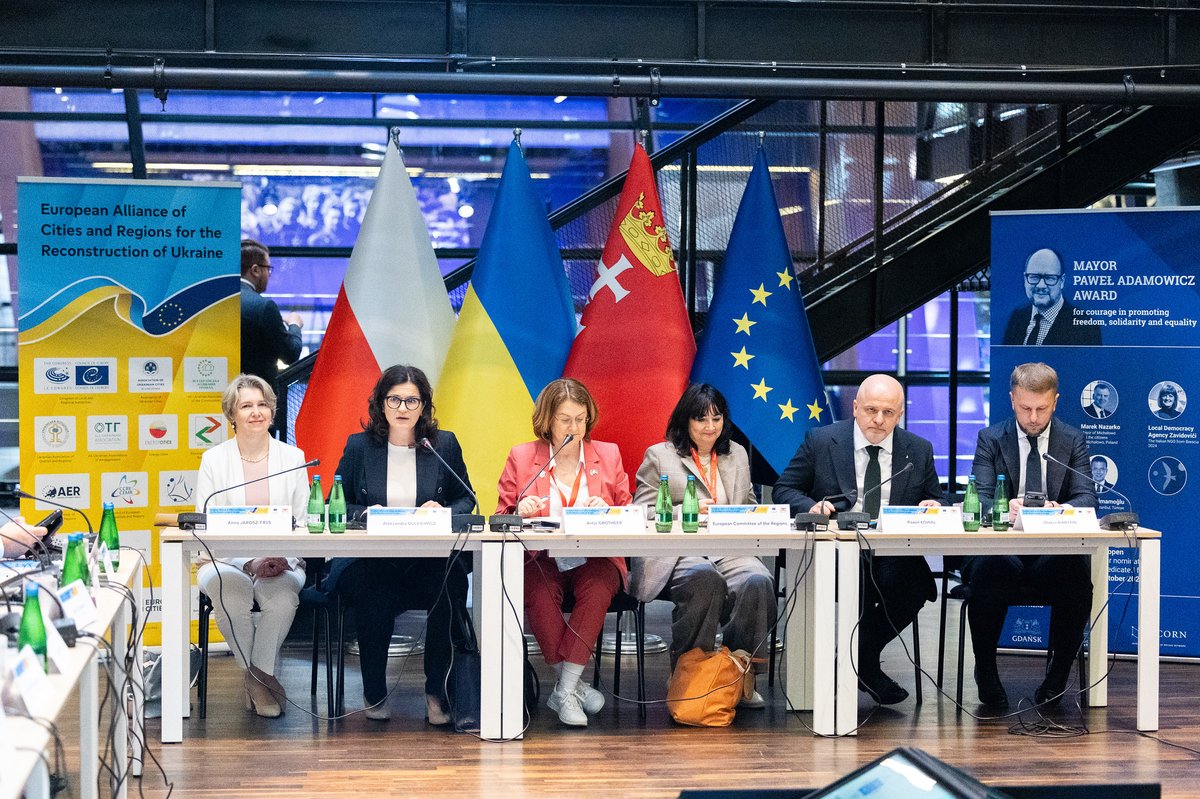
The European Alliance of Cities and Regions for the Reconstruction of Ukraine brings together local and regional authorities at the centre of Ukraine's post-war recovery and reconstruction efforts. The Alliance operates according to the principles of decentralisation, local capacity-building, strengthened good governance, sustainable reform and coordinated efforts, topics that are highlighted in the opinions of the European Committee of the Regions, European Parliament, European Commission and expert community.
Purpose statement
This briefing has been drafted at the request of a Member of the European Committee of the Regions, in the framework of the cooperation agreement between the European Parliament and the Committee.
Background
The European Alliance of Cities and Regions for the Reconstruction of Ukraine is an initiative launched in June 2022 by the European Committee of the Regions (CoR), in partnership with associations of Ukrainian and EU regions and cities, following Russia's invasion of Ukraine and the latter receiving EU candidate status. With over 100 members and advocating a bottom-up model for Ukraine's recovery, the Alliance focuses on empowering local and regional authorities (LRAs) to contribute successfully to the recovery and reconstruction of the country. This approach hinges on the key roles attributed to LRAs as frontline responders, providers of social services, and agents rebuilding local infrastructure, ensuring economic and social development as well as democratic resilience.
Mission
The Alliance supports a decentralised and local-driven recovery, the strengthening of local democracy and good governance. To this end, the initiative serves as a platform gathering EU and Ukrainian LRAs 'to coordinate joint efforts in support of an effective reconstruction of Ukraine'. It also advances the local dimension of recovery in EU-level discussions and in the context of the Ukraine Recovery Conference (URC), while actively engaging with the Ukraine Donor Platform and the OECD, advocating the assignment of reconstruction responsibilities, decision-making powers and resources to Ukrainian cities and regions. As an operational platform, the Alliance facilitates inter-municipal partnerships between EU and Ukrainian cities centred around social services, infrastructure, sustainable development, peer-to-peer knowledge exchange and people-to-people ties, while offering additional support towards technical assistance and administrative capacity-building. Notable examples of projects and initiatives aligned with this mission include TIPS4 Ukraine and the European Partnerships Hub (EPH) under U-LEAD with Europe. Overall, these efforts are seen as both conducive to Ukraine's resilience and reconstruction, and complementary to the country's reform as it relates to the EU accession process.
Engagement with the Ukraine Recovery Conference
A major function of the Alliance is discussing and delivering political statements to the annual Ukraine Recovery Conference (URC) and advocating decentralised reconstruction. The Alliance's joint statement adopted ahead of the June 2026 URC in Gdańsk calls for recognising LRAs as 'strategic partners and integral decision-makers in the planning, governance and implementation of reconstruction' projects. The Alliance encourages the setting-up of structured dialogue between LRAs with the Ukraine Donor Platform. The statement also refers to calls for integrating a 'localisation marker' into donor aid for the monitoring and tracing of decentralised support, and advocates for structured political and technical peer-to-peer practice exchanges between Ukrainian and European municipalities and regions. The Alliance highlights the need to support the EU's eastern border regions, as they contribute to Ukraine's military efforts and the country's reconstruction.
The Ukraine Recovery Conference, which took place in Gdańsk on 25 and 26 June 2026, addressed the local and regional dimension in Ukraine's reconstruction as one of the five themes framing the conference discussions. It highlighted the growing importance of win-win partnerships, regional policy and good governance. Specific focus was given to 'sustainable urban and rural development, modernised housing, decentralised energy systems, and strengthened local economies', including material and capacity-building support for LRAs. A Poland-Ukraine joint communication platform for municipalities is expected to be set up, aimed at accelerating an exchange of best practices, designing of community development solutions and crisis-response coordination.
The Alliance's efforts are anchored in the tailor-made support measures regularly adopted and updated by the CoR. The measures expand on existing initiatives to strengthen local democracy and decentralisation in Ukraine. The CoR's March 2026 opinion on the Enlargement package 2025 – Ukraine, Moldova and Georgia reinforces this approach, linking the success of EU enlargement to strengthened local and regional involvement, development and resilience.
Expert opinions
Experts recognise the role of local actors in the reform and governance track and the consultation and ownership track of reconstruction. Some analyses highlight: the undertaking of public administration reform as a necessary condition to unlock funding for reconstruction through the Ukraine Facility; the role of robust anti-corruption mechanisms and reforms in public transparency to strengthen governance, attract capital and investment, and ensure trust between international donors and local stakeholders; the importance of developing absorption capacities at the local level by the Ukrainian government; and transparency, accountability, proper oversight of funds and anti-corruption safeguards at all levels, including local governments, as requisites in Ukraine's reconstruction pricing system. Other opinions: underscore the need for balanced involvement of local authorities in consultation and reconstruction projects' development processes, and the use of local knowledge; suggest that local decision-making should inform elected officials, public administration, and investment partners, while decentralisation should be efficient, democratic, harmonious with national governance and sustainable to support reconstruction; call for formal acknowledgement of local priorities and ownership over implementing efforts at the local level; assign strong ownership capabilities to local authorities in managing development initiatives, to be aided by technical and strategic support of global partners. There is ample academic consensus around the desirability of Ukrainian ownership of reconstruction based on local knowledge and consultations with local authorities, and domestic support lending legitimacy to the process, while recommending a decentralisation process that could foster competition, resilience, and effective governance and resource allocation.
European Commission position
The European Commission embraces the multi-level governance agenda in Ukraine, its effective decentralisation reform and the restoring of local administrative functions. These requirements stem from Ukraine's EU accession commitments, the Ukraine Plan and the Public Administration Reform (PAR) roadmap. Furthermore, the Commission underlines the importance of adhering to the principles of subsidiarity, efficiency, accountability and local decision-making in the use of financial allocations for the recovery and reconstruction needs of Ukraine's subnational authorities envisioned in the Ukraine Facility. In the Ukraine 2025 Report accompanying the 2025 communication on EU enlargement policy, the Commission highlights the country's progress in adopting the law on public consultations and the 2025 comprehensive government action plan on regional development and decentralisation, as well as the reinstitution of mid-term local budgeting. The Commission also calls for better oversight mechanisms over local government decisions, a clearer legal framework on resuming local governance in de-occupied territories, improved implementation strategy and financial sustainability of PAR, progress in the management of local public investments, and the addressing of the local military administration issue.
European Parliament position
The Parliament resolution of 9 September 2025 on the 2023 and 2024 Commission reports on Ukraine addresses the decentralisation-reform-recovery nexus.It calls for progress in the decentralisation reform and the strengthening of local self-governance, welcoming the launching of Phase III of U-LEAD which focuses on the resilient recovery of Ukraine's localities and regions. The resolution also supports meaningful engagement of Ukraine's local authorities in advancing the implementation of the Ukraine Plan and associated reform commitments. Furthermore, the European Parliament makes the case for a reconstruction-accession nexus, underlining that reconstruction efforts must be grounded in the reform agenda on the rule of law, transparent governance, anti-corruption and public administration pursued by Ukraine as part of its accession to the EU. This interplay should subsequently help with attracting reconstruction investments, ensure a safe and stable investment environment, and foster public confidence.
The Committee on Foreign Affairs (AFET) report on the 2025 Commission report on Ukraine, due to be voted during the July 2026 plenary session, commends the country's multilevel governance and decentralisation efforts, and calls for additional reforms to support local self-government. On reconstruction efforts and preparation, it highlights the role of inclusive local ownership as a guiding principle.
Statement on the use of AI
Any AI-generated content in this text has been reviewed by the author(s).
Disclaimer
This document is prepared for, and addressed to, the Members and staff of the European Parliament as background material to assist them in their parliamentary work. The content of the document is the sole responsibility of its author(s) and any opinions expressed herein should not be taken to represent an official position of the Parliament.
Copyright
© European Union.
The reuse of this document is authorised under a Creative Commons Attribution 4.0 International (CC-BY 4.0) licence.

https://creativecommons.org/licenses/by/4.0/deed.en
To use or reproduce elements that are not owned by the European Union, permission may need to be sought directly from the respective rightsholders.