
Article page checkbox is not checked in page info.
European product act
European product act
David Ashton, Members' Research Service

Issues at stake
-
The package of reviews the Commission proposes is an opportunity to bring EU product legislation up-to-date with technological and policy developments. It will equip it for a digitalised world and the opportunities presented by the circular economy.
-
The package is a further response at EU level to the growth of direct shipments of low-value goods to consumers, commonly known as 'e-commerce'. This will be particularly the case with the reform of the market surveillance regulation.
-
It is unclear to what extent the three instruments will be reviewed together, possibly as a single legislative instrument, or in another combination. Regardless of the formal presentation of the files, there are certain interlinkages as a matter of policy which can be exploited through treatment of the reviews as a package. This concerns certain technical measures, such as the use of common specifications, or the digital product passport.
Purpose statement
This European Parliamentary Research Service paper aims to inform Members on issues related to a forthcoming European Commission initiative. It highlights the main choices which may shape the initiative and which Members may wish to explore ahead of adoption by the Commission. Based on documentary and other sources, it reflects the information available at the time of writing.
For further information on this topic, Members and staff of the European Parliament may contact the author.
Developments and insights – European Commission
In its 2026 work programme, the Commission announced reviews of the Standardisation Regulation (Regulation (EU) No 1025/2012), the New Legislative Framework (NLF) and the Market Surveillance Regulation (Regulation (EU) 2019/1020, MSR). These three initiatives, listed separately, are grouped together as the 'European product act'. The work programme sets an adoption date for the three legislative proposals in the third quarter of 2026. The likely date is September.
In the single market strategy, the Commission previews the three initiatives. It deals with the NLF and market surveillance reviews separately from the standardisation review. The former constitute 'barrier 7' in the list of 'Terrible Ten' barriers to single market integration (outdated product rules and lack of product compliance), while the latter is 'barrier 5' (delays in standard-setting). In an information note for a discussion of the European product act at the Competitiveness Council on 28 May 2026, a group of Member States note that the initiative 'should' result in a single proposal on the NLF and market surveillance, with standardisation being separate.
The Commission's policy focuses on updating the rules, which are outdated due to the age of some of the legislation, and strengthening the single market against the threat of unsafe products entering from the outside, particularly by means of online orders.
Standardisation Regulation
The Commission published an evaluation of the Standardisation Regulation in June 2025.1 The evaluation drew attention to the slow pace of delivery of standards and the limited range of stakeholders participating in the formulation of standards. The problem of speed of delivery has been exacerbated by Court of Justice judgments that have enhanced the status of harmonised standards in EU law. Furthermore, recent case law has found a requirement for free access to the content of harmonised standards, thereby complicating the process for publication of standards.
To prepare the current review, the Commission ran a public consultation from 24 September to 17 December 2025. It published a factual summary of the responses to this consultation on 10 February 2026. The summary groups the reported issues under four headings: (i) responsiveness of the standardisation system, including the speed with which standards are developed; (ii) inclusiveness of the standardisation process – meaning the ability to participate in setting standards; (iii) access to standards; and (iv) the international dimension of standardisation.
Delivery of standards can be improved by empowering the Commission to adopt common specifications when the European standardisation bodies are, for whatever reason, unable to deliver. Common specifications are an alternative means for manufacturers to demonstrate the compliance of their products with the applicable regulatory requirements, such as on safety. This is commonly known as a 'fall-back' and has been increasingly used in product legislation going back to Directive (EU) 2016/2102 on the accessibility of public sector body websites and mobile applications. The Commission addresses this point alongside the broader standardisation agenda in the single market strategy.
Common specifications
The ideas proposed by the Commission for revision of the Standardisation Regulation will be influenced by the outcome of negotiations on two files forming part of the single market simplification omnibus. In these files, the Commission aimed to update product harmonisation legislation (in the form of regulations, on the one hand, and directives, on the other) by empowering itself to adopt common specifications in situations where the EU's normal standardisation system is not delivering. The proposals aim to fill gaps in current legislation where such an empowerment does not exist.
The proposals drew fire from industry participants, who are broadly keen to keep the current industry-led approach to standardisation, and who cite what they see as limited clarity on the process for developing and adopting common specifications.
A political deal was struck on these files on 9 June 2026. As regards common specifications, it strikes a balance by specifying that the Commission may use this empowerment without a prior request to the European standardisation bodies only 'as a measure of last resort'. In this case, draft common specifications are to be accompanied by a report specifying, inter alia, the alternative measures taken which failed to mitigate the lack of harmonised standards. Furthermore, the deal contains a sunset clause to the effect that the empowerment is limited in time to 48 months. Finally, the Commission is encouraged to make publicly available on its website the details of any third parties involved in the drafting process. It is conceivable that an empowerment to adopt common specifications could be proposed by the Commission as a standard provision in the form of an amendment to the New Legislative Framework.
New Legislative Framework
The NLF is a framework for harmonised rules on the making available on the market of products in the EU. It dates back to 2008, when Decision No 768/2008/EC on a common framework for the marketing of products and Regulation (EC) No 765/2008 setting out the requirements for accreditation were adopted on the same day, as part of a package.
The former establishes a set of reference provisions which is applied to each sectoral act, thereby ensuring consistency between the different pieces of EU product legislation. This includes rules on the bodies responsible for the assessment of the conformity of products, both in-house and third-party. It also establishes procedures for that assessment. The latter establishes rules on accreditation, i.e. control of conformity assessment bodies carried out in the public domain and not as a commercial activity. Initially, it also covered market surveillance, but this subject-matter was removed when the updated Market Surveillance Regulation was adopted in 2019. Were the Commission to propose combining the existing NLF and market surveillance legislation in the European product act, this would represent a reversal of that decoupling.
The Commission published an evaluation of the NLF in November 2022. The main points on which the evaluation found updates might be necessary were the need for increased digitalisation of the EU product harmonisation framework and its adaptation to certain objectives of the circular economy. The logic for the latter point was that the NLF as currently conceived focuses on the moment at which the product is first placed on the market, whereas the objectives of the circular economy mean that compliance might need to be assessed dynamically, for example after recycling or repair.
To prepare the current review, the Commission ran a public consultation from 12 November 2025 to 4 February 2026. It published a factual summary of the responses on 4 March 2026. The summary examines the responses in relation to three main substantive themes: (i) the digital product passport (DPP); (ii) circularity; and (iii) conformity assessment bodies.
Digital product passport
The digital product passport (DPP) can be thought of as an 'ID card' for objects. Its legislative life began essentially with the 2024 Ecodesign Regulation (ESPR), which introduced a basis for the DPP in various product categories, which need to be rolled-out by the Commission in secondary legislation. It has also been mandated in sectoral legislation, such as the Batteries Regulation, the Construction Products Regulation and the Toy Safety Regulation. Under the Batteries Regulation, a DPP is mandatory from 18 February 2027 for industrial batteries of a certain capacity, electric vehicle batteries and other batteries for use in vehicles (light means of transport batteries). This is the first product group for which a DPP is mandatory. Technical work to underpin the DPP, relating to service providers and technical standards, is ongoing.
Market Surveillance Regulation
The review of the Market Surveillance Regulation is fundamentally different from the standardisation and NLF reviews. The regulation was adopted in 2019 and has applied since July 2021. The review is, therefore, less an adaptation of an outdated legislative instrument, but rather an immediate response driven by political considerations.
Given the short timeframe, there is no evaluation of the current legislation supporting the Commission's work, although the 2026 work programme does announce one for the fourth quarter of 2026, i.e. after the date announced for the legislative proposal.
This said, previous work provides some insights as to the possible content of the proposal. In a study on the implementation of the regulation carried out for the Commission in October 2024 (the 2024 MSR study), one option proposed by the authors for future reform was 'to continue reviewing the strengthening of responsibilities of providers of online marketplaces'. Furthermore, in the single market strategy, the Commission looked at reform of market surveillance in terms of 'EU-level governance'. As well as increasing national authorities' capacities, its ideas included the possible establishment of an EU market surveillance authority.2
Online marketplace responsibilities: The baseline
The Digital Services Act (DSA), which has applied since 17 February 2024, introduced a series of obligations on online marketplaces. Among them, online marketplaces are to identify business users and who is selling a product or offering a service (traceability) (Art. 30) and to design their interface to allow traders to supply the information required by EU legislation (the 'compliance by design' obligation) (Art. 31). The General Product Safety Regulation (GPSR), which has applied since 13 December 2024, implements the compliance by design obligation by obliging online marketplaces to enable traders to provide certain minimum product safety and traceability information, such as details of the manufacturer and information identifying the product (Art. 22(9)).
The DSA does not make online marketplaces liable for products offered for sale on them. In the reform of EU customs legislation, this non-liability is adjusted by giving the online marketplace the choice of assuming the obligations of the importer, including in relation to product compliance. As this liability is optional, there is no breach of the DSA. This is consistent with the position taken in Parliament's resolution on product safety and regulatory compliance in e-commerce and non-EU imports, to the effect that the 'deemed importer' concept under the customs reform should be consistent with the DSA.
Why is the European product act important?
The rise of e-commerce was an issue already at the time of the last revision of the Market Surveillance Regulation, and such concerns are expressed in the recitals to the regulation. They are further traced through the 2024 MSR study, which contains an annex detailing the evolution of e-commerce as it then stood.
The single market strategy notes 4.6 billion deliveries of low-value consignments (up to €150) into the EU in 2024, 'almost twice' the number recorded in 2023 (2.4 billion) and 'more than triple' compared to 2022 (1.4 billion). Latest informal figures indicate a further 26 % increase in 2025 to a total of 5.8 billion shipments. Furthermore, in its e‑commerce communication, the Commission stated 'e-commerce imports' constitute 97 % of all customs declarations.
In terms of product safety, the latest data come from the 2025 Safety Gate report. The sheer number of alerts for dangerous non-food products reported in 2025 stands out, at 4 671, an increase of 13 % on 2024 and 121 % on 2022.
Secondly, they allow for an understanding of the types of product most commonly notified as dangerous. For the third year running, the highest incidence of dangerous products is found in cosmetics (36 %), with toys (16 %) and electrical appliances and equipment (11 %) following.
Thirdly, the figures give an insight into the provenance of products notified as dangerous. In 2025, 1 648 alerts related to products originating from within the European Economic Area, 2 268 to products originating from Asian countries and 226 to products originating from other countries. Of those originating outside the EU, 2 006 were from the People's Republic of China, 59 from the United States and 70 from the United Kingdom.
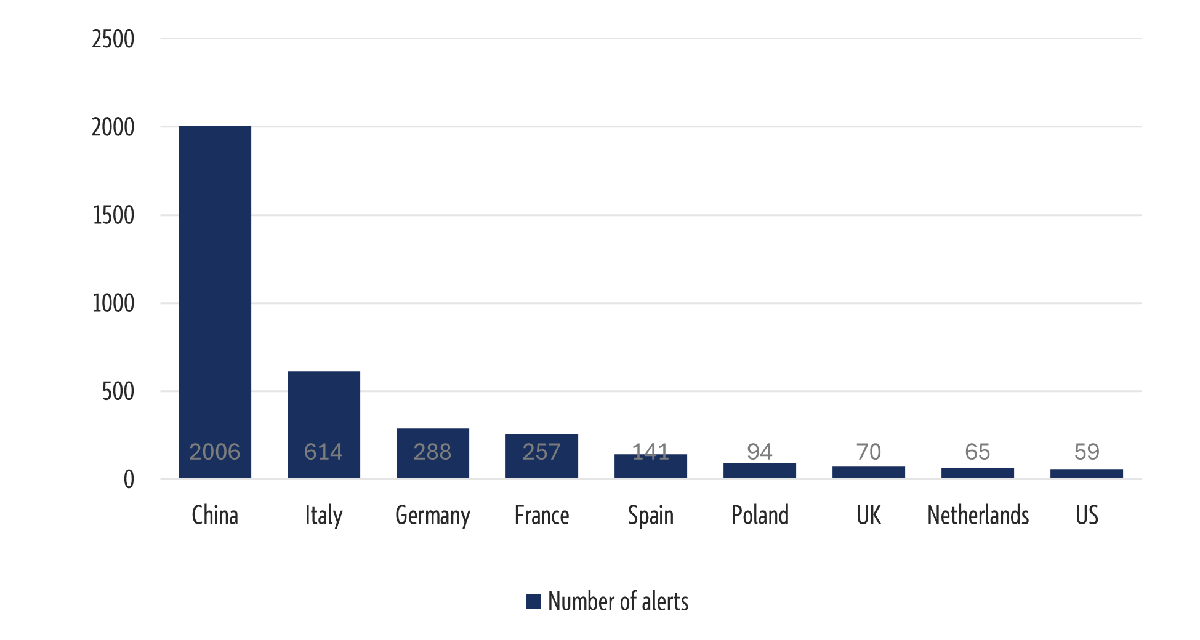
Image source: European Commission, 2025 Safety Gate report.
The results of the sweep were announced on 18 July 2025. Among other things, it found that, as regards the provision of the minimum product safety and traceability information for the manufacturer, 52 % of listings were compliant with the requirements of the General Product Safety Regulation. VLOPs had a higher compliance rate (65 %). As regards the provision of such information for the EU responsible person, 68 % of listings were compliant with the General Product Safety Regulation. Product listings displayed on VLOPs had a higher compliance rate (81 %). Market surveillance authorities found EU market surveillance authorities had previously notified 16 product offers that concerned a dangerous product to the EU Safety Gate. After a product was removed by a VLOP, it reappeared in six cases.
The e-commerce communication also promised that customs and market surveillance authorities would carry out checks on products imported from third countries with a particular risk of non-compliance with EU legislation, including product safety legislation (a 'priority control area'). This took place from April to June 2025. The authorities concerned looked at toys and small electronic devices offered for sale on 'four major marketplaces'. The headline findings were an overall rate of regulatory non-compliance of 55 % and a rate of 84 % of products found to be dangerous under laboratory testing.
Further Commission documents are critical of the number of checks measured absolutely. This applies both to market surveillance operations and customs checks. The 2026 Annual Single Market and Competitiveness Report concludes that market surveillance is 'insufficient'. In 2024, checks were carried out on 102 products per million EU inhabitants, a slight improvement on 2023, when this figure was 82. It also finds 'uneven national control performance' and 'inefficient cooperation' between market surveillance and customs authorities. As regards numbers of customs checks, the Commission's report on controls on products entering the EU market with regard to product compliance in 2024 (Directorate-General for Taxation and Customs Union) finds that customs checks were carried out on 82 per million imports in 2024, which compares to 124 per million in 2023 and 203 per million in 2022. This decrease is a direct result of the increasing number of shipments.
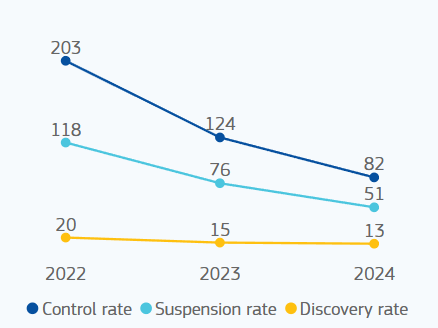
Source: European Commission, Report on controls on products entering the EU market with regard to product compliance in 2024.
According to the European Investment Bank's 2025 Investment Survey, 62 % of firms say the EU market is fragmented for their main product – the same as in 2024. This fragmentation not only covers regulatory requirements and standards, but also consumer protection rules.
Member State positions and interested parties' opinions
The proposed European product act was discussed at the Competitiveness Council on 28 May 2026. In the information note prepared as background for that discussion, a group of six Member States proposed priorities for the Commission when drawing up its proposals. According to those Member States, the legislation should be future-proof and provide for extensive use of digital technologies. Furthermore, it should ensure a level playing-field for all companies competing in the single market. In the discussion, the Dutch delegation noted that consistent legislation can help to reduce the administrative burden on business.
Standardisation
On 29 April 2026, the European Economic and Social Committee (EESC) adopted an opinion on strategic standardisation for a stronger single market (rapporteur: Angelo Pagliara, Workers – Group II, Italy). Among other things, the opinion calls for increased small and medium-sized enterprise (SME), trade union and civil society organisation participation in the standardisation system, while at the same time ensuring that that system remains 'industry-driven'. It also calls for improved public access to harmonised standards, although this is to be balanced by the protection of the intellectual property rights held by the European standardisation organisations.
Orgalim, an association representing Europe's technology industries, calls for binding timelines for standardisation requests (9‑12 months) and citations. To gain speed, they suggest changes to the drafting process, such as removing translation periods and shortening voting periods. ANEC, which represents the consumer voice in standardisation, advocates replacing the current harmonised standards system with a permanent, independent mechanism within the Commission, which would include legal and technical experts and which would be able to assess standards against fundamental rights. ANEC warns against the current funding constraints. It suggests that Annex III organisations (i.e. those eligible to receive funding under the current regulation) be explicitly designated as beneficiaries under a revised regulation.
Industry representatives such as BusinessEurope and Orgalim are concerned about the concept of free access to standards. They see complications as regards interaction with international standards, which are protected by copyright. BusinessEurope argues that a legal basis for compensation must be established in the revised regulation if standards are made available for free.
New Legislative Framework
BusinessEurope further proposes a specific 'NLF Check' for both legislative proposals and standardisation requests. This is conceived of as a quality assessment within the Commission, enacted at the earliest stage of drafting, to ensure that outcomes are technically feasible and coherent with the NLF. It is also intended to prevent the delegation of political issues to standardisation committees.
The Environmental Coalition on Standards argues that the NLF review should take the opportunity to update and harmonise definitions for circular economy processes and economic operators, aligning with the Ecodesign Regulation. To support circularity, used products with a 'CE mark' should retain the presumption of conformity of the original product, and the focus of any compliance assessment should be on the refurbishment process itself.
Market surveillance
At the meeting of the Competitiveness Council on 26 September 2024, Ministers heard an information point on the need to discuss and reflect upon a further unified approach regarding the enforcement of EU standards in e‑commerce. This point was at the request of Germany, with the support of Austria, Denmark, France, the Netherlands and Poland. In the supporting information note, those Member States expressed support for commitments made by Commission President Ursula von der Leyen to tackle problems with e-commerce. They called for reinforcement of market surveillance authorities' intervention powers, in particular regarding their ability to act against online platforms, alongside enhanced cooperation and coordination with customs authorities.
The Competitiveness Council held a public exchange of views on e‑commerce on 8 December 2025. A preparatory note from the Danish Presidency asked for Member State views on additional measures to be taken to counter problems and how Member States could coordinate within the existing framework. It asks specifically whether new legislative measures, such as increasing online marketplaces' responsibilities, are necessary. In the context of issues which were then current with platforms such as Shein, Temu and AliExpress, the French delegation took a strong position. It called for a market surveillance authority at EU level and strengthened coordination between EU authorities.
On 29 April 2026, the EESC adopted an evaluation report on the Market Surveillance Regulation (rapporteur: Antje Gerstein, Employers – Group I, Germany). The overall finding is that problems are linked to enforcement and are not regulatory. The report recommends strengthening checks on authorised representatives, as provided for under the current regulation, by means of minimum quality criteria and a publicly accessible database. The report also draws attention to the significant confusion between the regulation and associated legislation, such as rules on product safety, customs controls and consumer protection, and recommends that this be addressed in the upcoming European product act.
EU trade associations have expressed their views on e-commerce directly. In petitions sent to the European Parliament, associations complain of unfair competition from third countries in the markets for prams and footwear, which they allege threaten EU industry. These two petitions served as the basis for a motion for a resolution by Parliament's Committee on Petitions on the protection of EU companies, jobs and products against unfair competition from non-EU countries, which was adopted in plenary on 29 April 2026.
There is industry support for the establishment of an EU market surveillance authority. Both Orgalim and BusinessEurope take this position, although they caution that its mandate would need to be carefully defined and that it should not attempt to duplicate or take over all the work of Member States' market surveillance authorities, as national authorities are more attuned to local market sensitivities. Orgalim also suggests that a new EU market surveillance authority could carry out checks on products intended for use by businesses, as Member States' market surveillance authorities currently focus on products intended for use by consumers.
In line with its focus on business-to-business transactions, Orgalim also proposes amending the definition of a 'product presenting a risk' in the Market Surveillance Regulation to cover economic harm caused by non-compliance. It argues that this would help to address level playing-field issues caused by non-compliant low-value products imported from outside the EU. Further, Orgalim calls for the Commission to develop harmonised guidelines to improve cooperation between customs and market surveillance authorities. This idea is buttressed by an 'explain or comply' principle, whereby those authorities would need to justify any departure from the guidelines.
European Parliament views
On 9 July 2025, the European Parliament adopted a resolution on product safety and regulatory compliance in e‑commerce and non-EU imports. The resolution addresses the urgent need to strengthen product safety and regulatory compliance for goods imported via e-commerce, particularly from non-EU countries like China. The text highlights how a massive surge in low-value parcels has overwhelmed customs authorities, resulting in the influx of unsafe, counterfeit, and non-compliant products that undermine consumer protection and environmental standards. It recalls that this can result in unfair competition for EU companies, particularly SMEs. The resolution calls for the swift roll-out of the digital product passport for critical products sold online. Parliament calls on both the Commission and Member States to ensure a greater degree of cooperation between market surveillance authorities and for greater funding to be allocated to them. In this regard, Parliament also calls on the Commission to 'assess … the need' for an EU market surveillance authority that would ensure consistency, provide operational support to national market surveillance authorities and foster cooperation with the EU customs authority.
On 11 September 2025, the European Parliament adopted a resolution on implementation and streamlining of EU internal market rules to strengthen the single market. The resolution outlines a strategic framework to revitalise the EU single market by addressing regulatory fragmentation and excessive administrative burdens. The resolution advocates streamlining internal market rules to enhance global competitiveness while maintaining high social and environmental standards. Key priorities include reducing reporting costs for small businesses, improving the enforcement of existing laws, and leveraging digitalisation. The resolution also emphasises the need for a more inclusive stakeholder consultation process, aimed particularly at SMEs and other stakeholders with limited capacities.
On 21 October 2025, the European Parliament adopted a resolution on 'a new legislative framework for products that is fit for the digital and sustainable transition'. The resolution looks inter alia at the roles and responsibilities of economic operators, the digital product passport, standardisation and conformity assessment and the role of second-hand goods and repair in product supply chains. The resolution expresses the view that the digital product passport should play a role not only in making available product information, but also in establishing conformity by replacing existing declarations of conformity, as is the case with the new Toy Safety Regulation.
Further reading
- Ashton D., Problems presented by third-country e-commerce, EPRS, January 2025.
- D'Angelo G., Casolari F., Minardi M. and Tovo C., Mapping the funding gaps in the market surveillance and customs enforcement: Perspective of the upcoming Multiannual Financial Framework, Policy Department for Economy and Growth, European Parliament, February 2026.
- European Parliament, Review of the standardisation regulation, Legislative Train Schedule.
- European Parliament, New Legislative Framework review, Legislative Train Schedule.
- European Parliament, Review of the market surveillance regulation, Legislative Train Schedule.
Endnotes
Classification
Policy areas: Internal Market and Customs Union
Regions: European Union
Committees: Internal Market and Consumer Protection (IMCO)
Statement on the use of AI
Any AI-generated content in this text has been reviewed by the author.
Disclaimer
This document is prepared for, and addressed to, the Members and staff of the European Parliament as background material to assist them in their parliamentary work. The content of the document is the sole responsibility of its author(s) and any opinions expressed herein should not be taken to represent an official position of the Parliament.
Copyright
© European Union.
The reuse of this document is authorised under a Creative Commons Attribution 4.0 International (CC-BY 4.0) licence.

https://creativecommons.org/licenses/by/4.0/deed.en
To use or reproduce elements that are not owned by the European Union, permission may need to be sought directly from the respective rightsholders.