
Article page checkbox is not checked in page info.
EU legislation and policies to address racial and ethnic discrimination
EU legislation and policies to address racial and ethnic discrimination
David de Groot, Members' Research Service

Summary
People from racial and ethnic minority backgrounds face discrimination and its consequences on a daily basis. However, the exact scale of the problem is hard to gauge, owing to a lack of data and general under‑reporting of racist incidents. Although the European Union (EU) has been introducing legislation to combat racial and xenophobic discrimination since 2000, the problem persists. The global Black Lives Matter protests highlighted the need for new measures, while the COVID‑19 pandemic saw a major increase in reports of racist and xenophobic incidents, and the crisis it triggered had a disproportionately large negative effect on racial and ethnic minority groups, in the form of higher death and infection rates.
Studies point to the cost of racial discrimination not only for the individuals concerned, but also for society as a whole. For instance, a 2018 EPRS report argued that the loss in earnings caused by racial and ethnic discrimination for both individuals and societies amounts to billions of euros annually. EU citizens also acknowledge this problem: a 2019 survey found that over half of Europeans believe racial or ethnic discrimination to be widespread in their country.
To address racial discrimination and the inequalities it engenders, the European Commission has put forward a number of equality strategies and actions. The European Parliament, meanwhile, has long demanded an end to racial discrimination. In recent resolutions, Parliament has called for an end to structural racism, discrimination, racial profiling and police brutality; for protection of the right to protest peacefully; for an enhanced role for culture, education, media and sport in the fight against racism; and for authorities to take an intersectional approach.
This is a further update of a briefing , the previous edition of which was from April 2025.
Context
Although the EU prohibits and condemns racial discrimination, it persists across the Union. This was highlighted by the COVID‑19 pandemic. In April 2020, the European Union Agency for Fundamental Rights (FRA) reported a large increase in racist and xenophobic incidents, particularly against people of Asian or assumed Asian origin. COVID‑19 itself affected racial and ethnic minority groups disproportionately, with higher infection and death rates being reported and connected with existing patterns of inequality and discrimination. In June 2020, the United Nations High Commissioner for Human Rights, Michelle Bachelet, stated that 'the data tells us of a devastating impact from COVID‑19 on people of African descent, as well as ethnic minorities in some countries, including Brazil, France, the United Kingdom and the United States … in many other places, we expect similar patterns are occurring, but we are unable to say for sure given that data by race and ethnicity is simply not being collected or reported'.
Following the death of George Floyd at the hands of US police officers in March 2020, worldwide protests against racial inequality called for an end to police brutality. In some European countries, these protests also sparked a broader reassessment of the colonial past and how institutions and existing structures (including school curricula) perpetuate racial inequality.
Looking forward, there is a risk that existing biases will be hardwired into new, increasingly central technologies, such as artificial intelligence (AI) algorithms, causing further harm. This is because the historical and governmental data used for training AI reflect cultural biases and stereotypes.
A 2018 EPRS cost of non‑Europe report illustrates the considerable impacts that racial and ethnic discrimination are having on individuals, societies and economies. In financial terms, these translate into lost earnings ranging from €1.8 billion to €8 billion annually for individuals and losses ranging from €2.4 billion to €10.7 billion annually for societies.
Glossary
Discrimination: The Racial Equality Directive defines discrimination as 'treating a person less favourably than another person on the basis of race and/or ethnicity or creating any practice or arrangement, which would, for no legally justifiable reason, put persons of certain races and/or ethnicities at a disadvantage'.
Ethnic or racial origin: While the Racial Equality Directive does not define 'ethnic or racial origin', its preamble states explicitly that use of the term 'race' does not imply any admission by the EU of 'theories which attempt to determine the existence of separate human races'. The Member States have adopted various formulations in their national legislation: some do not mention 'race', referring only to 'ethnic' belonging or origin; others refer to 'presumed race' or 'real or presumed' racial belonging; others explicitly mention skin colour as a protected ground or as a characteristic feature of a national or ethnic minority. The boundary between religion and ethnicity is not clearly defined, as case law in some countries recognises discrimination against Jews, Muslims and Sikhs as racial discrimination.
Intersectionality: Attention has also been drawn to overlapping 'intersectional' forms of discrimination. For instance, a black woman with disabilities may face a combination of racism and discrimination based on her gender and disability. Some studies have concluded that various factors can influence educational achievements at the intersection of gender and ethnicity.
Minority: A non‑dominant group that is usually numerically smaller than the majority population of a state or region regarding its ethnic, religious or linguistic characteristics; members of this group (if only implicitly) maintain solidarity with their own culture, traditions, religion or language.
Racialisation: Processes that negatively label others using race as a label, also referred to as 'race making'.
Racism: Ideas or theories of superiority of one race or group of persons about one type of skin colour or ethnic origin.
Xenophobia: Attitudes, prejudices and behaviour that reject, exclude and often vilify people based on the perception that they are outsiders or foreigners to the community, society or national identity.
Scale of the problem
In 2019, an EU‑wide Eurobarometer survey found that 59 % of Europeans believed racial or ethnic discrimination to be widespread in their country, but with considerable variations between Member States. In the 2023 Eurobarometer survey this figure had risen to 60 %, with 61 % believing that discrimination on grounds of skin colour was widespread. These surveys also explored public attitudes towards people from groups at risk of discrimination. For the EU as a whole, the surveys revealed that attitudes to racialised and ethnic minorities had become more positive since an earlier survey conducted in 2015. In 2019, 65 % of respondents said that they were comfortable with the idea of a person with a different ethnic origin to the majority population in their country being elected to the highest political office (an increase of 10 percentage points from 2015). In 2023, this number increased further to 67 %. However, as with public perception of the extent of discrimination, there were wide variations in scores and changes over time among Member States.
In 2023, an average of 80 % of respondents said they would feel comfortable having daily contact with a colleague who is a black person, an increase from 79 % reported in 2019. In some Member States things have improved, in others there has been regression or no change. There is also substantial variance in scores, from 98 % of respondents in the Netherlands (96 % in 2019) and 95 % in Sweden (also 95 % in 2019) being totally comfortable, to 45 % in Bulgaria (previously 48 %), 56 % in Romania (previously 59 %) and Hungary (previously 46 %), and 57 % in Austria (no change). In 2023, 68 % of respondents said that they would feel comfortable if one of their children were in a relationship with a black person (66 % in 2019). Increases in this percentage were seen in all Member States except for Germany and Croatia, with the largest increase – 19 percentage points – in Czechia. The figures varied widely, from 92 % in the Netherlands (89 % in 2019) and Sweden (88 %) and 86 % in Spain (78 %), to 38 % in Cyprus (37 %), 37 % in Hungary (26 %) and 24 % in Bulgaria (15 %).
Individual experiences of discrimination
In 2019, Eurobarometer survey respondents who considered themselves to be from an ethnic minority were more likely than other respondents to report that they had experienced discrimination or harassment in the past 12 months (40 % compared to 17 % of respondents overall).
Harassment and violence
The FRA's 2017 EU‑MIDIS II survey asked respondents about their experiences of harassment and violence on a spectrum from offensive comments to physical attacks. The results showed that Roma and respondents with a North African background had experienced particularly high rates of hate‑motivated harassment in the 12 months before the survey (30 % and 29 %). The 2018 FRA report Being Black in the EU (based on EU‑MIDIS II data) and the 2023 Being Black in the EU report (based on a new survey) spotlighted the widespread harassment and violence faced by people of African descent, and showed that little had changed in the years between the surveys. In the 2023 report, 23 % of respondents had experienced what they perceived as racist harassment in the 12 months prior to the survey. Similarly, in the report Being Muslim in the EU, 27 % of respondents indicated that they had experienced harassment on ethnic or immigration grounds in the five years prior to the survey. The majority had experienced such harassment on multiple occasions. Nearly one in three (30 %) had experienced such harassment in the previous five years. For all groups, rates of hate‑motivated harassment varied widely across EU Member States. The picture was similar for racial violence, with 4 % of respondents of African descent having experienced what they perceived as racial violence in the past five years.
These surveys, as well as the FRA's 2021 report on crime, safety and victims' rights, showed that young respondents were more likely to experience racist harassment, including online. With regard to gender, the overall prevalence of hate‑motivated harassment and violence was similar for women and men, but women were more likely to experience harassment from a person known to them, such as an acquaintance or neighbour. Overall, of the respondents who had experienced hate‑motivated harassment, 3 % said that the perpetrator was a police officer or a border guard, and 4 % indicated that the perpetrator was a public official. Of the respondents who had experienced racist violence, 64 % did not report the incident to the police or another organisation. Among those who reported the incident to the police, the majority (58 %) were satisfied with how the police handled the complaint.
Police stops and racial profiling
Respondents with Asian, South Asian, North African or sub‑Saharan African backgrounds, and Roma, are more likely to say that they have been stopped by the police because of their immigrant or ethnic minority background. Of the respondents of African descent to the FRA's 2023 survey on Being black in the EU, one in four (26 %) had been stopped by the police in the five years prior to the survey and 12 % had been stopped by the police in the 12 months prior to the survey. Of those respondents that had been stopped, 58 % perceived the last stop as racially motivated. This view was highest in Germany (69 %), Spain (66 %) and Sweden (58 %), and lowest in Luxembourg (22 %), Poland (32 %) and Finland (34 %). People's experiences also differed in terms of the contexts in which they are stopped, according to a 2021 FRA report on police stops. For example, for the general population in Greece and Austria, most police stops (94 % and 87 %, respectively) happened when people were driving, on a bike, or using another vehicle, as opposed to police stopping them while on foot or in another situation. By contrast, 78 % of immigrants and descendants of immigrants from South Asia in Greece and 72 % of immigrants and descendants of immigrants from sub‑Saharan Africa in Austria who were stopped by the police experienced this while moving on foot. Levels of trust in the police on a scale from zero (absolutely no trust) to 10 (absolute trust) varied from 8.2 in Finland to 3.6 in Austria. The average level of trust in the countries surveyed was 6.3.
The European Court of Human Rights has ruled that it:
considers that once there is an arguable claim that the person concerned may have been targeted on account of racial characteristics and such acts ... fall into the ambit of Article 8, the authorities' duty to investigate the existence of a possible link between racist attitudes and a State agent's act is to be considered as implicit in their responsibilities under Article 14 of the Convention also when examined in conjunction with Article 8. This is essential in order for the protection against racial discrimination not to become theoretical and illusory in the context of non‑violent acts falling to be examined under Article 8, to ensure protection from stigmatisation of the persons concerned and to prevent the spread of xenophobic attitudes.
The Court considered that the authority to investigate such discrimination should be independent. Furthermore, it clarified in a judgment in 2024 that the burden of proof can be reversed and that the absence of a sufficient legal and administrative framework is liable to give rise to discriminatory identity checks.
Discrimination in areas of everyday life
When it comes to racial discrimination in daily life, in the 2023 FRA survey, 45 % of respondents of African descent felt they had suffered discrimination in the five years prior to the survey, and 34 % in the previous 12 months.
The areas in which the respondents to the 2017 EU-MIDIS II survey felt they had suffered discrimination differed considerably by ethnic group. Furthermore, there were substantial differences per country (Figure 1).
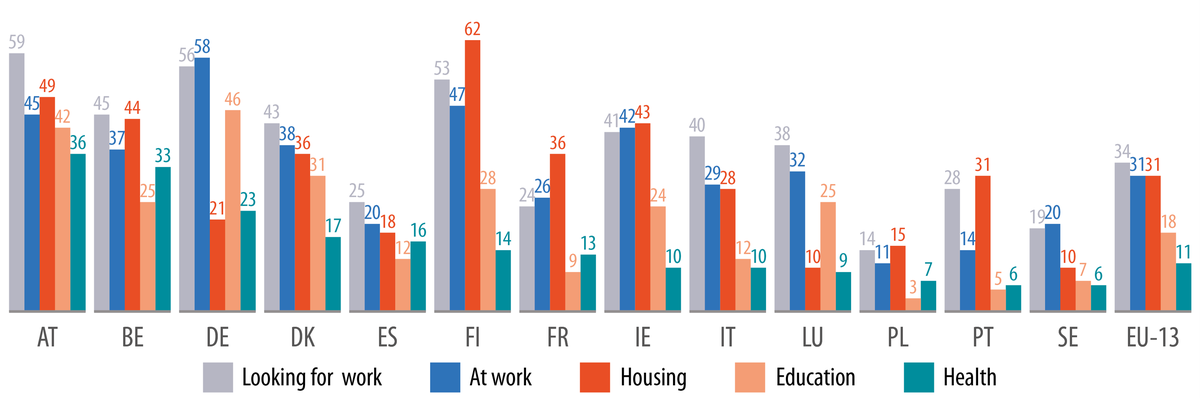
Source: FRA EU Survey on Immigrants and Descendants of Immigrants, 2022. Graphic by Samy Chahri, EPRS.
In the FRA EU Survey on Immigrants and Descendants of Immigrants, one third of respondents of African descent had felt discriminated against while looking for work. Of the respondents of African descent aged 16 to 24, 14 % were unemployed and not in education or training (NEET), which is similar to the general population (11 %). However, there were large differences between countries. Among young respondents (aged 16 to 24) in Spain and Sweden, about twice as many of those of African descent were NEET than in the general population. In France, the rate was 1.7 times as high as that for the general population in the same age group. A higher proportion of people of African descent than the general population work in jobs requiring qualifications below their educational level – an over-qualification rate of 46 % for people of African descent, compared to 22 % for the general population. Comparing the general employment rates of the respondents of African descent to those of the general population, large distinctions could be seen, with a differentiation of up to 16 percentage points in Sweden and Italy. This means that, in combination with the discrimination faced in education (the latter being generally necessary to attain higher‑paid employment), race can limit a person's options and expectations on the job market, which in turn limits their social and economic growth.
Under‑reporting and data collection issues
The surveys show that racism is a widespread issue in the EU. However, the scarcity of data makes it difficult to measure the exact scale of the problem. There are a number of reasons for this scarcity.
Firstly, as highlighted in the research for all the surveys mentioned, incidents of discrimination and racist and xenophobic crimes are often not reported to the authorities. The FRA surveys found that 88 % of cases of ethnic discrimination, 90 % of cases of hate‑motivated harassment and 72 % of cases of hate‑motivated violence were not reported. This can be due to a lack of trust in the authorities, a lack of trust that such reporting will lead to any results, and even a lack of awareness that what has happened is a crime. This means that the data available do not necessarily give a clear picture of how widespread discrimination and crimes based on racial and ethnic origin really are.
Secondly, depending on the circumstances, reports can be filed with many different institutions (e.g. police, equality bodies, ombudsmen and other human rights institutions), making it difficult to get a complete picture. Since 2016, to address this issue, the Netherlands has combined the data on discrimination collected by the police and equality bodies into a single multi‑agency report.
Thirdly, the data are not always fully disaggregated. Additionally, racial discrimination is not always registered as such, and may be registered as religious or another type of discrimination.
Lastly, many Member States are reluctant to collect data on inequalities based on racial and ethnic origin due to historical abuses of such records, leading to serious shortcomings when it comes to assessing the situation of minorities and the implementation and impacts of legislation and policy.
EU legal framework
Discrimination on grounds of race and ethnicity in EU primary law
The principles of equality and the prohibition of discrimination on the basis of racial and ethnic origin have an extensive legal basis in the EU Treaties (e.g. Articles 2 and 3 of the Treaty on European Union (TEU), and 10, 19 and 67(3) of the Treaty on the Functioning of the European Union (TFEU)).
These Treaty provisions are complemented by the Charter of Fundamental Rights of the EU, to which the Lisbon Treaty accorded the same legal value as the Treaties. The charter states explicitly in Article 20 that everyone is equal before the law and in Article 21(1) that 'any discrimination based on any ground such as sex, race, colour, ethnic [bolding added for emphasis] or social origin, genetic features, language, religion or belief, political or any other opinion, membership of a national minority, property, birth, disability, age or sexual orientation shall be prohibited'.
Prior to the adoption of the Treaty of Amsterdam in 1999, the relevant European Community Treaty provisions addressed discrimination on the grounds of nationality and sex only. The breakthrough Article 13 of the Treaty establishing the European Community (TEC) – introduced by the Treaty of Amsterdam (now Article 19 TFEU) – empowered the EU to adopt measures to deal with discrimination based on other grounds, including race and ethnic origin.
EU anti‑discrimination legislation: Scope and implementation
Racial Equality Directive
The first main EU instrument to prohibit discrimination based on racial and ethnic origin was the 2000 Racial Equality Directive, which implemented the principle of equal treatment irrespective of racial or ethnic origin. Compared with the Employment Equality Directive of the same year, which prohibits discrimination on grounds of religion or belief, disability, age or sexual orientation but is restricted to employment, occupation and vocational training, the Racial Equality Directive has a wider scope, as it obliges Member States to adopt anti‑discrimination legislation on:
-
conditions for access to employment, to self‑employment and to occupation, including selection criteria and recruitment conditions, whatever the branch of activity and at all levels of the professional hierarchy, including promotion;
-
access to all types and to all levels of vocational guidance, vocational training, advanced vocational training and retraining, including practical work experience;
-
employment and working conditions, including dismissal and pay; membership of and involvement in a workers' or employers' organisation, or any organisation whose members exercise a particular profession, including the benefits provided by such organisations;
-
social protection, including social security and healthcare;
-
social advantages;
-
education; and
-
access to and supply of goods and services available to the public, including housing.
The directive applies to third‑country nationals only when they are discriminated against on grounds of racial or ethnic origin and not when they are treated differently to EU citizens on grounds of nationality.
Framework Decision on Combating Racism and Xenophobia
A follow‑up to the 1996 joint action on combating racism and xenophobia, the 2008 Framework Decision on Combating Racism and Xenophobia provides for the approximation of laws and regulations of EU countries on offences involving certain manifestations of racism and xenophobia. It requires that certain serious manifestations of racism and xenophobia constitute an offence in all EU countries and be punishable by effective, proportionate and dissuasive penalties. These manifestations are:
-
publicly inciting violence or hatred towards a group of members or one member of a group defined by reference to race, colour, religion, descent or national or ethnic origin;
-
the commission of an act [referred to in the bullet point above] by public dissemination or distribution of tracts, pictures or other material;
-
publicly condoning, denying or grossly trivialising crimes of genocide, crimes against humanity and war crimes, directed against a group of persons or a member of such a group defined by reference to race, colour, religion, descent or national or ethnic origin when the conduct is carried out in a manner likely to incite to violence or hatred against such a group or a member of such a group, explicitly including such crimes committed during the Second World War.
Furthermore, the framework decision also requires that racist and xenophobic motivation be considered an aggravated circumstance. Whereas the majority of the public is aware that incitement is a criminal offence, many are not aware that denial and trivialisation of genocide (including the Holocaust), crimes against humanity and war crimes also constitute such an offence.
The framework decision applies within the territory of the EU Member States, or when the perpetrator is a national of a Member State, or when the legal person has its head office in a Member State. It also applies to online content when the perpetrator is physically present in a Member State, irrespective of the location of the server on which the content is stored, and when the content is stored on a server located in a Member State.
Victims' Rights Directive
The framework decision is reinforced by the Victims' Rights Directive, which aims to ensure that victims of crime receive appropriate information, support and protection and may participate in criminal proceedings wherever in the EU the damage occurred. Member States must also ensure that victims of crime are recognised and treated in a respectful, sensitive and professional manner according to their individual needs and without any discrimination. To this end, an individual assessment concerning the circumstances of the victim must be conducted, where particular attention is to be paid to victims who have suffered a crime committed with a bias or discriminatory motive, and to victims of hate crimes. Following a proposal from 2023 for a revision of the Victims' Rights Directive, Parliament and the Council reached agreement in December 2025. Parliament adopted the agreement at first reading on 21 May 2026. Member States will be required to put in place victims' helplines, facilitate the reporting of criminal offences by victims and third parties, ensure access to legal aid for eligible victims and facilitate victims' access to compensation through execution and enforcement measures. Support services will have to be made available for victims with specific needs, particularly those requiring physical protection, those in life-threatening situations and victims of sexual violence. Child victims will have access to child-friendly services. Victims' personal data will also have to be protected.
Audiovisual Media Services Directive
Under the Audiovisual Media Services Directive, Member States must ensure by appropriate means that audiovisual media services transmitted by media service providers under their jurisdiction do not contain any incitement to violence or hatred directed against a group of persons or a member of a group based on any of the grounds referred to in Article 21 of the Charter of Fundamental Rights of the EU. This is enhanced by the Code of conduct on countering illegal hate speech online.
Assessment of the transposition and implementation of EU legislation
According to the latest (March 2021) report on the implementation of the Race Equality Directive, while all Member States had transposed the directive, challenges remained regarding its implementation and application. Lack of awareness, diverse issues concerning access to justice, effective sanctions and the effective functioning of equality were among the concerns highlighted in the report. Some FRA reports and other sources echo these concerns, stating that the directive has 'immensely enhanced legal protection against discrimination on the grounds of racial and ethnic origin throughout the EU', while also concluding that there are challenges regarding enforcement of the legislation in practice.
In its 2014 report on the implementation of the Framework Decision on Combating Racism and Xenophobia, the Commission concluded that a number of Member States had not transposed all the provisions fully and/or correctly, namely in relation to the offences of denying, condoning or grossly trivialising certain crimes. The majority of Member States had provisions on incitement to racist and xenophobic violence and hatred, but these did not always seem to fully transpose the offences covered by the framework decision. Some gaps were also observed in relation to the racist and xenophobic motivation of crimes, the liability of legal persons and jurisdiction. In its 2024 report, the Commission stated that, since 2020, the Commission had 'launched 13 infringement cases against Member States whose national laws did not fully and accurately transpose the Framework Decision.'
According to a 2020 Commission report on the implementation of the Victims' Rights Directive, many EU Member States have not fully implemented the directive. More specifically, the requirement of an individual assessment of the victim's situation has been transposed only partially – or not at all − by several Member States. As a result, assessments do not take into consideration the fact that a crime has been committed with a bias or a discriminatory motive. In the 2022 evaluation, it was reported that the quality of individual assessments was hampered by practical factors such as 'the lack of specific guidelines, protocols and practical procedures for conducting the assessments or the lack of awareness among practitioners of the importance of the assessments and what they should consist of'.
Equality bodies
The Race Equality Directive and several other directives require Member States to set up national equality bodies. While it is possible to set up separate equality bodies with different competences, this approach requires much coordination between them. Instead, bundling the competences within a single body seems to be the preferred approach internationally. These equality bodies do most of the monitoring regarding the application of the equality directives and put in most of the efforts needed to ensure that Member States comply with them. However, they face many hurdles.
A number of international and European standards have been designed to strengthen these equality bodies. On 7 December 2022, the European Commission adopted two proposals aimed at strengthening equality bodies. The proposals lay down standards for equality bodies to ensure that people in all Member States enjoy a common minimum level of protection against discrimination. The proposals include provisions on the mandate, independence, resources and tasks of equality bodies. Just as importantly, they delineate these bodies' powers to engage in activities focused on the prevention of discrimination and on awareness raising, to deal with cases of discrimination and to assist victims. Both proposals were adopted in May 2024 and came into force in June 2024.
Institutional standards for equality bodies
The Race Equality Directive does not have specific requirements about the institutional rules concerning equality bodies. There are, however, multiple standards to ensure the independence and effectiveness of these bodies.
The most commonly known institutional rules for equality bodies are laid down in the United Nations Paris Principles. Equality bodies set up in accordance with these rules can also be accredited by the United Nations. These principles are further strengthened by the Council of Europe's European Commission against Racism and Intolerance and its General Policy Recommendation No 2 on equality bodies to combat racism and intolerance at national level, adopted on 7 December 2017.
Following a 2015 resolution of the European Parliament, in 2018 the European Commission adopted Recommendation (EU) 2018/951 on standards for equality bodies, to ensure the effectiveness and independence of such bodies.
Equality bodies can receive complaints concerning racial and ethnic discrimination, and act on these complaints in a variety of ways depending on the means granted to them under national law. This can range from helping the complainant to pursue the complaint, to acting as a judicial authority in the matter or bringing the matter to court itself.
In order to be effective, equality bodies have to be known to the public. To this end, they conduct awareness‑raising campaigns. This has been effective to varying degrees. The FRA considers that 'much stronger outreach is needed' to encourage victims to report incidents, while 'law enforcement and equality bodies need the right tools to deal with these reports effectively'.
In its 2020 report on 'Strong and effective national human rights institutions − challenges, promising practices and opportunities', the FRA stated that awareness of the respective national human rights institutions differs greatly across Member States. Whereas the overall average level of awareness stood at 68 %, it ranged from 96 % in Slovenia to 27 % in Belgium. Curiously, the rates of awareness do not necessarily reflect the number of complaints (in absolute terms as well as per capita) received by these institutions (in 2019, Slovenia received 200 new complaints, whereas Belgium (Unia) received 2 343 new complaints).
EU policy framework
In 1986, following a European Parliament committee of inquiry report, the Commission, Council and Parliament adopted a Joint Declaration against Racism and Xenophobia, which 'vigorously condemned all forms of intolerance, hostility and use of force against persons or groups of persons on the grounds of racial, religious, cultural, social or national differences'. The declaration also recognised the importance of information, awareness‑raising and prevention. In 1997, the EU organised the European Year against Racism to support national action in this area. Initiatives included the decision to establish a permanent European Monitoring Centre on Racism and Xenophobia (EUMC), to help the EU and the Member States develop practical policies, by investigating the extent of the problem, analysing the underlying causes and disseminating examples of good practice. The EUMC's mandate was extended in 2003, when it became the European Agency for Fundamental Rights (FRA).
Initiatives in the 2026‑2030 period
In the second von der Leyen Commission, Hadja Lahbib was appointed Commissioner for Equality, tasked, among other things, with presenting an anti-racism strategy. The Commissioner also coordinates an internal task force, intended to ensure that there is a consistent approach to equality across all Commission services and that equality is mainstreamed in all EU policies.
EU funding to tackle racism and xenophobia
There is no single EU funding programme for tackling racism and xenophobia. Funding for social inclusion and combating discrimination is available under the European structural and investment funds (ESIF). Funding for promoting tolerance is available under EU education and research programmes (Erasmus and Horizon). Funding for promoting fundamental rights and citizenship can be used to promote the principle of non‑discrimination on the grounds of sex, racial or ethnic origin, religion or belief, disability, age or sexual orientation, as well as to prevent and combat racism, xenophobia, homophobia and other forms of intolerance.
For the 2021‑2027 period, funding is available under the rights and values programme. EU funding supports civil society organisations and projects (including those focused on research into the implications of AI), such as Sienna, Sherpa and Panelfit.
Building on the EU anti‑racism action plan 2020‑2025, on 20 January 2026 the Commission adopted the EU anti-racism strategy 2026-2030. The strategy aims to strengthen the implementation and enforcement of existing EU anti-discrimination laws by, inter alia:
-
reviewing the Racial Equality Directive from 2000 and considering stronger sanctions where necessary;
-
strengthening the rules on tackling hate speech and hate crime, and ensuring the rights of victims through EU laws;
-
supporting equality bodies in EU countries to carry out their work.
The strategy also aims to tackle barriers and foster inclusion in education, employment, healthcare, and housing. As part of this, on 6 May 2026 the Commission made a proposal for a Council recommendation on fighting housing exclusion.
Furthermore, the strategy will focus on building anti-racism partnerships at all levels of society by continuing the work of the EU Anti-racism coordinator to promote constructive dialogue and cooperation among EU institutions, EU countries, civil society and academia, as well as increasing support to civil society organisations fighting racism.
Stakeholder positions
The European Network Against Racism (ENAR) called on the European Commission and Member States to go beyond the strategy and focus its work with civil society as follows:
-
adopt a robust and accurate definition of structural racism that acknowledges its systemic and institutional nature;
-
confront the EU's role in perpetuating racial injustice through its migration, security, and policing policies, with a commitment to reparatory justice;
-
provide concrete, binding measures to dismantle racist structures through national and local action plans against racism;
-
protect and sustain racialised and migrant-led civil society organisations through sustainable funding and an end to their criminalisation.
European Parliament position
The European Parliament has been a strong advocate against racial discrimination for many years. In 1984, it set up a Committee of inquiry into the rise of fascism and racism in Europe, which produced a report and a resolution in 1985 calling for a number of practical measures. These included recommendations to define Community powers and responsibilities in the area of race relations more broadly; to carry out EU‑wide surveys and awareness‑raising activities; and to set up mechanisms for dialogue with EU civil society. Parliament also called on Member States to ensure that national legislation on combating political extremism, racism and racial discrimination was continually updated and implemented in practice; to provide for effective means of legal recourse; and to set up specialist bodies to provide information on legal protection against discrimination, racism and incitement to racial hatred and violence.
Numerous European Parliament resolutions have been issued since. Most recently, in its resolution of 26 March 2019 on fundamental rights of people of African descent in Europe, its resolution of 19 June 2020 on the anti‑racism protests following the death of George Floyd, its resolution of 8 March 2022 on the role of culture, education, media and sport in the fight against racism, and its resolution of 10 November 2022 on racial justice, non‑discrimination and anti‑racism in the EU, Parliament called for an end to structural racism and discrimination, racial profiling, police brutality, for the right to peaceful protest, for a zero‑tolerance approach to racism and for an intersectional approach.
Parliament also considers that the EU institutions need to take concrete steps to address structural racism, discrimination and the under‑representation of racial and ethnic minority groups within their own structures. After the 2019 European elections, approximately 5 % of the Members of the European Parliament belonged to an ethnic minority, while approximately 10 % of the European population belongs to such minorities. After the UK left the EU in 2020, the percentage of Members belonging to an ethnic minority fell to 4 %.
As far as its own administration is concerned, with the appointment of a vice‑president to deal with issues of equal opportunities in its secretariat in 1998, Parliament made a firm commitment to achieving equality, diversity and inclusion. In 2004, Parliament's Bureau set up a high‑level group on gender equality (the HLG), whose mandate was extended to include diversity in 2006. The HLG, chaired by a vice‑president, sets out the main priorities for Parliament's secretariat to implement under the responsibility of the Directorate General for Personnel. In November 2020, Parliament set up a racial discrimination contact point for staff members, providing a dedicated address with a guarantee of confidentiality. In 2021, the Bureau adopted the HLG's report on diversity in the European Parliament's Secretariat, which laid out a roadmap with specific measures for the 2022‑2024 period. The number of specific measures regarding racism doubled from four in 2019 to eight in 2021. The roadmap acknowledged the need to tackle structural racism. The roadmap on diversity and inclusion in the European Parliament's Secretariat 2026-2029 would 'continue to develop targeted outreach mechanisms to make Parliament more attractive for people belonging to racial and ethnic minorities'.
Main references
- European Commission, Discrimination in the EU, Special Eurobarometer 493, 2019.
- European Commission, Discrimination in the EU, Special Eurobarometer 535, 2023.
- EU Agency for Fundamental Rights, Second European Union minorities and discrimination survey, 2017.
- EU Agency for Fundamental Rights, Being Black in the EU, Experiences of people of African descent, 2023.
- Van Ballegooij, W., Equality and the Fight against Racism and Xenophobia, EPRS, European Parliament, March 2018.
Disclaimer
This document is prepared for, and addressed to, the Members and staff of the European Parliament as background material to assist them in their parliamentary work. The content of the document is the sole responsibility of its author(s) and any opinions expressed herein should not be taken to represent an official position of the Parliament.
Copyright
© European Union.
The reuse of this document is authorised under a Creative Commons Attribution 4.0 International (CC-BY 4.0) licence.

https://creativecommons.org/licenses/by/4.0/deed.en
To use or reproduce elements that are not owned by the European Union, permission may need to be sought directly from the respective rightsholders.