
Article page checkbox is not checked in page info.
EU Arctic policy update
EU Arctic policy update
Gabija Leclerc, Members' Research Service
Issues at stake
Since the adoption of the latest EU Arctic policy in 2021, the geopolitical and geo‑economic situation in the Arctic has substantially changed. Fast‑evolving challenges and opportunities mean the EU's approach to the region needs to be updated.
-
The security situation in the region has shifted. Most significantly, Russia's full‑scale war on Ukraine has had broad implications for Arctic security, rendering the 'High North, low tensions' slogan obsolete. New realities, including growing militarisation in the region, increasing hybrid threats and rising tensions, demand a sharper focus on security and defence than in previous EU Arctic policy documents.
-
The geo‑economic competition in the Arctic is increasingly tense. The melting of sea ice is opening up new shipping lanes and making natural resource extraction in the region more feasible and cost‑effective. This motivates not only regional but also non‑regional actors to participate in the 'Arctic race'. China is one of the main interested parties. The update to EU Arctic policy could therefore encourage the EU and its Member States to defend their own interests and ensure that activities in the region are carried out in a fair, sustainable and lawful manner.
-
As climate change continues to accelerate in the Arctic, the update is expected to keep cooperation on climate and environment as a key pillar of EU Arctic policy.
-
Sustainable and inclusive development is also due to remain at the heart of the policy.
-
Given the Arctic's growing geopolitical and economic importance, it is likely that the new policy would increase its focus on bilateral relations with the Arctic countries and territories. The key areas for enhanced cooperation could be security and defence, energy and raw materials, and support for the potential future EU accession of partners in the European Arctic.
Purpose statement
This European Parliamentary Research Service paper aims to inform Members on issues related to a forthcoming Commission initiative. It highlights the main choices which may shape the initiative and which Members may wish to explore ahead of formal Commission adoption. Based on documentary and other sources, it reflects the information available at the time of writing.
For further information on this topic, Members and staff of the European Parliament may contact the author.
Development of the policy update
Currently, EU Arctic policy is largely based on the 2021 joint communication on stronger EU engagement for a peaceful, sustainable and prosperous Arctic. In line with this document, EU Arctic policy has focused on: (i) climate change mitigation and adaptation, and environmental protection; (ii) sustainable and inclusive development; and (iii) enhanced international cooperation. Science, research, technology, connectivity, innovation and the rights of indigenous peoples have been cross‑cutting priorities. Although the joint communication did not exclude the security angle from EU Arctic policy, it did not specify security and defence as a key area.
Given the significant geopolitical and geo‑economic changes in the Arctic region since 2021, many stakeholders, including the European Parliament, have been calling for an updated EU Arctic policy. For several years, the Commission resisted updating the 2021 communication, noting that in its essence the document remained pertinent. However, increasing challenges and a sense of urgency to seize the opportunities in the region, as well as the need to align the policy to reflect the new Commission's priorities (including competitiveness, strategic autonomy, sustainable prosperity, and security and defence) resulted in the Commission agreeing to the update.
In July 2025, the Commission President announced that EU Arctic policy would be reviewed. To gather feedback ahead of the update's adoption, the Commission launched a public consultation with a call for evidence on 22 December 2025. At the same time, the Commission and the EEAS held targeted consultations with Arctic partners.
The update is expected to take the form of a joint communication by the European Commission and the High Representative for Foreign and Security Policy. The Commission's Directorate‑General for International Partnerships (DG INTPA), Directorate‑General for Maritime Affairs and Fisheries (DG MARE) and the European External Action Service (EEAS) unit working on Western Europe (POL.EURCA.WEST.1) are in charge of preparing the update. Following its expected adoption in Autumn 2026, the communication will be forwarded to the European Parliament, the Council, the European Economic and Social Committee, and the Committee of the Regions.
Why is the initiative important?
Climate change, which is responsible for the region's ice receding at an unprecedented rate, continues to increase the Arctic's strategic importance. The melting ice is gradually opening up previously inaccessible shipping routes (see Figure 1), which makes it easier and cheaper to extract abundant natural resources and redraws the map, rendering areas more accessible to human activity – including those relating to security and defence. All of this spurs on different stakeholders to assert their interests in the region. Most notably, China, Russia and the United States (US) are now entangled in a tense competition for economic and geopolitical influence and assets in the Arctic.
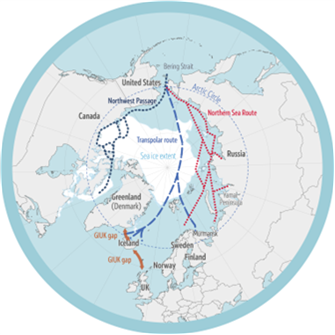
Source: EPRS, 2025; Graphic by Samy Chahri, EPRS.
Moreover, since Russia's full‑scale invasion of Ukraine in February 2022, geopolitical tensions in the Arctic have increased further. On the one hand, Russia's aggression was a catalyst for two Nordic countries, Finland and Sweden, to join the North Atlantic Treaty Organization (NATO), enhancing its northern dimension. On the other, Russia's intensifying hybrid threats, military build‑up and strengthened cooperation with China in the north have triggered concerns. Moreover, Russia's invasion of Ukraine compromised cooperation in the Arctic, reducing communication channels and further heightening tensions. As a result, the Arctic, once known for 'low‑tension' science and research cooperation efforts, is now an arena of mistrust.
In addition, the more recent tensions over US President Donald Trump's interest in taking over control of Greenland have also been destabilising. President Trump claimed that ownership and control of Greenland was necessary for US national security, refusing to rule out the use of military force. After months of tensions, the US President agreed to seek a negotiated solution in early 2026, but the situation laid bare the need for a clearer and more ambitious EU stance in the Arctic.
In this context, the EU has already taken steps to strengthen its Arctic cooperation, including through energy, raw materials, and security and defence partnerships with individual, non‑EU Arctic countries, notably Canada, Iceland, Norway and self‑governing Greenland.1 However, an updated EU Arctic policy is important for consolidating, strengthening and guiding further EU action in the region.
What is the initiative expected to address?
According to the call for evidence, an updated EU Arctic policy will address emerging challenges without compromising the EU's commitment to long‑standing key issues, such as climate change and the environment, science and research, cohesion and regional development, and indigenous peoples' rights. The update is also expected to align EU Arctic policy with new priorities such as competitiveness, strategic autonomy, sustainable prosperity, and security and defence.
Security and defence
The most anticipated aspect of the update is a stronger focus on security and defence, including cooperation on hybrid threats, such as cybersecurity risks, foreign interference, disinformation and targeting of critical infrastructure. It is thus likely to underline the need for closer EU‑NATO cooperation in the Arctic. It could encourage further EU bilateral or regional cooperation on security and defence with Arctic partners such as Iceland, Norway and Canada. The update may also outline a clearer separation of NATO and EU primary roles in the Arctic, with the former focusing on collective defence and deterrence and the latter employing its strengths in resilience‑building, regulatory frameworks and investment.
The update may focus on boosting EU investment in research and innovation in areas relevant to security and defence. These could include space, earth observation and digital technologies, advanced navigation technologies, artificial intelligence and advanced automation solutions. Beyond investment in research and innovation, the update is likely to encourage investment in capabilities to enhance the EU's capacity to monitor the Arctic's waters and seabed, protect critical infrastructure, such as undersea cables, and facilitate naval operations.
Going beyond cooperation and investment in security and defence, the update is expected to address security and defence more broadly in terms of, most notably, economic and energy security. The EU could enhance peace and stability in the region and beyond, by encouraging greater collaboration and investment in various fields, such as societal preparedness and resilience, sustainable infrastructure, energy and energy partnerships, connectivity and technology.
Importantly, energy security is expected to be one of the pillars of the security and defence dimension. Seeking to diversify supply and enhance the resilience of its energy systems, the update may encourage closer EU energy cooperation with its Arctic partners, most notably Norway. At the same time, as many environment‑focused stakeholders argue, managing climate change in the Arctic would contribute to greater regional security, so it is also likely the update would emphasise the climate‑security nexus.2 Although those two priorities could be achieved together, the pathway to the solution is far from straightforward. The question remains whether the update will attempt to boost EU energy security while focusing only on green energy, or also explore achieving energy security more quickly with the help of Arctic fossil fuels (see the second paragraph of the section 'Climate change, environmental protection and sustainable development' below).
Geo‑economic competition
In the context of increasing geo‑economic competition in the region, the update is likely to encourage the EU and its Member States to defend their interests and ensure that activities in the region are carried out in a fair, sustainable and lawful manner. In particular, the update is expected to outline pathways for seizing emerging opportunities in Arctic shipping routes and the exploration, exploitation and processing of sustainable resources – including critical raw materials, such as lithium, cobalt, nickel and rare earth elements essential for green and defence technologies. It may also aim to spur investment in environmentally sustainable infrastructure, connectivity, green technology, sustainable resource exploration and exploitation, and research and innovation (including in cold climate technologies) in the region, which would benefit both local and EU economies.
Climate change, environmental protection and sustainable development
The update will likely keep climate change action, environmental protection and sustainable development at the heart of EU Arctic policy. It could improve polar climate and environmental protection by strengthening relevant initiatives and incorporating recent scientific research and climate data. The update is likely to advocate sustainable resource management and mitigating adverse effects of activities such as fishing and mining.
At the same time, some insiders note that the update may soften the EU's stance on Arctic oil and gas drilling due to persistent concerns over energy security and the need to diversify energy imports amidst Russia's ongoing war on Ukraine and the instability in the Middle East. The 2021 communication aimed to 'push for oil, coal and gas to remain in the ground'. However, this was before major geopolitical developments in the EU neighbourhood and beyond took hold, which may now lead the EU to reassess its stance. That said, the Commission and the EEAS are still weighing up the options (boosting EU energy security while focusing only on green energy or achieving it more quickly with the help of Arctic fossil fuels), and the outcome remains to be seen.
Bilateral relations with Arctic countries
Given the region's growing importance, it is likely that the update will give greater emphasis to bilateral relations with Arctic countries and territories. The key areas of enhanced cooperation would probably be security and defence, energy and raw materials, people‑to‑people contact and support for the potential future EU accession of European Arctic partners.
Stakeholders' views
Following the launch of the public consultation, more than 1 500 pieces of unique feedback were collected from EU and non‑EU citizens, Arctic stakeholders, academia, business, environmental groups and others (see selected feedback below). They almost universally welcomed the planned update and outlined their recommendations.
Arctic stakeholders
Europaforum Northern Sweden, a network for politicians in Sweden's north, called for the update to build on three pillars – security, sustainability and prosperity. It noted that greater integration between these pillars is essential to reflect the needs of remote, sensitive areas with limited own capacity, while promoting the EU's interests of strategic autonomy, competitiveness and security.
The Norwegian Barents Secretariat, a compnay owned by the three county councils of northern Norway, argued that the update should place resilience at its core, as it enables Arctic communities' security, sustainable development and long‑term economic viability, whilst also supporting EU competitiveness. In parallel, the North Norway European Office (NNEO), owned by the three northernmost counties in Norway, recommended making security (including societal, energy and food security), preparedness and resilience more explicit priorities. According to the NNEO, robust Arctic communities and infrastructure contribute directly to European security and strategic autonomy. Similarly, the Oulu Regional Council (Finland) argued that to ensure a prosperous and resilient Arctic, the EU should reinforce high technology investments, critical infrastructure, connectivity, research and innovation ecosystems, food security, dual‑use capabilities and regional resilience as long‑term strategic investments in EU stability and strategic autonomy.
The Association of Municipalities Jämtland Härjedalen, consisting of eight municipalities in the Swedish Arctic, noted that Arctic policy should have an integrated and cohesive approach between the three objectives outlined in the 2021 joint communication. According to the association, all three areas need to be considered in the context of EU competitiveness and strategic autonomy. It also emphasised that EU Arctic policy must be built on stakeholder dialogue and address the current issue of underinvestment and outflow of revenues.
The Inuit Circumpolar Council (ICC), representing Inuit from Alaska, Canada, Greenland and Chukotka, underlined the centrality of tackling climate change. It also called on the EU to give special attention to the rights of Arctic indigenous peoples. The ICC highlighted the need for the EU to address the conflation of indigenous peoples with other groups, such as those described as 'local communities'. Finally, the ICC argued that EU Arctic policy should continue to focus on peace, dialogue and cooperation, including through strengthening the Arctic Council.
Environment‑focused stakeholders
The Planetary Restoration Action Group urged a reorientation of EU Arctic policy around a single overriding imperative: the preservation and restoration of Arctic conditions. It demanded that the European Parliament pass a resolution recognising the Arctic climate emergency, the establishment of a formal governance framework for Arctic restoration, and initiation and funding of a structured international research and testing programme for Arctic cooling interventions.
The EU Representative Office of the International Union for Conservation of Nature reiterated the importance of continuing to promote environmental protection, the precautionary principle and alignment with multilateral environmental agreements. It advocated a dedicated focus on biodiversity conservation, climate change adaptation and mitigation, and scientific cooperation.
The key message from the Jean Monnet Centre of Excellence on Just Fossil Fuel Transitions was to establish a permanent ban on the exploration and extraction of oil, coal and gas in the Arctic, building on existing partial moratoriums on hydrocarbon exploration.
The Clean Arctic Alliance, a coalition of 24 non‑profit groups collaborating to address the impact of international shipping on the Arctic, called on the EU to adopt a strong and progressive approach to furthering Arctic policy while respecting indigenous rights and sovereignty in the Arctic. The alliance stated that the EU should: (i) require early implementation and enforcement of the Arctic heavy fuel oil ban ahead of the 2029 deadline through EU and EEA ports; (ii) promote the mandatory use of low‑emission polar fuels in wider Arctic waters; (iii) support the accelerated uptake of energy efficiency measures, strengthening of measures regarding sewage wastewater discharges, regulation of currently unregulated Arctic shipping impacts, reduction of ship noise at sea and efforts to strengthen the IMO's Polar Code;3 and (iv) ensure that Arctic indigenous perspectives are central to the discussions.
Business stakeholders
Mediterranean Shipping Company (MSC), an international shipping and logistics group, argued that the update should not compromise the EU's commitments to climate and environmental protection or to scientific, technological or regional cohesion in favour of the proposals supporting new Arctic shipping routes that the industry, including MSC, considers non‑viable and of significant concern. MSC called for applying the precautionary principle regarding shipping routes in the Arctic. It also argued that the update should not refer to the maritime transport industry or shipping routes in the Arctic as part of the rationale for developing other elements of the policy. For instance, according to MSC, protecting shipping routes does not justify promoting defence and security cooperation if the maritime industry is not interested in those routes.
Fincantieri, an Italian shipbuilding company, highlighted that only a technology‑centred EU Arctic policy could enable the EU to take a rules‑based, sustainable approach to the Arctic and guarantee the security of its shipping routes. Fincantieri argued that strengthening the EU's position in the Arctic is closely linked to continuous investment in key innovation areas, including alternative propulsion systems and fuels, artificial intelligence and advanced automation and digital ship systems, predictive maintenance, and advanced navigation technologies. According to the company, research into innovative technologies must translate into advanced, special‑purpose platforms enabling the EU to enhance its capacity to survey the Arctic waters and seabed, facilitate naval operations and protect critical infrastructure. Fincantieri noted that an updated policy should leverage funding for Arctic maritime capabilities under the current and future multiannual financial framework (MFF), including the Connecting Europe Facility, European Competitiveness Fund and Horizon Europe.
Offshore Norge, the industry association for companies with activities on the Norwegian continental shelf within energy activities, recommended aligning the EU's Arctic policy with energy security objectives, including security of supply, diversification, resilience and closer energy cooperation. It noted that the update should recognise economic activity in the Arctic as a security enabler for the EU. Similarly, the Arctic Cluster Team, a Norwegian innovation cluster, suggested making the Arctic a strategic industrial pillar of the EU, a strategic provider of critical raw materials, and a hub for resilient energy systems. It noted that the policy should support Arctic hydrogen valleys, integrated CO2 infrastructure, Arctic energy system resilience and integration of Arctic energy hubs into broader EU energy security strategies.
Academia and research institutes
The Arctic Six, an alliance of Nordic universities, noted that climate change should remain the organising principle of EU Arctic policy, but be more explicitly integrated with infrastructure, preparedness, competitiveness and security. It argued that the update should more clearly reflect the post‑2022 security landscape. The alliance also noted that the update should frame the Arctic as a strategic region where sustainability, competitiveness and justice must be progressed together. Finally, according to the Arctic Six, science, research, technology, connectivity, innovation and the rights of indigenous peoples should remain central.
The Polar Research Committee of the Estonian Academy of Sciences stated that the EU must continue with stable, predictable and long‑term financing for polar research and research infrastructure.
Imperial College London highlighted technological innovation as a key opportunity to strengthen the EU's Arctic policy. It recommended strengthening the role of science, research, technology, connectivity and innovation through: (i) Arctic digital infrastructure and connectivity; (ii) expansion of the EU's Earth observation and monitoring systems; (iii) support to the Arctic research and innovation on cold‑climate technologies; (iv) promotion of the participatory monitoring and inclusive knowledge systems; and (v) strengthening of scientific cooperation and data sharing.
Others
The Office of the United Nations High Commissioner for Human Rights, in consultation with UNESCO, recommended the following: (i) recognising the impact of climate change and environmental degradation on the enjoyment of human rights, and contributing to protection of human rights; (ii) preventing human rights harms associated with military operations by adopting effective legal policy and early warning mechanisms, and guaranteeing access to remedies; and (iii) strengthening protection of human rights defenders, including environmental human rights defenders.
European Parliament's position
On 26 November 2025, the European Parliament adopted its recommendation to the Council, the Commission and the High Representative for Foreign and Security Policy on the EU's diplomatic strategy and geopolitical cooperation in the Arctic. The recommendation calls for a robust, values‑based, security‑oriented strategy to deepen partnerships with a focus on security and defence, natural resources and energy, science and geopolitical cooperation. It also encourages potential EU future enlargement to the European Arctic, notably to Iceland, Norway and Greenland.
Specifically, in the field of security, it recommends that the Council, the Commission and the High Representative:
-
condemn the growing militarisation of the Arctic, particularly stemming from Russia's military restructuring;
-
closely monitor China's growing strategic interest and activities in the Arctic;
-
fully implement EU sanctions on dual‑use technologies destined for Russia's Arctic military expansion, while supporting Ukraine's engagement with Arctic governance structures;
-
work together with the Member States and NATO allies to strengthen deterrent capabilities; deepen practical EU‑NATO cooperation in the Arctic in areas of shared concern – including maritime domain awareness, protection of critical infrastructure, logistics, and search and rescue interoperability; establish EU‑level security screening mechanisms for foreign Arctic research and infrastructure projects;
-
strengthen the protection of essential underwater infrastructure in the Arctic;
-
promote EU‑led investments and partnerships with trusted allies to secure critical Arctic infrastructure and reduce dependency on authoritarian powers.
On the freedom of navigation, it recommends:
-
supporting diplomatic dialogues to establish international agreements on freedom of navigation and peaceful maritime cooperation;
-
developing an EU and EEA strategy to counter Sino‑Russian cooperation in the High North, which potentially undermines freedom of navigation and international law.
Regarding climate, environment, sustainable prosperity, science and beyond, it recommends:
-
enhancing adaptation strategies with a security policy dimension, supporting monitoring initiatives and increasing investments in research programmes that prioritise balancing economic growth with protecting critical ecosystems;
-
strengthening partnerships with Greenland and other Arctic stakeholders on sustainable resource extraction and processing, while adhering to the highest environmental standards;
-
ensuring that indigenous interests and expertise are integrated in all levels of EU policymaking, prioritising mental health, literacy, language and youth programmes in the cooperation;
-
devising EU instruments that actively promote increased economic integration in the Arctic;
-
supporting Arctic universities, reinforcing mobility between EU and Arctic higher education institutions, increasing funding of interdisciplinary research on the Arctic and supporting continued EU funding for, and active participation in, Arctic research projects.
With regard to partnerships with countries and territories in the region, it recommends:
-
welcoming Iceland's upcoming referendum on the resumption of EU accession negotiations4 and engaging proactively with the Icelandic government, enhancing cooperation on common interests and offering assistance in the fight against hybrid threats and foreign interference;
-
exploring deeper cooperation with Norway, including possible extension of Article 42(7) of the Treaty on European Union to Norway and Norway's potential EU accession, including through enhanced cooperation on energy;
-
encouraging any potential initiative by Greenland to strengthen its political, institutional and economic links with the EU, including in the context of potential EU accession;
-
establishing a formal EU representation in the Faroe Islands;
-
strengthening collaboration with Canada and promoting security and defence cooperation in the Arctic as part of the EU‑Canada agenda;
-
advancing EU‑US dialogue on the Arctic.
On regional cooperation, it recommends:
-
reinforcing multilateral governance and cooperation through the Arctic Council, strengthening cooperation with the Arctic Council observer states and renewing efforts to support the EU's application to become a full observer in the Arctic Council;
-
increasing funding and support for cooperation with key Arctic institutions, such as the Arctic Economic Council, the Arctic Mayors' Forum and the Standing Committee of Parliamentarians of the Arctic Region.
To carry out the updated policy, the recommendation suggests increasing EU funding in the Arctic and strengthening the Special Envoy for Arctic Matters' mandate. It also calls for creating a dedicated Arctic unit within the EEAS to foster more comprehensive and proactive engagement with Arctic partners.
Endnotes
Disclaimer
This document is prepared for, and addressed to, the Members and staff of the European Parliament as background material to assist them in their parliamentary work. The content of the document is the sole responsibility of its author(s) and any opinions expressed herein should not be taken to represent an official position of the Parliament.
Copyright
© European Union.
The reuse of this document is authorised under a Creative Commons Attribution 4.0 International (CC-BY 4.0) licence.

To use or reproduce elements that are not owned by the European Union, permission may need to be sought directly from the respective rightsholders.