
Article page checkbox is not checked in page info.
Reforming the Better Regulation agenda: 'A simpler, clearer and better enforced EU rulebook'
Reforming the Better Regulation agenda 'A simpler, clearer and better enforced EU rulebook'
Irmgard Anglmayer and Talander Jansen with Ana-Bogdana Custură, Ex-Ante Impact Assessment Unit and Ex-Post Evaluation Unit

Summary
Marking the first reform of the Better Regulation framework since 2021, the Commission communication A simpler, clearer and better enforced EU rulebook aligns the EU's regulatory policy framework with the Commission's overall political priorities for the current term and steps up and formalises certain practices. In this respect, the communication advances the EU's simplification agenda, adjusts lawmaking to the new political imperative of competitiveness and seeks to make the EU acquis leaner. While previous Better Regulation reforms were geared towards improving regulatory quality (by adjusting impact assessment, evaluation and stakeholder consultation processes), the present reform is much broader in scope. It targets the full life cycle of EU laws, placing a particular emphasis on the review and enforcement stages. The communication is expected to be followed by a revision of the Better Regulation guidelines and toolbox later this year.
The communication's five headline ambitions span the different stages in the policy cycle, from the design of new legislation to implementation and enforcement. Regarding the latter, it notably commits to applying a more rigid approach to infringements and to stepping up measures against gold-plating. It introduces new concepts, such as 'simplicity by design' and 'regulatory deep cleaning' and envisages making greater use of legal techniques and tools such as codification, recast and sunset clauses. The communication contains several measures targeting single market improvements, which are largely inspired by the 2024 Letta report. These include prioritising full harmonisation of single market legislation, wherever possible.
The communication introduces major changes to the impact assessment process. Above all, the Commission commits to carrying out 'more and more focused' impact assessments. Guided by proportionality considerations and based on a newly developed 'matrix of key impacts', it introduces a two-tier approach to impact assessments that differentiates between 'major' and 'more targeted' initiatives. Moreover, it sets out a pathway for integrating politically urgent initiatives into the Better Regulation framework, thereby committing to preparing lighter impact assessments wherever feasible or, at least, analytical staff working documents with clearly defined minimum requirements. The communication also presents, for certain cases, a new category of Regulatory Scrutiny Board (RSB) opinions, namely opinions without qualification. Overall, the impact assessment reform seeks to achieve an increase in the number of files submitted to the RSB, while potentially weakening RSB scrutiny. The reform also envisages certain adjustments to stakeholder consultations but barely addresses the ex-post evaluation of EU policies. Instead, the communication introduces 'regulatory deep cleaning' as the new ex-post review instrument, in an effort to reduce the complexity and fragmentation of the EU acquis. It presents an associated action plan across 12 priority areas and mandates regular Commission progress reporting on the 'deep cleaning' exercise.
Background
On 28 April 2026, the European Commission released its most recent Better Regulation communication, A simpler, clearer and better enforced EU rulebook.1 Featuring as a priority initiative in the 2026 Commission work programme (CWP), this communication seeks to align the Better Regulation framework with the Commission's overall political priorities and practices for its current mandate. It particularly aims to modernise the rules on how EU laws are designed, implemented and enforced in order to strengthen the EU's competitiveness at a time where the EU is under pressure from major economic and geopolitical challenges. The communication marks the first reform of the EU's current Better Regulation framework since 2021, which has, since its inception in 2015, proven to be a dynamic agenda, and has thus been continuously adjusted to political priorities and regulatory needs. Figure 1 depicts the evolution since 2015.2
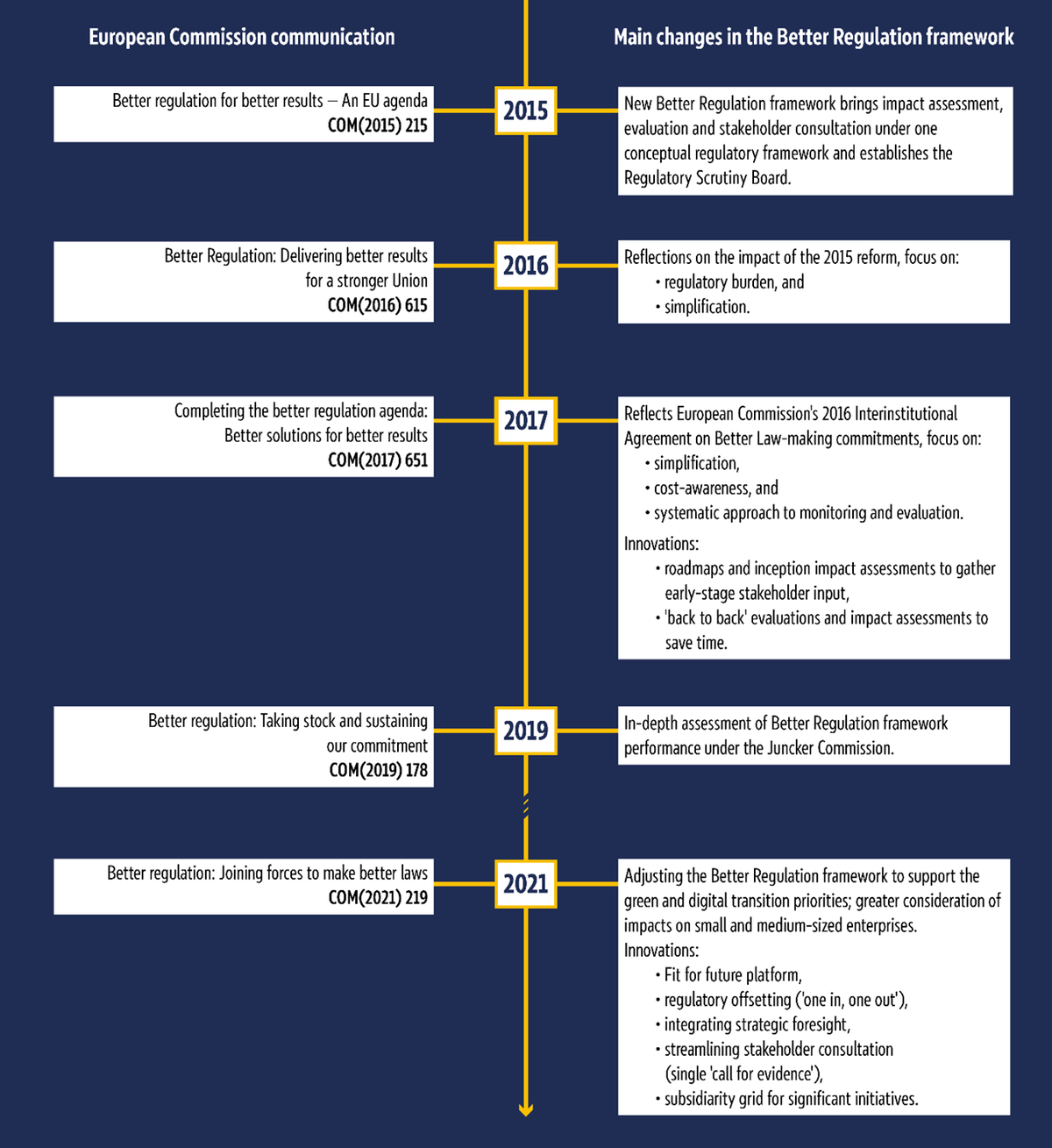
Source: Authors' own compilation'; graphic by Lucille Killmayer, EPRS, 2026.
The Commission communication examined in this briefing advances the EU's simplification agenda. It takes a broad approach to the EU's regulatory policy framework, placing emphasis on regulatory simplicity and clarity ('simplicity by design') and on the reduction of the complexity and fragmentation of the existing EU acquis ('regulatory deep cleaning'). It also seeks to improve the implementation and enforcement of EU law, including through enhanced infringement procedures and measures to address gold-plating by Member States. It also envisages changes to impact assessment, regulatory oversight and stakeholder consultation.
Some of the areas addressed by the communication were already foreshadowed in the Commission President's political guidelines 2024-2029 and mission letters to the Commissioners-designate, as well as in certain strategic documents, including the Letta report, the competitiveness compass, the communication A simpler and faster Europe, and the single market strategy. Overall, the Commission's regulatory simplification and burden reduction ambitions mirror a global trend, as the recent OECD report 'Smart regulations, strong business' illustrates.
Stakeholders provided input to the communication by means of contributions and position papers in response to the Commission's call for evidence, which was open from 7 January to 4 February 2026. In addition, some stakeholders also commented on the communication after its adoption. The communication envisions a revision of the Better Regulation Guidelines and the associated implementing toolbox, announced for later this year.
The communication's five headline ambitions
The communication sets out five headline ambitions covering the different stages in the policy cycle, from the design and drafting of new legislation to implementation and enforcement.
Headline ambition 1: 'Simplicity by design'
The communication postulates regulatory simplicity and clarity as opposed to regulatory complexity and fragmentation. It advocates for embedding simplicity 'into laws from the earliest design stages'. The concept 'simplicity by design' is defined in a way that those affected by a new legislative proposal need to be able to easily understand
-
what the goal is;
-
who must do what and when;
-
how new rights and obligations interact with existing ones;
-
how compliance is achieved;
-
what happens if obligations are not met.
The communication seeks to apply a 'simplicity by design' approach spanning several dimensions, including regulatory discipline; future-proof and adaptive regulation; leaner and more accessible legislation; realistic transposition and implementation deadlines; technological progress; and 'enforcement by design'. These dimensions are discussed in the following sub-sections.
Regulatory discipline
Regulatory discipline should ensure prioritisation of initiatives, a consistent application of the principles of subsidiarity and proportionality, and 'discipline and focus' with regard to delegated and implementing acts. The latter should be based on 'well-designed' empowerments in the basic act, limited to what is 'strictly necessary to effectively implement and enforce EU rules or international obligations'.
Box 1 Full harmonisation in the single market
When amending single-market legislation in recent years, the Commission has often proposed converting existing directives into regulations. It has generally justified this approach on the grounds that it simplifies the legal framework and ensures uniform EU-wide implementation, thus preventing the risk of divergent transposition and gold-plating.
An early example of such a change in legal instrument is the Regulation on Cableway Installations (proposed in 2014, adopted in 2016). More recent examples include the Machinery Regulation, the Toy Safety Regulation, the proposed regulation on late payments (a 2023 proposal currently blocked in the Council), and, in the context of capital markets integration, the proposed regulation on settlement finality.
Source: Authors' own compilation.
Furthermore, the communication stresses that the choice of the right legal instrument and the degree of harmonisation are crucial for deepening the single market and strengthening the EU's economic position. In this respect, it advocates for complete harmonisation and a 'more systematic use of exhaustive regulations' in relation to single market legislation (within the boundaries of the Treaties) to avoid regulatory fragmentation and gold-plating. The preference for complete harmonisation follows a trend that has been evident for a number of years, as illustrated in Box 1.
Future-proof and adaptive regulation
While the 2021 Better Regulation reform sought to integrate strategic foresight into policymaking to future-proof legislation, the new communication goes one step further. It places the focus on designing legislation from the outset in a way that it can easily adapt to future developments such as evolving technologies and geopolitical shocks or changes. To this end, rules need to be 'innovation friendly, embed anticipatory and long-term considerations, and provide the necessary legal certainty and confidence to invest and operate in the single market'.
Box 2 The use of sunset clauses in EU legislation
Sunset clauses embedded in legislation limit the application of a legislative act (or a provision thereof) to a predefined period. The act or provision then expires, unless it is reviewed and extended or amended. According to the Better Regulation Toolbox, the Commission considers sunset clauses an 'instrument of adaptive regulation', suitable for regulating matters 'in rapidly changing market or technological environments' and a 'tool for legislative experimentation'. Although the Commission, Parliament and Council agreed to systematically consider the use of sunset clauses in EU legislation (IIA-BLM 2016, point 23), their use remains rare.
Apart from crisis-related legislation, EU legislation featuring sunset clauses includes:
-
the EU Roaming Regulation, which is set to expire on 30 June 2032 'in order to provide certainty in the market and minimise regulatory burdens';
-
block exemption regulations in EU competition law, where the sunset clause triggers a review of market conditions to determine whether the granted exemption is still justified;
-
sustainable fisheries partnership agreements (SFPAs) between the EU and third countries, which rely on renewable multiannual protocols, requiring renegotiation to continue.
Source: BR Toolbox (Tool #22) and authors' own compilation.
In this context, the Commission commits, inter alia, to making greater use of sunset clauses, which let laws expire after a set period (or on a specific date) unless they are explicitly renewed (BR Toolbox, Tool #22). In the communication, the Commission argues that sunset clauses 'can help prevent the unnecessary proliferation of rules and reporting requirements' if used together with well-timed monitoring and evaluation clauses. Although the Better Regulation Toolbox includes rules for sunset clauses, their use has remained scarce in EU legislation (see Box 2).
However, eliminating an act or a legal provision from the rulebook may also raise questions regarding predictability and legal certainty. For this reason, the BR Toolbox (Tool #22) cautions that the risk of regulatory uncertainty should be taken into account when considering sunset clauses.3 Internationally, the OECD promotes the use of sunset clauses as a permanent review mechanism to ensure that the stock of regulation remains fit for purpose over time.4 It stresses, however, that this instrument is better suited to secondary or subordinate regulations, as, for primary legislation, 'the cost and disruption caused by any rules being inadvertently terminated could be high'.5
Leaner and more accessible legislation
Under this subheading, the Commission commits to a set of principles for preparing new policy proposals, including
-
improving the summaries of legislation on EurLex to better present the rights and obligations set out in a legal act and national implementation obligations;
-
improving access to EU legislation through rendering it machine-readable;
-
providing more and faster consolidated versions of EU legislation;
-
making greater use of codification and recast techniques6 (see Box 3);
-
streamlining recitals in EU legislation, by placing greater focus on the reasoning behind a legal act and the act's interpretation;
-
ensuring full consistency, clarity and coherence between new and existing legislation;
-
further developing the European legal data space, as set out in the 2025 communication on DigitalJustice@2030, to improve access to EU law and ensure the interoperability of legal and judicial data.
Box 3 Codification versus recast
Codification is a technique that brings together a legal act or several related acts and all their amendments into a single new act. The resulting act goes through the full legislative process and repeals and replaces the acts concerned, without introducing any substantive changes.
Recasting is a technique used when amending a basic legal act. It also requires the new act to pass through the entire legislative process, resulting in a single act incorporating the initial legal act and any amendments to it. But unlike codification, recasting involves substantive changes.
Between January 2015 and May 2026, the Commission presented 21 new proposals for codification and 49 for recasting (see graphic below). (Note: these figures do not consider amended proposals or corrigenda.)
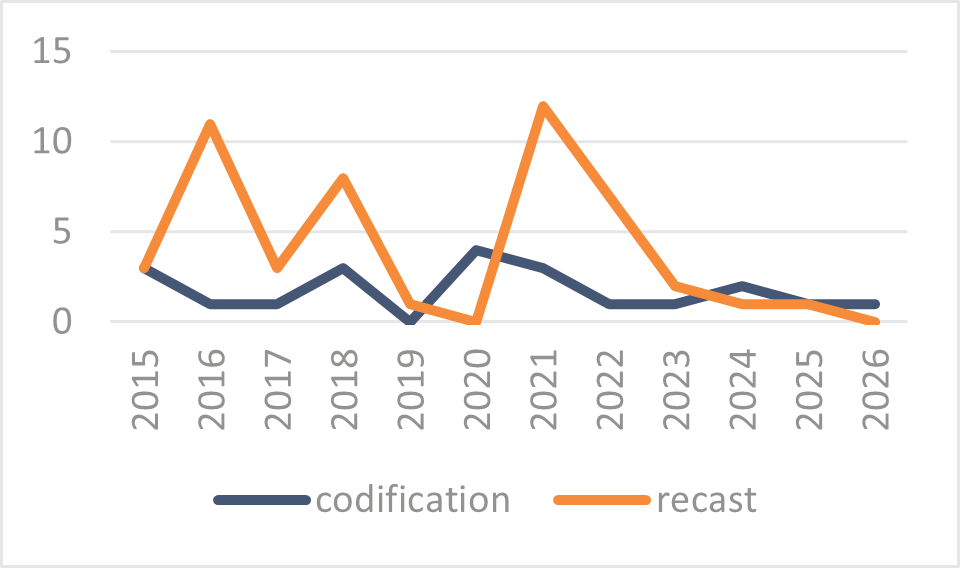
Source: Authors' compilation, based on EurLex data.
Realistic transposition and implementation deadlines
The Commission wants to ensure that new legislation sets out 'feasible and credible' transposition and implementation deadlines that are based on 'realistic estimates' of the time needed to develop the required implementing measures and digital tools, and to allow businesses and public authorities sufficient time to adapt.
The communication suggests to systematically consider using 'grandfathering clauses' (i.e. provisions under which an old rule continues to apply to existing situations while a new rule will apply to future cases) and provisions for a gradual phase-in of major obligations in proposals for new legislation to facilitate implementation.
Moreover, it commits to applying the 'think small first' principle, in other words taking into account the needs and capabilities of small and medium-sized enterprises (SMEs) when designing new legislation. The consideration of SMEs was welcomed by SME United, which had launched a 'Think small first' charter in 2025.
Tapping into technological progress
The Commission further commits to digital-ready policymaking, a principle enshrined in the Better Regulation Toolbox (Tool #28). This tool defines digital-ready legislation as interoperable, future-proof and agile by default. According to the communication, it is meant to foster smooth digital implementation and administrative burden reduction from the outset. Moreover, reliance on 'cutting edge technologies', including AI, are expected to improve legislative quality.
In this vein, the communication announces the development of a new IT tool 'that will help manag[e] EU laws, including implementing rules, more easily, and identify overlaps, gaps and unnecessary complexity'. While the communication does not disclose further details (such as the functionalities of this new IT tool and who would have access to it), it makes clear that this tool will be distinct from the Commission's electronic legal drafting tool, EdiT, which will continue to be used.
Enforcement by design
The communication commits to a new style of drafting legislation with enforcement in mind from the outset. It stresses the relevance of embedded monitoring and enforcement mechanisms, particularly for EU regulations due to their direct applicability. It also notes that EU rules should not only be easy to implement, monitor and enforce, but also 'difficult to abuse or circumvent'. The communication provides the following examples for 'enforcement by design':
-
designating national enforcement authorities and clearly defining their powers;
-
fact-finding powers for the Commission in certain areas;
-
prior notification mechanisms for draft national legislation, with a binding ex-ante compatibility assessment by the Commission before the adoption of national measures.
Headline ambition 2: Further improving the Better Regulation framework
Under this headline, the Commission proposes changes to the Better Regulation rules on impact assessments, urgency proposals, regulatory oversight and stakeholder consultations. A central element is the reform of the Commission's impact assessment system. Under the current rules, an impact assessment is required for initiatives likely to entail significant economic, social or environmental impacts or significant spending. Practice shows that the Commission has not always lived up to this commitment, often justifying the absence of an impact assessment on grounds of 'urgency to act'. The reform envisages more and more focused impact assessments, guided by proportionality considerations, and sets out a pathway for urgency procedures.
More and more focused impact assessments
In the communication, the Commission commits to underpinning more initiatives with an impact assessment. This responds to stakeholder demand and repeated calls by Parliament, most recently in a resolution of 27 November 2025, calling on the Commission 'to carry out impact assessments without exception'.
In pursuit of the above objective, the Commission introduces a two-tier approach to impact assessment, distinguishing between 'major new legislative initiatives or revisions' and 'more targeted initiatives'. The latter are defined as initiatives 'that do not significantly alter the policy objectives of existing legislation' but rather aim 'to optimise its effectiveness and efficiency'. It appears that only major initiatives will be accompanied by a full impact assessment, while more targeted initiatives will be covered by a lighter impact assessment. However, the communication remains vague on the practical implications of the distinction between these two categories.
The categorisation of initiatives ('major' and 'more targeted') will be guided by proportionality considerations and based on a newly developed 'matrix of key impacts', an initial screening tool to target the impact assessment to the most relevant impacts. This initial screening – that would be solely in the discretion of the Commission – will determine the scope and depth of the impact assessment and affect the Regulatory Scrutiny Board's (RSB) oversight role. In the current system, the RSB's binding opinions on draft impact assessments contain a qualification by default (i.e. a quality assessment that can be 'positive', 'positive with reservations' or 'negative'). Under the new system, qualified RSB opinions will be issued solely for impact assessments accompanying 'major initiatives'. For 'more targeted initiatives', the Board will still provide recommendations but no qualification, thereby effectively weakening RSB oversight. The absence of a formal qualified opinion may also affect the regulatory quality and evidential basis of the impact assessment.
Box 4 RSB opinions without qualification: The precedent of the post-2027 MFF
In line with the Better Regulation Guidelines, the RSB has traditionally attached a qualification to all its opinions, the only exception to date concerned the seven impact assessments accompanying the 2027-2034 MFF proposals the Commission put forward between July and September 2025. The Board did not provide any explanation for this unprecedented departure from practice. However, it issued highly critical opinions, noting significant shortcomings across most sections of the MFF-related draft impact assessments. It appears that the services only partially took the Board's comments into account.
While the precedent of the MFF impact assessments doubtlessly concerned major initiatives in terms of political and budgetary significance, the future use of opinions without qualification will apply to impact assessments supporting less significant 'targeted initiatives' and urgent initiatives.
Source: 2028-2034 MFF: Quality analysis of the Commission's impact assessments, EPRS, European Parliament, January 2026.
Under the current rules, when the RSB issues a negative opinion, the Commission services must resubmit an improved version to the Board. If the second (and final) opinion is again negative, the initiative cannot go ahead,7 unless, in 'exceptional circumstances', the Commissioner in charge of Better Regulation grants a derogation.8 In such cases, the Commission must explain its reasons in the explanatory memorandum of the proposal.
While the new two-tier system extends RSB oversight to a greater number of initiatives, the RSB's scrutiny powers could be reduced, as only 'major initiatives' could receive a negative opinion. This raises the question of whether the RSB could contest the initial categorisation based on the 'matrix of key impacts'. To date, the RSB has issued opinions without qualification only for one set of initiatives, namely the IAs accompanying the post-2027 MFF proposals (see Box 4).
Close monitoring of the application of the new two-tier system may be warranted by the co-legislators as part of their scrutiny role, to ensure that the Commission abides by its own rules and does not lower evidential standards or circumvent RSB oversight.
Minimum requirements for urgency procedures ('accelerated pathways')
The communication also seeks to reconcile time-consuming regulatory quality processes with the need for speed. In the past, the Commission has often argued that the urgency to act prevented it from conducting an impact assessment. Prompted by the European Ombudsman's recommendations to formally define 'urgent' situations that justify a derogation from the Better Regulation rules, the communication sets out minimum standards for urgent initiatives. It distinguishes 'genuine urgency' from 'routine expediency', based on the following criteria: shocks or crises; potential consequences of not taking immediate action; legal deadlines; and a political context creating a need for urgent action. Some of these criteria raise questions: legal deadlines can be anticipated, and the 'political context' criterion leaves considerable leeway for interpretation.
The communication states that the Commission will in future, 'where feasible', prepare impact assessments also for urgent initiatives, analysing expected significant impacts. These assessments will be subject to RSB review, although the 'Board will account for the required timelines' and similar to the above-mentioned 'more targeted initiatives' its opinions will come without qualification. The Commission will gather stakeholder input through a call for evidence and targeted consultations (including 'implementation dialogues' and 'reality checks', two new consultation tools introduced under the von der Leyen II mandate) and draw on 'the best possible evidence base'.
Only in exceptional circumstances, 'where the need for urgent action is so acute that proposals must be adopted within an extremely compressed timeframe', may the Commissioner responsible for Better Regulation grant a derogation from the usual procedural requirements, including impact assessment, consultation requirements and RSB scrutiny. For such cases, the Commission commits to routinely preparing an analytical staff working document (SWD) to be published either alongside a legislative proposal or within three months of its adoption.
The Society of European Affairs Professionals (SEAP) expressed scepticism regarding the release of an SWD after a proposal, arguing that this would not be reconcilable with the principle 'that impact assessments should inform, rather than follow, political choices'. Parliament likewise called on the Commission in 2022 to publish an SWD at the same time as the legislative proposal.
Box 5 Analytical SWDs in the place of IAs: Practice to date
Preparing an analytical SWD instead of an impact assessment was made possible by the 2021 Better Regulation reform for 'cases where the Commission was unable to produce an impact assessment where one should have been prepared'. These SWDs are intended to present 'the evidence behind the proposal and cost estimates'. In recent years, the Commission has increasingly reverted to this practice, typically arguing that the urgency of action would not allow for a full impact assessment. Analytical SWDs are not subject to impact assessment requirements, nor do they undergo RSB scrutiny, which may affect the regulatory quality of the associated initiative. In its resolution of 7 July 2022, Parliament cautioned that the SWD practice 'should not lead to the Commission circumventing its impact assessment obligations'.
Since the current Commission took office in December 2024, 43 legislative proposals under the ordinary legislative procedure (OLP) have been accompanied by an impact assessment, while 51 OLP proposals have relied on an analytical SWD instead of an impact assessment. The effective number of analytical SWDs is lower (33), as some SWDs accompanied more than one proposal. This is notably the case for the 10 Omnibus packages presented to date (12 SWDs covering 27 OLP Omnibus proposals). Most of the 33 analytical SWDs were published alongside the associated proposals (25) or within three months of their adoption by the College of Commissioners (3), while 5 were published later. With a length of between 7 and over 300 pages, the 33 sampled SWDs differ widely in scope and depth. Some come close to an impact assessment, while others are very short or rather specific. The best covered sections are political/legal context (33); problem definition (26); stakeholder input (26); proposed measures (21); assessment of impacts (17); cost-benefit assessment (16); evidence-base (12); and objectives (13).
Source: Authors' own compilation. Dataset: OLP proposals put forward between 01/12/2024 and 31/05/2026.
The communication sets minimum requirements for analytical SWDs. They must include (i) a problem definition; (ii) the approach chosen to address the problem; and (iii) an assessment of the proposal's key impacts, including a cost-benefit analysis and a climate consistency assessment. All decisions regarding urgencies and derogations from the procedural standards need to be transparently documented in the explanatory memorandum of the proposal concerned. Analytical SWDs accompanying urgent initiatives are not new. The current Commission makes extensive use of this practice (see Box 5). Defining minimum standards appears to be an improvement, given that such initiatives, which are not subject to RSB review, have often suffered from evidential shortcomings.
In conclusion, even if the new rules concerning impact assessment and urgency will result in more impact assessments, their quality remains to be seen, particularly given the reduced RSB role. It is not clear from the communication whether the RSB has any oversight role over the categorisation of initiatives as major, targeted or urgent. Table 1 below is a tentative summary of the Commission's new impact assessment approach.
| Major initiatives | Targeted initiatives | Urgent initiatives | Acute urgency (exception) | |
|---|---|---|---|---|
| determined through the initial 'matrix of key impacts' | ||||
| IA requirements | full IA | lighter IA process | lighter IA process (where feasible) | no IA (derogation); analytical SWD |
| RSB scrutiny | qualified RSB opinion | RSB opinion without qualification | RSB opinion without qualification | no RSB scrutiny |
| Stakeholder input | call for evidence or questionnaire; targeted consultations | call for evidence or questionnaire; targeted consultations | call for evidence; targeted consultations may take place | not required |
Source: Authors' compilation.
Changes in stakeholder consultations
The Commission plans some (seemingly minor) adjustments to its consultation practices, thereby addressing stakeholder concerns about the duration and overlap of consultations and insufficient feedback. In the future, the Commission intends to consult the public in principle only once on the same initiative, either through a (streamlined) call for evidence or a questionnaire, complemented by targeted consultations where appropriate.
The currently mandatory 12-week standard timeframe for open public consultations may be reduced 'by up to six weeks' if other public and/or targeted consultations are carried out for the same initiative.
Furthermore, the Commission will introduce an automated notification mechanism to inform stakeholders directly when the summary of the consultation results becomes available on the 'Have your say' portal. Finally, the Commission plans to better involve consultative committees and their networks (e.g. the Network of Regional Hubs (RegHubs) in consultation activities. The communication does not elaborate on how it will run consultations under the accelerated pathways.
Assessing the impacts of substantial amendments
In the communication, the Commission renews its call on the co-legislators to carry out impact assessments on substantial amendments tabled during the legislative stage. It argues that, 'without such assessments, the analysis of the expected impacts of laws becomes incomplete and potentially misleading', and proposes developing and implementing a common methodology based on a three-step approach:
-
First, the three institutions should attain a shared understanding of what constitutes a substantial amendment.
-
Second, the institution tabling a substantial amendment should provide an assessment of its impacts and quantify costs and benefits 'using a simple cost calculation method' such as the 'standard cost model'9 for administrative costs.
-
Third, the impacts of substantial amendments should be presented in 'a concise template' covering a general description, expected additional costs/benefits, affected stakeholders and impacts on competitiveness and innovation.
The Commission has reiterated this call multiple times, for instance, in its 2025 communication on A simpler and faster Europe, its 2024 annual report on the application of the principles of subsidiarity and proportionality, and in President von der Leyen's 2024-2029 political guidelines. In the 2016 Interinstitutional Agreement on Better Law-Making (IIA-BLM, point 15) the three institutions agreed that the co-legislators will, 'when they consider this to be appropriate and necessary for the legislative process, carry out impact assessments in relation to their substantial amendments to the Commission's proposal. In this respect, the agreement stipulates that 'the definition of a 'substantial' amendment should be for the respective Institution to determine'. Moreover, any impact assessment work undertaken by the co-legislators should take the Commission's impact assessment 'as the starting point for their further work'.
Parliament has expressed its view on this question, most recently in its resolution of 11 September 2025 on the implementation and streamlining of EU internal market rules to strengthen the single market. The resolution called 'for impact assessments to be carried out on substantial amendments proposed by the Parliament and the Council to the Commission's proposals', though without specifying by whom. Otherwise, it pointed to the provisions of the 2016 IIA-BLM cited above, however adding that 'the timeline of the lawmaking process' should also be considered.
Headline ambition 3: Regulatory deep cleaning
Regulatory deep cleaning is one of the novelties introduced by the communication to address the 'accumulation of laws' 'with the aim of reducing complexity and fragmentation to improve effectiveness and efficiency.' It relies on a sectoral mapping of the legislative stock under the responsibility of each Commissioner, an exercise launched in 2025 as 'stress testing'. By virtue of its political prominence it and ambition to systematically review the entire acquis, stress testing builds on the existing, more sporadic sectoral 'fitness checks' and the simplification and burden reduction programme REFIT.
Box 6 Reviewing and cleaning: Key steps
-
2009 First use of the term 'fitness check' by the Commission for a sectoral evaluation.
-
2012 Launch of the REFIT (regulatory fitness and performance) programme.
-
2015 Establishment of the REFIT Platform, a high‑level group to advise on simplification (mandate expired in 2019).
-
2018 Publication of the first Annual Burden Survey by the Commission (discontinued after 2023).
-
2021 Establishment of the Fit for Future Platform by the Commission to support simplification and burden reduction (platform ended in 2024).
-
2024 Political guidelines and mission letters introduced the concept of 'stress testing' and the ambition to screen the entire EU acquis.
-
2025 First annual reports on simplification and implementation, by Commissioner portfolio, covering 'stress testing' results.
-
2026 First mention of 'regulatory deep cleaning', a ramp-up of stress testing, focused on 12 single market priority areas, and the establishment of a new Simplification Platform.
All Commissioners reported on the initial stress testing results in their areas in the 2025 progress reports on simplification, implementation and enforcement. Building on the stress-testing mapping, the Commission is now moving to the operational phase. Annex I of the communication sets out an 'action plan for regulatory deep cleaning', identifying 12 priority areas (free movement of goods and services, financial services, customs, taxation, health and food safety, agriculture, transport, energy, climate, environment, digital, housing and permitting) for examination between 2026 and 2027. However, the annex remains rather vague regarding actions and timelines across the 12 priorities and is thus closer to a reflection paper than an action plan.
The deep cleaning exercise will be supported by the new Simplification Platform, established by a Commission decision on 28 April 2026. It brings together national, regional and local authorities, the European Committee of the Regions (supported by the Network of Regional Hubs), the Economic and Social Committee, social partners, businesses, and civil society organisations. The platform will play an advisory role on the simplification of EU rules and support tracking activities and reporting. It appears to be the direct successor to the Fit for Future platform, which operated from 2021 to 2024.
The Commission expects that regulatory deep cleaning will lead to both legislative and non-legislative measures. It will remove outdated rules, overlaps and unnecessary burdens, and foster consolidation, streamlining and digital tools. The communication further notes that the withdrawal of existing legislative proposals remains an option.
Given the thematic/sectoral approach and objectives, regulatory deep cleaning is likely to generate a pipeline of future Commission initiatives similar to the current Omnibus packages, with packages seeking to revise and recast several rules at the same time.
As these future initiatives will be geared towards 'efficiency and effectiveness', the Commission may classify them as 'targeted', which in turn might affect the robustness of their evidence base. Future revisions could therefore be based on limited evidence (as opposed to robust ex-post evaluations respecting all five criteria10 of the Better Regulation Guidelines and/or (full) impact assessments).
Overall, ex-post evaluation one of the core pillars of the Better Regulation framework, together with impact assessment and consultation plays a very limited role in this communication, despite the fact that a large part of the communication's scope concerns the policy stage of implementation, application and enforcement, the stage at which policy evaluation takes place. This limited role is somewhat surprising, given that the RSB's annual reports for 2024 and 2025 identified many shortcomings in the Commission's evaluation practices and made various reform suggestions, none of which have been taken up in this communication.
Headline ambition 4: Tackling regulatory gold-plating
Although gold-plating has been a concern for the EU institutions for decades11 as a hindrance to the single market, it was not mentioned in the 2024 political guidelines or in the mission letters to Commissioners-designate. It was, however, referred to repeatedly in the 2025 communication A simpler and a faster Europe, according to which gold-plating 'is a widely used term in the context of the implementation of the EU law, which refers to additional national obligations that go beyond EU requirements'. It is considered 'an imposition of extra requirements and administrative burden (norms, guidelines and procedures) interfering with the expected policy goals to be achieved by EU legislation'. The European Council, in its 19 March 2026 conclusions, supported this prioritisation by calling on 'Member States to avoid gold-plating and disproportionate national requirements when transposing and implementing EU rules'.
Box 7 Parliament's view on gold-plating
'The European Parliament
considers that a well-functioning single market, in which rules are implemented and enforced in a correct, coherent and effective way, is a shared responsibility of the EU institutions and the Member States;
stresses that gold-plating of EU directives and fragmented enforcement of EU rules remain an obstacle for the single market, disproportionately burdening SMEs and start-ups;
demands that the Commission ensure that EU rules are properly enforced across all of the Member States in a harmonised manner in order to address cross-border barriers;
urges the Member States, therefore, to address gold-plating and to ensure that national implementing measures are published transparently and in a timely manner and to avoid inconsistent implementation of EU laws, while recognising the right for Member States to maintain or introduce national measures under the conditions provided for in the Treaties;
calls for strengthened cooperation among existing authorities from different Member States and between national and EU regulatory authorities;
encourages the Commission to support Member States in achieving more harmonised implementation of EU law by further facilitating structured exchanges and mutual learning, including through the organisation of transposition workshops and the development and use of comparative tools and practices;'.
Source: European Parliament resolution of 11 September 2025 on the implementation and streamlining of EU internal market rules to strengthen the single market.
As exemplified in Box 7, Parliament has also repeatedly voiced concerns over gold-plating, while insisting that this should not affect Member States' right to introduce national measures under the conditions provided for in the Treaties. For the Commission, prioritising gold-plating is not only about burden reduction but also about clarifying responsibilities in a context where Member States often blame 'Brussels' for the complexity of EU rules and the burden they impose. According to the communication, 'economic actors may hold the EU accountable for regulatory burdens that actually originate from national policy choices, damaging the EU's reputation'.
To address gold-plating, the communication sets out a range of actions and follow-up measures:
-
create a Commission toolkit of best practices and criteria to help Member States avoid gold-plating in the transposition and implementation of EU law;
-
increase Commission support for Member States in the transposition of directives to identify gold-plating risks early on;
-
use implementation dialogues and reality checks to 'identify and examine implementation challenges in the form of gold-plating' and investigate instances thereof;
-
encourage Member States to better use the existing tools to flag more stringent national rules in the single market;
-
identify, with the support of the European Semester and the Single Market Enforcement Taskforce, key gold-plating issues in each Member State and draw up a list of priority instances to be tackled by them;
-
prevent gold-plating by favouring 'exhaustive regulations over directives' for legislative initiatives in single-market areas, thereby leaving little room for national additions and fragmentation.
The communication does not set any concrete targets or expected savings in relation to gold-plating.
Headline ambition 5: Better implementation and robust enforcement
The last chapter of the communication, like the two previous ones, concerns issues downstream of the lawmaking process. This chapter, excluding its annex, accounts for one third of the entire communication, contains some repetition on certain topics, and in both form and substance resembles an update of the Commission's 2022 communication on Enforcing EU law for a Europe that delivers. The emphasis on enforcement reflects the spirit of the Commission's renewed approach to Better Regulation, which goes beyond Better Regulation processes in the strict sense, to encompass the full lifecycle of EU rules.
Infringements and single market focus areas for enforcement
Annex II of the communication presents a list of 11 single market focus areas (Box 8), where the Commission intends to more proactively investigate possible implementation and enforcement shortcomings and address them, notably through 'swift infringement procedures'. The objective is to establish compliance with single market rules as quickly as possible. The Commission explicitly states that 'unlawful gold-plating will also form part of the enforcement of these focus areas'.
Although the communication refers to a number of tools - including new soft instruments such as 'implementation dialogues' and 'reality checks', introduced by the Commission at the start of its current mandate – it is mainly about a strong and renewed commitment to making full use of infringement powers. It addresses certain infringement issues identified in the Letta report, such as the 'slow pace of proceedings' and the 'inadequacy of penalties'.
In relation to infringements, the Commission commits in particular to:
-
increasing the use of pre-infringement dialogues for investigations and possible resolution;
-
launching infringement procedures whenever necessary, if a pre-infringement dialogue fails, or even before, in the case of well-documented breaches;
-
swiftly referring matters to the Court of Justice whenever appropriate;
-
for delays in notifying transposition, simplifying and accelerating the adoption of reasoned opinions (issued within six months after issuance of the letter of formal notice);
-
taking a stricter approach to Member States' requests for extension of the two-month response deadline, granting extensions only at the reasoned opinion stage and, at the letter of formal notice stage, 'only in very exceptional circumstances';
-
reducing the number of protracted infringement cases by prioritising cases that have been open for over five years but not yet been referred to the Court of Justice;
-
proposing more dissuasive financial penalties against Member States to the Court of Justice.
Box 8 The 11 single market focus areas
Free movement of goods
-
Product labelling;
-
Circular economy, packaging and waste;
-
Empowering consumers through electricity demand response.
Free movement of people and services
-
Posting of workers;
-
Construction and installation services related to the green transition;
-
Interoperable European railway systems;
-
Multimodal travel information services;
-
Late payments.
Freedom of establishment and free movement of capital
-
Digitalisation of company law and cross-border mobility of companies.
-
Bank consolidation.
-
Savings and investment
Source: Annex II of the communication.
All this is broadly in line with Parliament's stance on infringement, as expressed in its resolution of September 2025 on the single market. In that resolution, Parliament called on the Commission 'to uphold its role as a guardian of the Treaties by fully utilising its enforcement powers, including the initiation of infringement procedures, when necessary, to ensure the timely, consistent and effective enforcement of the single market rules'. It suggested that the Commission review its infringement procedures 'to ensure swifter, more automatic and predictable responses' and recommended expanding infringement procedures 'to address systemic violations of single market rules'.
The 11 single-market focus areas set out in Annex II partly overlap with the 12 priority areas for regulatory deep cleaning (Annex I) in terms of content and origins, although Annex II appears more focused and operational.
Monitoring and preventing enforcement issues
To prevent infringements and barriers to the single market, Member States are called upon to more proactively share implementation challenges with the Commission. The Commission, in turn, promises a new IT tool, 'a single-entry point for Member States to communicate with the Commission and to notify national implementing measures within the deadlines set in the regulations'. The Commission will also review and reinforce existing notification tools of national measures, such as those contained in the Single Market Transparency Directive and the Services Directive. If identified breaches remain unresolved, it commits to systematically launch infringement procedures, as described above.
Conclusions and outlook
The Commission communication seeks to reform the EU's Better Regulation framework in an ambitious way. It aligns the framework with the von der Leyen II Commission's competitiveness and simplification agenda, with some single market measures drawing on the Letta report. A major difference from previous Better Regulation reforms is the broad scope of the current reform. It goes far beyond the three core Better Regulation pillars, namely impact assessment, evaluation and stakeholder consultation, placing particular emphasis on the design of EU law ('simplicity by design'), review ('regulatory deep cleaning'), implementation (including measures to avoid gold-plating) and enforcement (in particular a more assertive infringement policy).
While some of the outlined concepts and measures are new (such as the 'matrix of key impacts', the increase in IAs and the two-tier approach to impact assessment), in other areas the communication builds on and strengthens existing tools and procedures (for instance, measures to tackle infringements and gold-plating), or formalises practices (for instance, the preparation of an analytical staff working document in the case of exceptionally urgent initiatives that do not allow for an impact assessment). The new rules concerning impact assessment and urgency will result in more impact assessments, although their quality remains to be seen. The reform will also affect regulatory oversight, as the abolition of qualified opinions on impact assessments underpinning 'more targeted' and 'urgent' initiatives could reduce the impact of the Regulatory Scrutiny Board's interventions.
In certain aspects, the communication remains vague and leaves room for interpretation. This concerns, in particular, the proportionate and more targeted approach to impact assessment. It is not clear from the communication whether the 'matrix of key impacts', which appears to be a decisive document, will be subject to RSB scrutiny – or contestation – and whether it will be made public. This may necessitate enhanced scrutiny of legislative initiatives categorised by the Commission based on the 'matrix of key impacts'.
The forthcoming revision of the Better Regulation Guidelines and Toolbox, expected later this year, together with the application of the revised Better Regulation framework, should bring more clarity to this and other points.
Endnotes
Classification
Policy areas: EU Democracy, Institutional and Parliamentary Law | EU Law: Legal System and Acts | Ex-ante Impact Assessment | Transposition and Implementation of Law
Statement on the use of AI
Any AI-generated content in this text has been reviewed by the author(s).
Disclaimer
This document is prepared for, and addressed to, the Members and staff of the European Parliament as background material to assist them in their parliamentary work. The content of the document is the sole responsibility of its author(s) and any opinions expressed herein should not be taken to represent an official position of the Parliament.
Copyright
© European Union.
The reuse of this document is authorised under a Creative Commons Attribution 4.0 International (CC-BY 4.0) licence.

https://creativecommons.org/licenses/by/4.0/deed.en
To use or reproduce elements that are not owned by the European Union, permission may need to be sought directly from the respective rightsholders.