
Article page checkbox is not checked in page info.
EU-Mexico agreements
EU Mexico agreements
Rosamund Shreeves, Members' Research Service
Summary
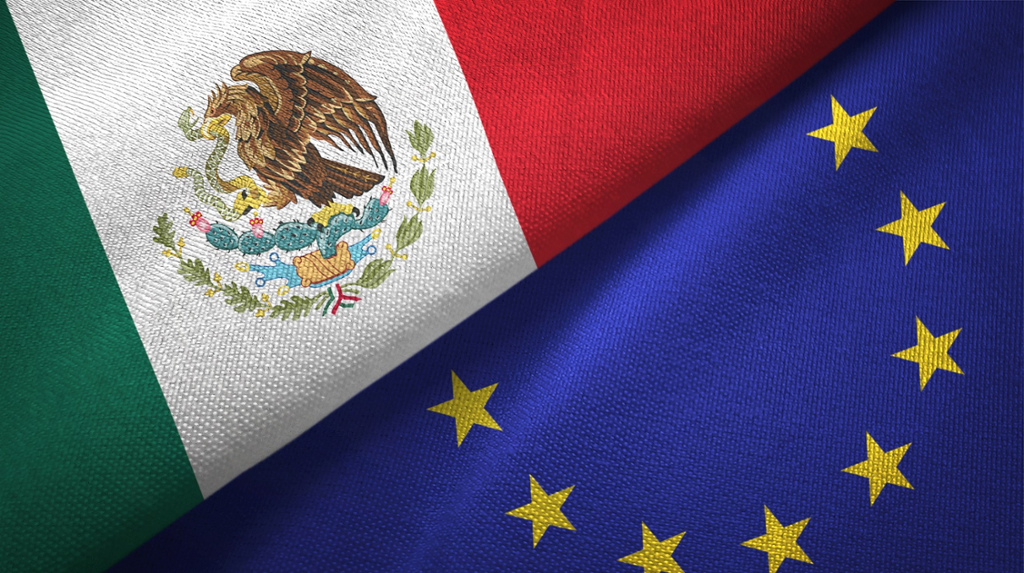
In May 2026, the EU and Mexico signed two agreements with a view to updating the current legal framework governing their bilateral relations to strengthen political and economic cooperation. During its July plenary session, the European Parliament is expected to decide whether to give its consent to the conclusion of the two instruments, the EU-Mexico Political, Economic and Cooperation Strategic Partnership Agreement (Modernised Global Agreement, MGA) and an interim Trade Agreement (iTA), which would apply until the MGA enters into force.
Background
The current framework for bilateral relations between the EU and Mexico is the economic partnership, political coordination and cooperation agreement (Global Agreement), in force since 2000, and the strategic partnership established in 2008 to deepen cooperation in multilateral fora and specific policy areas. In 2015, the parties agreed to update the Global Agreement in light of geopolitical developments and more recent EU trade agreements. Negotiations began in 2016 and concluded in January 2025. For EU ratification, the European Commission opted to split the agreement into two legal instruments: (i) the MGA,covering political dialogue and cooperation, and trade and investment; and (ii) the iTA, which covers the trade and investment provisions of the MGA that fall under exclusive EU competence. This allows the trade part of the agreement to be ratified more quickly as, unlike the MGA, the iTA does not require ratification by individual EU Member States. The Council approved the signature of the MGA and iTA in September 2025. Both agreements were signed during the 8th EU-Mexico Summit on 22 May 2026. Mexico is the EU's 11th-largest trading partner, while the EU ranks third among Mexico's main trade partners. The modernised agreement is intended to boost bilateral trade in goods and services, by removing most of the remaining tariffs on both sides and many non-tariff barriers. It also has a broader political and strategic dimension, aiming to strengthen cooperation in areas of mutual interest such as promoting shared values, upholding the multilateral system, building resilience and working together on global challenges including sustainable development, climate change, peace and security, and tackling corruption and organised crime.
European Parliament position
Both the MGA and the iTA require the consent of the European Parliament before they can be formally concluded by the Council. On 23 June 2026, the Committees on Foreign Affairs (AFET) and International Trade (INTA) jointly adopted, by 67 votes in favour, 15 against and 3 abstentions, their recommendation on granting consent to the conclusion of the EU-Mexico MGA, along with an accompanying interim report. The latter, adopted with 57 votes in favour, welcomes the MGA as a major step forward that will further expand economic cooperation and reinforce the strategic partnership. It flags opportunities for EU companies and farmers, noting that 568 EU geographical indications for traditional agri-food products will be protected in Mexico. It also supports the binding commitments to democratic principles, the rule of law, and fundamental human rights. The INTA Committee is due to vote on a draft recommendation on the conclusion of the iTA on 6 July, before the plenary vote. Parliament has previously supported the modernisation of the Global Agreement, for example in 2016 and 2025.
Recommendation on consent: MGA, 2025/0810(NLE) and 2025/0810R(NLE). Committee responsible: AFET/INTA; rapporteurs Javi López (S&D, Spain) and Borja Giménez Larraz (EPP, Spain).
Recommendation – iTA; 2025/0271(NLE). Committee responsible: INTA; rapporteur Borja Giménez Larraz (EPP, Spain). For further information on the trade pillar of the EU-Mexico MGA, see the Legislative Train Schedule.
Classification
Policy areas: Foreign Affairs | International Trade
Regions: Latin America and Caribbean
Committees: Foreign Affairs (AFET), International Trade (INTA)
Statement on the use of AI
Any AI-generated content in this text has been reviewed by the author(s).
Disclaimer
This document is prepared for, and addressed to, the Members and staff of the European Parliament as background material to assist them in their parliamentary work. The content of the document is the sole responsibility of its author(s) and any opinions expressed herein should not be taken to represent an official position of the Parliament.
Copyright
© European Union.
The reuse of this document is authorised under a Creative Commons Attribution 4.0 International (CC-BY 4.0) licence.

https://creativecommons.org/licenses/by/4.0/deed.en
To use or reproduce elements that are not owned by the European Union, permission may need to be sought directly from the respective rightsholders.