
Article page checkbox is not checked in page info.
Recognition of femicide in the EU
Recognition of femicide in the EU
Ionel Zamfir, Members' Research Service

Summary
Over a thousand women are killed in the EU each year in circumstances that often point to a gender‑related motive, and the perpetrators are most commonly intimate partners or family members. Data collected by a number of EU Member States on female homicides show no consistent downward trend, despite a range of measures aimed at combating gender‑based violence.
Widely publicised cases of femicide have highlighted systemic failures in prevention and victim protection, and have driven legislative reforms in several Member States. These include the introduction of femicide as an aggravating circumstance alongside measures on prevention, victim support and data collection.
Experts recommend avoiding an exclusive focus on harsher criminal penalties and instead implementing a comprehensive approach that addresses the root causes of femicide, strengthening prevention efforts, improving victim protection, enhancing data collection and raising public awareness.
At the EU level, existing legislative and non‑legislative measures address gender‑based violence more broadly but do not specifically recognise femicide as a distinct crime. The European Parliament has therefore urged for its formal recognition at EU level, arguing that this would improve legal clarity, data comparability and the effectiveness of prevention and protection measures.
Background
More than a thousand women are killed in the EU each year, most often by their intimate partners or family members, or in other circumstances that point to a gender‑related motive. Not only does this have fatal consequences for the victims but it can also have devastating effects on other family members, particularly children. Furthermore, it intimidates other women who wish to leave their violent partners or simply make use of their freedom and rights. Data collected by a number of EU Member States on intentional female homicide in general or on femicide by intimate partners or family members show no consistent downward trend, despite the recent adoption of measures1 to address gender‑based violence (see Figure 1).
Women's rights advocates and gender equality experts stress the need to specifically address the killings of women in relation to their gender. Killings of women occur most frequently at home or in specific settings and are driven by gender‑related motives. They include: intimate partner femicide; honour killings; dowry‑related killings; femicide linked to human trafficking, sexual exploitation or violence; female infanticide; killings motivated by hatred against the sexual orientation or gender identity of the victims; killings of women's rights activists; and unintended deaths resulting from female genital mutilation (FGM) or from failed abortions where abortions are criminalised.
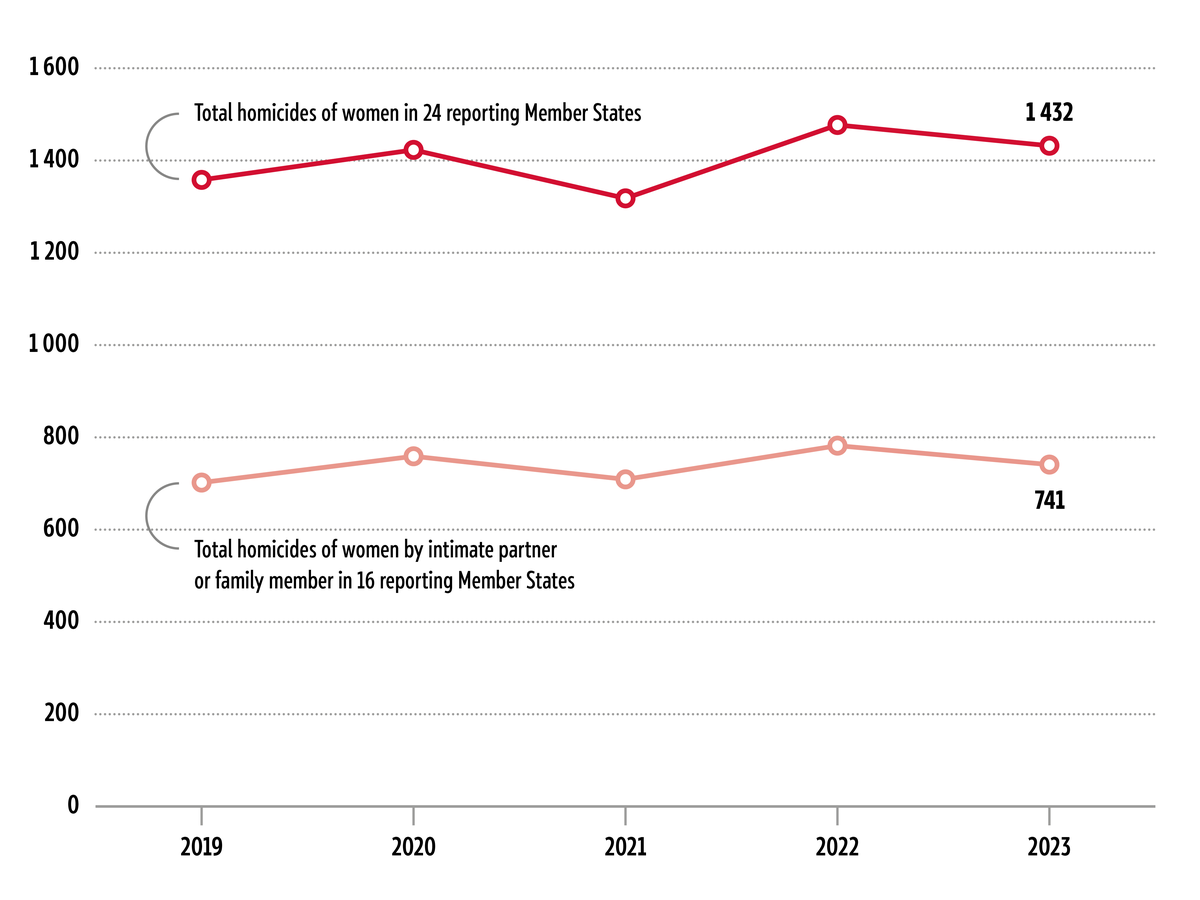
Data source: Eurostat, Intentional homicide victims by victim-offender relationship and sex[crim_hom_vrel], Intentional homicide and sexual offences by legal status and sex of the person involved[crim_hom_soff]; graphic by Samy Chahri, EPRS.
Femicide is a global problem. While comprehensive data on all gender‑related killings are lacking, the United Nations Office on Dugs and Crime (UNODC) estimates that approximately 50 000 women and girls worldwide lost their lives in 2024 due to femicide by intimate partners or family members alone. UNODC also stresses a significant disparity, noting that '60 % of female homicide victims are killed in their home, compared to only 11 % of men'. In Europe, the femicide prevalence rate is 0.5 victims per 100 000 inhabitants per year, which is significantly lower than in other parts of the world. For instance, the rate is 3 victims per 100 000 inhabitants in Africa and 1.5 in the Americas.
There are no EU data on specific types of femicide for all Member States. For instance, in 2024, only 17 Member States provided data to Eurostat on intimate partner femicide and/or femicide by other family members, while 24 provided data on homicides disaggregated by the sex of the victim (as illustrated in Figures 1 and 2). A study by the European Institute for Gender Equality (EIGE), Improving the collection of national administrative data on femicide in the EU, published in July 2025, notes that data based on family relationships 'underestimates the true extent of femicide, hiding gender‑related killings outside these relationships, such as killings of women in prostitution'.
Femicide is often preventable, as it is often preceded by recurrent episodes of domestic violence and abuse, some of which are reported to the authorities. When such violence is not reported, it is because victims fear doing so or do not trust that authorities would take any action. Even when it is reported, authorities often fail to take action due to social stereotypes that view gender violence as a private matter.
The failure of state authorities to act in what would in many cases have been preventable tragedies has stirred public outcry in EU countries, driving debates about the need for more effective policies and legislation. Recent femicides in Croatia, Cyprus, France, Italy, Malta and Romania, among others, have led to public protests and mobilisation demanding more action to stop these crimes.
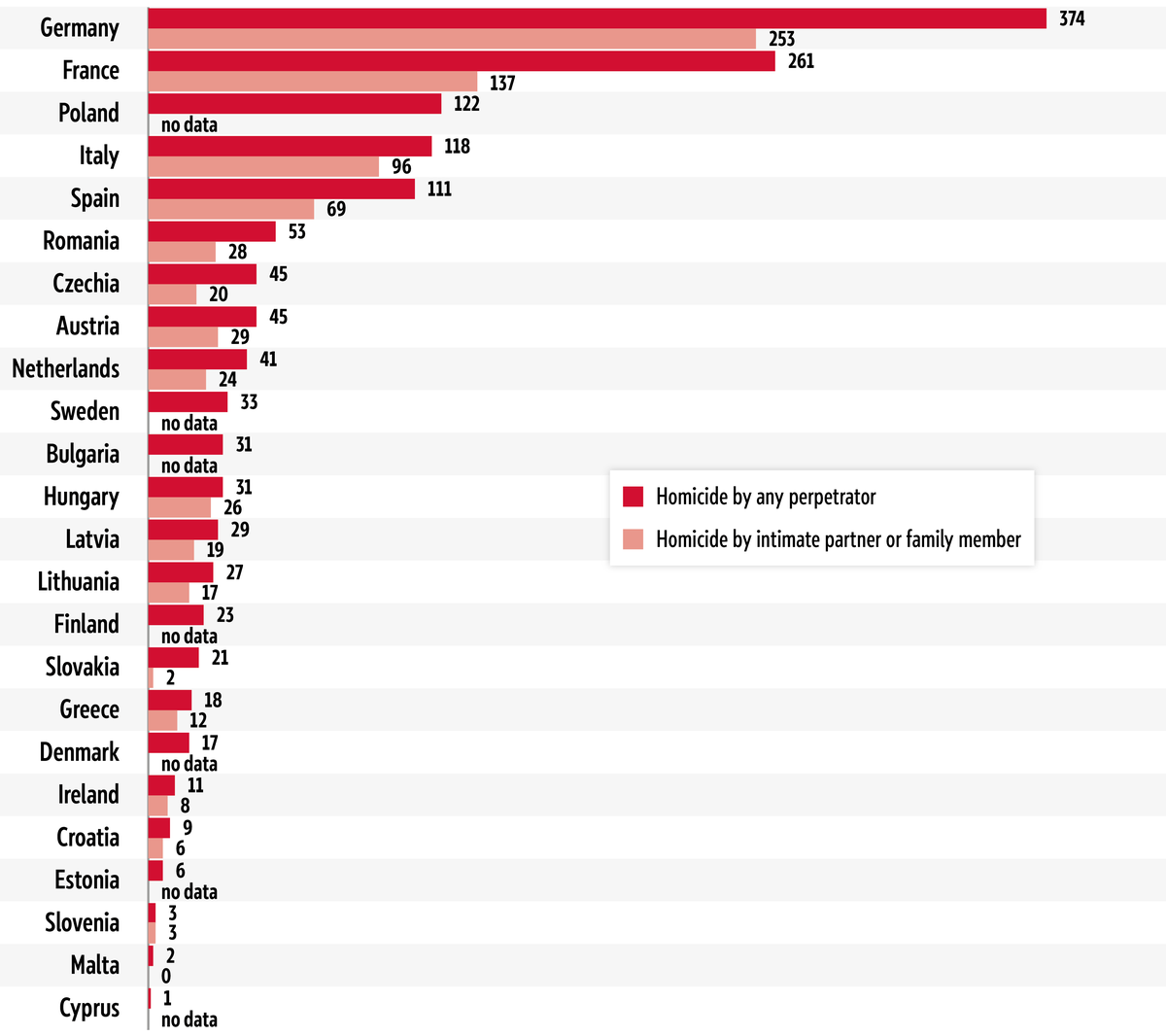
Data source: Eurostat, Intentional homicide victims by victim-offender relationship and sex[crim_hom_vrel], Intentional homicide and sexual offences by legal status and sex of the person involved[crim_hom_soff]; graphic by Samy Chahri, EPRS.
What is femicide
Femicide was initially used to refer to any killing of a woman. In order to emphasise that many lethal crimes against women are caused by misogynist or gender‑related motives, the term is now used to refer specifically to such killings and to establish a legal approach focused on the gender dimension of the crime. The term still faces obstacles to being integrated in the official legal terminology at national level even if it is consistently used by international organisations promoting women's rights.
Femicide is defined as 'the Intentional killing of a woman for misogynous or gender‑based reasons' in the International Classification of Crime for Statistical Purposes (ICCS), drawn up by UNODC. The European Institute for Gender Equality (EIGE) endorses this approach, defining femicide as the 'killing of women and girls because of their gender'.
According to the General recommendation No 35 on gender-based violence against women of the UN Committee on the Elimination of Discrimination against Women, gender‑related factors driving femicide include 'the ideology of men's entitlement and privilege over women, social norms regarding masculinity, and the need to assert male control or power, enforce gender roles, or prevent, discourage or punish what is considered to be unacceptable female behaviour'.
To distinguish femicide from other forms of homicide against women, it is necessary to define the gender‑related motives involved through clearly identifiable indicators. A statistical framework, adopted by UNODC and UN Women in 2021, distinguishes femicide based on several criteria. The first among these is the victim/perpetrator relationship. The vast majority of killings of women by intimate partners and other family members are motivated by gender‑related factors. This can include 'the need to assert male control or punish what is considered to be unacceptable female behaviour', as well as 'harmful traditional practices such as honour killings and dowry killings'. For practical purposes, all such killings can be categorised as femicide. In cases of killings of women by other perpetrators, the modus operandi or context of the intentional homicide can be indicative of femicide.
Based on this approach, EIGE proposes the following classification of femicide at EU level:
1) intentional killings of women by intimate partners (e.g. former or current partner, whether living in the same house or not);
2) intentional killings of women by other family members (e.g. honour killing, dowry‑related killing, others);
3) other types of intentional killings by other perpetrators:
-
as part of sexualised violence
-
related to sexual exploitation
-
related to trafficking
-
in the context of a continuum of violence (including by carers or persons in authority, killing of political activists, hate killing)
-
killings of elderly women by non‑family members
-
other types of killings
4) unintentional killings of women resulting from intimate partner violence, FGM or others.
What causes femicide
To prevent femicide, it is crucial to understand its causes. Experts propose a multilayered model of drivers and risk factors. A World Health Organization (WHO)/Pan American Health Organization (PAHO) report on femicide published in 2012 recommends applying the ecological model (also known as the socio‑ecological model), which is useful to understanding all forms of violence. According to this model, 'violence is influenced by factors operating at four levels: individual, family/relationship, community, and societal or structural (relating to laws, policies and wider societal influences). Drawing on this model, various institutional reports and journal articles2 have identified causal mechanisms and risk factors for femicide, such as the ones listed in Table 1 below:
| Risk factors | For the perpetration of femicide | For being a victim of femicide |
|---|---|---|
| Individual | unemployment
gun ownership forcing sexual intercourse alcohol and drug abuse mental health problems experience of abuse in childhood low level of education | pregnancy and abuse during pregnancy
low educational level attempted strangulation |
| Family | committment of abuse by an intimate partner
marital conflict and instability male dominance in the family jealousy controlling behaviour | escalation of repeated abuse by the perpetrator
child from previous relationship living together with the perpetrator economic dependence on the perpetrator divorce, separation or estrangement from the abusive partner conflict with other family members over behaviour, dowry, property |
| Community | culture of male aggressivity and dominance
lack of social cohesion poverty belonging to crime groups | expectation of strict observance of gender roles
social and geographic isolation (e.g. rural areas) lack of family and friends' support |
| Society | rigid traditional gender norms
acceptance of violence legal access to firearms impunity for domestic violence lack of enforcement of protection orders | obstacles to reporting violence and limited access to justice
social myths about gender‑based violence being a private matter lack of institutional support and protection structures war and conflict |
Source: Author's compilation based on the various reports mentioned in this briefing.
A review of the scientific research on the topic,3 which also builds on a multilayered understanding of femicide factors operating at the psychological, relational, and socio‑cultural level, identifies three broad profiles of perpetrators: perpetrators with severe mental illness; individuals with a history of violent behavior; 'socially conventional men whose violence is primarily driven by controlling, jealous, or patriarchal attitudes'.
According to the cited article, distorted gender ideologies that support male dominance play a role in structuring an abusive and controlling relationship prior to the femicide, while 'structural stressors—such as financial hardship, relationship dissolution, or perceived betrayal' compound psychological vulnerabilities leading to violence.
Beliefs in male domination, which provide perpetrators with a subjective motivation to commit the crime, are more typical of patriarchal and gender‑unequal social settings. Therefore, one issue of scientific interest in studying femicide has been whether its incidence is higher in gender‑unequal societies and communities, and tends to decrease when societies become more egalitarian. Regarding this issue, three types of hypotheses4 have been formulated:
-
Gender inequality nurtures violence against women and increases the risk of femicide; thus, a trend towards more equality reduces violence and femicide as women enjoy more legal protections and mentalities change.
-
A counter‑hypothesis states that increasing gender equality, at least initially, does not reduce violence, as it creates a hostile and at times violent reaction in some men towards women's empowerment.
-
A third viewpoint tries to reconcile the two opposing hypotheses, admitting that both dynamics coexist with different intensities depending on the degree of gender equality reached.
Why legal recognition of femicide matters
Femicide, like any other intentional killing, is already covered and sanctioned by criminal laws in all EU Member States. Related measures to prevent crime and protect victims of crime apply, including EU legislation. Nevertheless, femicide possesses distinct characteristics that necessitate specific prevention measures: it most often occurs at home, where women are fully exposed to the perpetrator's violence; it is frequently preceded by a continuum of violence and abuse; and/or it involves another gender‑motived factor, as explained above. Recognising femicide within criminal law facilitates sentencing and the imposition of more severe punishments, which can have a deterrent effect (although this is controversial; see Box 2).
Legal amendments adopted in response to public outcry about femicides usually include harsher punishments for femicide. Legal experts5 have nevertheless warned against an overemphasis on criminal law that encourages 'penal populism'. Making convictions harsher may not be effective in dissuading perpetrators. An academic article6 analysing laws that make femicide a distinct offence in Mexican states shows that such laws failed to reduce the crime. Instead, a comprehensive approach is needed, combining preventive and protective measures.
Femicide can be legally recongised outside the scope of criminal law through legal provisions that mandate comprehensive prevention measures, the raising of societal awareness as well as more systematic data gathering and scientific reasearch. An example in this respect is the Belgian legislation on the matter (see section below).
How to prevent femicide
The international community has recognised the need to address this global problem, and UN bodies have worked on proposing solutions. For instance, a 2013 UN General Assembly resolution, Taking action against gender-related killing of women and girls, called on UN states to adopt and enforce specific legislation, improve prevention, end impunity, punish perpetrators, strengthen criminal justice responses, and enhance data collection and analysis.
Recommendations for measures to prevent femicide, put forward in various reports,7 which are relevant in the EU context, include:
Legal measures
-
recognising femicide in law either as a distinct offence or an aggravating circumstance
-
ratifying and implementing the Istanbul Convention.
Risk assessment and victim protection
-
ensuring immediate responses to victims' complaints by multi‑disciplinary teams, including individual risks assessments
-
training professionals to identify violence risks and address victims' support needs
-
detecting technology‑facilitated violence as a precursor to physical violence
-
providing enforceable protection orders
-
establishing hotlines and shelters for victims of gender‑based violence
-
protecting children as vulnerable victims.
Judicial treatement of gender‑based violence cases
-
ensuring effective investigations through sufficient awareness among legal practitioners and adequate expertise in collecting evidence, for example, using the Latin American Model Protocol for the investigation of gender‑related killings of women
-
providing specialist training for police and criminal justice system officers for the investigation of gender‑related killings of women
-
implementing effective, proportionate and dissuasive sanctions for the perpetrators in preceding domestic violence acts
-
ensuring appropriate compensation for victims.
Awarness raising
-
bringing femicide in the focus of public attention by involving media
-
combatting harmful norms and stereotypes
-
promoting gender equality education in schools.
Data collection and research
-
collecting more specific and sex‑disaggrated data on violence and murders of women
-
conducting research, publishing public reports and establishing observatories.
EU action against femicide
The EU has established legislative and non‑legislative measures to prevent crime and protect victims of gender‑based violence. While it does not specifically tackle femicide, the EU Directive (EU) 2024/1385 on combatting violence against women mandates a comprehensive approach to protect victims and prevent violence against women. Measures relevant for preventing femicide include:
-
facilitating reporting of acts of violence against women and domestic violence by victims and witnesses;
-
prompt investigation by authorities;
-
assessment of individual protection needs and the issuing of emergency barring, restraining and protection orders;
-
specialist support services, including legal and psychological assistance;
-
help for victims of violence to build an independent life, including access to housing, employment and childcare;
-
helplines for victims;
-
sufficient shelter places for victims of violence;
-
obligations on Member States to collect data on 'the number of victims who have been killed due to violence against women or domestic violence'.
EU Directive 2012/29/EU on the rights of victims of crime is relevant for potential victims of femicide. The directive is about to be amended to strengthen the protection afforded to victims. Amendments provide for victims' helplines and support services for victims with specific needs, especially for those requiring physical protection, being in life‑threatening situations, or having experienced sexual violence. Directive 2011/99/EU on a European protection order provides for the cross‑border recognition and enforcement of protection orders, so that victims can enjoy this protection when moving within the EU, while Regulation 606/2013 provides for the mutual recognition of protection measures in civil matters between Member States.
The EU gender equality strategy 2026‑2030 makes combatting gender‑based violence one of the EU's priorities for action. The strategy emphasises the key role of law enforcement and prosecutorial authorities in preventing and combating femicide and commits to improving their capacity to promptly detect risks and intervene.
The EU has funded various projects to combat violence against women under the Daphne strand of its Citizens, Equality, Rights and Values (CERV) programme, and will continue to do so under the proposed future Agora programme.
Legislation in Member States
Several Member States have taken steps to recognise femicide in their legislation. These measures vary: some establish femicide as a new distinct crime, while others introduce the gender dimension into criminal law merely as an aggravating circumstance. Additionally, some provisions that focus on preventive measures and data collection contribute to the recognition of femicide outside the scope of criminal law.
In June 2022, Malta officially recognised femicide as an aggravating factor in murder by making a legislative amendment that was unanimously approved by Parliament (Act No X of 2022 An Act to further amend the Criminal Code, Cap. 9. of 28 June 2022). The amended Article 211A of the Criminal Code provides that courts should establish whether the wilful homicide of a woman meets the characteristics of femicide, namely: if the crime was the result of violence by an intimate partner or violence by another family member; was committed for misogynistic motives; was committed for reasons of honour or family reputation, or for religious reasons; was committed for reasons related to gender, gender identity or sexual orientation; was committed as a result of sexual violence or of other acts of a sexual nature; or was committed against a victim involved in prostitution, a victim of sexual exploitation or a victim of human trafficking for purposes of sexual exploitation.
In July 2022, Cyprus passed a new law making femicide a distinct crime punishable by potential lifetime imprisonment. The amendment to the Prevention and Combating of Violence against Women and Domestic Violence and Related Matters Law of 2021 provides that the killing of a woman through an unlawful act or omission (failing to do something when there was a legal duty to act) constitutes femicide. The following factors constitute aggravating circumstances: intimate partner violence; torture or the use of violence for misogynistic reasons; family violence; the use of violence for reasons of honour; the use of violence for reasons of religious beliefs; the use of violence for reasons of sexual orientation or gender identity; and the commission of the offence of female genital mutilation.
In July 2023, Belgium adopted a law on femicide and gender‑related killings (Loi sur la prévention et la lutte contre les féminicides, les homicides fondés sur le genre et les violences, 2023). Unlike in other countries, this law does not modify relevant criminal law provisions or introduce femicide into the Criminal Code. Instead, it focuses on prevention, data gathering, awarness‑raising and scientific research. The law distinguishes between: intimate femicide (committed by a partner or family member due to the victim's gender); non‑intimate femicide (committed in the context of sexual exploitation, human trafficking, sexual violence, or as part of a continuum of violence linked to a relationship of unequal power or abuse of power by the perpetrator over the victim, etc.); and indirect femicide (unintentional killing due to harmful practices or suicide).
The law establishes a Scientific Committee for the analysis of femicides and gender‑based homicides. The Belgian Institute for Equality between Women and Men is tasked with publishing yearly statistical reports on femicides and biennial studies on femicides to identify their causes and effects, as well as to assess the efficacy of existing measures.
In March 2024, the Croatian Parliament approved a bill to make femicide a specific criminal offence. The act introduces a legal definition of 'gender‑based murder' into the Criminal Code, providing harsher penalties for it: at least 10 years' imprisonment, or longer. It defines this type of murder based on the victim's acquaintance with the perpetrator, the victim's vulnerability, subordination or dependency, or a context of gender inequality, sexual violence or gender‑based violence.
In July 2025, the Italian Senate unanimously approved a bill introducing femicide as a distinct offence in the Italian Criminal Code, subject to more severe penalties. The amended Article 577-bis now defines femicide as the murder of a woman when the act is committed as an act of hatred, discrimination or abuse of power; as an act of control, possession or domination over a woman; in connection with the woman's refusal to establish or maintain an emotional relationship; or as an act limiting her individual freedom.
In March 2026, the Romanian Parliament adopted, with a broad majority, a new law (Law No 53 of 23 April 2026) that defines femicide as the intentional killing of women or their unintentional death resulting from violence or from practices that harm women. The law distinguishes between intimate femicide (committed by a family member) and non‑intimate femicide (by another perpetrator). It provides a non‑exhaustive list of gender‑related motivations that distinguish femicide from other forms of homicide aganist women.
The law does not establish a separate criminal offence of femidice in the Romanian Criminal Code. Instead, it extends the scope of qualified murder – an offence carrying heavier penalties – to killings motivated by control or domination over the victim, gender‑based discrimination, or the victim's refusal to enter or to stay in a marriage or similar relationship with the perpetrator. It also provides for harsher penalties for non‑lethal violence, threats and harassment committed in similar circumstances.
The law mandates comprehensive prevention and protection measures, such as establishing a registry for compliance with protection orders; data collection; drafting a yearly report on relevant matters; disseminating information to the public; providing tools for managing risks in criminal procedures for violence; and implementing gender equality education in schools.
Spain has defined an offence of sexual femicide in its Organic Law 10/2022 on the Comprehensive Guarantee of Sexual Freedom (Ley Orgánica 10/2022, de 6 de septiembre, de garantía integral de la libertad sexual).This law criminalises all sexual acts without free consent and creates the offence of 'sexual femicide', understood as the homicide or murder of a woman related to conduct defined in the law as sexual violence.
Other countries, such as France, Greece and Denmark, have also witnessed public debates or legislative initiatives on the legal recognition of femicide.
Stakeholders' views
Civil‑society organisations have expressed strong support for the legal recognition of femicide as a distinct crime. Civicus Lens notes the global mobilisation of civil society in 2025 to support the recognition of femicide as 'a specific crime, defined as the killing of women or girls because of their gender, with causes and consequences that set it apart from other forms of lethal violence'. The organisation also stresses the need for 'structural transformation', covering education on prevention, support services, specialised judicial training and accountability mechanisms.
The Wave Network, which brings together various organisations advocating for women's rights in Europe, is in favour of an EU‑wide criminalisation of femicide. It deplored the failure of the EU directive to include femicide among the EU crimes.
Parliament is strongly in favour of recognising femicide in law
The European Parliament, in its resolution of 13 November 2025 on the Gender Equality Strategy 2025, urges the Commission to recognise femicide as a distinct and stand‑alone crime. It emphasises that understanding femicide as 'the killing of a woman or girl because of her gender' is critical to comprehending its root causes linked to gender discrimination and power imbalances. Furthermore, it calls on the Commission 'to improve, in particular, data collection on the prevention, prosecution and sanctioning of GBV, including femicide'.
Parliament has repeatedly called for the recognition of femicide not only in the EU but also at the international level. In its Recommendation to the Council on EU priorities for the 70th session of the UN Commission on the Status of Women, adopted in February 2026, it stressed that femicide, defined as the gender‑related killing of women and girls, represents a grave violation of universal fundamental rights. It called for the global recognition of this crime and global efforts to eliminate it. In a January 2024 resolution, Parliament emphasised the role its parliamentary diplomacy could play in fighting femicide worldwide.
Main references
- EIGE, Defining and Identifying Femicide: A literature review, 2021.
- EIGE, Measuring Femicide in the EU and Internationally: An assessment, 2021.
- EIGE, Improving legal responses to counter femicide in the European Union:Perspectives from victims and professionals, 2023.
- UNODC and UN Women, Statistical framework for measuring the gender-related killing of women and girls (also referred to as 'femicide/feminicide'), 2021.
Endnotes
Disclaimer
This document is prepared for, and addressed to, the Members and staff of the European Parliament as background material to assist them in their parliamentary work. The content of the document is the sole responsibility of its author(s) and any opinions expressed herein should not be taken to represent an official position of the Parliament.
Copyright
© European Union.
The reuse of this document is authorised under a Creative Commons Attribution 4.0 International (CC-BY 4.0) licence.

To use or reproduce elements that are not owned by the European Union, permission may need to be sought directly from the respective rightsholders.