
Article page checkbox is not checked in page info.
Nuclear fusion: State of play
Nuclear fusion: State of play
Clément Evroux, Members' Research Service
Summary
In 2026, the European Commission is expected to publish a strategy on nuclear fusion. Nuclear fusion, i.e. the combination of two atoms into a single heavier one, has been known since the first half of the 20th century. Despite significant progress, the controlled and sustained fusion reaction required for practical energy production has not yet been fully mastered. This technology is deemed to offer significant opportunities for generating affordable, decarbonised energy. To expedite the pathway towards the proof of concept, a significant international cooperation project, the International Thermonuclear Experimental Reactor (ITER), was launched in 2007 by 34 countries, including the EU Member States. The progress in technological development made since then might pave the way for the technology to be ready for industrial use in the second half of the century. Countries such as China and the United States are investing in technological development, and have started designing framework conditions, including a conducive regulatory environment.
With the current discussion on the next multiannual financial framework (MFF) for 2028-2034, the EU is also expected to support further investment in fusion technologies, mostly through the proposed EURATOM research and training and Horizon Europe programmes, which build on the current (2021‑2027 MFF) programmes. However, stakeholders are stressing the relevance of providing appropriate framework conditions in addition to commensurate investment. This includes providing a conducive regulatory framework, as well as the talent pool necessary to develop and deploy such technologies.
What is nuclear fusion?
The International Atomic Energy Agency (IAEA) defines nuclear fusion as 'a process by which two light atomic nuclei combine to form a single heavier one while releasing massive amounts of energy'. This process takes place at the core of the Sun, where hydrogen nuclei collide and fuse into heavier helium while releasing extremely high amounts of energy. Fusion reaction occurs in a plasma, also known as the 'fourth state of the matter', that corresponds to a hot, dense and ionised gas. At every second, at around 15 million degrees Celsius, the Sun turns 600 million tonnes of hydrogen into helium.
Following significant scientific discoveries, including the understanding of nuclear fusion in stars and the first experiments on man-made fusion from the 1930s, the scientific community has been exploring the conditions for its industrial replication. Nuclear fusion could create four times more energy per kilogram of fuel than nuclear fission (and up to four million times more energy than oil and coal), while generating low- and intermediate-level waste, instead of high-level waste for nuclear fission, and representing less risk in the case of an accident.
However, the conditions for achieving nuclear fusion to produce actionable energy are demanding and have not yet been met (see Figure 1). They include:
-
heating a quantity of fuel above its ignition point: while the deuterium ignition point is above 100 million degrees Celsius on Earth, the boron ignition point would be expected to be at least 10 times higher;
-
keeping the reaction during enough time to allow the release of an amount of energy superior to the amount of energy used to establish the reaction (what fusion science terminology refers to as a 'Q greater than 1');
-
converting the energy released into a useful form of energy, such as electricity.
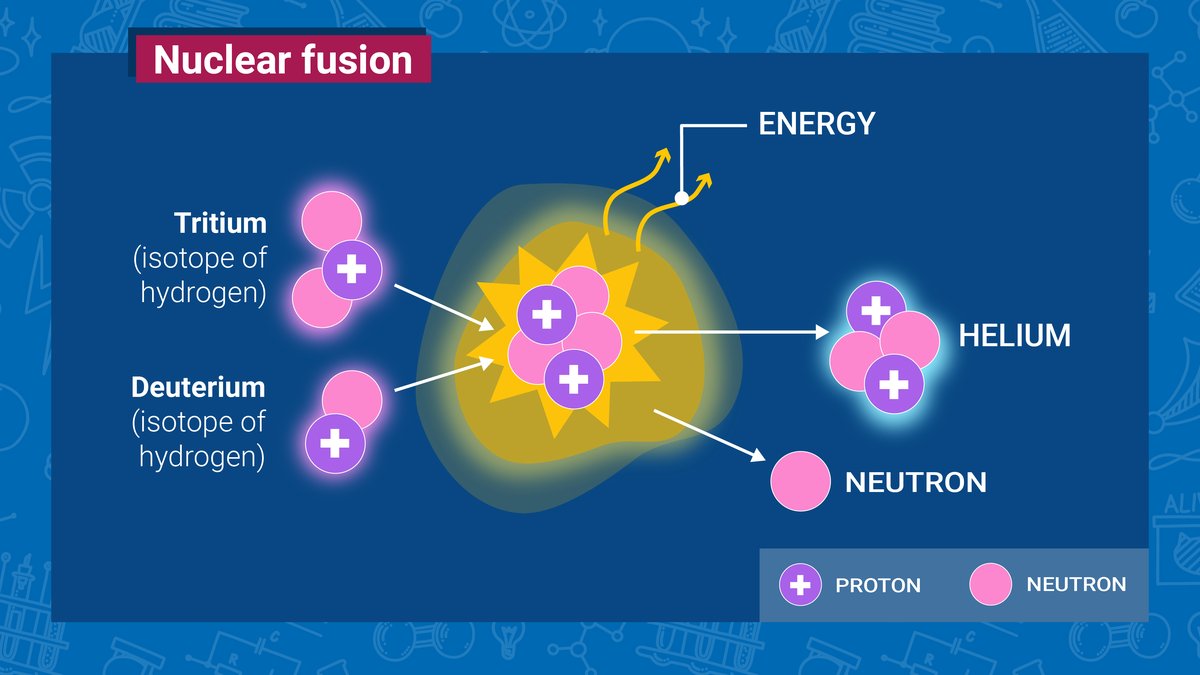
Source: International Atomic Energy Agency, What is Nuclear Fusion?, website, updated 2023.
By March 2026, only one experiment, conducted in 2022 in the US National Ignition Laboratory, is reported to have achieved the first and the second conditions.
The current development of nuclear fusion technologies is characterised by research on several kinds of fuels – including boron; deuterium (a common hydrogen isotope easy to source from sea water), and tritium, another hydrogen isotope that can be sourced from specific industrial processes – as well as by the design of several technologies to establish the fusion reaction. Some technologies are looking into enabling fusion through magnetic confinement fusion, which is based on magnetic fields containing the fusion fuels in the state of plasma. Another technology looks at enabling fusion through the inertial confinement fusion approach: the plasma is created using lasers and a small pellet filled with the required fuel. According to the IAEA, at a global level, there are currently more than 100 facilities based on magnetic confinement fusion ('tokamak' and 'stellarators', and less than 20 facilities based on inertial confinement fusion).
Advancements in nuclear fusion: Global progress
The advancement of knowledge and technology in nuclear fusion is driven by international cooperation, national scientific and technological agendas, and private-sector initiatives.
The primary international cooperative project in nuclear fusion is the International Fusion Energy Organization. Established in 2007 by 34 participating states, including China, the EU States, India, Japan, Korea, Russia and the US, it operates under a 35-year international agreement to build, develop and operate ITER. It is the largest fusion experiment to date aimed at demonstrating the scientific and technological feasibility of fusion through magnetic confinement fusion technology. The plant is expected to be ready for deuterium-tritium operation by 2039, with an estimated construction cost ranging from €18 billion to €22 billion (see Table 1). In November 2025, the 37th ITER Council meeting noted that ITER was 'somewhat ahead of schedule'.
| EU | China | India | Japan | Russia | South Korea | US | |
|---|---|---|---|---|---|---|---|
| Construction costs | 45.5 % | 9.1 % | 9.1 % | 9.1 % | 9.1 % | 9.1 % | 9.1 % |
| Operation costs | 34 % | 10 % | 10 % | 13 % | 10 % | 10 % | 13 % |
Data source: ITER Organization, Frequently asked questions, website, 2026.
In parallel to their commitment in ITER, several countries are conducting national initiatives to develop relevant knowledge and technologies for the operation of nuclear fusion systems in the next two decades.
The US supports nuclear fusion by developing both the magnetic confinement and inertial confinement technologies. According to the Congressional Research Service, in 2025, the federal government invested the equivalent of €681 million (of which 21 % corresponds to the US contribution to ITER) in its fusion science energy programme, and €589 million in its inertial confinement programme.
In China, while nuclear fusion has been identified in the 15th five-year plan (2026-2030) as a priority industry, the Chinese Academy of Sciences claims to pursue the aim of ensuring net fusion power gain and electricity generation by around 2030. In early 2026, a magnetic confinement infrastructure in China reportedly made progress in enhancing the management of the plasma conditions necessary for fusion.
Japan has updated an ambitious national strategy on nuclear fusion for the 2030s with a view to reducing the country's energy dependency and environmental footprint.
In 2026, South Korea decided to build a nuclear fusion demonstration reactor that would target demonstration by 2035.
Significantly, these national initiatives provide for the development and scale-up of private operators in nuclear fusion. For instance, the US is harnessing its 2025 fusion science and technology roadmap to facilitate a partnership between the public and private sectors in nuclear fusion around three priorities: build, innovate and grow. Public investment focuses on solving outstanding gaps in knowledge and technology, while also providing the framework conditions needed to operate fusion infrastructure, including talent. Private investment, meanwhile, supports all stages of sector development. This includes the construction of private nuclear fusion facilities. As a consequence, private investment is also increasingly opening to nuclear fusion projects.
According to the IAEA World Fusion Outlook 2025, global private investment in fusion reached €8.6 billion in 2025, indicating the expansion of the nuclear fusion supply chain from custom research and technological infrastructure to early-stage industrial manufacturing. The report associates this increase with the expectations regarding the contribution of nuclear fusion technologies to the provision of clean-electricity generation. Modelling by the Massachusetts Institute of Technology (MIT) estimates that nuclear fusion's share in global electricity generation could reach as much as 38 % to 50 % by 2100 in the most optimistic scenarios, where its cost would comprise between US$5 600 per kilowatt (/kW) and US$2 800/kW in 2050 (see Figure 2). The geographical breakdown of this surge in private investment shows US predominance. According to a 2025 report on global investment in the private fusion sector by the EU's Fusion for Energy (F4E) joint undertaking, the US accounts for 53 % of global investment, China for 34 %, and the EU a mere 5 %.
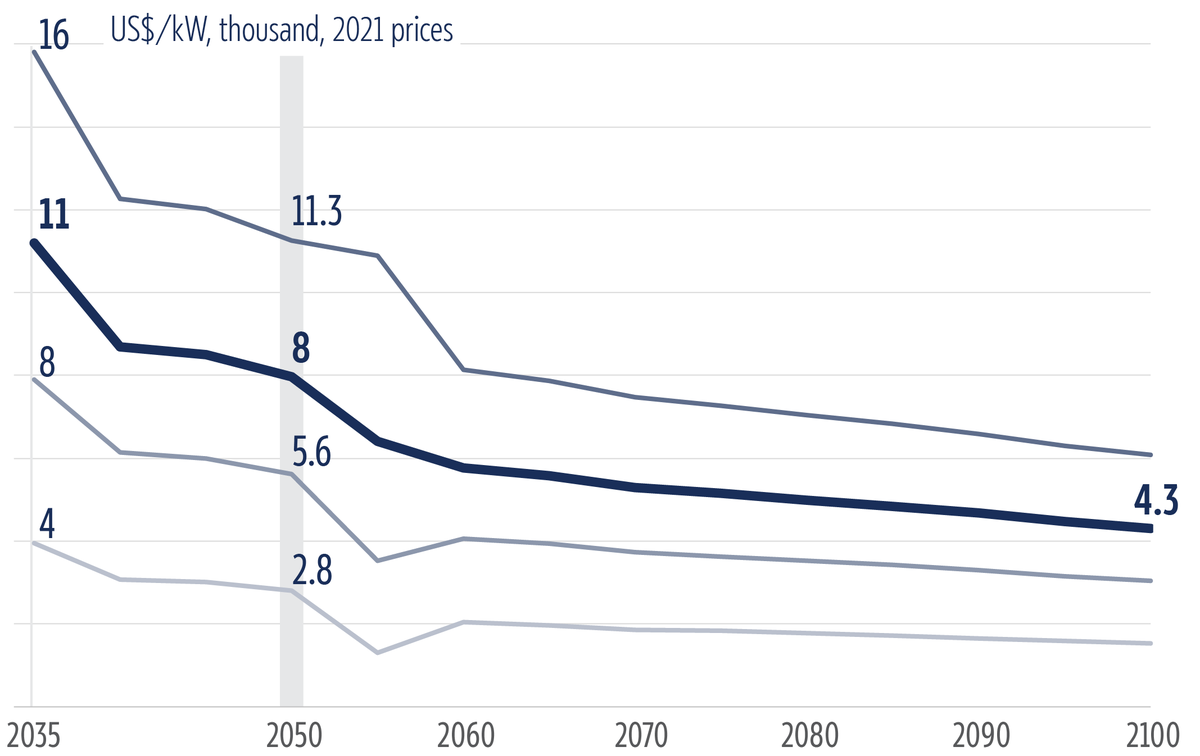
Data source: MIT Energy Initiative, The Role of Fusion Energy in a Decarbonized Energy System, 2024. Graphic by Nadejda Kresnichka-Nikolchova, EPRS, 2026. Note: The graph shows four sub-regional grid models. The base model assumes that fusion technology is commercially available in 2035 at overnight capital costs of US$11 000/kW and falls to about US$8 000/kW by 2050 and about US$4 300/kW by 2100.
European initiatives
Since 2014, 25 EU Member States have joined forces with Norway, Switzerland, Ukraine and the United Kingdom to establish the EUROfusion consortium, whose goal is to provide 'a clear and structured way forward to commercial energy from fusion', based on ITER, its successor DEMO, and other related scientific infrastructure such as the International Fusion Materials Irradiation Facility: DEMO-Oriented Neutron Source (IFMIF‑DONES), which will test and validate the materials to be used by such reactors.
The consortium is supported by the EURATOM research and training programme: in March 2026, following a grant of €549 million from 2021 to 2025, the European Commission announced an additional investment of €222 million under the 2026-2027 Euratom work programme to establish a further public-private partnership on nuclear fusion. In 2026, the European Innovation Council has also identified nuclear fusion as one of the breakthrough technologies eligible for its accelerator challenge.
In parallel, several Member States, including Germany, Spain , France, Italy and Finland, have designed or are designing national initiatives on nuclear fusion, some of which are outlined in the IAEA World Fusion Outlook. In addition, the EU can rely on world-class nuclear fusion infrastructure, which includes tokamaks (WEST), stellarators (Wendelstein 7‑X) and an inertial confinement system (CELIA). The EU is also hosting other relevant technological infrastructure, such as the Cernavodă Tritium Removal Facility in Romania, which could provide fuel for fusion reactors. According to the above-mentioned F4E report, the EU's situation is characterised by a dichotomy: on the one hand, it struggles to raise a competitive volume of investment, with average EU investment around three times smaller than that in the US, and 30 times smaller than China's; on the other, it offers a more balanced direction of investment in both magnetic confinement and inertial confinement technologies: at global level, 78 % of private investment targets magnetic confinement systems, while in the EU, 55 % of private investment targets inertial confinement solutions, and 45 % targets magnetic confinement solutions.
EU support for nuclear fusion in the proposed 2028-2034 MFF
Mario Draghi's report on the future of European competitiveness called on the EU to develop an overarching EU innovation strategy for nuclear fusion energy. In line with the report's conclusions, the Commission, in 2026, is set to publish a fusion strategy, prepared by a public consultation held in 2025. The strategy is expected to have a comprehensive approach that would include:
-
an investment strategy to develop and operate a pilot fusion power plan;
-
a workforce strategy to ensure a commensurate pool of talent;
-
support for a competitive supply chain made of nuclear fusion ecosystems;
-
a governance and regulatory framework to facilitate the deployment of fusion;
-
an international cooperation approach.
With the publication of the proposal for the 2028-2034 MFF, the Commission provides both targeted investments and other investment opportunities in fusion technologies. In terms of targeted investments, the proposed EURATOM research and training programme would invest €6.682 billion (current prices) to provide the EU's contribution to ITER; to advance fusion research as a new objective, supporting the transition from basic science to technology, engineering and innovation; and to develop the relevant expertise and skills through education and training. In terms of other investment opportunities, the proposed Horizon Europe programme 2028-2034 introduces the option of programming 'moonshots' that would correspond to a coherent sequence of investment from research to deployment, with a strong scientific component, boosting EU-wide value by facilitating co-investment with the Competitiveness Fund, Member States and the private sector. The explanatory memorandum of the Horizon Europe proposal identifies fusion as one of the possible moonshots:
Powering the green transition with fusion energy: the first commercial nuclear fusion power plant, able of generating safe, consistent, and reliable electricity to power homes, businesses, and hard-to-abate energy intensive industries. Overcome the scientific, engineering and technological challenges necessary for 'Europe to be the first to put Fusion on the grid by 2034'.
Stakeholder views
In 2025, the Commission published a report by an independent expert group on fusion, which supported the development of a comprehensive fusion strategy. The strategy should include continued support for ITER, whose operational phase might begin by the end of the 2028-2034 period, and an EU fusion roadmap to improve the European supply chain in Europe's capacity to achieve technological leadership. This should be supported by encouraging private-sector participation in the fusion supply chain and pursuing international cooperation on fusion further with selected partners, while ensuring a commensurate talent pool by enhancing training opportunities. The group also invited the Commission to act swiftly to make fusion a cornerstone of Europe's future energy landscape – including designing a conducive and responsible regulatory framework that should be underpinned by continuous dialogue with stakeholders and international partners to address aspects such as safety – and to strengthen non-proliferation measures. It noted that the expected regulatory framework could take the EURATOM Treaty as legal basis.
In January 2025, the German Max Planck Institute for Plasma Physics published remarks on a report on nuclear fusion published by the Office of Technology Assessment at the German Bundestag. While noting that 'fusion energy should be available at the beginning of the second half of this century', the Max Planck institute also stresses that nuclear fusion could also be employed beyond electricity generation, in particular to supply process heat for industry, to provide energy for the production of synthetic fuels such as hydrogen, to capture CO2 from the air, and to operate seawater desalination plants.
In November 2025, the French Alternative Energies and Atomic Energy Commission, a research organisation, published a statement on cooperation in 2026 with ITER and IAEA to enhance the participation of young and mid-career women in nuclear science and technological activities through mentoring and upskilling activities (Lise Meitner programme).
In January 2026, on the occasion of an event organised in the European Parliament, the Fusion Industry Association called on the EU to provide the framework conditions necessary to support the development of fusion innovation and industrial ecosystems across Europe. The main messages conveyed by the industry association refer to the need to (i) harness EU funding to support a large-scale public partnership to accelerate technological development while guaranteeing technological neutrality, and (ii) provide an agile EU regulatory framework that should not be derived from the nuclear fission regulatory framework. Following the event, Sweden-based company Novatron Fusion Group issued a statement in a similar vein, calling on the EU to provide the necessary infrastructure and framework conditions to enable the development and deployment of nuclear fusion.
In May 2025, Germany-based company Proxima Fusion issued a statement to explain the relevance of the stellarators technology, and in particular the opportunities of the convergence between physics validation, computational maturity, and artificial intelligence.
In March 2026, France-based company GenF noted that, with Europe investing in fusion, 'the conditions for laser-driven ICF [inertial confinement fusion] have never been stronger'.
European Economic and Social Committee position
In its opinion on the EURATOM research and training programme 2028-2032, adopted on 18 March 2026, the European Economic and Social Committee (EESC) said it perceived the support for nuclear fusion as a crucial funding item of the programme, and considered it important to support the EU's role in ITER in order to strengthen the European fusion energy ecosystem. The EESC believes that the support for fusion technology should represent a large share of the budget allocated to the programme, and should complement the moonshot outlined in the Horizon Europe proposal. It also called on the Commission to provide a comprehensive framework for nuclear fusion in its forthcoming strategy.
European Parliament position
On 20 January 2025, Parliament held a plenary debate on 'advancing the fusion industry for energy independence and innovation'. The discussion highlighted a broad consensus across the political groups on the positive role of fusion energy in enhancing the EU's strategic autonomy and decarbonisation agenda. While several Members urged the Commission to facilitate the delivery of ITER objectives, others also stressed the need to encourage private investment through public-private partnerships, and by setting up a conducive regulatory framework.
On 19 June 2025, Parliament adopted a resolution on the proposed clean industrial deal, in which it called on the Commission to advance research in nuclear fusion as a future energy technology.
Main references
- Evroux, C., EURATOM research and training programme for the period 2028-2032, EPRS, European Parliament, February 2026.
- Guedes Ferreira, V. and Vale, A., Fusion energy: A paradigm shift in power generation for Europe?, EPRS, European Parliament, September 2025.
Classification
Policy areas: Research Policy
Regions: European Union
Committees: Industry, Research and Energy (ITRE)
Disclaimer
This document is prepared for, and addressed to, the Members and staff of the European Parliament as background material to assist them in their parliamentary work. The content of the document is the sole responsibility of its author(s) and any opinions expressed herein should not be taken to represent an official position of the Parliament.
Copyright
© European Union.
The reuse of this document is authorised under a Creative Commons Attribution 4.0 International (CC-BY 4.0) licence.

https://creativecommons.org/licenses/by/4.0/deed.en
To use or reproduce elements that are not owned by the European Union, permission may need to be sought directly from the respective rightsholders.