
Article page checkbox is not checked in page info.
Plenary round-up – May 2026
Plenary round-up – May 2026
Clare Ferguson and Katarzyna Sochacka, EPRS
Summary
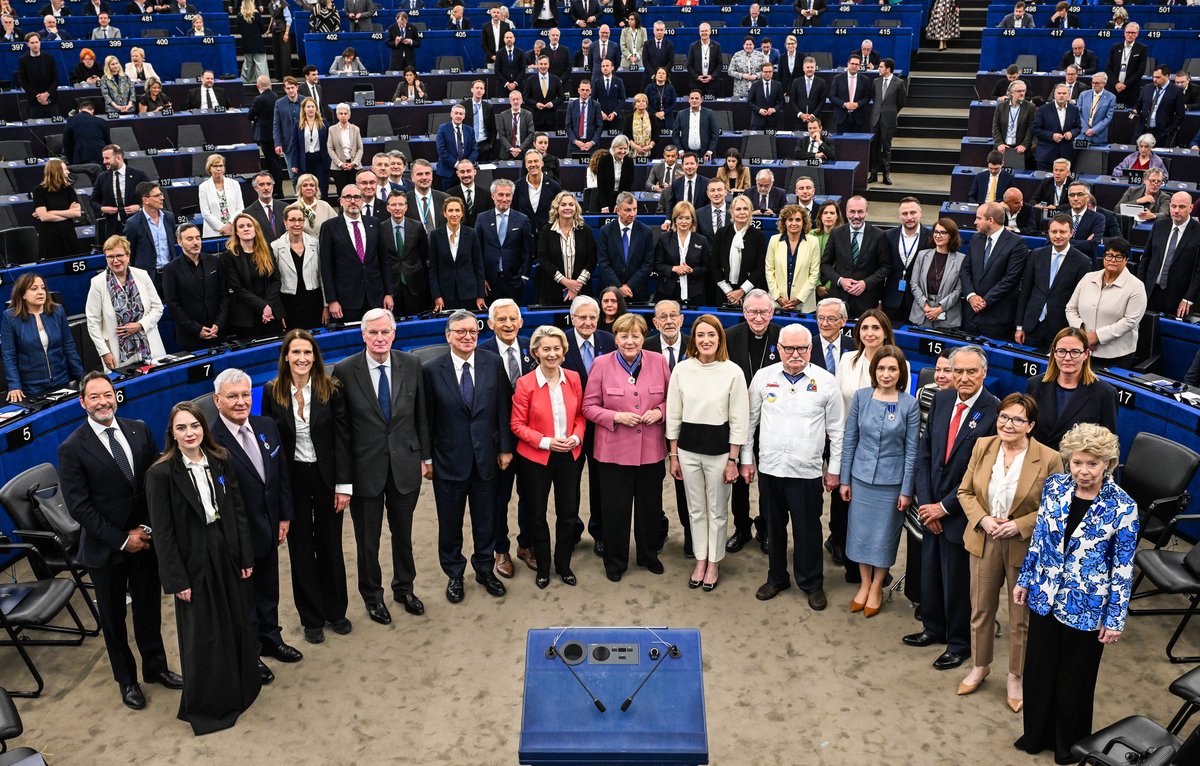
The highlight of the May 2026 plenary session was the first conferral ceremony for the European Order of Merit, honouring individuals' outstanding contributions to the European project and reaffirming the Union's shared values and commitment to solidarity, democracy and peace. Another key moment of the session was question time with Kaja Kallas, Vice-President of the Commission and High Representative for Foreign Affairs and Security Policy, where the EU strategy to address the current crises in the Middle East was discussed.
On foreign affairs and security, Parliament debated Europe's response to reduced United States military deployments in Europe, particularly on the Union's Eastern flank, in light of recent US decisions. Members also addressed political repression and the humanitarian situation in Cuba, as well as the Azerbaijani Parliament's decision to suspend cooperation with the European Parliament. In addition, Parliament commemorated the genocide of Armenians and Greeks in Pontos and Asia Minor.
Debates related to economic resilience, competitiveness and preparedness focused on EU cybersecurity and preparedness in view of advanced AI systems, as well as the urgent need to deliver on the single market to provide certainty and predictability for European businesses and quality jobs. Members also discussed sustainable financing of EU priorities through a new EU own resource linked to the online gambling and betting services sector.
Further debates covered European solidarity in securing access to medicines in a shifting geopolitical context, the Union's preparedness for health emergencies following the case of the MV Hondius and the hantavirus spread, recent proposals to fight poverty in the EU, and the need to reduce work-related fatalities. Parliament furthermore debated the recruitment of children by organised crime and the vehicle attack on pedestrians in Modena, with a focus on protecting public spaces and preventing violence. There were debates following the presentation of the fertilisers action plan, and on the need to adapt the EU legal framework on sustainable biofuels.
European Order of Merit
A ceremony with 13 of the first laureates of the European Order of Merit took place on 19 May 2026.The European Parliament initiated the award in 2025, to recognise those who have made a significant contribution to European integration or to the promotion of European values. The 20 laureates of this year's award, announced by President Roberta Metsola in March, include former German Chancellor Angela Merkel, former Solidarność leader and Polish President Lech Wałęsa, and Volodymyr Zelenskyy, President of Ukraine, who become Distinguished Members of the European Order of Merit. Meanwhile, the title of Honourable Member was conferred upon ten recipients including Jerzy Buzek, Former Prime Minister of Poland and former President of the European Parliament, and the title of Member to six others, plus the members of the band U2.
Question time: EU strategy on Middle East crises
High Representative/Vice-President, Kaja Kallas answered questions on the EU's strategy to address the crises in the Middle East . Two and a half years after the Hamas-led attack against Israel on 7 October 2023, which led to devastating wars in Gaza and Lebanon, the region is engulfed in another deep crisis, not only pitting Iran and its allies in the 'Axis of Resistance' against the US and Israel, but also drawing in the entire region with severe consequences for the global economy.
Tackling global steel over-capacity in the EU
A major employer in the EU, the steel industry currently faces high levels of global over-capacity, dependence on Russian imports, and threats to its competitiveness from US tariffs. Members debated and adopted a provisional agreement reached with the Council on a regulation aimed at shielding the EU steel market from the effects of global over-capacity. The regulation will also implement new safeguards to replace those introduced in response to the first Trump administration tariffs, which expire in June 2026. The provisional agreement supports the Commission's proposal to significantly reduce quotas and double tariffs, while also requiring product traceability in allocating annual quotas. The new legislation would apply from 1 July 2026, with a first review scheduled within six months.
Forest reproductive material
Forests provide many benefits for society but have come under increased pressure from climate change in recent years. Parliament adopted a provisional agreement reached with Council negotiators on the proposed regulation on forest reproductive material (FRM) needed to plant or replace forests. The proposal would require Member States to draw up contingency plans to ensure a sufficient supply of FRM to reforest areas affected by extreme weather events, natural disaster and disease.
Single European railway area
Railway capacity management remains fragmented in the EU, leading to congestion and poor cross-border coordination. Members adopted a provisional agreement on streamlining rail management across the EU. Committee on Transport and Tourism (TRAN) negotiators succeeded in introducing greater flexibility for rail capacity planning, with national networks encouraged to cooperate more closely.
Revised Victims' Rights Directive
Parliament remains committed to supporting victims of violent crime and advocating stronger protection of victims' rights. Parliament debated and adopted the agreed text on the revised Victims' Rights Directive. Under this text, Member States are obliged to implement support for victims, including helplines, robust reporting procedures, and to provide greater access to legal aid and compensation. EU governments also have to provide specific support for victims with particular needs, such as children or those requiring physical protection.
Comprehensive AI strategy for EU trade
As artificial intelligence (AI) becomes further integrated into our daily lives, it also impacts on global relations. Members considered and adopted an own-initiative report from the Committee on International Trade (INTA) on leveraging AI in EU trade policy. The report illustrates the potential benefits of AI use in trade, such as its potential to reduce market-entry barriers, strengthen customs and border controls, and support consumer protection. However, the report also addresses potential concerns, such as the impact on third-country competitiveness, global labour markets and the environment. Ultimately, the report argues that the EU's AI strategy should play a key role in shaping the rules in which AI operates and use all the tools available to the EU to protect the rules-based multilateral trading system from AI-generated market fragmentation.
United Nations Convention Against Cybercrime
Parliament gave its consent to the EU's conclusion of the agreement on the United Nations Convention against Cybercrime. The convention creates an international framework for cooperation to prevent and tackle cybercrime, which is frequently transnational. It also supports law enforcement measures and sets out a framework to provide global technical assistance.
81st session of the United Nations General Assembly
Against the backdrop of the current volatile geopolitical situation and threats to global governance, Parliament remains a strong supporter of rules-based multilateralism. Members debated and adopted a recommendation prepared by the Foreign Affairs Committee (AFET) on the EU's position for the United Nations General Assembly (UNGA), ahead of the 81st session taking place in New York this autumn. The recommendation reaffirms the need to safeguard and strengthen multilateralism, supports reform of the UN system (including the UN Security Council) and advocates for peace and security in areas including Ukraine and the Middle East, as well as the continued integration of a human rights-based approach to sustainable development.
Screening of foreign investments in the EU
Posing a risk to the internal market and creating uncertainty for investors, the current rules for foreign direct investment (FDI) screening are not consistent across all EU countries. In interinstitutional negotiations, Parliament successfully advocated a broader minimum scope for mandatory screening. Members adopted the provisional agreement on the revised FDI Screening Regulation, which streamlines national screening procedures to reduce complexity and creates greater transparency to make the EU a more attractive place for investors. These provisions provide for a minimum level of harmonisation across the EU.
EU-Uzbekistan Enhanced Partnership and Cooperation Agreement
Members gave Parliament's consent to the new EU–Uzbekistan Enhanced Partnership and Cooperation Agreement (EPCA). The agreement reflects the EU's growing strategic engagement with Central Asia, strengthens ties with Uzbekistan and replaces the existing cooperation agreement in force since 1999. A report from Parliament's Committee on Foreign Affairs (AFET) welcomes Uzbekistan's economic reforms and regional role and stresses that respect for human rights, democracy and the rule of law must remain central to the partnership.
Fisheries agreements with São Tomé and the Cook Islands
Parliament gave its consent for the conclusion of new protocols for two fisheries agreements. The first, a new protocol to the existing EU fisheries partnership agreement with the government of the Cook Islands, would grant fishing opportunities to EU vessels in the Cook Islands' waters while also promoting the country's sustainable management of fisheries resources. Parliament also voted on the protocol implementing the EU-São Tomé and Príncipe fisheries agreement (2025-2029). This new protocol allows EU vessels to continue fishing for tuna and other species in São Tomé and Príncipe's waters in return for an EU financial contribution, a portion of which will support São Tomé and Príncipe's fisheries policy.
Citizens' Initiative – 'Stop destroying videogames'
The number of people playing video games across the EU has risen since the COVID‑19 pandemic. Members debated a European Citizens' Initiative (ECI) that raises the issue of online videogame lifespans. Gathering over one million signatures, the Stop Destroying Video Games ECI calls to prevent publishers from discontinuing access to online video games. A hearing organised by the Committee on the Internal Market and Consumer Protection (IMCO), the Committee on Legal Affairs (LEGA) and the Committee on Petitions (PETI) underlined that, at present, EU consumer protection law does not specifically address the long-term usability of videogames. The European Commission is obliged to set out its views before 27 July 2026.
Opening of trilogue negotiations
Two decisions to enter into interinstitutional negotiations – from the TRAN committee on the CO2 emission class of heavy duty vehicles with trailers, and from the Fisheries (PECH) Committee on European fisheries and aquaculture statistics – were approved. Three other decisions, from the Economic and Monetary Affairs (ECON) Committee, on a general framework for securitisation and creating a specific framework for simple, transparent and standardised securitisation, and on prudential requirements for credit institutions as regards requirements for securitisation exposures, as well as from the TRAN committee on the technical roadside inspection of the roadworthiness of commercial vehicles circulating in the Union, were approved by vote.
This 'at a glance' note is intended to review some of the highlights of the plenary part-session, and notably to follow up on key dossiers identified by EPRS. It does not aim to be exhaustive. For more detailed information on specific files, please see other EPRS products, notably our 'EU legislation in progress' briefings, and the plenary minutes.
Statement on the use of artificial intelligence
Any AI-generated content in this text has been reviewed by the author(s).
Disclaimer
This document is prepared for, and addressed to, the Members and staff of the European Parliament as background material to assist them in their parliamentary work. The content of the document is the sole responsibility of its author(s) and any opinions expressed herein should not be taken to represent an official position of the Parliament.
Copyright
© European Union.
The reuse of this document is authorised under a Creative Commons Attribution 4.0 International (CC-BY 4.0) licence.

https://creativecommons.org/licenses/by/4.0/deed.en
To use or reproduce elements that are not owned by the European Union, permission may need to be sought directly from the respective rightsholders.