
Article page checkbox is not checked in page info.
Transboundary water governance: Competition and cooperation in a 'water bankruptcy' era
Transboundary water governance Competition and cooperation in a 'water bankruptcy' era
Eric Pichon, Members' Research Service
Summary
Water scarcity has become a structural issue, rather than a temporary crisis. Sustained pressure on water systems, due to rising demand, environmental degradation and climate change, has created lasting 'water bankruptcy' with significant consequences for public health, economic resilience, food security, social stability, and international security. Against this backdrop, effective governance to manage water resources, notably through coordination between various levels of governance and stakeholders ('integrated water resource management', IWRM) is of primary importance.
However, IWRM implementation remains uneven across countries, notably as regards transboundary water resources. While many countries share rivers, lakes and groundwater reservoirs, existing cooperation remains incomplete and often ill-adapted to long-term scarcity. International legal frameworks provide guiding principles, but their translation into actual agreements is limited, fragmented and often weakly enforced. Some transboundary deals have contributed to sparing the human right to water from geopolitical tensions; however, water resources are increasingly instrumentalised in disputes and conflicts. Opportunities to strengthen cooperation and build trust between countries sharing the same watercourses ('riparian countries') include enhanced capacity-building, more effective and diversified financing, transparent data-sharing and a credible dispute resolution mechanism. Moreover, to sustainably adapt to water bankruptcy, water policies should encompass broader social and economic trade-offs beyond quantitative water allocations.
The European Union's role in water diplomacy is part of its external action agenda, integrating cooperation on development, security and human rights. The EU promotes a nexus approach linking water with energy, food and ecosystems, at global level and through regional initiatives to support transboundary water management. The European Parliament acknowledges that water is a strategic priority for peace and security. It calls for stronger international engagement, improved enforcement mechanisms, and greater political commitment, including the creation of a dedicated EU representative to address international water-related risks and foster cooperation.
Global water bankruptcy as a security threat
Three quarters of the world's population live in a water-insecure country. Nearly a quarter of the 'critically water insecure' population live in Africa. This will not improve: a January 2026 report by researchers of the United Nations University Institute for Water, Environment and Health (UNU-INWEH) warns that the world has entered a 'global water bankruptcy' era: in many areas, water is used faster than nature can refill and water sources – including rivers, lakes, aquifers (natural groundwater reservoirs),1 and glaciers – may never fully recover.
'The language of crisis – suggesting a temporary emergency followed by a return to normal through mitigation efforts – no longer captures what is happening in many parts of the world.'
About 4 billion people experience severe water scarcity (i.e. need more than double what is sustainably available) during at least one month of the year. Some 2.2 billion people do not have access to safe drinking water. Unsafe water, sanitation, and hygiene remain major drivers of preventable disease. Every day, about 1 000 children under five die from diseases due to contaminated water and poor sanitation. In water-stressed regions, time spent collecting water, cumulatively 200 million hours every day, is often secured through unpaid labour, mostly by women and girls. It is not spent in school or paid activities, thus entrenching poverty. In many regions of the world, competing water needs for agriculture, energy and households exacerbates economic fragility, food insecurity, and displacement.
In a context of scarcity and rising water demand, there is a need to fairly manage the use of water while respecting environmental needs. According to the US Center for Strategic and International Studies (CSIS), four pillars are essential to build resilient water systems:
-
sustainable infrastructure, correctly maintained;
-
sufficient investment;
-
reliable data on water availability, quality and uses;
-
water governance institutions – cooperation over limited water resources involving the various decision-makers and stakeholders, across national and local government departments, between communities, and often between several countries.
Such a comprehensive approach is often referred to as 'integrated water resource management' (IWRM). In 2023, according to the UN IWRM data portal, 47 countries had a high or very high level of IWRM implementation, while 63 still needed to accelerate implementation ('medium-high') and 73 countries were left behind with 'low' or 'medium-low' IWRM implementation.
Need for more transboundary water agreements
When it comes to transboundary resources, 153 countries share 313 lake and river basins2 and 468 aquifers. However, only 43 of these countries have more than 90 % of their transboundary basins covered by bilateral or regional agreements – on average, only 59 % of a country's transboundary basins area is covered, according to the 2024 UN report on the topic. While the exact number of agreements and arrangements is difficult to tally,3 it is estimated that 226 have been concluded by Parties to the Water Convention (see Box 1 below) and that 140 are inspired by this framework convention. In addition, few existing arrangements are fully implemented (see map, Figure 1 below)
Box 1 – Water Convention and the Watercourses Convention
United Nations Economic Commission for Europe (UNECE) Water Convention
The Convention on the protection and use of transboundary watercourses and international lakes ('Water Convention', adopted in 1992 and in force since 1996) provides a template framework and assistance for transboundary water arrangements. Initially negotiated at the wider European level, it is open for accession to all UN member states since 2013. The Water Convention binds the parties sharing transboundary waters to negotiate (or adapt) agreements that commit to key principles and requirements:
-
Due diligence and do-no-harm rule: Prevent and reduce harmful transboundary environmental, health, and socio‑economic impacts.
-
Fair and reasonable use: Manage shared waters equitably and sustainably, and apply polluter‑pays principles.
-
Protection: Preserve and restore ecosystems.
-
Cooperation: Conduct environmental impact assessments, prepare contingency plans, set water‑quality goals, and limit pollution risks.
-
Create joint bodies to carry out these duties.
All 48 parties (at the time) reported for the latest progress report (covering 2020 to 2023). While most of the 157 river and lake basins concerned are covered by an agreement or arrangement, 85 out of 406 aquifers are not covered. There are 101 joint bodies for transboundary cooperation. The report notes a surge in the number of parties that have accessed the convention in recent years. The functioning of joint bodies is considered satisfying, except when it comes to natural risk prevention and management; in particular two thirds (67 %) of river and lake basins lack procedures for mutual assistance in case of accidental pollution, floods or other crisis situations. The report also notes that women, young people, and indigenous organisations are involved in few joint bodies. Security issues also challenge transboundary water cooperation. For instance, Russia's war of aggression against Ukraine has led Estonia, Finland, Latvia, Lithuania, Norway, Poland and Ukraine to suspend water cooperation with Russia and Belarus; the war has also disrupted Moldova-Ukraine and Slovakia-Ukraine cooperation.
UN Watercourses Convention
The Convention on the law of the non-navigational uses of international watercourses (UN Watercourses Convention), adopted by the UN General Assembly in 1997 and in force since 2014, codifies several principles, such as equitable and reasonable utilisation, the obligation not to cause significant harm, and the protection of international watercourses during armed conflict. It aims to provide a minimum legal framework for transboundary basin cooperation, to mitigate the lack of a specific agreement for some transboundary waters or the insufficiencies of existing agreements. However, only 42 states are parties, and not all riparian countries of some major transboundary watercourses, including the Euphrates-Tigris, Ganges, Mekong, and Nile, approved the convention.
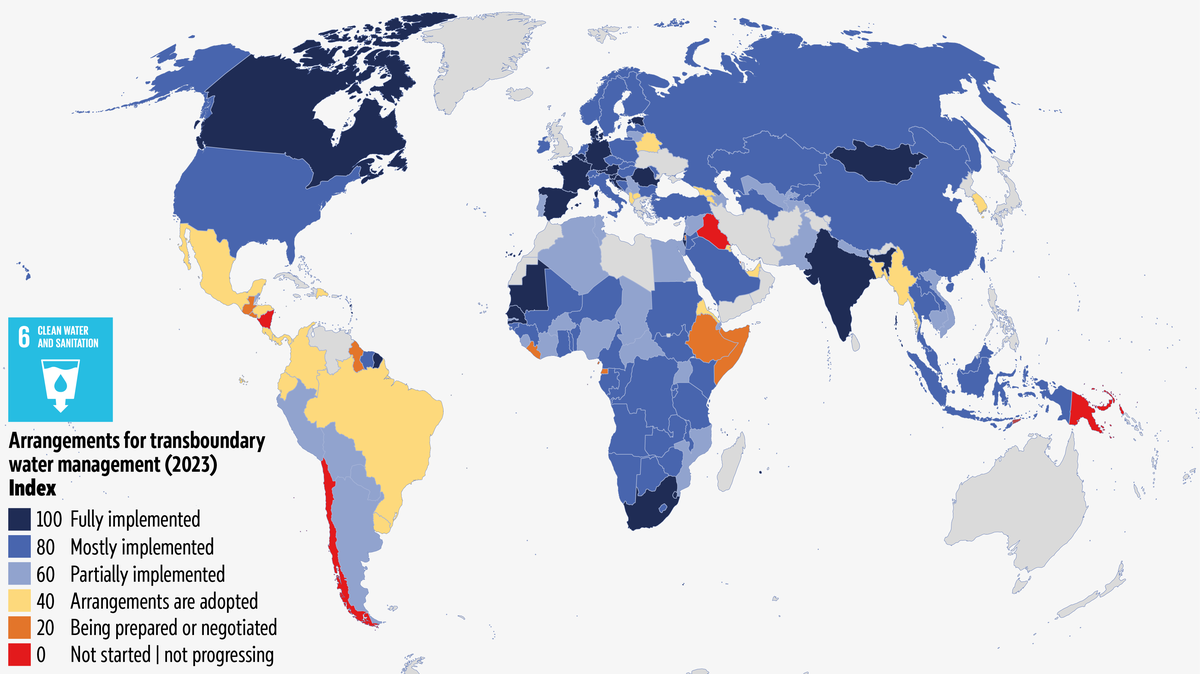
Data source: SDG Indicator 6.5.1, sub-question 1.2 c (country self-assessment), IWRM Data Portal, accessed 8 April 2026. Map by Samy Chahri, EPRS.
Achieving broader accession to global water conventions such as the 1992 UNECE Water Convention and the 1997 UN Watercourses Convention, as well as the implementation of functioning basin-level transboundary agreements, requires capacity-building efforts and strong diplomatic engagement, in particular in regions already affected by water-related conflict. A further challenge is that the existence of two international legal frameworks4 creates confusion and dispersion of effort, although they are compatible in many aspects; in April 2026, only 29 countries were parties to both conventions. Since 2024, progress has been made with the launch of the UN system-wide strategy for water and sanitation (UN SWS), coordinated by UN-Water. This initiative aims to strengthen coherence across the UN system and support countries in acceding to and implementing water-related conventions through coordinated technical and policy assistance.
An obstacle to effective cooperation is perception of unequal benefits — particularly between upstream and downstream states. Many transboundary river basins have experienced disputes, despite being covered by an agreement or arrangement, as these deals did not envisage the permanent diminution of available safe water. Such 'water scarcity‑induced conflicts' are most often initiated by downstream countries, according to a 2025 article in Nature Communications: tensions typically arise when upstream countries divert water for irrigation or industrial use, or when they alter river flows through dams. The authors of the article note a global trend: since 2017 the number of conflict events exceed cooperation. Other sources also document cases for which existing cooperation agreements have been challenged (see Box 2 below).
Box 2 – Examples of recent water-related disputes
-
In July 2025, China announced the construction of the Great Bend Dam to supply the world's largest hydroelectric plant. In retaliation, India began building a downstream dam; both dams are located near disputed territories on the Yarlung Tsanpo/Brahmaputra River. These projects risk adding to the environmental toll and tensions among the riparian countries and more broadly across South-East Asia, a region where transboundary water cooperation is fragmented and limited (see also the paragraph on the Mekong River in Box 3).
-
In Central Asia, the Amu Darya and Syr Darya rivers account for most water resources in the Aral Sea basin. Since the 1960s, water diversion for irrigation and hydropower is a primary cause of Aral Sea shrinkage. This is compounded by climate change: the volume of water available has dropped from an annual 8 400 m³ per person in the 1980s to 2 500 m³ today and could drop below 1 700 m³ by 2050. The Soviet era water-energy sharing system has only partially been replaced by fragmented and non-binding agreements. Afghanistan's Qosh-Tepa Canal project – expected to be completed in 2028 – is exacerbating tensions with other Amu Darya riparian countries, Uzbekistan, Turkmenistan, and Tajikistan, as it would divert significant volumes of water from the river.
-
In 2025, India suspended implementation of the Indus Waters Treaty (IWT, 1960) which governs the share of water with Pakistan. While this suspension was presented as a retaliation measure against cross-border terrorism, it is also due to India's discontent with its neighbour's unwillingness to renegotiate the treaty to adapt to water depletion due to climate change, and to allow India to develop more hydropower plants. In Pakistan, this has disrupted water supplies in cities such as Lahore and Karachi, hydropowered electricity supplies, and irrigation for a large share of agricultural production. It also makes risk management more difficult as India has stopped sharing data. The suspension of IWT cooperation mechanisms also deprives the two countries of one important, if not the only, channel of structured dialogue which had been sustained even during military conflicts.
-
The Nile river and its two main tributaries, the White Nile and the Blue Nile, flow through 10 countries (Burundi, the Democratic Republic of the Congo, Egypt, Ethiopia, Kenya, Rwanda, South Sudan, Sudan, Tanzania, and Uganda), which cooperate through the Nile Basin Initiative, but have so far failed to implement a cooperative framework agreement (CFA), as Egypt and Sudan refuse to amend a colonial-era treaty (1959) granting them fixed water quotas, ignoring the current impact of climate change on the variability of water availability along the river. Ethiopia's unilateral move to fill and operate the Grand Ethiopian Renaissance Dam (GERD, officially inaugurated on 9 September 2025) on the Blue Nile has further increased tensions between upstream and downstream countries.
-
Since 1964, a treaty between Canada and the USA governs the management of the Columbia River, according to which Canada built and operates dams in exchange for part of the hydropower generated in the USA. It was about to be renewed in 2024, with the participation of indigenous tribes for the first time, but President Donald Trump suspended the negotiations, alleging this treaty was too favourable to Canada. This suspension creates uncertainty for flood prevention, ecosystem preservation and the survival of salmon in the river.
-
In the Middle East and North Africa, desalination to reduce water scarcity and variability can ease pressure on depleted rivers and aquifers, however this can also trigger transboundary disputes over who bears costs and who gains secure access to desalinated water.
-
Water retention or contamination has also been used as a weapon of war. Parties in the US and Israel war against Iran accuse each other of striking desalination plants. Strikes on water infrastructure (such as the Khakovka Dam) in the Russia war against Ukraine have deprived millions of civilians of safe water, and have seriously damaged the environment. Cooperation on water issues between Israel and Palestine has always been difficult and in the current war, 'Israel's deliberate withholding of access to safe drinking water from Palestinians in Gaza' might amount to a crime against humanity, according to several UN experts.
Opportunities: harnessing transboundary water cooperation
The latest Water Convention progress report (see Box 1 above) highlights the need to better demonstrate the benefits of cooperation, including improved dam management, dispute prevention, and ecosystem protection. The success of transboundary water management depends not only on the existence of legal arrangements but also on technical and financial capacity and on the necessity to move beyond fixed water allocation to address 'water bankruptcy' in a more flexible manner. This requires strong governance and political will.
Capacity building and financing
Operational capacity is a decisive factor in translating agreements into effective cooperation. Accession to the Water and Watercourses Conventions can facilitate this. For example, the Water Convention provides an institutional platform for technical support and peer learning. This includes twinning arrangements (such as between Finland and Namibia), and partnership with universities to strengthen water-management skills and develop tools for satellite-based observation, or for early warning on floods and droughts. Complementing this, the UN SDG 6 capacity development initiative allows countries to request tailored support across the UN system to design and implement water governance projects, including cross-border. Despite these efforts, limited public resources and fragmented funding risk undermining transboundary water initiatives. While several international initiatives can help overcome this, complementary approaches are needed:
-
A key constraint for transboundary water projects is to attract private investment, which most often requires demonstrating a credible return on investment. Capacity-building efforts increasingly focus on training national and local authorities to design financially viable projects. However, this logic can be at odds with the principle of water as a common good.
-
International financial mechanisms remain central to funding large-scale water infrastructure by mobilising private and public finance. They include the Global Environment Facility (a financial mechanism for financing the UN Framework Convention on Climate Change (UNFCCC), the Convention on Biological Diversity, and other international conventions for the environment), the Green Climate Fund for mitigation and adaptation projects in developing states, and EU programmes (see below). In fragile contexts, the UN Joint SDG Fund and Peacebuilding Fund target cross-sectoral challenges, including water, sanitation and peacebuilding. The World Bank's CIWA Programme (Cooperation in International Waters in Africa), co-funded by the EU, supports riparian dialogue, conflict prevention, and climate resilience. The World Bank specifically requires that any water-related project in one country be notified to other riparian countries before funding it.
-
The UN-OECD-EU-supported Integrated National Financing Framework (INFF) helps countries integrate water priorities into national budgets, improve revenue collection, and develop investment strategies. This can reduce long-term dependence on external funding.
-
In some transboundary water-management schemes (notably in the Senegal River basin, see Box 3 below) states parties co-finance joint infrastructure based on the benefits they receive, which mitigates struggles between upstream and downstream states.
Adapting to water bankruptcy
Even when IWRM or transboundary water arrangements or agreements exist, the above-mentioned UNU-INWEH report highlights that most of them are inadequate in a context of 'water bankruptcy' as they mostly address the allocation of water as a measurable good and do not sufficiently consider the disruptions of the water cycle due to climate change, polluted soils, depleted wetlands or deforestation. The possible options to address these challenges include, according to a World Resources Institute (WRI) article:
-
Requiring minimum river flow can help limit the over-extraction of surface or groundwater, therefore preventing local population protest.
-
Improving water use efficiency can be achieved by investing in improved infrastructure, irrigation methods or industrial processes (e.g. in Iraq where two thirds of treated municipal water do not reach final users) .
-
However, such improvement can lead to an increase in total water consumption – a phenomenon known as the 'Jevons paradox': for example because a lower cost of water leads farmers to expand cultivated areas, or the increasing performance of technologies such as AI models lead to a surge in their usage and water footprint. For this reason, water-management schemes need to prevent increased stress on water through flexible demand caps adapted to a scarcity context.
-
More broadly, transboundary water cooperation will have to anticipate water bankruptcy in integrating it into a 'nexus' approach, to support the adaptation or transition of communities whose livelihood risks being permanently affected.
Political involvement
Technical cooperation is not enough to prevent or resolve water-related conflict. Transboundary water management schemes must embed inclusive participation, transparent sharing of costs and benefits, and allow for dispute resolution. According to a study of various institutional mechanisms, key success factors include:
-
Governance should reconcile competing national interests and reduce political sensitivity, notably with the inclusion of technical experts and civil society, including minority groups.
-
Transparent data-sharing — supported by satellite monitoring and joint information systems — can build trust.
-
To avoid that a transboundary agreement reflects the domination of a 'basin hegemon', a fair and sound dispute resolution mechanism must exist.
While they do not eliminate all causes of tension, several models applying these principles have proven to be comparatively robust (see Box 3).
Box 3 – Some noteworthy transboundary water cooperation agreements
The International Commission for the Protection of the Danube River (ICPDR) coordinates cooperation across 14 countries and the EU, under the Convention for the protection of the Danube. Regular ministerial meetings ensure political coordination, with stakeholder consultation. The ICPDR adopts river basin management plans (RBMPs), updated every six years, with binding commitments on water quality, flood risk, and ecosystem protection. Data-sharing platforms enable evidence-based policymaking and joint monitoring. Strong compliance mechanisms, integration with EU law, and stable financing make it one of the world's widest and most institutionalised transboundary water regimes.
The Mekong River Commission (MRC) brings together Cambodia, Laos, Thailand, and Vietnam, with China and Myanmar as 'dialogue partners'. The Agreement on the Cooperation for the Sustainable Development of the Mekong River Basin promotes equitable and sustainable water use. The MRC provides technical coordination, data-sharing, and basin planning, including procedures for notification and consultation on infrastructure projects such as dams. Hydrological modelling and climate impact assessment supports national decision-making. However, its effectiveness is constrained by limited enforcement powers and the absence of key upstream countries as full members, affecting basin-wide coherence. Despite these limitations, the MRC remains a platform for dialogue and conflict prevention.
The Southern African Development Community Protocol on Shared Watercourses provides a strong legal and institutional framework, which comprises River Basin Authorities (RBAs), managing specific infrastructures, and River Basin Organisations (RBOs), tasked with basin-wide coordination. RBOs produce annual progress reports subject to peer review. Political accountability is notably anchored by the Committee of Water Ministers. SADC transboundary water cooperation mechanisms reportedly help 'to curb conflicts way upstream before they became a regional concern'.
The Organisation pour la mise en valeur du fleuve Sénégal (OMVS, Senegal River basin organisation) brings together Guinea, Mali, Mauritania, and Senegal. Member states recognise the Senegal River as an international watercourse and jointly own core infrastructure. Costs are shared according to the benefits derived from irrigation, hydropower, and navigation. Decision-making is centralised in a Council of Ministers and supported by consultative bodies, including the Permanent Water Commission (administrative level) and the River Basin Committee (stakeholder level). Dedicated agencies ensure operational management. While the OMVS is often hailed as a success story, it has recently been challenged by upstream states like Guinea and Mali who have questioned the cost/benefit ratio of their participation and planned to build dams without consulting the Organisation.
The Niger Basin Authority (NBA, bringing together Benin, Burkina Faso, Cameroon, Chad, Côte d'Ivoire, Guinea, Mali, Niger, and Nigeria) coordinates water management projects in the Niger Basin. The binding Water Charter and NBA guidelines help ensure that investment supports food security and ecosystem sustainability ('water-energy-food-environment nexus'). This integrated approach has enabled coordinated interventions, such as sand dune fixation to protect navigability and irrigation, and dam construction in sites where their environmental and social impact is mitigated. After the coups in Mali, Burkina Faso and Niger, regional isolation and sanctions may have strained the functioning of the NBA.However, while the three states withdrew from ECOWAS, the regional community, they did not officially withdraw from the NBA.
The Lake Chad Basin Commission (LCBC) has expanded its mandate beyond water management to address cross-border security dynamics. It works in coordination with the Multinational Joint Task Force (MNJTF, a regional military force), linking water governance with military and humanitarian responses in an area where limited access to water contributes to strained relations between three million displaced people and the host communities. The Lake Chad Water Charter requires that the needs of women, young people, and vulnerable populations be systematically integrated into decision-making processes. Most inter-state conflicts over water access have been settled legally, however the management of transboundary waters by the LCBC is complicated as the basin has become a stronghold for Boko Haram and other insurgent armed groups.
EU water diplomacy
The EU has positioned itself as a global leader in water diplomacy. In 2002, it launched regional EU Water Initiatives (EUWI) to assist third countries to develop sustainable water management strategies. However, the initiative was discontinued in 2016 due to lack of funding and involvement of partners. Since then, water-related actions have been integrated into broader EU external policies and are more country-specific and intertwined with development cooperation, trade, humanitarian assistance, human rights, and security.
The EU highlights that water is a fundamental human right, and commits to ensuring fair and affordable access to safe water and sanitation for all, based on the AAAQ criteria (Availability, Accessibility, Affordability, cultural Acceptability, and Quality).This commitment includes empowering women, young people, and local communities through their participation in water management mechanisms and protecting environmental human rights defenders. Recognising that 'Water scarcity has the potential to affect peace and security', several Council Conclusions (19 November 2018, 19 November 2021, 9 March 2023) commit the EU 'to engage for the long term in fostering cooperative approaches to address the transboundary challenges of water'. The EU promotes a multilateral approach and universal accession to the Water Convention and the Watercourses Convention. It encourages riparian countries to develop shared arrangements and dedicated basin institutions.
In the field, the EU takes a 'nexus' approach, recognising the interdependence of water, energy, food and ecosystems (WEFE) and the need to manage trade-offs between them. These objectives are generally supported by 'Team Europe initiatives' that mobilise EU and Member States' grants and loans, private finance, research, and technical assistance. The Team Europe Initiative on Transboundary Water Management in Africa (TEI-TWM) and other transboundary water cooperation initiatives aim to strengthen coordination between river basin organisations, mobilise investment, and promote conflict-sensitive IWRM. The EU also supports the Union for the Mediterranean Water Agenda and its WEFE nexus approach. The 2025 EU water resilience strategy, although mainly aimed at improving water management within the EU, reaffirms its international commitment to 'promote water resilience through the Global Gateway' and to 'step up engagement in the Union for [the] Mediterranean.'
Box 4 – For an EU Blue Deal
The European Economic and Social Committee (EESC) urges the EU to address water-related security risks. External aspects are an essential part of its October 2023 Declaration for an EU Blue Deal, where it calls on the EU 'to increase its efforts on blue diplomacy' and stresses the importance of developing 'international policies to promote the sparing and efficient use of water in all sectors of the economy and society'. In December 2024, the EESC released an opinion focusing on the role of vulnerable groups in sustainable water management. It calls on the EU to systematically involve these groups and take human rights, indigenous rights and gender equality into account within water management contexts.
European Parliament position
The European Parliament considers transboundary water cooperation a strategic priority for international peace, security, and sustainable development. In calls for stronger enforcement mechanisms and condemns water weaponisation, notably in its2022 resolution on access to water as a human right , where it also emphasises IWRM for humanitarian and peacebuilding goals. In its 7 May 2025 resolution on the European water resilience strategy, Parliament urges deeper cooperation at EU and global levels, notably through digital monitoring tools, and for the EU to lead global efforts to protect and restore water ecosystems in line with SDG 6. It also calls for an EU special representative ('a dedicated EU diplomatic role') to address water‑related conflicts and promote cooperation in transboundary basins.
The Committee on Foreign Affairs (AFET) has prepared a 'recommendation to the Council, the Commission and the Vice-President of the Commission/High Representative of the Union on Foreign Affairs and Security Policy on promoting transnational governance on water in the interests of conflict prevention and peace' (rapporteur: Leoluca Orlando, Greens/EFA, Italy), with an opinion from the Committee on Development (rapporteur for opinion: György Hölvényi, PfE, Hungary). The report should be discussed and put to vote during the June 2026 plenary session. Recalling that access to water is a human right at stake, it recommends that Parliament condemn the weaponisation of water in conflicts (explicitly mentioning the destruction of the Kakhovka Dam); and that it reiterate its calls to:
-
develop the European External Action Service's capacity to lead EU water diplomacy action. This would include the appointment of an EU special representative for water, with deeper cooperation with the UN Special Envoy on Water;
-
provide predictable and increased funding for transboundary water management, while ensuring that funded projects do not exacerbate regional tensions;
-
lead on advancing SDG 6; enhancing monitoring and early warning systems, promoting research on water-related risks;
-
reinforce the international framework for transboundary water resources;
-
strengthen international accountability mechanisms, and prosecution of environmental war crimes targeting water infrastructure.
Main references
- This briefing complements and updates the section on the EU's role in promoting SDG 6 abroad, in Halleux, V. and Pichon, E., UN Sustainable Development Goal 6 on clean water and sanitation (SDG 6): EU support through focused action, EPRS, European Parliament, 2023.
- Madani, K., Global water bankruptcy: Living beyond our hydrological means in the post-crisis era, United Nations University Institute for Water, Environment and Health (UNU-INWEH), 2026.
- United Nations Economic Commission for Europe, Progress on transboundary water cooperation under the Water Convention: Third report on implementation of the Convention on the Protection and Use of Transboundary Watercourses and International Lakes 2020–2023, UNECE, 2024.
Endnotes
Classification
Policy areas: Development and Humanitarian Aid | Foreign Affairs
Committees: Development (DEVE)
Statement on the use of AI
Any AI-generated content in this text has been reviewed by the author. Perplexity, Consensus and NotebookLM were used to broaden and explore the range of sources available to the author.
Disclaimer
This document is prepared for, and addressed to, the Members and staff of the European Parliament as background material to assist them in their parliamentary work. The content of the document is the sole responsibility of its author(s) and any opinions expressed herein should not be taken to represent an official position of the Parliament.
Copyright
© European Union.
The reuse of this document is authorised under a Creative Commons Attribution 4.0 International (CC-BY 4.0) licence.

https://creativecommons.org/licenses/by/4.0/deed.en
To use or reproduce elements that are not owned by the European Union, permission may need to be sought directly from the respective rightsholders.