
Article page checkbox is not checked in page info.
Islands in the EU: Exploring the potential of insular territories
Islands in the EU Exploring the potential of insular territories
Vasilis Margaras, Members' Research Service

Summary
Several EU countries possess islands and insular territories. Various EU islands constitute world famous tourist destinations as they are home to considerable natural, heritage and cultural wealth. Certain islands also produce renowned agricultural products and handcrafts. However, islands also face considerable challenges. They struggle for adequate transport links with the nearest mainland. Their ecosystems are vulnerable, and natural resources are often scarce. Some of them are small and mountainous. Many are located on the periphery of a Member State, or constitute border regions, placing considerable limitations on their potential for economic growth. Islands are usually too small to allow economies of scale. They may lack human capital and possess limited public resources in health, education, research and innovation.
In most cases, islands are not self-sufficient in agricultural and industrial products or tertiary-sector services. They are usually reliant on imported fossil fuels and dependent on mainland energy networks. As most products and services are transported to islands, prices are usually considerably higher, adding to the cost of living in insular territories. In recent years, the EU's southern islands have seen an influx of migrants, whilst lacking the resources needed for their accommodation and integration.
However, although the state of insularity creates many problems, various studies suggest that islands can become 'lands of opportunities' by investing in their relative strengths. Solar, sea and wind energy opportunities can be explored to create sustainable energy communities. Tourism, agriculture and fisheries, as well as the high quality of life that many EU islands offer, in combination with the digitalisation of work bring more opportunities for their growth. Recent geopolitical uncertainties have also elevated the strategic role of islands, as many of them are based in strategic locations and host important military bases.
The European Commission has declared that it will present in the near future a strategy on islands and coastal territories, as well as an updated strategy on outermost regions, which include insular territories.
Eurostat definition
According to Eurostat, island regions are NUTS level 3 regions (small regions) that are entirely composed of one or more islands. In this context, islands are defined as territories having
-
a minimum surface area of 1 km²
-
a minimum distance between the island and the mainland of 1 km
-
a resident population of more than 50 inhabitants
-
no fixed link (for example, a bridge, a tunnel, or a dyke) between the island(s) and the mainland.
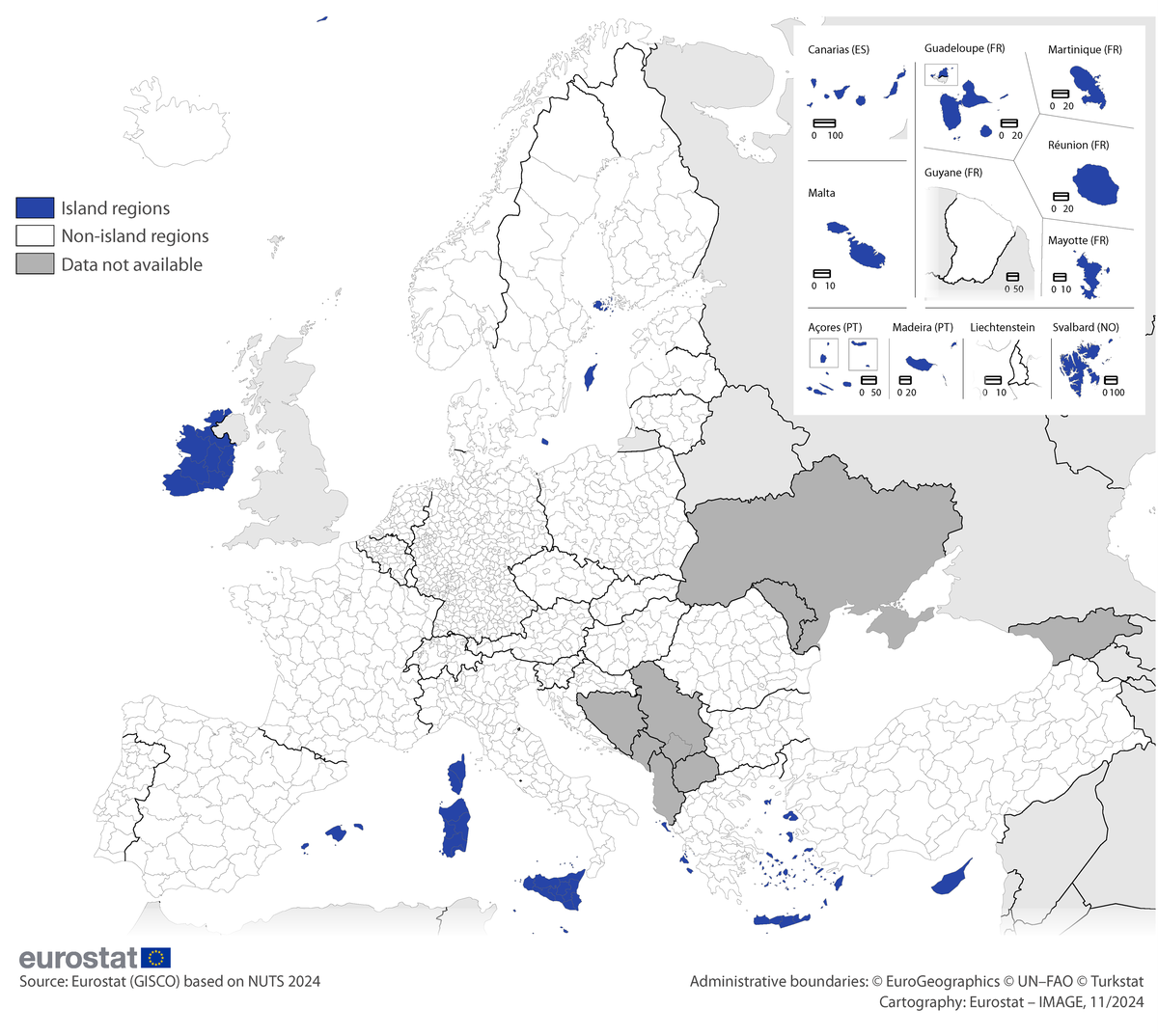
Source: Eurostat, 2024.
NUTS level 3 island regions may correspond to a single island or may be composed of several islands. Furthermore, an island region may be part of a bigger island that contains more than one NUTS level 3 region: for example, the regions within Ireland, Corsica, Sardinia, Sicily and Crete. The definition of an island region is such that it must be entirely composed of islands.
There are many examples of islands in the EU that form part of a NUTS level 3 region characterised by its islands, but where part of the territory also contains mainland areas and where, as a result, the region is classified as a non-island region (e.g. coastal areas of Croatia). Based on the above definitions, of the 1 165 NUTS 2024 level 3 regions, there are 58 island regions in the EU.
The typology of island regions may (optionally) be used to distinguish five different subcategories, depending on the size of the major island related to the NUTS level 3 region in question:
-
regions where the major island has < 50 000 inhabitants
-
regions where the major island has 50 000 – < 100 000 inhabitants
-
regions where the major island has 100 000 – < 250 000 inhabitants
-
regions corresponding to an island with 250 000 – < 1 million inhabitants, or regions that form part of such an island
-
regions that form part of an island with ≥ 1 million inhabitants.
As the European Commission is preparing a strategy that may include islands and coastal areas, it is also important to mention that Eurostat defines coastal areas as local administrative units (LAUs) bordering or close to a coastline. A coastline is defined as the line where land and water surfaces meet (border each other). Coastal areas are made of LAUs that border the coastline or LAUs that have at least 50 % of their surface area within a distance of 10 km from the coastline.
According to a European Parliament study, based on Eurostat data, in 2020, the European NUTS 3 island regions (thus excluding islands that are part of continental Europe NUTS 3 regions) were home to a total population of over 20.5 million inhabitants, which is 2 % more than the same NUTS 3 regions had in 2016. Island inhabitants in those NUTS 3 island regions represent 4.6 % of the EU's population. Other than this, the study mentions that there is a notable lack of comprehensive, harmonised data on the exact population of all EU islands.
EU legal dimension
Article 174 of the Treaty on the Functioning of the European Union (TFEU) recognises the special nature of island territories. The article states that, in order to promote its overall harmonious development, the Union shall develop and pursue its actions leading to the strengthening of its economic, social and territorial cohesion. In particular, the Union shall aim at reducing disparities between the levels of development of the various regions and the backwardness of the least favoured regions. Among the regions concerned, particular attention shall be paid to rural areas, areas affected by industrial transition, and regions which suffer from severe and permanent natural or demographic handicaps such as the northernmost regions with very low population density and island, cross-border and mountain regions.
In addition, Article 349 TFEU also provides special support measures for the EU outermost regions, some of which are also considered island regions. Article 170 regarding Trans-European Networks also states that EU actions shall take account of the need to link island, landlocked and peripheral regions with the central regions of the Union. However, there are no specific policies aimed at inclusively addressing insular issues.
Problems stemming from insularity
The EU's islands are far from being a single homogenous category. They have differing sizes, populations and levels of economic growth. Nevertheless, there are a number of common issues that affect most islands to a considerable degree.
Economic stagnation
According to the 9th European Commission Cohesion report, rural, mountainous, island, and sparsely populated areas continue to face specific challenges that hinder economic growth and development, stemming from lower physical and digital connectivity or limited education and training opportunities. The report states that there is a growing need to reflect better multiple development challenges, reform needs and differing social and employment circumstances to facilitate more efficient programming of EU funds in outermost, sparsely populated islands, mountainous, border regions, rural areas and areas affected by industrial transition and beyond.
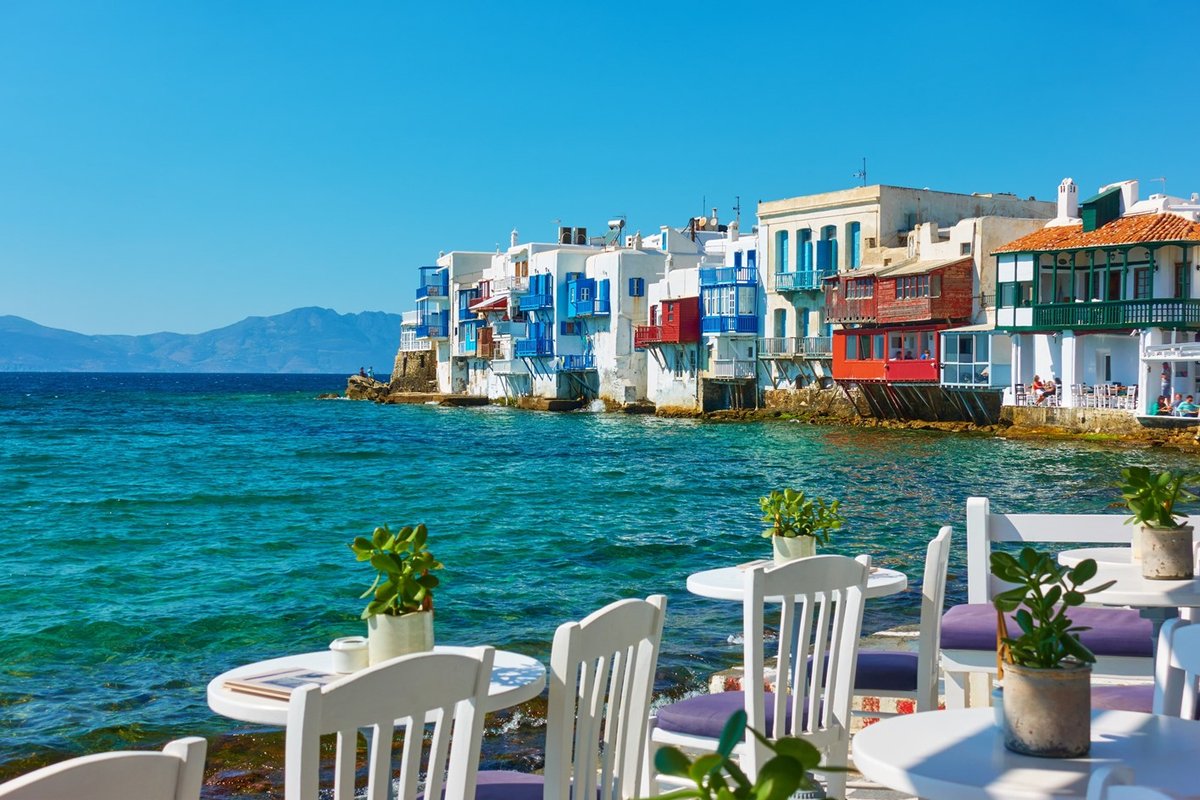
Case study: Region of the South Aegean
Source: © Roman Sigaev / Adobe Stock.
The region possesses important cultural and heritage spots but faces a number of environmental challenges that constitute a threat to its picturesque scenery. In many areas sufficient water, sewage and road infrastructure is still lacking. Air and maritime transport are of vital importance to the connectivity of the islands but are characterised by considerable limitations. Furthermore, for some islands, transport connectivity is considerably limited in the winter months. Each island possesses its own agricultural products, handcrafts and culinary specialities and cultural spots. However, the sectors of agriculture and fisheries are under pressure from climate change and depleted fishing stocks. Furthermore, health, education and welfare provisions are not adequately funded with parts of the population having to travel to mainland Greece in order to cover their needs. Heavily reliance on tourism is an opportunity but also characterised by risks, especially in times of geopolitical/economic tensions. Economic diversification activities could have further benefited the local economies.
The region of the South Aegean in Greece is a border region which constitutes a popular EU tourist destination. According to Eurostat, it is one of the top ten most popular destinations in foreign tourism. It includes a number of islands with very diverse profiles and needs. The region was one in only two in Greece to grow in population between 2011 and 2021, (with a population increase of 5 %). Tourism provided a number of job opportunities in times of economic crisis for the country. Still, not all of its islands have experienced population growth, with some of its smallest islands also suffering demographic losses. Although GDP growth is one of the highest in Greece, there is a considerable difference between heavily touristic islands and the rest of them. The archipelago also contains a number of uninhabited islands which contain important archaeological spots and important marine and biodiversity environments. However, tourism is a fragile industry: the travel restrictions of the COVID-19 pandemic dealt a big blow to the region leading to considerable income loss during the years of the epidemic.
The report also states that in all island regions apart from Ireland, GDP per head declined slightly in real terms over the 20-year period, especially after 2008, which clearly reflects structural weaknesses. GDP per head in the outermost regions was also less than the EU average after 2008. Dividing the period before and after the COVID-19 pandemic, i.e. 2009-2019 and 2020-2021, growth of GDP per head was above the EU average in both sub-periods in external border regions and island regions. The latter, however, is because of Ireland. In the other island regions, GDP per head fell in both the years before the pandemic and the years after (by 2.7 % between 2019 and 2021). The outermost regions were the most affected by GDP loss.
Transport-related issues
In order to maintain appropriate scheduled air services on routes which are vital for the economic development of the region they serve, Member States may impose public service obligations (PSOs) on certain chosen routes. Still, even with the help of PSOs, transport and lack of frequent and reliable connections with other territories – whether to neighbouring islands or mainland cities – constitute a major problem for insular territories. Accessibility to many EU islands is problematic and can be characterised by infrequent, and often expensive, transport. Islands are dependent on maritime and air transport to connect to the mainland. In certain cases, bad weather conditions may hamper connectivity thus creating a number of problems. Human transport, as well as the transport of products and services, to and from islands imposes additional costs upon the economic activity of insular territories. Islands may also constitute border areas, being located at the periphery of the Member State to which they belong. This geographical position exacerbates difficulties in the transfer of goods and people.
Fragile environment
Islands may have unique natural features, but their ecosystems are also fragile. They may also be mountainous with limited arable land. Islands are vulnerable to drought, rising sea levels and land erosion, climate change and extreme weather-related events. For many islands, fresh water is scarce, and the influx of tourists can further exacerbate problems relating to waste and wastewater management. Many islands have to import water or resort to costly desalination infrastructure. In certain cases, overtourism puts a strain on the use of land that is used to support the tourist recreational economy. In addition, many islands remain largely dependent on the mainland for supplies of expensive fossil fuels. Various islands still lack the infrastructure to exploit the potential of renewable energy resources. The goal of becoming energy efficient or ecologically self-sustaining through wind, tidal and solar power remains unfulfilled for many.
Monoculture economies - Inadequate services
The economies of the islands are oriented towards the primary and tertiary sectors, and hyper-specialisation weakens the economic fabric by making it more vulnerable to economic downturns and crises. Certain insular economies specialise in just one or a few economic fields (e.g. tourism) which may also have a seasonal character, or have limited economic activity due to their small size. This is especially the case with very small islands. Therefore, diversification of the economy towards other – particularly non-tourism-related – activities is needed. Most islands do not possess vibrant urban cities and therefore cannot benefit from urban financial spill-over like mainland rural areas. Due to their size, resources and the high cost of transport, islands cannot develop economies of scale as mainland territories do. Research and innovation opportunities are also limited as islands usually lack big universities or extended research and innovation clusters. The limited use of new information and communications technologies (ICTs) and low broadband coverage due to meagre financial incentives for operators also constitute important problems. Furthermore, declining fishing stocks, climate change, and small and dispersed agricultural land set limits to the profitability of the agri-fish sector. Agriculture on islands is hampered by their remote location, the small size of holdings, low diversity of production, dependence on local markets, and – in some cases – climate conditions. Furthermore, agricultural activity remains dependent on the supply of raw materials and lacks easy access to mainland markets.
The 2009 European debt crisis that affected Mediterranean countries, as well as the COVID-19 pandemic, had a severe impact on services of general interest (SGIs) on islands in the region, which were already limited prior to the crisis, and became considerably reduced. SGIs are not fully developed in many EU island territories, thus causing major difficulties in various aspects of everyday life. For instance, in many insular territories, health provisions, social care for the elderly and other related social provisions may be limited.
Demography and immigration
Demographic decline affects the least developed islands, which suffer from ageing populations, since younger members of society prefer to migrate to the mainland in search of better job prospects. On the other hand, islands with stronger economies have managed to reverse this trend, to maintain a younger population and attract out-of-island workers. Nevertheless, in most insular territories, professional opportunities remain limited and confined to specific fields (e.g. tourism, agri-fish sector). Seasonality of work especially in tourism further limits full-time employment prospects of the local population.
In certain cases where large numbers of migrants have recently arrived on island territories, (sometimes even far outnumbering the local population), islands are not always in a position to supply the necessary means of accommodation and assistance. Many islands are recipients of migrants; for instance, this has been the case of many Mediterranean islands (e.g. Aegean Islands, Crete, Cyprus, Lampedusa or outermost regions islands (e.g. Canary Islands, Mayotte).
High unemployment levels – Lack of professional development
The issue of seasonal employment is evident in many islands. Economic activity slows considerably during the low season and many seasonal businesses close, rendering a large number of people unemployed. Fisheries and agriculture are also stagnating in many insular areas due to low fish stocks and unprofitable land exploitation. Unfortunately, as certain islands are relatively small or possess fragile economies, they cannot always maintain their human capital, and lack expertise in new emerging fields such as ICT and green technologies. Furthermore, life-long learning opportunities which contribute to professional diversification are not easily accessible for insular populations.
Lack of a targeted framework of financial support for islands
Various island associations have claimed that islands are punished by the EU system of funding which allocates some EU funds to regions, according to their GDP level, in three main categories: less developed regions, transition regions and more developed regions. They suggest that this GDP-based classification places islands in the same categories as mainland regions that are privileged geographically. The focus of some EU funds allocation systems based on regional GDP levels – to the detriment of other indicators that, if considered, would show a more complete picture of the specific challenges of insular life – constitutes a further issue for insular territories. In addition, there are islands that are grouped in larger, non-homogenous regions that may include mainland areas, urban conurbations or diverging categories of islands. These divergent entities may elevate the GDP of the region, thus attributing it the status of 'transition' or 'more developed' region. Even within an archipelago that may be categorised as a more developed region, the majority of the islands might have the needs of a 'less developed region', and thus lose out on considerable EU funding aimed at, for instance, improving basic infrastructure. Furthermore, in an archipelago, wealth and economic growth cannot have the same 'spillover' effect as is the case with a mainland territory and urban areas.
Although there has been a European Strategy for the outermost regions and islands are mentioned in some macroregional strategies, there has been no common European strategy for insular areas in the past. Various regional leaders from insular territories and their lobbies have argued in the past that few concrete EU measures have aimed to directly support islands to date. Several insular regions and municipalities call for the development of an 'insular dimension' in EU policies, and for EU regional policy to take insularity factors, that affect them disproportionately, into account. Due to their small populations, an increase in EU funding for insular territories would have only a small impact on the total EU budget, but this minimal increase of funding would provide a significant boost to insular territories. Furthermore, 'insular mainstreaming' – that is, the setting of special provisions on how EU programmes and policies are developed for insular territories – is a demand expressed by local policy-makers.
Additional cost of insularity
A number of studies also raise the issue of the additional cost of insularity to the economy due to the high transport costs of imported products and services. A 2026 report documents the 'cost of insularity' using evidence from Croatia, Greece and Sweden, where transport costs can exceed mainland benchmarks by over 300 % in some cases, local government expenditure per capita can be 30-50 % higher, and housing prices can be 75-130 % higher in some island municipalities. It proposes methodological tools to measure these costs, improve data quality and enable more targeted fiscal, infrastructure and connectivity policies.
European Parliament
The European Parliament has been supportive of insular-friendly policies. Islands' priorities are reflected in many different opinions and legislative files, in particular when it comes to the work of the Committee on Regional Development (REGI).
In its 2022 resolution on islands and cohesion policy, Parliament recognises insularity as a permanent structural handicap, which makes it necessary to establish integration strategies that enable islands to face the challenges and overcome the obstacles specific to insularity. It calls on the European Commission to carry out a study on the diverse situations of island territories and to consider a strategy for islands with tangible proposals. The COVID-19 crisis, in addition to Brexit, had a severe impact on the islands of the European Union, whose economies are inherently vulnerable because of their insularity and other permanent structural challenges. Tourism has been one of the most fragile sectors, and the islands' growing hyper-specialisation in tourism needs to be counterbalanced by the development of other activities in the primary and secondary sectors and other service activities, including those related to the digital sector. The EU islands are also on the frontline of climate change, particularly with rising water levels and coastal erosion, and the warming and acidification of seas and oceans posing huge risks to population centres and to marine and terrestrial biodiversity.
Furthermore, islands are more exposed and vulnerable to natural disasters, such as volcanic eruptions, forest fires and cyclones. The resolution calls for a better response to the challenges faced by EU islands, whether demographic, economic or environmental. In addition, it calls for the implementation of a European strategy for islands, and for EU policies to take account of the specific characteristics of islands and of their sea basins through better management and collection of statistical information or a revision of the regional State aid scheme. It also supports the creation of an Islands Pact, modelled on the Urban Pact, with a view to defining a common EU policy on island matters.
It insists, inter alia, on points such as implementing regional policies, and targeted and sustainable measures to strengthen the capacity of islands to protect and restore their unique biodiversity, to promote a blue economy geared towards sustainable tourism and fisheries, and to support seabed research. It suggests the mobilisation of additional funding to provide better support for island regions in access to and management of water and to adopt a common water management policy for islands. It asks for the implementation of specific rules and financial support to help islands achieve climate neutrality goals and support the development of a wide range of renewable energy sources.
It calls for the need to adopt a regulation providing for specific measures in the field of agriculture in order to achieve food self-sufficiency and increase the competitiveness of their production, and to provide increased support for sustainable island development, agriculture, forest management and conservation, livestock, aquaculture, sustainable fisheries, local production and the blue economy, including through European cooperation programmes. It also mentions the provision of additional specific financial support for sustainable tourism in the islands in order to address the problem of seasonal tourism and resources for employment opportunities in regions threatened by depopulation. It claims that resources should be allocated to transport infrastructure in the islands, to prioritise increased investment in basic infrastructure to improve access to clean water and sanitation and for closing the digital skills gap. It also seeks coordinated solutions at European level that respect people's well-being and dignity while addressing the migratory pressure faced by some islands.
The 2023 resolution on the assessment of the European Commission communication on outermost regions recognises cohesion policy's role in unlocking the potential of the outermost regions, but also the permanent structural constraints they face, as well as the particular impact of the pandemic on their economies. It puts forward proposals for creating new EU programmes exclusively for the outermost regions (on fisheries, transport, energy and digital) following the POSEI agricultural scheme, a separate budget for them within the Connecting Europe Facility and a higher budget for POSEI agriculture. The text also suggested many new actions for the outermost regions (e.g. in the area of social policy, in particular the creation of 'employment-focused areas' and actions focused on young people), as well as new pilot projects (on tourism, culture, renewable energy, blue economy and training). It also calls for adapting EU legislation for the outermost regions (fishing fleet, State aid and plant protection), for taking the outermost regions into account in all EU initiatives and for developing a dedicated action plan to implement the outermost regions strategy.
In its 2025 resolution on the ninth report on economic and social cohesion, Parliament recognises the importance of supporting and financing specific solutions for regions with long-standing and serious economic difficulties or severe permanent natural and demographic handicaps. It reiterates the need for maintaining and improving the provision of quality essential services (such as education and healthcare), transport and digital connectivity of these regions, fostering their economic diversification and job creation, and helping them respond to challenges such as rural desertification, population ageing, poverty, depopulation, loneliness and isolation, as well as the lack of opportunities for vulnerable people such as individuals with disabilities. It underlines the need to prioritise the development and adequate funding of strategic sectors, such as renewable energy, sustainable tourism, digital innovation and infrastructure, in a manner that is tailored to the economic potential and resources of each region, in order to create broader conditions for endogenous growth and balanced development across all regions, especially rural, remote and less-developed areas, border regions, islands and outermost regions.
On 15 July 2025, the European Parliament Committee on Regional Development also organised a hearing on enhancing Cohesion Policy for Outermost Regions and Islands: Navigating Challenges and Seizing Opportunities Post-2027.
The European Parliament Intergroup on seas, rivers, islands and coastal areas is an informal grouping of Members, established to address the issue of insularity, and is active on maritime, coastal and waterway-related matters. It has also been active on issues related to issues that EU islands are facing as well as to ways to support their further development.
A European Parliament study on islands in the EU made a number of recommendations on EU priorities on islands, covering many areas such as economic development, transport, environment, public services and how EU policies can further boost the prospects of islands. In terms of economic resilience, the study suggests the further development of sustainable blue economy sectors such as marine renewable energy, aquaculture and blue biotechnology. The study also supports the development of circular economy practices and sustainable tourism practices. Boosting the development of upskilling facilities and jobs for the island inhabitants is another area of suggested action. Pilot projects can be of added value as islands can be an experimental 'probing and learning' environment which could attract young, innovative and entrepreneurial people and activities. The key challenge for islands should be to promote the development of clusters and smart specialisation strategies, while also supporting the niche activities in culture, e‑services and food production as well as non-seasonal tourism. Networks of innovation between islands can be part of the solution to address this challenge.
The study also claims that services of general interest are not fully developed and that it is important to allow policies that make it possible to design and implement tailor-made solutions for such services, taking into account local and regional specificities. Adequate policy responses to avoid a progressive depopulation of insular areas need to be drafted. It is important for islands to strengthen the provision of public services, especially in the healthcare sector. Sustainable transport for insular countries and regions which can help the transition from short-sea shipping and short haul aviation towards green and affordable means, while satisfying the needs of islands is seen as another point for policy action. The improvement of port infrastructure and development of safe, time-saving and fuel-efficient routes for the transportation of passengers and goods is also listed as a policy priority as well as access to high-quality broadband.
It is also mentioned that most insular territories still need to invest in basic infrastructure – such as roads, water supply and waste management facilities. In the future, islands will have to be more resilient, and they should have sufficient resources to better cope with situations such as natural disasters and health crises. Inter alia, islands should develop sustainable, less seasonal and more diversified economies. Specific efforts should be made to address the greater vulnerability of islands to the impacts of climate change. Opportunities for innovative projects on the conservation of heritage are envisaged and climate efforts can be part of a greener economy. Special attention should be given to islands in the national energy and climate plans regarding their decarbonisation. A strengthened response in case of extreme weather events should also be planned. When it comes to the EU level, the study suggests the development of EU policies that better suit the situation of insular territories, by ensuring that their specificity is consistently taken into account. This can take the form of financial instruments and integrated strategies dedicated to islands. The creation of dedicated macro-regional strategies and macro-regional cooperation for islands, as well as the collection of scientific data and support for islands, is also mentioned.
The views of advisory bodies and stakeholders
In its 2022 opinion on enhancing cohesion policy support for regions with geographic and demographic handicaps, the European Committee of the Regions (CoR) insists that, though EU Cohesion Policy has a key role to play in enforcing Article 174 TFEU, this mandate is binding on all other EU policies (in particular the European Green Deal and the Digital Agenda), which must not undermine the goal of territorial cohesion between these territories. It proposes that each Member State provides basic public services in Article 174 areas, in line with the European Social Pillar and the Charter of Fundamental Rights. The provisions of the Protocol on services of general interest should be taken into account in particular in this regard, for example the broad discretion of national, regional and local authorities in organising services, the promotion of universal access, and so on. The provision of effective and sustainable cross border public services should be systematically explored. It calls for post-2027 cohesion policy to include specific EU-level regional targeting and earmarking for regions with areas mentioned in Article 174, with a minimum aid threshold in partnership agreements. Potentially, this should also comprise other policies in the EU budget that have a territorial dimension, including any successor to Next Generation EU. It strongly welcomes the European Parliament's proposal asking the European Commission to draw up an 'EU Strategy for Islands' with an action plan to encourage growth and innovation in a sustainable way, protecting the environment and people living on islands, as well as an 'Islands Pact' to involve all actors via a multilevel, cross-sectoral approach.
With the re-launch of the CoR Insular Regions Interregional Group in July 2025, island representatives from across the European Union are coming together to tackle the unique challenges of insularity and demand tailored solutions in areas such as transport, climate action, and economic development. At a pivotal moment for Europe, with the start of negotiations on the post-2027 long-term budget of the EU, this group is set to drive concrete, collective action to build a fairer, more coherent Europe that truly reflects the realities of island territories.
In its 2026 opinion on the island dimension in European cohesion, competitiveness and sustainable development policies, the European Economic and Social Committee (EESC) believes that EU islands face persistent structural disadvantages but is of the view that islands are essential for the EU's geopolitical positioning, migration management, maritime security and energy transition. Their marine ecosystems and exclusive economic zones (EEZs) underpin the Blue Economy and biodiversity objectives. It mentions that despite recognition in the EU Treaties and political statements, islands' unique challenges are not adequately addressed in the EU's sectoral policies. Islands have the potential to be laboratories of innovation and sustainability, demonstrating solutions for climate adaptation, renewable energy, marine conservation and sustainable tourism. Effective EU policy for islands and island territories in general (including outermost regions and lake regions) requires integrated, cross-sectoral strategies addressing connectivity, economic diversification, social cohesion, ecological, social and economic resilience, and geopolitical readiness. It states that there are clear policy gaps and implementation deficits. It calls for the establishment of a dedicated EU strategy for islands (Islands Pact), supported by a specific legislative framework (Islands Act). That framework should be accompanied by a formal strategy and provide for the effective implementation of an 'insularity clause', with a view to systematically integrating the specific needs and constraints of islands into Union policies on cohesion, transport, energy, State aid, the environment and maritime affairs. It calls for the formal integration of monitoring, foresight and participatory governance into island policies, proposing a regular island implementation report to track key demographic, economic, social and environmental indicators. The opinion makes a number of suggestions regarding social and human capital, improving transport and connectivity as well as addressing housing, labour skills, migration and environmental issues.
In its position paper, Towards an EU Strategy for Islands, the Islands Commission of the Conference of Peripheral and Maritime Regions (CPMR) states that island-specific considerations have rarely been integrated in a consistent and structured way across EU policy frameworks. Structural constraints of islands are still insufficiently reflected in EU legislation and funding mechanisms. Islands remain disproportionately affected by the lack of tailored frameworks. For instance, EU State aid rules lack the flexibility needed to reflect the structural vulnerabilities and higher operating costs faced by island territories. This limits their ability to support essential services, sustain local businesses, and remain competitive. Islands should be included among the list of areas/situations where aid may be authorised under Article 107 TFEU. The strategy should lay the foundations for a tailored approach across EU policy and funds, notably through the integration of an 'island-proofing' mechanism. The persistent lack of reliable, disaggregated and interoperable data on islands must be addressed as a matter of priority.
The paper states that EU transport and connectivity policies do not adequately account for the structural dependence of island territories on a limited number of air and maritime transport means. Ensuring connectivity requires investments in sustainable transport infrastructure, complemented by more flexible State aid rules to support year-round services. Transport connectivity is affected by the impact of EU decarbonisation policies, which often lead to higher transport costs. It is essential to develop transitional and compensatory measures that enable island regions to remain accessible and economically viable while progressing towards climate objectives. EU funding instruments should better reflect the specific territorial challenges of island territories. The new strategy for islands could lead to the development of a dedicated Islands Pact, inspired by the existing Urban Pact and Rural Pact. Supporting the diversification of island economies is also critical, with targeted investment in the blue economy, sustainable coastal and maritime tourism, research, innovation and smart specialisation. The upcoming strategy should support measures that improve living conditions, facilitate skills development, and help territories attract and retain talent.
Environmental sustainability requires dedicated attention to the islands' energy security, many of which still rely heavily on imported fossil fuels. At the same time, islands have the potential to act as frontrunners in the deployment of renewable energy. Targeted support for climate risks preparedness, adaptation and mitigation measures is needed. The forthcoming strategy should be embedded within the broader evolution of EU policy frameworks. Insular recognition must be translated into synergies, particularly in relation to marine biodiversity, coastal and marine protection, as well as the strengthening of adapted circular and blue economy for islands that secures 'the freedom to stay'. It should also provide for close linkages with the development of the upcoming EU Sustainable Tourism Strategy. In addition, the parallel launch of the revision of the EU Strategy for the Outermost Regions offers a valuable opportunity to foster complementarity and ensure coherence across EU territorial approaches.
Furthermore, the CPRM Islands Commission position paper also states that strategically located EU islands enhance the Union's geopolitical presence by expanding its maritime security reach, enabling marine research, and unlocking access to marine resources. Their exclusive economic zones (EEZs) significantly enlarge the EU's territorial scope, offering unexplored and unexploited opportunities in seabed mining for rare earths and minerals.
According to an OECD report, a place-based policy framework is recommended to leverage islands' natural and cultural assets, strategic location and community networks. Islands are positioned as innovation laboratories for smart specialisation, digital transformation and skills development, and for advancing green, circular and blue economy transitions, including sustainable tourism that balances economic gains with environmental and social limits. The report concludes with an operational framework for multi-level governance, including island-proofing and implementation tools, addressing fragmented responsibilities, weak coordination, limited capacity, complex funding and insufficient data visibility. Together, these measures provide a roadmap for more coherent, equitable and effective island policy.
EURADA, the European Association of Development Agencies, has recently launched a new working group on insular regions, a platform designed to address the specific needs of island territories in areas such as sustainable development, digital transformation, and economic resilience.
Outlook
On 5 June 2025, the European Commission adopted the European ocean pact. The deterioration of the environment, coupled with the growing demand for maritime space and marine resources, has emphasised the necessity of coherent ocean governance — a goal that the ocean pact aims to achieve. The pact is a non-legislative strategy intended to serve as a unified reference framework for all ocean-related EU policies. Actions and initiatives in this pact are grouped under six priorities: ocean health; a sustainable blue economy; coastal communities and islands; ocean research, skills and literacy; maritime security and defence; and ocean governance. The Commission has also launched an industrial maritime strategy for a competitive, sustainable and resilient EU maritime sector. Its first pillar focuses on reinforcing Europe's maritime manufacturing capabilities and technological leadership to leverage the waterborne single market. The second pillar includes measures to strengthen the competitiveness, sustainability and connectivity of maritime transport whereas the third pillar seeks to bolster Europe's naval, underwater, dual-use and military mobility capabilities to step up security and resilience. The European Commission has also revealed its EU ports strategy aiming at stepping up the competitiveness, resilience, security and environmental sustainability of Europe's ports as well as supporting ports with clear and targeted funding principles aimed at improving the coordination and efficiency of EU financing.
The European Commission has opened a call for evidence for the EU strategy for islands. According to the call, setting up a coordinated policy framework for the development of islands will guide EU action and empower Member States to better steer the programming and implementation of their national policies and EU support. The strategy aims to achieve this through a set of objectives such as strengthening the economic competitiveness and attractiveness of islands by supporting traditional sectors (agriculture, fisheries, tourism) and economic diversification, encouraging innovation and smart specialisation, including in the blue economy, and improving connectivity with islands and with wider markets, both digitally and through transport links. It aims at fostering resilience and sustainability by advancing decarbonisation and strengthening renewable energy systems to reduce energy dependency, promoting circular and resource-efficient practices, including in waste and water management, and improving the capacity of islands to prepare for, adapt to, and mitigate climate-related risks. Another element is to address structural demographic challenges and helping to encourage people to remain in their regions (right to stay), by improving access to affordable housing and public services including education, training and health, as well as supporting cultural heritage and local identity. Furthermore, another aim is to support islands as strategic contributors to the EU's defence and security, including in the areas of energy and transport critical infrastructure, migration and border management, and threat detection and response capabilities. Furthermore, the European Commission has also opened up a call for evidence for the EU coastal communities strategy.
Main references
- Altmayer, A., The Mediterranean fishing area: State of play, EPRS, European Parliament, November 2024.
- Altmayer, A., Fisheries management measures in the Mediterranean: Transposition into EU law, EPRS, European Parliament, October 2024.
- Haase, D. and Maier, A., Research for REGI Committee – Islands of the European Union: State of play and future challenges, Policy Department for Structural and Cohesion Policies, European Parliament, 2021.
- Joint Research Centre (JRC), Drought in the Mediterranean Region, Publications Office of the European Union, 2024.
- Joint Research Centre (JRC), Costs and benefits of coastal adaptation in Europe, Publications Office of the European Union, 2020.
- Maupertuis, M-A., The European Union and its islands as they face today's challenges, Fondation Robert Schuman, July 2025.
- OECD, Policy Pathways Beyond the Shoreline: Enhancing Resilience and Innovation in Island Economies, OECD Rural Studies, 2026.
- Sajn, N., Future of agriculture and the post-2027 CAP, EPRS, European Parliament, June 2025.
- Scholaert, F., The European ocean pact, and an ocean act by 2027, EPRS, European Parliament, June 2025.
Classification
Policy areas: Regional Development
Regions: European Union
Committees: Regional Development (REGI)
Statement on the use of AI
Any AI-generated content in this text has been reviewed by the author(s).
Disclaimer
This document is prepared for, and addressed to, the Members and staff of the European Parliament as background material to assist them in their parliamentary work. The content of the document is the sole responsibility of its author(s) and any opinions expressed herein should not be taken to represent an official position of the Parliament.
Copyright
© European Union.
The reuse of this document is authorised under a Creative Commons Attribution 4.0 International (CC-BY 4.0) licence.

https://creativecommons.org/licenses/by/4.0/deed.en
To use or reproduce elements that are not owned by the European Union, permission may need to be sought directly from the respective rightsholders.