
Article page checkbox is not checked in page info.
Update of the EU emissions trading system for stationary installations, aviation, and maritime transport
Update of the EU emissions trading system for stationary installations, aviation, and maritime transport
Juan Fernando López Hernández, Members' Research Service
Issues at stake
The EU Emissions Trading System (ETS) Directive obliges the European Commission to report on progress by July 2026, potentially leading to legislative proposals where appropriate, on:
-
The inclusion of municipal waste incinerators and landfills;
-
How to account for negative emissions resulting from greenhouse gases (GHG) that are removed from the atmosphere and safely and permanently stored;
-
The expansion of greenhouse gas (GHG) emissions coverage to include international aviation within the EU ETS, pending an assessment of the Carbon Offsetting and Reduction Scheme for International Aviation,
-
The inclusion of combustion installations below 20 megawatts (MW) of total rated thermal input (capacity);
-
How to account for GHG emissions captured and utilised (CCU) in a product that enters the atmosphere after a certain period (non‑permanent CCU);
Additionally, the EU ETS Directive requires the Commission to address other issues with later deadlines. These include:
-
The inclusion of GHG emissions from medium‑sized offshore and cargo ships;
-
The expansion of GHG emissions coverage for international maritime voyages beyond the existing 50 %, if the International Maritime Organization does not adopt a global market measure to reduce GHG emissions;
-
The assessment of non‑CO₂ aviation effects;
-
The impact of carbon leakage on sectors not covered by Regulation (EU) 2023/956 on the carbon border adjustment mechanism (CBAM).
Purpose statement
This European Parliamentary Research Service paper aims to inform Members on issues related to a forthcoming Commission initiative. It highlights the main choices which may shape the initiative and which Members may wish to explore ahead of formal Commission adoption. Based on documentary and other sources, it reflects the information available at the time of writing. For further information on this topic, Members and staff of the European Parliament may contact the author.
Developments and insights – European Commission
Between 15 April and 8 July 2025, the Commission held a feedback call and a public consultation in view of the forthcoming review of the ETS1 and the market stability reserve (MSR).
The Commission's October 2025 version of its 2026 work programme confirmed the revision timeline with ETS1 and market stability reserve (MSR) proposals planned for the third quarter of 2026. In February 2026, the President of the Commission confirmed the upcoming reform of the EU ETS should take place in summer 2026. In April 2026, the Commission confirmed the review of the EU ETS will follow in July 2026.
In the European Commission, the Directorate‑General for Climate Action (DG CLIMA) is the lead DG. Four different units are responsible:
-
CLIMA.B.1, ETS (I): Policy coordination, international carbon markets;
-
CLIMA.B.2, ETS (II): Implementation, policy support and ETS registry;
-
CLIMA.B.4, Air, rail, water and intermodal policy;
-
CLIMA. C.2, Low carbon solutions (III): Research and low carbon technology deployment.
The update of the EU ETS for stationary installations, aviation, and maritime transport, and the relevant market stability reserve; is a legislative initiative under the Commission priority 'A new plan for Europe's sustainable prosperity and competitiveness', part of the 2024‑2029 Commission's list of priorities.
Why is the initiative important?
What is the ETS?
The ETS1 is a market based instrument, covering GHG emissions from electricity and heat generation, manufacturing industries, maritime transport, and aviation within the European Economic Area (EEA). Installations, aircraft and ship operators in the sectors covered by the ETS1 are required to buy allowances in the carbon market and surrender them annually to compensate for their GHG emissions footprint. A percentage of certificates is provided for free for certain sectors. One carbon certificate equals one tonne of carbon dioxide equivalent (t/CO2 e).1
The ETS1 is a cornerstone of the EU's climate policy and a key instrument in the fight against climate change. At the same time, it is an important source of revenue. In 2024 alone, the ETS1 generated €38.8 billion in revenue, and between 2026 and 2030 is expected to collect €135.8 billion in the EU.2 Its impact goes beyond the sectors covered by the scheme, as Member States can spend ETS revenue on industrial decarbonisation, energy transformation, clean technologies, adaptation to climate change, decarbonisation of the transport sector, and measures to ensure a just transition.
What would the revision change?
The upcoming Commission proposals to update the EU ETS1 and MSR would define the EU ETS legislative framework post‑2030. Article 1 of Directive 2003/87 on the EU emissions trading system (EU ETS Directive) states that the directive contributes to the achievement of the Union's climate neutrality objective and its climate targets as laid down in Regulation (EU) 2021/1119 establishing the framework for achieving climate neutrality (the European Climate Law) and thereby the objectives of the Paris Agreement. In March 2026, the EU adopted amendments to the European Climate Law adding a new 90 % net GHG emission reduction target by 2040 compared to a 1990 baseline.3 The EU had previously adopted a 2030 target and is required to deliver climate neutrality by 2050. The existing ETS1 objective of reducing GHG emissions by 62 % in 2030 compared to 2005 is aligned with the 2030 climate target.
An EU ETS target for 2040 will now follow, aligned with the new 90 % net GHG emission reduction target of the European Climate Law. The new EU ETS target for 2040 is the overarching issue to address in the revision of the EU ETS Directive, as it will define the overall ambition of the system, therefore impacting all other issues at stake. In addition, the amended European Climate Law asks the Commission to address a number of issues in the EU ETS Directive revision. Notably, it mandates inclusion of domestic permanent carbon removals to compensate for residual hard‑to‑abate emissions, revising the ETS1 trajectory to allow for limited emissions after 2039, and a slower phase‑out pathway for free allocation from 2028.
In this context, the Commission will evaluate potential adjustments to ensure the EU ETS remains the most cost‑efficient tool for achieving the EU's climate goals. The revision of the EU ETS Directive takes place at a key moment. Analysis estimates that in the coming decade, under the current legislative framework, the supply of allowances approaches zero. From that moment on, there is a risk that the carbon market could lack liquidity and become volatile, with participants reluctant to trade. This phenomenon is known as the EU ETS 'endgame'. Residual GHG emissions would remain in the EU from existing ETS1‑covered hard‑to‑abate sectors, in addition to the GHG emissions from those sectors that fail to decarbonise by 2040.
The current challenges
The revision is happening in a moment of increased economic pressure, intense international competition, geopolitical disturbance and high energy prices. Within this context, some voices perceive the EU ETS as a burdensome mechanism undermining EU competitiveness. This argument is even stronger when the EU is compared to other jurisdictions without a similar ambitious climate strategy. Contesting these criticisms, the President of the European Commission defended the EU ETS in February 2026, as bringing clear benefits. During the European Parliament plenary debate in preparation for the European Council meeting of 19‑20 March, she recognised the need for a modernised, EU ETS, and proposed to continue the debate in the European Parliament on 10 March 2026. Vice‑President of the European Commission for a Clean, Just and Competitive Transition, Teresa Ribera, has said that killing the carbon price is not a positive message and 'would be a huge mistake'.
Within its 19 March conclusions, the European Council called on the Commission to present a review of the ETS by July 2026 as the latest, to reduce carbon price volatility of carbon while preserving the ETS's essential role. Following the European Council meeting, the President of the Commission confirmed a proposal to revise the MSR, aiming to increase its firepower and reduce carbon price volatility. The Commission has proposed a targeted legislative revision of the MSR, pending a broader revision of the EU ETS and MSR in summer 2026. She also announced free allowances remaining beyond 2034, and a level playing field for the EU maritime sector. During the ETS review, the Commission intends to propose a €30 billion 'ETS Investment Booster", financed by 400 million ETS allowances and focused on lower‑income Member States. The ETS Directive revision is expected to open a fierce debate on reducing carbon price volatility and better use of ETS revenues, while preserving the essential role of the ETS as a core EU decarbonisation tool.
Member State positions and interested parties' opinions
Member State positions
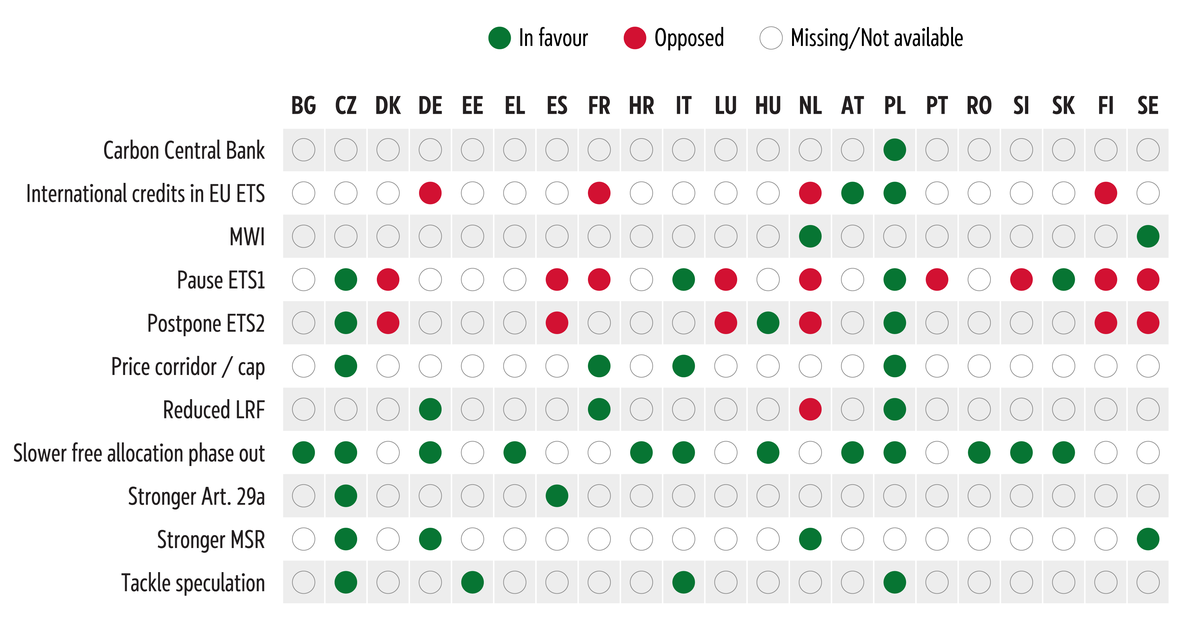
Figure 1 illustrates the disclosed opinion of a majority of Member States on key issues related to the ETS Directive revision.4 This list is non‑exhaustive, subject to evolving national views, and based on publicly available information. While it provides a snapshot of the current state of play, further developments could change these national positions ahead of the Commission's proposal.
Source: Compiled by the author on the basis of publicly available information. Graphic by Lucille Killmayer, EPRS.
Pause the EU emissions trading system
Poland and Czechia lead calls for the EU ETS to be suspended. In February 2026, the Italian Minister for Enterprise and Made in Italy, asked the European Commission to pause the EU ETS until the ETS1 review takes place. Robert Fico, Prime Minister of Slovakia proposes a 4‑5 year suspension on the application of the EU ETS. Following criticism from several Member States, the topic is now a high‑level discussion, with interventions from Heads of State or Government opposing or supporting the suspension of the EU ETS. In February 2026, French President Emmanuel Macron called to maintain the carbon market while Sweden's Industry Minister, Ebba Busch, called the EU ETS the EU's most successful economic instrument. France advocates not 'blowing everything up', with Macron's call following a statement from German Chancellor, Friedrich Merz, who had initially proposed the EU ETS be revised or postponed. Merz later clarified his stance, calling the ETS the 'right tool', while requiring readjustment to remain effective. Denmark, Finland, Luxembourg, the Netherlands, Portugal, Slovenia, Spain, and Sweden later produced a non‑paper, arguing that calling the EU ETS into question or suspending it constitutes a very worrying step.
Reduced linear reduction factor
The linear reduction factor (LRF) is key to defining the EU ETS' ambition. The LRF decreases the total number of available emission allowances annually to meet the EU ETS target. The EU ETS Directive sets an annual LRF reduction of 4.3 % until 2027, increased to 4.4 % from 2028. This LRF is aligned with a 62 % GHG emission reduction target for ETS1 sectors by 2030 compared to 2005. If the current 4.4 % remains, the ETS1 is expected to reach its endgame in the early 2040s. In 2025, the Netherlands asked to at least retain the EU ETS ambition at the current level. However, in October 2025, the German Minister for the Environment, Carsten Schneider, asked to extend the ETS1 after 2039. This could imply a less stringent LRF percentage and postponing the endgame. Germany is asking for the LRF to be adjusted from 2036, to align with residual emissions in relevant sectors, ensuring compatibility with the EU's new 90 % net emissions reduction target by 2040.
Slower free allocation phase out
In the EU ETS, the risk of carbon leakage is addressed through free allocation and indirect cost compensation. For the sectors covered by the CBAM Regulation, the free allocation is intended to be phased out by 2034. In November 2025, the Austrian Federal Minister for Agriculture, Forestry, Climate and Environmental Protection, Regions and Water Management requested a slower phase‑out of free allocations in the EU ETS from 2028, and to keep free allocation for sectors covered by the CBAM beyond 2034. Germany supports the expansion of free allocations (for exports), if effective carbon leakage protection cannot be achieved through CBAM. In February 2026, ahead of the Competitiveness Council, delegates from Bulgaria, Czechia, Hungary, Italy, Poland, Romania, Slovakia and Slovenia asked to revisit the free allowances phase‑out schedule and benchmark values.
Tackle carbon price fluctuation
Member State representatives also express concern about high carbon prices, and their possible impact on sectors covered by the EU ETS. They call for either direct intervention in the carbon price (price cap and corridors), or indirect intervention (such as limiting financial actors' market participation, stronger measures to address excessive price fluctuations through Article 29a of the ETS Directive, and MSR revision).5 Czechia, France and Poland advocate the establishment of a price cap. In March 2025, France circulated a non-paper calling, among other measures, to explore a carbon floor price for ETS1 in the EU ETS Directive revision. In February 2026, Czech Prime Minister, Andrej Babiš, wrote to the Council and Commission supporting a price cap or corridor to prevent excessive price rises and European industry relocation. He called to restrict trade for financial institutions, a measure Italy, Estonia and Poland also support. Spain would support targeted adjustments to reduce price volatility, while keeping the EU ETS price signal, and Czechia has proposed targeted amendments to Article 29a of the directive to address excessive price fluctuation.
The market stability reserve addresses EU ETS market volumes and therefore impacts carbon prices. Both Dutch and Czech representatives have set positions asking, among other elements, for a continued future MSR. The Netherlands asked to increase the MSR intake rate of 24 %, and to strengthen the cancellation mechanism. Czechia also asked for a continued MSR, but would empower the Commission to issue additional allowances to replenish the MSR. Sweden calls for a more dynamic MSR, capable of addressing deficits and high prices, and enhanced allowance storage to buffer against potential deficit.
Another point of interest is the expansion of the EU ETS scope to new sectors, until now not covered by carbon pricing. According to the Dutch Government, municipal waste incineration (MWI), should be part of the EU ETS from 2028, a position also supported by Sweden. Carbon pricing already covers MWI in Denmark, Sweden, Germany, the Netherlands, Lithuania and Norway.
Additional issues
Member States also expressed views on two issues the Commission has not planned to address in its proposal to revise the ETS1. Nevertheless, these issues could arise later in the negotiation process if either the European Parliament or the Council wish to amend the EU ETS Directive:
-
Reopening the emissions trading system to buildings, road transport and additional sectors (ETS2). Following adoption of the revised European Climate Law, ETS2 will begin in 2028, one year later than originally envisaged. For Czechia and Slovakia the one‑year delay is not enough, and, concerned about social impacts, both have called to postpone the ETS2 to 2030. This would require reopening provisions regulating the ETS2 in the EU ETS Directive. Representatives from Poland and Hungary also call for a longer postponement of the ETS2 and further adjustment in the upcoming EU ETS review. On 18 February 2026, Denmark, Finland, Luxembourg,and Sweden co‑signed a joint statement against a revision or further delay of the system. The statement was later signed by the Netherlands. Spain has also positioned itself against delaying the ETS2.
-
I nternationa l carbon credits in the EU ETS: under the European Climate Law, up to 5 % of international carbon credits can count towards the 90 % net GHG emission reduction target for 2040. The Commission's Climate Law proposal mentioned that international credits should not play a role in EU carbon market compliance, although this is not mentioned in the final version of the text. Austria and Poland have openly expressed their support for the integration of international credits in the EU ETS, while Germany, Finland, the Netherlands and France openly oppose.
Interested parties' opinions
On 11 February 2026, during the European Industry Summit in Antwerp, Belgium, industrial players wrote to EU leaders demanding a reduction in energy and carbon costs. Wrongly claimed to have the support of more than 1 300 companies and associations, the letter did not explicitly call to pause the ETS1. However, following calls from several EU Heads of State or Government to pause ETS1 (see Member State positions), the revision of the ETS1 drew significant public attention.
On 4 March 2026, a group of 17 energy and industrial players, trading platforms and NGOs, asked European leaders to 'stay the course' on the EU ETS. Noting the EU ETS works, they urged a targeted update of selected ETS1 parameters, including revenue recycling into industrial decarbonisation, in the upcoming ETS1 revision. A later second letter claimed the ongoing debate towards amending or even suspending the EU ETS is a serious misdiagnosis of the structural causes of economic erosion. This letter was signed by 103 organisations, including energy‑intensive industries, energy producers, and the technological and automotive industry. Michael Bloomberg, founder of the financial information provider, and think tanks such as I4CE, Bruegel and ECCO, have also come to support the ETS1. A cluster of 77 companies, industry associations, and civil society organisations call to not delay the ETS2.
Main references
- Jensen, L., Amending the European Climate Law, EPRS, European Parliament, February 2026.
- López Hernández, J.F., EU emissions trading system for buildings, road transport and additional sectors (ETS2): Status and concerns, EPRS, European Parliament, May 2025.
- López Hernández, J.F., International carbon credits and EU climate targets, EPRS, European Parliament, June 2025.
- López Hernández, J.F., Revision of the EU emissions trading system, EPRS, European Parliament, EPRS, January 2026.
- Sheil, S., Ten issues to watch in 2026, EPRS, European Parliament, January 2026.
Endnotes
Classification
Policy areas: Environment
Regions: European Union
Committees: Environment, Climate and Food Safety (ENVI)
Disclaimer
This document is prepared for, and addressed to, the Members and staff of the European Parliament as background material to assist them in their parliamentary work. The content of the document is the sole responsibility of its author(s) and any opinions expressed herein should not be taken to represent an official position of the Parliament.
Copyright
© European Union.
The reuse of this document is authorised under a Creative Commons Attribution 4.0 International (CC-BY 4.0) licence.

To use or reproduce elements that are not owned by the European Union, permission may need to be sought directly from the respective rightsholders.