
Article page checkbox is not checked in page info.
eTools for regulatory simplification and consistency – Annex B: Mapping eTools
eTools for regulatory simplification and consistency
David Kemp, Scientific Foresight Unit

Summary
This Options Brief summarises practical choices for adopting and scaling digital tools (eTools), particularly those integrating artificial intelligence (AI), to support regulatory simplification and consistency across the EU legislative cycle. It draws on a mapping of 30 eTools and 11 in‑depth use cases spanning the ideation, development and evaluation stages of the legislative cycle. The findings highlight best practice in the technical implementation and practical deployment of these eTools, evaluating their utility in supporting 'better regulation' objectives.
Statement of purpose
This document is based on the STOA study 'eTools for regulatory simplification and consistency'. The study was written by Michael Flickenschild, Daniel Nigohosyan, Peter Pelzer, Olga Batura, Giulia Lovaste, Georgia Theodorakopoulou, Maria Douka, Philipp Lämmel and Silke Cuno of Ecorys, GA‑Alliance, Fraunhofer Fokus and Rel‑I at the request of the Panel for the Future of Science and Technology (STOA), and managed by the Scientific Foresight Unit, within the Directorate General for Parliamentary Research Services (EPRS), European Parliament. STOA administrator responsible: David Kemp.
Summary of key functionalities of eTools
The study identified a broad range of digital and AI‑enabled functionalities that can support different stages of the EU legislative cycle, with varying levels of maturity and feasibility.
Across the ideation stage, tools increasingly help policymakers detect emerging policy needs, understand stakeholder views, and identify gaps, overlaps or obsolete elements in the existing legislation. Natural language processing systems, such as those used in Bundestag‑Mine (Germany) or AI Legislab (Spain), analyse large volumes of parliamentary materials to surface patterns, themes and potential areas for action. Other tools, including the Regulatory Impact Assessment (RIA) platform (Greece), support early coherence checks and structure impact‑assessment workflows, although the availability of high quality and standardised data remains a limiting factor. In this phase, eTools also facilitate participatory input by enabling more systematic collection and analysis of citizen and stakeholder feedback.
In the development stage, functionalities are more mature and widely deployed. Collaborative drafting environments such as LEOS (EU) provide structured, machine‑readable templates and enforce legal‑drafting rules, thereby improving internal consistency and reducing technical errors. A growing set of AI‑assisted features further enhances drafting quality, including semantic search, reference validation, automatic identification of inconsistencies and summarisation of amendments, as demonstrated by GenAI4Lex‑B (Italy) or LLaMandement (France). Workflow tools, such as MOPED (Slovenia), help manage timelines, coordinate contributions across services and maintain version control, while systems like Ulysses Suite (Brazil) automate amendment analysis and support the organisation of legislative documentation. Several tools can also simulate how amendments or proposed changes affect existing legal instruments, providing clearer visibility of their systemic impacts.
At the evaluation stage, functionalities remain relatively under‑developed but show promising potential. Systems such as the evaluation module within MOPED help structure ex‑post reviews by connecting impact expectations defined during drafting with monitoring information gathered after implementation. MOPED's feedback module uses semantic analysis to interpret citizen input and administrative insights, thereby feeding stakeholder perspectives into evaluation activities. While automated impact analysis remains largely theoretical due to methodological and data‑quality challenges, structured workflows, coherent metadata and machine‑readable drafting practices can significantly strengthen the foundations for future evaluation‑oriented tools.
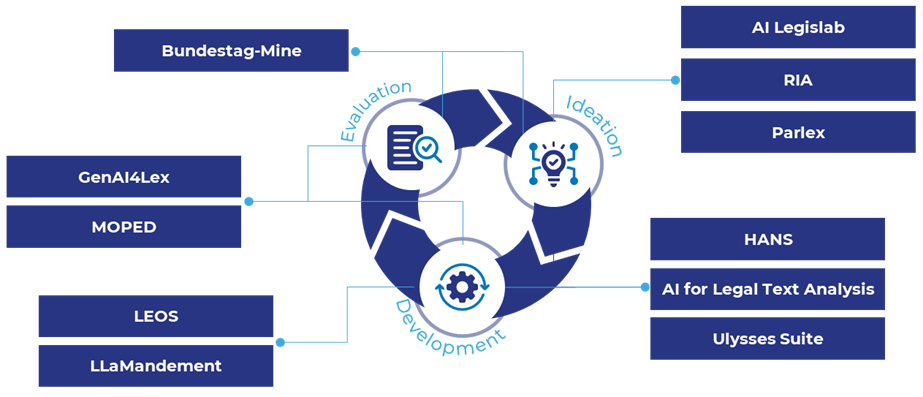
Source: Authors of the study.
Key insights from the review of use cases
The study shows that the adoption of eTools across the legislative cycle is uneven, with the most applications concentrated in the ideation and development stages, while ex‑ante and ex‑post evaluation remains constrained by data‑related and methodological shortcomings. Policymakers and parliamentary staff benefit from tools that support early identification of issues, structured drafting and improved transparency, but the absence of shared indicators, common evaluation frameworks and machine‑readable legislative data limits progress in assessing impacts once laws are in force.
A major insight is that functionality‑driven approaches, anchored in real user needs rather than in technology availability, lead to higher adoption rates and more meaningful results. Tools that reflect existing workflows, embed drafting rules and offer clear efficiency gains tend to be better integrated and more sustainable.
Interoperability emerges as a critical enabling condition across all use cases. Where tools rely on common standards such as Akoma Ntoso or EuroVoc, they achieve stronger alignment with the wider legislative ecosystem and create reusable data assets that support more advanced applications, including AI‑driven analytics. Conversely, legacy formats, siloed systems and inconsistent metadata significantly increase the cost and complexity of digital transformation.
The study also highlights the tension between rapid advances in AI and concerns about sovereignty, security and political neutrality. Many prototypes rely on non‑European AI models, making principled guidance, risk assessments and bias testing essential for institutional use.
Finally, the analysis shows that meaningful adoption requires not only technology but also institutional readiness: user training, change management, long‑term resourcing and a shared vision of digital parliamentary work are indispensable for unlocking the full benefits of eTools.
Policy options for the use of eTools in the legislative process
Option 1 – Adopt a functionality‑first roadmap for parliamentary digitalisation: This option focuses on embedding function‑based digital solutions that directly address recurring needs across the legislative cycle. This allows prioritising the deployment of eTool functionalities according to their usefulness and relevance to parliamentary needs, rather than pursuing technology‑driven or tool‑driven innovation. The study emphasises that functionalities should stem from user requirements and real workflows, as evidenced by the experience from LEOS, MOPED and Ulysses, where success depended on users defining the functional scope rather than developers. Decision‑makers would therefore be responsible for identifying, prioritising and coordinating functional needs in a structured way, focusing on re‑usable and high‑value capabilities such as semantic search, coherence checking, amendment analysis and drafting support.
The benefits lie in the potential to improve efficiency and reduce administrative burden where functionalities directly address time‑intensive processes. The study notes that feasibility is high because many promising functionalities already exist in pilots or in national parliaments, and because a modular, functionality‑first approach is future‑proof and avoids dependence on specific technologies. Risks stem from fragmentation if functional priorities differ between actors, and from the possibility that tools remain under‑used without clear mandates or training.
| No | Functionality | Examples of eTools |
|---|---|---|
| 1.1 | Identify regulatory needs, gaps, and emerging topics before formal drafting begins, e.g. from plenary debates to extract positions, concerns, and thematic clusters, offering early insight into societal and political priorities that could guide new legislative initiatives. | Bundestag‑Mine and Parlex (UK) |
| 1.2 | Ex‑ante assessment of external coherence by using AI to examine the legal hierarchy of a proposed measure and verify how it aligns with the broader legal framework. | Caminar L5 (Chile) |
| 1.3 | Ensure internal consistency of legislative texts (e.g. linking definitions, references, and amendments) with AI, rule‑based reasoning, and/or machine learning. | GenAI4Lex‑B, (augmented) LEOS, MOPED‑DOCS |
| 1.4 | Simulate how amendments affect existing legislation, enabling drafters to preview these impacts before finalising text. | Comparative Print Suite (CPS) (US) |
| 1.5 | Assess the success and impacts of existing legislation | Currently, no such tools have been identified, except for the Slovenian ex‑post evaluation module within the eLegislation ecosystem |
Source: Authors of the study.
Option 2 – Create a foundation for enhanced monitoring, ex‑ante impact assessment, and ex‑post evaluation: This option responds to the study's finding that the largest functional gaps exist in ex‑ante impact assessment and ex‑post evaluation, largely due to a lack of high‑quality data and consistent methodologies. It proposes establishing common definitions, indicators and structured approaches to monitoring and assessment, which would enable future development of eTools that support evaluation. The responsibility would be shared across EU institutions, as evaluations depend on a collective agreement on methods and on the availability of comparable data.
The potential benefits include enabling more robust assessment of legislative performance, supporting simplification efforts and strengthening the evidence base for future policy choices. According to the study, feasibility is tightly linked to inter‑institutional coordination, since many current methodologies differ across institutions. Sustainability is high if common structures and expectations are embedded early in the legislative process. Risks and uncertainties relate primarily to data inconsistency, divergent practices and the absence of clear monitoring requirements in legislation. Ethical and social considerations note the importance of transparent and systematic evaluation methods to avoid misinterpretation or selective use of evaluation results.
Option 3 – Establish an interinstitutional legal data‑structuring initiative: This option addresses the fragmented legal data landscape identified in the study, in which legislation, amendments and supporting documentation are often unstructured, inconsistent or stored in formats that hinder interoperability. The initiative would aim to promote machine‑readable formats, standardised metadata and the use of common legal standards such as Akoma Ntoso and EuroVoc. Responsibility would be shared among parliaments and administrations, with the goal of improving the foundation on which all eTools depend.
The benefits include enabling more reliable drafting support, improving the quality of search and cross‑referencing, and creating the conditions for advanced functionalities such as coherence checks and amendment simulation. The study acknowledges that feasibility is influenced by existing legacy systems and institutional preferences, but notes that the experience of LEOS and MOPED demonstrates the advantages of structured data. Sustainability is high, as structured data remains valuable regardless of technological developments. Risks relate to harmonising different national drafting practices and dealing with institutional resistance to changing established workflows.
Option 4 – Develop a European inter‑parliamentary interoperability framework: This option reflects the study's observation that national parliaments frequently develop bespoke tools, resulting in fragmentation and missed opportunities for re‑use. A shared framework would define common standards, reusable modules and reference architectures without imposing a single system. Responsibility could be shared between the European Parliament and national parliaments and would support voluntary alignment.
The benefits identified include reducing duplication, enabling cross‑country collaboration and helping parliaments adopt advanced functionalities. The feasibility of this option depends on political willingness, as the study notes that parliaments value institutional autonomy and may be reluctant to import tools developed elsewhere in a different context. Sustainability is strong where the framework builds on existing open standards and modular solutions. Risks include the challenge of balancing standardisation with national legislative traditions. Social and regulatory considerations centre on ensuring participation across parliaments with varying capacities.
Option 5 – Provide guidance on the acceptable use of (commercial) AI models in the legislative cycle and develop specialised evaluation benchmarks: This option arises from the study's finding that many parliaments already experiment with commercial AI models, despite concerns about digital sovereignty, neutrality and transparency. It suggests that parliaments adopt clear internal guidance on acceptable AI use, including safeguards, oversight requirements and criteria for selecting or evaluating models. The responsibility would fall on parliaments themselves, potentially drawing on existing national charters and EU‑level principles.
The benefits include supporting consistent and safe adoption of AI while managing risks linked to bias, data protection and over‑reliance on commercial models. The study notes that feasibility is high because many parliaments have already begun to articulate principles or charters for AI use. Risks and uncertainties concern the rapid evolution of AI systems and the reliance on third‑country models that may not reflect European political and cultural contexts. Ethical, social and regulatory concerns are central in this option, given the importance of neutrality, transparency and human oversight in legislative work.
Option 6 – Establish an inter‑parliamentary digital exchange and capacity‑building programme: This option reflects the study's insight that adoption of eTools depends as much on institutional culture and human capacity as on technological availability. A structured exchange programme would allow parliaments to share experiences, co‑develop approaches, and strengthen staff skills through training and mutual learning.
Benefits include more rapid uptake of promising functionalities, greater consistency across parliaments and the ability to learn from practical implementation challenges. The study notes that feasibility depends on continued engagement and available resources. Sustainability is linked to ongoing commitment from participating parliaments. Risks include uneven participation, differing institutional priorities and limited follow‑through if capacity building is not integrated into broader digital strategies.
| Policy option | Expected benefits | Feasibility | Risks and uncertainties |
|---|---|---|---|
| 1) Functionality‑first roadmap for the legislative cycle | Focuses investment on high‑value capabilities; improves drafting quality, amendment handling, and efficiency; enables coordinated introduction of tools | High – many functionalities exist/piloted; modular, incremental adoption | Uneven prioritisation; low uptake without mandates; underuse if not aligned with workflows |
| 2) Foundation for monitoring, ex‑ante impact assessment, and ex‑post evaluation | Improved monitoring, ex‑ante assessment, and evaluation | Medium – depends on inter‑institutional methods, shared indicators, and data readiness | Possible methodological challenges could hinder common agreement |
| 3) Interinstitutional legal data‑structuring initiative | Reduces drafting errors; improves search/cross‑references; underpins AI‑assisted functions; future‑proofs legal corpora | Medium – technically straightforward; institutionally complex (legacy formats, templates) | Heterogeneity of data structures; migration effort and coordination costs |
| 4) European inter‑parliamentary interoperability framework | Cuts duplication and enables reuse; strengthens collaboration and transparency while preserving autonomy | Medium – requires political buy‑in | Balancing between autonomy and common functional components may be challenging |
| 5) Guidance on acceptable use of (commercial) AI models and specialised benchmarks | Safer, coherent AI adoption; manages bias, neutrality and data protection; supports pragmatic use while safeguarding trust | High – many parliaments are already developing charters; can leverage EU‑level principles | Overly strict rules may slow innovation; overly vague rules may create risk |
| 6) Inter‑parliamentary digital exchange and capacity‑building programme | Enhances knowledge transfer, training, and best‑practice exchange | Medium – depends on sustained engagement and modest funding | Funding and participation levels may vary; risk of consultative focus without implementation |
Source: Authors of the study.
Statement on the use of AI
Any AI‑generated content in this text has been reviewed by the author(s).
Disclaimer
This document is prepared for, and addressed to, the Members and staff of the European Parliament as background material to assist them in their parliamentary work. The content of the document is the sole responsibility of its author(s) and any opinions expressed herein should not be taken to represent an official position of the Parliament.
Copyright
© European Union.
The reuse of this document is authorised under a Creative Commons Attribution 4.0 International (CC-BY 4.0) licence.

To use or reproduce elements that are not owned by the European Union, permission may need to be sought directly from the respective rightsholders.