Article page checkbox is not checked in page info.
Greater North Sea fishing area: State of play
Greater North Sea fishing area: State of play
Anne Altmayer, Members' Research Service
Summary
The Greater North Sea is part of the North-East Atlantic, the EU's most important fisheries area.
The marine area is surrounded by densely populated, highly industrialised countries making intensive use of the waters and coasts for a broad range of economic activities. This gives rise to several environmental issues and growing competition for space.
Fishing activities in the Greater North Sea have decreased considerably since the 1970s. Many fish stocks have reached sustainable levels. At the same time, the decline in catches is accompanied by a reduction in the size of the fishing fleet in the area.
Fisheries management in the region is highly complex and controversial, as only a small part of fish stocks is managed solely by the EU, with the bulk of stocks being shared with neighbouring non-EU countries.
The European Parliament has on multiple occasions contributed to the adoption of fisheries management rules in the Greater North Sea area, and pointed to relevant issues at stake.
Introduction
The Greater North Sea is part of the North-East Atlantic and consists of five key subareas: the northern, central and southern North Sea, the English Channel, and the Skagerrak and Kattegat Straits.1 The North-East Atlantic, together with the Baltic, Mediterranean and Black Seas, comprise a large part of EU waters.2
Fish catches in the Greater North Sea have seen a considerable reduction during the past 20 years, resulting in a more sustainable fishing level, on the one hand, and a shrinking fishing fleet, on the other. However, persisting environmental issues might undermine efforts to keep fish stocks at a sustainable level. Fisheries management in the North-East Atlantic requires multiple complex arrangements with third countries, in particular Norway and the United Kingdom (UK).
Main characteristics
While the southern part of the North Sea is rather shallow (0–50 metres of depth) and characterised by large river inputs and tidal currents, the northern part includes areas of up to 700 metres of depth, and is strongly influenced by Atlantic oceanic inflow. The Skagerrak and Kattegat form the link to the Baltic Sea and are less saline and less tidal than the rest of the marine region. The English Channel joins the southern North Sea to the Atlantic. It is strongly influenced by wind and tidal events.
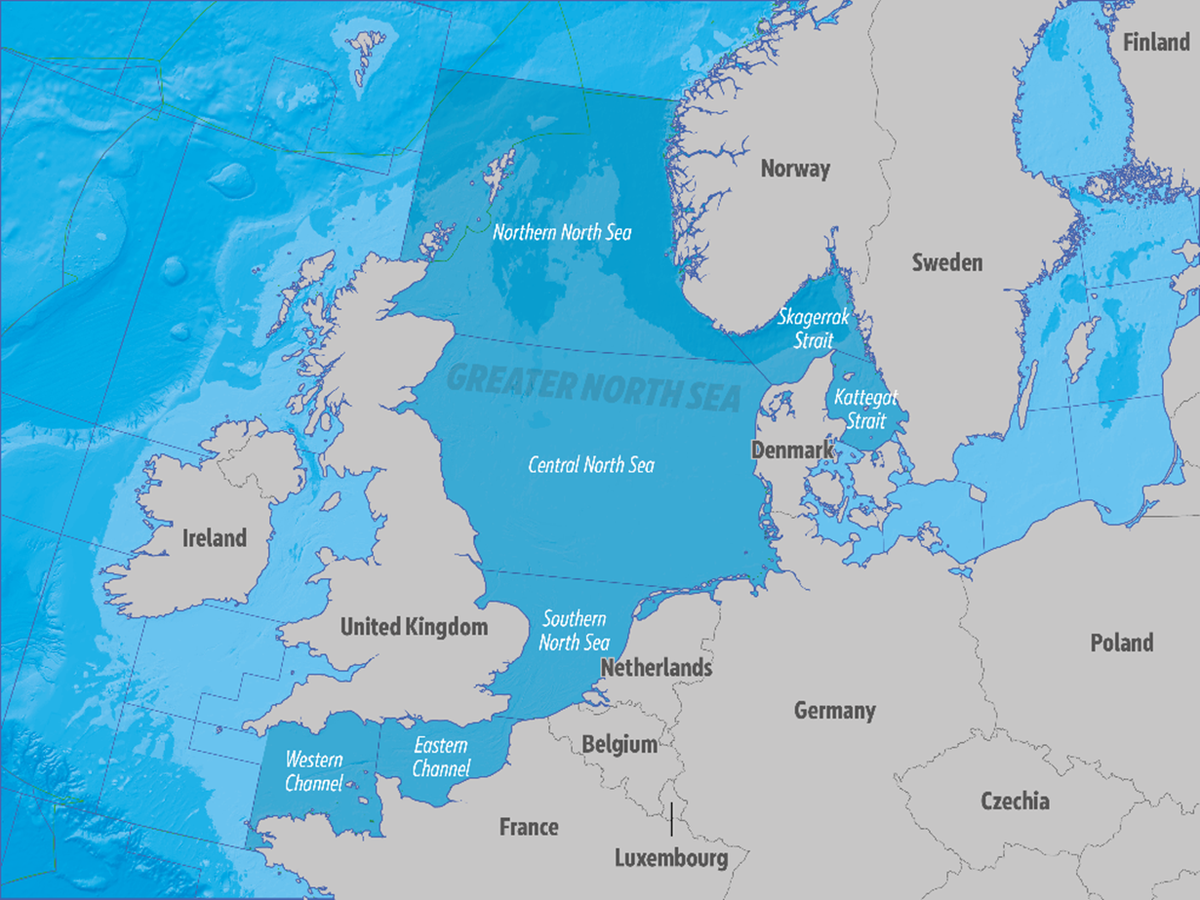
Source: Graphic by Samy Chahri, EPRS.
The Greater North Sea is home to approximately 230 species of fish, with important spawning grounds for several species, and prey for birds and marine mammals.
The marine area is surrounded by densely populated, highly industrialised countries: Belgium, Denmark, France, Germany, the Netherlands, Norway, Sweden and the UK, with around 184 million people living in the catchment areas (see Figure 1).
Environmental challenges
The Greater North Sea is intensively used for a broad range of economic activities that have potential impact on the natural environment. Major industry sectors putting pressure on ecosystems include shipping, oil and gas production, aggregates extraction, and – increasingly – offshore wind developments. As one of the most frequently traversed sea areas in the world, the North Sea accommodates the three largest EU ports – Rotterdam, Antwerp-Bruges and Hamburg – on its coastal zone, which is also heavily exploited for agriculture and tourism. Fisheries and the expanding aquaculture further contribute to the environmental issue. A 2023 assessment found that the pressures from these activities can negatively affect marine ecosystems and the services they provide for humans.
Pollution
While concentrations of many of the most serious hazardous substances have decreased substantially since the 1990s, a number of areas are still contaminated, in particular with persistent organic pollutants, such as polychlorinated biphenyls (PCBs, dioxin-like chemical substances) and heavy metals, such as mercury. These highly toxic substances are among the chemicals of major public health concern, because they remain present in water and sediments for decades or do not break down at all, and are easily taken up by animals, thus finding their way into the food chain.
The ubiquitous per- and polyfluoralkyl substances (PFAS), which are notably found in coastal regions, can become a matter of concern as well, particularly if present in seafood.
Contaminant concentrations are particularly high in the industrialised southern North Sea.
Moreover, physical disturbance, for instance by bottom trawling, anchoring or dredging, can cause the release of hazardous substances that had already settled in marine sediment.
Contamination in the Greater North Sea is mainly derived from shipping; industrial and urban inputs (e.g. wastewater and inputs from rivers); agricultural run-off; oil and gas extraction; and renewable energy installations.
Climate change
The main climate change effects – higher temperatures and an increased carbon dioxide (CO2) level in the atmosphere – are reflected in seawater becoming warmer, more acidic and less rich in oxygen. These effects can impact the living conditions of marine animals, in particular cold-water affinity species and organisms with calcium-based body parts.
Migration of species towards colder regions has already changed the spatial distribution of several plankton and fish species within the North Sea, and is likely to continue. Substantial impact has been observed, for instance, in the Belgian part of the North Sea coast, where temperatures over the past 60 years has increased faster than in other regions. A rise in temperature of around 2 °C has triggered a northward migration of species such as the Atlantic cod, and of some types of plankton that serve as food for fish species. Conversely, some fish species from warmer regions – including commercial ones such as anchovy and sardine, and harmful ones such as the poisonous lesser weever – are now able to survive more easily in the North Sea.
Furthermore, ocean acidification due to rising CO₂ levels in the atmosphere makes it increasingly difficult for various organisms, such as oysters, mussels, corals, certain plankton species and cuttlefish, to form their calcium-based skeletons.
Invasive species
Non-indigenous species, introduced for instance via maritime transport or aquaculture facilities, can become invasive and cause irreversible changes to marine ecosystems, with consequences for native fauna, including commercial fish species. Under conditions favourable for them, such as the absence of natural predators, non-indigenous species can reproduce, spread rapidly, and ultimately outdo native species in their competition for space and food. This is the case, for instance, for the Chinese mitten crab, found in large numbers in practically all coastal waters along the southern North Sea as well as in inland waters. The crab's diet includes algae, fish eggs, worms and shellfish. It is known to destroy fishing gear and to spread diseases and parasites.
The warming effect of climate change in the North Sea potentially facilitates the spread of species migrating from southern areas.
Overexploitation and seabed disturbance
Owing to reduced total allowable catches (TACs) under EU fisheries management, the average fishing mortality in the Greater North Sea has declined from 65 % above sustainability level in 2003, to 23 % below this level in 2023. However, several fish stocks are still overexploited, i.e. the number of fish caught is too high in relation to the stock, or above FMSY (see text box). In the demersal group (fish living near the seabed), this is the case for more than 50 % of stocks, the most prominent example being the North Sea cod.
Fishing mortality rate and maximum sustainable yield
The concept of maximum sustainable yield (MSY) refers to the highest amount of fish that can be taken from a stock without compromising its reproduction. The fishing mortality rate (F) refers to the proportion of fish caught relative to the total size of the stock. The application of the MSY approach requires that F should be set at a level that is consistent with MSY in the long term. These fishing mortality rates are referred to as FMSY . For each of the stocks subject to multiannual plans, a range of FMSY is defined (i.e. a lower and an upper limit between which all fishing mortality rates would lead to MSY in the long term). Fishing opportunities (the total allowable catches, or 'TACs') must then be set in accordance with these FMSY ranges.
Source: Peñas Lado, E., Quo vadis Common Fisheries Policy? , 2019.
Moreover, fishing using mobile bottom-contacting fishing gear has considerable impact on the seabed in the North Sea. In particular the Skagerrak and Kattegat seabed, as well as areas in the central North Sea and the Channel, show significant signs of physical disturbances. Other activities contributing to this pressure are dredging and marine aggregate extraction, deep-sea mining and gas and oil extraction. Unlike fisheries, these activities have not changed in intensity recently, and are likely to increase with the growing importance of blue economy sectors.
Eutrophication
Eutrophication, i.e. the excessive input of nutrients triggering a cascade of detrimental effects, was impacting the Greater North Sea ecoregion in previous decades, peaking in the 1980s. The introduction of measures to reduce nutrient input via rivers since 2000 has led to a gradual improvement. According to the International Council for the Exploration of the Sea (ICES), eutrophication is no longer an issue of major concern. Nevertheless, several parts of the south-eastern North Sea and Kattegat remain classified as problem areas.
Competition for space
In the context of the blue economy, the Greater North Sea is under growing pressure to accommodate different space-demanding activities. Shipping, offshore energy production, resource extraction, energy and data infrastructure, tourism, fishing and aquaculture are competing economic sectors. In addition, the reconciliation of these sectors with nature protection measures, in particular the EU's biodiversity strategy and nature restoration law, is expected to become an ever-growing challenge. In this context, maritime spatial planning (MSP) is becoming an increasingly important instrument. While most of the sectors of the blue economy are associated with more permanent spatial allocations, fisheries is highly dynamic in terms of both time and space. These temporal and spatial dynamics pose challenges for the coherent integration of fisheries into MSP frameworks.
Fisheries in the Greater North Sea
Around 7 000 fishing vessels are active in the Greater North Sea region, with the EU fishing fleet (i.e. vessels from Belgium, Denmark, Germany, France, the Netherlands and Sweden) accounting for about half of them. Norway and the UK are the biggest players in the area, with 432 375 tonnes and 410 589 tonnes of landings respectively in 2023. Among the EU countries, Denmark accounts for the biggest share of catches, with 353 287 tonnes.
Small-scale fishery vessels (SSCF) in the area account for almost half (47 %) of the total EU fleet, albeit with only a small share of the landed weight; by contrast, it is large-scale fishery (LSF) vessels that landed 97 % of the total weight, and generated 94 % of the total value. Revenue decreased for both parties between 2022 and 2023: by 13 % for the SSCF and by 14 % for the LSF.3
The number of landings (see Figure 2) has continuously declined in the Greater North Sea since the 1970s, and has stood at around 1.5 million tonnes since 2021. While some fish stocks – including hake, haddock and plaice in the North Sea, as well as herring in the North Sea, Skagerrak and Kattegat and the eastern English Channel – are fished at sustainable levels, this is not the case for some stocks of Norway lobster and Northern shelf cod. Fishing mortality for mackerel is also too high throughout all subregions. The status of some migratory species, such as eel 4 and salmon, is classified as poor, as well.
Fisheries in the Greater North Sea catch a large diversity of species, among which pelagic fish (living in the open water) account for by far the largest proportion of total landings. Herring and mackerel were the primary species both in this group and overall in terms of landed weight in 2023. In the group of demersal fish, sandeel ranked highest, while plaice and Norway lobster led in terms of numbers in the benthic (living on the seabed) and shellfish groups respectively.
In 2023, the key species in terms of landed weight were herring, mackerel, sandeel, sprat and blue whiting.
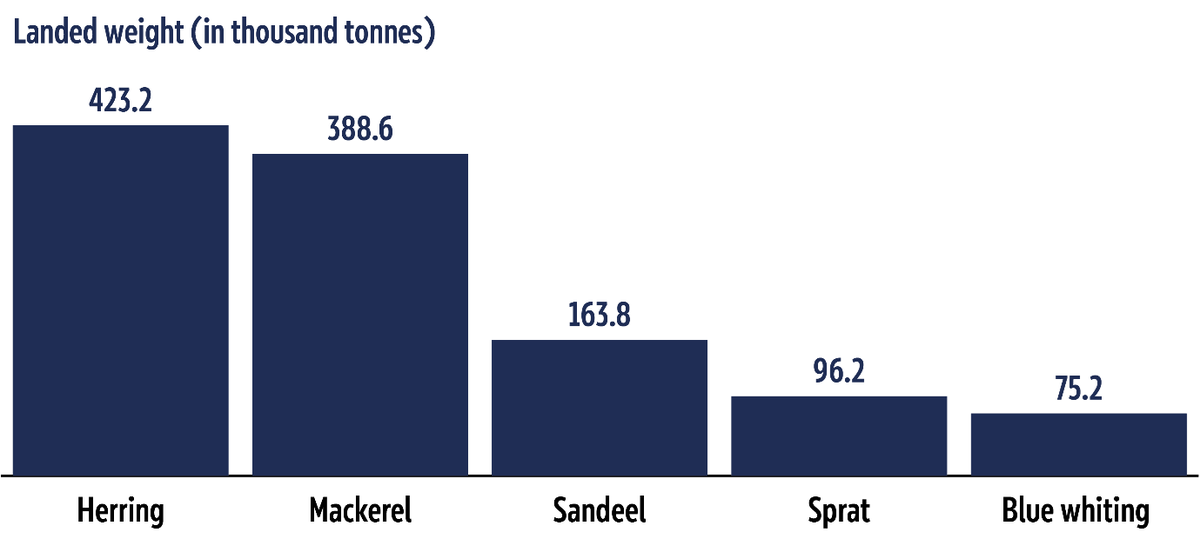
Data source: ICES, Greater North Sea ecoregion – fisheriesXplorer. Graphic by Samy Chahri, EPRS, 2026.
Management and main legislation
Fisheries management in the Greater North Sea falls partly under the EU common fisheries policy (CFP), and partly under UK and Norwegian legislation. Fish stocks are managed only to a minor extent by the EU on its own.5 The bulk of stocks is shared with the neighbouring non-EU countries and require joint management under the United Nations Convention on the Law of the Sea (UNCLOS) and one of its implementing agreements, the UN Fish Stocks Agreement (UNFSA) on straddling and highly migratory fish stocks. EU cooperation with third countries usually takes the form of agreements with the respective countries.
Fisheries management under the CFP aims to ensure that fishing and aquaculture activities are environmentally, economically and socially sustainable in the long term and contribute to the availability of food supplies. It must apply a precautionary principle and implement an ecosystem‑based approach in order to ensure that negative impacts of aquaculture and fisheries activities on marine ecosystems are minimised.
Annually, the EU allocates fishing opportunities for most of its commercial species, expressed as TACs. These are based on scientific assessments, including by the ICES and the Scientific, Technical and Economic Committee for Fisheries (STECF). EU Member States and the European Commission also receive input on North Sea fish management from the interdisciplinary stakeholder-led North Sea Advisory Council (NSAC) and the Pelagic Advisory Council (PAC). In the case of the Greater North Sea, the allocation of TACs implies, for many fisheries, a previous arrangement with third countries.
In view of long-term management and better predictability for the fishing sector, multiannual plans (MAPs) are in place for some areas and stocks. These plans aim at a sustainable level of fish stocks while taking into account the economic impact for the fisheries concerned. The 2018 MAP for demersal stocks in the North Sea 6 covers the fisheries for species living close to or on the seabed: cod, haddock, plaice, saithe, sole, whiting, anglerfish, Northern prawn and Norway lobster.
Given the high number of stocks that require international management, the EU has concluded a set of agreements with its neighbouring countries in the region. Among these 'Northern agreements', the ones with Norway and the UK are of particular importance.7 The agreements with Norway and the UK are of a reciprocal nature and are implemented through annual arrangements, in which parties agree on the TACs for common fish stocks and how to share these between them as quotas. As mentioned above, these arrangements are incorporated into the annual setting of fishing opportunities.
The EU–UK fisheries agreement covers almost 100 shared fish stocks, for which the parties jointly determine the TACs on an annual basis. The agreement is part of the 2020 EU–UK Trade and Cooperation Agreement, which also encompasses the preservation of full reciprocal access to waters until 30 June 2026. The agreement also provided for the EU quota shares to be gradually transferred to the UK, a process that was completed in 2025. In a new agreement, concluded on 20 June 2025, both parties decided to keep full reciprocal access until 2038.
The 1980 EU–Norway fisheries agreement is implemented in the form of several annual agreements, including an overall EU–Norway agreement covering the North Sea and the Atlantic; a neighbourhood EU–Norway agreement covering the Swedish fishery in the Norwegian waters of the North Sea; and an EU–Norway agreement covering Danish and Swedish fisheries in the Skagerrak and Kattegat.
In addition to the bilateral EU–Norway and EU–UK agreements, there is the EU‑UK‑Norway agreement. This trilateral agreement covers commercially exploited stocks in the North Sea waters of all three parties, including cod, haddock, whiting, saithe, herring, plaice and sprat.
Moreover, multilateral agreements exist with neighbouring countries on three pelagic stocks: mackerel, blue whiting and Atlanto–Scandian herring. While the parties used to agree on the TACs,8 these agreements do not include sharing arrangements, which means that there is no multilateral agreement on quota sharing – with overfishing as a result.
Fisheries in areas beyond national jurisdiction, i.e. the 'high seas', are regulated by regional fisheries management organisations (RFMOs), which operate under the legal framework established by the UNCLOS and the UNFSA. The North-East Atlantic Fisheries Commission (NEAFC) is one such organisation that is based on multilateral agreements between countries with fishing interests in these waters. Its convention area includes the Greater North Sea but stretches well beyond it. The NEAFC has six contracting parties (the EU; Denmark in respect of the Faroe Islands and Greenland; Iceland; Norway; Russia; and the UK) and includes Canada as a cooperating non-contracting party. As a member, the EU is bound to incorporate the organisations decisions into Union law. The NEAFC does not cover Atlantic salmon, as this species is the responsibility of the North Atlantic Salmon Conservation Organisation (NASCO).
The EU is also a contracting party to the Convention for the Protection of the Marine Environment of the North-East Atlantic (OSPAR Convention), adopted in 1992 under the auspices of the UN Environment Programme (UNEP). Signed by 16 contracting parties, including the EU and 11 of its Member States, OSPAR seeks to protect the marine environment of the North-East Atlantic, including the Greater North Sea.
Moreover, in view of environmental protection, the EU has signed the 1984 Bonn Agreement for cooperation in dealing with pollution of the North Sea by oil and other harmful substances. It is one of the earliest intergovernmental agreements to tackle pollution in marine waters.
Furthermore, the 2023 Greater North Sea Initiative (GNSBI) aims to foster cooperation among nine bordering countries in the fields of MSP, sustainable blue economy, and marine protection.
European Parliament's role
The European Parliament has been playing an important role as a co-legislator, highlighting its position in several resolutions on subjects relating to fisheries' management in the Greater North Sea area. Parliament's most significant recent achievements (newest first) include the following.
On 8 October 2025, Parliament and the Council adopted a revised regulation to give the EU a stronger tool to better tackle non-sustainable fishing practices allowed by non-EU countries in relation to stocks of common interest. The new regulation clarifies the conditions under which a third country's actions could lead to EU penalties, including import bans of fish and fishery products.
On 18 September 2024, Parliament adopted a regulation on conservation, management and control measures applicable in the area covered by the Convention on future multilateral cooperation in the North-East Atlantic fisheries. The regulation implements into EU law decisions taken by the NEAFC.
In its resolution of 18 January 2024 on the state of play in the implementation of the common fisheries policy and future perspectives, Parliament welcomed the fact that the EU–UK Trade and Cooperation Agreement incorporates a direct link between trade and fisheries, and called on the Commission and the Council to ensure that fisheries negotiations with the UK, as well as with other coastal states in the North-East Atlantic, are also 'linked to issues pertaining to trade and access to the EU single market'.
In a November 2023 resolution, Parliament expressed its concern about future access to UK waters, and called on the Commission to take all necessary measures to ensure that reciprocal access to waters and fisheries resources is maintained after 30 June 2026. Parliament also raised the issue of the unilateral introduction of fishing restrictions by the UK for the purpose of marine protection.
In its resolution of 4 April 2022 on the future of fisheries in the Channel, North Sea, Irish Sea and Atlantic Ocean, Parliament 'deplored the fact that the new post-Brexit international context in the North-East Atlantic is being used by third countries and territories such as Norway, Iceland and the Faroe Islands to adopt unilateral decisions'. It called on the Commission to be ready to use all appropriate tools, including market access measures.
Furthermore, on 28 January 2025, Parliament's Committee on Fisheries (PECH) held a public hearing entitled 'Fisheries relations with Norway', including ongoing disputes between the EU and Norway.
The PECH committee is currently working on an own-initiative resolution on the impact of the implementation of the Maritime Spatial Planning Directive 2014/89/EU on fisheries in selected fishing areas and sea basins.
Recent developments
On 16 December 2025, the Faroe Islands, Iceland, Norway and the UK concluded an agreement on mackerel fishing quotas without prior consultation with the EU. The arrangement sets the TAC at a level going beyond scientific recommendations, and excludes the EU from the quota-sharing agreement. The European Commission announced that it would assess the agreement's compatibility with international law.
On 13 December 2025, the Council agreed on fishing opportunities for 2026, covering the EU's own fish stocks and the shared stocks. Given the ongoing controversy on mackerel fishing quotas among North-East Atlantic coastal states for this species, only provisional catch limits were set for the first six months of 2026.
On 2 May 2025, the Arbitration Tribunal, established under the EU–UK Trade and Cooperation Agreement ruled that the UK did not act in compliance with the proportionality principle under the agreement and breached its obligations when it issued a ban on EU fishing vessels operating in the English waters of the North Sea and in all Scottish waters, preventing those vessels from fishing sandeel in these areas.
Main references
- Scholaert, F., EU-Norway relations in fisheries: An overview of the northern fisheries agreements, EPRS, European Parliament, November 2024.
Endnotes
Classification
Policy areas: Fisheries
Regions: European Union, Non-EU Europe and the North
Committees: Fisheries (PECH)
Disclaimer
This document is prepared for, and addressed to, the Members and staff of the European Parliament as background material to assist them in their parliamentary work. The content of the document is the sole responsibility of its author(s) and any opinions expressed herein should not be taken to represent an official position of the Parliament.
Copyright
© European Union.
The reuse of this document is authorised under a Creative Commons Attribution 4.0 International (CC-BY 4.0) licence.
https://creativecommons.org/licenses/by/4.0/deed.en
To use or reproduce elements that are not owned by the European Union, permission may need to be sought directly from the respective rightsholders.