
Article page checkbox is not checked in page info.
EU support for Ukraine for 2026-2027
EU support for Ukraine for 2026-2027
Tim Peters and Jakub Przetacznik with Silke Maes, Members' Research Service
Summary
On 11 February 2026, the European Parliament adopted three legislative acts to implement a €90 billion loan to Ukraine to cover the country's financial needs for the years 2026 and 2027: (i) a Ukraine Support Loan financed by the EU except for Czechia, Hungary and Slovakia; (ii) an amendment of the Ukraine Facility to use it for the disbursement of the new loan; and (iii) an amendment to the EU's multiannual financial framework (MFF) to use it as a guarantee for the loan, and to finance the grants used for the borrowing cost subsidy. On 23 February 2026, Hungary and Slovakia blocked the amendment of the MFF in the Council, which needs unanimity. The other two proposals were adopted.
The loan will be financed through EU borrowing on the capital markets backed by the EU budget's headroom. The EU budget will pay for the interest rates and other associated costs for Ukraine.
While €30 billion of the loan are meant to support the Ukrainian budget, €60 billion will be used to strengthen Ukraine's defence industrial capacities. The Commission proposal stipulates that defence products financed from the loan should, in principle, originate from the EU, European Economic Area, European Free Trade Association and Ukraine. Only if products are not available there, or cannot be delivered fast enough, can products from other third countries be bought.
In the past, Article 41(2) of the Treaty on European Union had been seen by many observers as an obstacle to financing weapons and military equipment from the EU budget. However, as the proposed Ukraine Support Loan is based on Article 212 of the Treaty on the Functioning of the European Union, the rules on the EU's common foreign and security policy do not apply.
Legislative Proposals
COM(2026) 20 – Proposal for a regulation implementing enhanced cooperation on the establishment of the Ukraine Support Loan for 2026 and 2027
COM(2026) 22 – Proposal for a regulation amending Regulation (EU) 2024/792 establishing the Ukraine Facility
COM(2026) 21 – Amended proposal for a Council regulation amending Regulation (EU, Euratom) 2020/2093 laying down the multiannual financial framework for the years 2021 to 2027
Introduction
On 18 December 2025, the European Council reached an agreement to provide a €90 billion loan to Ukraine to cover financing needs of the country in 2026 and 2027. The EU will generate the funds through EU borrowing backed by the EU budget's headroom. The agreement for the loan, taken under enhanced cooperation, will entail no financial obligations for Czechia, Hungary and Slovakia. The decision was taken after the European Council failed to reach an agreement on a reparations loan using immobilised Russian assets. The latter lacked consensus due to Belgian concerns over legal and financial repercussions and its demand for 'full and uncapped solidarity and risk-sharing' from other Member States.
European Commission legislative package
To implement the €90 billion support loan to Ukraine adopted by the European Council, on 14 January 2026 the European Commission adopted a package of legislative proposals consisting of:
-
a proposal for a regulation implementing enhanced cooperation on the establishment of the Ukraine Support Loan for 2026 and 2027
-
Legal base: Article 212 of the Treaty on the Functioning of the European Union (TFEU) authorising financial assistance outside the EU
-
Adoption procedure: ordinary legislative procedure, qualified majority voting in Council, simple majority in Parliament;
-
-
a proposal for a regulation amending the Ukraine Facility Regulation (EU) 2024/792 to use it for the implementation of the Ukraine Support Loan
-
Legal base: Article 212 TFEU
-
Adoption procedure: ordinary legislative procedure, qualified majority voting in Council, simple majority in Parliament;
-
-
a proposal to amend Regulation (EU, Euratom) 2020/2093 on the 2021‑2027 multiannual financial framework (MFF) (the 'MFF Regulation') to allow the EU budget to guarantee the loan and finance the interest rate subsidy
-
Legal base: Article 312 TFEU
-
Adoption procedure: unanimity in the Council, consent by Parliament.
-
On 20 January 2026, the European Parliament agreed to use the urgent procedure under Article 170(6) of its Rules of Procedure for those three proposals. That procedure allows Parliament to decide, exceptionally, on a proposal without a report, or based on an oral report by the committee responsible. On 21 January 2026, Parliament gave its consent to use the enhanced cooperation procedure under Article 329(1) TFEU for the Ukraine Support Loan. On 23 December 2025, the Commission had submitted a proposal for a Council decision authorising enhanced cooperation on the establishment of a loan for Ukraine. On 11 February 2026, the European Parliament adopted all three proposals.
Previously, on 12 December 2025, the Council had adopted a Council Regulation on emergency measures addressing the serious economic difficulties caused by Russia's actions in the context of its war of aggression against Ukraine, which permanently immobilised Russian Central Bank assets held in the EU. In accordance with Article 20(2)(j) of the proposed Ukraine Support Loan, Ukraine will be liable for the repayment of the principal of the loan after it receives war reparations. Furthermore, the European Commission underlined that the EU reserves its right to use the Russian assets immobilised in the Union to repay the loan, in full accordance with EU and international law. The reparations loan to Ukraine, as proposed by the Commission on 3 December 2025, remains on the table.
Ukraine Support Loan
The Ukraine Support Loan will have an overall volume of up to €90 billion. The loan will be financed through EU borrowing on the capital markets using a unified funding approach and guaranteed by the EU budget's headroom. In accordance with Article 22 of the proposed Ukraine Support Loan, the Union budget will be able to cover the debt service costs, i.e. the interest rates and costs of issuing and managing liquidity relating to the borrowing. In a meeting of the European Parliament's Committee on Budgets of 5 February 2026, the Commissioner for Budget, Piotr Serafin, quantified these debt service costs at around €1 billion for 2027 and around €3 billion per year from 2028. He underlined that other programmes would not be cut, and explained that the costs in the 2027 budget would be financed through availabilities in the budget and, if necessary, a new special instrument. To cater for these elements, the current MFF Regulation will have to be revised. Non-participating Member States will receive an opt-out adjustment pursuant to Article 11 of 'Making available' Council Regulation (EU, Euratom) No 609/2014. Regarding the costs from 2028, a solution will have to be agreed in the framework of the 2028‑2034 MFF.
Pursuant to Article 7(3)(c) of the Ukraine Support Loan, the indicative distribution of the loan is €60 billion to support Ukraine's defence industrial capacities, and €30 billion for macro-financial assistance or for budget assistance in the form of a loan to be implemented through the Ukraine Facility Regulation (EU) 2024/792.
The support for Ukraine's defence industrial capacities would be used primarily to purchase defence products made in Ukraine, the EU and European Economic Area (EEA)/European Free Trade Association (EFTA) countries, in accordance with Article 13(4) of the regulation. Article 13(5) contains an option to derogate from the 'European preference rule' if defence products needed by Ukraine cannot be procured in Ukraine, the EU or the EEA/EFTA, or if the delivery of the product would take too long. In a declaration in plenary on 11 February 2026, the Commission promised a speedy procedure under Article 13(5) to allow fast purchases of products needed by Ukraine to defend itself against the Russian occupiers, including drones. The Secretary General of the North Atlantic Treaty Organization (NATO), Mark Rutte, underlined during a meeting in the European Parliament on 26 January 2026 that the European defence industry 'cannot, at the moment, provide nearly enough of what Ukraine needs to defend itself today and to deter tomorrow'. The Council added a paragraph 11 to Article 13, allowing third countries such as the United Kingdom to participate in the scheme, under the condition that the country participates in the borrowing cost of the loan.
In the past, Article 41(2) TEU had been seen by many observers as an obstacle to financing weapons and military equipment from the EU budget. However, the legal base for the Ukraine Support Loan is Article 212 TFEU, which is about economic, financial and technical cooperation measures with third countries. Therefore, legal experts conclude that Article 41(2) TEU, which refers to the financing of operating expenditure under the EU's common foreign and security policy, does not apply to that loan.
The Ukraine Support Loan marks only the fifth time that the enhanced cooperation procedure has been used successfully since its establishment by the Treaty of Amsterdam in 1999.
European Parliament's next steps and timeline
The European Parliament adopted its position on the Ukraine Support Loan and the amendment of the Ukraine Facility at first reading on 11 February 2026. On 23 February, the Council adopted both the loan and the amended Facility and they were signed by Parliament and the Council on 24 February 2026. On 11 February 2026, Parliament furthermore gave its consent to the amendment of the 2021-2027 MFF. The Council was expected to adopt the amendment of the MFF at the Foreign Affairs Council on 23 February 2026. However, Hungary and Slovakia blocked the amendment of the MFF, which must be adopted unanimously, over concerns regarding the delivery of Russian oil through Ukraine to Hungary and Slovakia, even though both countries had previously agreed to amend the MFF.
Further international financing for Ukraine
The Commissioner for Economy and Productivity; Implementation and Simplification, Valdis Dombrovskis, stated in a meeting of the European Parliament's responsible committees on 27 January 2026 that the Ukraine Support Loan would cover around two thirds of Ukraine's financing needs for 2026 and 2027. The rest would be covered by the International Monetary Fund and other international donors.
State of play: EU support for Ukraine
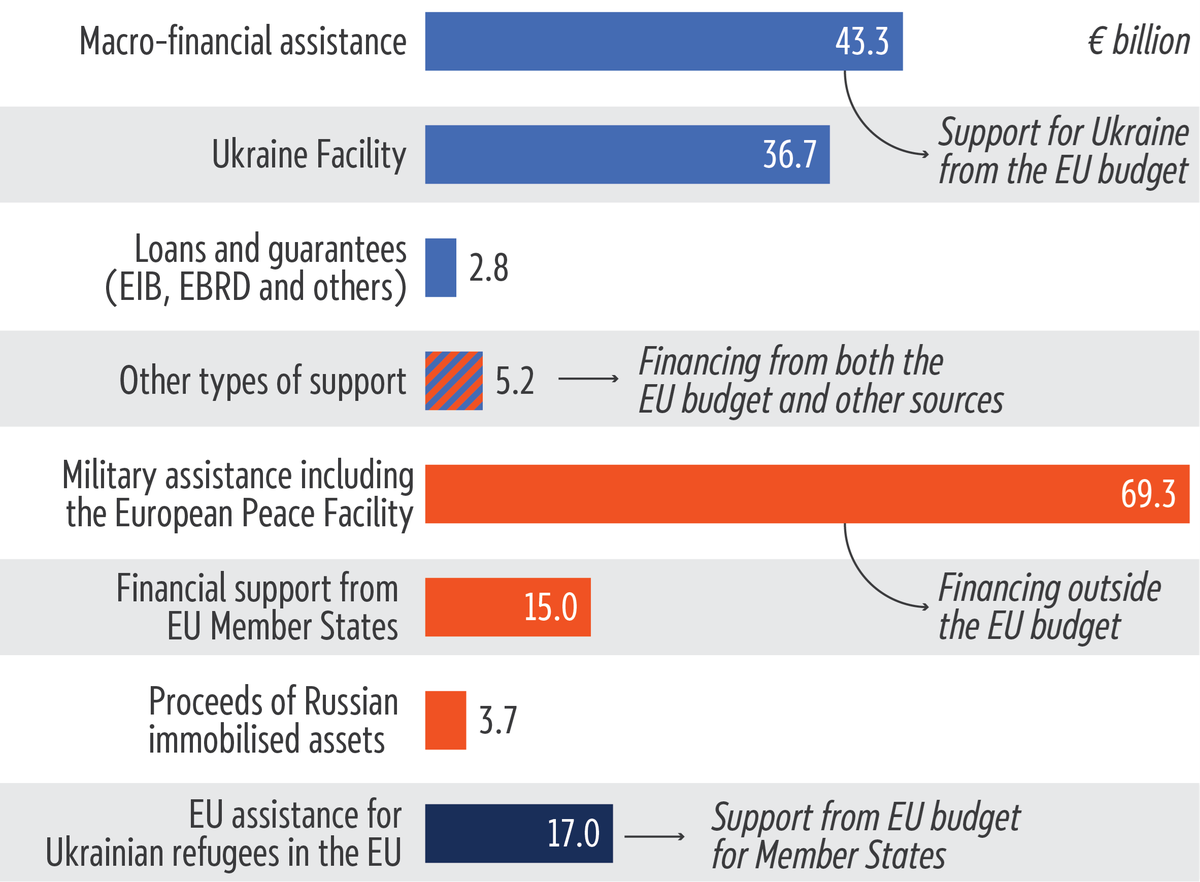
Data source: European Commission, EU Assistance to Ukraine, December 2025. Graphic by Lucille Killmayer, EPRS. Note: EIB: European Investment Bank; EBRD: European Bank for Reconstruction and Development.
In response to Russia's full-scale invasion of Ukraine in February 2022, the EU and its Member States have mobilised around €193 billion in financial, military and humanitarian assistance to support Ukraine, according to statistics provided by the European Commission (see Figure 1). Under the EU budget, support for Ukraine includes financial support through macro-financial assistance and the Ukraine Facility, as well as loans and guarantees from the EU and its financial institutions. In 2025, Team Europe surpassed the United States as the largest donor of allocated financial, humanitarian and military support for Ukraine, based on figures provided by the Kiel Institute's Ukraine Support Tracker.
Classification
Policy areas: Budget | Budgetary Control | Foreign Affairs | International Trade | Security and Defence
Regions: Non-EU Europe and the North
Committees: Foreign Affairs (AFET), International Trade (INTA), Budgets (BUDG), Budgetary Control (CONT)
Disclaimer
This document is prepared for, and addressed to, the Members and staff of the European Parliament as background material to assist them in their parliamentary work. The content of the document is the sole responsibility of its author(s) and any opinions expressed herein should not be taken to represent an official position of the Parliament.
Copyright
© European Union.
The reuse of this document is authorised under a Creative Commons Attribution 4.0 International (CC-BY 4.0) licence.

https://creativecommons.org/licenses/by/4.0/deed.en
To use or reproduce elements that are not owned by the European Union, permission may need to be sought directly from the respective rightsholders.