
Article page checkbox is not checked in page info.
An EU agenda for cities: Addressing cities' current challenges
An EU agenda for cities Addressing cities' current challenges
Vasilis Margaras, Members' Research Service

Summary
Towns and cities are home to nearly three quarters of the EU's population. Many EU cities and urban areas are vibrant spaces of economic growth and innovation. However, they also face complex challenges, such as tackling inequalities, addressing housing and demographic issues, building inclusive societies and responding to climate change and environmental degradation. Cities are at the forefront of implementing EU legislation in several policy areas, including cohesion, and have been demanding both a stronger role in shaping these policies and greater access to EU financial resources.
The EU's cohesion policy has a strong urban dimension. Its role in supporting sustainable urban development was strengthened in the current 2021‑2027 programming period to help cities play an active part in shaping and implementing policy responses to their own challenges. Cohesion funds invest more than €100 billion in towns and cities. For their part, cities are directly responsible for designing and implementing investments worth over €24 billion under cohesion policy programmes.
The 2016 Urban Agenda for the EU and the launch of participatory partnerships have created new expectations about the role of urban authorities in EU decision-making. The Pact of Amsterdam provided for urban partnerships focusing on key themes, such as air quality, urban poverty and housing. However, progress in empowering cities within cohesion policy has been limited. Stakeholders evaluating the progress of the Urban Agenda for the EU have highlighted issues such as insufficient EU resources channelled into urban issues, obstacles in obtaining direct EU funding, a lack of effective long-term urban governance mechanisms and limited input from urban areas into EU policies.
On 3 December 2025, the European Commission launched the EU agenda for cities to support cities in delivering on Europe's green, digital and social priorities. This new framework recognises the importance of cities in many policy areas and provides a set of instruments to involve them in EU policymaking.
The current briefing is an update of a previous briefing on the new urban policy agenda for the EU.
Introduction
According to Eurostat, a city is a local administrative unit (LAU) where the majority of the population lives in an urban centre of at least 50 000 inhabitants. A commuting zone contains the surrounding travel-to-work areas of a city where at least 15 % of employed residents work in that city, and a functional urban area consists of the city and its commuting zone. Metropolitan regions are urban agglomerations composed of NUTS level 3 regions (or groups thereof), where at least half the population lives inside a functional urban area of at least 250 000 inhabitants.
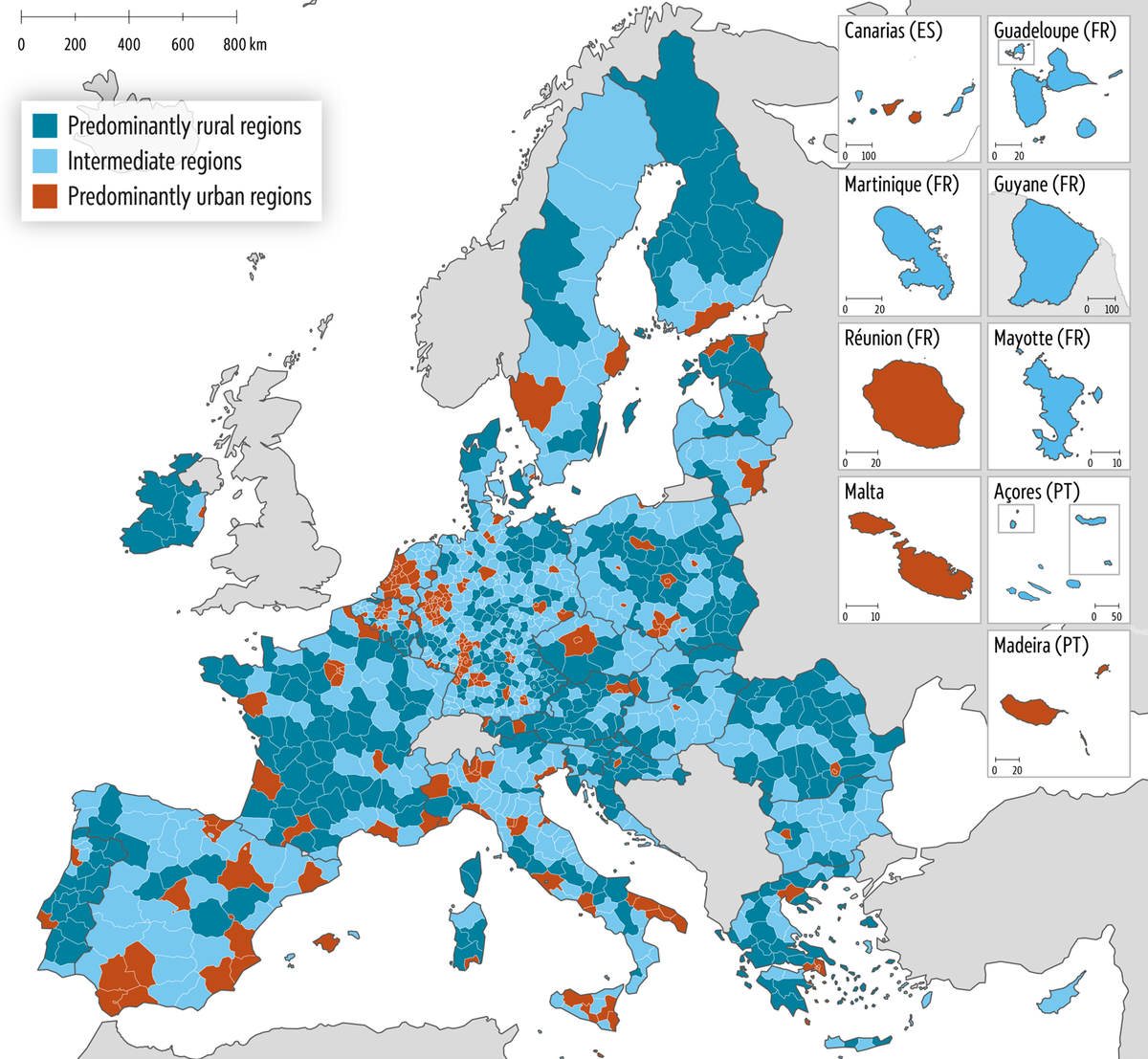
Source: European Commission, July 2024.
Map 1 shows the predominantly urban regions in red; these are NUTS 3 regions where more than 80 % of the population lives in urban clusters. Intermediate regions, marked in light blue, are NUTS 3 regions where between 50 % and 80 % of the population lives in urban clusters. Predominantly rural regions are indicated in teal. Eurostat reports that the distribution of the EU area by LAU level is 3.5 % for cities and 21 % for towns and suburbs. Rural areas make up 75.5 % of the EU area. However, in terms of regions, 9.9 % are categorised as urban, 50.4 % as 'intermediate regions' and 39.8 % as predominantly rural regions.
According to Eurostat, an analysis of population distribution by degree of urbanisation at the LAU level reveals that in 2021, 39.2 % of the EU population lived in cities, with lower shares living in towns and suburbs (36.3 %) and rural areas (24.6 %). Approximately three quarters of the EU population therefore live in urban areas.
Cohesion funds invest around €100 billion in towns and cities. For the 2021‑2027 period, objective 5 of EU cohesion policy – 'Europe closer to citizens' – was introduced as an enhanced commitment to integrated territorial development and a way to encourage sustainable urban development. A minimum of 8 % of the European Regional Development Fund (ERDF) resources in each Member State must be invested in priorities and projects selected by cities themselves, based on their own sustainable urban development strategies. The European Urban Initiative (EUI), established under Article 12 of the ERDF Regulation, forms part of this framework. With a budget of €395 million, it serves as an instrument to support cities of all sizes in building capacity and knowledge, fostering innovation and developing transferable and scalable solutions to urban challenges of EU relevance. Activities are coordinated with, and complemented by, the URBACT programme, which provides support to the intergovernmental work under the Urban Agenda for the EU.
In addition, the 2024 mission letter from the Executive Vice-President for Cohesion and Reforms, Raffaele Fitto, states that one of the Commissioner's main tasks is to ensure that people in the EU's regions – whether in cities, coastal communities or rural areas – have real opportunities to drive growth and productivity. It also highlights that all citizens have a right to stay in the place they call home.
According to the letter, another of the Executive Vice-President's tasks is to contribute to the European affordable housing plan. This includes injecting liquidity into the housing market and allowing Member States to double the planned cohesion policy investment in affordable housing. To harness cities' potential as engines of innovation, growth and competitiveness, the mission letter emphasises that an ambitious policy agenda for cities is needed.
The Urban Agenda for the EU and its evolution
The Urban Agenda for the EU (UAEU) is a new multi-level working method for urban policy and practice, promoting cooperation between Member States, cities, the European Commission and other stakeholders. Launched in May 2016 alongside the Pact of Amsterdam, the UAEU aims to involve urban authorities in achieving better regulation, funding and knowledge (knowledge base and exchange). It set itself the goal of strengthening the urban dimension in EU policy, allowing each participant to determine its level of involvement. The UAEU's first working programme covering 2016‑2021 established the agenda's operational framework, including its working method, actions and priority themes for the period, in line with the Pact of Amsterdam's objectives. Thematic partnerships serve as the main delivery mechanism, bringing together representatives from different government levels and stakeholders to collaborate on shared urban topics.
The New Leipzig Charter – 'The transformative power of cities for the common good' – was adopted at the informal ministerial meeting organised in November 2020. It serves as a key policy framework for sustainable urban development in the EU, highlighting the need for cities to put together integrated and sustainable urban development strategies across entire cities, from functional areas to neighbourhoods. The charter is strongly aligned with EU cohesion policy and its framework for sustainable urban development. At the same meeting, Member States agreed to implement the charter in their national and regional urban policies. An accompanying implementing document provides guidance for the next phase of the UAEU.
The Territorial Agenda 2030 – A future for all places, adopted on 1 December 2020, makes numerous references to the UAEU and highlights the role of cities in addressing major environmental and socio-economic challenges. It serves as a strategic framework for strategic spatial planning, calling for strengthening the territorial dimension across sector policies at all governance levels. The agenda aims to promote an inclusive and sustainable future for all places and support the achievement of the United Nations' Sustainable Development Goals (SDGs) within the EU.
On 26 November 2021, the informal meeting of EU ministers responsible for urban matters adopted the Ljubljana agreement, giving cities greater influence at EU level. The agreement was accompanied by the UAEU's second working programme (multiannual working programme 2022‑2026), which provides the framework for planning, implementing and monitoring the UAEU. It recommends the UAEU be more closely linked to EU agenda‑setting, policy-making and legislative processes at different levels to enhance its impact.
The UAEU working programme provides guidelines for its working methods. It emphasises that sectoral cooperation between Commission directorates-general (DGs) and national or regional ministries is crucial. These ministries should be included from the start in setting up and running partnerships and other forms of cooperation (OFC). It adds that systematic and early engagement by the European Investment Bank, European Parliament, European Committee of the Regions, European Economic and Social Committee and other stakeholders will further strengthen the UAEU.
The engagement of relevant Commission DGs in partnerships/OFC will be sought to allow for early and informal exchange on regulatory issues to achieve simpler and better EU laws. The Commission, with the help of the European Urban Initiative (EUI) secretariat, will foster intergovernmental cooperation on urban matters that bring EU added value and are relevant for the UAEU and the EUI. To help EU, national and urban leaders define further evolutions of UAEU shared responsibilities and actions, a cities forum will be held roughly every two years. As the key urban representative body in Parliament, the urban intergroup was asked to play an advisory role in the UAEU process. Parliament's Members and committees were invited to stay informed, follow the work of partnerships/OFC and provide recommendations.
The working programme confirms the validity of the 14 UAEU priority themes, which are topics addressed by the thematic partnerships. These cover:
-
inclusion of migrants and refugees
-
air quality
-
urban poverty
-
housing
-
circular economy
-
jobs and skills in the local economy
-
climate adaptation (including green infrastructure solutions)
-
energy transition
-
sustainable use of land and nature-based solutions
-
urban mobility
-
digital transition
-
innovative and responsible public procurement
-
culture and cultural heritage
-
security in public spaces.
The 20 UAEU partnerships
Ongoing: building decarbonisation, water-sensitive city, cities of equality, food, sustainable tourism, greening cities, public procurement, inclusion of migrants and refugees.
New: compact cities (approved in December 2025).
Concluded: culture and cultural heritage, security in public spaces, sustainable land use, energy transition, climate adaptation, urban mobility, digital transition, circular economy, jobs and skills in the local economy, urban poverty, housing, air quality.
The 2021 Ljubljana agreement added four new priority themes: cities of equality, food, greening cities and sustainable tourism. The Urban Agenda website provides more information on each partnership and its development. Furthermore, the Ljubljana agreement introduced the requirement to conduct an ex‑ante assessment before establishing a thematic partnership or an OFC under the UAEU, in order to identify potential links to the EU policy cycle. This procedure was first applied in establishing thematic partnerships on greening cities and sustainable tourism.
The UAEU working programme allows priority themes previously explored by partnerships to be revisited from a fresh perspective, taking into account unresolved challenges, priority issues in need of further investigation or matters common to a cluster of themes meriting renewed attention. The directors-general on urban matters (DGUM) – a cross-cutting group of Commission directors‑general overseeing urban policy across DGs – can review the list of priority themes annually and provide guidance informed by a bottom-up approach. Any new priority themes or modifications to existing ones must be reviewed by the EU ministers responsible for urban matters. All forms of multi-level and multi-stakeholder cooperation within the UAEU framework must be initiated by a well-reasoned proposal linked to an existing UAEU priority theme or theme cluster. Such proposals may originate from cities, regions and/or one or more UAEU stakeholders.
It is also recommended that partnerships/OFC maintain a consistently balanced composition to ensure both geographical and institutional diversity. This balance should be reflected in the representation of the European Commission, Member States, urban authorities and other stakeholders. It is important to ensure representation from a diverse and capable range of urban authorities of all sizes, reflecting the full variety of urban and regional contexts across the EU. Furthermore, it is recommended that at least one partnership/OFC coordinator be drawn from an urban authority. To encourage small and medium-sized urban authorities to participate in the UAEU process, several suggestions are offered. For example, partnerships or OFC should, where relevant, consider the challenges faced by small and medium-sized cities and towns. The selection criteria for partners should also be designed to motivate and encourage small and medium-sized urban authorities to participate in UAEU multi-level cooperation. The challenges they face could be addressed through future UAEU multi-level cooperation.
Developments in the Council of the EU and the European Commission
On 26 June 2024, the DGUM endorsed the ex-ante assessment for two priority themes – water‑sensitive city and building decarbonisation – specifically addressing integrated renovation programmes and local heating and cooling plans. These endorsements marked a key step towards establishing two new UAEU thematic partnerships (building decarbonisation and water-sensitive cities), launched during the Council's Belgian presidency. Separately during the Belgian presidency, compact cities was identified as a future partnership theme. On 16 May 2025, the DGUM formally endorsed the ex-ante assessment for compact cities (sustainable urban planning and sprawl mitigation), marking a significant step towards establishing a new UAEU thematic partnership.
In a joint declaration adopted during their informal meeting of 21 May 2025, EU ministers responsible for cohesion and urban matters underlined that cities of all sizes and their functional areas are key drivers of competitiveness and innovation, engines of economic growth and hubs of social and cultural development. They play a vital role in fostering sustainability and addressing contemporary challenges. The ministers highlighted the importance of addressing urban-rural linkages. They highlighted the necessity of adequate spatial planning that enables synergies between urban and rural areas, ultimately contributing to more resilient economies, sustainability and improved quality of life. They highlighted the potential benefits of strategically integrating housing policies and investment into broader urban and rural development frameworks. The ministers urged the European Commission to ensure that both the EU's post-2027 strategic, legislative and financial frameworks and current policy initiatives (particularly the new policy agenda for cities) incorporate the territorial dimension and address joint EU priorities and challenges. Furthermore, they called on the Commission to address the three dimensions of EU cities' transformative development – just, green and productive – as outlined in the New Leipzig Charter, ensuring their proper integration into future EU policies.
Additionally, the ministers emphasised that sustainable urban development requires adequate EU support. They urged the European Commission to view regions, cities of all sizes and their functional areas as strategic partners in shaping and implementing EU policies, rather than as passive funding recipients. It should likewise enhance institutional capacity building and urban cooperation so that cities of all sizes can contribute effectively to EU priorities. The ministers addressed the need to consolidate and better coordinate various EU instruments for cities (including, where relevant, their functional areas), making them accessible, efficient, effective, transparent and useful for regional and local authorities.
The ministers also wanted it to be made easier to set up UAEU thematic partnerships and implement the ensuing actions, especially those developed under the Better Regulation pillar, and to ensure operational interconnection between the UAEU and relevant EU programmes. They highlighted the importance of coordination, continuity and complementarity between the UAEU and the forthcoming policy agenda for cities. Regional and urban partners should also be able to contribute to policy agendas, including designing and implementing the new policy agenda for cities.
In addition, in April 2025 the Commission published a communication on the mid-term review of EU cohesion policy, accompanied by a proposal for a regulation amending the European Regional Development Fund, Cohesion Fund and Just Transition Fund. The communication outlined emerging priorities that could benefit from a reallocation of funding. These include closing the innovation gap and strengthening competitiveness and decarbonisation, defence and security, affordable housing, water resilience, energy transition and support to eastern border regions. Some of these topics, such as decarbonisation, affordable housing and energy, have also been identified as policy priorities by various urban stakeholders in their own strategic papers. The mid-term review regulations were adopted by the co-legislators in September 2025. It remains to be seen to what extent cities and urban areas will benefit from the increased funding allocated to the above priorities.
European Parliament's stance
Overall, the European Parliament has supported the establishment of an urban agenda as part of the Europe 2020 strategy objectives of smart, inclusive and sustainable growth. Parliament has supported the emergence of the UAEU and voted on a series of resolutions calling for an ambitious policy agenda that involves cities and towns in EU policymaking.
In its 2022 resolution on challenges for urban areas in the post-COVID-19 era, Parliament acknowledges the need for stronger cooperation on EU programmes and policies among and within urban areas. It notes that although existing urban initiatives have grown in recent years, coordination remains low and risks of duplication and indiscernible impacts remain. It welcomes the UAEU as a new model for multi-level governance, but regrets its voluntary nature. It calls on the Commission and Member States to strongly support local and regional authorities and their project management teams, ensuring that adequate administrative facilities exist in cities, towns and functional urban areas, including appropriately trained staff. It insists that regional and local authorities have a key role to play in all stages of EU decision-making – planning, preparation and implementation – and that more direct EU funding needs to be made available. It calls for a larger budget and scope for the EUI, while ensuring that cities in the outermost regions can access it easily and effectively. It calls on the Council and Member States to allocate up to 15 % for urban areas to address post-COVID challenges.
It asks the Commission to examine the EUI's effectiveness, in particular its budget and scope, and to encourage Member States to provide greater resources to support delivery of the UAEU. It regrets the lack of current opportunities to establish a structured dialogue between the Commission and cities in the Recovery and Resilience Facility for monitoring urban authorities' involvement in implementing national recovery and resilience plans. In its review, it calls on the Commission to report on the facility's implementation and examine the possible role of functional urban areas (which should be strengthened if needed) to guarantee effective implementation of the facility. Urban authorities should have the necessary support to properly implement national recovery and resilience plans through capacity building, exchanges and technical assistance.
Furthermore, it calls for a strategy for functional urban areas and medium‑sized cities, including funding for actions such as innovation partnerships and joint procurement schemes between EU cities, and cooperation between EU cities and regions.
In its 2025 resolution on the ninth report on economic and social cohesion, Parliament states that the cohesion policy model (a focus on regional and local levels, a place-based approach and decentralised strategic planning, programming and implementation based on the partnership principle) should be maintained across all regions. It should also be enhanced, since it is the EU's main long‑term investment instrument for reducing disparities, ensuring economic, social and territorial cohesion and stimulating sustainable regional and local growth. Parliament underlines the fact that towns, cities and metropolitan areas have specific challenges, including pockets of poverty, housing problems, traffic congestion and poor air quality. These put pressure on social and economic cohesion, which is often linked to uneven territorial development. It emphasises the need for a specific agenda for cities, calling for deepening their links with functional urban areas composed of smaller cities and towns, to ensure that economic and social benefits are distributed more evenly. It highlights the need to strengthen coordination between the UAEU initiatives and cohesion policy instruments, favouring an integrated approach that considers territorial specificities and emerging challenges.
It furthermore calls for ensuring more direct EU funding for regional and local authorities, cities and urban authorities. Investment in affordable housing should be increased as part of cohesion policy and its scope widened beyond the current focus on energy efficiency and social housing. Finally, it emphasises the importance of cohesion policy in rolling out and coordinating these initiatives.
In December 2024, Parliament set up a special committee on the EU housing crisis to propose solutions for decent, sustainable and affordable housing.
Parliament is expected to start drafting its own initiative report on the EU agenda for cities in 2026.
Advisory bodies' and stakeholders' views
The European Committee of the Regions (CoR)
In its opinion on metropolitan regions and functional urban areas, the CoR states that the social and economic influence of metropolitan areas often goes beyond their administrative boundaries. To achieve territorial cohesion, it calls for functional approaches that reflect commuting flows and the complex relationships between urban and rural areas. It stresses the growing importance of functional urban areas in EU policies and draws attention to the concept of functional areas in strategic discussions at all levels of governance. It is keen on a strong, flexible and reformed post‑2027 cohesion policy to further reduce regional disparities and increase competitiveness across EU regions, while also addressing new challenges, such as climate disasters and demographic change. It calls on the Commission to develop the future policy agenda for cities based on the well‑established territorial approaches and cooperation mechanisms of cohesion policy, strengthening dialogue with cities, metropolitan areas, functional urban areas and regions.
The CoR believes that the UAEU needs to be added to and further strengthened. Although the UAEU has facilitated strategic partnerships and dialogue between the Commission, Member States and local authorities, it has not ensured adequate levels of coordination and integration of urban perspectives into EU legislation or funding. Fresh impetus is needed for the UAEU, and the new Commission policy agenda for cities should include tools to support functional urban areas.
Furthermore, the future policy agenda for cities should adopt a thematically broad, horizontal approach focused on competitiveness, sustainability, digitalisation, social cohesion, housing, mobility and climate resilience. It should also encourage further integrated investment that fosters cohesive growth and strengthens urban-rural links. The CoR strongly opposes any attempt to centralise EU policies currently implemented under shared management, and supports greater decentralisation in the post-2027 framework. Finally, it calls for adequate funding for cities and metropolitan areas.
The EU agenda for cities
The EU urban agenda for cities was published in December 2025. It analyses the various challenges and opportunities faced by cities. The agenda states that cities are powerful magnets of talent and drivers of competitiveness, digitalisation, innovation and investment. Cities are key to ensuring the safety and security of public spaces and are on the frontline of EU resilience. They also provide better access to transport and are heavily involved in international cooperation activities. However, they show a mixed picture on poverty, social inclusion and equality, and experience acute challenges related to housing and buildings. The strategy describes the current level of EU support for cities and concludes that further EU support is needed.
The urban agenda for cities presents its vision for thriving, liveable, prosperous and inclusive cities that offer high levels of digital connectivity and opportunities for people of all generations and businesses. High‑quality jobs, affordable, sustainable and decent quality housing for all, and easy access to services are vital for thriving cities. European cities would provide opportunities for high educational attainment and skills development, attracting talent and integrating newcomers. The attractiveness of cities, including as vibrant, diverse tourism destinations that are sustainable and preserve their cultural heritage, is key to their prosperity. Safety, security, inclusiveness and respecting fundamental rights are of vital importance for cities across Europe. Smart, sustainable and affordable cities that provide inclusive mobility solutions will enhance people's quality of life.
Synergies should exist with nearby rural areas, creating a balanced relationship between urban and rural spaces. Energy efficiency, locally produced renewable energy, enhanced natural ecosystems and progress towards climate-neutrality all promote a healthy environment and resilience to the impacts of climate change, protecting economies and well-being. Fostering civic engagement and democratic participation at city level, where citizens often engage most actively with authorities, is of key importance. Policy-making should be based on relevant, up‑to‑date data and deliver publicly consulted and accepted outcomes tailored to local needs. City decisions need to be aligned with broader EU goals and initiatives, such as the competitiveness compass, the New Leipzig Charter and international frameworks, including the United Nations Agenda 2030 and the UN New Urban Agenda.
The agenda also outlines various practical steps:
-
From 2026, the European Commission will set up regular dialogues with cities. An annual high-level political dialogue will be organised with the Commission, giving local leaders the opportunity to inform policy discussions.
-
Regular, targeted consultations at technical level will be held between urban practitioners and relevant Commission services, to identify good practice and opportunities to reduce and simplify administrative burdens.
-
Regular dialogue will take place between the European Committee of the Regions and the European Parliament.
-
The Cities Forum will continue to take place regularly and the Commission will produce a state of European cities report at regular intervals.
-
The Commission has launched a web portal to facilitate cities' access to the current EU support available. This will act as a communication tool and space for stakeholders to interact and obtain information about activities, events, news, policy developments and opportunities of relevance to urban development. It will provide an overview of EU initiatives supporting cities (by topic, stage and implementation, etc.) and redirect users to detailed information. Later, under the next MFF, the portal will become a key element of the cities platform and be used for communication and outreach.
-
The fourth EUI innovative actions call will be launched in early 2026. It will focus on supporting smaller-scale pilot projects to test innovative solutions to urban challenges, particularly targeting small and medium-sized cities with limited innovation capacities.
-
In terms of funding in the next MFF, partnership and multi-level governance will be the guiding principles. EU Member States will be required to support territorial and local cooperation initiatives, including integrated urban development strategies. Member States and regions are encouraged to strengthen their commitment to resourcing urban strategies, including through their national and regional partnership plans (NRPPs). The agenda also sees funding opportunities for cities in the European competitiveness fund and the global Europe programme for international cooperation.
Reactions from regional/local stakeholders
From 14 April 2025 to 26 May 2025, the Commission opened a call for evidence for the new EU policy agenda for cities – a Commission initiative aimed at creating a more formal, structured EU urban policy framework – which attracted considerable input from local and regional stakeholders. Responses highlighted the UAEU's limitations, based on stakeholder experience, and identified the urban policy challenges to include in the future EU policy agenda for cities. After publication of the agenda, many stakeholders expressed their views on various themes which it covered.
According to Eurocities, city leaders have reacted positively to the announcement of the EU policy agenda for cities, stating that it recognises the role of cities in delivering on Europe's priorities. At the same time, they warn that the new framework risks falling short of its potential without stronger guarantees for cities regarding EU funding, governance and regulatory coordination. The new agenda responds to that call by setting out a unified vision for Europe's cities and introducing new tools, including EU city dialogues and an EU cities platform. These are expected to strengthen cities' role in EU policy-making and harmonise the fragmented landscape of EU city initiatives. The idea of bringing together city-related programmes, funds and initiatives in a single platform is a step towards a more coherent and accessible approach. For this ambitious initiative to become a reality, it must be supported by strong political leadership and internal coordination from all Commission services. In addition, the agenda signals a more strategic approach towards cities, including an annual political dialogue, stronger coordination across Commission DGs, better regulatory cooperation with local governments and closer links between EU missions, expert groups and city networks.
However, funding remains the critical missing piece. The agenda has done little to ease local leaders' worries over the Commission's plan to allow national governments to manage the distribution of funds to cities in the bloc's next seven-year budget. Cities welcome the reference to better use of existing EU programmes, but stress that encouragement alone is not enough. Local governments have spent months sounding the alarm, as such a measure would give national governments increased control over the EU budget's proposed national and regional partnership plans (NRPPs), and does not earmark minimum amounts for urban development expenditures. Based on previous experience of the EU Recovery and Resilience Facility (RRF), city leaders know that without clear earmarking, distinct urban chapters in national and regional plans and predictable access to resources, city governments risk once again being left dependent on decisions taken nationally.
In terms of governance, cities see progress but would like the structure to be improved. One EU dialogue per year with cities is a positive step but may not, on its own, be sufficient to deal with the complexity of EU legislation and programmes affecting cities. Eurocities has proposed long‑standing thematic boards linked to an overall urban sounding board that can escalate cross‑cutting issues and ensure consistent follow-up across Commission services. Furthermore, a clearer explanation of how the new agenda interacts with the existing Urban Agenda for the EU would be helpful. In the past, some Urban Agenda partnerships have struggled to influence sectoral policies because of uneven engagement from different Commission services. Cities want the new agenda to ensure that lessons from these partnerships are translated into strong regulatory changes and support for local implementation.
The Commission's internal capacity is another concern. City leaders will be watching closely to see how the European Commission organises the agenda's implementation, including inter-service coordination and dedicated teams working on cities. They stress that the agenda must be backed by concrete follow-up, meaning targeted funding, streamlined programmes, better access to data and evidence, and capacity-building offers that respond to real municipal needs rather than generic training.
According to the Council of European Municipalities and Regions (CEMR), the EU agenda for cities marks an important step towards strengthening the urban dimension of EU policies. It acknowledges the key role of local and regional governments in implementing 70 % of EU legislation, and thus the importance of better informing and liaising with local governments in the drafting process. It falls short of President Ursula von der Leyen's call for 'ambitious' in her mission letter to Executive Vice‑President Raffaele Fitto. In addition, several elements need to be clarified and improved to ensure the agenda truly delivers solutions for cities of all sizes and contributes to better policy-making by a transparent and representative partnership with local and regional governments at European level.
In addition, continued reliance on the Eurostat definition of 'urban centres' (50 000+ inhabitants) risks leaving much of Europe behind. As with the implementation of European innovative action, the Eurostat definition has become the minimum population criteria in calls for proposals directly managed by the Commission. This approach may inadvertently exclude small and medium-sized municipalities, which make up most local governments and are at the heart of delivering EU policies. Furthermore, an effective EU agenda must reflect the EU's full territorial diversity and avoid reinforcing urban-rural divides. The governance model proposed still relies heavily on ad hoc consultations, including the reference to the June 2025 implementation dialogue, which lacked transparency and representativity. The CEMR reiterates the need for a permanent, structured and inclusive multi-level governance mechanism involving local and regional governments and their representative associations at national and European level. This is essential for shaping – and not just implementing – EU policies.
In particular, the CEMR calls for a dedicated better implementation pillar as part of the EU Urban Agenda. This would comprise governance and competence impact assessments for all new EU proposals, capacity-building resources in the reforms pillar of the next MFF, regular and inclusive implementation dialogues, and a one-stop shop integrating all subnational governments' support tools. The CEMR welcomes the launch of the new EU city portal, which can help cities navigate funding opportunities more easily. At the same time, the future EU Facility – to be directly managed by the Commission – raises questions about the future of existing programmes (EUI and URBACT) and on smaller municipalities' governance, accessibility and safeguarding participation.
When referring to the NRPP for the post‑2027 EU budget, the Commission states that structured multi-level dialogue will be a key feature in the preparation and implementation of the plan, but did not include any binding measure to ensure this. On the other hand, the CEMR welcomes new initiatives announced in the agenda, including 'potential' access to the European Competitiveness Fund for clean transition and industrial decarbonisation, resilience, security and defence, high-level technical consultations with urban stakeholders, and greater support for capacity building, including for public procurement. Agenda measures can help cities accelerate the green and digital transitions – as long as access is equitable and not restricted to larger or better resourced municipalities.
According to ICLEI Europe, the agenda acknowledges cities as essential drivers of Europe's green, digital and social transition and clearly outlines the scale of the challenges they face. Yet the resources proposed fall short of what is needed to address them. It does not introduce dedicated EU funding for cities, instead encouraging Member States to consult local and regional governments when drafting their NRPPs. Crucially, it does not earmark any resources for cities under the proposed EU Facility. In its current form, the EU Facility, the Commission's new flexible financing instrument, provides only one shared budget line for cities – grouped with social innovation and employment – totalling just €11 billion for 2028‑2034.
Outlook
The UAEU has progressed considerably from its initial experimentation stage to ongoing partnerships that bear fruit. However, the Parliament, CoR and local and regional stakeholders point to several weaknesses and bottlenecks that hinder its future development. The UAEU's ambition is limited by the restricted influence of cities and urban areas in EU policy-making, insufficient resources allocated to the UAEU and the difficulties many small and medium-sized cities face in participating in and tracking UAEU-related developments and partnerships. Dealing with internal EU bureaucratic hurdles and navigating the complex policy and institutional fragmentation of EU governance further constrains the UAEU's ability to evolve in its current form and influence EU decision-making further.
The dialogue on the role of cities in EU policies has been revitalised by the European Commission's agenda for cities. However, the agenda is inextricably linked to the future of cohesion policy and the post-2027 EU budget. The EU budget proposals for 2028-2034 presented by the Commission in July 2025 include 27 NRPPs, combining cohesion funding and agricultural subsidies into one planning and implementation framework. This approach appears to reduce the overall cohesion budget and gives Member States more say in managing EU funds. However, the budget procedure is still in its early stages, with lengthy negotiations expected between the Council and Parliament. The final distribution of EU budget resources to cohesion policy, along with the accompanying legislative framework, will demonstrate the true level of ambition for cohesion and urban policy.
Main references
- Brandmüller, T., Farkas, M. and Fodor, R., Eurostat regional yearbook – 2025 edition, Eurostat, Luxembourg.
- De Gregorio Hurtado, S., 'The urban dimension of Cohesion Policy: insights into its genealogy, evolution, and future potential' in EU Cohesion Policy, Dotti, N., Musialkowska, I., De Gregorio Hurtado, S. and Walczyk, J., Edward Elgar Publishing Limited, Cheltenham, UK, 2024.
- European Investment Bank, The state of local infrastructure investment in Europe, April 2025.
- Margaras, V. and Szechy, B., Guide to EU funding – 2023 edition, EPRS, European Parliament, June 2023.
- Morrison, A. and Severin, A., Tactical urban regeneration, Interreg Europe, August 2025.
- Van Lierop, C., Strengthening the Urban Agenda for the EU, EPRS, European Parliament, January 2021.
Classification
Policy areas: Regional Development
Regions: European Union
Committees: Regional Development (REGI)
Disclaimer
This document is prepared for, and addressed to, the Members and staff of the European Parliament as background material to assist them in their parliamentary work. The content of the document is the sole responsibility of its author(s) and any opinions expressed herein should not be taken to represent an official position of the Parliament.
Copyright
© European Union.
The reuse of this document is authorised under a Creative Commons Attribution 4.0 International (CC-BY 4.0) licence.

https://creativecommons.org/licenses/by/4.0/deed.en
To use or reproduce elements that are not owned by the European Union, permission may need to be sought directly from the respective rightsholders.