
Article page checkbox is not checked in page info.
Impact of cormorant predation on EU fisheries and aquaculture
Impact of cormorant predation on EU fisheries and aquaculture
Frederik Scholaert, Members' Research Service
Summary
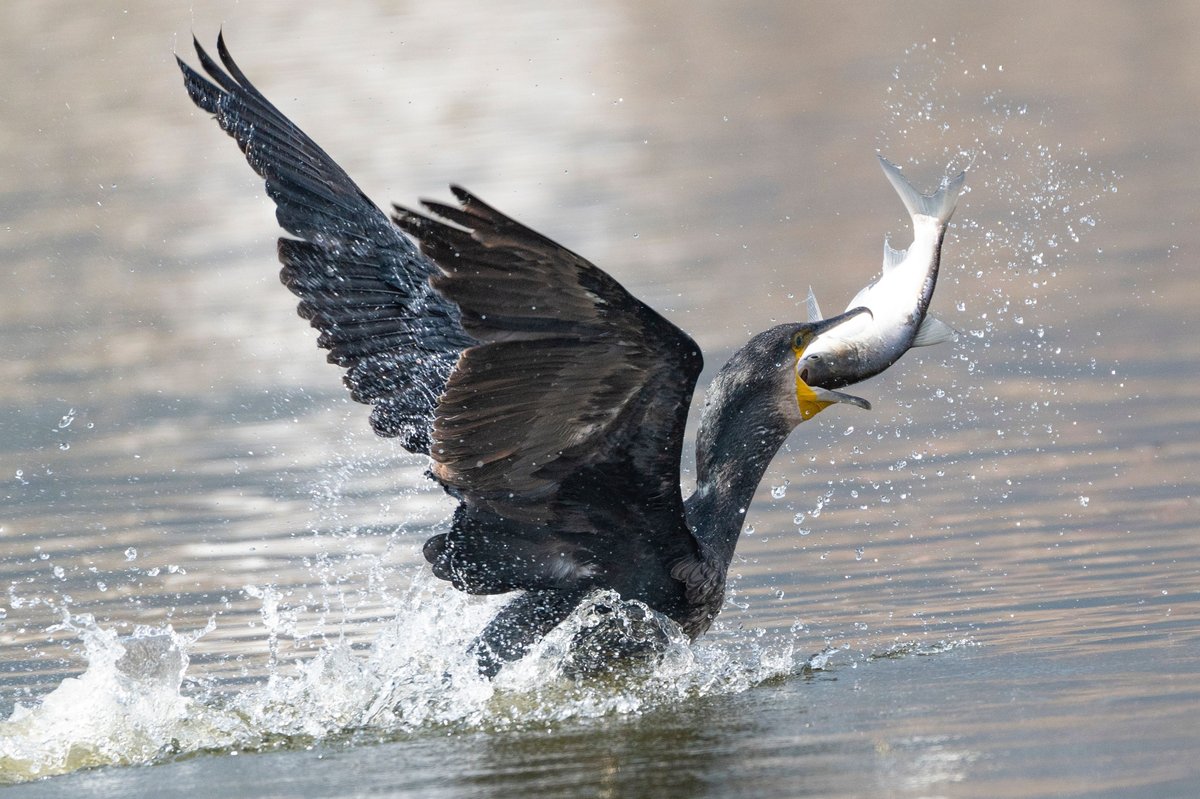
The great cormorant is a highly mobile, fish-eating bird that has a significant and widespread impact on fish stocks and aquaculture sites. Due to its predation impact, the cormorant was heavily persecuted in the 19th and early 20th centuries, but has been a protected species since the European Union Birds Directive came into force in 1979. Its population has grown significantly since then. While the bird cannot be hunted, the Birds Directive permits derogations to prevent serious damage to wild fish stocks and fish farms. These derogations are widely used by Member States, in a highly varied manner.
The European Parliament called for the adoption of a European cormorant management plan in 2008, to minimise the increasing impact of cormorants on fish stocks, fishing and aquaculture. This request was reiterated in the Parliament's 2018 and 2022 resolutions on aquaculture. Similarly, at Council meetings in September and October 2025, several Member States urged the European Commission to coordinate EU-wide management of cormorant populations.
Following recent discussions, the Commission held a structured dialogue with the Member States in October 2025. In this context, the Commission announced updated guidance on the use of derogations under the Birds Directive.
In November 2025, the European Inland Fisheries and Aquaculture Advisory Commission, an intergovernmental fisheries advisory body, published its final framework for a management plan as part of a project co-funded by the EU. The aim of this initiative is to maintain favourable conservation status for the cormorant while protecting fish species and aquaculture fish farms.
Cormorants in Europe
Species
The most common species of cormorant in Europe is the great cormorant (Phalacrocorax carbo). There are two other, smaller cormorant species in Europe: the shag and the pygmy cormorant. Cormorants are fish eaters and nest in colonies around coasts or inland bodies of water.
This briefing focuses on the great cormorant, referred to simply as the cormorant. It has two subspecies: the 'Atlantic' carbo subspecies (Phalacrocorax carbo carbo), and the 'continental' sinensis subspecies (Phalacrocorax carbo sinensis). The carbo subspecies is slightly larger and nests on coastal cliffs. Although it is regarded as a seabird, it sometimes breeds at inland sites. The sinensis subspecies has always inhabited both inland and coastal areas, typically nesting in trees.
The cormorant is a migratory bird, with many individuals from northern breeding areas migrating south in winter. However, their migration pattern is not typical. Some birds move just 100 km south, while others fly in stages across the Mediterranean to the coast of North Africa. Migration also varies with the severity of the winter. In recent decades, the sinensis subspecies has increasingly migrated and established new colonies across large inland waterbodies and wetlands in Europe.
The cormorant has few natural enemies. No predators regularly hunt them for food. The leading causes of death are exhaustion and starvation, mainly due to weather conditions, or human-made pressures.
Population numbers
Decline from the 19th century followed by spectacular increase from 1970 to 2000
Archaeological evidence shows the cormorant has been widespread across Europe since ancient times, while medieval accounts refer to cormorants' negative impact on fish stocks and aquaculture. As human settlements in Europe grew, cormorants were increasingly hunted, particularly at their breeding grounds. Long persecuted for damaging fish stocks, war was virtually declared on cormorants in the 19th century. Colonies were systematically destroyed, including by fire brigades and military forces. Sinensis numbers declined further around the mid-20th century as a result of harmful chemicals. By the early 1960s, the total number of breeding pairs in the main breeding range (comprising the Netherlands, Germany, Denmark, Sweden and Poland) had fallen to 3 500‑4 300 pairs.
The population began to grow as protection increased, particularly following the Birds Directive (see 'The Birds Directive'). In the five main breeding countries, average annual population growth was 18 % in the 1980s. While numbers stabilised in some core breeding areas, the sinensis population expanded along the Baltic Sea, re-establishing itself in areas where it had previously become extinct.
Stabilising in the 2000s
Coordinated pan-European counts have provided valuable insight into recent population trends (see box). The 2006 and 2012 nest counts show the European cormorant population has levelled off since 2006, with only a slight increase in the overall number of sinensis individuals and a decrease of the smaller carbo population.
Pan-European counts of 2006 and 2012/2013
The 'sustainable management of cormorant populations' (CorMan) was an EU initiative focused on cormorants and their impact, and involved counting breeding pairs (nests) in 2012 and winter night roosts in January 2013. The follow-up project, 'dynamics of the great cormorant population in Europe' (CormoDist), analysed migratory patterns by ringing sinensis subspecies chicks. Both CorMan and CormoDist were coordinated by Aarhus University (Denmark) and conducted in collaboration with the IUCN Wetlands International Cormorant Research Group. The latter carried out an earlier pan-European count of breeding pairs in 2006.
Unlike nest counts, winter counts examine distribution, by counting sleeping roosts, in the winter months. The 2013 winter count gathered data from around 38 countries. A similar 2003 census enabled comparison. The 2013 count estimated the number of cormorants at 636 000–648 000 individuals, which was 15 % more than in the 2003 census
Current population status in the EU
Article 12 reporting under the Birds Directive
Member States must report on the population status of species protected under the Birds Directive (Article 12) every six years. The Commission makes this information available via a webtool and a report. The most recent report, published in 2020, presented the results of the third reporting cycle for 2013–2018.
According to the 2013–2018 reporting cycle, there were around 253 000 breeding pairs and approximately 549 000 wintering birds in the EU27. As can be seen in Figure 1, the Baltic region is the most significant breeding range. The following Member States (in descending order of breeding pairs): Sweden, Denmark, Poland, Germany, Finland, Estonia, Lithuania and Latvia, accounted for 71 % of the total number of breeding pairs in the EU. High breeding numbers were also noted in the Netherlands and Romania (the latter having large colonies in the Danube Delta).
The largest numbers of wintering birds were observed in France (107 000), Italy (80 000), Germany (73 000) and Spain (70 000). The large number of cormorants that winter in southern EU countries contrasts with the small number of breeding pairs in these countries. This reflects the southward winter migration of the colonies breeding in countries around the Baltic Sea in particular, and to a lesser extent in countries around the North Sea, as detailed in the CormoDist report. However, although the breeding population in southern Europe is likely to remain small compared to the number of wintering cormorants, the number of breeding pairs in Spain increased significantly (fourfold since 2006).
Most recent figures – significant increase in the Baltic breeding population
Recent data from national sources indicates that the Baltic breeding population has increased again, to a total of around 245 000 breeding pairs across the eight Baltic EU Member States, about one third higher than the 2013–2018 figure. The highest increases were in Sweden (74 767 breeding pairs in 2023, an 83 % increase compared to 2012) and Estonia (43 600 breeding pairs in 2023, double the 2015 figure). Further increases can be noted for Finland and Lithuania. However, figures for Denmark, Germany, Poland and Latvia remained rather constant or slightly decreased.
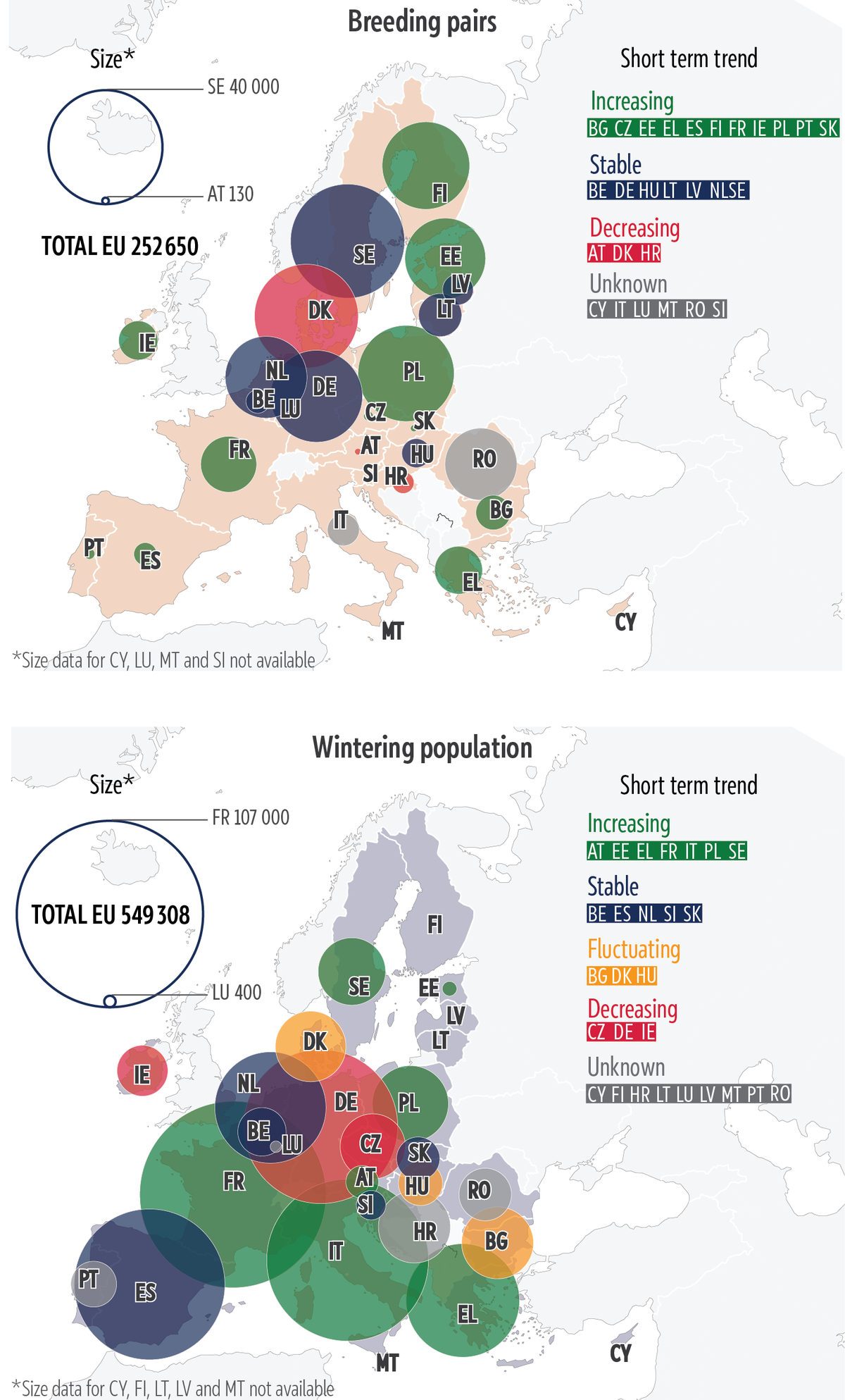
Data source: Population status of Phalacrocorax carbo (2013–2018 reporting period), Article 12 web tool, European Commission.
Impact on fisheries and aquaculture
The European Inland Fisheries and Aquaculture Advisory Commission (EIFAAC), the Federation of European Aquaculture Producers (FEAP) and the European Angling Alliance (EAA) estimate that cormorant predation has cost aquaculture and recreational fisheries in Europe over €350 million in both 2023 and 2024. In addition to direct losses from predation, indirect losses cover injuries and infections caused by cormorants. According to stakeholders, cormorant damage is jeopardising the profitability of pond farming.
Cormorants can also affect coastal fishing in marine waters. For example, Estonia's breeding population, primarily located on coastal sites, is estimated to consume approximately 16 000 tonnes of fish each year. This figure is roughly equivalent to the total catch of coastal fisheries. Of particular concern is the current state of Baltic cod stocks. These stocks are at an all-time low for a number of reasons, including historical overfishing and environmental stressors, so fisheries targeting this species have been halted. Scientific research estimated that 15 million cod per year are eaten by cormorants in the Danish part of the Western Baltic, whereas total cod recruitment is currently estimated to be between 4 million and 17 million per year. The Baltic Sea Advisory Council (BSAC) is divided on how to tackle this issue. Fisheries representatives in the BSAC believe that if predation is the cause of the extremely high natural mortality of juvenile cod, then immediate measures to manage cormorant populations are needed to allow the cod stocks to recover. However, environmental NGO representatives draw attention to the poor state of the Baltic ecosystem as the reason for the low cod recruitment. They are calling for habitats to be restored and for cod bycatch to be further minimised.
Cormorants' in-river foraging also impacts wild freshwater fish species. Examples include grayling, salmon, trout and eel. While there is little documentation on cormorant predation's contribution to decline of these species, research in Denmark shows even a small number of cormorants can deplete river populations.
Birds Directive
The cormorant was granted protection under the 1979 Birds Directive, one of the EU's earliest environmental laws. The directive aims at protecting all naturally occurring wild bird species in the EU, as well as their most important habitats. Notably, it stipulates that Member States must implement a comprehensive protection system for these birds. This includes prohibiting the deliberate disturbance, capture or killing of the birds, as well as the destruction or robbery of their nests. Annex II of the directive lists bird species that may be hunted under national legislation due to their population level, geographical distribution and reproductive rate throughout the EU. The cormorant is not listed in this annex.
Article 9 derogations
However, even if a species is not listed in Annex II, Article 9 of the directive allows Member States to derogate from the protection status when birds are causing, or are likely to cause, serious damage. These measures, as well as compensation for losses caused by cormorants, can be co-financed by the European Maritime, Fisheries and Aquaculture Fund (EMFAF). In 2013, the Commission published guidelines on the use of such measures. Member States must report these measures to the Commission, which publishes them on a dashboard. The process of authorising derogations varies widely across Member States, with regions often being given this responsibility. For more information on implementation in five Member States with either a high breeding population (Sweden and Denmark), a high wintering population (Italy) or both (France and Germany), see the box.
Examples of the implementation of Article 9 in selected Member States and regions.
After facing spectacular increases in cormorant numbers, Denmark pioneered a national cormorant management plan in 1992, after which cormorant numbers levelled off. The latest version of the plan dates from 2022. The measures focus on controlling the breeding population in areas where conflicts arise. For example, the government grants permission to oil eggs and/or destroy nests and eggs to reduce the size of existing colonies or prevent new ones from forming. The Danish Environmental Protection Agency is responsible for the plan, while local units of the Danish Nature Agency manage breeding colonies on state-owned land. The measures have no effect on wintering birds, which primarily come from Norway and Sweden.
In Sweden, the country with the highest breeding population, the Environmental Protection Agency defined a national cormorant management plan. The plan is rather a guidance document for county administrations who are responsible for issuing decisions or defining regional management plans, for example Västernorrland County (which allows the killing of 800 cormorants, 5 % of the population in the county) and Gäveleborg County (explicitly defines protective hunting as shooting birds, egg pricking and egg oiling).
In France, the decree of 24 February 2025 provides the framework under which French départements may grant derogations. Hunting quotas may go up to 30 % of the wintering population to protect endangered fish populations and fish farms (maximum of 10 % for the latter). France shoots the most cormorants, with up to more than 30 000 shot annually for many years. As France does not grant derogations for the carbo subspecies — which is difficult to distinguish from the sinensis subspecies — hunting is prohibited in the eight coastal departments of Brittany and Normandy.
In Germany, the Federal Nature Conservation Act (Article 45), grants state governments the right to regulate derogations and all German states have adopted a cormorant ordinance. Notable examples include those of Mecklenburg-Western Pomerania, Schleswig-Holstein and Baden-Württemberg. The latter also participates in an international project on cormorant management at Lake Constance, which involves spraying eggs with oil from drones to prevent them from hatching. On 12 March 2024, the CDU/CSU parliamentary group brought forward a motion for a national cormorant action plan, favouring a harmonised approach across the country. The group thereby referenced a similar position adopted by the European Parliament at the EU level. However, the demand for such a plan was rejected by a majority in the German Environment Committee, with some opponents rejecting population control through hunting altogether and others believing that real solutions can only be achieved at the EU level.
In Italy, national law 157/92 (Articles 19, 19-bis and 19-ter) assigns responsibility for managing the derogations to the regions. Many regions, including Emilia-Romagna, Liguria, Lombardia, Piemonte (Cuneo province), Veneto, and Friuli Venezia Giulia, make use of it. For example, Emilia-Romagna targets the protection of aquaculture sites and lists a range of non-lethal deterrents, whereby targeted killing is allowed only after the regional council verified those non-lethal measures are not adequate to prevent serious damage. The plan also sets a maximum number of birds that may be killed during the winter season: 10 % of the population recorded the previous winter.
As shown in Figure 2, killing was the most common control measure for which derogations were granted , followed by capture. The next most common activities were disturbance and the destruction or removal of nests or eggs. The legal justification for these measures is mostly 'prevention of serious damage', accounting for 78 % of the total. However, a significant proportion of the derogations are 'for the protection of flora and fauna'. It should be noted that one derogation may cover many individual birds or nests.
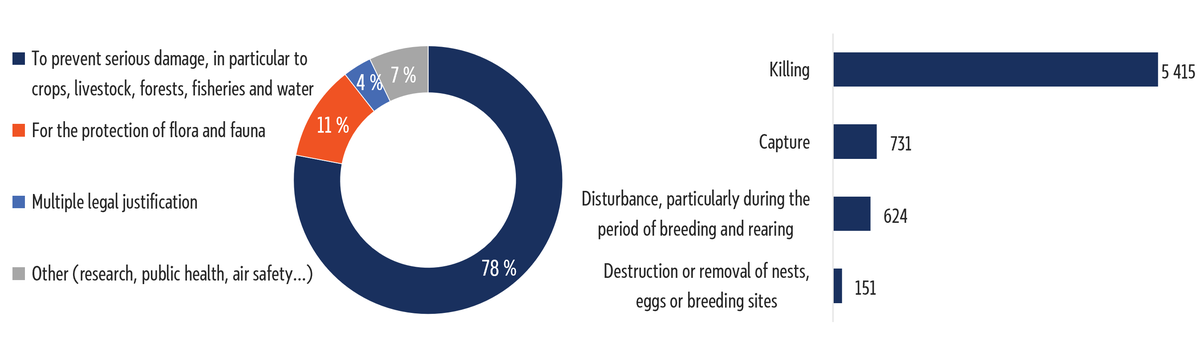
Data source: Dashboard on the use of Article 9 of the Birds Directive, European Environment Agency.
European Inland Fisheries and Aquaculture Advisory Commission (EIFAAC) cormorant management plan
Introduction
The EIFAAC is an intergovernmental organisation that covers inland fisheries and aquaculture in Europe. The organisation was established under the umbrella of the Food and Agriculture Organization of the United Nations (FAO) in 1957 and has 38 members: 37 European countries and the EU. Issues relating to cormorants have been on the EIFAAC's agenda for many years, resulting in advisory notes (2022, 2024) and a resolution (EIFAAC/31/2022/3). The organisation has a purely advisory role. The EIFAAC ran an EU/FAO-funded project on cormorant predation in 2024 and 2025. As set out in the EMFAF work programme, the project aimed ao contributing to the adoption of effective cormorant management measures, including through a draft European-wide management plan.
A framework for a cormorant management plan
In November 2025, the EIFAAC published the results of its project in a report. The report highlights that the cormorant population continues to increase, and that the mitigation measures in place have been largely unsuccessful. It emphasises that derogations are applied unevenly, with some countries rarely using lethal control measures and acting as a source of replenishment for birds in other countries. With the framework for a cormorant management plan (CMP), the EIFAAC aims to present a balanced and science-based roadmap for managing the complex interactions between cormorants, fisheries, aquaculture and fish conservation in Europe.
Cormorant management toolbox
The EIFAAC project builds on previous EU-funded projects such as REDCAFE (2000–2001) and INTERCAFE (2004–2008). REDCAFE was the first project to examine the cormorant-fisheries conflict on a pan-European scale. INTERCAFE aimed at further improving scientific knowledge of such conflicts. One outcome was the publication of a cormorant management toolbox in 2012. The toolbox focused on practical solutions to reduce conflict, such as ways to scare cormorants, to protect fish, and to reduce the availability of fish (e.g. by modifying the time of stocking). It also covered lethal measures.
Specifically, the framework sets out 37 measures across five steps to develop a CMP. They include defining scientifically informed reference values representing good cormorant population status and 'end-points' of cormorant population abundance. Those values would determine the management measures, namely the selection of non-lethal deterrents and lethal control measures. Non-lethal deterrents include scaring methods (e.g. acoustic or visual deterrents), exclusion devices (e.g. nets), and habitat modification. They would be based on an updated INTERCAFE toolbox, and essentially protect sensitive ecological areas and aquaculture farms. Lethal control methods, such as oiling eggs or regulated culling, should be used in a targeted manner. If the abundance of the cormorant population falls below a threshold that threatens its conservation status, such measures should be suspended until the population has recovered. Conversely, where the population is increasing and has an adverse impact, efforts should be intensified. The framework's main objective is to maintain favourable conservation status for the cormorant throughout its European distribution range, while achieving favourable conservation status for fish species and aquaculture production targets.
Points of view
Stakeholders
Birdlife International, an environmental NGO, grouping 123 global conservation organisations, published an opinion in response to a draft of the framework. According to the organisation, the call to cull cormorants across Europe does not offer workable solutions for resolving conflicts or protecting fish populations. The organisation states that an EU-wide CMP disregards scientific evidence, as research has concluded that reducing populations would have no proportional effect on local conflicts unless the species is pushed to the brink of extinction. Birdlife believes that instead, the derogation system provides sufficient flexibility, allowing targeted action where needed. Another environmental NGO, Wetlands International, sent a letter to the Commission asking for the proposed European CMP to be rejected categorically. The letter is supported by some 35 other organisations.
The FEAP published a position in November 2024 on the need for coordinated European management. of the cormorant. The paper states that the breeding areas are so far from feeding and wintering areas, that the location of source and effect are spatially distant from each other. FEAP highlights the increased population in combination with the high fish consumption of a single cormorant (about 500 g per day). The organisation highlights the direct losses resulting from the consumption of farmed fish, as well as the indirect losses caused by factors such as reduced production efficiency and, lower weight gain in wounded fish.
EU institutions
Council
In its 2022 conclusions on aquaculture, the Council noted with concern the growing populations of predators, in particular protected species such as cormorants, and urged the Commission to identify EU-wide management measures to prevent or reduce the damage on aquaculture.
On 3 June 2025, the Polish Presidency of the Council and EIFAAC organised a conference on cormorants. During the conference, experts and stakeholders provided updates on the impact of cormorant predation and its economic consequences, and presented the draft EIFAAC management plan.
Following the conference, Sweden presented a note at the Agriculture and Fisheries Council (AGRIFISH) meeting on 23 September 2025. Supported by Czechia, Estonia, Finland, Latvia, Romania and Slovakia, the note stressed the need for measures to allow ecosystem-based hunting of cormorants. Specifically, the seven countries requested that the Commission propose listing cormorants in Annex II of the Birds Directive, and take action to coordinate cormorant management within the EU based on the EIFAAC plan. At the meeting, in addition to the signatory Member States, the other intervening Member States either expressed their support for a CMP (Hungary, Germany, the Netherlands, France, Italy and Lithuania), or acknowledged the concerns expressed in the note (Poland, Austria and Spain). However, both France and Hungary expressed reservations about adding the cormorant to Annex II. Furthermore, the Baltic Member States highlighted the challenges that cormorants pose to the recovery of Baltic fish stocks.
At the AGRIFISH meeting on 28 October 2025, Finland, Estonia, Sweden, Poland, Lithuania and Latvia issued a joint statement urging the Commission 'to find solutions for better management of great cormorants and seals, in order to take into account their impact on fish stocks and ensuring the balance of the ecosystem.'
European Commission
At the AGRIFISH Council on 23 September 2025, European Commissioner for the Environment, Jessika Roswall, noted that, when preventive measures are insufficient to protect fisheries and aquaculture, derogations to the protective regime permit solutions, including lethal action. However, the Commissioner acknowledged that the system of derogations in several Member States was administratively burdensome and insufficient to address local pressures. The Commissioner therefore proposed providing updated guidance documents to assist national authorities. Regarding the request to add the cormorant to the list of huntable species, the Commissioner reiterated that killing cormorants during the breeding season and spring migration — when most cormorants are culled — as well as destroying nests or oiling eggs, would still require derogations. The Commissioner announced a structured dialogue with interested Member States and relevant stakeholders to help identify operational best practices, reduce administrative barriers, and support coordinated action, particularly across borders and along migration routes. As this transboundary approach could be beneficial, the Commission would take the suggestions put forward in the EIFAAC plan into account. The structured dialogue with Member States took place on 28 October 2025.
In response to a written question from the European Parliament regarding the measures that the Commission would propose, the Commissioner stated in her 9 December 2025 response that the Commission would continue to encourage cooperation among Member States with regard to effective measures for addressing conflicts. The Commissioner referred to the structured dialogue she had convened with the relevant national authorities regarding 'addressing national challenges concerning the use of derogations' and how the Commission could assist with this issue. The Commissioner stated that the 2013 guidance document on the use of derogations is being revised and will be integrated into 'new, broader guidance on the general system of protection of bird species under the Birds Directive'. In 2026, the Commission would start work – in the context of aquaculture – on a 'document providing recommendations and good practices for managing interactions with predators'.
European Parliament's position
On the initiative of its Committee on Fisheries (PECH), the European Parliament adopted several resolutions expressing its position on the great cormorant.
In 2008, the Parliament adopted a resolution urging the adoption of a coordinated EU-level CMP. The resolution pointed to the rapid growth of the cormorant population and the damage it was causing to aquaculture enterprises and wild fish stocks. It called for a management plan to minimise the increasing impact of cormorants on fish stocks, fishing, and aquaculture.
In 2013, a related study was published and presented for PECH.
In a 2018 resolution on aquaculture, Parliament highlighted that pond farmers are struggling with substantial losses due to predators such as cormorants, and reiterated its view on the adoption of a European CMP.
On 11 May 2022, the PECH committee held a hearing on the issue of cormorants. The hearing included presentations from six speakers.
In October 2022, the Parliament adopted a new resolution on aquaculture in which it referred to its previous resolutions. It reiterated Parliament's call for a EU-wide CMP that could 'properly and definitively address the problem the aquaculture sector has been facing for many years'.
On 2 July 2025, 10 Members of the European Parliament from four different political groups sent a letter to the European Commission, recalling Parliament's stance on the adoption of a CMP.
Main references
- Framework for a European Management Plan for the Great Cormorant , Food and Agriculture Organization of the United Nations, November 2025.
- Cowx, I., Between Fisheries and Bird Conservation: The Cormorant Conflict, Policy Department Structural and Cohesion Policies, European Parliament, January 2013.
Disclaimer
This document is prepared for, and addressed to, the Members and staff of the European Parliament as background material to assist them in their parliamentary work. The content of the document is the sole responsibility of its author(s) and any opinions expressed herein should not be taken to represent an official position of the Parliament.
Copyright
© European Union.
The reuse of this document is authorised under a Creative Commons Attribution 4.0 International (CC-BY 4.0) licence.

https://creativecommons.org/licenses/by/4.0/deed.en
To use or reproduce elements that are not owned by the European Union, permission may need to be sought directly from the respective rightsholders.