
Article page checkbox is not checked in page info.
Laureates of the 2025 Sakharov Prize: Andrzej Poczobut and Mzia Amaglobeli, journalists fighting for democracy in Belarus and Georgia
Laureates of the 2025 Sakharov Prize Andrzej Poczobut and Mzia Amaglobeli, journalists fighting for democracy in Belarus and Georgia
Anna Caprile and Jakub Przetacznik, Members' Research Service
Summary
Respect for fundamental freedoms and human rights is a core value of the European Union (EU), and one that is promoted through its policies. The European Parliament's Sakharov Prize honours the work of people who stand up for these freedoms and rights. This year's Sakharov Prize is to be awarded to journalists Andrzej Poczobut and Mzia Amaglobeli, both jailed for defending freedom of expression and democracy in their respective countries, Belarus and Georgia. The award ceremony will take place during the Parliament's December plenary session.
Significance of the Sakharov Prize
The European Parliament's Sakharov Prize for Freedom of Thought, named after the eminent Soviet Russian scientist, dissident and Nobel Peace Prize winner Andrei Sakharov, is the highest tribute paid by the EU to human rights work. Every year since 1988 – when the prize winners were Nelson Mandela and Anatoly Marchenko – Parliament has awarded the Sakharov Prize to individuals or organisations for their outstanding achievements in defending human rights and fundamental freedoms. One of last year's Sakharov Prize laureates, Maria Corina Machado from Venezuela, was recently also awarded the 2025 Nobel Peace Prize.
Award procedure and the 2025 Sakharov Prize finalists and laureates
A political group, or at least 40 Members of Parliament, can nominate a candidate for the Sakharov Prize each year. From the list of nominees, three finalists are shortlisted in a joint vote by the Committee on Foreign Affairs, the Committee on Development and the Subcommittee on Human Rights. The three finalists for the 2025 Prize were: Andrzej Poczobut from Belarus and Mzia Amaglobeli from Georgia, imprisoned journalists fighting for freedom in their countries; Journalists and Humanitarian Aid Workers in Palestine and all conflict zones, represented by the Palestinian Journalists Syndicate, the Red Crescent, and UNRWA; and Serbian students. On 22 October, the Conference of Presidents of political groups decided to award the 2025 Sakharov Prize to Andrzej Poczobut and Mzia Amaglobeli. Announcing the decision, Parliament's President, Roberta Metsola, said that, through this award, the Parliament 'honours two journalists whose courage shines as a beacon for all who refuse to be silenced. The Parliament stands with them, and with all those who continue to demand freedom.' Andrzej Poczobut is the fourth Sakharov prize laureate from Belarus. The previous three were the democratic opposition in 2020, Aliaksandr Milinkevich in 2006 and the Belarusian Association of Journalists in 2004. It is the first Sakharov Prize for a laureate from Georgia.
The fight for freedom and democracy in Belarus
The contested 2020 presidential election results – where Aliaksandr Lukashenka, in power since 1994, was declared the winner with over 80 % of the vote against Sviatlana Tsikhanouskaya – sparked widespread peaceful protests, which were violently suppressed by state security forces. The Belarusian authorities subsequently intensified repression against independent media and non-governmental organisations, introducing lengthy prison terms for legitimate human rights activities labelled by the regime as 'extremist'. There are currently 1 221 recognised political prisoners in Belarus, including 33 journalists and other media workers. Those in prison face harsh treatment, torture and deteriorating health conditions, as well as incommunicado detention. Among them is Andrzej Poczobut , a journalist and Polish minority activist, arrested in 2011, 2012 and again in 2021, since when he has been sentenced to 8 years in prison. Despite his health, he has been held in solitary confinement for several periods.
The fight to restore democracy and the European path in Georgia
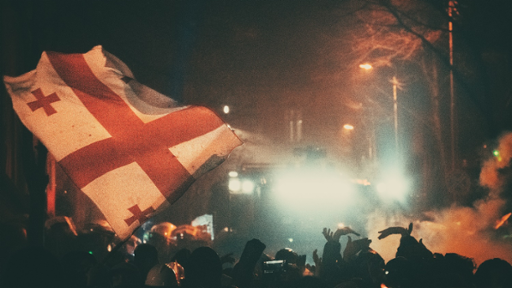
Shortly after the EU granted candidate status to Georgia, the government adopted the controversial law on the transparency of foreign influence – disregarding the Council of Europe Venice Commission's assessment that the law adversely affects pluralism and democracy. The European Council concluded that this law represents democratic 'backsliding ... de facto leading to a halt of the accession process'. The 26 October 2024 parliamentary elections, won again by the ruling Georgian Dream party (in power since 2012), were, according to the OSCE/ODIHR Election Observation Mission, marred by highly divisive campaign rhetoric and widespread reports of pressure on voters. Moreover, other international and domestic observers were much harsher. The ensuing mass protests were repressed with increased violence by the authorities. In November 2024, the Georgian government announced that it would not pursue further integration talks with the EU until 2028, prompting renewed protests that continue to date and are being countered with increased brutality by the government. Legislative initiatives adopted since 2024, including the foreign agents registration act and the law on family values and the protection of minors, have further undermined civil society, the independence of the judiciary and state institutions and human rights. Arrested in January 2025 for joining anti-government protests in Georgia, Mzia Amaglobeli – journalist and director of online media outlets Batumelebi and Netgazeti – was sentenced to two years in prison on political grounds, becoming the first female political prisoner since the country's independence. Over 400 people were detained in the initial weeks of the protests, and over 60 people are currently regarded as political prisoners in Georgia.
EU and European Parliament positions
The EU does not recognise the results of Belarus' presidential elections of 8 August 2020 and considers that Aliaksandr Lukashenka lacks any democratic legitimacy. It condemns the deteriorating human rights situation in Belarus and its involvement in Russia's military aggression against Ukraine, and has imposed sanctions on Belarus as a response. In a resolution adopted on 15 March 2023, Parliament called for the immediate and unconditional release of Andrzej Poczobut. In a formal sitting on 22 October 2025, Parliament welcomed two prominent opposition leaders from Belarus, Sergey Tihanovski and Sviatlana Tsikhanouskaya, adopting a further resolution on the situation in Belarus the same day. The resolution calls for the release of all political prisoners, including Andrzej Poczobut, and demands an end to the criminalisation of journalism and the harassment of journalists both within Belarus and in exile. As far back as 2012, Parliament adopted a resolution concerning the case of Andrzej Poczobut.
The Commission's recent 2025 enlargement package certified that, 'following the December 2024 European Council Conclusions and in light of Georgia's continued backsliding, the Commission considers Georgia a candidate country in name only'. Previously, the EU had regretted the course taken by the government, and had condemned unlawful repression of protesters and arbitrary detentions. In a November 2024 resolution, Parliament called for fresh elections in Georgia, following the contested ones held in October 2024. In a June 2025 resolution, Parliament called for the immediate and unconditional release of Mzia Amaglobeli. In a July 2025 resolution, MEPs reconfirmed the policy of not recognising Georgia's one-party parliament, deplored democratic backsliding and repression in the country, which jeopardise Georgia's EU accession path, and called on the EU and Member States to impose bilateral and coordinated personal sanctions on key Georgian Dream officials, including Georgian Dream's founder, oligarch Bidzina Ivanishvili.
Statement on the use of AI
Any AI-generated content in this text has been reviewed by the author(s).
Disclaimer
This document is prepared for, and addressed to, the Members and staff of the European Parliament as background material to assist them in their parliamentary work. The content of the document is the sole responsibility of its author(s) and any opinions expressed herein should not be taken to represent an official position of the Parliament.
Copyright
© European Union.
The reuse of this document is authorised under a Creative Commons Attribution 4.0 International (CC-BY 4.0) licence.

https://creativecommons.org/licenses/by/4.0/deed.en
To use or reproduce elements that are not owned by the European Union, permission may need to be sought directly from the respective rightsholders.