
Article page checkbox is not checked in page info.
Assessing the potential and challenges of the European Citizens' Initiative
Assessing the potential and challenges of the European Citizens' Initiative
Clément Franzoso, Members' Research Service

Summary
The European Citizens' Initiative (ECI) is an important tool of participatory democracy in the European Union (EU), which gives Europeans a more active role in shaping EU policy. The initiative allows citizens to call on the European Commission to make new proposals for EU legislation if they gather at least one million signatures from at least seven EU Member States. Since its introduction under the Lisbon Treaty, the ECI has promoted political engagement, raised awareness of key issues and strengthened the EU's democratic legitimacy. However, it faces significant challenges, such as difficulty gathering the required support, low public awareness, bureaucratic hurdles and a lack of binding outcomes.
To be registered, an initiative must meet a set of formal criteria assessed by the Commission. If it does, the Commission registers the initiative, and the organisers can then begin collecting signatures. It is important to note that the Commission is not obliged to act on registered ECIs, which ultimately limits the potential impact of the initiative.
While the ECI promotes cross-border collaboration and increases citizen participation, its potential is hindered by limitations such as the complex administrative process and lack of guaranteed legislative action. The Commission plays a decisive role in both the registration and follow-up stages of an ECI, but its strict interpretation of admissibility requirements has drawn criticism. Examples of successful initiatives include 'Right2Water', which advocates for the human right to water and sanitation, and 'Stop Vivisection', which calls for an end to animal testing in the EU.
While the ECI has helped raise awareness and foster political participation, its overall effectiveness remains constrained. Improvements in accessibility, awareness, follow-up actions and support are essential to unlock its full potential as a tool for active citizenship in the EU.
Introduction
The European Citizens' Initiative, rooted in the principles of civic participation and democratic legitimacy, is a significant achievement of the European Union. It grants European citizens the right to have a stronger voice and actively participate in EU policymaking.
The European Parliament played a significant role in shaping the ECI instrument during the years leading up to the adoption of the ECI Regulation in 2011. For instance, in 2009 Parliament proposed a detailed ECI implementation plan, which laid out the five stages of the ECI, the format for relations between organisers and the Commission from registration to final response, and the time limits to be observed, among other things. After the entry into force of the Lisbon Treaty later that year, Parliament actively contributed to negotiations on the ECI Regulation, making the instrument more accessible1 and user-friendly. Parliament advocated for reducing the minimum number of Member States needed for support, ensuring admissibility checks before registration, and extending the right to sign an ECI to all EU citizens and residents, regardless of their nationality.
Since the entry into force of the Lisbon Treaty, the right to submit a citizens' initiative has been enshrined in Title II – Provisions on Democratic Principles of the Treaty on European Union (TEU). Article 10 TEU underlines the will to ensure the implementation of three fundamental principles: democratic equality, representative democracy and participatory democracy. Article 11(4) TEU establishes the basic framework for that right:
not less than one million citizens who are nationals of a significant number of Member States may take the initiative of inviting the European Commission, within the framework of its powers, to submit any appropriate proposal on matters where citizens consider that a legal act of the Union is required
Article 24(1) of the Treaty on the Functioning of the European Union (TFEU) sets out the general principles for an ECI regulation, defining the specific procedures and requirements related to the instrument. The proposal for a regulation was the result of extensive consultation. At the end of 2009, the Commission issued a green paper to seek the views of stakeholders on key issues that would shape the future regulation. Regulation (EU) No 211/2011 was adopted in 2011 and entered into force on 1 April 2012.2
Over time, Parliament's Constitutional Affairs and Petitions Committees has pushed for simplifying the procedures applicable to the ECI and improving its impact. In 2015, Parliament called for a revision to streamline personal data requirements and provide funding for ECI organisers. In September 2017, the Commission presented a legislative proposal to revise the ECI. Following interinstitutional negotiations, the final agreed act was signed on 17 April 2019 and published in the Official Journal of the European Union on 17 May 2019. The new ECI rules (Regulation (EU) 2019/788) repealing Regulation (EU) No 211/2011 have applied since 1 January 2020, following ongoing efforts to improve its accessibility and effectiveness in response to the Commission's roadmap of 2017. In the new regulation, the improvements proposed by the Parliament were considered to make the ECI more accessible. Later on, in its resolution of 13 June 2023, Parliament committed to further exploring ways to make the ECI more accessible and effective in the possible context of a future revision of the Treaties.
This briefing presents the ECI process and provides some examples of successful ECIs. It then presents its main advantages and challenges.
The ECI process
Organising committee
The first step in the creation of an ECI is the establishment of an organising committee – a 'citizens' committee' – formed by at least seven people who are residents of at least seven different Member States (but not necessarily of seven different nationalities) and who are of the right age to vote in the European elections. The committee must designate a representative and a substitute to act as contact persons for the specific ECI.
Registration
Before it can start collecting statements of support from citizens, the organising committee must register the initiative with the Commission. This involves submitting a document in one of the official EU languages, which indicates the title and subject matter of the initiative; a short description outlining the proposed legal basis for action; and information on the committee members and all sources of support and funding for the initiative. The Commission has two months to decide whether to register the initiative; it will examine and register only initiatives that meet the specific legal criteria laid down in Article 6(3) of the 2019 ECI Regulation. Apart from the procedural requirements applicable to it, the initiative must fall into a subject area in which the Commission has the power to propose EU legislation (similarly to petitions addressed to the European Parliament, this condition is often the most difficult to fulfil). ECIs must not be abusive, frivolous or offensive. They should be aligned with EU values, as set out in Article 2 TEU and the EU Charter of Fundamental Rights.3
The Commission's decisions regarding ECIs have a legal basis and are open to judicial or extrajudicial redress. Specifically, they can be contested by bringing proceedings before the Court of Justice of the European Union (CJEU) or filing a complaint to the European Ombudsman. This has resulted in the development of a significant body of case law (see the Section on the 'Role of key players'). The Commission must ensure that all its decisions related to ECIs are made publicly available both in the ECI Register and on the official ECI website.
Collection of statements of support
Once the initiative is registered, its organisers have 12 months to gather one million statements of support before it can be considered by the Commission. The collection process must follow specific rules set out in both the ECI Regulation and Commission Implementing4 Regulation (EU) 2019/1799, which specifies the rules for online collection. Under these rules, the kick-off date for launching support collection must occur within six months after registration, with notification to the Commission at least 10 days beforehand. Additionally, in a quarter of Member States, a minimum number of signatures must be obtained from each Member State. This number is determined by multiplying the number of Members of the European Parliament (MEPs) elected in each Member State by the total number of MEPs.
Verification and certification
Once the necessary number of statements of support has been collected from a sufficient number of Member States, the organisers must send the signatures collected within three months of the end of the collection period to the designated national authorities. These authorities must certify the statements of support within a maximum of three months. The checks may be exhaustive or based on random sampling. Once the last certificate is received, the organisers have three months to submit them to the Commission.
Submission and examination
At this stage, the organisers are required to submit the certificates, together with information regarding any funding received from any source. Upon receiving the submission, the Commission must publish a notice, as required by Article 14(1) of the ECI Regulation, and transmit the initiative to Parliament, the Council, the European Economic and Social Committee, the European Committee of the Regions and the national parliaments. The Commission must also immediately publish the initiative in a register and arrange a meeting with the organisers at an appropriate level within one month of submission to allow them to explain the details of their request as per Article 15(1) of the ECI Regulation. Following an exchange of views with the Commission, the organisers are given an opportunity to present the initiative at a public hearing held by Parliament.
The Commission must issue a formal reply to a valid initiative within six months, explaining why it will (or will not) propose a new law based on the initiative. In a communication setting out its legal and political findings, the Commission must provide a formal list of intended actions and a clear timeline for their execution. The Commission's decision may be subject to appeal before the General Court of Justice or to a complaint for maladministration to the Ombudsman. If the Commission decides to adopt a legislative proposal in response to an ECI, it must follow the ordinary legislative procedure; while some proposals may fall under special procedures, this is rare. Most Commission proposals must be discussed and adopted by the co-legislators: Parliament and the Council.
In the EU legal order, the Commission has almost a monopoly on the right of legislative initiative, with few exceptions. This means that the Commission has nearly complete discretionary power on whether to initiate legislation. Against this backdrop, the purpose of the ECI is to give citizens an opportunity to contribute to the work of the EU by providing them with a greater stake in the democratic process of the EU. The desire for broader citizen participation in the democratic process has been a priority for Parliament over the years, as evidenced by its resolution (2014/2257(INI)).
The role of key players
European Parliament
Within three months of the submission of the initiative to the Commission, the organisers have the opportunity to explain their initiative at a public hearing held at Parliament's Committee on Petitions. Rules 228 and 236 of Parliament's Rules of Procedure, which govern public hearings and debates, also apply to citizens' initiatives hearings.5 The committee responsible for the subject matter organises the hearing and may subsequently draft a report. MEPs can then hold a debate in plenary to call on the Commission to propose the legislation. Additionally, Parliament is responsible for evaluating the actions taken by the Commission following the registration of the ECI. In this scenario, another debate may take place in plenary, in accordance with Rule 228(9). If the Commission has decided not to submit a legislative proposal following the registration of the ECI, the Petitions committee may opt to hold a hearing; Parliament may choose to hold a plenary debate or activate Article 225 TFEU (Parliament's right of legislative initiative).
Court of Justice of the European Union
The CJEU has played a key role in clarifying the procedural and legal boundaries of the ECI, especially regarding the refusal of registration and the lack of follow-up by the Commission. Over time, this could potentially lead to a more refined and transparent system for citizens to contribute to shaping EU legislation.
First, the Court has recognised that the significant number of ECI proposals whose registration is rejected do 'not fall manifestly outside' the framework of the Commission's powers. Most claims before the CJEU are related to the (allegedly) strict interpretation of the legal admissibility6 test carried out by the Commission. Essentially, the Court's strict interpretation of the legal admissibility test for ECIs ensures that the Commission does not unduly restrict the ability of citizens to initiate legislative proposals, even if there are concerns about the ECI's legal basis or scope. The Commission must focus on whether the ECI falls within its existing powers and, if so, it must register the initiative.
Second, the legal and political findings adopted by the Commission at the end of the ECI procedure have also been disputed. In case C-418/18 P, the CJEU noted that the purpose of the ECI is to 'invite' the Commission to submit an appropriate proposal for the implementation of the Treaties, but does not oblige it to take specific actions. The Court provided greater clarity on how the Commission should interpret and act upon successful initiatives, helping to define its role. Although organisers have rarely succeeded in contesting the Commission's decisions, the Court's rulings have nonetheless contributed to shaping the practice and understanding of the ECI process. As academic Agnieszka Parol notes, the CJEU confirmed in its case law that a Commission proposal for an EU legislative act in response to an ECI is optional. At the same time, the Court emphasised that an ECI meeting the legal requirements places certain obligations on the Commission, as outlined in secondary legislation. This is why, on the ECI website, all ECIs that fulfil the conditions and receive the necessary statements of support are already seen and referred to as 'successful ECIs'.
European Ombudsman (the Ombudsman)
The Ombudsman plays a crucial role in investigating how the Commission handles ECI requests, especially in cases where an ECI is refused registration. In 2014, the Ombudsman opened an inquiry into the implementation of ECIs to evaluate public awareness, the functionality of the Commission systems, and to address concerns about data protection and signature collection. In July 2017, the Ombudsman sent a letter to the Commission proposing improvements to the ECI procedure (SI/6/2017/KR), with the aim of enhancing the effectiveness of the process and ensuring that it empowers citizens to influence EU policy. The Ombudsman recommended enhancing the ECI platform as an inquiry tool for organisers and for providing clearer reasons for refusing registrations. It also stressed the importance of verifying the accuracy of information regarding the funding and sponsorship of ECI organisers, and urged the Commission to allow EU citizens to sign statements of support, regardless of their residence, as previously stated in its 2015 decision following the inquiry.
At a practical level, it asked for a modification of the starting period of the signature collection; insisted on improving the individual online collection systems (IOCS) for persons with disabilities; and underlined the value of the ECI as a platform for public debate. It also considered it useful to include the Council in public hearings on ECIs. Finally, it considered it of utmost importance that the Commission explain its political choices in detail, especially where it chooses not to act on an ECI that has successfully met all signature and procedural requirements.
European Economic and Social Committee (EESC)
The EESC is promoting the ECI and building stakeholder networks by organising an annual conference, the ECI Day, and other related information events. It also takes the lead in interinstitutional cooperation between the competent EU administrations. The EESC facilitates emerging initiatives, providing a platform for dialogue and information, bringing together organisers and hosting meetings in its role as the home of civil society. Moreover, it is an institutional mentor, offering the Commission assistance in the evaluation phase of an ECI by jointly organising a public hearing and drawing up an opinion on a successful ECI in time for the Commission's evaluation, as part of its normal consultative role.7 Finally, the EESC maintains a permanent partnership with some players such as the ECI Campaign and the European Citizen Action Service.
Expert group on ECI implementation
An expert group (Type D), composed of representatives from Member States' national, regional or local authorities, was set up in 2012 to coordinate the implementation of the ECI with the Member States. In its latest ECI review, it calls on the Commission to further raise awareness and consider the possibility of reintroducing IOCS. The group advises providing financial support to valid ECIs and progressively supporting others in achieving milestones, with the aim of strengthening debate on and follow-up of ECIs. The review also encourages Member States to lower the requirement towards the age of supporters and utilise all available means of eID for signing ECIs.
Examples of answered ECIs
To date, 10 initiatives have received an answer ('Water and sanitation are a human right! Water is a public good, not a commodity! (Right2Water)'; 'One of Us'; 'Stop Vivisection'; 'Ban Glyphosate'; 'Minority SafePack'; 'End the Cage Age'; 'Save Bees and Farmers'; 'Stop finning – stop the trade'; 'Save Cruelty-Free Cosmetics'; 'Fur-Free Europe').8 The 'Cohesion policy for the equality of the regions and sustainability of the regional cultures' ECI has been declared valid by the Commission but not yet answered. Three other ECIs are at the verification stage (however, according to the Commission, 'Stop extremism' seems to have been abandoned by the organisers at the stage of verification of the statements of support). The number of signatures collected has exceeded by far the one million threshold in a couple of instances (see Figure 1 below).
Moreover, there are seven ECIs for which the collection of signatures is still ongoing.
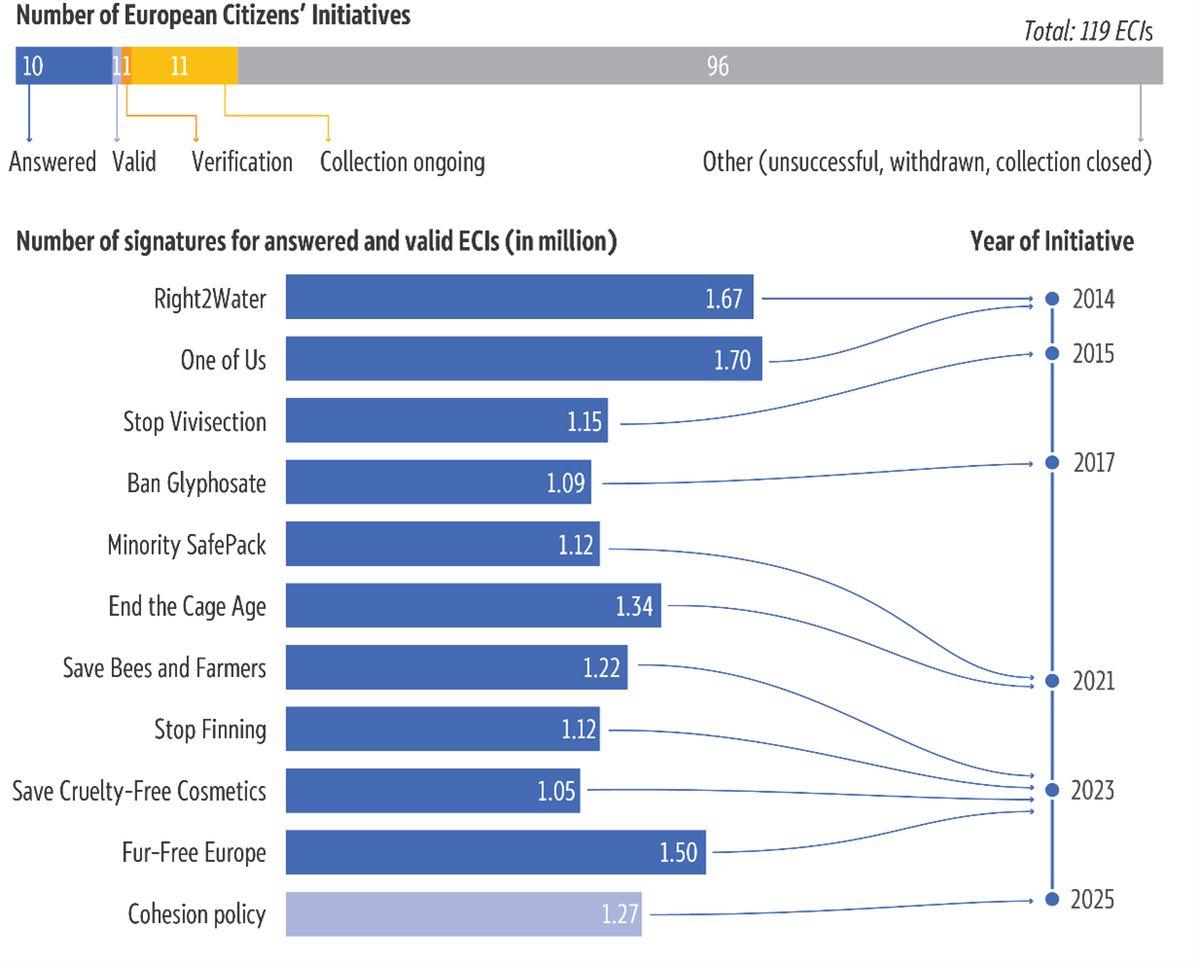
Data source: ECI Forum Infographic, May 2024; ECI website, European Commission.
Based on the analysis of existing ECIs, it seems that ECI campaigns often do not require EU-wide mobilisation to succeed. Instead, they need strong support in a few populous Member States to reach the minimum per country and one million total support signatures. In contrast, campaigns that spread resources too thinly across many countries, like the UBI ECI, have struggled to meet the thresholds.
The case of 'Water and sanitation are a human right! Water is a public good, not a commodity! (Right2Water)'
Right2 Water, the very first ECI to fulfil all ECI conditions, asked the Commission to propose legislation implementing the human right to water and sanitation as recognised by the United Nations, and promoting the provision of water and sanitation as essential public services for all. The proposed EU legislation would have required EU institutions and Member States' governments to ensure sufficient and clean drinking water and sanitation for all citizens. Water supply and the management of water resources were to be excluded from 'internal market rules', and water services from liberalisation efforts. Finally, the initiative proposed that the EU increase its efforts to achieve universal access to water and sanitation. The organisation behind this ECI was the European Public Services Union (EPSU), a Belgian federation of 260 trade unions that based its campaign largely on grassroots organisations. Its success came through media coverage; as Louisa Parks9 explains: 'In late January 2013, a German comedian and satirist featured material about the right to water and the privatisation of water supplies on his television programme, ending the piece with information about the ECI and how it could contribute to safeguard publicly owned water supplies in the country. This led to a significant jump in the numbers of signatures' (1 236 455 in Germany alone).
In response to this initiative, the Commission declared its commitment to taking concrete steps and working on a number of new actions in areas of direct relevance to it, and to reaching its goals by reinforcing the implementation of its water quality legislation, building on the commitments outlined in the 7th environment action programme (EAP) and the Water Blueprint. The Commission also promised to launch an EU-wide public consultation on the Drinking Water Directive, with a focus on improving access to quality water in the EU and enhancing transparency in urban wastewater and drinking water data management. It emphasised the potential benefits of benchmarking water quality and fostering a structured dialogue among stakeholders on transparency in the water sector. Finally, the Commission promised to promote and share best practices among Member States, identify new opportunities for cooperation, and advocate for universal access to safe drinking water and sanitation as a priority area for future sustainable development goals.
In 2015, Parliament adopted an own-initiative report and amended the Drinking Water Directive to improve the monitoring of drinking water across the EU. The amendment entered into force on 28 October 2015. On 1 February 2018, the Commission proposed a further revision, adopted by the co-legislators in December 2020. In January 2024, new EU-wide minimum hygiene standards for materials and products used in drinking water distribution were adopted.
The case of 'One of Us'
'One of Us' aimed to ensure 'the juridical protection of the dignity, the right to life and of the integrity of every human being from conception in the areas of EU competence in which such protection is of particular importance'. According to the organisers, any patent on invention had to respect the fundamental principles safeguarding the dignity and integrity of the person. They referred to the Brüstle case, in which the human embryo was defined as the beginning of the development of a human being. They also claimed that to ensure consistency in areas of its competence where the life of the human embryo is at stake, the EU should establish a ban and end the financing of activities that presuppose the destruction of human embryos in the areas of research, development aid and public health. According to the organisers, the Brüstle case clarified that human life begins at fertilisation and that, out of respect for human dignity, it excludes the possibility of patenting any procedure that involves the destruction of a human embryo. The CJEU stated that: '...the legal protection of biotechnological inventions must be interpreted as meaning that any human ovum after fertilisation, any non-fertilised human ovum into which the cell nucleus from a mature human cell has been transplanted, and any non-fertilised human ovum whose division and further development have been stimulated by parthenogenesis constitute a ''human embryo''. It is for the referring court to ascertain, in the light of scientific developments, whether a stem cell obtained from a human embryo at the blastocyst stage constitutes a ''human embryo'' ...'. This highly sensitive issue from an ideological and religious point of view received its highest number of statements of support in Italy, Poland, Spain, Germany and Romania. It was also the second ECI to reach the minimum signatures threshold since 2012.
In its communication of May 2014, the Commission explained that it had decided not to submit a legislative proposal, stating that 'the EU Financial Regulation10 ... already ensures that all EU expenditure, including in the areas of research, development cooperation and public health, must respect human dignity, the right to life, and the right to the integrity of the person'. The organisers, insisting that the Commission should act after a successful collection of signatures, decided to contest the decision. The lawsuit was unsuccessful before the General Court in April 2018, and before the Grand Chamber of the European Court of Justice in December 2019. Some argue that this effectively grants the Commission a veto power over any ECI it does not wish to support.
The case of 'Stop Vivisection'
'Stop Vivisection' called for an EU legislative framework to repeal Directive 2010/63/EU on the protection of animals used for scientific purposes. It also proposed a ban on animal testing, advocating for the mandatory use of data directly relevant to the human species. The organisers urged the phasing out of animal experiments, backing their request with ethical objections and solid scientific evidence that challenges the effectiveness of the 'animal model' for predicting human responses. This ECI demonstrated that collecting a minimum of one million signatures is feasible, as shown by the successful gathering of signatures in just a few Member States. Its organisers strategically focused on populous Member States to increase their chances of success. 'Stop Vivisection' concentrated its efforts on Italy, where it gathered 690 000 statements of support, capitalising on the country's robust animal rights movement and political networks. Italy has a long history of animal rights activism, with influential organisations like LAV and LEAL leading efforts against animal experimentation (the world's first known petition against animal experimentation was organised in Florence in 186311). Furthermore, the campaign received political support from MEP and animal rights advocate Sonia Alfano. Finally, media coverage of the Green Hill scandal, where mistreated dogs were bred for experiments, also helped to raise public awareness.
In its response to this ECI, the Commission stated that it 'shares the Citizens' Initiative's conviction that animal testing should be phased out. This is the goal of EU legislation.', but that it did not share the view that scientific principles invalidate the 'animal model' and refused to replace the 2010 directive, arguing that 'during a time of transition, [animal testing is] still necessary'. Consequently, in 2016, the organisers complained to the Ombudsman, who concluded that there was no case of maladministration by the Commission. The Ombudsman considered that the Commission 'has complied with its duty to explain, in a clear, comprehensible and detailed manner, its position and political choices'; therefore, it had not 'failed to comply with the spirit and logic of the ECI rules'.
Main achievements and remaining challenges
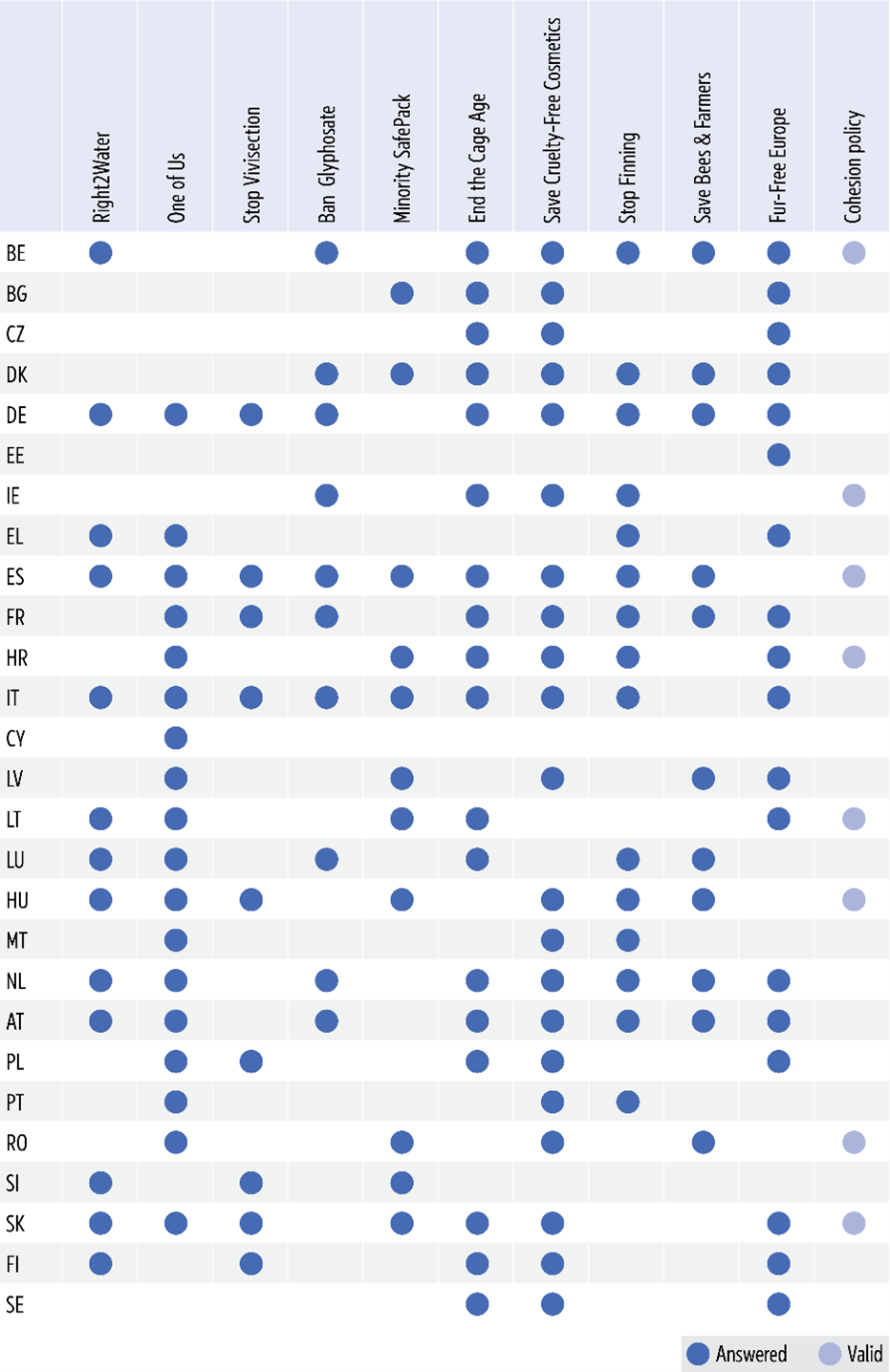
The ECI has encouraged and stimulated political engagement by allowing citizens to raise issues they feel are important but may not otherwise receive attention at the EU level. This has helped promote active citizenship and civic involvement, which are crucial for a healthy and democratic society.12 Even when an ECI does not gather enough support, it can still serve as an effective tool for raising awareness and stimulating political debate about specific issues. Successful campaigns often bring attention to important topics, mobilise public opinion and influence political discourse, as demonstrated by the examples above. In fact, as shown in Figure 2 below, a majority of answered ECIs have easily met the minimum threshold of signatures in more than a quarter of Member States, with one in two reaching the threshold in more than half of the Member States.
The ECI strengthens the EU's legitimacy by allowing citizens to participate in the political process in a more direct way than traditional methods like voting. It demonstrates citizens' commitment to participating in setting the political agenda, which can enhance the EU's democratic credentials.13 By allowing citizens to have a direct say in the legislative process, the ECI fosters a sense of empowerment and participation in EU democracy, similar to other instruments of direct democracy such as referenda or citizens panels. It provides a platform that helps bridge the gap between EU institutions and citizens. Heidelberg University Professors Jale Tosun and Simon Schaub argue that:
instead of developing the ECI into a legislative instrument, the ECI might also continue to be an agenda-setting tool, which simply serves to draw attention to certain issues. If so, then its registration process should be designed in a less restrictive fashion so as to allow more initiatives to reach the political elites 14
The ECI also fosters cooperation and solidarity across borders by requiring signatures from different EU Member States. Finally, the 2019 reform enabled the digitalisation of the ECI process (registration, dedicated website, signature collection system), starting a path towards a genuine e‑democracy scenario. In this spirit, in her 2020 study Agnieszka Parol suggested improving democratic practices through online tools, also based on a digitally enhanced citizen participation tool that Professor Kalypso Nicolaidis developed as part of the Democratic Panopticon.
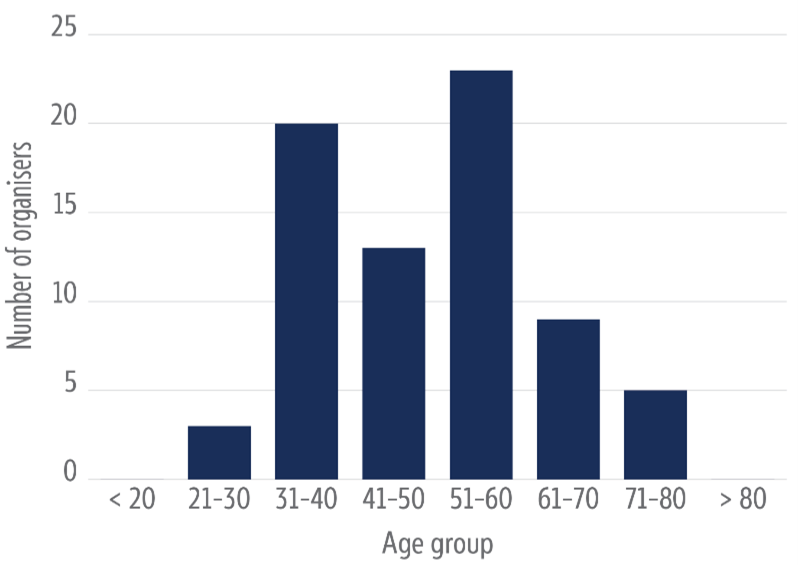
Today, 13 years after the ECI came into existence, far too many EU citizens remain unaware of this instrument of direct democracy or do not know how to use it effectively. Despite its potential, it has not been widely used, and many people do not understand how they can get involved in the process or how it could influence EU legislation. Young people, in particular, seem unaware of the ECI's existence; none of the organisers of the 10 ECIs that successfully met all criteria and received a formal response from the Commission were between 18 and 21 years old (see Figure 3 below).
To address these difficulties, the Commission has launched a dedicated web page listing ongoing ECIs, created a newsletter, established the ECI Forum and supported the network of ECI Ambassadors – mainly representatives of civil society organisations who voluntarily promote the instrument – as well as a broader network of ECI multipliers. Some experts argue that the rules on the ECI's form and substance remain too strict, and that transparency could be further improved.
Moreover, the requirement to gather signatures from at least seven EU Member States can be an obstacle, as the process is often complex, time-consuming and expensive. Meeting the five criteria to register an ECI under Article 6(3) of the 2019 ECI Regulation can also be seen as restrictive by the public, especially the limitation of the ECI scope because the subject must strictly fall under the framework of EU powers.
These legal hurdles can discourage participation and make the process intimidating for citizens without prior experience in advocacy or lobbying.15 While an ECI can lead the Commission to consider a legislative proposal, it has no legal obligation to act on it. This limits the potential of the ECI as a genuine tool for shaping EU law. Indeed, many ECIs are not followed by concrete legislative action, which undermines their effectiveness and the trust citizens place in the process.
Some initiatives struggle due to a lack of funding, media support and institutional backing. While grassroots organisations can campaign effectively, the lack of infrastructure and resources, compared to well-funded lobby groups, can hinder the success of many ECI campaigns.
Critics argue that the scope of an ECI is also too limited in practice and that the need for multinational support can make it difficult to achieve widespread public engagement. The diverse political landscapes across the EU mean that public opinion on a single issue may vary widely across countries, making it harder to gain traction across different Member States. Finally, an ECI cannot put forward proposals to modify the EU Treaties, which arguably limits its impact.
According to several academics, '(t)he Commission is by far the most important player in the ECI'. Considering its role as the promoter of the general interest of the Union (Article 17(1) TEU) and its (quasi-)monopoly of legislative initiatives (Article 17(2) TEU), the Commission plays a key part in the ECI procedure. By performing the functions of assistance, organisation, supervision and decision-making, it therefore leads and controls all key stages of the ECI cycle.
On one hand, legal scholars have criticised the (allegedly) strict and legalistic interpretation and application of the admissibility test laid down in Article 6(3) of the 2019 ECI Regulation by the Commission. On the other hand, the almost monopolistic power of the Commission in the law-making process remains the biggest challenge of the ECI. After her empirical study of cases, the conclusion of another academic, Anna-Angela Kandyla, echoes several scholars' opinions. She argues that the Commission should 'politically commit' to bringing the successful initiatives' legislative requests to the legislature. Additionally, one could argue that Parliament, the only EU institution directly elected by the EU citizens, would be more legitimate than the Commission to decide on the registration of an ECI. Finally, academics like Carsten Berg propose to transform the ECI into a popular initiative tool that would trigger an EU-wide referendum.
To sum up, while the ECI is a significant step towards increasing direct democratic engagement in the EU, its practical challenges often undermine its effectiveness. It has succeeded in raising awareness and fostering political participation, but the barriers to success (such as the complex task of organising an ECI, low public awareness and the lack of binding outcomes) have limited its real impact on the actual EU policymaking process. To make the ECI a truly effective tool for citizens, improvements in accessibility and support for initiatives are essential. Enhancing its visibility and removing bureaucratic hurdles could help unlock its full potential as a meaningful tool for active citizenship in the EU. Ultimately, the main challenge would be to ensure concrete follow-up after a successful ECI by including, in a modification of the Treaties,16 a new binding obligation for the Commission to act on a successful ECI.
Main references
- Kandyla, A., The Emperor's New Clothes? Assessing the Democratic Value of the European Citizens' Initiative, European University Institute, 2020.Karatzia, A., The European citizens' initiative and the EU institutional balance: on realism and the possibilities of affecting EU lawmaking, Common Market Law Review 54, 2017, pp. 177-208.
- Kotanidis, S., Conference on the Future of Europe: Overview of the final proposals, EPRS, European Parliament, 2022.
- Longo, E., The European Citizens' initiative: too much democracy for EU polity?, Cambridge University Press, 2019.
- Pacheco, Y., Lopes, D. et al., European Citizens' Initiative: A Tool for Engagement and Active Citizenship Workbook ECI from A to Z, Universitätsverlag Göttingen, 2023.
- Parol, A., The European Citizens' Initiative reform: Does it matter?, Review of European and Comparative Law, Vol. XL, 2020.
- Parol, A., The European Citizens' Initiative 'One of Us'. A Gloss to the Judgment of the CJEU of 19 December 2019 in Case C-418/18 P. Puppinck and Others v. Commission, Review of European and Comparative Law, Vol. 56, No 1, 2024.
- Tosun, J. and Schaub, S., Constructing policy narratives for transnational mobilization: Insights from European Citizens' Initiatives, Institute of Political Science, Heidelberg University, 2021.
- Weisskircher, M., The European Citizens' Initiative: Mobilization Strategies and Consequences, 2019.
Endnotes
Classification
Policy areas: EU Democracy, Institutional and Parliamentary Law
Regions: European Union
Disclaimer
This document is prepared for, and addressed to, the Members and staff of the European Parliament as background material to assist them in their parliamentary work. The content of the document is the sole responsibility of its author(s) and any opinions expressed herein should not be taken to represent an official position of the Parliament.
Copyright
© European Union.
The reuse of this document is authorised under a Creative Commons Attribution 4.0 International (CC-BY 4.0) licence.

https://creativecommons.org/licenses/by/4.0/deed.en
To use or reproduce elements that are not owned by the European Union, permission may need to be sought directly from the respective rightsholders.