
Article page checkbox is not checked in page info.
The third generation of national climate plans: Analysis of major economies' nationally determined contributions ahead of COP30
The third generation of national climate plans Analysis of major economies' nationally determined contributions ahead of COP30
Gregor Erbach with Charlotte Hourdin, Members' Research Service
Summary
The forthcoming United Nations Climate Change Conference – COP30 – to be held in Belém, Brazil, in November 2025, is a decisive moment in international climate action. By September 2025, countries have to submit the third round of Nationally Determined Contributions (NDC 3.0) that will determine whether the targets of the Paris Agreement remain within reach. NDCs are countries' climate plans, setting national greenhouse gas (GHG) emissions reduction targets and means of implementation. Parties to the Paris Agreement must update them every five years to ensure progress towards the agreement's temperature target. The updated NDCs cover a timeframe up to 2035 and must align with the outcomes of the first global stocktake and with Parties' long-term GHG emissions reduction objectives.
Analysis by the United Nations Environment Programme shows that current efforts would lead to global warming of between 2.6 and 3.1 °C by 2100. Therefore, NDCs should demonstrate increased ambition, backed by concrete measures to deliver on the targets. Those major economies that have already submitted NDCs 3.0 (Brazil, Canada, Japan, the United Kingdom and the United States) have set higher targets for 2035 compared with 2030. However, these pledges would already take up about 36 % of the remaining post-2030 carbon budget for 1.5 °C, while these Parties represent only 19.2 % of global emissions.
The EU needs to submit its collective NDC 3.0 in September 2025, informed by the legislative proposal for amending the European Climate Law with a climate target for 2040.
COP30 – A critical moment for global climate action
Ten years after the Paris Agreement was concluded, global climate action is at a critical juncture. Up to now, global efforts to reduce greenhouse gas (GHG) emissions have not been sufficient to put the world on track to achieving the targets of the Paris Agreement, holding 'the increase in the global average temperature to well below 2 °C above pre-industrial levels and pursuing efforts to limit the temperature increase to 1.5 °C'. Instead, the United Nations Environment Programme (UNEP) Emissions Gap Report 2024 finds that the current national efforts put the world on a trajectory for a 2.6 to 3.1 °C temperature rise during this century. This would lead to a surge in damages ranging from extreme weather events, to sea level rise, to risks to food security and a danger of crossing climate tipping points.
Delayed climate action has already led to a significant increase in GHG concentrations in the atmosphere, and average global temperature rise exceeded 1.5 °C in 2024. Scientists warn that five more years of current GHG emissions would lead to breaching the goal to limit global warming to 1.5 °C over the longer term. The Intergovernmental Panel on Climate Change (IPCC) highlighted the need for global emissions to peak before 2025 in order to limit global warming to 1.5 °C.
Nationally determined contributions (NDCs) are key to the global climate negotiations. Ahead of the conference of the parties (COP), the secretariat of the United Nations Framework Convention on Climate Change (UNFCCC) shares a synthesis report based on latest NDCs, showing progress or shortfalls in Parties' combined contributions, providing a factual basis for talks. Parties must submit their third round of NDCs (NDC 3.0), with targets for 2035, by September 2025, before the November COP30 in Belém, Brazil. On 19 August 2025, COP30 President André Corrêa do Lago urged Parties to submit their NDCs in time for inclusion in the UNFCCC 2025 Synthesis Report and suggested the high-level event on 24 September 2025, on the margins of the 80th United Nations (UN) General Assembly, as a platform for unveiling the new 2035 targets. As of 1 September 2025, only 30 out of 195 Parties have submitted their NDC 3.0. COP30 will take place in a context of eroding trust in international climate cooperation, amid long-standing disputes about climate finance between developed and developing countries, geopolitical tensions, and the recent withdrawal of the United States (US) from the Paris Agreement.1
An analysis of major economies' NDCs 3.0, provided in the annex, is meant to inform the EU's discussions on its 2035 target. It shows that, among the 10 largest global emitters 2 in 2022, only Brazil, Japan and the US submitted their NDCs3 by 1 September 2025. Canada and the United Kingdom (UK) – respectively the 11th and 23rd largest emitters – also submitted their NDCs ahead of the extended deadline. Together, these major economies account for around two thirds of global GHG emissions. Their NDCs 3.0 are valuable documents to compare the national target-setting processes and planned means of implementations, in alignment with international discussions and long-term goals. With the US withdrawing from the Paris Agreement, the US NDC will not be analysed in detail.
NDCs under the Paris Agreement
NDCs are the core mechanism for implementing the goals of the Paris Agreement, which uses a bottom-up process in which each country sets its own targets for emissions reductions and adaptation to climate change, with stricter requirements for developed countries.4 However, the agreement's voluntary nature constitutes its central dilemma, as each Party determines the scope and ambition of its contribution to the collective effort. Moreover, NDCs are neither legally binding nor enforceable. To ensure progress, the Paris Agreement introduced a 'ratchet mechanism', which requires that NDCs must communicate increasingly ambitious efforts with a 10-year horizon every five years.5
In 2015, before the Paris Agreement was concluded, countries submitted intended NDCs with a timeframe to 2025. These became NDCs as soon as a country joined the agreement. The second round of NDCs (NDC 2.0), with a timeframe to 2030, started in 2020; however, the coronavirus pandemic caused delays and the postponement of COP26 in Glasgow by one year to 2021. The 2021 Glasgow Climate Pact requested 'Parties to revisit and strengthen the 2030 targets in their NDCs as necessary to align with the Paris Agreement temperature goal by the end of 2022'. Among the countries studied, Canada, China, Russia, Saudi Arabia and the US have not updated their NDC 2.0. The EU updated its NDC 2.0 in October 2023 to reflect the fit for 55 package. The deadline for the third wave of NDCs was extended from February to September 2025, leaving just enough time to analyse data and publish the UNFCCC synthesis report to inform COP30 negotiations in November.
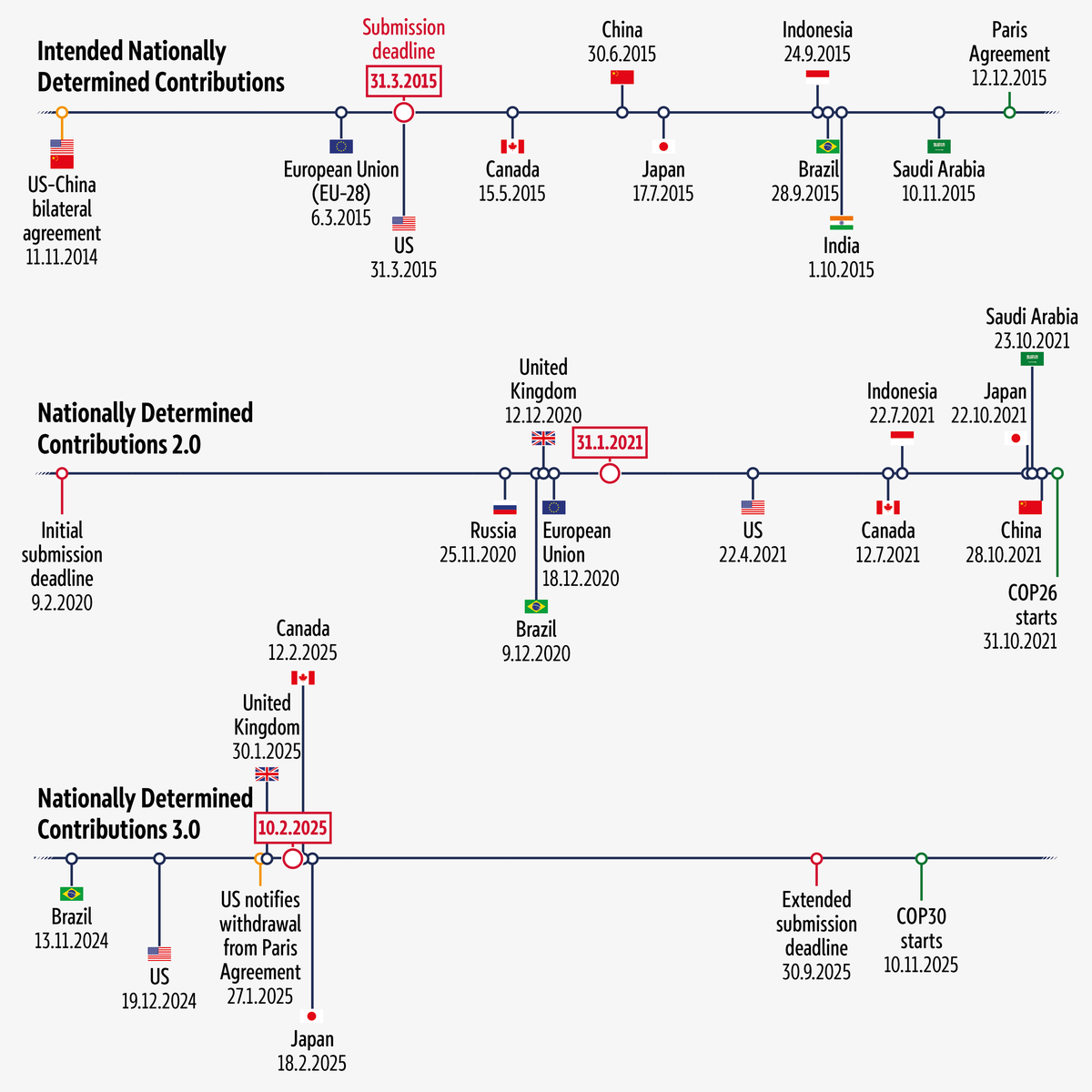
Source: UNFCCC NDC Registry. Graphic by: Samy Chahri, EPRS.
The EU has traditionally been among the first Parties to submit an NDC, demonstrating leadership by setting ambitious targets. Since unilateral ambition of one Party leads to costs for that Party while benefiting all other Parties, many tend to wait until other NDCs have been submitted (see Figure 1). The EU's NDC 3.0 was delayed by concerns about the competitiveness of European industry, a reset of the European Green Deal, and the link with the EU's proposed 2040 climate target (see page 8).
Box 1 – Outcomes of the first global stocktake
The COP28 decision on the outcome of the first global stocktake calls for:
-
tripling renewable energy capacity and doubling annual energy efficiency improvements by 2030
-
phasing down unabated coal power
-
accelerating efforts towards net-zero-emission energy systems
-
transitioning away from fossil fuels
-
accelerating zero- and low-emission technologies
-
substantially reducing non-carbon-dioxide emissions, especially methane, by 2030
-
accelerating emissions reductions in road transport
-
phasing out inefficient fossil fuel subsidies.
The transparency framework to monitor NDC delivery also feeds into the global stocktake, the periodic assessment of collective progress towards achieving the Paris Agreement's goals, starting in 2023 and recurring every five years. In turn, the outcomes of the global stocktake guide Parties in updating and strengthening their NDCs. The first global stocktake called on Parties to contribute to a list of eight global efforts in their next NDCs (see Box 1) and to align NDCs with national long-term strategies. Some Parties, including Brazil, mention their intention to reflect outcomes of the global stocktake in their next NDCs. Other Parties have more binding processes, such as the EU with its Climate Law explicitly linking the process of setting a climate target for 2040 to the global stocktake.
Under the Paris Agreement, all Parties should strive to formulate and communicate long-term low GHG emissions development strategies, which can include target years for peaking emissions and climate neutrality, and low GHG emissions trajectories. The 2050 Pathways Platform published a guide for aligning NDCs with long-term strategies, to ensure that short-term plans such as NDCs incorporate and support the long-term systemic transformations specified in long-term strategies. Only half of Parties' NDCs 2.0 provided long-term visions for emissions reductions.
The EU submitted its long-term strategy in March 2020, in line with the European Climate Law that sets a climate neutrality target by 2050. However, the updated EU NDC 2.0 does not refer explicitly to the long-term strategy. Under the EU Governance Regulation, Member States must submit to the European Commission national long-term strategies with a 30-year perspective, and update them every five years where necessary.
Third wave of NDCs
Under the Paris Agreement, new NDCs should represent a progression. The Climate Action Tracker (CAT), an independent scientific project, provided a guide to a good 2035 climate target. According to this guide, current NDCs 2.0 would lead to 2.5 °C warming by 2100, while breaching the 1.5 °C target by the early 2030s, and the 2 °C target by 2040. To achieve the targets, NDCs 2.0 need be revised to close the 2030 emissions gap, and NDC 3.0 targets should accelerate emissions reductions.
Reflecting NDCs' bottom-up nature, Parties take different approaches to updating their NDCs, from expansions in scope and coverage to changes in target type. Nevertheless, the global stocktake specifically encouraged the Parties to come forward in their NDCs 3.0 with 'ambitious, economy-wide emission reduction targets, covering all GHGs, sectors and categories'. Among the five major economies studied that have submitted an NDC 3.0, ambition levels differ. While none have enhanced their 2030 targets, they all set enhanced targets for 2035, although Canada's upper target for 2030 is the same as its lower one for 2035 (45 % below 2005 levels). Japan's 2035 target assumes a linear trajectory between its 2030 target and its climate neutrality goal. Russia has not yet published an NDC 3.0 but adopted an executive order that sets a 2035 target of reducing net GHG emissions by 65-67 % below 1990 levels, which is less ambitious than its previous target of 70 % by 2030 and effectively allows emissions to grow, since current levels are already below this target.
CAT provides feasible domestic emissions reduction pathways for each country and found that only the UK's 2035 target is aligned with its 1.5 °C pathway, which is a clear improvement from the previous NDC. For Canada, a substantial gap remains between the 2035 target's upper range and its 1.5 °C pathway; the gap has widened compared with Canada's 2030 target. Japan pledged a 60 % net reduction by 2035 compared with 2013 but would need to increase this target to at least 81 % to align with its 1.5 °C pathway. Finally, CAT considers Brazil's NDC 3.0 incompatible with its 1.5 °C pathway, acknowledging uncertainties with regards to emissions and removals in the land use, land use change and forestry (LULUCF) sector. For comparison, CAT rated the EU's 2030 target as 'insufficient', because global warming would reach between 2 and 3 °C if all Parties were to adopt the same approach.
Box 2 – Types of targets
Parties use different types of targets, depending on economic development and national circumstances.
Absolute emissions reductions targets, usually expressed as a percentage and relative to a base year; used by most of the Parties analysed, including Brazil, Canada, Japan and the UK.
Emissions intensity reduction targets per unit of GDP relative to a base year, such as China's and India's.
Baseline scenario targets relative to business-as-usual projections (in the absence of mitigation policies), such as Indonesia's.
Trajectory targets that can include a year for peaking emissions, such as China's.
Non-GHG targets that focus on sectors, including relating to renewable energy, energy efficiency, forestry, etc.
Some lower-income countries, such as Indonesia, have also chosen unconditional as well as conditional targets, which are subject to availability of international support.
Parties use a variety of target types, and sometimes multiple ones (see Box 2). More than 80 % of Parties have economy-wide targets covering almost all sectors, with an increasing share adopting absolute emissions reduction targets in updated NDCs. The International Energy Agency (IEA) highlighted that countries with higher gross domestic product (GDP) per capita have mostly set absolute emissions reduction targets, while countries with low to medium GDP per capita have mostly adopted baseline scenario targets, which offer greater flexibility to pursue economic development but are less predictable in terms of actual emissions outcomes. Nevertheless, the IEA points out that several higher-income countries also set intensity or business-as-usual scenario targets. For instance, Saudi Arabia's target is to reduce or avoid 278 million tonnes of CO2 equivalent (MtCO2e) annually by 2030, supposedly below a 2019 baseline scenario but without providing a relative baseline projection.
Economy-wide targets should include all sectors: energy (including in transport and buildings), industrial processes and product use, agriculture, forestry and other land use, and waste.6 Parties studied include all or almost all sectors. However, CAT warns that a combined target for emissions reductions and GHG removals can mask inadequate overall action, and recommends Parties to communicate separate targets for emissions reductions and removals. For instance, Brazil's NDC 3.0 lacks details on the expected contributions of the land use, land-use change and forestry (LULUCF) sector to the 2035 target, which has vast implications on the level of decarbonisation required for other sectors. Conversely, the EU's updated NDC 2.0 communicated an enhanced separate target for LULUCF removals (310 MtCO2e in 2030). Indonesia's NDC 2.0 provided separate sectoral targets relative to its business-as-usual scenario, including for LULUCF removals. However, neither the EU nor Indonesia seem on track to reach their LULUCF targets. Targets should also cover seven GHGs.7
Dividing the global carbon budget
The IPCC estimated the maximum amount of cumulative net emissions that would result in limiting global warming to 1.5 °C and 2 °C – the carbon budget.8 To limit global warming to 1.5 °C with a 50 % likelihood by 2100, there is a remaining carbon budget of 500 gigatonnes of CO2 (GtCO2) from 2020 onwards. The UNFCCC further determined that, if all NDCs 2.0 were implemented, the remaining 1.5 °C carbon budget9 from 2030 onwards would be around 70 GtCO2, as shown in Figure 2. This corresponds to approximately two years of projected global emissions by 2030. The NDC 3.0 targets from Brazil, Canada, Japan and the UK would take up 17 % of this remaining post-2030 budget (36 % if including the US), while the Parties concerned were only responsible for around 7.5 % of global emissions in 2022 (19.2 % if including the US).
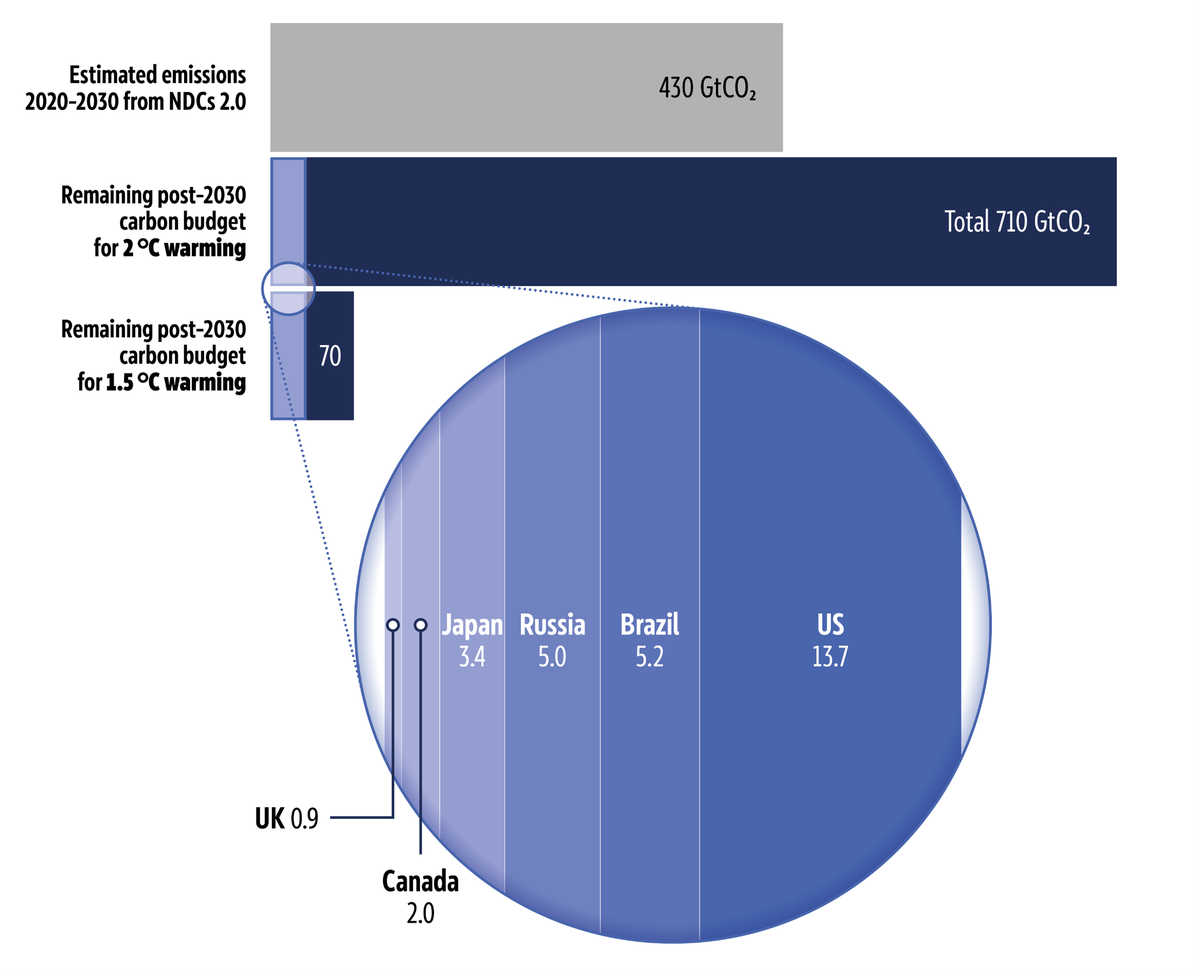
Source: UNFCCC 2024 NDC Synthesis Report, UNFCCC NDC Registry. Graphic by: Samy Chahri, EPRS. Parties' emissions between 2031 and 2035 are calculated on the assumption of linear annual reductions between the 2030 target (NDC 2.0) and the 2035 target (NDC 3.0). For targets stated as a range, the middle value was used. All except Canada include LULUCF. Russia set its 2035 target in an executive order of August 2025, but has not yet submitted an NDC 3.0. The US NDC 3.0 was submitted before the Trump administration announced the country's withdrawal from the Paris Agreement; therefore actual US emissions between 2031 and 2035 are likely to be higher. The carbon budget concerns carbon dioxide (CO2) whereas countries' targets include CO2 equivalent (CO2e) greenhouse gases.
There is no agreed definition of national 'fair shares' of global carbon budgets. Some approaches combine various equity principles into one fair-share allocation scheme, while others, such as CAT, determines a fair share range for each country based on a broad spectrum of views. CAT uses seven effort-sharing categories: historical responsibility; capability/need; equality; equal cumulative per capita emissions; capability; cost (welfare loss); and right to development. In that way, CAT rates NDC 2.0 unconditional targets from Indonesia, Russia and Saudi Arabia as 'critically insufficient' against their fair share, and as 'insufficient' for all other Parties studied, except for Brazil, whose NDC 2.0 target is considered as 'almost sufficient'. Moreover, UNEP stresses that G20 members must cut emissions faster than the global average, to be aligned with fair share pathways.
The European Scientific Advisory Board on Climate Change gives three perspectives on the EU's fair share: 'legal' under the Paris Agreement and domestic law; 'ethical', considering several equity approaches; and 'practical', accounting for historical, per capita and consumption-based emissions.
Delivery on NDC targets
Along with the ambition gap, there is also an implementation gap regarding both emissions reductions and adaptation to climate change (see Box 3). A 2025 assessment found an increasingly widening gap between national ambition and actual policy performance. Moreover, UNEP's Emissions Gap Report 2024 found that the G20 member countries would exceed their NDC 2.0 targets by 1 GtCO2e in 2030 under current policy projections, with 11 members off track. India, Türkiye and Mexico are the most likely to reach their (comparatively weak) targets, followed by China, the EU and Russia.
Box 3 – Climate adaptation in the NDCs
The Paris Agreement recognises mitigation co-benefits resulting from adaptation actions, and requires Parties to submit adaptation communications periodically, referring to a national adaptation plan. The global stocktake noted that adaptation measures are 'fragmented, incremental, sector specific and unequally distributed across regions', and that adaptation gaps will continue to widen under current implementation efforts. Consequently, it called on Parties to establish their adaptation planning by 2025 and progress with implementation. The European Commission updated the EU adaptation strategy in 2021, and announced an EU climate adaptation plan for 2026. Furthermore, the European Climate Law requires Member States to adopt and implement national adaptation strategies and plans.
Over 80 % of NDCs 2.0 included an adaptation component, which represents progress from previous NDCs, with an increased focus on planning and with more time-bound quantitative targets and indicators. India, Indonesia, Russia and Saudi Arabia detail adaptation measures in their NDCs 2.0, while the EU does not.
Japan did not include any information relating to adaptation in its NDC 3.0, but submitted a biennial transparency report of its adaptation communication on 21 February 2025. Brazil's NDC 3.0 refers to its National Adaptation Strategy and 16 sectoral adaptation plans developed under its Climate Plan and provides 13 national adaptation guidelines and nine objectives. It also mentions mitigation co-benefits from adaptation measures. Brazil's adaptation priorities are in line with the main adaptation components highlighted by the UNFCCC 2024 NDC Synthesis Report (food security; water resources; biodiversity and ecosystems; infrastructure; health; disaster risk management; coastal areas; urban areas; livelihoods; and oceans). The UK's NDC 3.0 details its adaptation planning, as well, with its third National Adaptation Programme covering 2023-2028 under its Climate Change Act. Finally, Canada's NDC 3.0 refers to its 2023 National Adaptation Strategy and accompanying Adaptation Action Plan that implements the strategy's goals, objective and targets in five priority areas: disaster resilience; health; biodiversity; infrastructure; and workers. Moreover, Canada mentions the strategy's accountability, with its first progress report due in 2026.
Under the Paris Agreement, Parties should 'intend to achieve' their NDCs and 'pursue domestic mitigation measures' with this aim. In practice, Parties will establish a national system comprising legislation, administrative procedures, sectoral plans, financial resources and enforcement mechanisms, with higher expectations for developed country Parties. More than 90 % of NDCs 2.0 have provided information on means of implementation, although with significant variation in structure and depth. Canada and the UK's NDCs 3.0 mention legal acts implementing their targets, while those of Brazil and Japan highlight their national plans but no legally binding provisions. NDCs 3.0 also indicate the presence of national advisory bodies that inform the climate policies of Canada, Japan and the UK (see annex). CAT rated NDC 2.0 policies and actions from the four Parties studied, as well as the EU, as 'insufficient' against modelled domestic pathways.
Implementation of conditional targets depends on international climate finance (see Box 4), and NDCs increasingly mention that it can flow through voluntary cooperation under Article 6 of the Paris Agreement. UNFCCC reports that 78 % of Parties intend to use at least one of the three Article 6 approaches, with 52 % referring to cooperative approaches (Article 6.2). Parties can trade emissions reductions bilaterally, through internationally transferred mitigation outcomes (ITMOs) that the buyer country uses to fill gaps in its nationally determined emissions reduction target.
The UK's NDC states that it does not currently intend to use these approaches but might do so in the future. Canada goes further, saying it may potentially use them, but without giving any details. CAT considers this a lack of transparency and clarity. Japan's NDC 3.0 mentions the creation and implementation of its Joint Crediting Mechanism (JCM), a bilateral initiative to support quantified emissions reductions and GHG removals in partner countries. Japan intends to use JCM credits (around 100 MtCO2e by 2030 and 200 MtCO2e by 2040) to achieve its own NDC targets. It wants to take the lead in the development of international rules for such market mechanisms, including to avoid double counting of emissions reductions. Conversely, Brazil considers enhancing its NDC 3.0 target (from -59 % to -67 % by 2030 relative to 2005) using ITMOs generated in Brazil to attract international investment. However, any mitigation outcomes transferred to third countries cannot be counted towards Brazil's NDC target.
Box 4 – International climate finance pledges and needs
On top of the implementation gap, there is a conditionality gap. The UNFCCC estimates that full implementation of all NDCs 2.0 would reduce global emissions by around 5.9 % by 2030 compared with 2019. However, if only unconditional targets were realised, emissions would increase by 0.8 %. In total, 24 Parties have communicated measures intended to achieve conditional targets, mainly through solar energy, conversion of ecosystems, wind energy and improved energy efficiency in industry. The Paris Agreement states that developed countries must provide financial resources to assist developing countries and communicate their goals biennially. Since 2020, developed countries should jointly provide US$100 billion (€85.5 billion) to developing countries annually. Although this pledge was met for the first time in 2022, it remains far from the estimated needs for achieving conditional targets, which would require US$1.6 trillion (€1.37 trillion) annually. The global stocktake underlined this growing gap between finance needs and support. COP29 decided on a new common quantified goal to provide US$300 billion (€256 billion) annually by 2035 to developing countries, and to mobilise US$1.3 trillion (€1.1 trillion) annually from public and private sources.
To deliver on this goal, Parties need to include climate finance contributions or needs in the third wave of NDCs. In NDCs 2.0, 46 % of Parties provided estimates of financial needs. The UK's NDC 3.0 mentions its commitment to spend £11.6 billion (€13.4 billion) in international climate finance over the 2021-2026 period. Canada's NDC 3.0 refers to its investment of CAD5.3 billion (€3.3 billion) to support mitigation in developing countries over 2021-2026, which corresponds to 60 % of its international climate finance. Nevertheless, CAT rates Canada, Japan and the UK's international climate finance pledges as 'highly insufficient' compared with their fair share. Although the EU and its Member States are the largest providers of climate finance (€28.6 billion from public sources, plus €7.2 billion in private finance in 2023), the latest EU NDC lacks information in this respect, and CAT rates the EU's contributions as 'insufficient'.
The EU's NDC 2.0 specifies the domestic nature of its 2030 target and does not refer to the use of international credits. The Commission proposal for a 2040 climate target states that international credits could possibly contribute towards EU climate goals starting from 2036.
Setting the EU NDC 3.0
The EU submits a single NDC on behalf of all Member States; it will be formally adopted by the Council. Wopke Hoekstra, the EU Climate Commissioner, stated the intention of aligning the NDC 3.0 target for 2035 with the EU's climate target for 2040. On 2 July 2025, the Commission tabled its proposal for a 2040 climate target,10 as a targeted amendment to the European Climate Law. The Commission's proposal for the 2040 target is a reduction of net GHG emissions by 90 % below 1990 levels, with limited use of international credits from 2036.
The legislative timeline is rather tight. The Environment Council is expected to discuss the proposal and the EU NDC 3.0 on 18 September 2025. In Parliament, the Committee on the Environment, Climate and Food Safety (ENVI) plans to adopt its position on the EU 2040 target on 23 September, and the vote in plenary is scheduled for the October I session, together with a resolution on COP30.
Regarding international climate cooperation, the Commission plans to table the EU's global climate and energy strategy for 2025-2029 in the third quarter of 2025. A public consultation is open until 11 September 2025. On 24 July 2025, the EU and China published a joint statement on climate, reaffirming their intention to finalise their NDCs 3.0 before COP30 and to deepen collaboration on energy transition, adaptation, methane reduction, carbon markets, and low-carbon technologies.
Main references
- Jeudy-Hugo, S. et al., Insights for designing mitigation elements in the next round of Nationally Determined Contributions (NDCs), OECD/IEA Climate Change Expert Group, May 2024.
- Jensen, L., Amending the European Climate Law: Setting an emissions reduction target for 2040, EPRS, European Parliament, September 2025.
- UNEP, Emissions Gap Report 2024, October 2024.
- UNFCCC, 2024 NDC Synthesis Report, October 2024.
Endnotes
Annex
Countries are sorted by GHG emissions in 2022, starting with the largest emitters.
| China – NDC 3.0 not yet submitted | |
|---|---|
| GHG emissions in 2022 | 12 716 MtCO2e or 25.4 % of global emissions including LULUCF (source: Climate Watch) |
| Long-term strategy target | Peak carbon dioxide emissions before 2030 and achieve climate neutrality before 2060 |
| NDC 2.0 target | Reduction of net CO2 emissions per unit of GDP by over 65 % by 2030 from the 2005 level |
| Target type | Carbon intensity target; unconditional |
| Separate target(s) | Increase the share of non-fossil fuels in primary energy consumption to around 25 %. Increase the forest stock volume by 6 billion m3 from the 2005 level. Increase total installed capacity of wind and solar power to over 1 200 gigawatts |
| India – NDC 3.0 not yet submitted | |
| GHG emissions in 2022 | 3 737 MtCO2e or 7.5 % of global emissions including LULUCF (source: Climate Watch) |
| Long-term strategy target | Climate neutrality by 2070, according to its NDC 2.0 and long-term strategy |
| NDC 2.0 target | Net reduction of carbon intensity of its GDP by 45 % by 2030 from the 2005 level |
| Target type | Carbon intensity target; contingent on additional means of implementation to be provided by developed country Parties, technology transfer and capacity building |
| Separate target(s) | Achieve about 50 % cumulative electric power installed capacity from non-fossil fuel-based energy resources by 2030. Create an additional carbon sink of 2.5-3 GtCO2e through additional forest and tree cover by 2030 |
| European Union – NDC 3.0 not yet submitted | |
| GHG emissions in 2022 | 3 061 MtCO2e or 6.1 % of global emissions including LULUCF (source: Climate Watch) |
| Long-term strategy target | Climate neutrality by 2050, according to its NDC 2.0 and long-term strategy |
| NDC 2.0 target | Reduction of net GHG emissions by at least 55 % by 2030 from the 1990 level |
| Target type | Absolute and economy-wide, base year target; unconditional. The EU submits a single NDC on behalf of all Member States and has opted for joint implementation with Iceland and Norway |
| Sectors and gases included | All economic sectors; all seven GHGs |
| Article 6 use | 2030 target to be achieved through domestic measures only. Exploring possibilities to link EU emissions trading systems (ETS) with other robust ETSs |
| Separate target(s) | Net GHG removal target of 310 MtCO2e in LULUCF sector in 2030. See fit for 55 package |
| National implementation | European Climate Law, Governance Regulation, national energy and climate plans. For more details, see L. Jensen, The EU's climate action strategy, EPRS, European Parliament, May 2025 |
| Adaptation | Not included |
| Russia – NDC 3.0 not yet submitted | |
| GHG emissions in 2022 | 1 821 MtCO2e or 3.6 % of global emissions including LULUCF (source: Climate Watch) |
| Long-term strategy target | Climate neutrality by 2060, according to its long-term strategy |
| NDC 2.0 target | Reduction of net GHG emissions by 70 % by 2030 from the 1990 level |
| 2035 target in national law | Reduction of net GHG emissions by 65-67 % by 2035 from the 1990 level |
| Target type | Absolute and economy-wide, base year target; unconditional |
| Separate target(s) | No available information |
| Brazil – NDC 3.0 submitted on 13 November 2024 | |
| GHG emissions in 2022 | 1 538 MtCO2e or 3.1 % of global emissions including LULUCF (source: Climate Watch) |
| Long-term target | Climate neutrality by 2050, according to its NDC 3.0 (Brazil has not yet submitted a long-term strategy to the UNFCCC) |
| NDC 2.0 target | Reduction of net GHG emissions by 48.4 % by 2025, and 53.1 % by 2030, from the 2005 level |
| NDC 3.0 target | Reduction of net GHG emissions by 59-67 % by 2035 from the 2005 level |
| Target type | Absolute and economy-wide, base year target; unconditional |
| Sectors and gases included | All economic sectors; CO2, CH4, N2O, SF6, PFCs and HFCs |
| Article 6 use | Possibility to raise ambition beyond the -59 % level through international investments financed from the international transfer of mitigation outcomes generated in Brazil |
| Separate target(s) | No separate removal target |
| National implementation | Update of the National Plan on Climate Change (Climate Plan); no external advisory board |
| Adaptation | National Adaptation Strategy under the Climate Plan, with 16 sectoral adaptation plans being developed |
| Indonesia – NDC 3.0 not yet submitted | |
| GHG emissions in 2022 | 1 530 MtCO2e or 3.1 % of global emissions including LULUCF (source: Climate Watch) |
| Long-term strategy target | Peak GHG emissions in 2030 and achieve climate neutrality by 2060 or sooner |
| NDC 2.0 target | Reduction of net emissions by 31.89 % unconditionally (and 43.2 % conditionally) by 2030, compared with business-as-usual scenarios of emissions projection started in 2010 |
| Target type | Baseline scenario target (relative to business-as-usual); conditional |
| Separate target(s) | Reduction of emissions by 12.5 % for the energy sector, 1.4 % for waste, 0.2 % for industrial processes and product use (IPPU), 0.3 % for agriculture, and 17.4 % for LULUCF, with detailed conditional sectoral targets |
| Japan – NDC 3.0 submitted on 18 February 2025 | |
| GHG emissions in 2022 | 1 044 MtCO2e or 2.1 % of global emissions including LULUCF (source: Climate Watch) |
| Long-term strategy target | Climate neutrality by 2050, according to its NDC 3.0 and long-term strategy |
| NDC 2.0 target | Reduction of net GHG emissions by 46 % by 2025 from the 2013 level |
| NDC 3.0 target | Reduction of net GHG emissions by 60 % by 2035, and 73 % by 2040, from the 2005 level |
| Target type | Absolute and economy-wide, base year target; unconditional |
| Sectors and gases included | All economic sectors; all seven GHGs |
| Article 6 use | Creation of the Joint Crediting Mechanism to secure accumulated emissions reductions and removals of approximately 100 MtCO2 by 2030 and 200 MtCO2 by 2040 |
| Separate target(s) | No separate removal target |
| National implementation | Plan for global warming countermeasures; Advisory committee for natural resources and energy |
| Adaptation | Not included |
| Saudi Arabia – NDC 3.0 not yet submitted | |
| GHG emissions in 2022 | 775 MtCO2e or 1.5 % of global emissions including LULUCF (source: Climate Watch) |
| Long-term target | Climate neutrality by 2060 (announcement by Crown Prince Mohammed bin Salman in October 2021). Saudi Arabia has not yet submitted a long-term strategy to the UNFCCC |
| NDC 2.0 target | Reducing and avoiding net GHG emissions by 278 MtCO2e annually by 2030, with 2019 as the base year |
| Target type | Not explicitly stated – CAT assumes a baseline scenario target; unconditional |
| Separate target(s) | Reach a renewable energy share of the energy mix of around 50 % by 2030. Half of electricity generated by natural gas by 2030 |
| Canada – NDC 3.0 submitted on 12 February 2025 | |
| GHG emissions in 2022 | 750 MtCO2e or 1.5 % of global emissions including LULUCF (source: Climate Watch) |
| Long-term strategy target | Climate neutrality by 2050, according to its NDC 3.0 and long-term strategy |
| NDC 2.0 target | Reduction of net emissions by 40-45 % by 2030, from the 2005 level |
| NDC 3.0 target | Reduction of net emissions by 45-50 % by 2035 from the 2005 level |
| Target type | Absolute and economy-wide, base year target; unconditional |
| Sectors and gases included | Energy, IPPU, agriculture, LULUCF (excluded for base year), waste; all seven GHGs |
| Article 6 use | Considering the potential |
| Separate target(s) | No separate removal target. |
| National implementation | Net-Zero Emissions Accountability Act. Net-Zero Advisory Body. |
| Adaptation | National Adaptation Strategy. |
| United Kingdom – NDC 3.0 submitted on 30 January 2025 | |
| GHG emissions in 2022 | 414 MtCO2e or 0.8 % of global emissions including LULUCF (source: Climate Watch) |
| Long-term strategy target | Climate neutrality by 2050, according to its NDC 3.0 and long-term strategy |
| NDC 2.0 target | Reduction of net GHG emissions by at least 68 % by 2030 from the 1990 level (excluding international aviation and shipping) |
| NDC 3.0 target | Reduction of net GHG emissions by 81 % by 2035 from the 2005 level (excluding international aviation and shipping) |
| Target type | Absolute and economy-wide, base year target; unconditional |
| Sectors and gases included | All economic sectors; CO2, CH4, and N2O (base year 1990), HFCs, PFCs, SF6 and NF3 (base year 1995) |
| Article 6 use | Does not currently intend to use cooperative approaches but reserves its right to do so |
| Separate target(s) | No separate removal target |
| National implementation | Climate Change Act; Climate Change Committee |
| Adaptation | Third National Adaptation Programme |
Classification
Policy areas: Environment
Regions: European Union, Canada and United States, Latin America and Caribbean, Mediterranean and Middle East, RUSSIA
Committees: Environment, Climate and Food Safety (ENVI)
Disclaimer
This document is prepared for, and addressed to, the Members and staff of the European Parliament as background material to assist them in their parliamentary work. The content of the document is the sole responsibility of its author(s) and any opinions expressed herein should not be taken to represent an official position of the Parliament.
Copyright
© European Union.
The reuse of this document is authorised under a Creative Commons Attribution 4.0 International (CC-BY 4.0) licence.

https://creativecommons.org/licenses/by/4.0/deed.en
To use or reproduce elements that are not owned by the European Union, permission may need to be sought directly from the respective rightsholders.