
Article page checkbox is not checked in page info.
The EU's climate action strategy
The EU's climate action strategy
Liselotte Jensen with Charlotte Hourdin, Climate Action Research and Tracking Service, Members' Research Service
Summary
Under the European Climate Law, the EU must reduce its net greenhouse gas (GHG) emissions by 55 % by 2030 compared with 1990, and reach climate neutrality by 2050 (see trajectory in Figure 1). Over the 2005-2023 period, net emissions in the EU decreased by 30.5 % (37 % compared with 1990). The land use, land-use change and forestry (LULUCF) sector is a significant carbon sink, although its capacity to increase carbon sequestration is under pressure, while the EU emissions trading system (ETS) is one of the most effective mitigation tools, having reduced emissions by the sectors it covers by 48.1 % since 2005. Sectors for which Member States are obliged to reduce GHG emissions under the 'effort-sharing' legislation decreased their emissions by 17.1 % in 2023 compared with 2005.
Investments tracked as climate-related spending account for 42.6 % of the total grants and loans approved under the Recovery and Resilience Facility (RRF) and the REPowerEU initiative. By 30 June 2024, Member States had to update their national energy and climate plans (NECPs), aligned with the EU's increased 2030 targets. As of May 2025, three final plans are still pending. A May 2025 assessment of submitted final NECPs show a significant gap reduction from earlier analysis, with net GHG emissions estimated to decrease by 54 % by 2030, compared with 1990 levels. In a 2023 survey, 46 % of EU citizens identified climate change as one of the four most serious problems facing the world. Most Europeans (56 %) said it was the responsibility of the EU or the national government to tackle climate change, followed by business/industry (53 %); 35 % found it to be a personal responsibility.
This briefing is one in a series covering all EU Member States.
The EU's starting point
Following adoption of the European Climate Law in 2021, the 'fit for 55' package aligned the climate acquis with the raised 2030 climate target, with a view to climate neutrality by 2050. As of May 2025, only the revision of the Energy Taxation Directive is still ongoing. The main changes to core climate policies included the phase-out of free allowances for aviation and a faster reduction of the overall number of allowances available under the EU ETS, which covers power plants, industrial installations and aviation, with maritime emissions added with the revision. The carbon border adjustment mechanism (CBAM) is a new tool to incentivise emissions reduction globally and avoid the risk of carbon leakage into third countries by ensuring carbon pricing on imports of specific products where the European industry is covered under EU ETS. The phase-out of free allowances for these EU sectors is synchronised with the phase-in of CBAM. Owing to the success of carbon pricing in reducing emissions, a new ETS – ETS2 – was established. ETS2 will primarily target emissions from fuels used in transport and buildings, two sectors where emissions reductions have proven difficult.
The new 2030 EU-level target under the Effort-sharing Regulation is a -40 % reduction in emissions compared with 2005, with national targets ranging from -10 % to -50 %. With a declining trend in the overall EU carbon sink in recent years, the LULUCF Regulation had its 'no debit' approach changed to a target of increasing the EU carbon sink. The revisions also included increased targets for renewable energy and energy efficiency improvements by 2030.
The current multiannual financial framework and the Next Generation EU instrument earmark 30 % of expenditure for climate objectives, featuring several green funding programmes. In addition, the Innovation Fund is financed from EU ETS revenue, with ETS2 financing the largest part of the Social Climate Fund. The European Investment Bank further invests in supporting EU climate objectives.
The EU has delivered on its 2020 climate targets for GHG emissions, share of renewable energy and energy consumption, in part because of the pandemic-linked recession in 2020. At Member State level, seven countries made use of flexibility options to deliver on their 2020 targets, while eight countries failed to deliver on specific targets, primarily those relating to energy efficiency. Between 2005 and 2023, emissions were reduced in all sectors when looking at EU aggregate data. Transport, accounting for a quarter of the EU's total emissions, holds the largest share, followed closely by energy industries. EU carbon intensity decreased by 44.4 % over the period, while per capita emissions fell by 32.4 %, reaching 7.2 tonnes of carbon dioxide equivalent (tCO2e) in 2023.
In the 2025 Climate Change Performance Index (CCPI), the EU received a medium rating across the four categories: GHG emissions, renewable energy, energy use, and climate policy. The CCPI ranks countries based on their climate protection performance using primarily quantitative data, with experts providing qualitative evaluation of a country's forward-looking climate policies. The experts note that the EU's recent revisions strengthened its climate frameworks. However, they still consider that it is not aligned with the Paris Agreement's 1.5 °C ambition. As a key demand, experts point to halting fossil fuel subsidies, an issue repeatedly highlighted by the European Parliament, most recently in 2024.
Climate action governance
European Climate Law headline targets – as well as other key targets, such as for renewable energy expansion – are set at EU level, making enforcement more complex. The key approach to overcoming this governance challenge is by linking national obligations to collective EU goals. The 2018 Governance Regulation, originating from the 2015 energy union strategy, introduced a single governance framework that integrates an overlapping set of enforcement mechanisms in the areas of climate and energy policy. It requires Member States to prepare and submit every decade new NECPs covering 10-year periods (Article 3), alongside long-term strategies with a 30-year perspective (Article 15). The regulation ensures regular progress reporting and enables the European Commission to issue recommendations or corrective actions, with obligations on Member States to react and respond. This 'iterative dialogue' allows a 'harder soft governance' (Article 1).
In the case of non-compliance by Member States, the Commission can make use of the infringement procedure in Articles 258, 259 and 260 of the Treaty on the Functioning of the EU (TFEU). In November 2024, the Commission used this option against several Member States that failed to submit their final updated NECPs. If the pre-litigation phase does not succeed, the Commission might refer the case to the Court of Justice of the EU (CJEU), which can either order the Member States to take action or impose penalties. Achievement of the EU-level targets is thus underpinned by a range of targets and tools in various legislative acts for which the Governance Regulation ensures monitoring, reporting and progress, as set out above. Further to this, 18 Member States have adopted national climate laws; 13 of these countries have a long-term climate neutrality target.
Beyond the GHG emissions targets, the European Climate Law established an independent European Scientific Advisory Board on Climate Change (ESABCC) to serve as a point of reference for independent scientific and technical expertise (Articles 3 and 12). The Commission also launched the European Climate Pact in 2020 as a platform for citizens and organisations to connect, share information, debate and act in order to multiply the impact of climate solutions.
The 2013 EU strategy on adaptation to climate change was revised in 2021, to increase resilience to unavoidable climate change impacts. This strategy enhanced the Climate-ADAPT Platform as the go-to resource for sharing best practice and climate risk knowledge. The first European Climate Risk Assessment (EUCRA) was published in January 2024. In March 2025, the Commission adopted the European preparedness union strategy – which covers a large array of risks, including climate impacts – and highlighted the planned European climate adaptation plan, to be presented in 2026. Owing to the regional and local nature of climate impacts, adaptation measures must be implemented at different levels. Article 5 of the European Climate Law requires Member States to adopt and implement national adaptation strategies and plans. There is no obligation to set binding measurable targets. Since March 2021, Member States are required to report on their national climate change adaptation planning and strategies biannually under the Governance Regulation. Adaptation goals are to be included in the NECPs, if available.
Climate action in the national recovery and resilience plans
The 2021 Recovery and Resilience Facility (RRF) and additional funding under the 2022 REPowerEU plan allow Member States to use EU funds and loans for reforms and investments to boost economic growth and energy transition. Under the RRF, 37 % of funds must go towards climate action, with Member States' national recovery and resilience plans (NRRPs) subject to EU-level analysis and approval. Chapters added subsequently for REPowerEU actions focus on accelerating the energy transition.
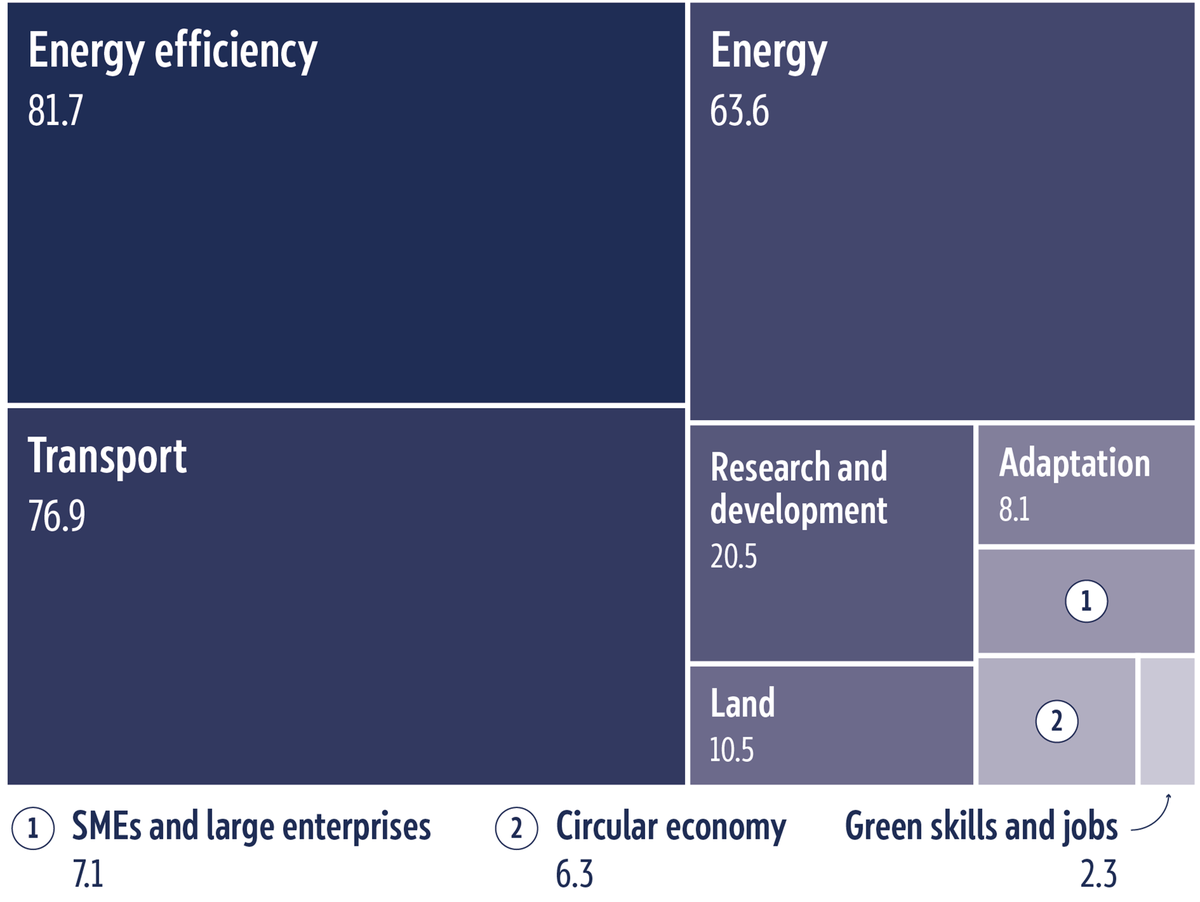
Data source: European Commission, as of 1 April 2025; Graphic by Lucille Killmayer and Ville Seppälä, EPRS.
As of April 2025, 43 % of total requested funds and loans were tracked as climate spending. Figure 2 shows the aggregated spending per intervention field across the EU, with energy efficiency, transport and energy investments accounting for 80 % of total expenditure for climate action and energy transition.
Energy situation
In 2023, the EU's energy supply was 1 789 million tonnes of oil equivalent (Mtoe), including 35 Mtoe of electricity imports, not shown in Figure 3 below. Close to a third of available energy is produced within the EU. The EU imports almost all of its fossil fuels such as oil and petroleum products (97.3 %) as well as gas (91.1 %). Solid fossil fuels and peat (8.3 % of the EU's energy mix) are imported at a share of 45.3 %. The EU exported 434 Mtoe after transformation, mostly oil and petroleum products, some gas, and electricity equivalent to imports.
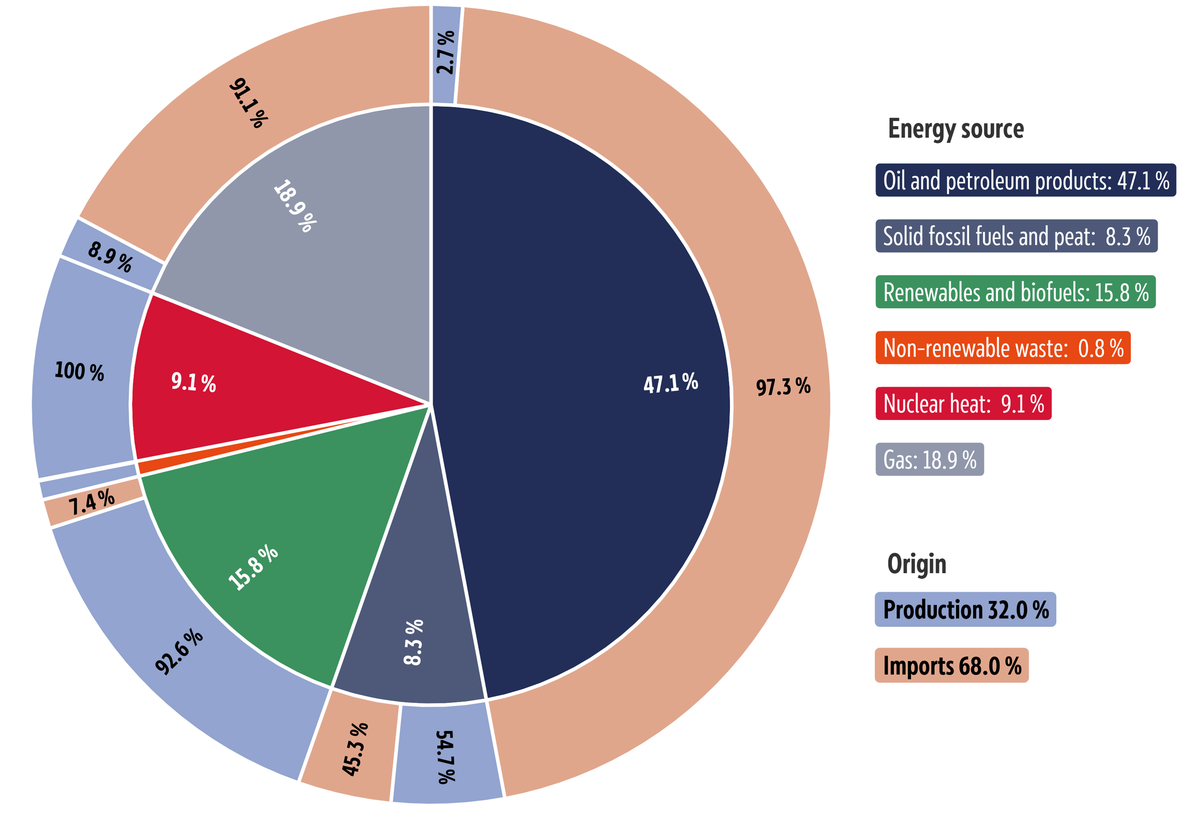
Data source: Eurostat (nrg_bal_sd), 2024.
Accounting for 47.1 % of the EU's 2023 total energy mix, oil and petroleum products remain by far the largest energy source. Data from 2024 show the top three countries of origin were the US, with 16.1 % by value, Norway (13.5 %) and Kazakhstan (11.5 %). An embargo on seaborne imports of Russian crude oil has been in place since the end of 2022, and on refined petroleum products since early 2023. Crude oil imports from Russia fell from 27.2 % in Q2 2022 to a 3 % share in February 2024.
The second largest energy source at EU level in 2023 was gas (18.9 %). Norway is the EU's largest supplier of natural gas in gaseous state, providing 45.6 % in 2024, while 45.3 % of liquefied natural gas (LNG) was imported from the US. According to the latest state of the energy union report, the origin of gas imports changed drastically following measures and sanctions put in place by the EU and its Member States in response to Russia's invasion of Ukraine. By mid-2024, the share of overall EU gas imports from Russia was 18 %, compared with 45 % in 2021. The report shows gas demand reductions per Member State from August 2022 to May 2024, with an EU-level decline of 18 %. Over the same period, 12 new LNG terminals were commissioned, facilitating – along with the expansion of six existing ones – the diversification of gas imports into the EU.
For the 8.3 % fraction of solid fossil fuels and peat, which includes coal, most brown coal is produced and consumed in the same country. Coal is primarily imported as hard coal, which in 2023 was only still produced in the EU by Poland and Czechia. In 2021, Russia supplied more than half of the EU's hard coal. An embargo on Russian coal imports shifted extra-EU coal supply to Australia (37.3 % by value) and the US (32.3 %) in 2024. Peat is only used in a few EU countries, where it is domestically produced. To aid the transition away from peat for energy, the EU Just Transition Fund supports transition plans inter alia in Finland and Ireland (the primary peat consumers).
In line with EU climate ambitions, and further prompted by energy security concerns due to Russia's war against Ukraine, the 2022 REPowerEU plan seeks to speed up the deployment of renewable energy sources (RES) to boost the EU's energy autonomy. The plan included higher-ambition amendments to the EU directives on renewable energy (RED), energy efficiency (EED) and energy performance of buildings (EPBD), then already under 'fit for 55' revision.
RES accounted for 15.8 % of the EU's energy mix in 2023, and for 24.1 % of final energy consumption (see Figure 4). In 2023, for the first time, RES were the main source of electricity production, accounting for 44.7 %, followed by fossil fuels (32.5 %) and nuclear energy (22.8 %). Eurostat shows RES shares per Member State and reports an increase to 47 % RES in electricity generation in 2024.
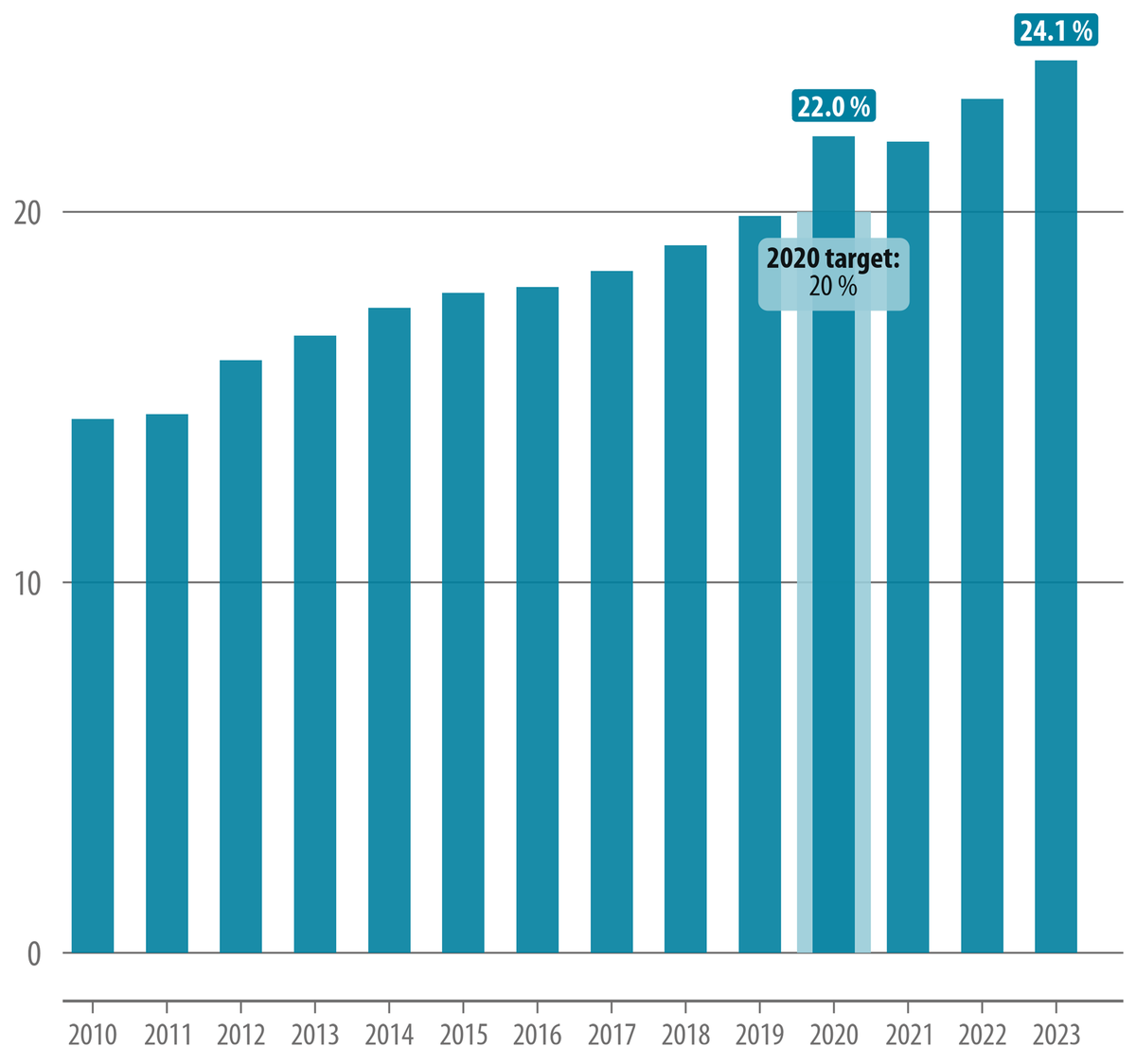
Data source: Eurostat (nrg_ind_ren), 2024. Graphic by Lucille Killmayer and Ville Seppälä, EPRS.
In a context of clear policy direction and high gas prices, installed wind and solar capacity saw an increase of 36 % from 2021 to 2023. In 2023, 56 gigawatts (GW) of new solar capacity and 16.2 GW of wind energy was installed. At the end of 2023, there was an estimated 263 GW of solar and 221 GW of wind at EU level. Despite these marked increases, the Commission notes that urgent action is needed to close the remaining 1.5 percentage point gap towards the 42.5 % RES in final energy consumption by 2030.
The REPowerEU plan and the action plan for affordable energy both include measures to support acceleration, for instance through faster permitting, more investment and better interconnections. Several fuel-specific targets have been set. By 2030, installed solar energy capacity should reach 700 GW; for gaseous fuels, annual biomethane production should reach 35 billion cubic meters (bcm), and renewable hydrogen, 20 Mt (combined import and production). The May 2025 final NECP analysis notes an estimated 25.85 bcm of combined biogas and biomethane production by 2030, down from the November 2024 estimation of 32 bcm, based on draft NECPs. Although various measures have been taken to improve market conditions for renewable hydrogen, 96 % of hydrogen to date is fossil-based, amounting in 2023 to 7.3 Mt or 2 % of EU energy demand. As the Commission notes, however, the EU has the largest pipeline of announced hydrogen projects.
Sectoral challenges and strategies
From 1990 to 2023, an absolute decoupling at EU level could be observed, with gross domestic product growing by 68 % and net GHG emissions falling by 37 % during the same period.
In 2023, 21.5 % of the EU's total emissions came from energy industries, a year-on-year decrease of 3.4 percentage points compared with 2022, mainly due to the increase in RES. From 2005 to 2023, emissions from energy industries decreased by 50 %. Industry emissions, comprising manufacturing, construction, process emissions and product use, decreased by 34 % over the same period, and accounted for 20 % of the EU's total emissions in 2023. The 2023 Green Deal industrial plan and the 2024 Net Zero Industry Act kicked off actions to simplify permitting and accelerate the scale-up of net-zero industries within the EU. Identifying key strategic capacities and sectors, initiatives in the previous legislature also focused on critical raw materials, batteries, semiconductors and clean hydrogen. A March 2025 action plan seeks to support the steel and metal sectors to remain competitive, also supported by several decarbonisation initiatives (see below).
At EU level, emissions have stayed within the allocations provided for under the Effort-sharing Decision for the 2013-2020 period. The Effort-sharing Regulation (ESR) revision lowered the allocation ceiling, as shown in Figure 5 below. Responsible for 65 % of EU domestic emissions, effort-sharing sectors include transport, buildings, agriculture, waste and smaller industrial installations. In 2023, 10 Member States surpassed their allocations under the ESR before the use of flexibilities.
Despite falling between 2007 and 2013, emissions grew up to 2020, when the impact of COVID‑19 slashed emissions by 13 % year-on-year. The sector then rebounded by 11 % between 2020 and 2022. In 2023, it achieved a 1 % reduction at EU level over 2022, with the greatest reductions seen in Croatia (-14 %), Slovenia (‑8.9 %) and Hungary (‑6 %). France's emissions reduction (4 Mt) from 2022 to 2023 was the highest in absolute terms, more than Croatia's, Slovenia's and Hungary's combined (2.4 Mt). The Commission estimates a 38 % reduction in ESR by 2030.
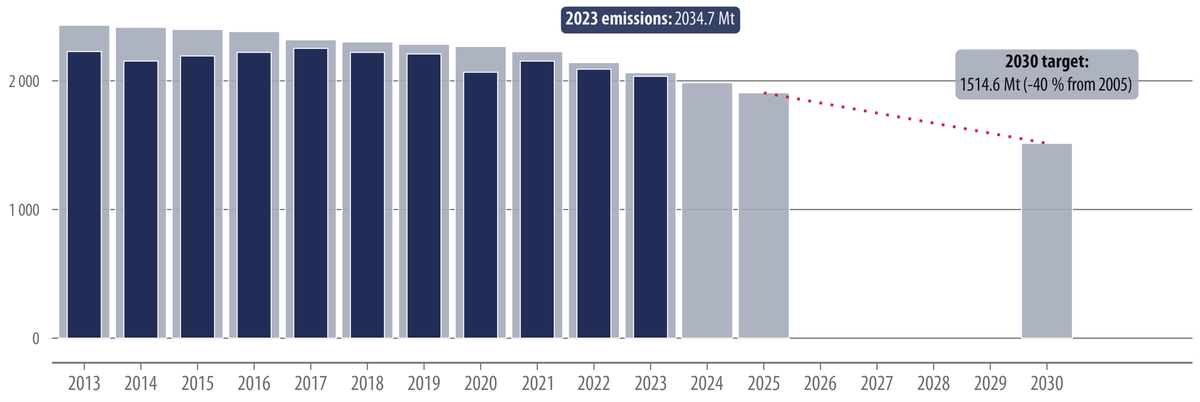
Data source: EEA, 2024. Graphic by Lucille Killmayer and Ville Seppälä, EPRS.
Transport is the worst performing sector in terms of emissions reductions in the EU over the 2005-2023 period, having only achieved -5.5 %. Complementing each other, the Alternative Fuels Infrastructure Regulation ensures the roll-out of charging and hydrogen refuelling points, while the CO2 emissions performance standards will increase the share of zero- and low-emission vehicles.
In 2023, 'other emissions' represented 19.5 % of total emissions in the EU, a share which, due to reductions in other sectors, is at the same level as in 2005. These emissions are mostly linked to buildings, both commercial and residential, and fugitive emissions from industry. The category saw a 28 % decrease from 2005 to 2023. Improving the energy efficiency of the European building stock is essential, as it accounts for 40 % of the EU's total energy consumption. Several strategies and laws address energy consumption in buildings, in particular the EPBD and the EED. Under the EPBD, Member States must submit draft national building renovation plans by the end of 2025, building on their renovation strategies from 2020. Several initiatives seek to support increased action in the area of energy-efficient buildings, including the dedicated BUILD UP web portal.
The Commission has identified transport, buildings and industry as the most challenging sectors where emissions reductions must accelerate. From 2027, carbon pricing will start under ETS2 on GHG emissions from fuels for road transport, buildings and small industrial installations not covered under the EU ETS. The reduction of allowances ('cap') will lead to 43 % fewer emissions by 2030 compared with 2005 for the sectors covered by ETS2. Member States must submit social climate plans by June 2025, indicating measures to offset negative social impacts of the carbon price on vulnerable citizens.
Agriculture accounted for 11 % of total emissions in 2023. Emissions decreased by 7.4 % between 2005 and 2023, with a 2 % reduction achieved between 2022 and 2023 alone. However, Member States' own projections show that, with the current measures, emissions from agriculture would increase towards 2030. With additional, planned measures, emissions would remain at -7 % compared with 2005. The largest share (49 %) of emissions in agriculture stems from livestock farming, which releases methane. The release of nitrous oxide, linked to fertiliser use, is responsible for 30 % of the sector's emissions. The third main fraction (17 %) comes from manure management.
As the 2023 EU soil strategy stated, sustainable soil management boosts biodiversity and ensures healthy and fertile soils for food production. Soil also stores vast amounts of carbon, but its capacity to do so is currently at risk. On 10 April 2025, the co-legislators provisionally agreed on a soil monitoring law establishing a harmonised framework for sampling, monitoring and defining soil health status. Although no binding targets for improving soil health exist, comparable data across the EU will allow authorities to support land managers in improving soil health.
The 2024 Nature Restoration Regulation set targets across a broad range of ecosystems, including for restoring agricultural ones to enhance biodiversity and reduce GHG emissions. The law also comprises a target to plant 3 billion trees at EU level by 2030, as well as other measures expected to have a positive long-term impact on the LULUCF sector.
LULUCF acts as a carbon sink. The sector's carbon removals fell from 2013 to 2022, but are estimated to have increased back to 2018 levels in 2023 (Figure 6). The overall negative trend is largely due to increased harvesting and slower forest growth, particularly in Member States with ageing forests.
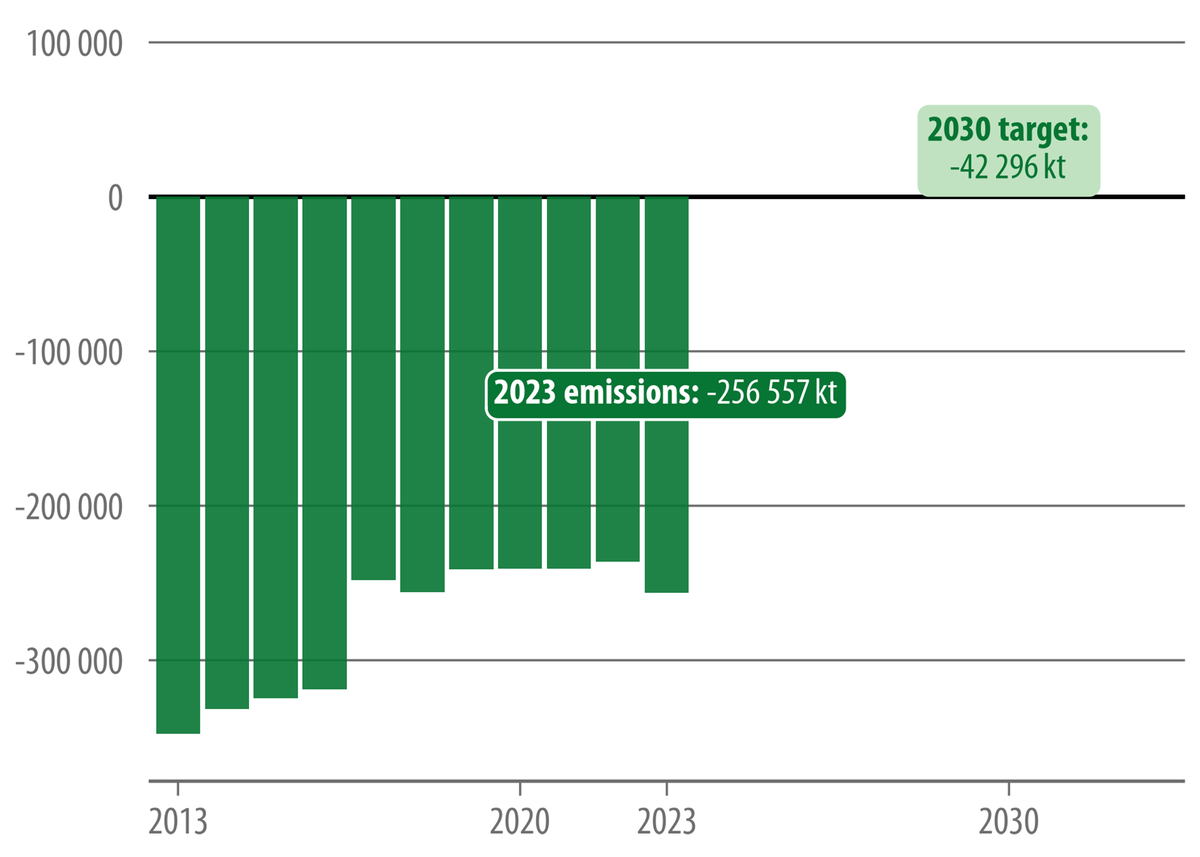
Data source: EEA (2030 target is based on 2016-2018 baseline), 2024. Graphic by Lucille Killmayer and Ville Seppälä, EPRS.
Under the LULUCF Regulation, the EU must achieve a net GHG emissions removal of 310 million tonnes of CO2e (MtCO2e) by 2030, with binding national targets. The Commission's assessment of final NECPs indicate that planned efforts would leave a 45-60 MtCO2e gap to the 2030 EU-wide LULUCF target; the annex to the assessment of final NECPs details expected national gaps. Three Member States are yet to submit their final NECPs. Among these, the draft assessments showed two of them delivering on their LULUCF obligations, and one, Poland, having a gap to its national binding LULUCF target of 18.9 MtCO2e. In the annex, Poland's gap is reduced to 5.9 MtCO2e. Seven of the 15 Member States likely to underachieve on LULUCF targets have carbon removal gaps of over 5 MtCO2e.
Draft carbon farming methodologies under the Union certification framework for permanent carbon removals, carbon farming and carbon storage in products were presented in May 2025. These are expected to promote further carbon farming initiatives through market prospects of its certificates.
Latest policy developments
As of May 2025, Belgium, Estonia and Poland still have to submit their final NECPs, despite the infringement procedures launched in November for failure to abide by the June 2024 deadline. Eight national-level non-governmental organisations have lodged a formal complaint with the Commission (compiled on the Climate Action Network Europe campaign website), asserting that their countries' NECPs are not aligned with their binding national targets from EU legislation, or lack pathways to phase out fossil fuel subsidies. The Commission has 12 months to assess and decide on a course of action. On 12 March 2025, it sent reasoned opinions to the Member States that have yet to submit a final NECP; as of mid-May, it could decide to refer those cases to the CJEU.
The latest analysis of Member States' climate action strategies improved previous assessments towards delivery of the 2030 targets, with the exception of LULUCF. Concerns about competitiveness, social fairness and overall feasibility have, however, slowed down progress towards setting a 2040 climate target. The European Climate Law calls for a legislative proposal to set a 2040 target within six months of the global stocktake under the Paris Agreement, completed at the end of 2023. The Commission launched the debate in February 2024 with an impact-assessed communication announcing an intended net 90 % reduction target for 2040, and outlining the indicative EU GHG budget for the years 2030 to 2050. The 2025 Commission work programme included a legislative proposal for Q1, now only expected before summer 2025. The delay is linked to pushback from some Member States, prompting the Commission to consider options for further flexibilities in climate policies going forward. The public consultation on the forthcoming review of the EU ETS includes questions on further links with international carbon markets, which might be a way to increase flexibility. On 5 May 2025, Commissioner Hoekstra said the 2040 target would likely come with flexibilities, possibly verifiable extra-EU emissions reductions.
The EU ETS review is expected to consider inclusion of EU CRCF certificates to boost EU ETS liquidity and EU carbon dioxide removals (CDR) simultaneously. In a recent report on CDR, the ESABCC highlights the increased need for CDR from 2030 towards 2050, calling for binding separate targets for permanent and temporary removals, as well as new pricing instruments for the LULUCF sector. The uncertainties and risks associated with relying on LULUCF removals are also outlined in a recent analysis from the Institute for European Environmental Policy. At the national level, the recent German coalition agreement states a need to allow 'highly qualified and credible CO2 reductions in non-European partner countries' for delivering on climate targets.
Political will is better aligned on the need to act on adaptation and preparedness. The forthcoming (June) water resilience strategy is meant to complement work on climate adaptation, and address water issues identified in both the EUCRA and the preparedness strategy. On 7 May, Parliament adopted its own-initiative report, calling on the Commission to propose sectoral targets. Based on risk assessments, they should cover water efficiency and abstraction. Members call for integrating climate adaptation into water management, with early warning systems and preparedness.
The new Commission has a clear focus on boosting industrial competitiveness through innovation and decarbonisation, as set out in the competitiveness compass. Decarbonisation helps deliver on climate commitments, and – of growing importance – it enables the EU and its industry to wean off expensive dependency on foreign fossil fuels. In the process, European clean-tech expertise can be positioned favourably in global markets. In February, the affordable energy action plan, part of the Clean Industrial Deal (CID), laid out key actions to reduce energy costs and increase the EU's energy autonomy through a completed energy union. To assist Europe's energy-intensive industry, the CID announced the Industrial Decarbonisation Bank for mid-2026, with a pilot auction in 2025 and an industrial decarbonisation accelerator act for the end of 2025. The aim is to support infrastructure needs and boost the EU clean-tech market through carbon labels and public procurement.
Main references
- European Commission, EU climate action progress report 2024, COM(2024) 498, 2024.
- European Commission, EU-wide assessment of the final updated NECPs, COM(2025) 274, 2025.
- European Commission, State of the Energy Union report 2024, COM(2024) 404, 2024.
Classification
Policy areas: Environment
Regions: European Union
Committees: Environment, Climate and Food Safety (ENVI)
Disclaimer
This document is prepared for, and addressed to, the Members and staff of the European Parliament as background material to assist them in their parliamentary work. The content of the document is the sole responsibility of its author(s) and any opinions expressed herein should not be taken to represent an official position of the Parliament.
Copyright
© European Union.
The reuse of this document is authorised under a Creative Commons Attribution 4.0 International (CC-BY 4.0) licence.

https://creativecommons.org/licenses/by/4.0/deed.en
To use or reproduce elements that are not owned by the European Union, permission may need to be sought directly from the respective rightsholders.