
Article page checkbox is not checked in page info.
Observers in the European Parliament
Observers in the European Parliament
Silvia Kotanidis, Members' Research Service
Summary
Accession to the European Union is a long process, requiring not only legislative, administrative and economic adaptation to EU standards, but also a degree of adaptation to the working methods of the EU institutions. One of these new working methods candidate countries must navigate is how the European Parliament organises its activities, how members interact, and how to build alliances and dialogue among the various political families represented in Parliament.
Parliament's rules of procedure allow parliamentary representatives of candidate countries to experience all these aspects in person, in advance of accession. Once the accession procedure is nearing conclusion, i.e. once an accession treaty is signed, the parliament of the acceding country may be invited to appoint, from among its members, persons who will be granted observer status to the European Parliament. As they are not yet elected in European elections, these observers remain members of the acceding country's parliament, but have the opportunity to participate, with some limitations, in parliamentary activities. For example, they cannot vote or fill any elected position within Parliament's organisation. However, they can participate in the activities of the parliamentary group to which they are affiliated, and attend plenary sittings and committee meetings.
Observers were appointed in the last three EU enlargements, and remained in office either until ad hoc European Elections were organised for the acceding country, i.e. outside the official electoral cycle (Croatia, Romania and Bulgaria), or until the end of the parliamentary term (2004 enlargement).
The possibility for Ukraine to have observer members in the European Parliament, under the current rules, depends upon the progress on accession negotiations, which officially only opened in December 2023. Nevertheless, cooperation between the Verkhovna Rada, the Ukrainian parliament, and the European Parliament already takes place in other forms.
Observer status under the Parliament's Rules of Procedure
The Parliament's current Rules of Procedure explicitly deal with observer status in Rule 13, which states:
'1. Where a Treaty on the accession of a State to the European Union has been signed, the President may, after obtaining the agreement of the Conference of Presidents, invite the parliament of the acceding State to appoint, from among its own members, a number of observers equal to the number of seats in the European Parliament to be allocated to that State upon accession.
2. Those observers shall take part in the proceedings of Parliament pending the entry into force of the Treaty of Accession, and shall have a right to speak in committees and political groups. They shall not have the right to vote or to stand for election to positions in Parliament, nor shall they represent the Parliament externally. Their participation shall not have any legal effect on Parliament's proceedings.
3. Their treatment shall be assimilated to that of a Member as regards the use of Parliament's facilities and the reimbursement of travel and subsistence expenses incurred in their activities as observers.'
In other words, the current Rules of Procedure provide that:
-
Observer status in Parliament presupposes the prior signing (but not ratification) of an accession treaty, which means that it is a status attributed to members between the time when the accession treaty is signed, to be ratified at a later stage, and the elections to the European Parliament following accession;
-
Observers are invited by the President of the European Parliament, without this being an obligation ('may') and after Parliament's Conference of Presidents consents;
-
The parliament of the acceding state nominates the same number of observer members that the acceding country will be entitled to after accession. Observer members therefore remain members of the acceding state's parliament and are not Members of the European Parliament;
-
Observers participate in Parliament's life, may speak in committees and political groups but may not vote, may not be elected to positions related to Parliament's organisation, may not represent Parliament externally and their activity may not legally affect Parliament's proceedings;
-
The economic treatment of observer members is assimilated to the Members of Parliament.
On 29 January 2003, Parliament's Bureau adopted a Handbook addressed to observers, laying down the practicalities of their office in detail.
As the handbook sets out, the procedure for appointing national deputies with observer status/observers and their mandate is as follows:
-
The European Parliament receives notification of the appointment made by national parliaments following the signing of the treaty of accession (i.e. this can still be done before ratification by the candidate country and the EU Member States);
-
The observer's term of office ends on the date of accession, i.e. on the date on which, following the entry into force of the accession treaty (after ratification), observers are replaced by Members, and at the latest upon the conclusion of the European Parliament's current term;
-
An observer's term of office may also end due to death or resignation (2.2):
-
in the event of an observer's death, on the date of death;
-
notification of an observer's resignation must be made to the President of the European Parliament, either by the outgoing observer or by the president of the national parliament concerned, specifying the date on which it takes effect, which must not be more than three months after notification.
-
Although at the moment of enlargement members with observer status enjoy reduced rights in many respects, compared to Members of the European Parliament, their work and presence allows them to familiarise themselves with the European Parliament's working procedures. They follow the adoption of EU legislation closely and are able to build relations with Members of the various political groups and committees. They also play an important role in building relations at parliamentary and political level between the European Union and their respective countries.
In particular, observers may:
-
Take part in the work of political groups according to arrangements to be laid down by each group. They are not taken into account for calculations based on the number of group Members (2.3);
-
Take part in parliamentary activity (2.4). For that purpose, they may:
-
passively attend plenary sittings without the right to speak, vote or stand for elections;
-
participate in the work of committees and inter-parliamentary delegations as appointed by their political groups, with the right to speak but without the right to vote, nor may they stand for election. They cannot participate in delegation missions as, based on Rule 13, observer members may not represent the Parliament externally. Their right to speak depends on the Chair of the body (Rule 222(2)). They may also attend meetings of committees to which they are not assigned, unless the committee decides otherwise;
-
submit texts to a parliamentary body, in lieu of tabling texts (e.g. amendments to legislative proposals), through its Chair and with his/her agreement subject to the body's agenda and workload. These texts are not Parliamentary documents;
-
use translation and interpretation services, which will be provided wherever possible;1
-
observers are also subject to Member's rules on security.2
-
Overview of previous EU enlargements
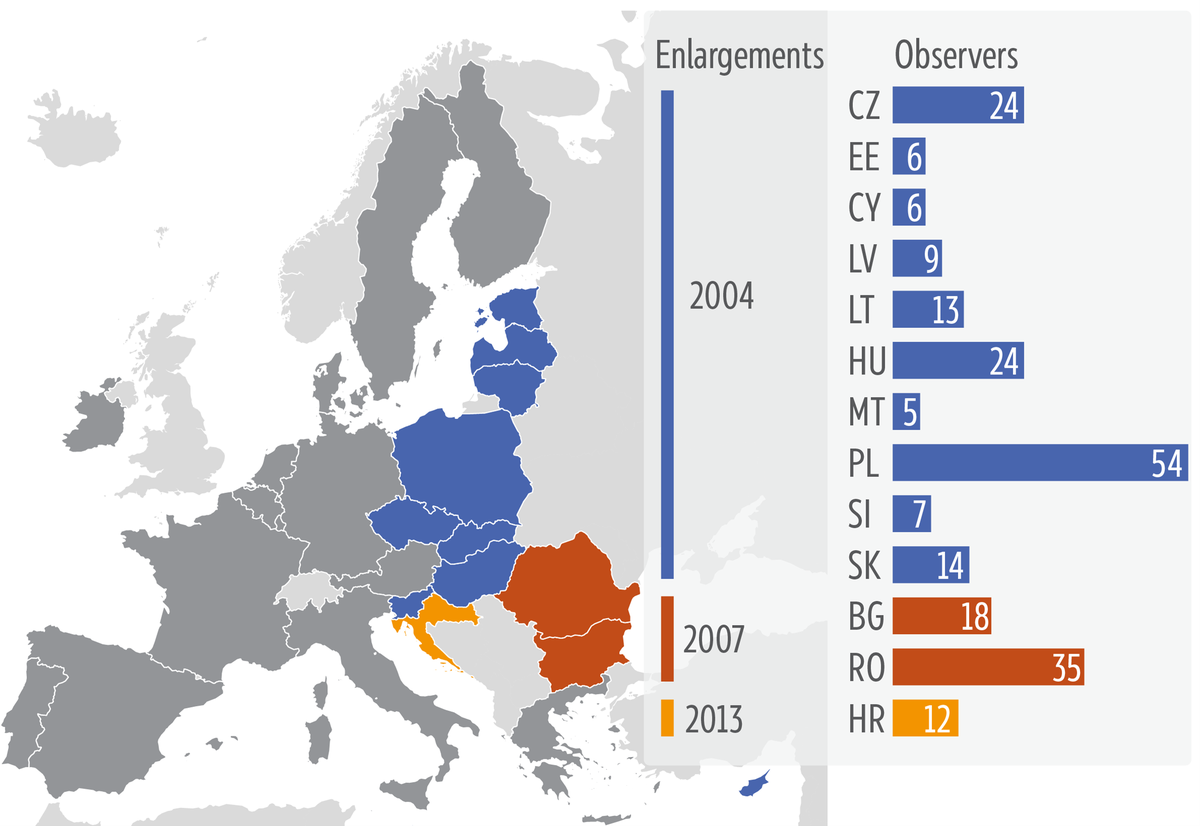
Observers are therefore appointed for a period starting after the signature of an accession treaty (but before ratification) and their mandate lasts until their country's accession or until the end of the European Parliament's term. In some cases, such as for the accession of Croatia, Bulgaria and Romania, stand-alone elections in those new Member States were necessary to elect their members to the European Parliament. In other cases, the acceding states voted for their Members of the European Parliament during European elections, such as in the 2004 enlargement, when 10 new countries joined the EU.
Upon accession, the number of seats allocated to acceding countries is indicated in the accession treaties or in acts annexed to them. This was the case for the countries that joined after the 2004 enlargement (Article 11 of the Act of Accession), the 2007 enlargement (Article 3 of the Treaty Amending Act) and Croatia (Article 19 of the Act of Accession). After accession, for all Member States and before each European elections, the Members of Parliament are allocated according to a European Council decision, adopted by unanimous vote, on the initiative of Parliament and with its consent (Article 14(2)(2) TEU). For example, the European Council decision of 18 June 2018 established the composition of Parliament in the 2019-2024 parliamentary term, while the European Council decision of 23 September 2023 determined the number of Members for the 2024-2025 parliamentary term.
| Enlargement | Number of observers | Start date of the observer mandate |
|---|---|---|
| 2004 Czech Republic, Estonia, Cyprus, Latvia, Lithuania, Hungary, Malta, Poland, Slovenia and Slovakia | 162 | 5 May 2003 |
| 2007 Bulgaria and Romania | 53 | 26 September 2005 |
| 2013 Croatia | 12 | 1 April 2012 |
| Total : | 227 |
2004 enlargement
The 2004 EU enlargement saw 10 countries accede to the EU after the signature of the accession treaty on 16 April 2003, and with effect from 1 May 2004. Following the signature, 162 observers were appointed by their respective parliaments upon an invitation from the President of the European Parliament, and began their mandate on 5 May 2003.
| Country | Number of observers |
|---|---|
| Poland | 54 |
| Czech Republic | 24 |
| Hungary | 24 |
| Slovakia | 14 |
| Lithuania | 13 |
| Latvia | 9 |
| Slovenia | 7 |
| Estonia | 6 |
| Cyprus | 6 |
| Malta | 5 |
| Total: | 162 |
Source: Euractiv, 2003.
Source: EPRS
| Political groups | No of observers |
|---|---|
| European People's Party (EPP) | 69 |
| The Party of European Socialists (PES)** | 57 |
| The Group of the European Liberal Democrat and Reform Party (ELDR)*** | 13 |
| Non-attached/Non-inscrits (NI) | 12 |
| Confederal Group of the European United Left and the Nordic Green Left (GUE/NGL) | 7 |
| Union for a Europe of the Nations (UEN)**** | 3 |
| Greens/European Free Alliance (Greens/EFA) | 1 |
| Group for a Europe of Democracies and Diversities (EDD)***** | 0 |
* According to Borkowski (p. 111), four Polish members registered their presence only after the referendum on the ratification of the Accession Treaty and they joined the NI group. The EPRS Historical Archives, consulted for this briefing, also confirm this information.
** Later renamed the Progressive Alliance of Socialist and Democrats (S&D Group).
*** This political party changed its name from ELDR to ALDE at the Dublin party conference in 2012.
**** The UEN was established in July 1999 (5th legislative term), supplanting the former Union for Europe, and operated until June 2009. Its members migrated to other political groups following the 2009 elections (7th legislative term).
***** The EDD was established in 1999, and following the 2004 elections (6th legislative term) became the Independence/Democracy (IND/DEM) political group.Source: Euractiv, 2003, adapted with information from EPRS Historical Archives, European Parliament.
2007 enlargement
Following the signature of the Treaty of accession with Bulgaria and Romania on 25 April 2005, the European Parliament welcomed 53 observers (35 from Romania and 18 from Bulgaria) on 26 September 2005. Although a motion for a resolution sought to delay the arrival of observers from Romania and Bulgaria to one year before accession, this motion was withdrawn and Parliament's resolution of 7 July 2005 ultimately endorsed the decision of the Conference of Presidents to welcome the Romanian and Bulgarian observers from 26 September 2005.
Bulgaria and Romania joined the EU as of 1 January 2007. Romania held its first elections to the European Parliament on 25 November 2007, while Bulgaria held its first European elections on 20 May 2007. These were stand-alone elections, and the Members elected at that time remained in their posts until the next regular European Elections held on 4‑7 June 2009.
| Political groups | Romania: 35 observers | Bulgaria: 18 observers | Total per political group |
|---|---|---|---|
| EPP | 9 | 4 | 13 |
| PES | 12 | 6 | 18 |
| ALDE | 7 | 7 | 14 |
| NI | 7 | 1 | 8 |
Source: European Parliament, 2005.
2013 enlargement
Following the signature of the Treaty on the accession of Croatia to the EU on 9 December 2011, Parliament's President, after obtaining the agreement of the Conference of Presidents, invited the Croatian Parliament to appoint 12 observers from among its own members, equal to the number of future European Parliament seats allocated to Croatia.
From 1 April 2012, 12 observers from Croatia joined the European Parliament until Croatia's accession to the EU on 1 July 2013. Elections took place in Croatia on 14 April 2013 to elect the Croatian Members of the European Parliament. Croatia therefore held a stand-alone election in 2013, and the elected Croatian Members took their seats on 1 July 2013 (date of Croatia's accession), with a mandate until the next European elections that took place for all (then 28) Member States a year later, i.e. between 22 and 25 May 2014.
| Political groups | Number of observers |
|---|---|
| Socialists and Democrats (S&D) | 7 |
| EPP | 3 |
| ALDE | 1 |
| NI | 1 |
Source: European Parliament, 2011.
Candidate countries at the 2002 European Convention on the Future of Europe
In addition to the representative of governments of the (at the time) 15 Member States, the composition of the 2002-2003 European Convention on the Future of Europe also included 13 representatives of Heads of States or Government (one per country) from candidate countries as main parties. This included representatives of governments from the 10 countries that would accede to the EU in 2004, plus representatives from Romania, Bulgaria and Turkey. The composition of the Convention also included 26 representatives of national parliaments from candidate countries (two per country). This included representatives of the 10 countries that acceded to the EU in 2004, plus Romania, Bulgaria, and Turkey.
Although negotiations with respect to the 10 countries that acceded to the EU in 2004 were at the final stage when the European Convention began in February 2002, the accession treaty had already been signed by the time the Intergovernmental Conference started, i.e. 4 October 2003. This allowed the 10 acceding countries to participate in the Intergovernmental Conference that followed the 2002 European Convention on the Future of Europe, on an equal footing to other Member States. However, representatives of Romania, Bulgaria and Turkey had observer status at the Intergovernmental Conference. The Treaty establishing a Constitution for Europe, i.e. the outcome of the 2003-2004 Intergovernmental Conference was signed on 29 October 2004, including by the 10 states that acceded to the EU on 1 May 2004.
The term 'observers' used at the 2002 European Convention on the Future of Europe referred to representatives of the Committee of the Regions, the Economic and Social Committee, European Social Partners and the European Ombudsman (i.e. did not refer to candidate countries). However, observers were entitled to submit written observations to the Presidium and receive written contributions submitted by others through the Secretariat (Rule 4 of the European Convention's Rules of Procedure).
Current institutional support framework for Ukraine
Ukraine concluded an Association Agreement with the EU and its Members in 2014. The EU and Ukraine have also provisionally applied a Deep and Comprehensive Free Trade Area (DCFTA) since January 2016.
On 28 February 2022, immediately after Russia's full-scale invasion of Ukraine, the country initiated its path towards EU accession by formally applying for EU membership. In June 2022, the European Commission gave its opinion on Ukraine's application (in addition to applications from Moldova and Georgia) and gave its positive assessment on Ukraine being granted candidate country status based on considerations involving political criteria, economic criteria and the ability of the country to assume the obligations of EU membership (EU acquis).
In June 2022, the European Council awarded candidate status to Ukraine and in November 2023 the Commission recommended the Council of the EU begin negotiations with Ukraine. In the conclusions of its 14‑15 December 2023 meeting, the European Council decided to open negotiations with Ukraine (and Moldova).
At present, the relations between the Verkhovna Rada (the Ukrainian parliament) and the European Parliament are regulated by a Memorandum of Understanding (MoU) signed in November 2023 by the President of the European Parliament and the Chairman of the Ukrainian parliament. This is a renewal of the previous Memorandum of Understanding, signed in 2021.
The objectives of the 2021 Memorandum include:
'• modernising standards of Parliamentarism, in line with best European practices, where consensus-building and dialogue are central to ensuring inclusive institutional reform and to pursuing the EU reform agenda;
• strengthening the constitutional roles of law-making, oversight and representation of the Rada; thereby improving the quality of legislation and of the legislative process in Ukraine, particularly in the framework of the preparations for and conduct and oversight of the accession negotiations;
• increasing the transparency, predictability, efficiency and openness of the proceedings of the Rada;
• promoting contacts between Members of the respective Parliaments and Parliamentary bodies, especially in the framework of the committee-to-committee cooperation, paying special attention to the role played in this process by the EU-Ukraine Parliamentary Association Committee (PAC), providing for a flexible coordinating platform to facilitate these exchanges, without prejudice to the autonomy of the parliamentary committees.'
In addition, according to Articles 467 and 468 of the Association Agreement between the European Union and its Member States, and Ukraine, a Parliamentary Association Committee (PAC) is established composed of Members of the European Parliament and members of the Ukrainian parliament. This Parliamentary Association Committee is a forum for its members to meet and exchange views. The observer status of Ukrainian representatives was discussed in the PAC, but without issuing any declaration or written contribution. In the framework of the Democracy Support and Election Coordination Group, Parliament engages in a number of activities, including those aimed at promoting democracy beyond the EU's borders, such as the Jean Monnet Dialogues for Peace and Democracy devoted to promoting democratic parliamentary culture, in which Ukraine has participated. Ukraine also participates in Euronest, a parliamentary forum gathering delegates from the European Parliament and Eastern European Partners, created to strengthen the Eastern Partnership and responsible for parliamentary consultation, supervision and monitoring. The last Euronest meeting in March 2024 adopted several resolutions focusing on the war against Ukraine.
Conclusions
The European Parliament's Rules of Procedure (Rule 13) provide for the possibility to award observer status to members appointed by the national parliament of an acceding state. This has been the practice at least in the last three enlargements. Observer members can thereby acquire knowledge of Parliament's working practices and build their political network. Observer members remain in office until the end of the European Parliament term, and the European elections following their country's accession to the EU, or until ad hoc elections take place in their country (e.g. Croatia, Romania and Bulgaria) outside the set EU-wide electoral cycle. However, this observer status presupposes that the accession treaty is signed, as Rule 13 mandates, although its ratification is not required for the appointment of observers.
Endnotes
Classification
Policy areas: EU Democracy, Institutional and Parliamentary Law
Regions: European Union
Statement on the use of AI
Any AI-generated content in this text has been reviewed by the author(s).
Disclaimer
This document is prepared for, and addressed to, the Members and staff of the European Parliament as background material to assist them in their parliamentary work. The content of the document is the sole responsibility of its author(s) and any opinions expressed herein should not be taken to represent an official position of the Parliament.
Copyright
© European Union.
The reuse of this document is authorised under a Creative Commons Attribution 4.0 International (CC-BY 4.0) licence.

https://creativecommons.org/licenses/by/4.0/deed.en
To use or reproduce elements that are not owned by the European Union, permission may need to be sought directly from the respective rightsholders.