
Article page checkbox is not checked in page info.
European Peace Facility – For Ukraine, but not only
European Peace Facility – For Ukraine, but not only
Bruno Bilquin; Members' Research Service.

Summary
The European Peace Facility (EPF) was created in March 2021 as a funding instrument aimed at enhancing the EU's ability to prevent conflicts, build and preserve peace, and strengthen international security and stability. The EPF rests on two pillars. The first is to fund EU military operations and missions under the common foreign and security policy. The second is to provide assistance to countries in the EU's eastern neighbourhood, the Middle East and Africa to strengthen security in their respective regions. Following Russia's all-out invasion of Ukraine in February 2022, the EU started using the EPF to rapidly deliver military aid to Ukraine. This support was provided alongside continued assistance to the EU's eastern neighbourhood, as well as to partners in the Middle East and Africa. The EPF has a total financial ceiling of more than €17 billion for the 2021-2027 period. As the facility is an off-budget instrument, EU Member States contribute directly to it, based on the gross national income key.
Currently, the EPF lacks fresh resources to continue supporting Ukraine in facing the war. Furthermore, since March 2023, Hungary has refused to mobilise EPF funds in military aid to Ukraine. In line with the sanctions imposed on Russia in 2022, Russian assets held in EU banks were frozen. In May 2024, the Council of the EU allocated 90 % of the 'windfall' (extraordinary) profits from these frozen assets to the EPF. A first transfer of €1.5 billion from these profits to Ukraine took place in mid-2024. A second payment, possibly amounting to €2 billion, is expected in spring 2025.
Given Hungary's veto, the EU is looking for more reliable ways to continue assistance to Ukraine than by means of the windfall profits from the Russian assets channelled through the EPF. On 24 October 2024, the EU created the Ukraine Loan Cooperation Mechanism (ULCM) and issued an exceptional macro-financial assistance loan of €18.1 billion, the EU's part of an EU-G7 syndicated loan to Ukraine totalling €45 billion. Starting after March 2025, 95 % of the windfall profits from the Russian assets held in EU banks will be allocated to the EU budget and channelled through the ULCM to Ukraine. The remaining 5 % will be allocated to the EPF. Beyond Ukraine, for which the EPF-funded approved military support amounts to approximately €10.6 billion, the EPF has an available budget of €6.4 billion to fund, until 2027, both the common costs of EU military missions and operations abroad – including its military assistance mission in support of Ukraine – and assistance measures for the armed forces of partner countries.
Introduction
The European Peace Facility (EPF), operational since July 2021, finances activities with military implications, including the common costs of EU military missions and operations abroad, and supports the armies of partner countries with infrastructure, training and equipment. In response to the Russian invasion of Ukraine on 24 February 2022, the EU quickly mobilised funds for the delivery by Member States of military equipment, including lethal weaponry – a first in EU history – to assist Ukraine. However, in a context of rising global insecurity, with other wars and violent conflicts erupting worldwide, as well as transactional or confrontational relations between countries challenging the international order, the EU needs a robust EPF to support partners and regions beyond Ukraine and the Black Sea.
The EPF operates outside the EU budget and is funded through contributions from the 27 EU Member States based on their gross national income. However, necessary increases in the EPF budget and EPF mobilisations are not immune to blockages from Member States.
In search of fresh resources for the EPF, particularly to continue providing Ukraine with much needed military assistance in the face of Russian aggression, the EU must be innovative, especially as United States (US) support has become uncertain. Besides Ukraine, the EU also provides military assistance to other partners in the wider Black Sea region, such as Georgia, Moldova and Armenia, and to other fragile regions within its expanded vicinity. These regions include Africa (Egypt, Libya, Mauritania, the Gulf of Guinea, the Central African Republic, the Horn of Africa, the Red Sea and Mozambique, whose army benefitted from the first two mobilisations of the EPF in July and November 2021), despite the forced closure of the EU military missions in the Sahel (Niger and Mali). Closer by regions, such as the Balkans (Kosovo, North Macedonia, Albania, Montenegro), as well as the Middle East (Jordan and Lebanon), also receive such support.
Funding for Ukraine
In March 2024, the EU decided to allocate €5 billion in military aid to Ukraine through a third top-up to the initial EPF budget, taking the shape of a dedicated fund, the Ukraine Assistance Fund. Faced with Hungary's refusal to support the move, mobilising these resources proved challenging. The EU then decided to channel through the EPF the extraordinary revenues of the Russian assets located within its banks, which it had frozen as part of its sanctions against Russia, to ensure the military aid Kyiv needed. However, the EPF was soon replaced as the channel for these revenues to Ukraine by an EU macro-financial assistance loan (MFA loan) for Ukraine worth €18.1 billion, together with an accompanying Ukraine Loan Assistance Mechanism. This loan is the EU's part of a G7-led initiative for an extraordinary revenue acceleration (ERA) loan for Ukraine worth US$50 billion (€45 billion), to be repaid by future flows of extraordinary revenues from frozen Russian sovereign assets held in the EU.
On 10 January 2025, the European Commission disbursed the first €3 billion tranche of the EU's MFA loan for Ukraine.
Cuts to military use of profits from Russian frozen assets
Based primarily on Council Regulation 2024/576 of 12 February 2024 concerning sanctions against Russia for its war of aggression on Ukraine, the Council initially decided on 21 May 2024 to use the 'windfall' profits (extraordinary revenues) from frozen Russian assets to support Ukraine's self-defence. Ninety per cent of these revenues would be used through the European Peace Facility, which is outside the EU budget. The remaining 10 % would be used for Ukraine's reconstruction through the Ukraine Facility, which is within the EU budget.
The G7 at its Apulia summit of 14 June 2024 and the European Council at its meeting of 27 June 2024 both approved a plan to provide Ukraine with the US$50 billion syndicated loan mentioned earlier.
On 26 July 2024, the Commission disbursed the first payment of €1.5 billion from these revenues to Ukraine. The allocation was 90 % (€1.35 billion) for military equipment through the EPF, including procurement from Ukraine's defence industry, and 10 % (€150 million) for reconstruction aid through the Ukraine Facility. This was in addition to the €10.6 billion for Ukraine under the EPF and the €50 billion under the Ukraine Facility. On 24 October 2024, the Council decided to reverse this allocation ratio. Now, only 5 % of the revenues from the frozen assets will go through the EPF, and 95 % will go through a new budgetary instrument established on the same day: the Ukraine Loan Cooperation Mechanism (ULCM). The ULCM was created by Regulation (EU) 2024/2773, which was adopted under the ordinary legislative procedure, as it involves the EU budget.
ULCM and macro-financial assistance loan
The adoption of the ULCM Regulation was the solution found in response to Hungary's refusal to extend the deadline – this extension has been happening every six months – for renewing the EU sanctions regime imposed on Russia, including its assets freezing component (see below). This regulation allows the EU to use the €18.1 billion macro-financial assistance loan from its budget as part of the broader planned G7 loan, which will use Russian assets frozen in Western jurisdictions to support Ukraine. Initially, the MFA loan amount was set at €35 billion, but the G7 finance ministers agreed to reduce it to €18.1 billion on 25 October. This decision was made after the US agreed to participate in the broader G7 loan.
On 25 September 2024, more than 30 countries and the EU issued a joint declaration of support for the recovery and reconstruction of Ukraine. They committed to continuing their efforts to implement the decision made in Apulia to launch an ERA loan for Ukraine by the end of 2024, 'in order to make available approximately US$50 billion in additional funding to Ukraine'.
The €18.1 billion loan and its supporting mechanism provide budgetary 'headroom', allowing the EU to continue its financial support for Ukraine, even if its sanctions on Russia were lifted or rendered inactive due to a Member State's veto in the Council or actions taken to otherwise block the renewal of the sanctions.
The Ukraine Loan Cooperation Mechanism aims to provide Ukraine with sufficient and continuous financial support to help it repay its loans without adding to its debt burden. The transfer from Euroclear Belgium to the Commission (Euroclear is the only EU central securities depository falling within the scope of Regulation 2024/576, as it holds the necessary amount of Russian frozen assets - reserves and assets worth more than €1 million) of future tranches of windfall profits from frozen Russian assets will be included in the mechanism's resources. These profits are estimated at around €3 billion annually, based on the approximately €192 billion held in Russian assets by Euroclear. The other part of the mechanism's resources will come from voluntary financial contributions from Member States, third countries or other sources, depending on a contribution agreement to be concluded between the Commission and the contributor.
The EU's macro-financial assistance (MFA) loan to Ukraine will be paid out in successive tranches and repaid over a period of up to 45 years. The MFA loan was available until 31 December 2024, with all tranches expected to be disbursed by 31 December 2025. As mentioned earlier, on 10 January 2025, the Commission disbursed the first €3 billion tranche of the MFA loan for Ukraine, which will be repaid using revenues from frozen Russian assets in the EU.
Reportedly, on 25 June 2024, during the last week of its presidency of the EU Council and just before the start of the Hungarian Presidency, Belgium presented a confidential document for discussion at the Foreign Affairs Council. This document outlined options to counter Hungarian vetoes or obstructions to EU draft decisions regarding the continuation of military and financial aid for Ukraine.
Among these options was a legal interpretation stating that Hungary, by abstaining from voting on the adoption of Council Regulation 576 of 12 February 2024 (which allowed the EU to use the windfall profits obtained directly from frozen Russian assets to support Ukraine), lost its say on how exactly and for what specific purposes these profits would be used. In the Foreign Affairs Council of 24 June, Hungary did not object to this legal interpretation as reiterated by the then HR/VP Borrell in his remarks after the meeting. He stated, 'This [the €1.4 billion first tranche of revenues from the frozen Russian assets] will be allocated to Ukraine, but for these three purposes: air defence, ammunition and supporting the Ukrainian industry .... We understand that legally, since one Member State did not participate in the decision to use these assets, it has not the right to participate in deciding to which purpose they are allocated'.
A February 2024 report for the European Parliamentary Research Service suggested that the Commission's proposal to channel the windfall profits – that is, the interest accrued – from the Russian frozen assets to Kyiv through the EU budget may not necessarily align with international law. This is mainly due to concerns about property rights over the interest, given the lack of public access to contracts between Euroclear and the Russian Central Bank.
Windfall profits from frozen Russian assets: Double allocation mode
The situation regarding the payments of the windfall profits obtained through the freezing of the Russian assets for Ukraine is as follows. For 2024, the only payment, on 26 July 2024, was channelled to Ukraine through the EPF for 90 % of the funds and through the Ukraine Facility for 10 % of the funds (as mentioned above). For 2025, the first biannual payment will continue to be channelled through the EPF for 90 % of the funds and through the Ukraine Facility for 10 % of the funds. All payments thereafter will be channelled through the EPF for 5 % of the funds (for military support) and through the newly established Ukraine Loan Cooperation Mechanism for 95 % of the funds (to guarantee the loans agreed under the mechanism). There are no conditionalities or restrictions as to the civilian or military destination of the expenses Ukraine will pay with these loans.
Josep Borrell suggested that the US$300 billion of Russian state assets frozen in the West could potentially be used to assist Ukraine in rebuilding after the war as part of a 'just and sustainable peace'. This would represent a significant shift from the current practice of solely using the windfall profits from the frozen Russian assets for support to Ukraine's military and for the country's reconstruction, to actually using the capital itself.
HR/VP Kaja Kallas, during her confirmation hearing before the European Parliament's Committee on Foreign Affairs on 12 November 2024, also acknowledged the 'legitimacy' of Ukraine's request to use the frozen Russian assets for reconstruction. She reportedly stated that, given the scale of destruction of Ukraine, there would be nothing left from those assets: 'We must use these funds, it is Russia that is destroying Ukraine and will have to pay for its reconstruction'.
The potential seizure of the frozen Russian assets, specifically the capital, has raised concerns about legal uncertainties, the risk of major investors shunning the EU, and opposition from the European Central Bank and Euroclear Belgium.
Russian assets freeze risk lapsing at end July 2025
The proposal to extend from six months to 36 months, or until 2028, the renewal of the sanctions on Russian sovereign assets and thereby the freezing of their windfall profits, has not yet been adopted due to Hungary's persistent blocking.
During Hungary's six-month Council presidency from 1 July 2024 to 31 December 2024, they reportedly did not table the Commission's proposal to extend the above deadline to 36 months. The Hungarian finance minister confirmed on 5 October 2024, after an EU ministerial meeting, that Hungary believed the issue of extending the deadline should be discussed after the US elections of 5 November 2024. Following the meeting of 5 October, the then Commissioner for the Economy, Paolo Gentiloni, stated that extending the deadline was a pre-condition for the United States' participation in the G7-planned loan on an equal footing. Despite this, on 27 January 2025 the Council renewed the EU sanctions regime for another six months until 31 July 2025. However, Hungary reportedly initially threatened to veto the renewal. It was only after intense pressure from the US that Hungary eventually backed down on its veto intention. To prevent Hungary from vetoing sanctions against Russia, their renewal, or the extension of their duration, at least six Member States are considering making them national decisions.
On 24 February, exactly three years after the start of Russia's full-scale invasion of Ukraine, the Council adopted its 16th sanctions package against Russia. If Hungary continues to veto the extension of the deadline to renew the sanctions, and/or vetoes the next renewal of the sanctions regime (scheduled for no later than 31 July 2025, unless an extension of the deadline is approved before then), the 'frozen Russian assets' package and the allocation of the windfall profits accruing from them to Ukraine through the EPF and the Ukraine Facility will expire on 31 July 2025.
At least €6 billion worth of EPF funds for Ukraine remain blocked
In his above-mentioned press remarks after the 24 June 2024 Foreign Affairs Council meeting, Josep Borrell expressed regret that 'one country' was still 'blocking the use of about €6 billion from the EPF'. He did not specify the exact composition of this amount, yet an analysis suggests the following:
-
€5 billion from the Ukraine Assistance Fund (UAF): Dedicated to providing military assistance to Ukraine, the UAF is a €5 billion fund that was created within the EPF by Council Decision (CFSP) 2024/890 of 18 March 2024. The UAF is the third top-up to the EPF's initial global ceiling, bringing it to over €17 billion in current prices for 2021- 2027, including around €10.6 billion approved for military support to Ukraine. (this latter amount comprises €5 billion of the UAF, plus seven regular tranches of at least €0.5 billion each released through successive Council decisions between February 2022 and February 2023, or at least €3.5 billion, plus the first two tracks of €1 billion each of the ammunition plan for Ukraine). Reportedly, Hungary blocked the mobilisation of UAF funds in May 2024;
-
€1 billion to be reimbursed to Member States under the EPF for their military assistance to Ukraine, including €500 million to Poland (the other blocked €500 million may correspond to the planned eighth regular tranche of about €500 million for military aid to Ukraine, blocked by Hungary since March 2023).
Speaking to reporters after the Foreign Affairs Council meeting of 14 April 2025, the Polish Foreign Minister, Radosław Sikorski, stated that he had unsuccessfully reiterated his request to Hungary to lift its veto on 'nearly €7 billion' from the EPF.
Interestingly, Hungary did not veto two important Council decisions in April and May 2023. These decisions, (CFSP) 2023/810 of 13 April 2023 and (CFSP) 2023/927 of 5 May 2023), activated a fresh €2 billion from the EPF for artillery ammunition. This ammunition could either be donated to Ukraine and partially reimbursed to the donating Member States, or delivered at a later stage through joint procurement by Member States. These Council decisions were the first two tracks of the three-track ammunition plan for Ukraine. Hungary constructively abstained from voting on these two decisions.
However, considering the persistent urgent need for military support and ammunition for Ukraine, on 17 March 2025 the HR/VP presented a €20 billion initiative for continued military aid at the Council. This plan includes €5 billion for the quick delivery of 2 billion ammunition rounds. Prior to this, at the extraordinary meeting of the European Council meeting of 6 March 2025, for the first time since 2022 and the Russian invasion of Ukraine, Hungary opposed the adoption of official European Council 'conclusions at 27' on continued support for Ukraine. This led to the remaining 26 Member States having to deliver separate conclusions on the matter.
At the above European Council meeting, the HR/VP declared that for her new initiative on the continuation of military support, she would apply the formula of the 'coalition of the willing', 'so that one country cannot block everybody else', referencing the Hungarian veto in the Council. Her initiative was expected to be endorsed by 26 Member States, minus Hungary, at the European Council of 20 March. However, reportedly, this was not the case, as some other countries, including France, Italy and Spain, which had expected to be the major financial contributors to the HR/VP initiative, welcomed it with reservations. The 'conclusions at 26' of the 20 March European Council meeting only state: 'The European Council recalls the initiatives to enhance EU military support to Ukraine, notably that of the High Representative to coordinate increased support by Member States and other participating States, on a voluntary basis, notably on large-calibre artillery ammunition and missiles, as well as the military needs component of the G7 ERA initiative'. This wording was far from being an endorsement of the HR/VP initiative. However, when it comes to the artillery ammunition, a coalition of the willing, led by Germany and the Netherlands, obtained at least partial results. In her press remarks after the Foreign Affair Council meeting of 14 April, the HR/VP announced that two-thirds of the target of delivering 2 million shells had already been reached, equating to about 1.3 million shells.
New EPF-funded common costs of military missions and operations abroad
Rapid deployment capacity, non-executive military missions and EU exercises
On 5 November 2024, the Council adopted Decision 2024/2846, amending the basic Council Decision 2021/509 establishing the EPF. This decision entered into force directly, allowing the EPF to cover a greater share of the common costs associated with CSDP missions and operations. This includes covering the common costs for the future Rapid Deployment Capacity – a modular force consisting of 5 000 personnel – as well as other specific costs for non-executive military missions. This move signifies a broader sharing of common military costs between the EU Member States.
To ensure the implementation of the rapid deployment capacity by 2025, the EPF operations pillar now covers certain costs of that capacity. These costs are the same as those for the EU battlegroups, including the costs of transport to the deployment area of the rapid deployment capacity, the additional costs related to its deployment, the supply of food, water and fuel, and the transport costs related to its redeployment.
Furthermore, the EPF also systematically covers two types of common costs associated with non-executive military missions (these currently comprise two training missions in the Central African Republic and Somalia, and two military assistance missions for Ukraine and in Mozambique). These costs cover:
-
the protection of essential security forces and services, including accommodation of force protection teams;
-
the deployment of medical capacities in response to pandemics.
The EPF may also cover another three types of common costs associated with non-executive military missions at the request of the operations commander and subject to the approval of the EPF Committee (composed of a representative of each Member State and chaired by a representative of the presidency of the Council, the EPF Committee adopts the EPF annual budget and the implementing rules on the EPF expenditure). These costs are for:
-
essential additional equipment, especially security equipment, such as gates, watchtowers, access roads and enclosures. They will also be used for the basic renovation of training facilities in the theatre of operations, which are necessary for the deployed forces;
-
in-theatre transport for the deployed forces, including force protection teams;
-
office space.
Finally, according to the new Article 45(1) of the EPF basic decision, EPF funding now clearly covers the costs of EU exercises. This follows rules and procedures similar to those for operations to which all Member States contribute, up to an amount decided by the EPF Committee for each type of exercise. The committee may decide to exceed this amount on a case-by-case basis when approving the budget of an exercise. The new Article 4, point (g) of the EPF decision provides a stricter definition of an EU exercise: 'a military CSDP exercise or the military component of a civilian CSDP exercise, agreed in the EU Programme of Exercises and Exercise-Related Activities under the CFSP and conducted in accordance with the Exercise Policy of the EU under the CFSP'.
Common costs increased for EUMAM Ukraine
On 8 November 2024, the Council decided to extend the initial two-year mandate of the EU Military Assistance Mission in support of Ukraine (EUMAM Ukraine) for an additional two years, from 14 November 2024 to 15 November 2026. Council Decision (CFSP) 2024/2876 also increased the EPF-funded common costs of the mission for that period. These costs now amount to €408.8 million within the EPF's operations pillar, which is a significant increase compared to the €106.7 million for the previous period (November 2022-November 2024). EUMAM Ukraine also received direct additional funding from the EPF's assistance pillar, with assistance measures totalling €255 million so far.
According to the HR/VP, EUMAM had already trained over 73 000 soldiers by mid-April 2025.
The Political and Security Committee (PSC), composed of the Member States' ambassadors, had agreed on 22 October 2024 that a strategic assessment of the mission should be presented no later than January 2025,with a view to assist in the taking of a decision to enhance the capabilities and effectiveness of EUMAM Ukraine. The assessment will be followed by a strategic review, which is to be conducted before 15 November 2026. At its meeting on 14 April 2025,the Foreign Affairs Council debated the issue of expanding 'the mandate of the missions that we have' (as worded by the HR/VP, a reference to EUMAM Ukraine, the EU civilian Advisory Mission for Civilian Security Sector Reform in Ukraine, and perhaps also to the EU civilian Border Assistance Mission to Moldova and Ukraine) in order to contribute to the security guarantees of a coalition of the willing (led by France and the United Kingdom).
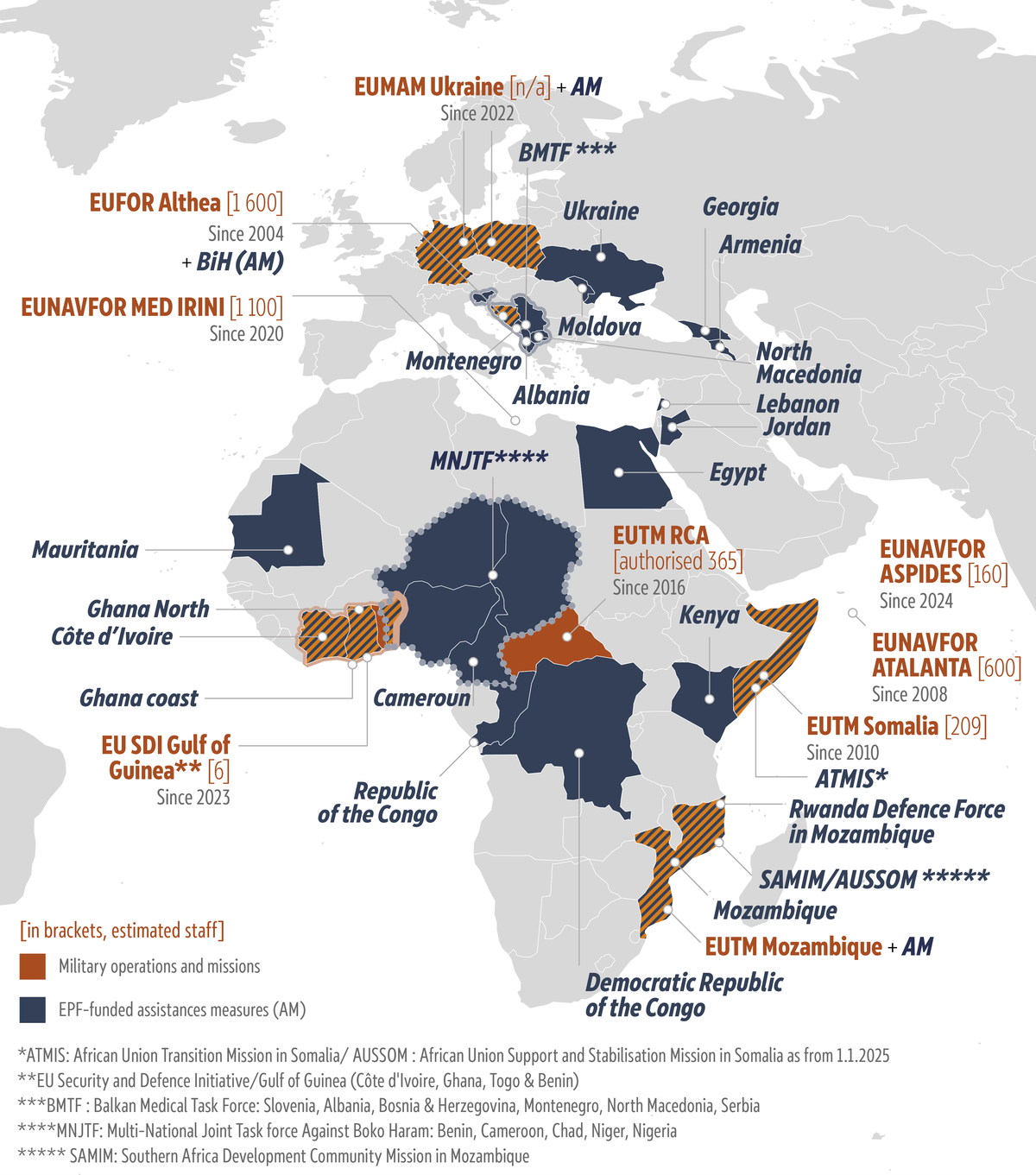
Data source: Graphic by: Stephanie Pradier, Samy Chahri, EPRS.
EPF-funded assistance measures adopted since April 2024
Since the two assistance measures (AM) of €194 million in total for Ukraine, adopted on 27 and 28 November 2023, the Council has adopted, or the PSC has approved in the case of the support to Somalia and the African Union Transition Mission in Somalia (ATMIS) under the general AM of €600 million for African-led Peace Support Operations for 2022-2024, the following 22 AMs, funded from the assistance pillar of the EPF, for the armies of partner countries, or for ATMIS:
| COUNTRY | AMOUNT (in millions) | DATE |
|---|---|---|
| Moldova (mobility, air surveillance, electronic, logistics) | €41 m | 4 April 2024 |
| Ghana (territorial control and protection of civilians) | €25 m | 4 April |
| Somalia (equipment, security tasks taken from ATMIS) | €40 m | 16 April |
| ATMIS (allowances of African troops under ATMIS) | €70 m | 16 April |
| Côte d'Ivoire (secure land borders, fight armed groups) | €15 m | 29 April |
| Moldova (man-portable air defence systems) | €9 m | 13 June |
| Kenya (secure border with Somalia, al-Shabaab threat) | €20 m | 24 June |
| Benin (equipment and pre-deployment training) | €5 m | 15 July |
| Albania (effectiveness & participation in missions abroad) | €13 m | 15 July |
| Albania (logistics and protection of civilians in crises) | €10 m | 22 July |
| Mauritania (land and sea surveillance & deterrence) | €15 m | 22 July |
| Lebanon (medical, logistics & engineering operations) | €15 m | 23 September |
| North Macedonia (boost its participation in missions abroad) | €13 m | 25 September |
| Egypt (address security threats in Western Egypt) | €20 m | 5 November |
| Republic of the Congo (step up its navy patrols) | €5 m | 5 November |
| Rwandan army in Mozambique (Cabo Delgado) | €20 m | 18 November |
| Jordan (security and stability in the north and east) | €13.25 m | 25 November |
| Lebanon (stability in the South of Litani Sector) | €60 m | 21 January 2025 |
| Montenegro (strengthen defence capacity & participation in missions) | €6 m | 28 February |
| Mauritania (a second patrol boat for the navy and mobile land surveillance assets) | €20 m | 24 March |
| Moldova (mobility equipment, command and control equipment) | €40 m | 7 April |
| Moldova (8 short-range lethal air defence systems) | €20 m | 23 April |
Data source: EPRS.
Out of these 22 new EPF-funded AMs, decided between April 2024 and April 2025, five are the first ever to support the armed forces of Egypt, Armenia, Albania, Kenya and Montenegro. The other 17 AMs complement previous AMs. For instance, the AM for Jordan from 25 November 2024 adds to a previous AM of €7 million decided on 20 February 2023, while the AM for Lebanon from 21 January complements two previous AMs (the first of 23 September 2024 for €15 million and the second of 1 December 2022 for €6 million). Notably, none of these 22 recent AMs benefits Ukraine, as they are all directed to other fragile regions in the broader EU vicinity. These are the EU neighbourhood and its two flanks. These are the eastern flank with Moldova, Armenia, North Macedonia, Albania and Montenegro, and the southern flank with Lebanon and Egypt, the Horn of Africa with Somalia and Kenya, the Sahel and Gulf of Guinea region (with Mauritania, Côte d'Ivoire, Ghana, Benin and the Republic of the Congo), and Mozambique.
According to the Council, the AMs for North Macedonia, Albania and Montenegro aim to strengthen the countries' capacities to participate in the EU's common security and defence policy operations and missions and other international missions. These AMs reflect the consistent commitment of the three countries to enhancing their cooperation in security and defence. For Albania and Montenegro, there is a goal of 'full alignment with the EU's Common Foreign and Security Policy'(CFSP), while for North Macedonia, the Council press release uses the expression 'with a view to a full alignment' with the CFSP.
The 18 November 2024 AM for the Rwanda Defence Force (RDF) in the Cabo Delgado Province of Mozambique continues to support the deployment of the RDF in that province, following a first AM of a similar amount (€20 million), decided on 1 December 2022. Both AMs have raised criticism among think tanks (such as Egmont) and NGOs (such as Global Witness), due to the UN-documented support from the RDF to the M23 rebellion in eastern DRC and the RDF's presence in eastern DRC. The fact that seven months after the first AM (December 2022) of €20 million for the RDF in Mozambique, the Council adopted another AM of the same amount for the DRC's Armed Forces (FARDC) on 20 July 2023 is unlikely to make Congolese authorities and people oblivious to the EU's continued support to the army of an invader. Paradoxically, the AM for the DRC, implemented by the Belgian Ministry of Defence, is in the form of support to equip the Belgium-trained 31st Rapid Reaction Brigade of the FARDC, active in eastern DRC, and to rehabilitate the brigade's headquarters.
Belgium constructively abstained from voting in the Council on the recent second AM for the RDF in the Cabo Delgado Province, emphasising that RDF's presence in DRC territory violates the territorial integrity and sovereignty of the country, as well as the UN Charter. Belgium also stressed the importance of strictly adhering to the additional conditionalities outlined in the first AM of December 2022, 'in order to ensure that the aid remains exclusively dedicated to the fight against terrorism in Mozambique by the RDF, in support of the Mozambican armed forces and for the benefit of the Mozambican people, and is not diverted to other purposes or used for other operational areas'. However, the implementation of these conditionalities seems unlikely, as noted in the Egmont policy brief. The conditionality of theatre disconnection cannot be controlled or enforced on the ground, and once EPF funds are transferred to the Rwandan Ministry of Finance, they cannot be traced. Additionally, the UN Group of Experts on DRC reported that three FDR commanders have been operating in both Rwandan intervention forces in Mozambique and in the DRC.
The second AM for the Rwandan army in Mozambique sparked renewed controversy when on 27 January 2025, Rwanda-backed Congolese Tutsi rebels of the M23, along with Rwandan soldiers, entered and captured Goma, the capital city of North-Kivu Province in the DRC. On 16 February, they also took control of Bukavu, the capital city of South-Kivu Province, and on 19 March, they seized Walikale (North-Kivu), a potential key transit point on the way to the DRC capital Kinshasa. After a momentary withdrawal from the centre of Walikale, on 22 April the M23 reportedly tried to strengthen their positions around Walikale.
In a resolution of 13 February 2025 on the escalation of violence in the eastern DRC, the European Parliament called on the Commission and the Member States to review EPF assistance to the Rwandan Defence Force in Mozambique's Cabo Delgado Province. At a press conference after the Foreign Affairs Council meeting of 25 February, the HR/VP announced that EU defence consultations with Rwanda had been suspended. On 17 March, the Council sanctioned another nine Rwandans and Congolese individuals and one entity in relation to the conflict in the east and the advance of the M23.
Classification
Policy areas: Development and Humanitarian Aid | Foreign Affairs | Security and Defence | Public International Law
Regions: European Union, Mediterranean and Middle East, Non-EU Europe and the North, Sub-Saharan Africa
Disclaimer
This document is prepared for, and addressed to, the Members and staff of the European Parliament as background material to assist them in their parliamentary work. The content of the document is the sole responsibility of its author(s) and any opinions expressed herein should not be taken to represent an official position of the Parliament.
Copyright
© European Union.
The reuse of this document is authorised under a Creative Commons Attribution 4.0 International (CC-BY 4.0) licence.

https://creativecommons.org/licenses/by/4.0/deed.en
To use or reproduce elements that are not owned by the European Union, permission may need to be sought directly from the respective rightsholders.