
Article page checkbox is not checked in page info.
Understanding trilogue: Parliament's rules and practices for reaching provisional agreement on legislation
Understanding trilogue Parliament's rules and practices for reaching provisional agreement on legislation
Micaela Del Monte, Members' Research Service
Summary
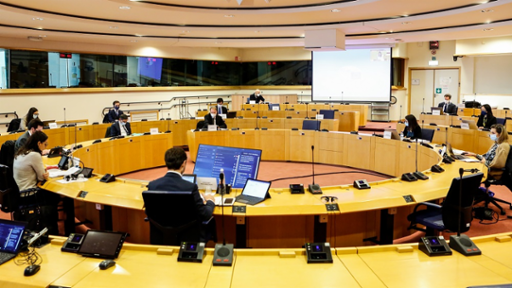
Thanks to successive Treaty revisions, the European Parliament legislates on an equal footing with the Council. Today, a vast number of policies are decided under the ordinary legislative procedure (Article 294, Treaty on the Functioning of the European Union − TFEU), previously known as co-decision. To adopt legislation, Parliament, representing European Union citizens, and the Council, representing the governments of the EU Member States, have to agree on an identical text. This requires time and negotiation. The complexity of the EU legislative process has sometimes been criticised as lengthy and subject to gridlock. To overcome this issue, the co-legislators have developed methods of informal contact to speed up the legislative process, while ensuring representativeness and oversight. One of the tools commonly used today are trilogue meetings, defined as 'informal tripartite meetings on legislative proposals between representatives of the Parliament, the Council and the Commission'.
Due to the absence of any explicit reference in the Treaties, trilogue began in the early 1990s, on a very informal basis, and evolved over time. In the beginning, the institutions filled the legal void with an informal practice that became progressively formalised over time and resulted, inter alia, in successive modifications of Parliament's Rules of Procedure. These modifications were driven by the need to ensure that trilogue negotiations support the legislative process in Parliament efficiently, while remaining fully transparent and representative. Today, Parliament's Rules of Procedure define the key elements of trilogue: how to conduct negotiations, and how to ensure that both the committee(s) responsible and plenary are fully informed and can exercise their oversight role. Other elements, such as the number and frequency of meetings, and the practical conduct of the negotiations depend on the nature of the legislative file to be negotiated, and thus remain uncodified.
This briefing updates a 2021 EPRS publication.
Introduction
Successive Treaty revisions have extended the former co-decision procedure,1 known today as the ordinary legislative procedure (OLP) (Article 289(1) TFEU). The Treaty of Lisbon sets 85 legal bases which provide for use of the OLP.2 The detailed procedure is spelt out in Article 294 TFEU, but in essence, the OLP requires the Council and Parliament to agree, on an equal footing, on a common joint text, over up to three readings.3
The European Parliament's empowerment, from a consultative role to fully fledged co-legislator for most EU policies, has profoundly changed the institutional balance in the decision-making process. As a consequence, greater interaction and cooperation between the two co‑legislators is required to reach a legislative agreement. However, this increased formal and informal interaction between Parliament and Council in the name of efficiency still required complete transparency, in full respect of the EU's democratic principles. Following introduction of the co-decision procedure, it became clear that both intensive formal negotiations and informal interaction would be required for most files in order to reach agreement. Trilogues reportedly originated as tripartite meetings in 1994 under the German Council Presidency and became standard practice under the 1995 Spanish Presidency, although such meetings had already been routine in budgetary conciliation since the 1970s.
The main reason for introducing informal meetings was the need to create flexibility to smooth the legislative process. However, their organisation and structure have evolved. For instance, Parliament's4 trilogue delegations were originally limited to the committee chair and the rapporteur. However, they were soon enlarged to include the shadow rapporteurs, to strengthen Parliament's position by broadening the range of actors involved and ensuring greater representativeness. The scope of informal trilogues also evolved from preparing conciliation committee meetings to becoming a tool to deal with politically sensitive files where negotiations can be intense. After the Amsterdam Treaty introduced the possibility to adopt legislation at first reading, trilogues progressively became the standard legislative practice, regardless of a file's complexity. Their use went well beyond original expectations for several reasons, including efficiency gains in the transaction costs of negotiating (which are considered to increase with the number of participants, increased workload and complexity of the legislative files) and gains in terms of institutional power. For instance, it is argued that one reason the Council favoured informal over formal negotiations was because trilogues aligned with the Council's traditional operation, i.e. 'searching for agreement outside the public eye'.5
The progressive extension of the co-decision procedure to additional policy areas, accompanied by enhanced informal contacts between the two co-legislators, resulted in fewer conciliation meetings and a corresponding increase in agreements at first reading.6 The conclusion of early agreements soon became an explicit objective of the legislative process, in the 2007 joint declaration on practical arrangements for the co-decision procedure (Paragraph 21). However, the need to maximise the effectiveness and speed of the legislative process was already spelt out in Declaration 34 attached to the Amsterdam Treaty (1997), which called on the Commission, Council and Parliament to 'make every effort to ensure that the co-decision procedure operates as expeditiously as possible'.
Both Parliament and the Council decided to take a step further and to develop a plethora of informal contacts at different levels. Traditional negotiation thus progressively took place outside the view of the full Parliament. Questions therefore arose about how far the negotiating team could go in reaching an agreement, the representativeness of the process and its transparency. In principle, Parliament's committee meetings are held in public. However, Rule 78(7) explicitly states the deliberations of the delegation to the conciliation committee shall not be public. Moreover the Rules of Procedure dealing with interinstitutional negotiations (Rules 71 to 75) do not envisage publication of the content of negotiations. Nevertheless, the negotiating team needs to report back to the relevant committee on progress in the negotiations (Rule 75(3)). Parliament has addressed many of these questions through successive revisions of the Rules of Procedure. For instance, the negotiating team did not originally include the shadow rapporteurs from each political group, and were not obliged to report back to the committees. Nor were committee decisions to enter into negotiations announced in plenary.
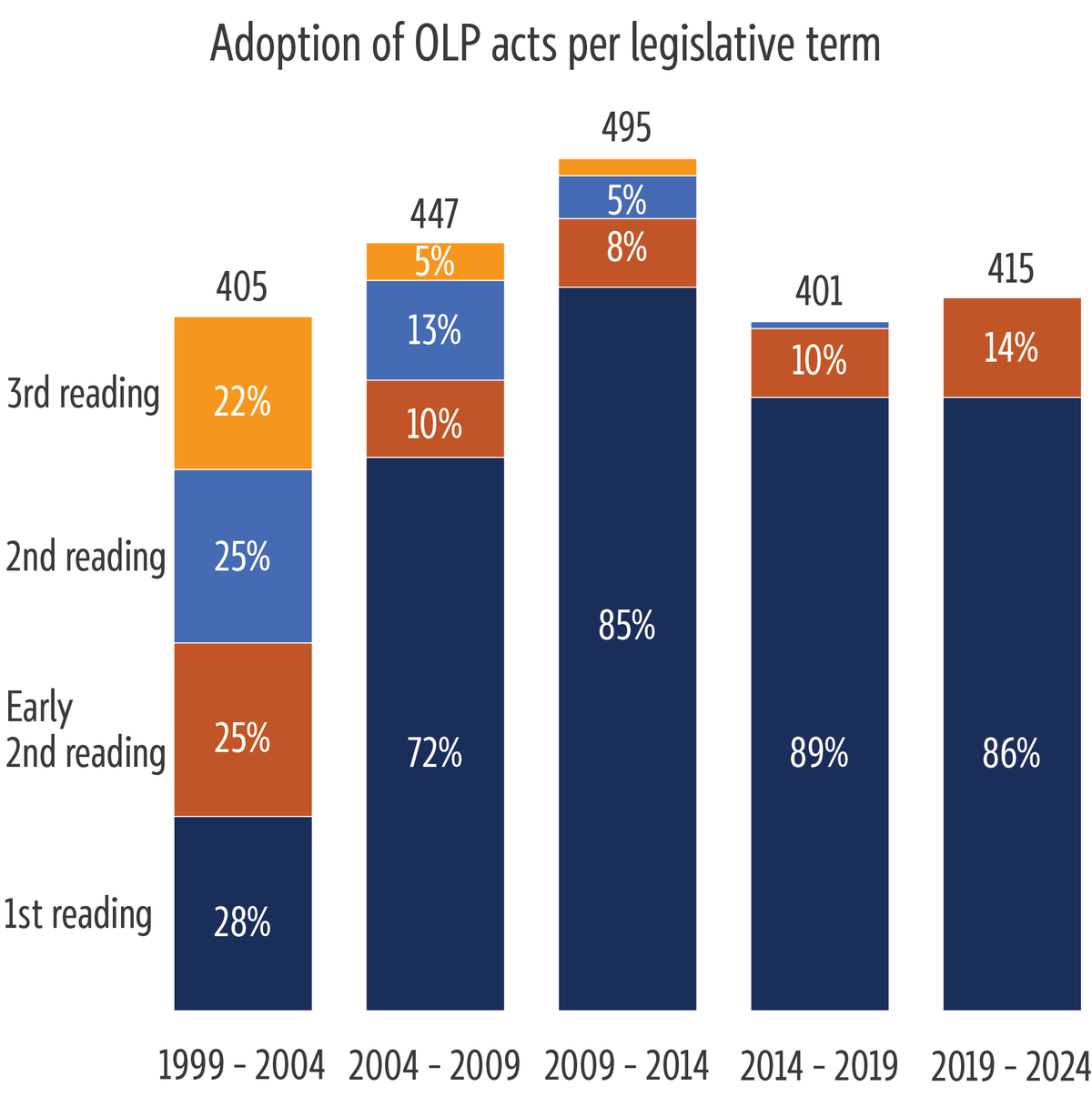
Data source: Activity Report, Developments and trends of the ordinary legislative procedure 2019-2024, ninth parliamentary term, Directorate-General for Internal Policies, European Parliament.
Rapid adoption of legislative acts is often mentioned as one of trilogues' main advantages, with most agreements now being reached at first reading. During the eighth legislative term (2014-2019), there were more first-reading agreements than ever (89 %), due to the co-legislators' ability to reach agreement in trilogue negotiations. This high proportion continued in the ninth legislative term, with 86 % of proposals adopted at first reading. The remaining 14 % were adopted at early second reading, with, therefore, a slight increase (from 10 % to 14 %) in files adopted at early second reading in comparison to the eighth term. Third readings of proposed legislation had fallen entirely out of use by the eighth term. And standard second readings have also become the exception.
The Activity Report covering the 2019-2024 (ninth) term confirms that trilogue remains the preferred framework to reach agreement on a Commission proposal, with 973 trilogue meetings taking place during the term.7 In the same period, Parliament saw an increasing number of files concluded without trilogue, compared to the previous term. In the eighth term, 28 of the 401 OLP files were agreed without trilogue. In the ninth term, 118 of the 415 OLP files were concluded without trilogue.8 The increased number of procedures completed without trilogue is explained by the more frequent use of the urgent legislative procedure, as well as the practice of concluding files without negotiations in codification of an act.9
The unforeseen COVID‑19 crisis in 2020 impacted legislative work, including interinstitutional negotiations. For instance, for health and precautionary reasons, some trilogue meetings were organised 'remotely' (without the physical presence of the main actors and staff), or 'semi-remotely' (with main actors physically present, but staff connected remotely).
Governing rules and established practices
Although there is no explicit reference to trilogue in the EU Treaties, Article 295 TFEU states that the Parliament, Council and Commission shall consult each other and may find arrangements for cooperation, including by concluding interinstitutional agreements (IIA). The institutional practice of informal negotiations between the co-legislators has progressively been codified in joint declarations and interinstitutional agreements as well as in Parliament's Rules of Procedure. The 2007 joint declaration on practical arrangements for the co‑decision procedure called on the institutions to cooperate in good faith throughout the legislative process, to establish appropriate interinstitutional contacts and exchange information. On cooperation, the joint declaration clarifies it can take place in tripartite meetings, known as 'trilogues', at all stages of the legislative process. It also recognises that these meetings have proved a vital and flexible mechanism to reach agreement at an early stage in the legislative process. In 2016, the IIA on Better Law-Making called on the three institutions to ensure the transparency of the legislative process, including the 'appropriate handling of trilateral negotiations' (paragraph 38).
Notwithstanding the absence of a reference to trilogue meetings in the Treaties, the Court of Justice of the European Union (CJEU) has explicitly referred to 'tripartite meetings', for instance in Cases C-409/13 and T‑540/15. In the latter case, the Court recognised that trilogues are an 'established practice by which most EU legislation is adopted and are therefore regarded, by the Parliament itself, as decisive phases of the legislative process'. The Court had also previously made it clear that institutional practice (although not referring to trilogue in particular) may be relied upon, provided that it does not derogate from Treaty rules.10
Parliament's rules governing negotiations
Title II, Chapter 3, Section 3 of Parliament's Rules of Procedure deals with interinstitutional/trilogue negotiations under the OLP. The section clarifies, when, how and under what conditions the co-legislators conduct negotiations to agree on a common text. Negotiations may start at any time during the legislative procedure. Parliament decides whether a given committee may start negotiating and adopts a mandate that constitutes the basis for conducting negotiations, with the objective of reaching an agreement on a common text. The agreement is known as 'first reading', 'early second reading', 'second reading' or 'third reading' (the latter during conciliation), depending on the stage of the legislative process at which it is reached. Different rules and majorities apply at different stages of the legislative process.
Ahead of Parliament's first reading, the decision to enter negotiations can be taken either by the committee responsible or by the plenary. In the former case, the decision is announced in plenary after adoption of the report in committee. If Members or a political group or groups reaching at least the medium threshold (Rule 72(2)) − i.e. one‑tenth of Members (Rule 186(1)(b)), request, the decision is submitted to a vote by the end of the day following the announcement in Parliament. Since the most recent reform of the Rules of Procedure in July 2024, opinion-giving committees (Rule 57) may also request a vote in plenary. The vote by simple majority takes place during the same part-session. In the absence of a request for a vote within the set deadline, or as soon as the plenary approves the committee decision, interinstitutional negotiations can begin. Should the plenary reject the committee decision, the committee report is put on the agenda of the following plenary part-session Parliament's President sets a deadline for amendments (Rule 72(3)). In the absence of a committee decision (by an absolute majority of the committee's Members) to open negotiations, the committee may directly table its report in plenary and Rule 60(4) may apply (request for referral back to the committee responsible for negotiations – Rule 61). In this case, and should the plenary approve the referral, the amendments adopted in plenary constitute the mandate for negotiations (known as a 'plenary mandate').11
When the decision to enter interinstitutional negotiations is taken after Parliament has adopted its first-reading position, but ahead of Council's first reading (known as 'early second-reading negotiations'), the Parliament's first-reading position constitutes the mandate for negotiations. The committee's decision to negotiate on that basis is simply announced in plenary (Rule 73). Parliament's first-reading position also serves as the mandate when Parliament decides to enter into negotiations after the Council has adopted its position at first reading, although in this case with no announcement in plenary (Rule 74). In both cases, there is no need for a further vote in plenary as the latter has already voted on the Parliament's first-reading position. However, the committee responsible may adopt negotiating guidelines or table amendments to the Council's first-reading position if the latter contains new elements not covered by the original legislative proposal or by Parliament's first-reading position (Rule 74, second paragraph).
| When | Rule | Mandate | Committee decision to begin negotiations | Plenary |
|---|---|---|---|---|
|
Ahead of Parliament's first reading (Committee mandate) | 72 | Committee report as endorsed by the plenary by simple majority or without any vote (Rule 72(1)) | Decision taken by a majority of committee Members |
Announcement in plenary. May be put to vote under certain circumstances (Rule 72(2)) |
|
Ahead of Parliament's first reading (Plenary mandate) | 60.4 and 61 | Committee legislative report as amended in plenary | No decision; or decision rejected by plenary | Text adopted in plenary constitutes the mandate |
| Ahead of
Council's first reading | 73 | Parliament's first-reading position | Decision taken by a majority of its members | Announcement only in plenary* and reference in the minutes |
| Ahead of Parliament's second reading | 74 | Parliament's first-reading position | Committee decision by simple majority | No announcement in plenary |
Source: Author.
* In this case, Parliament's first-reading position constitutes the negotiating mandate and the decision taken at committee level cannot be contested or put to a vote in plenary (contrary to the procedure applicable to the mandate for first-reading negotiations). Negotiations can therefore start as soon as the committee has taken a decision.
Parliamentary committees' role
Originally, one of the perceived risks was that trilateral meetings could progressively erode the committees' role as Parliament's 'legislative engine'. However, successive modifications of Parliament's Rules of Procedure, in 2007, 2012, 2016 and 2024, have streamlined the process across committees and ensured that they remain at the centre of the legislative process. For instance, the July 2024 revision touched upon the conduct of negotiations. First, according to Rule 58(6), Parliament's trilogue negotiating team must also include the rapporteur from the committee responsible for budgetary issues for the aspects referred to in Rule 58(3) – provision of a budgetary assessment. Second, the wording of Rule 75(1) (former Rule 74(1)) was modified on the conduct of negotiations, i.e. who should preside the negotiating team (see conduct of negotiations below).
Today, it is for the committees in the first instance to decide whether to enter into negotiations or not, to adopt the mandate for negotiations and to decide how to conduct them. They remain the principal component of the Parliament's negotiating teams, which have to regularly (i.e. after each trilogue meeting) report back to committees on progress in the negotiations, as well as share the relevant documents. Committee secretariats not only ensure trilogues function smoothly, they may also play a key role in maintaining institutional memory. Trilogues remain partly uncodified, therefore in addition to advising, committee secretariats may provide the substantive as well as procedural memory. 12 Extensive research on trilogues has identified two main patterns in the common culture of trilogue amongst committees: the central role of the chair and the organisation of work between technical and political layers. The role of the chair may vary according to the circumstances, with the chair performing the role of key negotiator, problem-solver, or delegating most of the negotiating task to a vice-chair. This categorisation has to be taken with caution, however, as other factors may impact the role of the chair, for instance they may play a less-active role in trilogues due to the heavy legislative workload in certain committees.
Conduct of negotiations
Negotiations are conducted, from Parliament's point of view, on the basis of the Code of Conduct for negotiating in the context of the OLP, laid down by the Conference of Presidents (Rule 71). Each institution designates its participants in trilogue meetings in accordance with its own rules of procedure. The rapporteur leads Parliament's negotiating team, and the chair of the committee responsible or a vice-chair presides. The negotiating team should also include the shadow rapporteurs from each political group willing to participate (Rule 75). The Code of Conduct requires Parliament's political balance to be respected throughout all negotiations and envisages that the negotiating team be assisted by an 'administrative support team'. The secretariat of the committee responsible coordinates this team, which is composed of individuals from the Parliament's Secretariat, including inter alia, from its Legal Service. Following the 2024 reform of Parliament's Rules of Procedure, a shadow rapporteur for the report concerned may not preside over the negotiating team. The same reform introduced the possibility for the rapporteur to preside exceptionally over a trilogue meeting if neither the chair nor a vice-chair are able to attend, providing that Parliament's President is informed in advance.
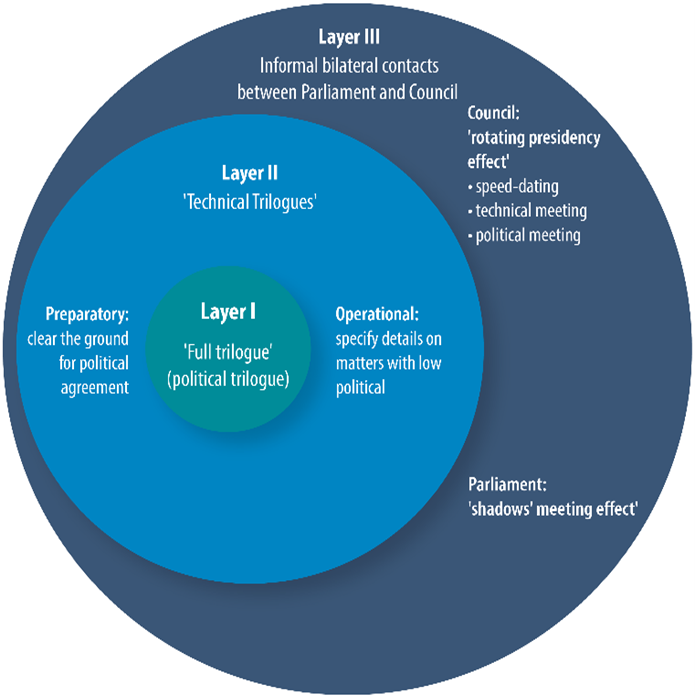
Source: C. Roederer-Rynning and J. Greenwood, The culture of trilogues, Journal of European Public Policy, Vol. 22(8), Taylor & Francis Online, 2015, pp. 1148-1165.
In practice, trilogues are 'usually conducted in an informal framework', at 'different levels of representation' (General principles of the 2007 joint declaration), and chaired alternately by the Parliament and the Council, depending on where the meeting is hosted. The number and conduct of meetings remain largely uncodified and thus left to the practice developed by committees, and in particular by their chairs, and depending on the complexity of the file. For instance, research13 (See Figure 2) identifies some recurrent patterns in relation to the Committee on Economic and Monetary Affairs (ECON)14 during the sixth and seventh legislative terms. These include no bilateral talks until Parliament and Council had adopted their mandates, strict distinction in roles between individuals involved in technical and political trilogues, the committee chair leading the Parliament negotiating team and no negotiation between other Members and the Council presidency in the chair's absence.
Parliament and Council regularly exchange information on the progress of files under negotiation. The discussions may touch upon both political and technical issues. Much is left to the practice of individual committees and their Council counterparts, however, and, the staff of the three institutions usually handle the more technical issues (in interinstitutional technical meetings), in view of the political-level meetings where the 'real negotiations take place'.15 The distinction between political and technical elements is not always clear-cut. For instance, researchers16 identify three different layers of trilogue practices: political trilogues, technical trilogues and a third layer of bilateral meetings 'between the political and the technical staff of the Parliament and the Council'. The three layers take place in parallel, sometimes simultaneously and are characterised by constant interaction. Many rounds might be necessary for complex or controversial files.
The Code of Conduct refers to a joint document as the basis for conducting negotiations, often referred to as the 'four-column' document because separate columns indicate the position of each of the three institutions involved and any provisionally agreed compromise text. The document is therefore subject to constant revision, particularly the 'compromise' column and was at the centre of a case at the CJEU (see scrutiny of trilogues below). Following each trilogue meeting, either Parliament's rapporteur or the chair of the negotiating team reports back to the committee responsible or, if the committee cannot meet in a timely manner, to the committee coordinators (Rule 75(3)). However, in Case T-540/15, the Court referred to the duty to report back to committee, underlining that 'The absence of detailed and uniform minutes, and the variable disclosure thereof, do not therefore mitigate the lack of transparency of ongoing trilogue work'.
Trilogue facts and figures
Ninth legislative term, 2019-2024
-
973 trilogue meetings took place on 415 legislative proposals.
As in the previous term, the top four committees involved in trilogues were the Committees on Civil Liberties, Justice and Home Affairs (164), on Environment, Public Health and Food Safety (119), on Industry, Research and Energy (101), and on Economic and Monetary Affairs (91).
-
187 committee mandates for negotiation were adopted at first reading, of which 20 were challenged in plenary (none successfully).
-
93 plenary mandates were adopted.
Source: Activity Report, Developments and trends of the Ordinary Legislative Procedure 2019-2024, Ninth Parliamentary Term.
When the co-legislators reach a provisional agreement, this should be confirmed by an exchange of letters between the co-chairs (paragraph 35 of the 2007 Joint Declaration) and then formally approved by the Council and the Parliament in plenary. Should a provisional agreement be approved by the committee responsible in Parliament, by a single vote and a majority of the votes cast, it is then considered by the plenary (Rule 75(4)). Although Members of Parliament are able to table amendments in principle, this would put the provisional agreement at risk and any amendment adopted would require the text to be renegotiated with the Council. In Case T‑540/15, the Court underlined that most of the agreements reached in trilogue meetings 'are subsequently adopted, mostly without substantial amendment, by the co-legislator' (paragraph 72). Bressanelli et al.17 argue there are many reasons for this, including that negotiating teams usually benefit from strong mandates, and the subsequent political costs that would make reaching future agreements with the Council more difficult for Parliament. As the final legislative act is the result of the co-legislators' joint effort, Parliament and Council announce the successful negotiation results in a joint press conference, and their presidents sign the final text at a joint ceremony (paragraphs 45 and 47 of the 2007 Joint Declaration).
European Commission's role
In light of its right to initiate legislation (Article 17 TEU), the 2007 Joint Declaration calls on the Commission to facilitate contacts between the two co-legislators with a view to reconciling different positions, while having regard to their respective roles as laid down in the Treaties. In Case T-424/14, the CJEU considered 'the Commission does not itself act in a legislative capacity' when preparing a legislative act, because this precedes the actual legislative procedure. Moreover, the Court added that 'it is the Parliament and the Council who exercise legislative functions'. However, one expert argued in 202018 that the Commission's behaviour is often not totally neutral, but instead tends to go beyond the 'honest broker' role in acting like a committed negotiator. While an honest broker would seek a compromise between the co-legislators and assist them, the expert claims that the Commission actively defends its original draft proposal − a role that could lead to the proposal's withdrawal in exceptional circumstances.19 Others note that to overcome gridlock in negotiations, the Commission is increasingly asked to amend its original proposal and come forward with proposals 'in line' with the co‑legislators' requests, which could be seen as an attempt to impinge on the Commission's right of initiative.
Transparency challenges
The principle of transparency is one of the main foundations of a democratic system based on the rule of law. Without it, citizens are not able to participate effectively in the decision-making process and to scrutinise political choices made on their behalf. In successive Treaty revisions, the EU has addressed the transparency deficit of its administration, legislation-making and policy-making processes. Since the Treaty of Maastricht, efforts have been made to promote a more transparent, open and inclusive decision-making process. The EU institutions are to conduct their work as openly as possible (Article 15(1) TFEU), with the Parliament (Article 15(2) TFEU) and Council (Article 16(8) TEU) meeting in public, the latter specifically 'when it deliberates and votes on a draft legislative act'. In addition, institutions must ensure the publication of documents relating to legislative procedures, and allow citizens and EU residents to access the types of documents as enshrined in Article 15(3) TFEU and Article 42 of the Charter of Fundamental Rights of the EU. This fundamental right is also reflected in secondary law adopted in 2001 (Regulation (EC) No 1049/2001 on public access to European Parliament, Council and Commission documents). This lays down that legislative documents are in principle public, with some limited exceptions detailed in Article 4. In this context, questions have been raised about the transparency of trilogues, because the co-legislators meet outside formal decision-making channels and behind closed doors, thus limiting the possibility for scrutinising the conduct of negotiations. While transparency tools should be in place, it is also recognised that the institutions should be granted the necessary flexibility to negotiate. In April 2024, the Parliament, Council and Commission jointly launched the EU Law Tracker, which according to its official description aims 'to facilitate traceability of the various steps in the EU legislative process' of proposals falling under the ordinary legislative procedure (OLP).
European Ombudsman's inquiries on transparency
In view of the concern regarding trilogues' democratic deficit, the Ombudsman initiated a strategic inquiry on the issue in 2015 (OI/8/2015/JAS). The then Ombudsman, Emily O'Reilly, concluded that there was no case of maladministration. Nevertheless, she recommended the institutions proactively promote the transparency of trilogues by means, inter alia, of publishing their documents, to allow citizens to have all the necessary information to understand the political considerations at stake during negotiations. More precisely, she proposed the publication of calendars of forthcoming trilogue meetings, initial positions of the three institutions and meeting agendas, before or shortly after the beginning of negotiations. The Ombudsman recognised the co-legislators' need for space to deliberate, so the disclosure of some documents, such as the four-column documents and final agreed text, could therefore take place as soon as possible after the conclusion of the file.
The Ombudsman conducted a separate inquiry into the transparency of Council's legislative process (OI/2/2017/TE) in March 2017. In that case, the report concluded that the institution's practices constituted maladministration. The report stated that the Council failed to systematically record the identities of Member States expressing positions on legislative files in preparatory level bodies. Moreover, the Council automatically assigned 'LIMITE' status20 to ongoing deliberations − meaning the files were for internal use only – in violation of the principle of providing the widest possible public access to documents established in CJEU case law.21 The Ombudsman recommended that the Council review the 'LIMITE' status of documents setting out its position (the third, 'Council' column of the four-column table) to make it publicly available before trilogue negotiations take place. In March 2023, following a complaint introduced by four civil society organisations requesting access to the most recent version of the four-column table related to the Digital Market Act, the Ombudsman stressed that 'time' is key when providing access to documents linked to the legislative procedure. Indeed timely public access is essential if citizens wish to influence the outcome of the legislative process. In relation to another complaint, this time against the Commission, the Ombudsman expressed a similar position, arguing that 'public access to legislative documents is particularly time sensitive' for interested citizens and stakeholders to express their views, which might be taken into consideration by the legislator. In a 2022 decision, the Ombudsman went even further and affirmed that granting timely access to documents related to the legislative procedure would allow citizens to participate effectively in the decision-making process and ultimately would enhance the 'quality and the legitimacy of that process'.
Court of Justice of the EU sheds light on transparency issues
The CJEU's jurisprudence, prior to and since the entry into force of the Lisbon Treaty, played a crucial role in strengthening legislative transparency. The CJEU has interpreted the exceptions under Regulation (EC) 1049/2001 narrowly, by enforcing the principle of the widest possible access to legislative documents; in joined cases Sweden and Turco v Council and in Council v Access Info Europe . In March 2018, in De Capitani v European Parliament (Case T-540/15), the Court touched upon the balance between transparency and efficiency in the context of ongoing trilogue negotiations. In 2015, the applicant requested Parliament grant him access to the multi-column documents of ongoing trilogues with a legal basis in Title V TFEU and Article 16 TFEU. Parliament granted full access to five multi-column tables and partial access to two others based on Article 4(3) of Regulation (EC) 1049/2001, a decision that was challenged by the applicant. In its judgment, the Court recalled the need to demonstrate that the risk of undermining, specifically and actually, the decision-making process needs to be reasonably predictable and not purely hypothetical, in line with the principle that derogations are to be interpreted strictly. The Court further stated institutions must evaluate requests for the documents of ongoing negotiations on a case-by-case basis and that access may be refused only when duly justified.
The Court's decision followed the logic of previous rulings (Case T-84/03, Sweden and Turco v Council ), which affirmed the importance of citizens' awareness of political considerations during the decision-making process in order to fully exercise their democratic rights. According to the Court's ruling in Case T-540/15, trilogues should not be treated differently, as they are an integral part of the legislative procedure, and therefore they must comply with the principles of transparency and public access to documents. In De Capitani v Council (T‑163/21) in 2023, the Court confirmed that the Council also had to grant access to documents created within its working groups in relation to the legislative procedure. While the Court recognised that the principles of publicity and transparency are inherent to the EU legislative procedure, it also clearly stated that 'Article 15(3) TFEU, does not provide for an unconditional right of access to documents, including legislative documents' (paragraph 23). The right of access to documents 'may be subject to limits and conditions laid down by regulations, including as regards access to legislative documents', but it remains of fundamental importance because inter alia it 'contributes to conferring greater legitimacy on the institutions in the eyes of Union citizens'.
Remaining challenges
Parliament makes its negotiating mandates and the names of the main negotiating team members publicly available. Moreover, Parliament has addressed transparency issues through successive modifications of its Rules of Procedure, to reinforce political oversight of trilogues, among other things. Most recently in 2023, in two resolutions (here and here), Parliament called on the other EU institutions to comply with the CJEU judgment in Case T‑540/15 and called for enhanced transparency in the legislative procedure, including on trilogue negotiations. Despite evident progress, one study22 argued in 2019 that some rules are not systematically complied with in practice; for instance, negotiating teams do not systematically report back to committee meetings or sometimes reports lack substance.
In response to the European Ombudsman, the Commission agreed that the responsibility for trilogues could be made clearer by identifying the Commissioner and directorate-general responsible. Some experts23 point out that the persistent difficulties in tracing four-column or meeting documents largely remain, as they are scattered across different databases and are still not proactively published at an early, or even later, stage according to different sources.
Finally, the Council has taken only slow steps to improve trilogues' transparency, leading Parliament to adopt a resolution in 2019 endorsing the Ombudsman's proposals and calling on the Council to comply. In early 2020, a group of Member States24 made commitments to improve transparency in the Council by ensuring proactive publication of legislative documents and greater openness in trilogue negotiations. Moreover, they committed to record the main political lines of discussion and national statements in the note accompanying the mandate, as well as systematic publication of important Council legislative documents. A few months later, the Council itself committed to proactively publish progress reports on trilogues as well as the mandate for negotiations. However, the October 2023 Ombudsman's decision to open an own-initiative inquiry addressing the Parliament, Council and Commission in parallel illustrates that challenges persist. The Ombudsman reported continued complaints about the 'insufficient and delayed public access granted to legislative documents' held by the three institutions. An investigation was therefore opened into whether the three institutions give full effect to the principle of legislative transparency as established in EU law, in well-established EU case-law and in the Ombudsman's recommendations. The inquiry concluded that the Council and Commission, while disclosing a large number of legislative documents, continue 'to apply the exceptions under Regulation 1049/2001 too broadly, that is, in a manner that is not consistent with EU case-law'.
Main references
- Brandsma G. J., Transparency of EU informal trilogues through public feedback in the European Parliament: promise unfulfilled, Journal of European Public Policy, Vol. 26(10), Taylor & Francis Online, 2019, pp. 1464-1483.
- Handbook on the Ordinary Legislative Procedure, Directorate-General for Internal Policies of the Union, European Parliament, December 2024.
- Kulger Dionigi M. and Koop C., Investigation of informal trilogue negotiations since the Lisbon Treaty – Added value, lack of transparency and possible democratic deficit, Study for the European Economic and Social Committee, July 2017.
- Mańko R., The European Parliament's new Rules of Procedure: Parliament 2024 Reform, European Parliament, EPRS, September 2024.
- Activity Report, Developments and trends in the ordinary legislative procedure, ninth parliamentary term, Directorate-General for Internal Policies Directorate for Legislative and Committee Coordination Legislative Affairs Unit, 2024.
- Martines F., Transparency of legislative procedures and access to acts of trilogues: Case T-540/15, De Capitani v European Parliament, European Papers, Vol. 3(2), European Forum, 2018, pp. 947-959 .
- Reh C., Héritier A., Bressanelli E. and Koop C., The informal politics of legislation: Explaining secluded decision‑Making in the European Union, Comparative Political Studies, Vol. 46(9), Sage, 2011, pp. 1112-1142.
- Rugge G., Trilogue and Access to Documents: de Capitani v European Parliament, Common Market Law Review 56, Kluwer Law International, 2019, pp. 237-258.
- Shackleton M. and Raunio T., Co-decision since Amsterdam: A laboratory for institutional innovation and change, Journal of European Public Policy, Vol. 10(2), Taylor & Francis Online, 2003, pp. 171-188.
- 20 years of co-decision, Conference report, Conciliations and Co-decision Secretariat, European Parliament, November 2013.
Endnotes
Classification
Policy areas: EU Democracy, Institutional and Parliamentary Law
Regions: European Union
Disclaimer
This document is prepared for, and addressed to, the Members and staff of the European Parliament as background material to assist them in their parliamentary work. The content of the document is the sole responsibility of its author(s) and any opinions expressed herein should not be taken to represent an official position of the Parliament.
Copyright
© European Union.
The reuse of this document is authorised under a Creative Commons Attribution 4.0 International (CC-BY 4.0) licence.
https://creativecommons.org/licenses/by/4.0/deed.en
To use or reproduce elements that are not owned by the European Union, permission may need to be sought directly from the respective rightsholders.