
Article page checkbox is not checked in page info.
China's increasing presence in Latin America: Implications for the European Union
China's increasing presence in Latin America: Implications for the European Union
Marc Jütten, Members' Research Service
Summary
Within just two decades, China has transformed from an insignificant player to a dominant force in Latin America, alongside the United States (US) and the European Union (EU). Predictions suggest that by 2035, China may even overtake the US as Latin America's most important trading partner.
China has been South America's top trading partner for quite some time. The region holds strategic importance for the future of the global economy due to its abundance of resources and critical raw materials, such as lithium and copper. In parallel to maintaining economic ties with Latin America and the Caribbean (LAC), China is also enhancing its political relationship with the region, primarily through the China-Community of Latin American and Caribbean States (CELAC) forum. In 2018, China extended its vast global infrastructure development strategy – the Belt and Road Initiative – to Latin America. A recent example of Chinese strategic investment in the region is the Chancay megaport in Peru, which could be a game changer in Latin American logistics, as it will reroute trade between Latin America and Asia, bypassing the Atlantic and the Panama Canal.
Recent actions by the Trump administration aimed at countering China's influence in LAC may inadvertently strengthen China's position in the region even further, as was seen during the first Trump administration.
For the EU, which is in urgent need of a diversified supply of critical raw materials to navigate the clean and digital transition of its economy, the LAC region is now more strategically important than ever. The EU's envisaged partnership agreement with Mercosur, the South American trading block, will test the EU's commitment to deepening its partnership with Latin America through the conclusion of this agreement. The European Parliament is expected to vote on the proposed agreement during its current legislative term.
China's outreach towards LAC and the EU's response
China has emerged as the third major player in Latin America, altering the position of the United States (US) and the European Union (EU) as traditional partners in the region. Since China's accession to the World Trade Organization (WTO) in 2001 and its increased integration with the global economy, the country has continuously strengthened its economic and political ties with Latin America and the Caribbean (LAC), which consists of 33 countries. Today, China is Latin America's second-largest trading partner, following the US and preceding the EU. In resource-rich South America, which includes Argentina, Bolivia, Brazil, Chile, Colombia, Ecuador, Guyana, Paraguay, Peru, Suriname, Uruguay and Venezuela, China plays an even more significant economic role, being the region's top trading partner.
The Belt and Road Initiative (BRI), officially launched in September 2013, is a cornerstone of China's foreign policy. Since 2018, the BRI has played an important role in Latin America as well. Additionally, China has signed nearly 1 000 bilateral agreements with LAC countries to facilitate and promote trade, investment and cooperation across a wide range of sectors.
One key reason why China is expanding its presence in Latin America is to secure its supply of critical raw materials (CRM) and bolster its global dominance in strategic and emerging technologies. The negligence of others has allowed China to quickly establish itself as a major player in Latin America. The US and the EU have overlooked Latin America for too long. Some analysts attribute the loss of the US and the EU's exclusive position in the region to inattentive foreign policies, growing domestic scepticism about traditional free trade agreements and a failure to monitor the security implications of China's increasing presence in the western hemisphere.
For example, the EU has missed the opportunity to hold a summit with the region for over eight years, from 2015 to 2023. Additionally, the EU's vaccine diplomacy during the COVID-19 pandemic damaged its reputation and credibility in the eyes of countries from the Global South. While China was among the first suppliers of vaccines to LAC (Russia being the other one), the EU fell behind both China (and the US) on vaccine donations. Moreover, EU legislative initiatives under the Green Deal (the Deforestation Regulation), have been perceived by some Latin American countries, such as Argentina and Brazil, as protectionist. Furthermore, China has provided an expanding market for Latin American exports, especially in natural resources such as copper, soybeans, oil and gas.
Only recently, against the backdrop of Russia's war against Ukraine, has the EU stepped up its efforts to strengthen relations with Latin America. In June 2023, it adopted a joint communication setting out a new agenda for EU-LAC relations. In July 2023, the EU and the Community of Latin American and Caribbean States (CELAC) held their long-awaited leaders' summit in Brussels, where the EU unveiled its investment plan for LAC as part of the Global Gateway Investment Agenda (GGIA). In December 2023, the EU and Chile signed an advanced framework agreement to enhance their trade and investment ties. Additionally, on 17 January 2025, political negotiations aimed at updating the EU's global agreement with Mexico were successfully concluded. Some observers believe that the real game changer in EU-LAC relations could be the planned EU-Mercosur partnership agreement. The EU reached a political agreement on 6 December 2024, but its implementation remains uncertain due to opposition from some EU Member States like France and Poland. Conversely, China, increasingly viewed by the EU as a competitor and systemic rival, stands ready to solidify further its economic ties with Latin America, particularly with Mercosur.
China's political engagement with Latin America
In parallel to its economic outreach to Latin America, China has also been strengthening its political ties with the region. Some analysts have divided China's engagement in Latin America into three phases: strategic exploration (1993-2002), strategic development (2003-2013) and strategic improvement (2014 – present). The Chinese government released its first policy paper on LAC in 2008, outlining the goal of establishing a comprehensive and cooperative partnership based on equality, mutual benefit and common development with LAC countries. The second policy paper on LAC, published in November 2016, put forward China's overall policy objectives for the region. These objectives include strengthening cooperation in political, economic, social, cultural and people-to-people relations, as well as international collaboration, peace, security and judicial affairs. Over time, there has been an intensification in political activities and dialogue between China and LAC. An example of this trend is the IV China-CELAC political parties forum, which took place in December 2024 in Beijing, bringing together representatives from nearly 100 national and regional political parties from 30 LAC countries.
The growing political relevance of LAC to China has been demonstrated by numerous high-level political visits to the region. In 2024, Chinese President Xi Jinping made his sixth visit to the region since 2013. Between 2013 and 2024, he visited the region more frequently than Presidents Obama, Trump and Biden combined. President Xi used his recent participation in two major summits in Latin America – the APEC summit in Peru and the G20 summit in Brazil – to update the China–Peru free trade agreement (FTA), inaugurate the port of Chancay and elevate the strategic partnership between Brazil and China to the level of a China–Brazil community. This involved the signing of 37 international acts in areas such as trade, investment, energy, mining and finance.
Aside from Latin America being an important supplier of raw materials for the Chinese economy, analysts point out that China's outreach towards the region supports its broader geopolitical strategic objectives, particularly the annexation of Taiwan. By deepening economic dependencies and investments, China has not only gained access to crucial resources but also reshaped the political orientation of the region. Considering the level of recognition for the one-China policy by LAC countries, it can be said that China's political rapprochement with the region has been quite successful. While in 2017, 18 out of the 33 LAC countries still recognised Taiwan's sovereignty, today only seven of these countries maintain diplomatic relations with Taiwan (Belize, Guatemala, Haiti, Paraguay, Saint Kitts and Nevis, Saint Lucia, and Saint Vincent and the Grenadines).
China has sought to engage with LAC through various channels: regional organisations, bilateral partnerships and international fora. The year 2025 marks the 10th anniversary of the first meeting of the intergovernmental China-CELAC forum, established in 2014 during the first China-LAC summit in Brasília, Brazil. The first ministerial meeting of the forum was held in Beijing in January 2015. Over the years, the forum has become an important framework for dialogue and cooperation.
During the third ministerial meeting of the China-CELAC forum in December 2021, the parties adopted a China-CELAC joint action plan (2022-2024). This 13-page document outlines various initiatives to guide cooperation between the two regions in areas such as politics and security, economy, infrastructure and international affairs. According to the Chinese Minister of Foreign Affairs, Wang Yi, China will use the 10th anniversary of the China-CELAC forum to open a new chapter of cooperation with LAC countries. Adam Ratzlaff, a specialist in inter-American affairs, believes that one of the most important aspects of the forum is that it has consolidated Chinese multilateral engagement in the LAC region into a single identifiable channel.
China also participates in what some experts describe as a 'spaghetti bowl' of regional organisations and initiatives within LAC. It is a member of the Inter-American Development Bank and the Caribbean Development Bank, and it holds permanent observer status in six organisations while actively engaging with 11 others.
In addition to partnerships focused on region-to-region relations, China has signed comprehensive strategic partnerships with Argentina, Brazil, Chile, Ecuador, Mexico, Peru, Uruguay and Venezuela. Observers note that cooperation in specific fields or topics has emerged within the traditional bilateral partnerships between China and Latin American countries. For instance, the joint statement between China and Brazil on Deepening the Comprehensive Strategic Partnership, signed in April 2023, proposed the creation of a digital economic partnership, a sustainable development partnership, and a technology-based partnership between companies in the two countries.
China's cooperation with LAC countries also takes place through international intergovernmental organisations. Specifically, BRICS and G20 serve as crucial platforms for China to foster relations with countries from the Global South and to work towards the creation of a new multipolar world order. Alongside Brazil, China advocates for reforms in global institutions to make them more representative and responsive to the needs of developing countries. In February 2025, in addition to the founding member Brazil, two other LAC countries, Cuba and resource-rich Bolivia, joined the BRICS club as partner countries.
The G20 forum provides another intergovernmental opportunity for China to work closely with LAC countries and influence global governance, particularly through summit declarations and agenda setting. Three Latin American countries – Argentina, Brazil and Mexico – are G20 members.
China's primary interests in the LAC region remain economic and diplomatic. Military engagement is neither a significant aspect of China's activities nor a key objective of its strategy towards the region. Analysts consider the probability of China creating a military sphere of influence in LAC relatively small. However, China has been making efforts to expand its military cooperation in the region by, for instance, providing professional military education to various LAC countries.
For observers, China's focus on soft power – a development framework centred on aid, investment, trade, as well as cultural and educational ties – has helped Beijing build political goodwill with LAC governments and position itself as a viable alternative partner to the US and the EU.
The Belt and Road Initiative
In 2013, when China officially launched the Belt and Road Initiative (BRI), Latin America was not initially considered part of the initiative. It was not until five years later at the Second China–CELAC ministerial forum in Santiago, that China invited LAC countries to join the BRI. To date, 21 out of the 33 LAC countries have signed up to the initiative with 12 in Central America and the Caribbean and nine in South America. Most recently, in February 2025, in a significant concession to the US, Panama's President, Jose Raul Mulino, confirmed that his country had pulled out of the BRI. On the other hand, Colombia, LAC's fourth largest economy, has announced its plans to join the BRI soon.
The BRI does not have a formal budget, nor does it offer any guarantees of financing to countries that participate in it. However, the export credits funded by China's state-owned banks and Chinese state-owned enterprises (SOEs) as executors of the construction contracts are crucial components of the BRI. Estimates suggest that BRI spending has reached over US$1 trillion.
In comparison, the EU's response to the BRI, the Global Gateway, aims to mobilise up to €300 billion of investment in partner countries around the globe between 2021 and 2027. The Commission has announced that by 2027, the Global Gateway will have mobilised €45 billion for soft and hard infrastructure investment in LAC.
A recent example of a project under the BRI is the Chancay deep-water megaport in Peru, majority-owned by the Chinese state shipping company Cosco. This port will establish a direct shipping lane between Shanghai and the Peruvian city of Chancay. Observers view the port as a game changer in Latin American logistics, as it will also benefit other South American countries such as Brazil, Chile, Colombia and Ecuador, by serving as a gateway linking shipping routes across land and sea and between Asia and Latin America. As a result, trade between Latin America and Asia will shift away from the Atlantic Ocean and the route through the Panama Canal, directly to the Pacific Ocean.
Enhancing economic and trade relations
China's trade relations with Latin America highlight the significant role China plays in the region today, as shown in Figure 1. With its 16.9 % share in LAC total trade with the world, China has overtaken the EU, which holds a 10.7 % share. In 2023, China was Latin America's second-largest trading partner after the US (37.3 %). Between 2007 and 2023, China's share increased by 9.6 percentage points, whereas the EU and US shares decreased by 2 and 1.1 percentage points respectively. In South America, China's economic influence is even stronger; there, China has overtaken the US to become the region's top trading partner. According to the World Economic Forum, trade between China and LAC grew 26-fold between 2000 and 2020, increasing from US$12 billion to US$315 billion. Projections suggest that this trade will double by 2035, reaching more than US$700 billion. It seems that China is set to reach this figure: according to the IMF, the total value of China-LAC trade was US$478.9 billion in 2023. The main exports from LAC to China include mineral ores (32 %), oil seeds (18 %), and mineral fuels and oils (12 %). Chinese exports to LAC in 2022 amounted to US$252.5 billion, with the main categories being electrical machinery and equipment (23 %), machinery and appliances (14 %), and motor vehicles and parts (8 %).
By comparison, EU-CELAC total trade in goods and services reached around US$380 billion (€369 billion), which is a 39 % increase since 2013. Despite expanding its overall trade relations with LAC, the EU has been losing market share over the past 25 years, according to a European Commission report. Without the dense network of association, trade or political and cooperation agreements with 27 of the 33 LAC countries, the EU's position would have been even weaker: its share in imports by FTA partners in the region has declined from 10 % to 8 %, while a much steeper decline, from 35 % to 18 %, has been experienced with non-FTA partners.
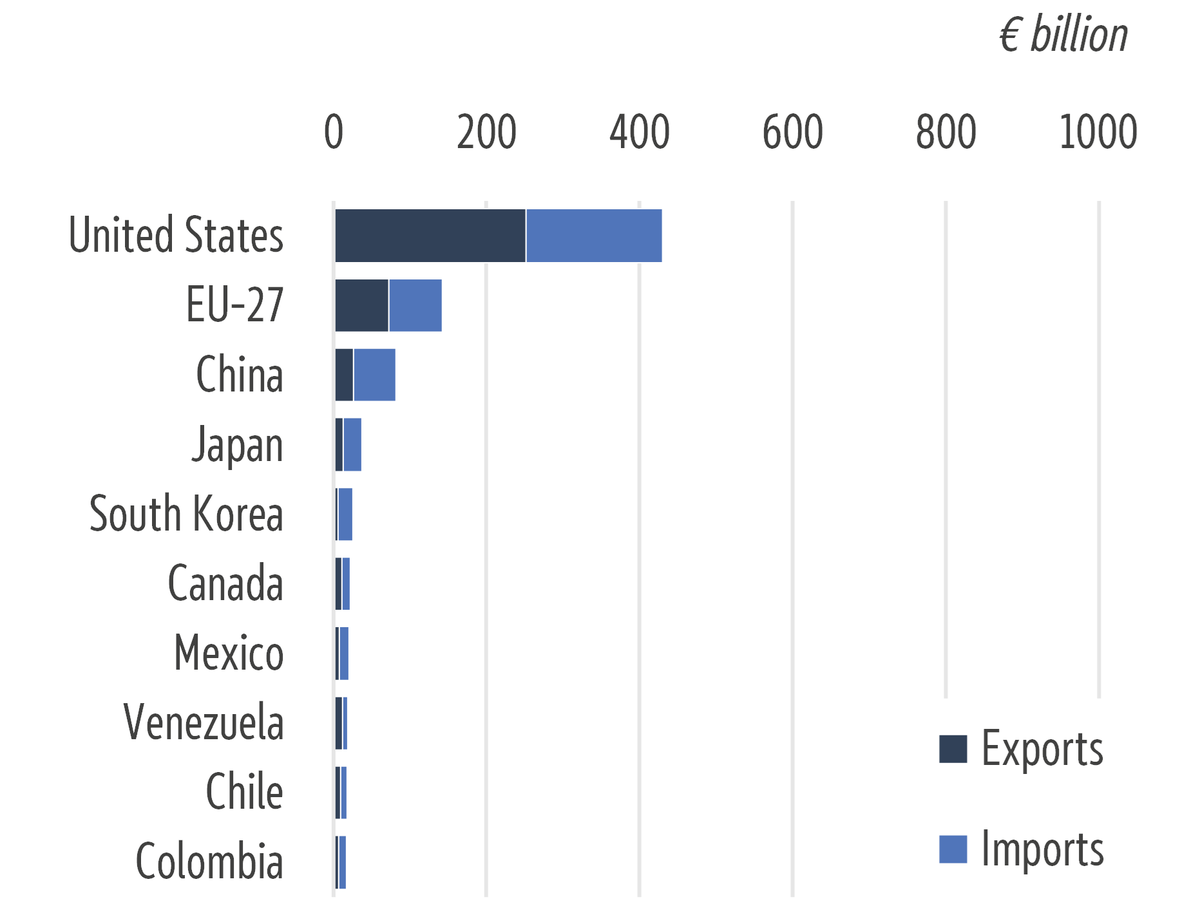
Data source: IMF.
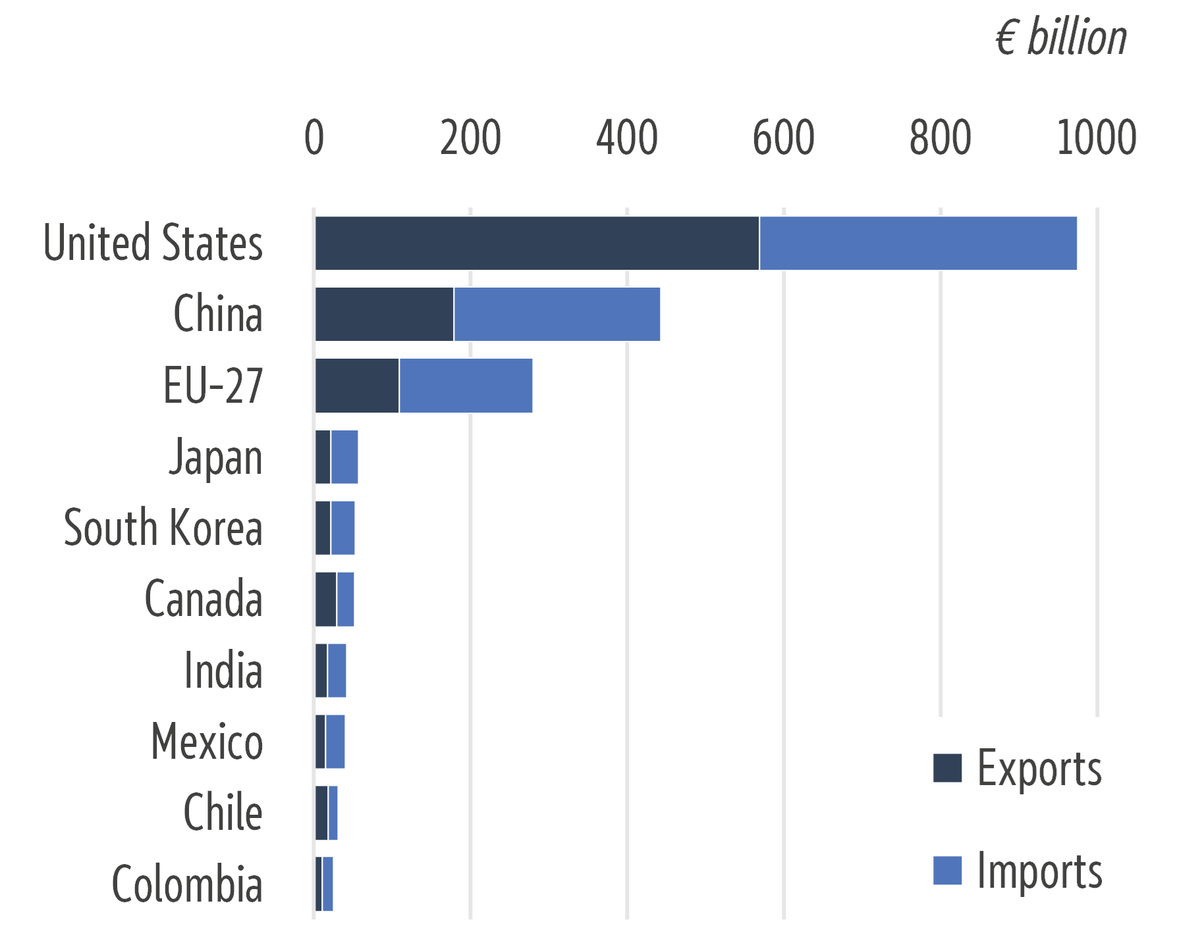
Data source: IMF.
Compared to the EU, China has trade agreements with only a few LAC countries: Chile (2005), Peru (2009), Costa Rica (2011), Nicaragua and Ecuador (2024). The FTAs signed with Chile and Peru have both been upgraded. In November 2017, Chile and China signed a protocol to the FTA, enhancing trade liberalisation and expanding tariff exemptions to approximately 98 % of all items. A year later, in November 2018, Peru and China signed a protocol upgrading their FTA as well.
Taking a closer look at China's trade relations with Mexico and Mercosur, with which the EU would like to conclude – respectively upgrade in the case of the latter – trade agreements, the following picture emerges: in 2017, the EU lost its long-standing position as Mercosur's first trading partner to China. China's trade with Mercosur reached roughly US$190 billion in 2023, about 18 times the total in 2003. In 2023, China accounted for 26.7 % of the bloc's external trade, up from 24.1 % in 2018. It surpassed the EU (which accounted for 16.9 % of the bloc's external trade, down from 20.1 % in 2018) and the US (which accounted for 13.9 % of the bloc's external trade, down from 14.4 % in 2018). Although there is no FTA between China and Mercosur yet, China has indicated its strategic interest in the region by announcing that it would increase bilateral trade with South America to US$500 billion by 2025 and invest US$250 billion in the LAC region.
Most Mercosur member states have emphasised their desire to boost ties with China. Uruguay has been in negotiations with China over a bilateral trade deal since 2021, with Montevideo pushing for a broader Mercosur trade agreement with China. The Brazilian President, Luiz Inácio Lula da Silva, has expressed support for potentially pursuing an FTA with China. Paraguay is also seeking to gain access to the Chinese market though a trade deal between Beijing and Mercosur. Even Argentina's President, Javier Milei, who previously had a critical stance towards China, has shifted towards an increasingly pragmatic form of collaboration. Additionally, two Mercosur member states, Argentina and Uruguay, are participants in China's BRI. In comparison, in 2022, trade in goods and services between the EU and Mercosur reached around €160 billion and bilateral investment exceeding €380 billion.
Against the backdrop of plans to update the EU's global agreement with Mexico, which has the second-largest economy in LAC and is a member of the G20 and the OECD, it is worth noting that China is Mexico's second-largest trading partner after the US. Trade relations between Mexico and China have experienced unprecedented growth. Over the past 25 years, Chinese exports to Mexico have increased by an annualised rate of 10.6 %. In 2023, Mexico exported US$9 billion worth of goods to China, primarily minerals and machinery, while importing US$119 billion, resulting in a trade deficit of US$110 billion. By way of comparison, Mexico-EU trade in goods and services is around €105 billion. Mexico ranks tenth in terms of its share in China's total exports worldwide and accounts for 2.44 % of China's total exports, making it China's most important market in Latin America, followed by Brazil at 1.72 %. The increase in Chinese exports to Mexico has led to tensions with the US, as China is using Mexico as an attractive entry point into the US, thanks to the US-Mexico-Canada Agreement (USMCA) providing tariff-free access for goods made with enough North American content).
Chinese foreign direct investment (FDI) in Latin America has remained at significant levels over the past two decades, even though overall FDI has decreased. Latin America is now the second-largest recipient of Chinese direct investment after Asia. Reliable investment figures are hard to obtain, but it is estimated that Chinese FDI in LAC totals US$187.5 billion, which is still well below US or EU FDI flows. For comparison, according to the European External Action Service, the EU is the leading investor in the LAC region, with FDI stocks at about US$765 (€741) billion in 2022. On average, China's FDI reached US$14.2 billion per year between 2010 and 2019 but fell to an average of US$7.7 billion from 2020 to 2021, and then US$6.4 billion in 2022. According to a report from the Inter-American Dialogue think-tank, the drop in investment levels does not reflect a lack of interest in Latin America, but rather a shift in Chinese FDI from costly infrastructure projects to specific industries described by China as 'new infrastructure'. This term encompasses, among other aspects, telecommunications, CRM production and energy transition.
Around two thirds of Chinese investment is in the areas of energy, raw materials and mining. Raw materials are the most important sector in terms of total Chinese FDI, accounting for 46 % of investment from 2015 to 2021. Critical metals and minerals projects have been a prominent focus for Chinese investors, accounting for 98 % of total Chinese mining investment. Chinese investment in LAC's energy sector is also highly substantial. In Brazil, China owns and operates more than 300 power plants and 50 % of Sao Paulo's hydropower generation, which, combined, constitutes 10 % of the country's total energy generation capacity. In Chile, 57 % of electricity distribution is owned by Chinese companies.
A 2025 study on China, Latin America and the US, published by the Konrad-Adenauer-Stiftung, informs that the two Chinese development banks – the China Development Bank (CDB) and the Export-Import Bank of China (EXIM) – have loaned over US$141 billion to LAC countries since 2005, more than the World Bank, the Inter-American Development Bank (IDB) and the Latin American Development Bank combined. This ranks LAC countries at second place (24 %) after Asia (29 %) in terms of all loans distributed globally by China between 2005 and 2021, followed by Africa (23 %).
China as a rival in the race for critical raw materials
From the EU's perspective, taking a closer look at China's activities with regard to Latin America's critical raw materials could be revealing. Chinese involvement in Latin America has historically focused on securing food and raw material supplies, such as beef and soy, copper and iron. The global transition to renewable energy and electric vehicles has increased Latin America's strategic significance to China, particularly due to its need for critical raw materials like lithium, copper, and niobium. China is the primary buyer of Latin America's raw materials: in 2023, it accounted for 34 % of the region's mineral exports.
Of the 34 critical raw materials on the EU's CRM list, 25 are extracted in Latin America. Latin America, in particular South America, is primarily rich in lithium and copper, which are essential for renewable energy technologies and the production of the lithium-ion batteries used in laptops, smartphones and hybrid and electric vehicles. Lithium-ion batteries are also increasingly used to store excess power generated from wind, solar and other renewable energy sources. United Nations Conference on Trade and Development (UNCTAD) projections based on data from the International Energy Agency indicate that by 2050, lithium demand could rise by over 1 500 % (with similar increases forecast for nickel, cobalt and copper). The EU's demand for lithium alone is expected to increase 12-fold by 2030 and 21-fold by 2050. According to the 2024 US Geological Survey, Argentina, Bolivia and Chile – jointly referred to as the 'lithium triangle' – hold about half of the world's estimated lithium resources. Argentina (6 %) and Chile (24 %) account for around 30 % of global lithium production. Beyond the lithium triangle, other Latin American countries, such as Brazil and Peru, are exploring their potential lithium reserves as well. In addition to its abundance of lithium, Latin America has the world's largest copper reserves. Copper is another mineral that is crucial for renewable energy technologies. Chile is the world's number one copper producer, accounting for 27 % of global supply. Peru, the second-largest producer, accounts for 11 % of global supply. China is Chile's largest global trading partner, largest export destination and largest source of imports. Some 77 % of Chile's exports to China were copper ore and related products, which makes Chile one of the few LAC countries with a trade surplus with China.
Since 2018, China has invested US$11 billion in lithium extraction in Latin America. Chinese mining companies, such as Ganfeng, Tianqi and Zijin, have gained either partial or full access to mineral mines across the world, including in Latin America. For example, Chinese companies have purchased half of the world's largest lithium mines. One notable deal took place in January 2023, when a consortium of Chinese companies (CATL, BRUNP and CMOC) invested US$1.4 billion in the construction of two lithium extraction plants on Bolivian land in partnership with Bolivian YLB. A second deal was signed in June 2023, with CITIC Guoan agreeing to invest US$857 million in a project located in Bolivia's Uyuni salt flats, which contain vast amounts of lithium.
Outlook
One result of Trump's first presidency (2017- 2021) was an increase in China's presence in LAC, as Trump's hard-line approach towards the region drove certain governments closer to China. Specifically, Mexico benefited from Trump's protectionist trade policy and trade war against China. Companies seeking to avoid tariffs by diversifying production out of China saw Mexico as a good option thanks to its affordable labour, decent infrastructure and, most importantly, its free-trade agreement with the US. Consequently, China's FDI flows into Mexico grew significantly from US$38 million in 2011 to US$386 million in 2021.
Looking at the US's recent activities addressed at LAC, it is possible that a similar scenario could repeat itself. After less than a month in office, the Trump administration has undertaken actions that many LAC states perceive as unfriendly. For instance, the US has halted – and threatened to eliminate – many US foreign assistance programmes, deported migrants back to Colombia under threat of tariffs, claimed that the US would take back the Panama Canal alleging that it was operated by China, and imposed (paused at the time of writing) a 25 % additional tariff on imports from Mexico.
Apart from the US government scoring some possible short-term successes in limiting China's influence in LAC, such as Panama's withdrawal from the BRI, indications are that the China-LAC relationship will continue to grow. A strategic foresight report on China-LAC Trade 2035 predicts that unprecedented trade values accompanied by greater Chinese investment and financial flows will further increase China's economic importance for LAC countries. By 2035, China and the US will compete for the position of LAC's top trade partner.
The Panama Canal
Work on the Panama Canal under US supervision began in 1904 and finished in 1914. Today, the canal is operated by the Panama Canal Authority, an agency of the Panamanian government.
Revenue generated by the canal accounts for more than 6 % of Panama's GDP. Furthermore, the canal is a strategic waterway that handles about 5 % of global maritime trade volume. Between 13 000 and 14 000 ships cross the 82-kilometre waterway in an average year.
The US — followed by China and Japan — is the Panama Canal's main client, with nearly 72 % of cargo passing through either coming from or headed to US ports.
A subsidiary of CK Hutchison Holdings – owned by the Hong Kong billionaire Li Ka-shing – has operated two of the canal's five port terminals (at the Atlantic and Pacific ends of the canal) since it won the tender in 1997.
Source: The BBC.
From an EU perspective, the question is how to respond to China's ever increasing presence in LAC, more particularly against the backdrop of the EU's urgent need of (a diversified) supply of critical raw materials (CRM) to master the clean and digital transition of its economy. Despite the likely rosy outlook for China-LAC economic relations, analysts point out that there is also increasing scepticism in Latin America with regard to China's foreign economic policy. Criticism focuses on issues such as debt traps, cheap goods flooding the market and crowding out domestic manufacturers, poor sustainability practices, and a continued dependency on raw material exports to fuel Chinese demand. Additionally, there is also some frustration over the recent changes in the scale and scope of China's regional investment, which has slowed significantly over the last decade. On the other hand, many Latin Americans see Europe as a desirable partner. A 2021 survey conducted in 10 LAC countries (Argentina, Bolivia, Brazil, Chile, Colombia, Costa Rica, Guatemala, Mexico, Uruguay, and Venezuela) revealed that 48 % were of the opinion that Europe would be the world region their country would benefit most from having links with (followed by North America (19 %), Latin America (12 %) and Asia-Pacific (8 %). Latin Americans recognise Europe's leadership in domains such as the environment, human rights, peace, poverty and inequality, and humanitarian aid. However, Europe is also perceived as less influential or even weak when it comes to science and education, military power, as well as technological development. Europe's economic power in Latin America is perceived as much lower than that of China or the US.
Consequently, if tensions between the US and China increase further, and given Latin America's policy of active non-alignment, there might be significant room for progress in the development of the EU-CELAC strategic partnership. The EU could use this window of opportunity to present itself to LAC countries as a mutually beneficial, sustainable and more appealing alternative. However, a litmus test for the EU and its objective to strengthen ties with LAC will certainly be the envisaged EU-Mercosur partnership agreement, upon which the European Parliament is expected to vote during the current legislative period.
Main references
- Barrios, R., Rios, K., China's Engagement with Latin America and the Caribbean, Congressional Research Service, 2023.
- Creutzfeldt, B., Dourado, L. and Ferchen, M., Lessons for Europe? Understanding China's Engagement in Latin America, Friedrich-Ebert-Stiftung e.V Bonn, February 2024.
- Johnston, K., China, Latin America, and the United States. Geopolitial Impacts and New Challenges, Konrad-Adenauer-Stiftung USA, January 2025.
- Jütten, M., EU–Latin America: Enhancing cooperation on critical raw materials, EPRS, European Parliament, December 2024.
- Prazeres, T., Bohl, D. and Zhang, P., China-LAC Trade: Four Scenarios in 2035, Atlantic Council, 2021.
- Raza, W., Grohs, H., Trade aspects of China's presence in Latin America and the Caribbean, European Parliament 2022.
- Roy, D., China's Growing Influence in Latin America, Council on Foreign Relations, January 2025.
Disclaimer
This document is prepared for, and addressed to, the Members and staff of the European Parliament as background material to assist them in their parliamentary work. The content of the document is the sole responsibility of its author(s) and any opinions expressed herein should not be taken to represent an official position of the Parliament.
Copyright
© European Union.
The reuse of this document is authorised under a Creative Commons Attribution 4.0 International (CC-BY 4.0) licence.

https://creativecommons.org/licenses/by/4.0/deed.en
To use or reproduce elements that are not owned by the European Union, permission may need to be sought directly from the respective rightsholders.