
Article page checkbox is not checked in page info.
Parliament's right of legislative initiative
Parliament's right of legislative initiative
Silvia Kotanidis, Members' Research Service

Summary
The European Commission has a near monopoly on legislative initiative in the European Union (EU), with special initiative rights for other institutions applying only in certain specific cases. However, the European Parliament and the Council may invite the Commission to submit legislative proposals. While this 'indirect' initiative right does not create an obligation on the Commission to propose the legislation requested, the Treaty of Lisbon codified the Commission's obligation to provide reasons for any refusal to follow a parliamentary initiative. Against this backdrop, some argue that Parliament could take the Commission to the Court of Justice of the EU if it fails to justify a negative decision.
Others see Parliament's increasing participation in overall political planning – particularly through negotiations on the Commission's annual work programme (CWP) – as a further channel for Parliament to increase its influence on EU legislation. It is thus argued that the increased role of Parliament in the legislative procedure should have reduced the need for its Members to make use of legislative initiatives. Notwithstanding that, there is a trend towards greater use of formal parliamentary legislative initiatives to assert greater influence on the political process.
In her inaugural address in July 2019 and in her political guidelines, the then newly elected President of the European Commission, Ursula von der Leyen, pledged to strengthen the partnership with the European Parliament, inter alia, by responding with a proposal for a legislative act whenever Parliament, acting by a majority of its Members, adopts a resolution requesting that the Commission submit legislative proposals. She added that this commitment would have to fully respect the proportionality, subsidiarity and better law‑making principles. President von der Leyen also said that she supported moves towards recognising a right for Parliament of legislative initiative. A similar commitment to strengthen cooperation with Parliament on the exercise of Parliament's indirect right of legislative initiative was expressed by Ursula von der Leyen in her 2024‑2029 political guidelines.
This briefing is an update of a 2013 briefing by Eva‑Maria Poptcheva, and a 2020 briefing by Silvia Kotanidis.
Parliament's initiative rights
Whereas in the Member States, alongside governments, national parliaments are empowered to propose legislation, through either a certain number of Members of Parliament, a political party group, or even individual Members, at EU level the Treaty on European Union (TEU) reserves the right to initiate legislation almost entirely for the European Commission (Article 17(2) TEU).
It is suggested that the Commission's monopoly of initiative was originally rooted in the mistrust of the political process in post‑war Europe. As a consequence, European integration and the identification of the 'general interest' of the Communities were entrusted to a technocratic authority, whose decisions were to be legitimated by its expertise and performance.1
The Treaty of Lisbon reinforced Parliament's right to request the Commission to submit a legislative proposal, in the Treaty on the Functioning of the European Union (TFEU). In line with the evolving institutional balance, many expect Parliament's role in the EU's political and legislative agenda‑setting procedures to develop further in the coming years.
Article 225 TFEU
The European Parliament may, acting by a majority of its component Members, request the Commission to submit any appropriate proposal on matters on which it considers that a Union act is required for the purpose of implementing the Treaties. If the Commission does not submit a proposal, it shall inform the European Parliament of the reasons.
Right to initiate legislation
The right of the European Parliament to initiate legislation (Article 225 TFEU) was first enshrined in the Treaties with the Treaty of Maastricht (Article 138b). However, Parliament was already influencing the legislative agenda before then, by introducing items to the budget and through its – non‑legislative – 'initiative reports' issued to put political pressure on the Commission. In 1990, Parliament demanded for itself a full‑fledged initiative right, not dependent on the Commission, to address the alleged democratic deficit in the then Communities. This question was discussed again within the European Convention in 2002 and 2003. However, under pressure to confer the same right on the Council, which, it was feared, might dilute the initiative right of the Commission and complicate the legislative procedure, Parliament's negotiators dropped their demands for a 'direct' initiative right.
Parliament's special initiative rights
Under the Treaties, the European Parliament has a number of special initiative rights, where it can make formal proposals for legislation – mainly concerning its own organisation, functions and the European elections. These include: the determination of the existence of a clear risk that a Member State breaches the Union values (Article 7 TEU), provisions establishing the composition of the European Parliament (Article 14 TEU), amendments of the Treaties (48(2) TEU), European electoral legislation (Article 223 TFEU), regulations and general conditions governing the performance of the duties of its Members (Article 223(2) TFEU), provisions governing the right of inquiry (Article 226 TFEU), and rules concerning the performance of the Ombudsman's duties (Article 228(4) TFEU).
Nature of the legislative initiative right
Parliament's initiative right under Article 225 TFEU applies to any EU act within the Treaties, and not only to policy areas where legislation is adopted under the ordinary legislative procedure. The only requirement is that the Commission must have the right to propose legislation in this area.
'Indirect' initiative right
Parliament's right to initiate legislation is an 'indirect' one, as it only gives Parliament the possibility to 'invite' the Commission to submit a legislative proposal. A similar 'indirect' initiative right is also conferred upon the Council (Article 241 TFEU), which may ask the Commission to undertake pre‑legislative 'studies' of, inter alia, economic, social and legal circumstances and to submit to it any appropriate proposals. For example, the Regulation on Registration, Evaluation, Authorisation and Restriction of Chemicals (REACH) was adopted after a Council initiative. The Lisbon Treaty also gave a similar indirect right of initiative to groups of at least one million EU citizens through a European Citizens' Initiative (Article 11(4) TEU).
The Lisbon Treaty strengthened Parliament's initiative right by introducing the obligation for the Commission to give reasons for any refusal to propose legislation following a request. However Parliament had previously managed to secure for itself a stronger position vis‑à‑vis the Commission through interinstitutional agreements. The Commission, for instance, committed itself to 'duly reason on a case‑by‑case basis' its decisions on Parliament's requests in a 1995 Code of Conduct.2
Is there an obligation for the Commission to submit a proposal?
The question whether the European Commission is obliged to submit a legislative proposal further to Parliament's 'invitation' has been disputed in the legal literature. Some argue that adoption of a legislative initiative report by the required absolute majority in Parliament, as well as the political accountability of the Commission vis‑à‑vis the Parliament, place an obligation on the Commission to react. The majority of academics, however, draw an analogy with the Council's initiative right, where no absolute obligation exists, as well as to the historical origins of the provision, and argue against the binding nature of the obligation.
Codification – in the Lisbon Treaty – of the Commission's obligation to give reasons for its decision not to submit a proposal establishes that the Commission is not bound to Parliament's initiative. The obligation to inform Parliament about the reasons for rejecting an initiative is, however, seen by some as a reflection of Parliament's increasing control powers vis‑à‑vis the Commission.3
Follow‑up of Parliament's legislative initiatives
Despite the discretion conferred upon the Commission, Parliament has gained a commitment from the Commission on its follow‑up to Parliament's legislative initiatives over the years.
The Commission committed itself in the European Parliament–European Commission Framework Agreement 4 of 2010 to report on the concrete follow‑up of any parliamentary legislative initiative within three months after its adoption in plenary. Moreover, the Commission agreed to come forward with a legislative proposal at the latest within one year or to include the proposal in its next annual work programme (recital 16). This has been assessed by many commentators as a decisive restriction of the Commission's discretion regarding Parliament's legislative requests. Some also stress that this commitment has effectively reduced the possibility of 'waiting games' with Parliament as far as controversial legislative initiatives are concerned.
Many commentators conclude that the Commission is obliged to take action on a parliamentary legislative initiative or at least has to explain its follow‑up and any negative decision.5
As a consequence, many scholars argue that Parliament could lodge an action for failure to act pursuant to Article 265 TFEU with the Court of Justice of the EU (CJEU) if the Commission failed to take any action in response to a request from Parliament.6 Recourse to the CJEU could not result in obliging the Commission to submit the proposal requested, but would at least oblige the Commission to consider Parliament's request.7 It has also been argued that the political consequence of a failure by the Commission to provide sufficient reasons for the rejection of Parliament's request could be cause for a motion of censure on the Commission's activities (Article 234 TFEU).8
Procedure
The Treaties leave the arrangements for exercising the right of initiative with Parliament. According to Parliament's Rules of Procedure (Rule 47(2)), the right to table a legislative proposal is conferred upon any Member, and a proposal can be tabled jointly by up to 10 Members. Rule 47(1) establishes that a resolution to request the Commission to submit a legislative proposal is always adopted on the basis of a legislative‑initiative report.9 The proposal needs to specify the legal basis for the proposed draft act. It is submitted to the President of the Parliament who, after verifying whether the legal requirements are fulfilled, may refer the proposal for an opinion on the appropriateness of the legal basis to the Legal Affairs Committee (JURI). The JURI committee must give an opinion without undue delay.
If the proposal is admissible, the President announces it in plenary and refers it to the committee responsible for the subject matter. If the committee decides to draw up a legislative‑initiative report and the President does not refer the proposal to the JURI committee for an opinion on the appropriateness of the legal basis, the responsible committee must request such an opinion, which must be delivered without undue delay (Rule 47(2)). The committee must decide within three months whether to draft a legislative‑initiative report, and the Conference of Presidents must then authorise the committee to do so.
An absolute majority of component Members is necessary in plenary for adoption. The resolution includes recommendations on the content of the proposal requested, and on whether it respects fundamental rights and the principle of subsidiarity. Where a proposal has financial implications, Parliament indicates how sufficient financial resources could be provided and may set a deadline for the Commission to submit such a proposal. The Conference of Committee Chairs is responsible for monitoring whether the Commission complies with the three‑month rule to communicate its intended follow‑up.
New channels for Parliament's say on the legislative agenda
Changes in the institutional balance
Neither the Treaty of Lisbon nor previous treaties introduced formal changes to the right of the Commission to propose legislation. However, many commentators argue that the expanded use and consolidation of co‑decision – now the ordinary legislative procedure – has in practice led to the gradual erosion of the Commission's monopoly of initiative. It has been argued that, even though the Commission possesses a quasi‑monopoly over the formal right of legislative initiative, it shares the right of political initiative with the European Council, the Council and the Parliament.10
Some commentators, however, regard the reduction of the Commission's role as the only policy developer – inter alia, in favour of an elected institution such as the Parliament – as a natural evolution of the democratisation process and as a 'maturing of the Union's institutional set‑up'.11
Role of the European Parliament in legislative planning
Under the 2010 Framework Agreement, the Commission must take into account the priorities expressed by Parliament and justify any departure from the proposals set out in the Commission Work Programme (CWP). In this way, Parliament's contribution towards shaping the CWP results directly in greater political influence on the legislative initiatives to be submitted by the Commission. Some call for further institutionalisation of this consultative process.
Timetable for the CWP
The timetable for the CWP is set out in Annex IV to the 2010 Framework Agreement (also included in the Compendium of the main legal acts related to Parliament's Rules of Procedure). It envisages a dialogue between the Commission and the corresponding parliamentary committees. On the basis of a summary report by the Conference of Presidents on the implementation of the CWP, Parliament adopts a resolution at the July part‑session, outlining its position and including in it particular requests based on legislative‑initiative reports. Annual legislative planning is based on structured dialogue, covering both the ongoing and future CWPs, aimed at ensuring a common understanding between Parliament and the Commission.
Apart from requiring the Commission to give 'prompt and detailed' consideration to requests for proposals for Union acts made by the European Parliament (and Council) pursuant to Article 225 TFEU, the interinstitutional agreement between Parliament, the Council and the Commission on better law‑making, which entered into force in April 2016 (the 2016 IIA), details a number of further obligations in the hands of the Commission (e.g. the three‑month deadline to state the follow‑up it intends to give by adopting a specific communication; the obligation to justify abstention and provide, where appropriate, an analysis of possible alternatives and address 'European added value' and the 'cost of non‑Europe' (paragraph 10 of the 2016 IIA)).
The 2016 IIA also places strong emphasis on interinstitutional cooperation in the phase of legislative programming, in which Parliament is involved along with the other two institutions, particularly as regards multiannual programming (paragraph 5 of the 2016 IIA). It provides for a structured exchange of views following the adoption of the CWP, leading to a joint declaration by the presidents of the three institutions (paragraph 7 of the 2016 IIA).
EAVA
The European Added Value Unit (EAVA) within EPRS provides European Added Value assessments to set out in detail the justification for proposals made to the Commission by the Parliament under Article 225 TFEU. It may conduct specific follow‑up research on major legislative requests made by Parliament for the CWP.
Parliament's legislative initiatives in practice
More legislation, fewer initiatives
Many scholars see a relationship between the number of initiatives (legislative and non‑legislative) submitted by MEPs and Parliament's increasing legislative competences.12 With Parliament more involved in pending legislative procedures, less time and resources are left for new proposals.13
Legislative initiatives and their follow‑up
In May 2018, Parliament adopted a resolution on the interpretation and implementation of the 2016 IIA, welcoming the Commission replying, for the most part, within the three‑month deadline. However, it observed that specific communications were not being adopted, thus the political response to Parliament's requests did not receive full transparency. Parliament also expressed dissatisfaction that several own‑initiative reports have remained unanswered and called on the Commission to provide the co‑legislators, within three months, with the reasons why a proposal is withdrawn and with a reasoned opinion on requests for legislative or non‑legislative proposals.
Parliament adopted 29 legislative initiatives during the 2014‑2019 and 2009‑2014 legislative terms (see Annex). The Commission's follow‑up differs from case to case. Generally, it includes a reference to Parliament's call for legislation in its legislative proposal, should it make one. Of the 29 initiatives mentioned from the 2014‑2019 and 2009‑2014 terms, the reply by the Commission contained positive feedback on the issue tackled by Parliament in 15 cases. Such positive feedback contained mixed messages. For example, it explained that the issue was already taken care of by existing proposals, or that further analysis was necessary, or that it would have been dealt with in ways different to those suggested by Parliament. In only two cases did the Commission announce clearly that a legislative proposal would have been submitted.
As the Annex shows, during the ninth legislative term (2019‑2024), Parliament submitted 25 resolutions under Article 225 TFEU, asking the Commission to initiate legislative initiatives in several areas. As can be seen from the Annex, the interaction between Parliament and the Commission was more positive than in previous legislative terms, as the Commission acknowledged, in all except two of these 25 requests, the need to start legislative work, or stated that legislative initiatives taking into account Parliament's concerns were in the pipeline.
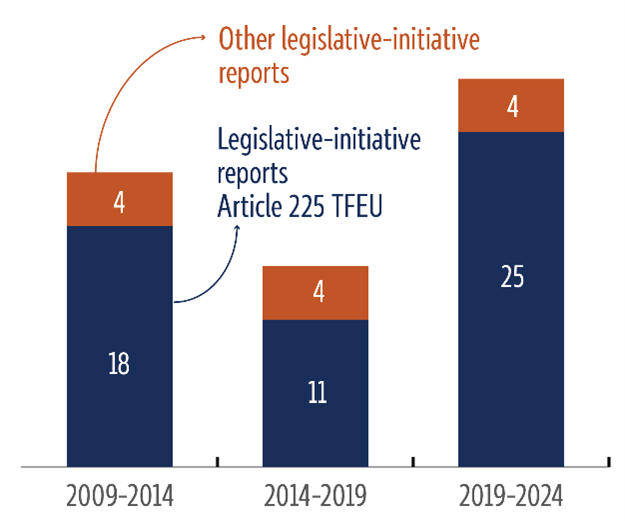
Source: EPRS. Graphic by Giulio Sabbati, EPRS
Recent developments
In 2019, European Commission President Ursula von der Leyen expressed in her pre-election address and in her political guidelines the intention to establish a strong partnership with the European Parliament. She also expressed the intention to call for a Conference on the Future of Europe, which would involve institutions and citizens, with the objective of debating a wide range of issues, including those of an institutional nature.
In her 2019 political guidelines, President von der Leyen pledged, inter alia, to support Parliament, as the representative institution of citizens, gaining a stronger role in initiating legislation. In this respect, she committed to responding with a legislative act whenever Parliament, acting by a majority of its Members, adopted resolutions requesting that the Commission submit legislative proposals, adding that this commitment should fully respect the proportionality, subsidiarity and better law‑making principles. President von der Leyen also said that she supported recognising Parliament's right of legislative initiative.
Taking stock of her implementation of these past commitments, in her political guidelines for 2024‑2029, Ursula von der Leyen reiterated her intention to continue on the same path with a view to strengthening cooperation with Parliament and, as far as initiatives under Article 225 are concerned, to strengthen the structural dialogue between Commissioners and the committees responsible.
In his replies to the written questionnaire submitted prior to his hearing, Commissioner‑designate Maroš Šefčovič confirmed the success of this cooperation with Parliament, stating that the Commission had upheld its promise by responding positively to 24 out of 25 resolutions under Article 225 TFEU. With a view to continuing on this path, Maroš Šefčovič declared that the new Commission intended to strengthen the commitment by making sure that Commissioners take part in structural dialogues with parliamentary committees on resolutions adopted under Article 225.
Looking back to previous legislative terms, in February 2017 Parliament adopted two comprehensive resolutions suggesting ways to improve the functioning of the EU, either by building on the potential of the Lisbon Treaty – without Treaty changes– (2014/2249(INI)) or by engaging in more substantial changes to the current set‑up (2014/2248(INI)). In this way, Parliament promoted an enhancement of its legislative powers, not only with respect to its right of 'indirect initiative' (Article 225 TFEU), but also with respect to a full‑fledged 'stand‑alone' right of legislative initiative. Parliament proposed the attribution of a true right of legislative initiative to (the Council and) Parliament, and expressed its intention to make more use of the legislative initiative right under Article 225 TFEU.
In two resolutions of February 2019, Parliament reiterated its position (i.e. that the Commission should take more serious account of its requests; that more legislative requests be translated into concrete proposals; and that Parliament be given, in the context of a future Treaty change, a true right of legislative initiative – Resolution 2018/2113(INI)) and recalled the possibility of substantial modifications of the Treaties awarding Parliament the 'stand‑alone' right to submit legislative proposals (2018/2094(INI)).
However, a substantial advance in advocating for a stand‑alone right of Parliament was made with the resolution adopted on 6 June 2022 on Parliament's right of legislative initiative (2020/2132(INI)). In this resolution, Parliament recalled that a general and direct right of legislative initiative for Parliament could strengthen the democratic legitimacy of the EU, since Parliament is the only directly elected EU institution. In this resolution, Parliament called for the recognition of its right of legislative initiative without excluding a concurrent right for the Commission or even a monopoly in certain areas such as that of the budget. The resolution also envisages a possible parallel right of legislative initiative for the Council in strictly defined areas.
The above resolution of June 2022 came right after the conclusion of the Conference on the Future of Europe, an innovative process of deliberative democracy that took place between 2021 and 2022 with the direct participation of citizens in citizens' panels and as components of the Conference's structure. In this context, bestowing the right of legislative initiative on Parliament featured among the 326 measures developed by the Conference in its final report issued in May 2022 (proposal 38(4)). For this recommendation to be implemented, however, the ordinary revision procedure under Article 48 TEU is needed.
In the aftermath of the Conference, in three resolutions (of 4 May 2022 (point 11), 9 June 2022 (point 5) and 22 November 2023 (point 5)), Parliament proposed to start a convention to amend the Treaties, each time calling for Parliament to be awarded the right of legislative initiative.
In October 2024, Parliament and the Commission agreed on a set of principles that will guide the renegotiation of the 2010 Framework Agreement on relations between them, with a view, inter alia, to ensuring the principle of equal treatment as well as the timely and detailed flow of information between the two institutions. Principle 9 explicitly refers to the objective of strengthening Parliament's right of initiative by enhancing the Commission's follow‑up of corresponding resolutions. While the Commission adopted its negotiating mandate on 4 December, the Council expressed its concerns over the renegotiation in a letter of 20 November. In particular, the Council stressed the need to maintain the interinstitutional balance as provided for in the EU Treaties.
Annex
Tables 1, 2 and 3 show cases in each of the past three terms respectively in which Parliament voted in plenary to request the Commission to submit a proposal pursuant to Article 225 TFEU. Tables 4, 5 and 6 show cases of legislative‑initiative reports submitted with regard to decisions (or legal acts) to be adopted uniquely by the Council or proposals for regulation according to Article 226 TFEU. (Data are from the Legislative Observatory (OEIL) and the Legislative Coordination Unit, European Parliament.)
| Legislative‑initiative report (INL) | Adoption in plenary | Votes | Committee | Commission response |
|---|---|---|---|---|
|
Right to disconnect | 21 January 2021 |
For – 472 Against – 126 Abstained – 83 | EMPL | The Commission responded with a letter of 25 March 2021 committing to follow up on Parliament's initiative by first inviting social partners to find common solutions and, on that basis, to engage in a formal social partner consultation under Article 154 with a view to a possible Commission proposal. |
|
Protecting workers from asbestos | 20 October 2021 |
For – 675 Against – 2 Abstained – 23 | EMPL | The Commission agreed, in a letter of 19 January 2022, on the importance of protecting workers and citizens against exposure to asbestos, which must be a priority. The Commission also committed to legislative and non‑legislative actions, as requested by Parliament, or, where not possible, to alternative approaches to achieve the goals identified by Parliament. |
|
EU legal framework to halt and reverse EU‑driven global deforestation | 22 October 2020 |
For – 377 Against – 75 Abstained – 243 | ENVI | The Commission confirmed, in a letter of 9 December 2020, that it had already launched preparations for a legal framework to halt and reverse EU‑driven deforestation. It was undertaking an impact assessment and planned to come forward with such a proposal in the second quarter of 2021. |
|
Revision of European Works Council Directive | 2 February 2023 |
For – 385 Against – 118 Abstained – 99 | EMPL | The Commission replied, in a letter of 1 March 2023, that an assessment of Parliament's requests was underway in parallel with a two‑stage consultation of EU social partners. A suitable follow‑up would be considered to calls in the resolution for non‑legislative action in light of the results of the social partner consultation and in its assessment of legislative and non‑legislative options to achieve the objectives of this initiative. |
|
Quality traineeships in the EU | 14 June 2023 |
For – 404 Against – 78 Abstained – 130 | EMPL | The Commission confirmed, in a letter of 29 June 2023, that, as part of its planned initiative on a reinforced quality framework for traineeships (QFT), it intended to follow up on the European Parliament resolution with a proposal for a legislative act that fully respects subsidiarity and proportionality and that an assessment of Parliament's proposal was already underway. |
|
Framework of ethical aspects of artificial intelligence, robotics and related technologies | 20 October 2020 |
For – 559 Against – 44 Abstained – 88 | JURI | The Commission replied, in a letter of 15 December 2020, that it intended to follow up on the European Parliament resolution with a legislative proposal, including on safety, liability, fundamental rights and data, scheduled for early 2021. |
|
Civil liability regime for artificial intelligence | 20 October 2020 |
For – 626 Against – 25 Abstained – 40 | JURI | The Commission confirmed, in a letter of 15 December 2020, that it shared the objectives set out in the European Parliament resolution. It pointed out that the legal instrument proposed by Parliament (a regulation) might require due reflection in light of the principle of subsidiarity. |
|
Digital Services Act: Improving the functioning of the Single Market | 20 October 2020 |
For – 571 Against – 26 Abstained – 94 | IMCO | The Commission replied, in a letter of 15 December 2020, that two legislative proposals adopted by the College of Commissioners on 15 December 2020 – the Digital Services Act and a Digital Markets Act – aimed to follow up on the European Parliament's proposal. |
|
Digital Services Act: Adapting commercial and civil law rules for commercial entities operating online | 20 October 2020 |
For – 637 Against – 26 Abstained – 28 | JURI | The Commission confirmed, in a letter of 15 December 2020, that two legislative proposals adopted on 15 December 2020 by the College of Commissioners – the Digital Services Act and a Digital Markets Act – were intended to follow up on the European Parliament resolution. |
|
A statute for European cross‑border associations and non‑profit organisations | 17 February 2022 |
For – 530 Against – 146 Abstained – 15 | JURI | The Commission confirmed, in a letter of 11 May 2022, that it would make legislative proposals to take into account Parliament's concerns in order to allow associations and potentially other non‑profit organisations to enjoy fully the single market freedoms. |
|
Digital Finance: Emerging risks in crypto‑assets – regulatory and supervisory challenges in the area of financial services, institutions and markets | 8 October 2020 |
For – 542 Against – 63 Abstained – 89 | ECON | The Commission underlined, in a letter of 3 December 2020, that it had already delivered on the issues emphasised by Parliament with the adoption, on 24 September 2020, of a digital finance strategy and two sets of legislative proposals on digital operational resilience and crypto‑assets. |
|
Combating gender‑based violence: Cyber‑violence | 14 December 2021 |
For – 513 Against – 122 Abstained – 58 |
FEMM LIBE | The Commission replied, in a letter of 16 March 2022, that it had already followed up on the European Parliament's recommendations with two legislative proposals adopted on 9 December 2021 and 8 March 2022, leading, respectively, to a Council decision extending the list of EU crimes in Article 83(1) TFEU to include hate crime and hate speech and a proposal for a directive on combating violence against women and domestic violence. The Commission announced that it would further complement these two proposals with non‑legislative actions. |
|
Challenges of sport events' organisers in the digital environment | 19 May 2021 |
For – 479 Against – 179 Abstained – 40 | JURI | The Commission replied, in a letter of 20 July 2021, that it intended to further analyse whether specific rules were needed to address piracy of sport content before it followed up with a legislative or any other action in the first half of 2022. The Commission also planned to assess whether the directive on the enforcement of intellectual property rights needed to be amended and how further cooperation and exchange of information between national authorities and courts could be achieved. |
|
Corporate due diligence and corporate accountability | 10 March 2021 |
For – 504 Against – 79 Abstained – 112 | JURI | The Commission replied, in a letter of 8 June 2021, that it intended to follow up on Parliament's recommendation with a legislative proposal by June 2021. In addition, the Commission announced its intention to review its 'decent work' agenda and update the 2006 Communication on 'Decent work for all'. The Commission announced that it would further consider Parliament's recommendation on stakeholders' involvement in its preparatory work and the private international law aspects following evaluation of the Brussels Ia and Rome II Regulations. |
|
Responsible private funding of litigation | 13 September 2022 |
For – 504 Against – 57 Abstained – 65 | JURI | The Commission replied, in a letter of 30 November 2022, that third‑party litigation funding (TPLF) is already addressed in Union law by the Directive on Representative Actions. The Commission intends to assess the status and possible additional measures only after the complete transposition and application of the Directive by the Member States. |
|
Fair and simpler taxation supporting the recovery strategy | 10 March 2022 |
For – 476 Against – 78 Abstained – 129 | ECON | The Commission replied, in a letter of 7 June 2022, that it had already taken action on a large majority of issues – for example, with the one‑stop shop (OSS) allowing businesses to avoid multiple VAT registrations in the EU for cross‑border transactions. Among other initiatives, the VAT in the Digital Age package will broaden the scope of the OSS and cover some of the existing gaps. |
|
Legal migration policy and law | 25 November 2021 |
For – 497 Against – 160 Abstained – 38 | LIBE | The Commission announced, in a letter of 23 February 2022, its intention to address the issues with the 'Skills and Talent' package and with legislative and non‑legislative measures. This includes a recast of Directive 2003/109/EC on Long‑term Residents and a recast of Directive 2011/98/EC on the Single Permit simplifying and harmonising rules on residence and work permits for third‑country workers, strengthening their protection and equal treatment. |
|
Citizenship and residence by investment schemes | 9 March 2022 |
For – 595 Against – 12 Abstained – 74 | LIBE | The Commission replied, in a letter of 7 June 2022, that it believed that the package of legislative and non‑legislative measures already initiated or to be taken during the mandate of this Commission met Parliament's request to a very large extent. |
|
Identifying gender‑based violence as a new area of crime listed in Article 83(1) TFEU | 16 September 2021 |
For – 427 Against – 119 Abstained – 140 |
LIBE FEMM | The Commission replied, in a letter of 9 December 2021, that it welcomed Parliament's recommendations for a legislative initiative and considered that the package of legislative and non‑legislative initiatives planned for 2021 and 2022 met Parliament's request. |
|
Digitalisation of the European reporting, monitoring and audit | 23 November 2021 |
For – 659 Against – 28 Abstained – 1 | CONT | The Commission announced, in a letter of 16 February 2022, that it intended to follow up on Parliament's resolution with a legislative initiative in the second quarter of 2022. This may have differed in some technical elements from Parliament's approach, but met Parliament's approach overall. |
| Digitalisation and Administrative Law 2021/2161(INL) | 22 November 2023 |
For – 531 Against – 17 Abstained – 66 | JURI | The Commission recalled, in a letter of 27 February 2024, that, following a 2013 Parliament resolution and expert work undertaken after that, it was not convinced that the benefits of using a legislative instrument would outweigh the costs. The several initiatives undertaken to establish a common regulatory set‑up for digitalisation of the institutions and public sector bodies across the EU, such as the revised corporate digital strategy of 2022, the AI strategy and the Interoperable Europe Act, satisfy Parliament's requests. However, the Commission announced that it would gather further evidence to allow the next College of Commissioners, as requested by Parliament, to continue the work on this matter. |
|
Amending the proposed mechanism to resolve legal and administrative obstacles in a cross‑border context | 14 September 2023 |
For – 521 Against – 36 Abstained – 13 | REGI | The Commission replied, in a letter of 12 December 2023, that it shared Parliament's concerns and that it took an initiative with its proposal for a European Cross Border Mechanism in 2018, on which Parliament adopted its first reading position on 14 February 2019. However, the Council decided not to continue work on that proposal. The Commission thought that an amendment of the pending legislative proposal from 2018 was still necessary, so it adopted an amended proposal to simplify it and strengthen its voluntary approach, while also taking account of Member States' concerns. |
|
EU framework for the social and professional situation of artists and workers in the cultural and creative sectors | 21 November 2023 |
For – 433 Against – 100 Abstained – 99 |
EMPL CULT | The Commission replied with a letter of 21 February 2024, sharing Parliament's concerns and announcing that it intended to kick off work in this area. In particular, the Commission mentioned initiatives to reinforce the implementation and enforcement of existing rules, identify regulatory gaps, enhance interactions with social partners, involve the Senior Labour Inspectors Committee in the field of health and safety at work, and develop good practices, particularly in the area of undeclared work. |
|
Promotion of the freedom of scientific research in the EU | 17 January 2024 |
For – 461 Against – 34 Abstained – 140 | ITRE | The Commission announced, in a letter of 21 February 2024, that it intended to follow up on Parliament's proposal by first gathering information and launching appropriate studies to support future legislative initiatives. The Commission also committed to taking into account the work undertaken by Parliament in the area of academic freedom. |
| A safety net to protect the beneficiaries of EU programmes: Setting up an MFF contingency plan
2020/2051(INL) | 13 May 2020 |
For – 616 Against – 29 Abstained – 46 | BUDG | The Commission stated, in a letter of 9 September 2020, that it did not intend to propose contingency measures for the time being because interinstitutional work should be intensified to achieve an agreement on NextGenerationEU and the 2021‑2027 MFF. |
| Legislative‑initiative report (INL) | Adoption in plenary | Votes | Committee | Commission response |
|---|---|---|---|---|
| Humanitarian visas 2018/2271(INL) | 11 December 2018 |
For – 429 Against – 194 Abstained – 41 | LIBE | The Commission responded (1 April 2019, SP(2019)149) that the objectives of Parliament's initiative were partially covered by the 2016 proposal for a regulation establishing a Union Resettlement Framework. |
| Expedited settlement of commercial disputes 2018/2079(INL) | 13 December 2018 |
For – 521 Against – 35 Abstained – 14 | JURI | The Commission responded (11 March 2019, SP(2019)129) that, at that stage, it did not seem appropriate to engage in preparatory action concerning the establishment of a European Commercial Court. |
| Statute for social and solidarity‑based enterprises 2016/2237(INL) | 5 July 2018 |
For – 398 Against – 78 Abstained – 44 | JURI | The Commission responded (8 November 2018, SP(2018)630) that it had already undertaken a number of initiatives and programmes linked with social enterprises. In some cases, the Commission did not share the same opinion as Parliament. |
| Odometer manipulation in motor vehicles: revision of the EU legal framework 2017/2064(INL) | 31 May 2018 |
For – 577 Against – 32 Abstained – 19 | TRAN | The Commission responded (26 September 2018, SP(2018)516) that it would study further possible solutions and review the relevant international standards, though it noted that Parliament's recommendations were sufficiently covered by the existing legislation. |
| Common minimum standards of civil procedures 2015/2084(INL) | 4 July 2017 |
For – 545 Against – 79 Abstained – 71 | JURI | The Commission responded (16 October 2017, SP(2017)539) that the EU civil justice instruments already contained civil procedure rules. It noted that, if further action were needed, it intended to take the proposal into account. |
|
Limitation periods for traffic accidents | 4 July 2017 |
For – 558 Against – 69 Abstained – 73 | JURI | The Commission noted (6 October 2017, SP(2017)540) that harmonisation of national limitation periods could not be limited to traffic accident cases in isolation and should be addressed in a future report on the application of the Rome II Regulation. |
| Protection of vulnerable adults 2015/2085(INL) | 1 June 2017 |
For – 539 Against – 23 Abstained – 72 | JURI | The Commission responded (30 August 2017, SP(2017)510) that a legislative initiative would produce the desired effects only when a sufficient number of Member States had joined the 2000 Hague Convention on international protection of adults. |
| Civil law rules on robotics 2015/2103(INL) | 16 February 2017 |
For – 396 Against – 123 Abstained – 85 | JURI | The Commission responded (16 May 2017, SP(2017)310) that it intended to assess whether legislative action was necessary. |
|
Cross‑border aspects of adoptions | 2 February 2017 |
For – 533 Against – 41 Abstained – 72 | JURI | The Commission responded (10 April 2017, SP(2017)188) that it was aware of the existing problems. It nevertheless pointed out that an initiative needs to be evidence‑based and that it was waiting for the results of a consultation. |
|
Establishment of an EU mechanism on democracy, the rule of law and fundamental rights | 25 October 2016 |
For – 405 Against – 171 Abstained – 39 | LIBE | The Commission noted (17 February 2017, SP(2017)16) the need to use the existing instruments. As regards the rule of law, on 2 May 2018 the Commission proposed a mechanism to protect the EU budget in case of deficiencies regarding the rule of law in a Member State. |
|
Bringing transparency, coordination and convergence to corporate tax policies in the Union | 16 December 2015 |
For – 500 Against – 122 Abstained – 81 | ECON |
The Commission responded (3 May 2016, SP(2016)180) that it had addressed Parliament's request by submitting a 2016 legislative proposal regarding mandatory, public country‑by‑country reporting. Later, in 2018, the Commission proposed rules to ensure that digital business activities are taxed in a fair and growth‑friendly way in the EU. |
| Legislative‑initiative report (INL) | Adoption in plenary | Votes | Committee | Commission response |
|---|---|---|---|---|
| European system of financial supervision (ESFS) review 2013/2166(INL) | 11 March 2014 |
For – 544 Against – 110 Abstained – 16 | ECON | The Commission responded (11 August 2014, SP(2014(457) that it did not intend at this stage to accompany its report on the review of the ESFS/ESAs with legislative proposals. |
|
Review of the European Arrest Warrant | 27 February 2014 |
For – 495 Against – 51 Abstained – 11 | LIBE | The Commission responded (22 July 2014, SP(2014)447) that it did not share Parliament's view on revising the European Arrest Warrant, though it intended to monitor its operation. |
|
Combating violence against women | 25 February 2014 | Adopted by show of hands | FEMM | The Commission noted (22 July 2014, SP(2014)447)* that various legal measures had been adopted in this field and that Parliament's proposal lacked clarity in some aspects. As a result, the Commission did not consider it appropriate to submit a legislative proposal on prevention measures. Taking into account the ongoing efforts to improve statistics on gender‑based violence, the Commission would consider the opportunity to submit further proposals to improve statistics in this area. |
| EU donor coordination on development aid 2013/2057(INL) | 11 December 2013 | Adopted by show of hands | DEVE | The Commission expressed (6 May 2014, SP(2014)260) its reservations in relation to the pertinence and timeliness of the proposed regulatory approach to improve EU coordination. The Commission proposed a number of steps as a follow‑up to Parliament's recommendations. |
|
Parliament's rights in the appointment procedure of future Executive Directors of the European Environment Agency | 11 September 2013 | Adopted by show of hands | ENVI | The Commission (19 December 2013, SP(2013)816) agreed with the proposed formalisation of the hearing procedure in the EEA Regulation. However, rather than putting forward, at this stage, a legislative amendment to the EEA Regulation solely for this issue, the Commission proposed to confirm, by letter, its agreement and its commitment to follow the current practice |
|
Statute for a European mutual society | 14 March 2013 | Adopted by show of hands | JURI | The Commission replied (29 July 2013, SP(2013)442) that it intended to wait for the results of a consultation in order to address these issues. A proposal was withdrawn in 2006, and no new proposal has since been scheduled in the CWP. |
|
Better governance for the single market | 7 February 2013 |
For – 527 Against – 30 Abstained – 31 | IMCO | The Commission replied expressing doubts (28 June 2013, SP(2013)304) as to whether Article 26(3) TFEU could be used as a legal basis to adopt a legislative act on the governance of the single market. |
|
Towards a genuine Economic and Monetary Union 2012/2151(INL) (Follow‑up of 2010/2099(INL)) | 20 November 2012 |
For – 482 Against – 160 Abstained – 35 | ECON |
The Commission pointed (2 April 2013, SP(2013)110) to proposals already submitted and notes its intention to submit further proposals in this field. In July 2013 (and thereafter), the Commission published the Banking Union proposals, which include the Single Resolution Mechanism, the Single Supervisory Mechanism, the European Deposit Insurance Scheme and a proposal on sovereign bond‑backed securities. |
|
Information and consultation of workers, anticipation and management of restructuring | 15 January 2013 |
For – 503 Against – 107 Abstained – 72 | EMPL | Taking into account the clear lack of a possible agreement between social partners and in the Council on further action to be taken, the Commission committed, in its reply of 19 June 2013 (SP(2013)251) to proposing a communication. |
|
Law of administrative procedure of the European Union | 15 January 2013 |
For – 572 Against – 16 Abstained – 12 | JURI | Given the complexity of this subject and the importance of ensuring high administrative standards, the Commission (SP(2013)251) undertook to launch a detailed stocktaking exercise. |
|
Access to basic banking services | 4 July 2012 |
For – 585 Against – 68 Abstained – 5 | ECON |
The Commission intended (31 October 2012, SP(2012)636) to examine the results of a public consultation and to assess the need to bring forward a proposal. In May 2013, the Commission submitted a proposal (COM/2013/0266). |
| Equal pay for male and female workers for equal work 2011/2285(INL) | 24 May 2012 | Adopted by show of hands | FEMM | The Commission noted (24 September 2012, SP(2012)542) that, before deciding on amending the existing legislation, it needed to submit a report to Parliament. |
|
Law applicable to non‑contractual obligations (Rome II) | 10 May 2012 | Adopted by show of hands | JURI | No written response available. |
|
Cross‑border transfer of company seats | 2 February 2012 | Adopted by show of hands | JURI | The Commission noted (1 June 2012, SP(2016)260/2) that, based on the 2007 impact assessment, it had decided not to present a legislative proposal in this matter, although it intended to reflect on further actions. |
| Insolvency proceedings in the context of EU company law 2011/2006(INL) | 15 November 2011 | Adopted by show of hands | JURI |
The Commission observed (5 March 2012, SP(2012)55) that Parliament's recommendations would be taken into account. Regarding insolvency, the Commission subsequently submitted proposals on 12 December 2012 (COM/2012/0744) and 22 November 2016 (COM(2016)723). |
| Improving economic governance and stability framework of the Union 2010/2099(INL) | 20 October 2010 |
For – 468 Against – 61 Abstained – 45 | ECON | The Commission pointed to (28 March 2011, SP(2011)609) several legislative proposals that had been submitted in this regard in the area of fiscal policy and macroeconomic imbalances (six‑pack) and two later legislative initiatives to ensure additional coordination and surveillance of budgetary processes for all euro area members (two‑pack). |
|
Cross‑border crisis management in the banking sector | 7 July 2010 | Adopted by show of hands | ECON |
The Commission noted (29 November 2010, SP(2010)6850) that a legislative proposal was to be submitted. The proposal was submitted on 6 June 2012 (COM/2012/0280). |
|
Proposed interim measures for freezing and disclosure of debtors' assets in cross‑border cases | 10 May 2011 | Adopted by show of hands | JURI |
The Commission pointed out (19 September 2011, SP(2011)6333) that a proposal was to be submitted. The proposal was submitted on 25 November 2011 (COM/2011/0445). |
*The Legislative Observatory (OEIL) includes identical numbers and dates for this file and the file noted above.
| Legislative‑initiative report (INL) | Adoption in plenary | Votes | Committee |
|---|---|---|---|
|
Proposals of the European Parliament for the amendment of the Treaties 2022/2051(INL) |
22 November 2023 |
For – 291 Against – 274 Abstained – 44 |
AFCO |
|
Composition of the European Parliament |
15 June 2023 |
For – 312 Against – 201 Abstained – 44 |
AFCO |
|
Draft regulation of the European Parliament laying down the regulations and general conditions governing the performance of the Ombudsman's duties (Statute of the European Ombudsman) and repealing Decision 94/262/ECSC, EC, Euratom 2021/2053(INL) linked to 2019/0090(APP) |
9 June 2021 |
For – 602 Against – 9 Abstained – 81 | |
|
Proposal for a Council Regulation on the election of the members of the European Parliament by direct universal suffrage, repealing Council Decision (76/787/ECSC, EEC, Euratom) and the Act concerning the election of the members of the European Parliament by direct universal suffrage annexed to that decision |
3 May 2022 |
For – 331 Against – 257 Abstained – 52 |
*Legislative‑initiative reports submitted with regard to decisions (or legal acts) to be adopted uniquely by the Council or proposals for a regulation according to Article 226 TFEU concerning the Parliament's right of inquiry.
| Legislative‑initiative report (INL) | Adoption in plenary | Votes | Committee |
|---|---|---|---|
|
Reform of Statute of the European Ombudsman | 12 February 2019 |
For – 573 Against – 29 Abstained – 66 | AFCO |
|
Proposal for a Council decision concerning Hungary | 12 September 2018 |
For – 448 Against – 197 Abstained – 48 | LIBE |
|
Composition of the European Parliament | 7 February 2018 |
For – 400 Against – 183 Abstained – 96 | AFCO |
|
Reform of the electoral law of the European Union | 11 November 2015 |
For – 315 Against – 234 Abstained – 55 | AFCO |
*Legislative own‑initiative reports submitted with regard to decisions (or legal acts) to be adopted uniquely by the Council or proposals for a regulation according to Article 226 TFEU concerning the Parliament's right of inquiry.
| Legislative‑initiative report (INL) | Adoption in plenary | Votes | Committee |
|---|---|---|---|
|
Improving the practical arrangements for the holding of the European elections in 2014 | 4 July 2013 |
For – 507 Against – 120 Abstained – 18 | AFCO |
| Composition of the European Parliament with a view to the 2014 elections 2012/2309(INL) | 13 March 2013 |
For – 536 Against – 111 Abstained – 44 | AFCO |
|
Jurisdictional system for patent disputes | 11 December 2012 |
For – 483 Against – 161 Abstained – 38 | JURI |
|
European Parliament's right of inquiry | 16 April 2014 |
For – 532 Against – 81 Abstained – 7 | AFCO |
Endnotes
Classification
Policy areas: EU Democracy, Institutional and Parliamentary Law
Regions: European Union
Disclaimer
This document is prepared for, and addressed to, the Members and staff of the European Parliament as background material to assist them in their parliamentary work. The content of the document is the sole responsibility of its author(s) and any opinions expressed herein should not be taken to represent an official position of the Parliament.
Copyright
© European Union.
The reuse of this document is authorised under a Creative Commons Attribution 4.0 International (CC-BY 4.0) licence.

To use or reproduce elements that are not owned by the European Union, permission may need to be sought directly from the respective rightsholders.