
Article page checkbox is not checked in page info.
The European Parliament's powers: Motion of censure
The European Parliament's powers: Motion of censure
Micaela Del Monte, Members' Research Service
Summary
The European Parliament's powers and influence have evolved significantly since its establishment. Starting out as a Common Assembly – a consultative body made up of delegations from the national parliaments of the EU Member States – in 1979 the European Parliament became a directly elected institution with both budgetary and legislative powers. Today, it is a fully fledged legislative body with competences in a broad range of EU policy areas, and considerable influence over the majority of EU affairs. While law-making is central to its activities, Parliament also has various other responsibilities stemming from its powers in areas such as the EU budget, scrutiny, appointments, agenda-setting and the constitutional foundation of the EU.
From its inception, one of Parliament's key roles has been to scrutinise the European Commission, the EU's executive branch. Parliament can use a host of instruments to hold the Commission to account, such as voting on its investiture or dismissal as a collective body. According to the EU Treaties, the Commission is accountable to the Parliament as a body and must resign if the Parliament adopts a motion of censure.
The Parliament's right to dismiss the Commission as a body is regarded as a 'nuclear option'. It has never been enforced, as the required majority of votes has never been reached, but it exerts real political pressure. In 1999, for example, the mere threat of a motion of censure led to the resignation of the entire Santer Commission.
Introduction
The history of the European Parliament is one of an evolving institution that has acquired new powers and extended its influence over the years.1 The Common Assembly, which later became the European Parliamentary Assembly and then the European Parliament, first met in March 1958. Since then, the assembly has evolved into a directly elected institution with legislative and budgetary powers. With the Lisbon Treaty, the European Parliament became a full-fledged co-legislator alongside the Council. From its origins, the Assembly was granted the right to force the High Authority, the predecessor of the European Commission, to resign before the end of its term. In this sense, scrutiny of the executive was included among the Assembly's powers as one that was inherent to its parliamentary functions.
Originally, according to Article 24 of the 1951 Treaty establishing the European Coal and Steel Community (ECSC), the Common Assembly could only censure the High Authority when the latter presented its general annual report on the activities of the Community and its administrative expenditures to the Assembly (Article 17 ECSC). After discussing the report in an open session, the Assembly could vote by open ballot on a motion of censure only after a period of not less than 3 days following the introduction of the motion. 'If the motion of censure is adopted by two-thirds of the members present and voting, representing a majority of the total membership, the members of the High Authority must resign in a body.' In this case, the Authority had to remain in place until its replacement but could only carry out 'current business'. When the High Authority was transformed into a single Commission for the three Communities in 1965, Article 144 of the EEC Treaty (the founding Treaty) introduced a general right of censure that was not limited to the annual report but touching upon any aspect of the Commission's activities and enforceable at any time.
Today, the Commission has a 5-year term of office (Article 17(3) of the Treaty on European Union, TEU) which aligns with Parliament's term (Article 14(3) TEU).2 Elections to the European Parliament are usually held in May or June, followed by the election of the Commission President (Article 17(7) TEU). Hearings for the Commissioners-designate are then organised before the parliamentary committees. Finally, the Commission as a whole, including its president, is appointed by the European Council after it has received Parliament's consent through a vote.
After its appointment and throughout its entire term of office, the Commission, as a body, remains accountable to the European Parliament, as clearly stated in Article 17(8) TEU. This is why, if trust between the two institutions is lost, the Parliament may vote on a motion of censure. This motion mirrors the Parliament's procedure of investiture of the Commission as a collective body. However, P. Magnette3 has argued that the censure procedure is much 'more parliamentary than the appointment procedure', as it is a bilateral process between the Parliament and the Commission, with no role for the Council and the European Council. It serves as a tool for scrutinising the executive on the basis of past actions rather than political differences. Magnette also argues that in the EU context, Parliament has strategically used the motion to strengthen its position also with regard to the Council. For example, the four motions tabled prior to 1979 all focused on the Parliament's legislative budgetary prerogatives and mostly aimed to enhance Parliament's role in the common agricultural policy (CAP). In other instances, the motions, even if they had little chance of being approved, were used to make the voices of certain political parties in the EU heard. This was the case, for example, with two motions tabled by the extreme-right French Members of the European Parliament (MEPs) in 1991 and 1992, which opposed the Commission's alleged intention to expand its powers at the expense of the Member States.
Present-day use of the motion of censure
According to Article 234 on of the Treaty on the Functioning of the European Union (TFEU) and Article 17(8) TEU, the Parliament may table a motion of censure to question the collective responsibility of the Commission. Article 234 TFEU lays out several procedural requirements applicable to a motion of censure.
-
A motion can pass only if there is double majority (i.e. a two-thirds majority of the votes cast, representing a majority4 of the component MEPs).
-
The vote should be public.
-
A minimum of 3 days should elapse between the moment when the Parliament's President announces receipt of a motion of censure and the actual vote.
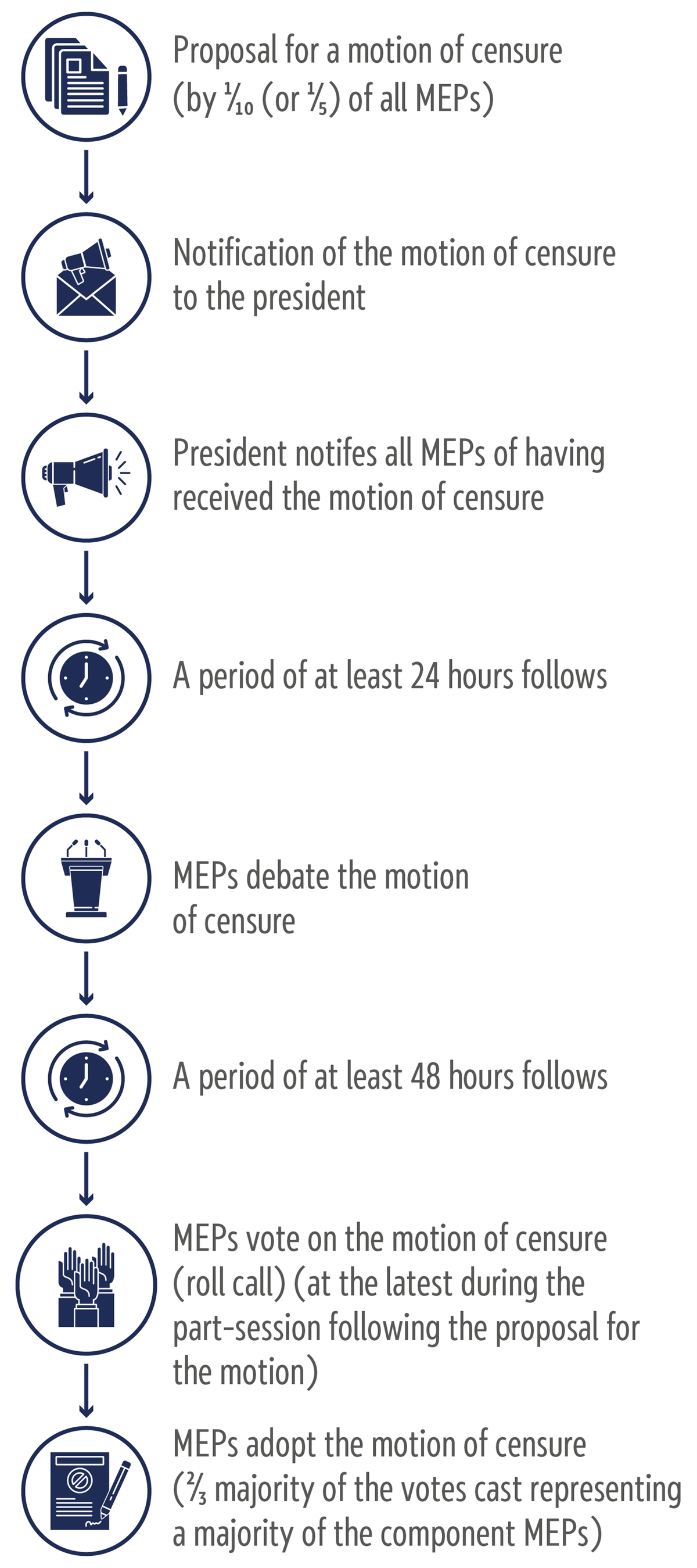
Graphic by Lucille Killmayer, EPRS.
The double majority required (i.e. a two-thirds majority of the votes cast, representing a majority of Parliament's component Members as per Article 17(7) TEU, which is greater than the majority required to elect the Commission President) to approve the motion of censure is considered crucial, because this motion is viewed as the ultimate strategic tool – a 'nuclear option'5 – for holding the Commission accountable.
Parliament's Rules of Procedure (RoP) provide further procedural details. Rule 131 states that a motion of censure may be submitted to the Parliament's President by one-tenth (72) of the component MEPs, unless another motion of censure has been voted on in the preceding 2 months. In the latter case, any new motion tabled by less than one-fifth (144) of MEPs will be considered inadmissible. The motion should clearly state the reasons for its introduction. The president announces the motion to MEPs immediately after having received it, but the debate does not take place until at least 24 hours have elapsed since that announcement.
Similarly, the vote by roll call will not occur until at least another 48 hours have elapsed after the debate. It is argued that the RoP require a delay between the tabling of the motion and the debate and vote to prevent MEPs from acting 'under the emotional spell of the session'.6 The debate and the vote must take place during the part-session following the motion's submission, to avoid prolonged uncertainty for the Commission.
For the motion to be adopted, it must receive support from two-thirds of the votes cast, representing a majority (361) of all MEPs. The Presidents of the Council and, respectively, of the Commission will be notified of the outcome of the vote.
The notion of current business
Both Articles 234 and 246 TFEU (6th paragraph) refer to the notion of current business. They state that the College (Members of the Commission) should remain in place and deal with 'current business' until it is replaced in the event of a motion of censure being passed or in the event of a collective resignation, respectively. It is worth mentioning that Article 246 TFEU does not refer to the notion of current business in the event of the resignation of individual Members of the Commission. The notion of current business embodies the principle of institutional continuity. For instance, the Barroso II Commission took office with a few months of delay, starting work on 10 February 2010, instead of 1 November 2009, due to the time it took to ratify the Lisbon Treaty. On that occasion, the Commission spokesperson, Johannes Laitenberger, declared that the Commission's mandate was extended 'based on the principle of institutional continuity' to allow the Commission to work in a 'caretaker capacity'.
The Treaties do not clearly define what constitutes current business. However, it is argued that the Commission must act as a 'caretaker administration' not only in cases of collective resignation but also when the new Commission does not immediately take office after the previous College's term expires. This was the case in 2019, when three Commissioners-designate failed to pass the hearings process, making it necessary for three Member States to nominate new candidates, and committees to conduct new hearings. As a result, the Commission could not assume office on 1 November as planned, and the outgoing Commission remained in office until the formal appointment of the von der Leyen Commission. The notion of current business would also include all routine daily tasks, actions that cannot be postponed until the appointment of the next College, and the Commission's responsibilities stemming from its role as the 'guardian of the Treaties'.7 Against this background, the adoption of new legislative proposals would appear to be excluded, except in cases of emergency measures.
The position of the High Representative
Article 17(8) TEU clearly states that if a censure motion passes, the Commission must resign as a body, and the High Representative of the Union for Foreign Affairs and Security Policy must resign from the duties that they carry out in the Commission. Since the entry into force of the Lisbon Treaty, the High Representative (HR) has a dual role because they also serve as Vice President of the Commission. This raises the question of whether a motion of censure would only affect the role of Vice President, or if it would also affect the role of HR. In other words, if a motion of censure is passed, would the HR retain their duties in the Council?
The Treaty is not entirely clear on this matter. However, Article 246 TFEU states that in the event of resignation, replacement or death of the HR, the procedure to follow is outlined in Article 18(1) TEU. According to this article, it is up to the European Council to end the HR's term of office, following the same procedure used for their appointment, which involves a vote by qualified majority with the agreement of the President of the Commission. Schutze and Tridimas8 believe that a motion of censure towards the entire College would de facto affect the HR in all of their functions. On the other hand, Jacqué9 considers that the HR would retain their specific duties as only the European Council has the authority to appoint and dismiss them.
Dismissal of individual Commissioners
EU primary law does not allow for Parliament to vote on a motion of censure against an individual Commissioner. Currently, aside from Articles 245 and 247 TFEU (which address compulsory retirement), Parliament's options for removing individual Commissioners are outlined in the second sub-paragraph of Article 17(6) TEU, which states that a Commissioner must resign if so requested by the Commission President.10 If the president requests the resignation of the HR, the procedure detailed in Article 18(1) TEU would apply. The Commissioner who replaces the outgoing one would complete the remainder of their predecessor's term.
Parliament may also call for the resignation of an individual Commissioner and pressure the President of the Commission to give it due consideration. Section II, point 5 of the 2010 framework agreement on relations between the Parliament and the Commission requires the Commission President to 'seriously consider' the request of the Parliament to withdraw confidence in an individual Commissioner. The President of the Commission thus has two options: either to request the resignation of the Commissioner or to explain their refusal to do so at the Parliament's next part-session. The current procedure is the result of a practice that started after the collective resignation of the Santer Commission and was later codified in the legal texts. The procedures for appointing and removing the Commission demonstrate how constitutional conventions complement the legal framework set out in the Treaties. These conventions can gain significance over time in the absence of clear and detailed legal norms, as seen in the case of the hearings for Commissioners-designate. In certain instances, these conventions have also allowed Parliament to increase its powers of scrutiny over the EU executive.
After the fall of the Santer Commission (see section on 'The rise and fall of the Santer Commission'), the incoming Commission President, Romani Prodi, asked his College members to promise that they would resign if he asked any of them to do so. The 1999 report on the institutional implications of enlargement suggested formalising Prodi's informal arrangement in the Treaties, as did the Commission in its contribution to the revision of the Treaties.11 The only possibility to remove an individual Commissioner, as set in the Treaties, fell under the remit of the Court of Justice (ECJ) which could rule on the compulsory retirement of a Commissioner (Articles 245 and 247 TFEU). This is still the case today.
Over the years, Parliament has increased its power of scrutiny over the Commission mostly by going beyond the mere letter of the Treaties. Although the motion of censure against individual Commissioners is not explicitly established in the Treaties, Parliament has found a way to pressure the Commission before the appointment of the Commissioners. The precedent set during the hearings of the Barroso I Commission paved the way for Parliament to question candidates considered inadequate or unsuitable.12 In 2004, following the confirmation hearings of the Commissioners-designate, Parliament objected to three candidates, citing conflicts of interest and insufficient qualifications as its reasons. Parliament only confirmed the Commission after the replacement of the Italian and Latvian nominees and the reshuffling of the portfolio of the Hungarian Commissioner-designate. Most recently, in 2019, ahead of the appointment of the von der Leyen Commission, 26 candidates received a positive assessment after their hearings.13 One candidate, from France, was found unfit to be a member of the College following the hearing, and was subsequently withdrawn and replaced by another candidate.
To date, Parliament has never requested the removal of a Commissioner during their term of office. The case of John Dalli, the Maltese Commissioner in charge of the health and consumer protection portfolio in the Barroso Commission, is unique. In 2012, Dalli offered his resignation to President Barroso following an investigation by the European Anti-Fraud Office (OLAF). He later brought a case to the ECJ claiming that it was President Barroso who had discontinued his term of office. The ECJ ruled that Dalli had voluntarily resigned (Case C-394/15, Dalli v European Commission).
The impossibility of censuring an individual Commissioner is seen as a consequence of the principle of collective responsibility of the Commission. Parliament has requested the right to remove individual Commissioners several times, but to no avail. In 2019, in the context of Treaty reforms, for instance, the Parliament's Committee on Constitutional Affairs suggested discussing the possibility of lowering the required threshold to adopt a motion of censure and holding individual Commissioners accountable to Parliament. As stressed by Parliament back in 1999, the principle of collegiality cannot be interpreted as exempting individual Commissioners from the consequences of their own wrongdoing, incompetence or negligent management. More recently, in September 2023, Parliament explicitly called for the introduction of the possibility to trigger a motion of censure against individual Commissioners as a tool to strengthen Parliament's scrutiny over the Commission. In December 2023, Parliament proposed to reform the EU Treaties calling inter alia for the possibility for a majority of Parliament's Members to pass a motion of censure against a member of the executive (amendment 40). Should this happen, the President of the Commission 'shall consider requesting that the member of the Executive concerned resign'.
Resignation, death or incapacitation of individual Commissioners
The procedure for replacing individual Commissioners during their term of office is governed by the second paragraph of Article 246 TFEU. Throughout the 5-year term of office of individual Commissioners, they can resign, die or become incapacitated. There have been several instances of individual replacements during the Commission's 2019-2024 term but also in previous terms. For instance, in September 2020, following the resignation of the Trade Commissioner, Irishman Phil Hogan, his position went to Mairead McGuinness, who was entrusted with the financial services, financial stability and capital markets union portfolio. In May 2023, after national elections in Bulgaria, Mariya Gabriel resigned as Commissioner for Innovation, Research, Culture, Education and Youth to join the Bulgarian government, and Iliana Ivanova took over her position and portfolio. In November 2023, Commission Executive Vice-President and Commissioner for Climate Action, Frans Timmermans, resigned, and his portfolio was handed to Wopke Hoekstra, but not the VP position.
Political weapon or act of parliamentarism?
The Parliament has rarely tabled a motion of censure. Since 1972, when this motion was first used, a total of 13 motions have been tabled (nine of them since the first direct elections in 1979, with four of those since the collective resignation of the Santer Commission). There are various reasons why none ever reached the required majority to pass. A technical reason could be the high threshold required to approve the motion, i.e. a two-thirds majority of the votes cast, representing a majority of all MEPs. A political reason, as argued by some scholars,14 could be the long-standing common institutional perspective shared by the Parliament and the Commission, formalised through working arrangements and interinstitutional agreements. Another political reason could be the fact that the Parliament often sees the Commission as its ally in opposition to the Council.15 Regardless of the reason(s) behind it, the mere possibility of the Parliament censuring the Commission has influenced the relationship between the two institutions.
As argued by many, the motion of censure is considered a 'reserve power',16 and the mere threat of using it may prompt the EU executive to heed Parliament's demands. The motion of censure is often referred to as a 'nuclear weapon' because it clearly indicates to the Commission that it is accountable to Parliament, not to the individual governments that put forward their suggestions for the Commissioners-designate. The fact that it has never been used has not deprived this instrument of its efficacy. On the contrary, its mere existence has empowered Parliament to assert its authority over the Commission. Along these lines, M. Westlake recalls that in 1996 Parliament set up a committee of inquiry to investigate the bovine spongiform encephalopathy (BSE) crisis. The findings of the final report led 70 MEPs to table a motion of censure. Although the motion was defeated in plenary, it gave Parliament the opportunity to introduce the concept of 'conditional censure'. This meant that the Commission was given a 6-month period to address the concerns raised by Parliament. Moreover, Parliament formed a temporary committee to follow up on the recommendations made by the BSE committee of inquiry. According to Westlake, these actions were another instance of parliamentary innovation and the occasion for Parliament to exercise political pressure on the Commission. They demonstrated Parliament's ability to use two scrutiny instruments – the committee of inquiry and the motion of censure – to introduce and enforce policy changes. In February 1997, Parliament once again threatened to censure the Commission if it failed to adhere to the recommendations of the committee of inquiry.
According to experts on the subject, this 'proved to be a winning strategy' because the Commission largely met Parliament's requests, including proposing an amendment to Article 129 of the EC Treaty at the Intergovernmental Conference in Amsterdam to expand Community areas of competence to include health policy. Parliament applied a similar strategy during the crisis that eventually led to the resignation of the Santer Commission. Likewise, in a 2021 resolution on the rule of law situation in the EU and the application of the Conditionality Regulation, Parliament expressed its dissatisfaction with the Commission's lack of response to ongoing serious violations of the rule of law in some Member States. The resolution recalled Parliament's ultimate right to vote on a motion of censure against the Commission.
The rise and fall of the Santer Commission
The Prime Minister of the Grand Duchy of Luxembourg, Jacques Santer, was appointed President of the Commission in July 1994. His nomination came after the United Kingdom vetoed an earlier candidate, the Belgian Prime Minister Jean-Luc Dehaene, due to concerns that he was too much of a federalist. Some analysts viewed Santer as a 'second choice', and the Parliament itself displayed reservations about his nomination by narrowly approving him (260 votes for, 238 against and 23 abstentions). Nevertheless, Santer managed to persuade the Parliament to endorse the Commission in January 1995 with a comfortable majority (417 votes for, 104 against and 59 abstentions). While the Santer Commission played a pivotal role in several dossiers, including those on preparations for the single currency, the reform of the common agricultural policy and the EU's enlargement, Parliament was not satisfied with the Commission's management methods. It came therefore as no surprise that in December 1998, the Parliament was unable to grant discharge 17 to the Commission for the fiscal year 1996.
Parliament highlighted 'the weaknesses in accountability of Commissioners as well as the absence of a visible and effective code of conduct on nominations of high level officials', and 'expressed deep concern about the many problems in nearly all categories of the budget, amounting to an unacceptably high number of cases where the execution of the budget has been inappropriate' (author's bold for emphasis). Parliament's refusal to grant discharge in 1998 triggered a series of events that eventually led to the collective resignation of the Santer Commission due to fears that the Parliament would adopt a motion of censure. As events unfolded, the focus shifted from budgetary issues to the broader issue of the Commission's political responsibility and accountability. In January 1999, a motion of censure was discussed in Parliament, at the request of Socialist leader Pauline Green (United Kingdom, PES). Green referred to numerous serious problems within the Commission, including 'secrecy, patronage, nepotism, and obstructionism'. A second motion of censure was introduced by Hervé Fabre-Aubrespy (France, I-EN), which received cross-party support and the signatures of MEPs from all Member States except Luxembourg. He stressed that Parliament's credibility was at stake. The motion for censure was rejected by a small majority (232 for, 293 against and 27 abstentions). However, in January 1999, Parliament called for the creation of a committee of independent experts 18 under the auspices of the Parliament and the Commission. Its task would be to 'examine the way in which the Commission detects and deals with fraud, mismanagement and nepotism, including a fundamental review of Commission practices in the awarding of all financial contracts, to report by 15 March 1999 on their assessment in the first instance on the College of Commissioners'. As S. Hix argues,19 the 'Parliament put the Commission on probation' until the Committee of Independent Experts delivered its report.
The establishment of the Committee of Independent Experts was met with some reservations. Concerns were raised regarding its compatibility with the institutional framework outlined in the Treaties. Some argued that the Parliament was 'abdicating its responsibilities by handing effective control of the functioning of the Commission to a committee of experts'. Santer accepted the establishment of the committee, despite considering 'the tone of the report's conclusions to be wholly unjustified'. He was unable to convince the two Commissioners allegedly involved, Edith Cresson from France and Manuel Marin from Spain, both Socialists,20 to resign individually. Handing in their resignations, he believed, was a political act that could potentially lead to 'deep and lasting reform in all the European institutions'. Mario Monti, Commissioner for the Internal Market, later publicly stated that the Commission resigned collectively because some members failed to uphold their 'individual responsibilities'.
The Committee of Independents Experts had precisely 5 weeks to examine a set number of specific allegations; it was not an investigative committee assigned to conduct its own inquiry. On 15 March 1999, it released a report in which it concluded that the fraud allegations against individual Commissioners were unfounded.21 However, it took a firm stance on the collective responsibility of the College,22 stating that the Commission had lost control over its administration and that the principle of collective responsibility was being used as a shield. The report said:
The responsibility of individual Commissioners, or of the Commission as a body, cannot be a vague idea, a concept which in practice proves unrealistic.... that sense of responsibility is essential. It must be demonstrated, first and foremost, by the Commissioners individually and the Commission as a body. The temptation to deprive the concept of responsibility of all substance is a dangerous one. That concept is the ultimate manifestation of democracy 23 (bold added by the author for emphasis).
With what is now an infamous sentence, the report sharply concluded that within the Commission '[i]t is becoming difficult to find anyone who has even the slightest sense of responsibility'.
From that point on, it was inevitable that Parliament would adopt a motion of censure. To prevent this, the College of Commissioners (20 at the time)24 decided to resign as a group, although they remained in office until the appointment of the new Commission, which happened quite quickly.25 Later in March 1999, in Berlin, the European Council nominated Romano Prodi as President of the new Commission, and Parliament approved his nomination on 5 May. The Commissioners were nominated by the Council, in agreement with Prodi, on 19 July. Subsequent hearings were held in September, and Parliament endorsed the new College on 15 September (404 for, 153 against, 27 abstentions). Despite the massive damage to the reputation of the outgoing College, several of its members were reappointed as Commissioners. These 'survivors' were Neil Kinnock (UK), Franz Fischler (Austria), Erkki Liikanen (Finland) and Mario Monti (Italy).
In September 1999, the Committee of Independent Experts released its second report with proposals for tackling mismanagement, irregularities and fraud. It is argued that the events leading up to and following the resignation of the Santer Commission illustrated the Parliament's ability to take advantage of 'its democratic mandate and enforce, among other things, its powers of oversight'. The crisis also led to a number of institutional and administrative reforms that increased the Commission's accountability to the Parliament (See section on 'The many consequences of the Commission's resignation in 1999').
Some questioned the lawfulness of the collective resignation of the Santer Commission, given that Parliament never adopted a motion of censure. The European Court of Justice in case T-219/99 (British Airways v Commission of the European Communities) considered it lawful, but as a sum of individual resignations.26 The Court stated:
In a statement on 22 March 1999, the Council, while considering it necessary to appoint a new Commission as quickly as possible, expressed the wish that, until that time, the Commissioners would continue to perform their duties in accordance with the Treaties. It is clear from Article 201 EC that Commissioners cannot be regarded as having been 'obliged to resign as a body', within the meaning of the last sentence of the second paragraph of that article, unless the Parliament has first adopted a motion of censure under the conditions defined by the same article. In the absence of such a motion, as in this case, individual resignations, even if simultaneous, of all the Commission's Members constitute a scenario that falls outside the provisions of Article 201 EC. (paragraphs 49, 50, 51) (bold added by the author for emphasis).
The Court also stated that the fact that all Commissioners had resigned simultaneously did not impinge on the voluntary nature of the resignations (paragraph 53).
The many consequences of the Commission's resignation in 1999
As mentioned earlier, the resignation of the Santer Commission caused major reputational damage to the Commission. However, it also helped to rebalance its relationship with the Parliament, and brought about policy and administrative changes. Additionally, MEPs demonstrated to their constituents that holding the Commission accountable was achievable. This showed that the two institutions were linked by the principle of democratic responsibility, similar to what happens at national level, where the executive depends and relies on the support of a parliamentary majority.
According to one of Parliament's former Presidents, Nicole Fontaine, the resignation of the Santer Commission was the third major development in the Parliament's history, after the 1979 direct elections and the adoption of the Maastricht Treaty in 1992, which vested the Parliament with major legislative powers. It is worth noting that in September 1999, Italian Prime Minister and then nominee for Commission President, Romano Prodi, declared before the Parliament's Conference of Presidents that if the Parliament expressed a lack of confidence in a Commissioner, he (Prodi), as president, would seriously consider requesting that Commissioner to resign. This political commitment by President Prodi was later formalised in Article 9 of the 2000 framework agreement (FA) on relations between the European Parliament and the Commission. This article stated that if the Parliament expressed a lack of confidence in a Commissioner, the Commission President had to seriously consider it and then make a decision either to request the Commissioner's resignation or explain his or her decision to Parliament. The revised 2005 framework agreement confirmed this commitment in the section on 'Political responsibility'. The Council criticised both versions of the FA for bringing about 'a shift in the institutional balance resulting from the Treaties in force' and for not having been negotiated in full respect of the principle of sincere cooperation. In the end, thanks to these FAs, Parliament was able to create a mechanism to call on the responsibility of individual Commissioners, a provision that had not featured in the EU Treaties before.
As mentioned earlier, a 1999 Parliament resolution called for individual Commissioners to be held accountable in cases of personal wrongdoing, incompetence or negligent management of policies under their responsibility. In a 2000 resolution on the second report of the Committee of Independent Experts, Parliament stressed its role in the democratic scrutiny of the Commission and put forward a number of ideas. Similarly, one of Parliament's former Presidents, Pat Cox, argued that the notion of collective responsibility should not be seen as a shield to protect the Commission but as a 'sword of public accountability'.
The relationship between the Commission and the Parliament became even more significant with the appointment of a Commission Vice-President responsible for dealing with Parliament. Sylvain Bisarre, a senior Commission official, noted that the Commission had started paying greater attention to the responses provided to written and oral questions posed by MEPs and that the presence of Commissioners in plenary and committee meetings had become more consistent.
In 1999, the turnout in the European elections fell below 50 % for the first time, a 7 percentage-point decrease compared to 1994.
In April 1999, the European Anti-Fraud Office (OLAF) was created as an independent fraud investigation office to replace the Anti-Fraud Coordination Unit (UCLAF), which operated as part of the Commission's Secretariat-General and had fewer investigative powers. The EU Financial Regulation and the Statute of EU civil servants were also revised and entered into force in 2002 and 2004, respectively. Furthermore, Commission President Prodi promised a number of institutional reforms to enhance the transparency and accountability of the Commission. In 2000, the Commission presented a white paper entitled Reforming the Commission, which resulted in the establishment of an interinstitutional committee to monitor standards of behaviour in the Commission, Parliament and Council. To the same end, Commissioner Neil Kinnock27 was assigned a portfolio that specifically dealt with personnel and budgetary issues and institutional reforms. In relation to these reforms, M. Shackleton points out that although Parliament only had a consultative role, it showed determination to use its influence and ensured that its priorities were duly taken into consideration during the legislative process.
In 2006 the European Court of Justice (ECJ) in Case C-432/04 found Edith Cresson guilty of breaching the obligations arising from her office as a Commissioner. However, the Court decided not to strip her of her pension rights. In his opinion, Advocate General (AG) Geelhoed took the opportunity to shed light on the interpretation of Article 213(2) of the Treaty establishing the European Community (EC).
In the AG's opinion, a Commissioner needs to be 'competent from a professional point' and 'of irreproachable behaviour'. The authority and credibility of the office stem from the respect of these basic standards. Although the Commission acts as a collegiate body, measures should be in place to ensure that the 'misuse of powers is sanctioned'. It is worth noting that the AG further elaborated on the concept of accountability: 'It is inherent to this function that the sanctioning power is vested either in the institution of which the individual concerned is a member or in another institution with equivalent status in the constitutional framework'. (bold added by the author for emphasis).
The existence of powers to impose sanctions also serves a preventive function. The AG further explained that there is a direct link between the expected standard of conduct for Commissioners and the role of the Commission in the institutional setting. The Commission, being not only the EU executive body, also fulfils a quasi-judicial role in the field of competition. This is why it should operate with total impartiality and independence. Individual Commissioners should adhere to the highest standards of independence, impartiality and integrity. Therefore, decisions made by Commissioners must be based solely on objective criteria, keeping the public interest in mind and not their own private interests. Finally, the AG recalled the seven Nolan principles, which are the ethical standards for serving in public life in the United Kingdom: selflessness, integrity, objectivity, accountability, openness, honesty and leadership.
Main references
- Gerbet P., 'The crisis of the Santer Commission', Luxembourg Centre for contemporary and digital history (CVCE.eu) 2016.
- International Bank for Reconstruction and Development, The Role of Parliament in Curbing Corruption , The World Bank, Washington D.C. 2006, pp. s 149-157.
- Jacqué J.P., Droit institutionnel de l'Union européenne, Dalloz, 10ème édition, 2023, p. 722.
- Diaz Crego M., Vote of investiture for the Commission, EPRS, European Parliament, 2019.
- Kotanidis S., Mańko R., Mildebrath H., Del Monte M. and Toft S., The evolving powers of the European Parliament, EPRS, European Parliament, September 2024.
- Peterson J. and Shackleton M., The Institutions of the European Union, Third Edition, Oxford University Press, 2012, p. 97.
- Ringe N. F., The Santer Commission Resignation Crisis: Government Opposition Dynamics in Executive-Legislative Relations of the EU , University of Pittsburgh, 2003.
- Schutze R. and Tridimas T. (eds.), Oxford principles of European Union Law, Volume I: The European Union Legal Order, 2018, p. 555.
- Tomkins A., 'Responsibility and Resignation in the European Commission', The Modern Law Review Limited, 1999 (MLR 62:5, September).
- Building Parliament: 50 years of European Parliament history, 1958-2008, European Parliament, 2008.
- Westlake M., 'The European Parliament's Emerging Powers of Appointment', Journal of Common Market Studies, Vol. 36, No 3 1998.
Endnotes
Annex I
| Date | Motion | Vote |
|---|---|---|
| 31 December 1972 |
EP power of control over the European Commission budget (Spénale, FR, Socialist) OJ C 138/32 | Withdrawn |
| 16 June 1976 |
Incorporation of skimmed milk powder in animal feed and lack of consultation of the European Parliament (Kirk, UK, on behalf of the European Conservative Group) 109/76 |
Votes cast: 127 For: 18 Against: 109 Abstentions:4 |
| 10 December 1976 |
Parliament's right of control, access to documents (Aigner, DE, on behalf of the Christian Democratic Group) 480/76 | Withdrawn |
| 10 March 1977 |
Commission management of stock of agricultural products (de la Malene, FR, on behalf of the Group of European Progressive Democrats) 3/77 |
Votes cast: 111 For: 15 Against: 95 Abstention: 1 |
| 15 February 1990 |
The common agricultural policy (CAP) and the expansion of Commission competences (Le Pen, FR on behalf of the Technical Group of the European Right) B 3 – 272/90 |
Members: 567 Votes cast: 262 For: 16 Against: 241 Abstentions: 5 |
| 11 July 1991 |
Commission and Council Policy on Yugoslavia (Group of the European Right) |
Members: 567 Votes cast: 219 For: 8 Against: 206 Abstentions: 5 |
| 17 December 1992 | The position adopted by the Commission during the GATT negotiations on the
agricultural sector (Belgian Green and 71 other Members)
B3-1676/92 |
Members: 567 Votes cast: 357 For: 94 Against: 248 Abstentions: 15 |
| 20 February 1997 | The Commission's role with regard to the bovine spongiform encephalopathy – BSE
(Happart, BE, Socialist and 71 other Members)
1997/2032(INS) |
Members: 626 Votes cast: 459 For: 118 Against: 326 Abstentions: 15 |
| 14 January 1999 |
The 1996 discharge (Fabre-Aubrespy, FR, Europe of Nations Group and 69 other Members) |
Members: 626 Votes cast: 552 For: 232 Against: 293 Abstentions: 27 |
| March 1999 | Santer Commission resigns in anticipation of the motion of censure | |
| 4 May 2004 | Allegations of mismanagement in Eurostat (Bonde, DK, Independence/Democracy Group
and 64 other Members)
2004/2036(INS) |
Members: 788 Votes cast: 666 For: 88 Against: 515 Abstentions: 63 |
| 8 June 2005 |
Allegation against Commission President Barroso for involving a conflict of interest (Farage, UK, UKIP and 76 other Members ) |
Members: 732 Votes cast: 659 For: 35 Against: 589 Abstentions: 35 |
| 27 November 2014 | Allegation against Commission President Juncker for his involvement in 'Lux leaks'
(76 EFDD and non-attached Members)
2014/2197(INS) |
Members: 750 Votes cast: 650 For: 101 Against: 461 Abstentions: 88 |
| 12 May 2016 |
Alleged inaction on endocrine disruptors (Piernicola Pedicini EFDD, IT and signed by 82 EFD, GUE, ENF and NI Members) 2016/1594(MOC) | Lapsed as it lacked the required number of signatures (1/10 of MEPs) |
Sources: M. Remáč, Parliamentary scrutiny of the European Commission: Implementation of Treaty provisions, EPRS, European Parliament 2019; and K. Lenaerts, P. Van Nuffel and T. Corthaut, EU Constitutional Law, 2021, p. 393.
Classification
Policy areas: EU Democracy, Institutional and Parliamentary Law
Regions: European Union
Disclaimer
This document is prepared for, and addressed to, the Members and staff of the European Parliament as background material to assist them in their parliamentary work. The content of the document is the sole responsibility of its author(s) and any opinions expressed herein should not be taken to represent an official position of the Parliament.
Copyright
© European Union.
The reuse of this document is authorised under a Creative Commons Attribution 4.0 International (CC-BY 4.0) licence.

https://creativecommons.org/licenses/by/4.0/deed.en
To use or reproduce elements that are not owned by the European Union, permission may need to be sought directly from the respective rightsholders.